



Abstract
Climate-related migration is likely to become important demographic data for urban planning, as climate impacts increase over this century. Our systematic literature review examines current scholarship on internal climate-related migration modeling, destinations, sending and receiving communities in the United States. Based on background articles plus 30 articles in the systematic literature review, we find that climate-related migrants mostly relocate to adjacent areas, and receiving communities experience socio-infrastructural hardships. Also, modeling is not yet precise enough for local planning use. But our findings do suggest which communities are most at risk of climate-related population change and suggest directions for future research.
Keywords
Introduction
Among the most important data that urban and regional planners use are demographic projections—how many people will want to live in an area matters enormously when choosing long-term policy. Climate change is increasingly recognized as an important influence on these demographic patterns (Black et al. 2011; Gemenne 2011; McLeman and Gemenne 2018; Kaczan and Orgill-Meyer 2020), but to date is largely unconsidered in regional and local planning. This article is inherently an argument that attention to the impact of climate change on people plays an important role in planning. As best said by the Foresight Report (The Government Office for Science 2011) “migration in the face of global environmental change may not be just part of the ‘problem’ but can also be part of the solution. In particular, planned and facilitated approaches to human migration can ease people out of situations of vulnerability.” (10). The quote is largely in reference to international migration, but it holds for domestic, internal migration as well. For planners, this requires attention to the likely magnitude and spatial patterns of climate-related mobility, the experiences of those who move, those who stay, and those who live in the areas that receive the movers.
This article uses a systematic literature review to assess recent research on the topic of climate-related migration, including how it has been modeled, the destinations of movers, and its effects on both sending and receiving areas, and helps illuminate research needs that would better enable the inclusion of climate-related migration data into urban planning. This paper focuses on United States-related experiences, and in particular, domestic migration—movement within the country, as compared to immigration from other countries. We begin by providing the terminology that is commonly used in the field and a brief overview of the topic. The paper then uses the results of the systematic literature review to fully investigate four research questions, with particular attention to literature on the United States and related to domestic climate mobility: (1) Demographic models used for climate-related migration, (2) characteristics of the sending communities, (3) projected destinations of the climate migrants, and (4) impacts on the receiving communities.
Background and Terminology
Human mobility is defined by the UN as “the ability of individuals, families or groups of people to choose their place of residence,” while migration is the process of an individual or group changing their place of residence, whether this is within-country (internal or domestic migration) or between countries (immigration) (The Government Office for Science 2011, 233). Of the overall global population mobility, about one-quarter is international, while the remaining three-quarters is domestic, often a movement from rural areas to urban areas (Adger et al. 2020). Persons who are forced to flee their homes to avoid violence or other natural or human-made disasters but stay within their home country are considered internally displaced persons (UNHCR n.d.), which is the population that much of this article considers. How much of this mobility is related to climate change is a hotly debated and complex topic, but the consensus is moving toward a recognition that climate change is a significant factor, as recognized by the United Nations High Commissioner for Refugees (UNHCR n.d.).
The number of climate-related migrants is likely to be high. The World Bank's 2021 Groundswell report, for example, analyzed likely domestic climate-related mobility in predominantly low and middle-income countries across six regions, and projected 216 million internal climate migrants by 2050 (Clement et al. 2021); international mobility was not included. But projections vary a great deal. Lincke and Hinkel (2021), for example, modeled mobility resulting from sea level rise (SLR) and coastal flooding while controlling for expected urban resilience measures, and estimated there would be 17–72 million global coastal migrants in the twenty-first century.
As will be further described below, isolating climate as a cause for mobility is difficult (Fussell, Hunter, and Gray 2014). Most households factor in a range of variables, including their sense of likely future harm from climate but also their sense of the likelihood of good jobs, housing, amenities and family connections at their destination, all set within legal structures and financial capability when they weigh a move (Yun and Waldorf 2016; Fussell et al. 2017; Fan, Fisher-Vanden, and Klaiber 2018; Chen and Lee 2022). Demographers generally view these as “push” factors—what encourages people to move away, and “pull” factors—the advantages expected to be received in the chosen new place. Given that household decisions around mobility are complex, we use the term “climate-related migration” instead of the simpler climate migration to allow for climate to be one of potentially many factors influencing mobility decisions.
For climate-related mobility, it is helpful to differentiate between different types of disasters and thus different types of climate-movers, who tend to have very different profiles and experiences. UNFCCC and UNHCR categorize cyclones/tornadoes, typhoons/hurricanes, earthquakes, and wildfires as rapid or sudden onset disasters. Rapid-onset disaster migration often begins as temporary; some movers will return home (termed “return migration”), while others become permanent residents of receiving areas (McLeman and Hunter 2010; Randall n.d.). An extensive set of literature analyzing past disaster experiences means that the socio-economic variables determining mobility outcomes are fairly well understood, although the specifics of any particular disaster make generalization difficult. Slow-onset disasters evolve more gradually over time and often repetitively, and include extreme heat, SLR, drought, repetitive wild-fire evacuations, and air quality alerts (UNFCCC n.d.; UNHCR n.d.). Sometimes climate change brings both together—SLR brings more coastal flooding, for instance, so the separation of rapid and slow is not complete. The decision to move is less hasty for slow-onset events, and as a result, return migration is less in this group. The socio-economic variables for slow-onset migration are not as well understood, but there have been significant recent efforts to project the migration impacts of slow-onset events. Many of the climate-related migration models focus on slow-onset events by, for instance, modeling SLR and positing that residents in those areas will move. In both cases, these experiences create “sending communities”—places experiencing out-migration, and “receiving communities”—places experiencing in-migration. The terms “migrants” or “newcomers” denote the people who move from sending to receiving communities, and the people who already live in the places that receive the migrants are termed “current residents.” While we don’t focus on this in this paper, it is important to note a third group of people affected by disaster—“trapped populations” whose lack of some mix of money, social ties, jobs, stability, and outside opportunities puts them at risk of significant harm from being stuck in declining situations (Black et al. 2013; Zickgraf 2021).
The methods followed in the literature review process are described in detail in the following section. The findings are then presented in four sections: (1) Models used for climate-related migration and considered factors, (2) destinations of the climate migrants, (3) characteristics of the sending communities, and (4) impacts on the receiving communities. The final section presents a synthesis of our results and explores the limitations of the study, policy implications, and directions for future research.
Methods
Systematic literature review allows for reviewing and synthesizing relevant literature following a logical and systematic process (Petticrew and Roberts 2006; Mallett et al. 2012; Pickering and Byrne 2014; Horte and Eisenman 2020). According to Berrang-Ford, Pearce, and Ford (2015), a systematic review process typically includes: Defining the research questions and the scope of the review, documenting the selection process along with development of inclusion and exclusion criteria, critically appraising the quality of the included studies, analyzing and synthesizing evidence, and presenting the results. This study also followed these methodological steps.
Research Questions and the Scope
The research questions for this study are: (1) How do researchers model climate-related migration and what are the key findings of the models, (2) what are the characteristics of and impacts on sending areas, (3) what are the destinations of climate-related migrants, and (4) what are the characteristics of and impacts on the receiving communities. The scope of the systematic literature review is limited to peer-reviewed studies on US-based internal climate-related migration, while introductory and concluding sections bring in broader literature.
Inclusion and Exclusion Criteria in Document Selection
We selected peer-reviewed academic articles written in English excluding non-peer-reviewed journals, newspaper articles, reports from websites, books, and dissertations. The keyword search was conducted in databases including Google Scholar, JSTOR, ProQuest, and Web of Science. Journal websites, alternative databases, and online platforms like ResearchGate and Academia were searched for any missing abstracts and similar information. We also reviewed the reference lists and papers citing the included articles to ensure inclusion of relevant studies. Almost all climate-related migration articles highlighting the situation in the United States are contemporary, so there was no specific starting point in the publication timeline while searching for journals. The end point of the timeline was the date when database searching ended (April 15, 2023). We used the search terms climate change and internal migration and their synonyms such as displacement, relocation, or resettlement in the titles (see Appendix 1). Basic information about the articles (e.g., name, author, publication date, abstract) was imported into Zotero Desktop software.
The initial keyword searches yielded 2866 articles (Figure 1). Based on titles, papers were excluded that clearly did not meet the research theme and inclusion criteria. From the 446 articles remaining, abstracts were analyzed. Articles were removed that were not written based on the United States or outside the focus of our paper, dropping the total to 81. From these, full articles were tested against our search criteria, leaving 30 articles that fully met all criteria.
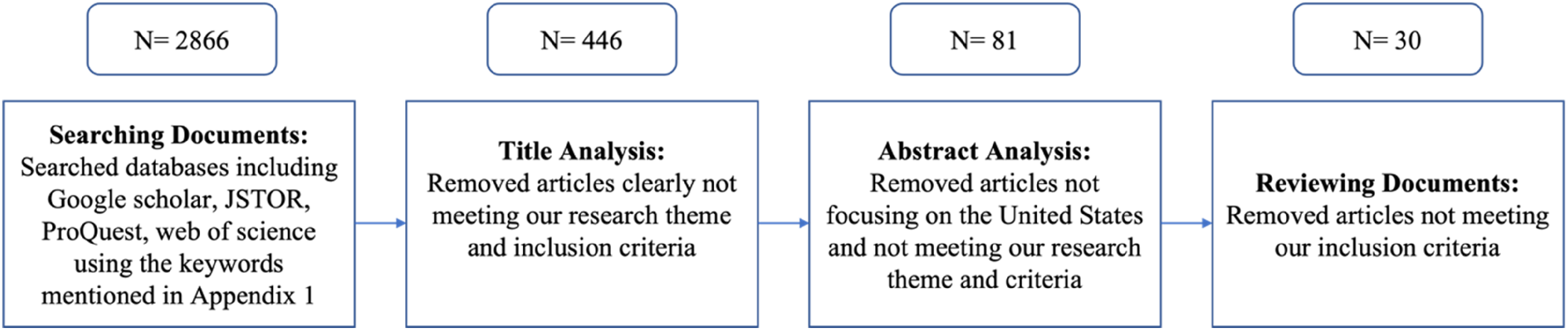
Documents search and selection process of reviewed articles.
Appraising Quality and Synthesizing Evidence
The studies included in the review were coded based on predefined criteria and documented on an Excel sheet (See Appendix 2 for summaries of articles). Basic information about the reviewed literature, such as the author(s), publication year, journal, considered disaster(s), unit of analysis, and investigating issues was collected, and the methodological approach of each paper was coded for data sources and methods of analysis. The substantive content of each article was coded based on the following categories: models used, factors considered for modeling the climate-related migration, destinations of the migrants, the distance between origin and destination, reasons behind the choice of the destinations, characteristics of sending communities, and impacts on receiving communities. Finally, the similarities and contradictions of the articles were identified and discussed. The results are presented in the following section.
Results
Modeling Climate Migration
In this section, we describe 23 modeling papers, which are summarized in Appendix 3. Generally, the papers are dividing between those that project future US climate-related mobility and those that use past disaster experiences to investigate outcomes. We focus first on the findings of those that project future US climate-related migration, to provide a sense of scale of future US mobility. We then discuss the data sources and modeling approaches of the full set of papers, and then present the findings of past experiences, organized by slow and rapid onset where applicable. We conclude with synthesis and recommendations for future research, as well as observations on the utility of current work for the practice of planning.
Perhaps the most important question for climate-related migration is just how many people will move, and to where. Modeling anticipated climate-related migration is complex, as it requires estimating future hazards and likely responses of the population, and the very complex issue of differentiating climate-related mobility from other motivations, with little ability to test outcomes of the models against reality. A small set of studies attempts to project future climate-related mobility, while a broader set uses historical evidence such as Hurricane Katrina to attempt to isolate climate-related mobility from broader mobility (retrospective studies).
In widely cited Projection papers, Hauer, Evans and Mishra (2016); Robinson, Dilkina and Moreno-Cruz (2020) modeled likely loss of land from SLR by 2100, with both papers finding that approximately 13 million US residents are at risk of SLR-induced migration by 2100. Projecting a 2100 horizon in internal climate migration facilitates long-term planning that is also in line with the climate forecasts provided by the IPCC. It may also facilitate the inclusion of climate migration into national-, regional-, and local-level policies, promoting sustainable climate mitigation and adaptation planning actions. On the negative side, a 2100 horizon can make this seem like a tomorrow-problem, not today, particularly at the local level. Robinson, Dilkina and Moreno-Cruz (2020) additionally modeled the impacts of SLR expanding over a larger area beyond just the affected coastal zones, potentially increasing movement by fourfold. Hauer, Evans and Mishra (2016) based their models on the period from 1940 to 2010, while Hauer (2017) studied SLR from 1990 to 2013. Robinson, Dilkina and Moreno-Cruz (2020) assumed that climate-related migration flow might not follow usual migration trends, arguing that those who are already adjusted to circumstances in flooded areas might not choose to move to a place far from their origin. Importantly, most of the climate-related migration destinations and patterns modeling were conducted at the county level, assuming that hazards within the county will force movers out of the county (Hauer 2017; Robinson, Dilkina and Moreno-Cruz 2020). The reasons behind this include data availability, ease of modeling, and also policy-relevance, but given that, as described below, a lot of migration is within-region, this scale of modeling also limits planning usefulness.
Data sources vary by author. Most of the models used census data for both rapid and slow-onset disasters (Gutmann et al. 2005; Myers, Slack and Singelmann 2008; Boustan, Kahn and Rhode 2012; Hauer 2017). Internal Revenue Service data was another common source for the climate modelers (Fussell, Curtis and DeWaard 2014; Hauer 2017; Eyer et al. 2018). For SLR-related models, projected impact data from the National Oceanographic and Atmospheric Administration (NOAA) were widely used (Hauer, Evans and Mishra 2016; Robinson, Dilkina and Moreno-Cruz 2020). Other than these, the Spatial Hazard Events and Loss Database for the United States, which covers a wide range of disaster types, was frequently used (Schultz and Elliott 2013; Fussell et al. 2017; Chen and Lee 2022). For at-risk population and destination modeling as a result of Katrina, some modelers used data released by the Federal Emergency Management Agency (Fussell, Curtis and DeWaard 2014; Curtis, Fussell and DeWaard 2015; Eyer et al. 2018).
Multivariate regression modeling is the general data analysis approach. Prospective modeling (projecting future scenarios) done by Hauer, Evans and Mishra (2016) and Robinson, Dilkina and Moreno-Cruz 2020 used regression-based inferences to predict the at-risk population in 2100 due to SLR. Retrospective studies (observing past/historical data) by Schultz and Elliott (2013); Sheldon and Zhan (2019); Chen and Lee (2022) used regression models to examine the relationship between different characteristics of disasters and housing or property-related issues. Boustan et al. (2020) used regression to isolate the net migration rate based on the number and severity of several disasters. But there are other approaches as well. Eyer et al. (2018) developed an econometric model to identify attraction features for the Katrina-induced migrants. Boustan, Kahn and Rhode (2012); Sheldon and Zhan (2022) each developed a discrete choice framework including the multinomial logit model, conditional logit model to examine different prospects of the destinations and the tendency of the households regarding migration decisions. Other approaches used time-series models, mediation analysis models, agent-based modeling for smaller scales, and/or machine learning-based migration models to investigate the factors or consequences linked with internal climate migration (Gutmann et al. 2005; Reinhardt 2015; Robinson, Dilkina and Moreno-Cruz 2020).
Hurricane Katrina outcomes have been modeled extensively. Among the reviewed literature, eight articles included the development of models related to the 2005 Hurricane Katrina, including Myers, Slack and Singelmann (2008); Fussell, Curtis and DeWaard (2014); Sastry and Gregory (2014); Curtis, Fussell and DeWaard (2015); Yun and Waldorf (2016); Eyer et al. (2018); van Holm and Wyczalkowski (2019); Aune, Gesch and Smith (2020). Fussell, Curtis and DeWaard (2014); Sastry and Gregory (2014); Curtis, Fussell and DeWaard (2015); Eyer et al. (2018) focused on migration flows, whereas Myers, Slack and Singelmann (2008); Yun and Waldorf (2016); van Holm and Wyczalkowski (2019); Aune, Gesch and Smith (2020) highlighted the social or economic aspects that were drivers or results of human migration after Katrina.
A significant characteristic of rapid-onset disaster displacement is that many people try to eventually move back home, whether to the same house or just the same area, so that initial displacement is not the same as long-term relocation. The models that accounted for return migration typically incorporated one year before or after the climate event (e.g., Sastry and Gregory 2014 and Reinhardt 2015 re Katrina), while others used multi-year periods (see Fussell, Curtis and DeWaard 2014; Curtis, Fussell and DeWaard 2015 and van Holm and Wyczalkowski 2019). Gutmann et al. (2005) took a different path and analyzed the Dust Bowl that took place in the central and southern plains of the United States during the Great Depression from 1930 to 1990. In disaster recovery-period migration, county-to-county ties and flows were observed. Upon return, areas with new job opportunities—such as infrastructure construction or repair—attracted new residents beyond those who were forced out but returned (Curtis, Fussell and DeWaard 2015).
Both before-migration and after-migration income were observed as important migration variables for sending and receiving communities (Yun and Waldorf 2016; Chen and Lee 2022). Sheldon and Zhan (2022) also considered the availability of FEMA aid, and severity of the disasters for modeling household migration decisions through a conditional logit model.
Most climate modelers considered one particular disaster (Myers, Slack and Singelmann 2008; Sastry and Gregory 2014; Hauer 2017; Eyer et al. 2018; Robinson, Dilkina and Moreno-Cruz 2020). Models that included multiple disasters usually considered a longer time period (Schultz and Elliott 2013; Sheldon and Zhan 2019; Chen and Lee 2022). Sheldon and Zhan (2022) incorporated three types of disasters: Hurricanes, coastal storms, and floods to explore whether natural disasters direct more households to migrate and if migrant households alter their destination choices after undergoing a disaster. Schultz and Elliott (2013) noted the eccentricity of disasters and variations in their consequences with Boustan, Kahn and Rhode (2012) finding that migration responses vary depending on types of disasters. For instance, their study found young people fleeing from tornado-stricken areas were attracted to flood-experiencing zones. On the whole, it is difficult to develop single models that consider several types of disasters simultaneously.
A challenge with these models is that migration decisions are not straightforward, and decisions of individual or household-level migration depend not only on individual or household-level characteristics but also on the community level. Locational attributes like land use planning and infrastructural resilience, socio-economic attributes like social vulnerability, adaptation capacity, and race all play a role in migration decisions. One of the most comprehensive modeling efforts is by McLeman and Smit (2006), who described a conceptual model to examine the relationship between climate change and human migration based upon the concepts of vulnerability, exposure, and adaptive capacity, including specific measures of household wealth (both social and economic), land ownership, and the possibility of return migration (McLeman and Smit 2006). Uniquely, McLeman and Smit (2006) showed that the existence and actions of community institutions like non-profit organizations, social clubs, and community-based organizations are important for migration as these entities usually value community interests and take steps to welcome newcomers beyond just arranging the resettlement. Mann et al. (2014) and Fan, Fisher-Vanden and Klaiber (2018) considered housing attributes including desirability and price in climate-related migration. Employment or job opportunities was another considered factor regarding migration modeling (Gutmann et al. 2005).
Researchers are aware of the limitations of modeling climate-related migration. Mann et al. (2014) stated some shortcomings of the existing migration models, including implementation as discrete choice models, numerical difficulties, and therefore, they developed a model that was easy to implement in their study. Partridge, Feng and Rembert (2017) agreed that climate change modeling of US migration should be improved by adopting enhanced theoretical frameworks, identifying stronger institutional features and local resilience, and embracing more precise climate measures to better reflect the future numbers and intensities of climate events. We return to this issue below.
Modeling—Synthesis and Future Directions for Research
Climate-related migration models are used to predict the time, location, or rate of migration and return, which eventually benefits policymakers and planners’ efforts to promote social resilience. These models may help economic planning by guiding investment priorities and determining the locations that should have more job opportunities and housing development. As a result, policymakers, planners, organizations, and communities can make informed decisions to facilitate appropriate resource allocations. A wide range of models have been used with different strengths and weaknesses; there is no settled leading method for developing the models or even which factors to model. Among the challenges is that every disaster is unique, and they often have idiosyncratic impacts. It is difficult to combine individual, household, and community-level characteristics of the migrants to model their migration patterns at any fine resolution.
Many factors including income, job opportunities, and housing affordability affect migration more generally. It has been difficult to date to separate the impact of climate from these more general factors—but without that, models are less reliable. And household decisions are mediated by the net impact on the house, the household's wealth, employment, and other factors. Integration of findings from different types of models such as conceptual models, spatial models, simulation models validating the outcomes of internal climate-related migration is limited in existing studies, and would be helpful in creating a bigger picture of climate-related moves. There are crucial data limitations, and climate, infrastructural, socio-economic, and geospatial data collection and monitoring should be enhanced, allowing better data accessibility for the climate models. Similarly, it would be helpful to have more clarity around the differences between sudden-onset versus slow-onset experiences, and whether movers respond to these differently. Little is known, for instance, about the threshold for moving away from slow-onset events—is it the third flood? The fourth? The fifth evacuation for wildfire risk? Most retrospective modelers considered only rapid-onset disasters such as hurricanes and major floods. But slow-onset disasters also need attention in climate-related migration modeling because of their long-term impacts.
For planners, a key limitation of the current projection modeling is the large unit of analysis typically used—the county. Robinson, Dilkina and Moreno-Cruz (2020), for instance, assumed that everyone in an SLR-impacted county would be at risk to migrate, which while useful for large-scale modeling, seems quite unlikely, particularly given findings that in recent disasters, most people move within their metropolitan area, not beyond it (described in the next section). This larger unit of analysis is chosen basically for data availability. Developing localized models would be helpful for realizing the localized impacts, tailoring policies, adaptation responses, etc. But downscaling regional or county-level climate forecasts to a sub-county level may lower accuracy in projecting local climate impacts on migration structure, challenging the validity of the modeling.
Equity issues of particular concern for planners have not been modeled extensively. Indigenous communities are highly vulnerable to the impacts of climate-related migration (van Holm and Wyczalkowski 2019; Aune, Gesch and Smith 2020). But this aspect is missing in the field of climate-related migration modeling. Dedekorkut-Howes, Torabi and Howes (2020) have highlighted that long-term structural measures for climate change adaptation can fail and communities may have to migrate, even if they are not willing to do so. Other authors note that suffering is a likely outcome for less-resourced households and communities who are not able to move and instead remain mired in difficult circumstances (Chen and Lee 2022), and gentrification is a real concern for those who seek to return to an area they were displaced from (van Holm and Wyczalkowski 2019; Aune, Gesch and Smith 2020). We present more on these studies in sections below. These issues as well as differentiated outcomes from slow and sudden onset events should be considered in future modeling.
It is worth noting that literature reviews of global climate-related migration studies, while outside of our systematic review scope, are very cautious about the current utility and dependability of existing prospective modeling. Beyer, Schewe and Abel (2023) report “Econometric models have produced a wide range of results that are not always consistent, or even comparable, with one another” (2). Schewel et al. (2024) summarize their findings based on a review of 30 recent models as “at this stage of development, forecasting models are not yet able to provide reliable numerical estimates of future climate-related migration. Rather, models are best used as tools to consider a range of possible futures, to explore systems dynamics, to test theories or potential policy effects” (1). Further, Schewel et al. (2024) note that most modeling is on between-countries migration, rather than internal movement, even though domestic mobility constitutes the larger share of responses to climate hazards; the Groundswell report noted above is an important outlier in this, but does not include data for the United States. For an extended general discussion of the strengths and weaknesses of various global climate-related migration modeling approaches and suggestions for future research, see Fussell et al. (2017); Hoffmann, Šedová and Vinke (2021); Beyer, Schewe and Abel (2023), and generally the journal Frontiers in Climate's section on Climate Mobility.
See Appendix 3 for more detail on the climate-related migration models described above and their major findings. In the next sections, we move beyond the focus on how modeling is done to discuss findings, including those from qualitative studies.
Destinations of the Climate Migrants
Destinations and Rapid-Onset Disaster
Two important characteristics of rapid-onset disaster moves are that many of them will be temporary, creating a quick pulse of mobility, and most movement is within the same metropolitan region. The movement of populations displaced during Hurricane Katrina (New Orleans metro area) and Maria (Puerto Rico) has been intensively studied. In Katrina, more than 50% of the climate-induced movers relocated within the New Orleans metropolitan region, and those who left the metro area mostly moved to large, nearby counties or other southern states (Sastry and Gregory 2014; Eyer et al. 2018). Sheldon and Zhan (2022) generalized that for natural disasters, households tend to change counties but remain within the greater metropolitan region, particularly when those previously flooded areas received significant federal infrastructure investment (see also Boustan, Kahn and Rhode 2012). Those who move long distances often choose areas with existing social/cultural connections. Following Hurricane Maria, around 10,000 Puerto Ricans migrated to Buffalo by 2019, where they had families and friends (Marandi and Main 2021).
Relatively well-off communities, with less damage and places closer to metropolitan areas generally experience significant return or new in-migration even after severe devastation (Cross 2013; Fussell, Curtis and DeWaard 2014). The recovery migration of hurricanes Katrina and Rita-stricken coastline counties was spatially clustered, in mostly neighboring and urban counties (Curtis, Fussell and DeWaard 2015). But this is often not to the same house—Sastry and Gregory (2014) found that following Katrina, under one-third of the returned-migrants moved back to the residence in which they lived before the hurricane. Reinhardt (2015); van Holm and Wyczalkowski (2019); Aune, Gesch and Smith (2020) argued that racial disadvantages are entangled with limited income, less political trust, greater neighborhood vulnerability, and gentrification, which may explain less return migration of Black populations.
Destinations and Rapid-Onset Disasters
The average duration and permanence of migration vary based on the nature of the disaster faced, among other factors. McLeman and Hunter (2010) found that sudden-onset events cause temporary displacement. Contrarily, slow-onset climate changes such as SLR with repetitive low-grade flooding, droughts, land degradation, or fluctuation in precipitation trends usually cause long-term migration. The reason for this may lie in the consequences of the disasters. Slow-onset disasters steadily degrade quality of life in ways that typically can only be addressed, if at all, through building major new infrastructure–for example, salinization water plants (Cole et al. 2021). The time scale of major new infrastructure can be long and uncertain and beyond people's tolerance. In addition, slow-onset events allow time for people to make more orderly decisions and find alternative livelihood options (Kaczan and Orgill-Meyer 2020; Ivanova et al. 2024). Hence, long-term migration occurs. While as described above, researchers found significant return migration associated with rapid onset disasters, this has not been widely documented for US slow onset disasters. This difference between short-term pulses and long-term trends is important for planning.
Receiving communities from slow-onset disasters are primarily those near the impacted areas, although there is less agreement on whether climate migrants will follow established migration patterns to leverage existing communal networks. Modeling by Hauer (2017) and Robinson, Dilkina and Moreno-Cruz (2020) agreed that SLR-related migration involves both intra- and inter-state relocations. Hauer (2017) did not include the distance between the origin and the destination, which Robinson, Dilkina and Moreno-Cruz (2020) did in their study. According to Robinson, Dilkina and Moreno-Cruz (2020) projections, the main destination of climate migrants is counties just inland of their origin, but also include other large cities offering more housing and employment opportunities.
Moving to Risk
If climate safety were the deciding factor in migration decisions, we would expect migration away from hazard-prone geographies toward climate-safer areas. But there is still more movement to high-risk destinations rather than away from them (Fussell et al. 2017). For instance, Mann et al. (2014) found rapid development in the wildland urban-interface (WUI), where wildfire risks are most obvious. They predicted that between 2000 and 2050, at least 640,000 to 1.2 million new homes will be constructed in the WUI (Mann et al. 2014). While climate migrants generally favor mild winters and refreshing summers (Boustan, Kahn and Rhode 2012; Fan, Fisher-Vanden and Klaiber 2018; Sheldon and Zhan 2022), this preference does not overcome other relocation choice factors. Marandi and Main (2021) found that people are moving to locations in the southern U.S. in search of affordable housing, employment opportunities, and comfortable winters, despite increasing heat. This holds even for those experiencing climate-related displacement; Eyer et al. (2018) found that post-Katrina, counties that experienced fewer disasters received greater in-migrants during 2005, but more disaster-affected areas had an increased in-migration rate as well. States and cities are enabling this movement through zoning and infrastructure choices, as exemplified by East Coast areas constructing new housing in flood-exposed zones two to three times quicker than in non-exposed locations (Marandi and Main 2021). It appears that social or familial networks, financially convenient housing, and job prospects, facilitated by municipal and state efforts to assure their finances and provide housing (Teicher and Marchman 2023), overshadow concerns around vulnerability at the destinations.
Destinations—Synthesis and Future Directions for Research
For both rapid-onset and slow-onset disasters, the decision on whether and where to relocate is complex, and vulnerability to future climate hazards is not currently demonstrated to be a highly determinative factor. In general, U.S. internal climate migrants prefer destinations close to their existing homes, balanced with searching for areas with income and employment prospects, social connections, affordable housing opportunities, political trust, and protective infrastructure—as well as mild weather and access to the outdoors. So, both socio-cultural and economic aspects are important for determining the destination choices of migrants. Climate safety generally works as an additive element along with other factors, rather than being a single influencer.
Mobility modelers generally consider both “push” and “pull” factors, in other words, what makes a person or household move and what makes them choose where to go. The common push and pull factors considered in the development of internal migration models are depicted in Figure 2. In general, higher household income was observed to be a push factor in modeling migration accompanied by the housing or demographic characteristics, severity of disasters, limited support from community institutions, and substantial housing damages (Myers, Slack and Singelmann 2008; Boustan et al. 2020). However, researchers have also found that renters, the elderly population, and racial minority groups have a larger migration tendency (Myers, Slack and Singelmann 2008; Mitchell, Esnard and Sapat 2012), which contradicts the above findings on income effects—this is an area that needs work. The pull factors affecting the choices of destinations are clearer and similar to non-climate-related mobility: Employment opportunities, income prospects, affordable housing options, strong social connections, convenient climate, and the presence of favorable government regulations (Gutmann and Field 2010; Hauer 2017; Marandi and Main 2021).
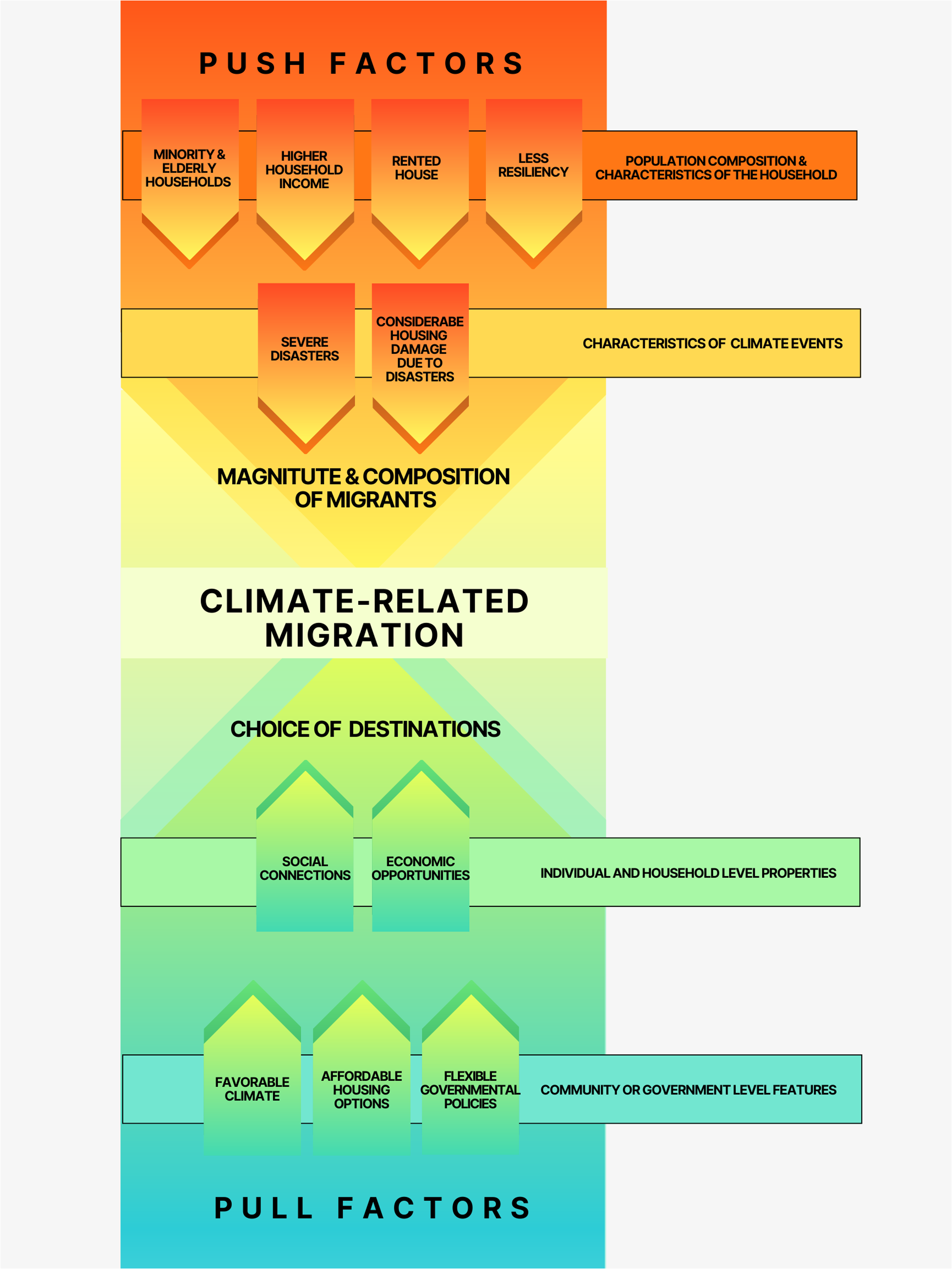
Push–pull factors of climate-related migration.
Characteristics of and Impacts on Sending Communities
Climate change is expected to cause population redistribution all over the United States (Fan, Fisher-Vanden and Klaiber 2018), but in very uneven ways. A general picture of areas vulnerable to significant out-migration after a disaster includes those with:
relatively high percentage of residents with less educational qualifications, and limited decision-making power (Myers, Slack and Singelmann 2008; Mitchell, Esnard and Sapat 2012) a relatively high percentage of young adults (aged 25–39) and/or adults who were born outside of the affected location (Sastry and Gregory 2014) limited resilient infrastructure (Zaninetti and Colten 2012; Chen and Lee 2022).
The role of population growth trends and housing vacancy seems unsettled. Cross (2013), for example, found that areas with decreasing population growth rates and/or higher housing vacancy pre-disaster had a higher risk of out-migration, while Boustan, Kahn and Rhode (2012) found that areas experiencing high population and employment growth in the last ten years have higher out-migration rates after disasters. Similarly, the role of perceived risk of future disasters is unclear. Fussell et al. (2017) found that climate has no statistical impact on population distribution for less dense and steady or already shrinking locations, while Boustan et al. (2020) found that disasters perceived as posing future risks may cause more out-migration from the affected places. The contradictory findings may relate to the specifics modeled. Fussell et al. (2017) conducted their study at the county level and included the occurrences of hurricanes and tropical storms for observing migration patterns, whereas Cross (2013) studied at the place level (census-defined places) focusing on tornado, hurricane, river flooding. The tornado-affected communities saw more out-migration than the other disaster-stricken areas, because of devastating and long-term consequences (Cross 2013). Clearly, more work is needed on this topic.
There is more consistency in findings that disasters may threaten socioeconomic stability in sending areas, with increased instability increasing the tendency for residents to migrate. A key impact is on the income levels in the sending areas. Initially, for federally recognized disasters, income may increase (Schultz and Elliott 2013), but over the longer term, poverty rates increase in severely affected areas due to a combination of higher-income households moving out, lower-income individuals moving in because of cheaper housing costs, and the direct adverse financial impacts of the disasters on current residents (Boustan et al. 2020; see also Zaninetti and Colten 2012; Schultz and Elliott 2013; Fan, Fisher-Vanden and Klaiber 2018). This eventually led to increased socioeconomic inequality within the concerned areas. Effects on the labor market occur as well: Fan, Fisher-Vanden and Klaiber (2018) highlighted that a decrease in population leads to lower output in labor-intensive sectors and consumer goods sectors. Reductions in land value may combine with land use constraints to worsen the financial position of affected municipalities (Shi and Varuzzo 2020). Typically, disasters exacerbate existing socioeconomic problems like lack of affordable housing, high living costs, low wages etc. which eventually leads to further out-migration or reduced return migration (Kuru, Ganapati and Marr 2022).
There can be long-term positive outcomes from the rebuilding process in sending communities. For example, hurricane-associated losses often correlate over time with increased population growth in highly dense and growing counties (Fussell et al. 2017), likely through denser redevelopment in the aftermath. Fussell et al. (2017) attributed this to the considerable general and resilient infrastructural investment in the years following hurricane-related financial losses.
Sending Communities—Synthesis and Future Directions for Research
Each major disaster has unique characteristics, both in the conditions of the community pre-disaster and the impacts of the event itself—this makes sweeping generalizations about post-disaster mobility inappropriate, although as noted above, there are general trends. The time frame of research matters a great deal in the findings—the initial pulse of large out-migration after a major disaster is often softened by return migration as rebuilding occurs. Along with the level of disaster impact, out-migration primarily seems highest in areas that were already experiencing demographic and infrastructural challenges, such as population decline, or housing vacancies, even before the disasters occurred. On the other hand, local-level climate resiliency promotes in-situ adaptation. More research is needed on the ability of, in the short term, mobilization of resources, social supports, and amenities and facilities by the local governments of vulnerable areas; and in the longer term, infrastructure improvement to reduce out-migration. Notably, the research above almost all pertains to sudden-onset disasters; research on the slower and less visible movement from slow-onset disasters is also needed. Additionally, research is needed into how likely sending communities could anticipate future population decreases and plan ways to use vacated land to protect safer areas—a planned retreat at the local or regional scale (Stone 2024).
The complex interaction of socioeconomic status, consequences of disasters, and community-level resilience capacity highlights the need for tailored local-level climate adaptation practices that build social equity while reducing likely harms. While it may be too early in the research for communities to effectively include climate-related migration modeling into their demographic projections, they can use the above information to assess their relative level of risk for significant out-migration. This is further discussed in our conclusions.
Characteristics of and Impacts on the Receiving Communities
Given the propensity to move close to former residences, sending and receiving areas may be in the same municipality, and are most likely to be in the same region (Sheldon and Zhan 2022). The likelihood of becoming a receiving community is basically the flip-side of that outlined above for sending areas. Areas most likely to become receiving communities are those that are located close to disaster-prone areas, that provide cultural and social ties to disaster-prone areas, and those that have available housing, jobs, and social services for movers (Marandi and Main 2021). Resilient infrastructure may also increase the rate of in-migration (Boustan, Kahn and Rhode 2012).
As a new area of study, there is limited peer-reviewed literature about climate-related migration impacts on receiving communities, as highlighted by Marandi and Main (2021) and Teicher and Marchman (2023). Some expected challenges to receiving communities are already documented: housing price spikes and resulting gentrification and community change (Li and Spidalieri 2021). Fan, Fisher-Vanden and Klaiber (2018) found that increases in housing price gradually lessens the propensity for more in-migration in those places. Beyond housing and neighborhood change, there are other impacts. Fan, Fisher-Vanden and Klaiber (2018) considered the redistribution of labor wages due to climate-related migration. They found by incorporating labor wages and housing prices that the gross regional product flourishes in the Northeast, West, and California, declining in the South and Midwest.
Receiving community's challenges often land hardest on historically marginalized people (Aune, Gesch and Smith 2020). They typically have a lack of access to information and limited financial resources. This perpetuates and can escalate inequality in host communities in the aftermath of in-migration within their areas (van Holm and Wyczalkowski 2019; Aune, Gesch and Smith 2020).
Marandi and Main (2021) mentioned that the potential receiving communities can be well served by collaborating with community-based organizations, aid agencies, and the private sector. Teicher and Marchman (2023) emphasized that facilitating participatory planning and allocating resources to the locally familiar community-based organizations can be beneficial for the receiving communities in integrating the in-migrants with the current residents. de Sherbinin et al. (2011) also stated that participatory decision-making will have positive impacts on the receiving communities when they face in-migration in their areas.
Receiving Communities and Rapid Onset Disasters
The most widely documented risk to receiving communities is housing availability often resulting in gentrification and displacement. Two of the best-documented examples regarding gentrification and displacement impacts of disaster-related migration are the outcomes of the Category 5 Hurricanes Katrina and Maria. In New Orleans after Hurricane Katrina, economic revival has taken 15 years, and displacement and marginalization of the area's African American inhabitants continued (Zaninetti and Colten 2012). Aune, Gesch and Smith (2020) also highlighted the impacts of post-recovery gentrification on Black people, less educated, lower income, unemployed, and renters in New Orleans. Mitchell, Esnard and Sapat (2012) reviewed scholarly articles focusing on the dilemma of housing after Hurricanes Andrew, Katrina, and Ike, emphasizing the importance of housing and sheltering policies in the destination areas. van Holm and Wyczalkowski (2019) noted that a decade after Katrina, New Orleans neighborhoods that had experienced a higher percentage of hurricane-related building devastation were found to be gentrified. Beyond housing, Li and Spidalieri (2021) highlighted that if there are significant socio-economic and cultural differences between the newly arrived and existing residents, conflict can arise. They also mentioned that Hurricane Maria brought impacts on jobs, transportation, and social services, creating challenges for the receiving communities.
Receiving Communities and Rapid-Onset Disasters
It seems likely that slow-onset disasters are easier for receiving communities to manage compared to the quick pulse of in-comers after a disaster and often-temporary relocations of rapid-onset events, but authors such as Hauer (2017) and Marandi and Main (2021) argue that long-term impacts of slow-onset disasters still may be significant. Housing availability and gentrification are key issues that will no doubt be concerns for slow-onset receiving communities (Teicher and Marchman 2023). Hauer (2017) anticipates that SLR-related mobility will worsen water and growth management issues and threaten the balance of development and natural resource protection. There is uncertainty about how many people will stay versus return to their prior location, but little US research to date has clearly described the significance of these differences.
Receiving Communities—Synthesis and Future Directions for Research
Literature to date suggests that, for receiving communities, challenges in housing and gentrification are the most common issues resulting from climate-related migration. Additionally, for slow-onset disasters, water or growth management issues were observed or anticipated. Equity issues are significant and need further research. Like the sending neighborhoods, the government actions and policies of the receiving areas also play significant roles.
There are steps that likely receiving areas can take. Similar to our comment above about sending areas, areas that are adjacent to high-risk geographies may want to consider likely population increases over the next few decades in their planning. Areas adjacent to high-risk locations should proactively address housing availability and affordability, adopt climate mitigation and adaptation strategies, and build social and economic opportunities. Teicher and Marchman (2023) found that in-migrants can be well-integrated into receiving communities by considering the distinct needs of the current and new residents, balancing economic growth with social equity, and implementing long-term deconcentration planning.
Summary, Future Research Needs, and Policy Recommendations
This study focuses on US domestic climate-related migration, and answers four research questions: (1) How do researchers model climate-related migration and what are the key findings of the models, (2) what are the destinations of climate-related migrants, (3) what are the characteristics of and impacts on sending areas, and (4) what are the characteristics of and impacts on the receiving communities.
Modeling
Exactly how many climate-related movers to expect is deeply unsettled, with researchers finding magnitudes of difference in their projections based on the assumptions of their models. Climate-related migration modelers mostly considered severity of disasters, household income, availability of aid, extent of housing damage as push factors that encourage movement, and income or employment opportunities, social networks, flexible policies and regulations as pull factors that influence destination decisions. The relative importance of climate as a factor of climate migration, the unit of analysis used in the models, and the thresholds for moving are key variables in the models, and need to be more critically considered. Considerations of different disasters and community-level factors were limited in developing the models, restraining the effectiveness of the models in shaping policy frameworks and planning. As an emerging field, there is much yet to be done to standardize climate-related migration models and underlying factors (Fussell et al. 2017), destination choices, and features of sending and receiving communities together, which may provide a holistic view regarding internal climate migration.
Although some time-series analyses have been conducted by some researchers, these are insufficient to fully apprehend the temporal dimension of migration pattern, including the length of stay in the host communities. Mitchell, Esnard and Sapat (2012) tried to highlight that availability of aid (social services, for instance) may influence the length of stay in the receiving communities for the return migrants. There is some evidence that resiliency investments discourage out-migration, but more knowledge about what types and any negative effects, such as people believing they are safe when they are not, would be helpful.
An equity perspective is underdeveloped in climate models, although much better documented in qualitative research. It is not clear to-date whether the poorest are likely to move or be stuck to suffer in inadequate housing and impacted neighborhoods. Poor understanding of this may prolong current inequities. Power dynamics and rules of justice studies might illuminate impediments and prospects to improve outcomes for the migrants in both the receiving and sending communities.
The research results were organized to explore the differences between rapid-onset events and slower catastrophes such as SLR. Slow-onset related migration tends to occur as a trickle, while sudden-onset as a rapid, less-predictable pulse. Return migration is less common among the movers induced by slow-onset disasters than those who migrated due to rapid-onset events. A significant need is a better understanding of the thresholds for decisions to move away from the impacts of slow-onset events (how many wildfire/flood evacuations before one moves?); the answer is likely to be complicated, but important in developing more nuanced and useful projections.
Importantly for planning, the widespread use of large-scale county-level models restricts current modeling's practical applications in local planning, although it may work reasonably well for regional planning. Future studies with more resolved modeling would be essential for planning to fundamentally address climate-related migration. It is not clear that modeling is sufficiently developed and stabilized at this time to be useful for integrating projections into local planning, although models do highlight general trends and risk factors.
Destinations
While the popular imagination of climate migrants is of long-distance moves, research to date suggests that climate-related migration in the United States is fundamentally a regional issue, with considerable intra-regional movement usually to nearby or within metropolitan centers. Distant places attract climate-related movers when these places offer considerable housing, job, and social connection opportunities for them. Climate safety is not the primary pull-factor for destination decisions, and movers often choose climate-vulnerable zones in search of factors like affordable housing and more economic prospects. More people are inclined to migrate from already struggling locations. For that reason, places having shrinking population; higher housing vacancy; intense housing damage; and communities having less power, and/or education face greater out-migration rate. This may conflict with the marketing of climate-safer locations, where many cities that have lost population are positioning themselves as destinations.
While working with destinations of the climate migrants and features of the sending and receiving communities, future studies may investigate factors such as access to social services and cultural issues. These should engage the involvement and perceptions of movers in both the sending and receiving communities. We know less about receiving communities in general, and this area offers a broad range of research opportunities. Future research may benefit from utilizing both qualitative and quantitative methods, statistical investigations, and geospatial tools. It is important for future research to report more on comparative inspection of all the factors related to domestic climate-related migration and choices of destinations, which would be helpful in acquiring a better sense of in situ solutions and responses for combating climate change. Finally, we note that voluntary climate movers may become more important as younger generations with more climate awareness mature and make location decisions, but little is understood or even theorized about this.
Sending and Receiving Areas
Socio-economic challenges like high costs of living, decreasing labor supplies, and unaffordable housing options may magnify under rapid in-migration, resulting in socioeconomic inequality. Receiving areas often struggle with housing affordability issues, social service provision, and infrastructure sufficiency. Disadvantaged communities in terms of income, education, and/or race tend to experience in-migration related gentrification. In sending areas, there is significant risk that the poor will be trapped in low-service, low-desirability areas while their wealthier neighbors move away. Therefore, the planners need to take targeted interventions specifically for disadvantaged demographic groups—both their current residents and potential newcomers. Understanding these dynamics is important for planners to reduce regional inequalities and promote effective community-level planning.
The impacts of pulse-migration after a disaster and the levels of return of migrants to their homes are crucial to service provision and planning, and studies of Hurricanes Katrina and Maria help illuminate this. Slow onset is less studied, and an improved understanding of the differing impacts and effective policy responses between the two types would be helpful, from the perspective of both sending and receiving communities, as well as the movers themselves.
This study suggests that more policy and planning attention is needed on climate-induced human mobility as an important consideration for local, regional, and state governments. The field is developing rapidly, and we expect that projections will be more useful for practice within the decade. It is clear that climate-related migration is likely to increase the uncertainty and variability of demographic projections, which are core data for land use planning. Areas that fit the characteristics identified above for sending or receiving communities may benefit from scenario planning to directly address this increased uncertainty. In general, for community-level planning, we note that climate-related migration is not that different from other experiences of rapid growth or shrinkage, and studies that use previous local and regional experiences to draw lessons from, for instance, the de-growth of former industrial areas, for managing climate-related mobility can be useful in practice. Policymakers, local government institutions, and non-governmental organizations should concentrate on the steps required to create positive outcomes for hosting and sending communities, as well as the movers themselves. Impacts of climate-related migration on receiving communities highlight the need for coordinated policy responses at the local, national, and international levels. Poor neighborhoods should not bear the brunt of negative impacts, but without policy interventions, likely will. Clearly, this is an area of emerging scholarship with many opportunities for modeling, planning, and policy research and practice.
Supplemental Material
sj-docx-1-jpl-10.1177_08854122261429510 - Supplemental material for Understanding U.S. Internal Climate-related Migration: Research to Date and Implications for Planners
Supplemental material, sj-docx-1-jpl-10.1177_08854122261429510 for Understanding U.S. Internal Climate-related Migration: Research to Date and Implications for Planners by Paromita Shome, Omur D Kuru and Elisabeth Infield in Journal of Planning Literature
Footnotes
Acknowledgements
The authors would like to acknowledge and thank their peers and colleagues for their inspiration and support throughout the development of this work.

Ethical Considerations
As the review is solely based on publicly available literature and does not entail direct research involving human or animal subjects, ethical approval was not needed.
Consent for Publication
All authors of this manuscript have explicitly consented to its publication. We hereby confirm that the manuscript has undergone a thorough review and has received approval from all listed authors.
Declaration of Conflicting Interests
The authors declared no potential conflicts of interest with respect to the research, authorship, and/or publication of this article.
Funding
The authors disclosed receipt of the following financial support for the research, authorship, and/or publication of this article: This research was supported by the National Science Foundation under Grant 016949-00002.
Data Availability Statement
This article is based on a systematic literature review and does not involve the collection of new primary data. The data utilized in this article include published articles, reports, and scholarly sources, all of which are cited in the reference list. For more information on the literature reviewed and their availability, please see the references section of this article.
Supplemental Material
Supplemental material for this article is available online.
References
Supplementary Material
Please find the following supplemental material available below.
For Open Access articles published under a Creative Commons License, all supplemental material carries the same license as the article it is associated with.
For non-Open Access articles published, all supplemental material carries a non-exclusive license, and permission requests for re-use of supplemental material or any part of supplemental material shall be sent directly to the copyright owner as specified in the copyright notice associated with the article.
