



Abstract
Climate change has recently been ascribed a causative role in creating situations of heightened insecurity in the context of migration This paper responds to calls for greater scholarly engagement with slow onset climate change events, including a focus on more localised and contextually nuanced relationships between precarious forms of human mobility and climate change. There is further scope for geographers to contribute to this growing body of literature, coming from a long-standing engagement with the human dimensions of climate change on the one hand and a growing critical appraisal of precarious labour/ migration on the other. This paper seeks to offer some directions for further study of this increasingly important relationship focusing on three registers; gendered mobilities, compounding factors and debt burdens . I make my arguments through a case study which examines the key drivers of labour migration for South Asian transnational migrant workers from rural households primarily in the central districts of Dhaka, Manik Ganj and Munji Ganj in Bangladesh and the State of Tamil Nadu, India.
Introduction
This paper examines the relationship between precarious labour migration and climate change, moving beyond the organising framework of modern slavery. A modern slavery framing of the nexus between climate change and labour migration lies at the core of techno-bureaucratic humanitarian fixes of anti-trafficking generally and in relation to climate mobilities specifically (Baldwin et al., 2019). In this vein, a growing critical scholarship on climate mobilities has identified the need for, “a more focused climate mobilities research agenda that recognises the multiple drivers of mobility and multi-directional movement’ (Cundill et al., 2021). Baldwin et al. (2019), for example, encourage analyses of climate mobilities that recognise that individual household decisions around migration are highly contextual, embedded in existing migration regimes and structural factors, amongst others. They challenge the narrowing of climate mobilities research that often accompanies the ‘troubling political category’ of the ‘climate refugee’ (p. 290). Instead, they favour research which recognises that climate mobilities take a variety of forms and, “on a spectrum of (in)voluntariness depending on whether change is slow, like droughts and landscape degradation, or fast, as in floods, storms and fires” (p. 291). Thus, I hope to add weight to Brown et al.'s (2019) recent call for geographers to pay further attention to the wide and complex range of ways, “extreme labour exploitation is entangled with… anthropogenic climate change and multiple environmental crises” (p. x).
Focusing on experiences of transnational labour migration from rural farming communities in South Asia to illustrate my discussion, my thesis in the paper is that slow, protracted temporalities associated with climate change shape migration decisions in specific ways. Urgent, highly constrained propelled migration is less evident in these slow temporalities than negotiated, planned and considered decisions which are embedded in, and intersect with the contextual nuances of gender, migration history, and other factors – both structural and situational - that shape and influence mobility decisions. Examining these mobilities helps unsettle normative readings of gendered vulnerability associated with climate change. A similar argument highlighting the importance of gender was advanced in a recent study of migration as an adaptation strategy in the face of climate change in Zimbabwe (Tirivangasi, 2024). Similarly, Van Praag (2021) adopts a life course perspective to understand (im)mobility decisions and constraints in the face of climate change in Morocco. He found, as I have, that, “Few respondents referred to an urgent need to migrate in the light of slow-onset environmental changes. Rather, migration aspirations were entangled with other societal changes and employment opportunitiesClear definitions of slow onset climate change – what the UNFCCC (2015) labels as ‘slow onset events’ (SOEs) – are lacking in the extant literature on the subject. In most cases SOEs are defined in contrast to rapid onset events. Article 8 of the Paris Agreement, for example, states that, “Parties recognize the importance of averting, minimizing and addressing loss and damage associated with the adverse effects of climate change, including extreme weather events and slow onset events” (UNFCCC, 2015). In attempting to explain this relative neglect of SOEs, van der Geest and van den Berg (2021) suggest that the higher visibility and immediacy of sudden (or rapid) onset extreme weather events can at least partly account for this difference (see also Staupe-Delgado, 2019). Nonetheless, the UNFCCC (2015) do list eight types of SOEs that have helped delineate the parameters of these events and establish research directions. These include rising temperatures, sea level rise, salination, ocean acidification, glacial retreat, land degradation, desertification and loss of biodiversity. The rural communities drawn on as the case study for this paper's discussion have been most affected by salination and land degradation resulting in declining agricultural productivity and consequently a significant diminution of farming-based livelihoods. As the case study demonstrates, a lack of capital to invest back into farming improvements has further compromised the ability of many rural households to build resilient farming futures in the face of SOEs.
In the paper I propose three avenues for exploring the entanglements between climate change and precarious labour migration, focusing on slow, rather than rapid onset events. With a particular focus on drivers of hyper-precarious labour migration, these avenues include gender and axes of identity, multiple and compounding drivers, and debts. I draw on excerpts from the recently completed first phase of a project examining the transnational lives of South Asian (Bangladeshi and Tamil Indian) transnational migrant workers to illuminate my discussion. This project focuses on transnational transient migrant workmen from Tamil Nadu in India and from Bangladesh, especially the Dhaka division (2014–2018). The first phase of the project involved fieldwork in the migration destination states of Singapore and Malaysia, which are key destination for South Asian men migrating into construction, shipyard and landscaping sectors. Linking slow onset climate change in the rural communities in my case study to men's heightened vulnerability to precarious migration helps unsettle normative readings of gendered vulnerability within climate migration, where extant scholarship focuses disproportionately on women and children.
Agriculture, rural livelihoods and slow onset climate change in Bangladesh and Tamil Nadu
Agriculture in the global South is already undergoing dramatic changes which have severely compromised the ability of rural households to reproduce themselves, including the impacts of structural adjustment policies, devaluing of primary commodities of the world market, and rising costs of farming inputs (Rigg, 2016). Climate change has emerged as playing an important role in shaping many of these transformations. Labour migration has become a key economic strategy for households and communities in the global South, especially given that the absorptive capacity of agriculture and off-farm employment opportunities in rural areas are both declining (Scherrer, 2018). This has created a pool of excess and underemployed labour in rural areas and severely compromised the social reproduction of farming households. Much critical work on these adaptation strategies has documented the role structural and other factors play in inhibiting and shaping rural adaptation. In my analysis in this paper the operation of the migration regime governing transnational labour migration of South Asian men plays a pivotal role, alongside gender and social norms operating in South Asia. Efforts to adapt where households and individuals are pushed to engage in ‘risky’ strategies due to pre-existing precarity can, relatedly, adversely affect adaptation strategies (Missbach, 2017). As my analysis reveals, “precarity [becomes] both a cause and consequence” (Natarajan et al., 2019). Thus, this paper follows Brace and Geoghegan's (2011) call for more grounded and localised understandings of climate change adaptation, paying attention to how it is embedded in multiple structures of power relations and rural change (Rigg, 2016).
A good deal of scholarly and media attention is directed towards simple causal linkages between rapid onset climate change events, such as cyclones, fires and floods and forced migration (Boas et al., 2019). This has often been to the detriment of a more sustained engagement with how slow onset climate change processes intersect with precarious forms of human mobility. Zickgraf (2021) recognises that the type of hazard and the speed with which it occurs, “shape human mobility responses in terms of agency, temporality and space” (p. 21). As she rightly points out, the more gradual climatic vulnerabilities created by slow onset processes, such as drought or coastal erosion, have so far largely failed to capture the vast majority of public (and research) attention, which has been directed towards rapid onset events (see also Lazcko and Aghazam, 2009 on this point). In fact, it is international organisations that have led the way in asserting the need to direct attention towards slow onset events (for example, Nishimura, 2018).
Several slow onset climate change processes can be causally linked to out-migration. These include drought and desertification, sea-level rises leading to loss of productive and residential land, rising water table leading to soil salinity, loss of biodiversity in natural resource dependent communities, and climate variability (especially changes in temperature and rainfall patterns) (Piguet, 2010). These processes were variously evident in my study in Tamil Nadu and Bangladesh. In Tamil Nadu protracted drought has followed changing rainfall patterns as monsoonal rain become erratic, resulting in less available water supply and reduced crop yields. Over time soil degradation has worsened as drought has continued, dramatically reduced the productive land available for cropping and severely diminishing livelihoods of small rural farming households (Saravanakumar, 2015). A recent study by Jeganathan et al. (2021) assessed the socio-economic vulnerability of rural households in Tamil Nadu in the context of climate risk, along with the capacity of households to adapt. Using climate data from the India Meteorological Department (IMD) the study assessed each district in the State and revealed, “alarming socio-economic and infrastructural conditions” as inhibiting state and district level capacity to build climate resilience (p. 121). The study listed the district with the highest sensitivity and lowest adaptive capacity to these climate risks as Ariyalur. Nagapattinam, Ramanathapuram, Thiruvarur, Thiruvallur, Thanjavur, Perambalur, Pudukottai, and Thiruvannamalai were listed as the other districts that are extremely risk prone. Of the Tamil participants in my study, ninety-two percent cited these districts respectively as their places of origin.
In the central and southern river regions of the Ganges-Brahmaputra-Meghna Delta in Bangladesh, particularly Dhaka, Manik Ganj and Munji Ganj districts from where just over sixty percent of my Bangladeshi participants originate, rising estuarine river levels have severely impacted the water table, with extensive soil salinity threatening cropping and horticultural activities (Desgupta and Robinson, 2022). In studying the changing conditions in this Delta, Pethick and Orford (2013) found that land subsidence causes a relative sea-level rise of up to 10 mm per year, compared to the absolute sea level rise of 2 mm per year. In this Delta region, sea-level rise can influence storm surges that flood the aquifers in low-lying river estuary areas with seawater. Rice is the key staple crop in these districts and is grown either for subsistence or commercially by all my participants. The rising soil salinity has inhibited plant growth as nutrients are leached out of the soil. Salinity tolerant crops are, for most, prohibitively expensive to invest in for the households in my study. In many of the households of my Bangladeshi participants, fruit and vegetables were also grown on small plots, both for subsistence and for sale at market. The inundation of farms with floodwaters produced similar effects on horticultural activities as it has on rice crop yield, further exaccerbating the vulnerability of these households as efforts to diversify agricultural activities realised little reward.
In sum, the environmental conditions that propel prospective migrant workers to leave are discrete, with the situation in Tamil Nadu presenting a range of very different challenges than in Central and Southern Bangladesh. It is estimated that approximately 42 per cent of India's land area is under drought conditions because of the persistence of El Nino conditions since 2015, resulting in a reduced monsoonal rainfall which supplies a significant proportion of the country's annual rainfall total. Tamil Nadu has faced persistent drought for at least fifteen years (Gowtham et al., 2020). The northwestern regions of Bangladesh face similar challenges with protracted drought. However, the central and southern delta regions are impacted by increasing soil salinity resulting from floods and a rising water table (Corwin, 2021). Although rapid onset events propel people to move immediately in the wake of the impact of the event, slow onset events are much more variegated in their mobility consequences. What this means for prospective labour migrants is that they often retain a presence (one or more family members) at home, supplementing (or replacing) household income through remittances. This, once again, differs markedly from the dominant discourses of climate change induced migration purported in much of the literature. It is to a fuller examination of these other experiences that I now turn.
Methodology, ethics & participants
The data on which this paper's arguments are based is the first phase of a project exploring the transnational lives of hyper-precarious migrant workers. The first phase focused on workers’ lives in situ in the destination countries: primarily Singapore, where eighty-five percent of the participants were engaged as transient migrant workers, and secondarily in West Malaysia, where the remaining fifteen percent of participants were based. Tamil Indian and Bangladeshi low-valued male migrant workers comprise most transient male migrant workers in Singapore and Malaysia, with governance and circumstances of their migrations, including the visa and financial arrangements, working conditions and sectors of deployment reasonably consistent across these two source countries.
The study adopted a qualitative methodology involving repeat (where feasible) in-depth interviews with over one hundred men in the construction, shipyard and landscaping sectors. This method was complimented by an unstructured narrative/ diary writing process for some interviewees (fifty-eight in total), a selection of which were published as edited volumes of migrant worker stories (see Yea et al., 2014, 2015, 2017). The project did not explicitly seek to identify the role of climate change-related factors as drivers of out-migration for the participants. It was only on deeper analysis of the key themes during the data coding process that the importance of climate hazards in explaining migration decisions became visible. The adoption of in-depth, open-ended methods – particularly the diary and narrative writing method - therefore played a very important role in rendering climate hazard narratives visible in broader articulations of migration drivers and experiences (Dowling et al., 2016). In the collective then, the data provided some examples of the increasingly prevalent linkages between hyper-precarious forms of labour migration and anthropogenic climate change.
In identifying the role climate change played in my participants’ migration decisions and trajectories, I adopted a mobilities approach. Following Wiegel et al. (2019), a mobilities perspective can, “better ground and pluralise our understanding of how environmental change and human mobility relate” (p. 1). For Wiegel et al. (2019), a mobilities perspective sees “environmental migrants as agents of adaptation” (p. 1) and, in line with my intent to understand the intersecting roles of various drivers of migration, a mobilities perspective asks, “when and why do people decide to move or not in response to environmental change, where and under what conditions, and who can or must stay behind” (p. 2).
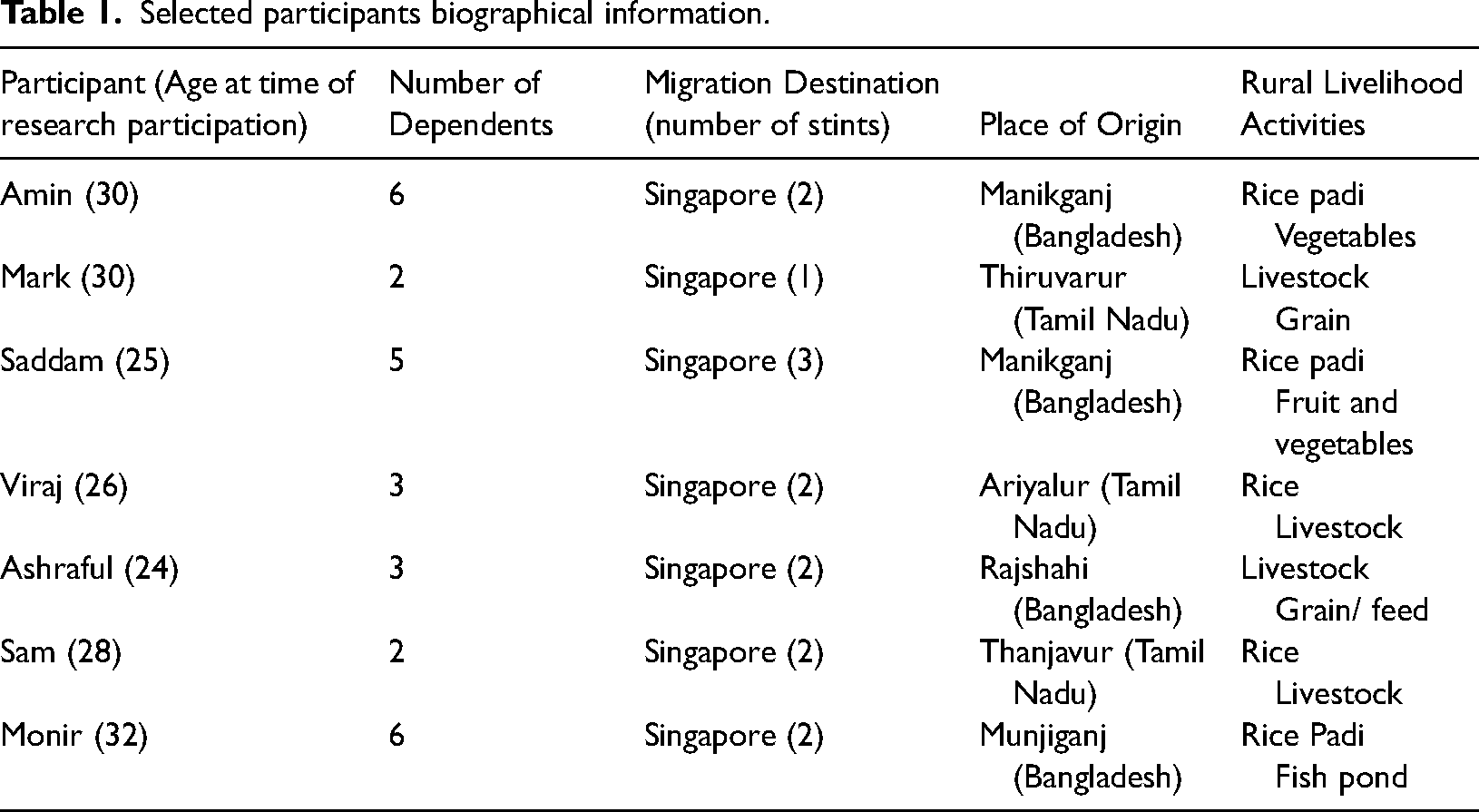
All but seven of the participants originated in rural districts of Bangladesh and Tamil Nadu respectively, with ninety-three percent of those men engaged in agriculture, either as a full-time or part-time livelihood activity. The property arrangements varied, from those who owned and worked their own land, to those who worked as sharefarmers on others land. One-third of participants had also engaged in seasonal work, either in agriculture or factories, to supplement their farming incomes. Table 1, below, provides background information on those participants whose experiences are directly drawn on in this paper's discussion. These are typical of the men who participated in the study (Table 1).
Selected participants biographical information.
Inheritance structures in both regions have greatly contributed to a slow reduction in the size of land holdings over time and this has, in turn, made farming and more challenging livelihood strategy for many.
The interviews delved extensively into pre-migration livelihood strategies and household arrangements, including family structure and income, as well as structural, situational and personal pressures on households. This interview topics aimed to tease out the key drivers of migration. The interviews did not explicitly ask about the influence of climate change or other factors on migration decisions within households. The questions about migration drivers were deliberately open-ended, aiming to understand the complexities in migration decision-making and the inter-relationships between key drivers.
Given the very marked (racial, gender, linguistic) differences in identity between myself and the participants, I adopted an approach to positionality that rejected, ‘the determinism implied by ‘insider/outsider’ dichotomy’ in favour of an approach that, ‘underlines the reflexive situated dimension of the field interaction and stresses the need for continual assessment of the rapport process’ (Goina, 2008: 135). This approach enabled me to see my position and relationship(s) with participants as fluid (my interactions with individual participants was not always the same) and sometimes changing (as relationships with some participants were deeper and ongoing, whilst with others, interactions were much briefer). Distance and proximity were reflexively, continually negotiated, particularly as my research often called for intimate and emotive disclosures about work, masculinity, family, and money. Following Goina (2008: 136), this approach enabled me to, ‘maintain the balance between ‘doing distance’ and ‘doing closeness’’. Further, my positionality, as someone from outside the participants’ social worlds (and therefore unknown to relatives and friends in the migration destination and their home countries) was helpful in achieving frank disclosures from many participants about their situations in whilst abroad during interviews. Specifically, many of the participants saw in me the opportunity to relate aspects of their labour migration situations without fear of these circumstances being communicated ‘back home’ in India or Bangladesh. The wider circulation of these situations was an ongoing source of anxiety for all my participants because gossip could lead to censure and stigmatisation. Being on the outside of these social and community relations was therefore an enabling aspect of the fieldwork. I was also positioned as someone who knew organisations (NGOs) that might be able to assist some of the men, but again, my positioning outside these organisations encouraged men to reveal aspects of their experiences that they thought of no value to NGOs – such as problems with wives and parents back home. I often did assist participants by introducing them to migrant rights NGOs who might be able to assist the participants to overcome various vulnerabilities associated with life on a Special Pass.
Gendered vulnerability to precarious migration
Extant literature on the gendered nature of vulnerability in situations of climate change-related migrations identifies the heightened risk of trafficking for women and girls in situations of immediate and protracted displacement (Lama et al., 2021, Eversten and van der Geest, 2020). Similarly, Barras argues that women are more vulnerable in situations of climate-related displacements and forced migration because they also play a key role in the care, support and reconstruction of their communities. These views, although undoubtedly correct, tend to reinforce the prevailing assumption that women and girls are consistently more vulnerable that men and boys to the impacts of climate change – related precarious migration and displacement (for South Asian examples see Bhatta et al., 2015, Yadav and Lal, 2018). UN Women (no date) also relate the greater vulnerability of women and girls to negative impacts of climate change with gender inequality. As they state, “The climate crisis is not “gender neutral”. Women and girls experience the greatest impacts of climate change, which amplifies existing gender inequalities and poses unique threats to their livelihoods, health, and safety”. Similarly, Bhatta et al. (2015) argue that in the South Asian region women are, “disproportionately affected by climate risks” and “the ability to adapt and cope is with changes to climate change is also gendered” (p. 4). They argue that in this region, because women tend to be poorer, less educated and have a lower health status and limited direct access to or ownership of natural resources, they are disproportionately affected by climate risks. This focus has, perhaps inadvertently, resulted in the relative neglect of the experiences of precarity of men and boys that are causally linked to climate change. In other words, there appears to be a mutually reinforcing assumption that rapid onset events combined with existing gender roles and inequalities with rural communities both render women and girls vulnerable, with limited scholarship examining the relationship between gender inequality, climate change and migration beyond this focus (for an East African exception see, Abebe, 2014). Sultana (2014) has thus called for research examining the gendered nature of climate change impacts to attend to, “the complex ways in which social power relations operate in communal responses to adaptation strategies” (p. 374). For my case study this means attending to the ways different genders experience vulnerability differentially and dynamically.
As the experiences of transnational migrant workmen from India and Bangladesh demonstrate, slow onset events can often mean that it is men and boys who are at greater risk of precarious migration where climate change plays a role. This is due primarily to gendered socio-cultural precepts of the male breadwinner operating in South Asia (Osella and Osella, 2006) and social opposition to women's unaccompanied migration operating in concert with existing knowledge and networks to facilitate migration. It is also more likely that in both Bangladesh and India male members of households will have migrated internally for work previously, often in occupations that bear some relation to the types of job opportunities abroad, such as construction or mechanical work.
Amongst the participants in my research gendered discourses of the migrant male breadwinner undergird household decisions about who should migrate in the face of multiple and intersecting insecurities. This discourse was evident in both Bangladesh and Tamil Nadu. As one of my Bangladeshi participants, Amin (interview 27 June 2017), explained: My father and brother both went abroad to Dubai before me. It is right that the man should go. My wife must care for my mother. We do not have children yet. But when they come, she must also care for them. How could she be the one to go abroad? She [wife] cannot go because it is not appropriate for women to go abroad alone. There are many stories of Bangladeshi women who go to work in Saudi or Dubai and face many problems.
A similar explanation was offered by many of my Tamil participants. Although women often engaged in circular/ seasonal labour migration within Tamil Nadu, going abroad was rarely an option in the face of economic or environmental pressures. These men often cited the lack of education and cost of training for female migrants, which were impossible to bear for already financially burdened households. As Mark (interview 1 March 2015) recalled: My father was the one who first suggested I go abroad for work when the yield from our crops were too low to provide for us three years ago. I was reluctant to go, as I had heard many bad stories. But he convinced me by saying that Singapore is very strict with laws and there are many Tamil workers there. Actually, I wanted my wife to go abroad, because I could go to Chennai and work in a mechanic shop, as I had done several times before. But there was no choice as she [wife] did not have any formal education and I believe she would not have passed the training that is required for a helper [domestic helper].
The role of women in rural livelihood strategies for migrant sending households in my study also offered a partial explanation for why men went abroad for work in times of climate crisis, rather than women. In both Bangladesh and Tamil Nadu, women continued to play a crucial role at home. Although tending crops and farm animals occupied less time for all family members in the face of climate change induced land erosion, women have more diversified roles within the rural economy than men. This meant they were often more ‘needed’ at home. Apart from caring responsibilities within the family (children, elderly relatives), some of the female relatives of the male participants were able to engage in remunerative activities outside the household. This included the sale of some fruit and vegetables, or cooked products at local markets. Some of the Bangladeshi men in the study allowed their female relatives to work at nearby garment factories. This applied primarily to younger female members of the households. In all these cases, and despite women's significant ongoing contribution to the household economy through paid and unpaid work, it was the male household members who migrated in times of climate change-induced precarity, and who were validated as the main breadwinners at such times. Wiegel et al. (2019) and Nyantakyi have both noted how household scale gendered dynamics, particularly the intersection between gender, seniority, marital status and external policies all shape resource access and control and, in this case, also shape opportunities and constraints for labour migration.
In sum, Amin and Mark's experiences were common amongst the men in this study. The history of male out-migration (both in times of household crisis and in ‘normal times’), was coupled with considerations of the gendered division of labour within households and cultural norms around gender and work, as well as the generally lower levels of education amongst women (particularly in Tamil Nadu). These factors help explain why men were more at risk of engaging in precarious labour migration, rather than women when crops failed and farming no longer became a viable economic pursuit. The networks of recruitment – both formal and informal – operating within the communities where my participants resided were important in helping to understand why it was much easier for men to migrate abroad for work than women in these settings. A gendered lens can thus help us better understand, “who moves and how this is determined” (Cundill et al., 2021: 3) in the context of climate change-related mobilities. Linking slow onset climate change in rural communities in both these geographical contexts to men's heightened vulnerability to precarious migration helps unsettle normative readings of gendered vulnerability associated with climate change that tend to see women and children as facing more extreme vulnerability, particularly to forced labour and human trafficking.
Environmental precarity and compounding factors
A second register through which the precarious labour migration – climate change interface operates concerns drivers that compound or intersect with climate change as a migration driver. There has been welcome recognition in critical scholarship on precarious migration that drivers of out-migration are rarely singular or locatable in one particular circumstance or event (Alberti, 2014). Further, micro-scale circumstances and factors intersect in complex constellations with structural factors like government development policies and the geographic concentration of investment and transformation of the local economic base (Seto, 2011). Zickgraf (2021: 21), for example, acknowledges that, “a constellation of factors and local features affect the mobility decision, its trajectory, and its consequences, as does the hazard itself”. Black et al. (2011) have developed this argument more fully, citing five main drivers of migration decisions – economic, social, political, demographic and environmental. Rarely, they argue, does one driver explain the flows or decisions about migration. As such, “the effect of the environment is therefore highly dependent on economic, political, social and demographic context” (p. S3). Following this, they suggest the impact of climate change on migration can be both direct (as in impacting the degree of “hazardousness” of a place) or indirect (for example, through economic drivers that may changes the livelihoods of families, or politically through conflicts over resources). Similarly, Cundill et al. (2021) argue that climate change induced stressors are ‘threat multipliers’ (p. 2) and must be considered in relation to other factors. Building on these insights, this part of the paper examines the interstices between climate change and other drivers of precarious migration.
In my study there were three repeatedly cited compounding drivers most commonly discussed by participants; namely, reduced size of landholdings due to inheritance structures; the inability to sow genetically modified, high yielding crops that required large, continuous plots or significant financial investment, and; dowry payments for sisters or daughters marriages. The latter two of these factors were often tied to high levels of borrowing by rural households, particularly from microfinance institutions (MFIs). MFI borrowing has been cited by others as compounding, rather than reducing, the precarity of rural households across a range of contexts in the global South because loans are increasingly used for non-productive purposes or to finance migration (see, for example, Green and Estes, 2019, Natarajan and Brickell, 2022).
Twenty-five years old Saddam, from Manikganj in central Bangladesh migrated to Singapore in early 2015. His motivations for migrating illustrate the complex and intersecting role of dowry payments and inheritance structures in Bangladesh, coupled with his positioning in the family as the oldest child. These factors compounded the declining profitability of his family farm for more than four consecutive years in propelling him abroad for work. His natal family includes two younger brothers and a younger sister. At the time Saddam migrated to Singapore for work, his parents were both elderly and his father had suffered a stroke and had limited mobility. As the oldest child, Saddam had the main responsibility for the care of his elderly parents and was also entrusted to raise the dowry necessary for his younger sister to marry. One of his younger brothers had already graduated high school but failed one of his subjects and so the family decided it would be better to send him to work in Dhaka, rather than attempt to gain college education. His other brother was still in high school, and the family was pinning their hopes on this brother to receive enough formal education to secure a more highly paid job in Dhaka. It was the combined impact of all these circumstances, rather than climate change alone, that explained Saddam's decision to migrate to Singapore. As he recounted (Interview 15 May 2015), My younger sister will marry soon. My parents have already arranged the marriage for her. But we cannot do it [the marriage ceremony] yet because the family [of the fiancé] is demanding a large dowry. I cannot pay this dowry from our income from farming. It is already a struggle to pay for all the other costs of the household, and for my brother's education. We do not want to sell any of our land, and so the only other option is for me to take a job abroad. There is an agent in our district who is quite reputable. I went to him to secure work in Singapore, but his reputation was for naught.
For some, concerns about declining profitability of farms intersected with immediate events that necessitated urgent responses. These events acted as drivers of out-migration in concert with climate change impacts on rural livelihoods. Illnesses were the most cited of these, leading to often unmanageable costs of hospitalisation, treatment, and check-ups. For many rural dwellers whose homes were remotely situation from any hospital or clinic, there was also the steep costs of travel and, potentially, accommodation. For nearly all the Tamil participants in my study, the idea of going abroad for work was one commonly circulated within their communities and social networks. Prospective migrants often knew – personally or indirectly – of men who had gone abroad, returned and, perhaps, subsequently engaged in another stint abroad. In this sense, the latent knowledge and contacts to commence the process of going abroad were accessible to the Tamil men in my study. Yet even where rural livelihoods were severely threatened by climate change-related hazards such as protracted drought (Deshingkar, 2019) most were unmotivated to leave and fell into a migration mindset only due to a more immediate circumstance. Twenty-six year old Viraj was in this situation. After the birth of their first child Viraj's wife had been diagnosed with an ovarian cyst which required two operations, and with no guarantee that she would recover. There was no choice, as he explained, but to borrow from a local moneylender to pay for the costs of the surgeries. His family had just been making ends meet before his wife fell ill, so there were no savings on which to draw. As it turned out, Viraj's wife passed away whilst he was in Singapore and his elderly parents took responsibility for caring for his son during his absence.
For men like Saddam and Viraj, compounding vulnerabilities explained their decisions to migrate under extremely constrained circumstances. For both men the local recruiters they approached to assist with arranging their migration were informal brokers and so contract stipulations were vaguely construed and, once in Singapore, not upheld. It was difficult for both Viraj and Saddam to consider a different recruitment pathway, as this would have been more costly (in terms of fees and documentary requirements) and also required travelling further from home in order to access information/ an appropriate recruitment agency. In other words, the financial vulnerabilities they experienced in their rural livelihoods negatively impacted their ability to engage in safe migration strategies, which had repercussions on their work arrangements in Singapore, as will be discussed next.
Circular migration and debt
Circular migration for work, particularly amongst male members of rural households, has been a central feature of life and livelihoods in both Tamil Nadu and Bangladesh for generations (Osella and Osella, 2006). Recent literature has also identified the impact of failed migration stints associated with labour exploitation in propelling migrants in these regions to engage in further migration stints (Sarkar, 2017). Whilst much of the documentation of climate change-related migration tends to assume singular movements away from sites of anthropogenic disaster zones, for my participants, circular migration was a far more common occurrence. This finding resonates with Boas et al.'s (2022) suggestion that one important tenet amongst many that characterise climate mobilities involves circular mobilities that are embedded, “in ongoing patterns and histories of movement, and the material and political conditions under which it takes place” (p. 3366).
Saddam, introduced above, migrated to Singapore for work three times within a period of five years. The first time he failed to save any money because his company did not have enough work for him and cancelled his work visa after just a few months. The second time he experienced extreme instances of wage theft which also left him without enough savings to establish a business back in Bangladesh. The third time he returned was also characterised by wage theft, mainly due to non-payment for extensive periods of overtime worked. Each time Saddam returned to Bangladesh he weighed up his various options against his financial and familial circumstances at home. Although his home had not been directly impacted by flooding for several years, pre-dating his first migration stint abroad, he was still not able to forge a livelihood that would support his family through farming. He explained it this way (Interview 15 May 2015): I want to stop going abroad for working. I want to settle down and marry. There is no point to farm because my family farm does not provide enough for us anymore. The soil is no good now. There is too much water coming. So, I must try to save enough to start a small business when I come back. I like shrimp farming. Some of my friends from Singapore [other Bangladeshi workers] tried it and they earn good money. I think it is a good option for my family.
The loss of livestock due to climate change also presented a considerable threat to the livelihoods of Bangladeshi migrant workers and their families. Unlike the slow leaching of soil in flood prone areas, northern regions of Bangladesh have been impacted by severe and prolonged drought. Whilst drought undoubtedly impacted crop production activities in rural, migrant-sending households, it also negatively affected the feed available for livestock. The reduced ability of farming households to produce feed on their own land necessitated the buying of stock feed, reducing the income of many households considerably. Although most participants in my study were from the central and southern regions of Bangladesh, fifteen per cent of participants were from Rajshahi in northwest Bangladesh, one of the most severely drought affected regions of the country. Twenty-four-year-old Ashraful's natal family had tended cattle on their small, 3-acre plot for three generations. But, as Ashraful (Interview 18 June 2015) lamented, We had to sell some of the cows, one by one, because we could not afford to feed them. There was nothing on our farm [no harvests]. We had different income coming in, so we never relied too much on one thing – vegetables, milk from our cows, and sometimes goat meat. Now, the cows are gone, the milk is gone and we can’t grow anything on our land. If I don’t migrate to Singapore, then probably the next thing to be gone is our land.
In Tamil Nadu a similar pattern of risky out-migration for work abroad was evident and much like Ashraful, drought was the key environmental change responsible for rendering soil unproductive for farming purposes. As with the rural migrants in Bangladesh, transnational labour migrants from Tamil Nadu were turning to other livelihood options as farming income steadily declined. Sam's experiences capture many of the dilemmas facing my Tamil participants, and echo the livelihood constrains faced by Saddam and Ashraful. As he explained (Interview March 20 2017), My family cannot survive on the money we make from our farm. During good years, there is income. But in bad years there is nothing. The last three years there has been nothing. In the beginning we used some of our savings to pay for the things we needed until the following year. Three years we live this way, hoping that the next year would return to normal [meaning annual rainfall patterns are restored]. What else can I do? As I said, each year we hope the rains will come back, but they don’t. So, after my first migration nothing had changed when I returned home. Except this time, I had a heavy debt which still needed to be paid off. There were no more savings on which we could depend, so I made the decision to come back to Singapore. Yes, there was more debt by going again, but it was better than staying at home.
In sum, over three-quarters of the participants in my research in Singapore and Malaysia had migrated more than once, with more than half being on their third or fourth stint abroad when I had met them, and several more had migrated more than four times. Most of these men spoke of the need to pay of migration debts from previous migration stints as their principal motivation for engaging in serial circular migration. However, deeper analysis of their narratives revealed that the situations back home were not conducive to adopting a different livelihood strategy that did not involve migration abroad for work. For those engaged in farming in Bangladesh and Tamil Nadu prior to migration, the impacts of climate change on their farms had not lessened and, if anything, had intensified. For men like Ashraful, whose remittances aimed to help regenerate farmland as a productive asset, the costs of land recovery through new inputs were increasingly prohibitive. No-one in my research wanted to continue to come to Singapore or Malaysia for work, but a confluence of factors, including the continual deterioration of productive rural land holdings, made it almost impossible to do otherwise. Berchoux et al. (2019) suggest that any explanation of out-migration should take into account the different abilities of rural households to access capital and resources in times of agricultural shocks induced by climate change. Better resourced households in my study could also absorb the shocks more readily without needing to engage in temporary labour migration strategies. This was certainly borne out in the experiences of my participants.
Conclusion
This paper has explored the interstices of climate change and precarious (im)mobilities of transnational migrant workers. Drawing on a case study of South Asian migrant workers deployed in Singapore and Malaysia, discussion in the paper aimed to draw out the ways these workers are propelled abroad by a confluence of drivers that include the impacts of climate change on rural livelihoods. Most extant literature on climate-driven labour migration, including for South Asia, has examined the internal labour migration of rural dwellers to major cities, rather than examining transnational migration pathways. Climate change as a driver of precarious migration abroad, I suggested, intersected with gender norms, as well as other personal, situational and structural drivers to produce a large population of men in rural Tamil Nadu and Bangladesh who were positioned as the most suitable subjects to engage in transnational labour migration strategies. Focusing on men redresses the emphasis in much of the academic and grey literature on women and children as experiencing heightened vulnerability in the wake of climate change events. This gendered bias, emerges from a focus on rapid onset climate change events, where immediate and large-scale population displacement occurs. By examining the experiences of (im)mobility of populations affected by slow onset events, such as seen in the impacts of droughts and floods on soil and water quality in agricultural areas, we gain a sense of the diversity of experiences of, and narratives about climate change-induced migrations. The case study has delved into the experiences of one such group in further detail. It is recommended that further research across a range of contexts could yield greater insight into the diversity of such experiences (for example, Natarajan et al. 2019 on Cambodia).
The discussion in the paper also drew out the diversity in mobility pathways of migrants who are displaced by slow onset climate change events. In the case study examined in this paper, entire families and communities were not displaced but, for the most part, remained in situ whilst one family member left for work abroad. This adaptive strategy, nonetheless, was not always successful, as the conditions under which migration occurred were fraught with uncertainty and high costs associated with the financialisation of migration. For all but those who returned with serious injuries, this failure to build the resilience of rural livelihoods through initial migration stints resulted in at least two or more repeat migrations. Again, such trajectories challenge the dominant characterisations of mobility and displacement patterns in the face of rapid onset events associated with climate change. Circular migration of one family member was the norm, rather than the exception, in the cases of my participants. In tracing the vulnerable mobility trajectories of those impacted by climate change it is thus, arguably, important to look beyond the experiences of those displaced and living in temporary accommodation where insecurity of housing and other basic needs and where gender-based violence is rife no doubt presents a high-risk context.
In sum, following Brown et al. (2019) and Boas et al. (2019, 2022), I wished to make a case for greater consideration of a wide range of situations in which climate change intersects with precarious migration. Challenging the centrality of key tropes associated with forced labour and human trafficking in the wake of rapid onset events characterised by mass population displacements, I aimed to assert the importance of other experiences of vulnerability caused by slow onset climate change events, particularly as they inhere to rural livelihoods and households. Men emerge as the key subjects of vulnerable migrations in this case. Pressured due to gendered religious and social norms and embedded in geographical contexts where there is a well-established migration recruitment industry and networks, men from economically marginal farming households become the key subjects of transnational labour migration strategies. Their experiences of prolonged precarity, despite the adoption of labour migration as an adaptive strategy, nonetheless speak to the constrained circumstances under which migration takes place and to the growing cost of restoring agricultural-based livelihood strategy for future economic and environmental security. The focus on men's vulnerability in these situations should not be overstated though; left-behind family members must also manage the insecurities created by climate change and the absence of (normally) a male breadwinner (Ahmed and Eklund, 2021). A gendered lens on the relationship between climate change and precarious labour migration should not privilege either men or women or any other gender identity. Rather, it should speak relationally to a range of situations and to both those who move and those who are left behind. South Asian transnational migrant workers and their households thus illustrate the constrained migration of those who have no real choice at home to work and make a living as drought, floods and rising water tables undermine rural life in profoundly adverse ways.
Highlights
Challenges the characterisation of climate change induced mobilities often seen in extant literature on modern day slavery and climate change
Examines in detail the experiences of transnational migration as a livelihood strategy for South Asian rural communities
Explores the relationship between precarious migration and climate change through three themes of gender, intersecting vulnerabilities and debt.
