



Abstract
This article systematically reviews and synthesizes English-language literature from the past four decades to explore the interplay between rapid population growth (RPG), crime and fear, and their diverse impacts, focusing on small and rural municipalities. A search of peer-reviewed articles across major databases—Scopus, Web of Science, and JSTOR—from 1980 to August 2024 identified 72 relevant articles out of 1364 publications. A bibliometric analysis of the articles and their thematic review are guided by the following questions: What are the defining characteristics of places experiencing RPG? How does RPG affect crime and public perceptions of fear? Are there other notable consequences? The article also explores the main recommendations of research to mitigate these negative impacts and concludes by reflecting on the findings and providing insights for future research and policy implications.
Introduction
Rapid population growth (RPG) refers to a relatively fast increase in the number of people within a specific place over a relatively short period—a phenomenon previously noted in the international literature (see, e.g., Barton, Njeh, and LaRose 2024; Dahle and Archbold 2015). RPG and changes in population composition are often associated with higher rates of antisocial behavior, crime, and an overall declared decreased quality of life due to increased noise, pollution, traffic, living costs, stress experienced on infrastructure, and demands on local government services and competition for public resources (Ruddell and Ortiz 2015). Local planners and government leaders often become overwhelmed by the challenges of a population boom (Morrison, Wilson, and Bell 2012).
Although economic growth often leads to increased job opportunities and other benefits, RPG can undermine informal social control mechanisms, potentially leading to higher crime rates (Krannich 2012). Newcomers tend to be young and few maintain formal or long-term ties to the community. Like other young people, they are more likely to consume alcohol or drugs and engage in antisocial behavior (Archbold, Dahle, and Jordan 2013; Brown, Forsyth, and Berthelot 2014). RPG can challenge urban sustainability by making it difficult for municipalities to balance social, economic, and environmental factors over the long term.
While several studies have examined the effects of population growth, crime, and safety perceptions individually, our understanding of how these elements interact, particularly in small-town contexts, remains limited. Existing research tends to focus on large urban areas, often overlooking the unique dynamics of rapidly growing smaller municipalities. This gap may reflect a disciplinary fragmentation and a historical emphasis on urban centers literature. This article fills the gap by reviewing four decades of studies on the relationship between RPG, crime, fear, and quality of life factors such as housing stock. An earlier review by Stretesky and Grimmer (2020) focused on shale gas production and its potential impact on crime and, therefore, was much narrower than this review. One literature review on the housing-related impacts of boomtowns was also carried out by Ennis, Finlayson, and Speering (2013), but did not address safety issues in detail.
The main research questions are:
What are the characteristics of a place undergoing RPG? What are the expected impacts of RPG on crime and fear? What are the other consequences of RPG found in this specific literature? What are the main recommendations for tackling these negative impacts?
This study aligns with the broader tradition in planning to analyze, monitor, and manage the consequences of planned interventions, particularly in how they affect people's lives, communities, and their relationship to place. This approach is commonly framed within the concept of social impact assessment (SIA) (see, e.g., Gagnon, Hirsch, and Howitt 1993; Imperiale and Vanclay 2023). Specifically, this article contributes to that tradition by reviewing studies that explore whether and how RPG disrupts local conditions of crime and safety, social dimensions that remain underexamined in mainstream planning discourse. By situating crime and safety issues within the SIA framework, it allows for a better understanding of place attachment and the cumulative impacts of demographic change on communities in general.
This article consists of six parts. First, we introduce definitions the reader might need to understand the rest of the article. Then, we present the research questions and the study's methodology. The literature review results are presented in the bibliometric section and then the thematic section. The article reports on interventions to tackle crime and fear in RPG municipalities, followed by recommendations for future research and policy.
Main Definitions and Delimitations
While resulting in economic advantages, RPG brings with it a risk of social disruption and negative impact. Crime and fear of crime are examples of possible problems. To facilitate reading, we introduce some of the most essential concepts used in this systematic review.
A crime is an act that, according to the penal code, is punishable by law. A crime is fundamentally defined as an antisocial act that violates a law and for which a punishment can be imposed by the state or in the name of the state (UNHSP, 2007).
Fear of crime is the emotional response expressed about potential victimization, concern about crime in general, or symbols of crime (Ferraro 1995).
A boomtown is unique because many jobs lead to a high turnover rate. Most of these jobs are high-paid and require few skills or little experience, but the cost of living is high and a societal challenge, as the influx of people to the area means that accommodation is scarce and in high demand (O'Connor 2015).
A post-boom town is one in which rapid economic and population growth driven by a specific economic activity has faded (or declined completely) after a period of growth. The post-boom phase involves economic diversification, stabilization, or decline.
FIFO—fly-in fly-out— is a work arrangement commonly used in mining, oil, gas, and remote construction industries. In this system, workers are flown into a remote job site for a set period (often for weeks), during which they live and work on-site (Carrington, Hogg, and Scott 2016). After their shift, they are flown back home for rest before returning to the job site for another rotation. This is also known as DIDO (drive-in drive-out) if done by car (Carrington, Hogg, and McIntosh 2011).
Methodology
A systematic review seeks to compile all evidence that meets the predefined eligibility criteria to address specific research questions and uses systematic and documented methods to minimize bias (Krnic Martinic et al. 2019). A comprehensive search for academic articles in English was conducted using three different databases: Scopus, Web of Science, and JSTOR. First, a search with a set of keywords in the respective databases was carried out. A total of 1364 articles were identified (Appendix 1).
A systematic overview protocol of type PRISMA-P 2015 (Moher et al. 2015) was adopted to support inclusion based on the following criteria (Figure 1):
Articles written in English from 1980 to August 2024 published in Scopus (title, abstract, keywords), Web of Science (title, author, publication type, abstract, keywords), and JSTOR (title, abstract, author, and caption). The articles include empirical studies (non-theoretical only) in English from 1980 to August 2024 applied to different types of settlements (Appendix 2). Studies reporting the link between crime/fear and other impacts given the fact that RPG is associated in the literature to housing pressure in terms of increased demand, regulatory violations, and health-related issues, including substance abuse, mental distress, and suicides. We have yet to include publications that did not satisfy criteria 1, 2, and 3 but included environmental impact/crime.
The results of the PRISMA overview protocol describe the process of defining the eligibility of the articles included (Figure 1).
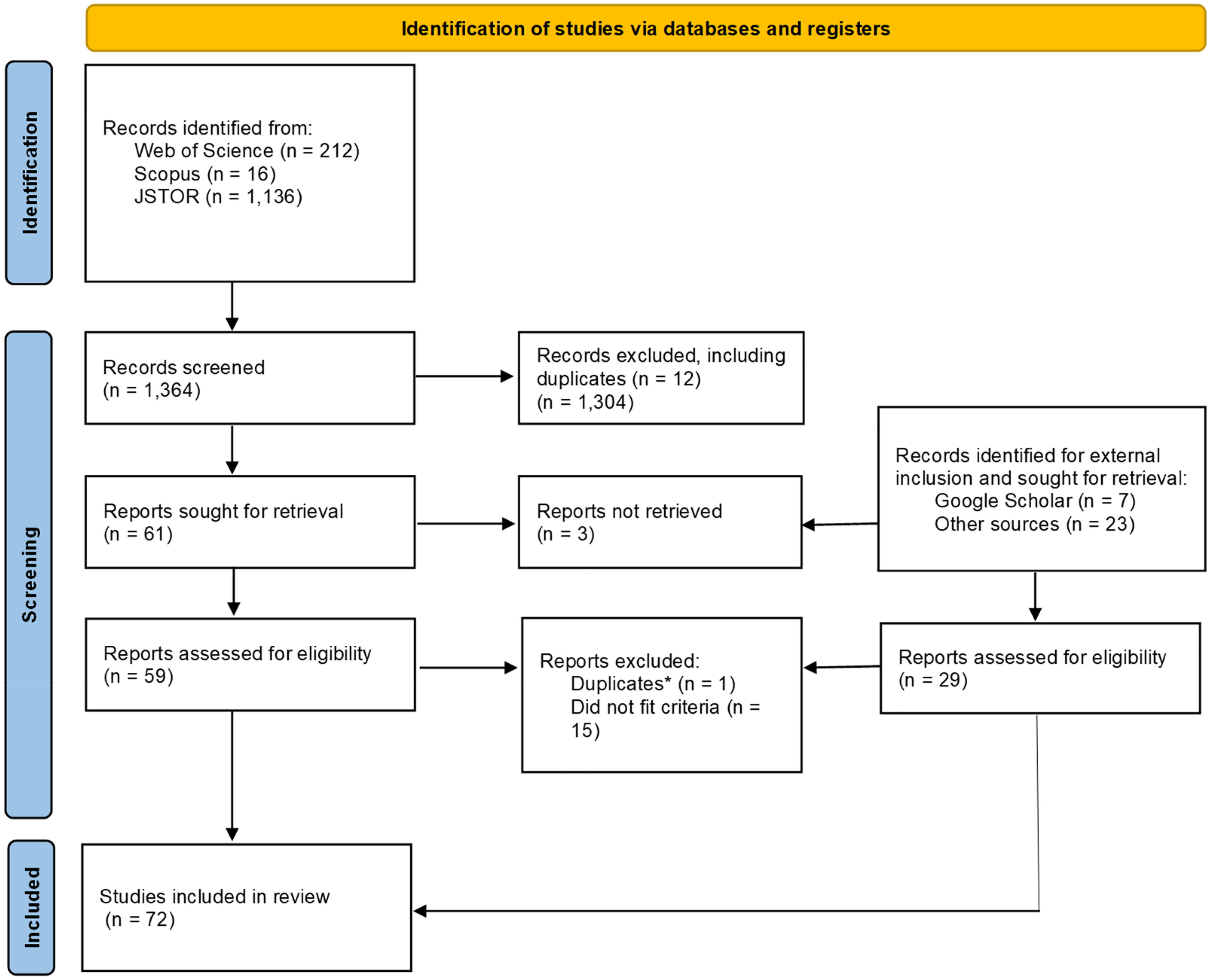
The methodological steps to perform the literature search based on the five selection criteria adapted from Moher et al. (2015).
Out of 1364 articles, 72 were selected. As many as 1364 were screened based on the title; 12 were duplicates. The remaining 1352 articles were screened separately by the two independent authors based on title and abstract. As many as 1292 were deemed to be outside the inclusion criteria. This included articles on health, economics, incarceration, and papers on population increase as a historical event. The records were marked with one of the three colors: green, yellow, or red. The two lists were then compared. Records marked in green or yellow by both reviewers stayed in the selection, while the others were removed. The yellows were assessed more in detail and either excluded or included. Sixty-one articles were sought for retrieval, and 59 were successfully retrieved. These were evaluated according to the inclusion criteria. Out of the selection, 16 mismatches between the authors were identified and discussed based on an initial reading. Two of these were deemed as fitting the selection criteria. A new wave of reading targeting led to an agreement to revisit the selection criteria and exclude two articles. The process of selection resulted in 44 articles. After the first reading of the articles, we found eligible articles that did not appear in our search but were in the reference list of the initial 59 articles or otherwise identified. Of this selection, 29 were relevant. One was a duplicate and therefore excluded, resulting in 72 articles (Figure 1).
Findings
Bibliometric Analysis
- Articles by source
We selected 72 articles in total. The majority were identified through academic databases: 33% from Web of Science (24 articles), 15% from JSTOR (11), 13% from Scopus (9 articles), and 10% from Google Scholar (7 articles). Additionally, 26% of the articles (19 articles) were discovered by screening the reference lists of articles initially selected from Web of Science and JSTOR. A smaller proportion (3%) came from other sources (2 articles).
- Evolution of the field over time
The earliest publication within the defined period of our search was written by Brookshire and D'Arge (1980), published in the Natural Resources Journal and tested the hypothesis that boomtowns lead to higher crime rates. Note that a few seminal articles, such as Albrecht (1978), were published in the 1970s and focused on social disruption, including crime. One of the most recent articles was published by Ruddell, O'Connor, and John Wilson (2024), which analyzed youth crime in natural resource-based boom communities. The most recent publications differ in content from the 1980s to 1990s. In the 1980s, studies were primarily concerned with immediate disruptions such as rising crime and pressure on public services, using primarily quantitative methods and focusing mainly on the US context. By the 1990s, the literature had broadened to include social trust, identity, and community cohesion, often exploring tensions between residents and migrants. The country of study has shifted from exclusively the United States to a more diverse set of countries. Methodologically, this period introduced longitudinal and meta-analytical approaches; for more details, see the supplementary material. There is a shift during the 2000s and 2010s as the research started to include intersectional perspectives and began to map global patterns, including perspectives from the Global South and Australasia. It is also during this period that fear of crime has started to be linked to gender, ethnicity, and class, and studies increasingly adopted mixed methods and comparative designs. More recently, the literature has turned its attention to RPG as a driver of sustainability transitions, climate-induced mobility, and emerging forms of inequality. From the 2020s, studies started to examine how RPG generates new crime opportunities and safety concerns shaped by environmental risks. The population focus has shifted toward vulnerable groups more than in previous studies. For more details, see the supplementary material.
- Type of methods
Quantitative analyses (descriptive or confirmatory statistical analyses, official statistics) are used in 46% of the 72 articles. Qualitative articles (case studies, interviews) comprised 28%, and 26% used mixed methods. Among the quantitative pieces is the recent study by Barton, Njeh, and LaRose (2024), who examined the relationship of RPG with violence and property crime levels in one of the fastest-growing suburban areas in Frisco, Texas, USA, using random-effect regression models. The results indicate that RPG was not associated with changes in crime. Meanwhile, Shakya and Sohag (2021) used a double selection regression model to demonstrate that US states undergoing a fracking boom encountered more crimes than other US states. Interviews with locals (e.g., residents, actors, and policymakers) characterize most qualitative studies. For instance, the study by Scott, Carrington, and McIntosh (2012) examines the ability of social groups to organize themselves and how that helps shape the “crime talk” in isolated rural areas in Australia, particularly concerning FIFO workers. Finally, the remaining studies used a mixed-method approach, combining qualitative and quantitative methods to study changes in RPG. Most of these used descriptive data in combination with interviews, such as those of Marais et al. (2019), who investigated social disruption among mining communities in South Africa.
- Journals and disciplines
The most common journals are from social sciences, especially rural sociology and criminology, but the literature extends to the disciplines of geography, tourism, agriculture/environmental sciences, and economics, to name a few. The dominant journal at 15% (comprising 11 articles) is Rural Sociology (sociology), followed by three journals at 4%, respectively: Internet Journal of Criminology (law and criminology), Rural Society (social sciences), and The Social Science Journal (social sciences). American Journal of Criminal Justice (law and criminology) and Policing (others) make up 3%, respectively. The remaining 67% are published in academic journals such as the American Journal of Agricultural Economics, Extractive Industries and Society, Human Geography, Child Welfare Journal, and Tourism Management and other fields.
- Trends and authorship by gender
The overall trend shows an increase in publications over time, with two peaks occurring in 2011 and 2018. In 2016, the Internet Journal of Criminology published a special issue focused on the challenges of rural law enforcement agencies in resource-based boomtowns. Three of those articles were included in this review. Most articles were written in 2018 in various journals (five publications having women as the primary authors and four with men as the primary authors).
Looking further at the gender break, we notice that more men have consistently been the lead authors (64%) than women (36%) over the entire period. There has been a noticeable increase in articles with women as first authors in recent years, particularly from 2011 onward. There was also a notable predominance of a mixed-method approach among studies by women from 2011 onward, in contrast with studies by men. None of the women authors are based in the Global South, whereas a minority of male authors published articles in African and Brazilian universities. We acknowledge the limitations of our approach in identifying author gender. In our analysis, we used the first names of primary authors to infer gender presentation, recognizing that this method is imperfect and does not account for gender orientation or nonbinary classifications. Our intention was not to determine gender definitively but to observe potential trends in how research is framed, using a proxy based on commonly gendered names, to investigate possible differences between women and men, given the dominance of men in the international literature in this area.
- Location by university and study area
Most studies are conducted by universities in North America and Australia, with study areas mainly in North America (United States, 54%; Canada, 11%) or Australia (18%). The United Kingdom is fourth (6%), with no study area in that country. Four percent of studies are published by primary authors based in universities in South Africa, with the remaining publications from universities in Brazil, Denmark, Kenya, Sweden, and Switzerland (1.4%, respectively). The order of the countries looks slightly different when ranking is organized by the study area. After North America and Australia, South Africa accounts for 4% of the studies, with Brazil and those studies covering multiple countries accounting for 3% of the articles, respectively. The remaining countries contributed 1.4% each.
- Type of study area
Two-thirds of the articles focused on areas more extensive than a city, often multiple cities or regions, for instance, the Bowen Basin in Queensland, Australia, or Bakken region in North Dakota and Montana in the United States. In 18% of cases, the study focuses on a particular geographical area, either a small city and village or a small group of small geographically connected communities; small centers can be considered small urban areas embedded within a larger rural context or rural areas/communities. Examples are Fort McMurray, Canada, and Pajala, Sweden. The remaining 6% encompass larger cities and regions, such as Kigali, Rwanda, and Greater Sydney, Australia.
In-Depth Analysis by Research Theme
Characteristics of a Place Undergoing RPG
RPG is an essential characteristic of boomtowns (England and Albrecht 1984; Keough 2015)—communities that experience rapid growth and a swift increase in economic activities, often centered around a single dominant industry, typically resource-based (such as oil or gas), described in particular in North American literature (e.g., Ennis, Finlayson, and Speering 2013; Lawrie, Tonts, and Plummer 2011; Parkins and Angell 2011; Stretesky and Grimmer 2020). However, RPG can also be associated with other causes of sudden exponential growth, such as tourism (Irandu 2006; Park and Stokowski 2009), proximity to bigger towns while providing affordable housing (Barton, Njeh, and LaRose 2024), or a new industry (Artz, Orazem, and Otto 2007; Perez-Sindin 2021). Research on RPG has historically been concerned with conditions in rural or small towns (Brookshire and D'Arge 1980; Ennis, Finlayson, and Speering 2013; Keough 2015; Park and Stokowski 2009; Ruddell, O'Connor, and John Wilson 2024) in North America (65%, equating to 47 articles out of 72), with an rise in Australian case studies from 2007 (18%).
International research has a long-standing tradition of exploring the relationship between RPG and its consequences. Classic theorists argued that rapid change disrupts communities, leading to social instability, normlessness, or anomie (e.g., Durkheim 1893/2018). At the municipality level, “normlessness” means a lack of or weakening of social controls, creating crime opportunities. Conflict theorists argue that RPG can heighten competition for scarce resources, leading to social conflict and inequality (Quinney 1999). Similarly, Merton (1938) suggested that RPG can intensify competition for limited resources, such as jobs, education, and housing. This competition can lead to societal strain, where individuals feel pressured to achieve societal goals but lack legitimate means, pushing individuals toward crime as an alternative way of achieving success (Agnew 1992).
A complementary perspective is based on the hypothesis that growth is beneficial because it expands economic and other opportunities. People experiencing RPG may be able to see beyond short-term disruption and envision long-term community gains (Forsyth, Luthra, and Bankston 2007). Only a few articles are devoted to the positive impact of RPG. Several studies in this review focus on interconnected countries, states, and regions, where crimes such as money laundering, human trafficking, and drug smuggling are more prevalent. Neoliberal economic policies, which emphasize free markets, reduced government intervention, and privatization, are critical to this process (Garland 2001). Economic and cultural shifts influence local crime patterns, crime control, and criminal justice practices.
Figure 2 shows the complex system of RPG and its positive and negative impacts, here focusing mainly on crime and fear of crime. A larger workforce can boost local economies and attract investments. A growing population often leads to better roads, utilities, and public services (Brown, Geertsen, and Krannich 1989). With rapid growth, several negative impacts emerge, including crime and fear of crime (Archbold 2015; Petkova et al. 2009). When resources such as housing, employment, and social services become strained, tensions and disputes can increase, even leading to higher instances of violent crime (e.g., Park and Stokowski 2009; Heitkamp and Mayzer 2018). Organized criminal networks can exploit weak governance, expanding illicit activities such as money laundering, drug-related offences, purchasing of real estate, or exploiting foreign labor (e.g., Jayasundara, Heitkamp, and Ruddell 2016; Britto 2016). RPG can exacerbate vulnerabilities for certain groups, particularly women, leading to a rise in gender-based violence, such as domestic abuse or sexual assault (Heitkamp and Mayzer 2018; Stretesky and Grimmer 2020).
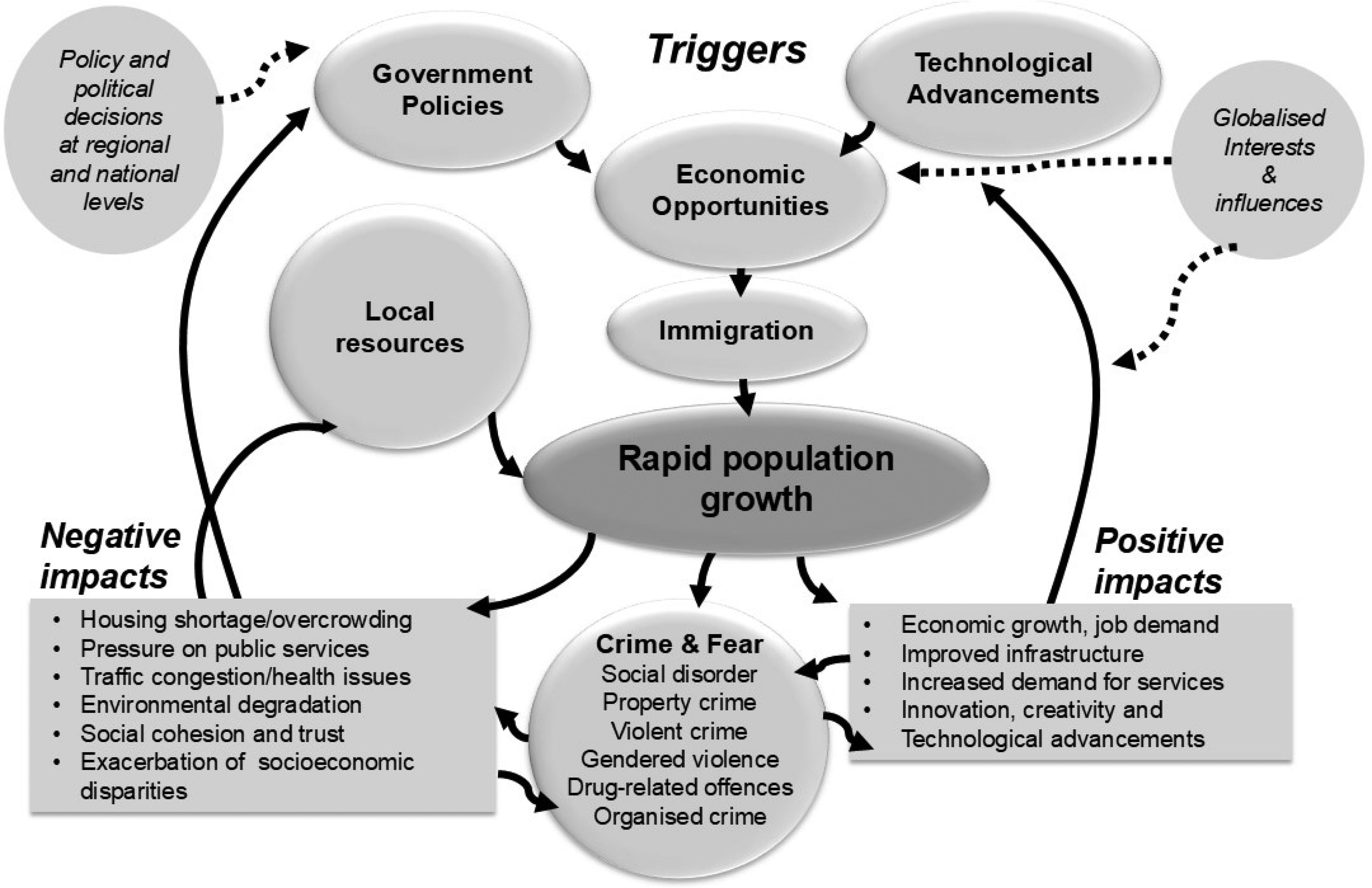
A conceptual model of RPG and its positive and negative impacts on communities.
Policies at regional and national levels can influence population growth at the local level, either directly through laws and economic incentives or indirectly by encouraging urbanization and infrastructure development. Multiple triggers drive RPG, but it can strain local resources, leading to a rise in crime and fear of crime. These negative impacts are interconnected, forming a feedback loop where the perception of crime can reinforce social disorder, undermine community cohesion and trust, and reduce the positive impact of RPG. In the next section, we focus on RPG impacts from the 72 studies analyzed in this review.
Crime, Fear, and Other Negative Consequences of RPG
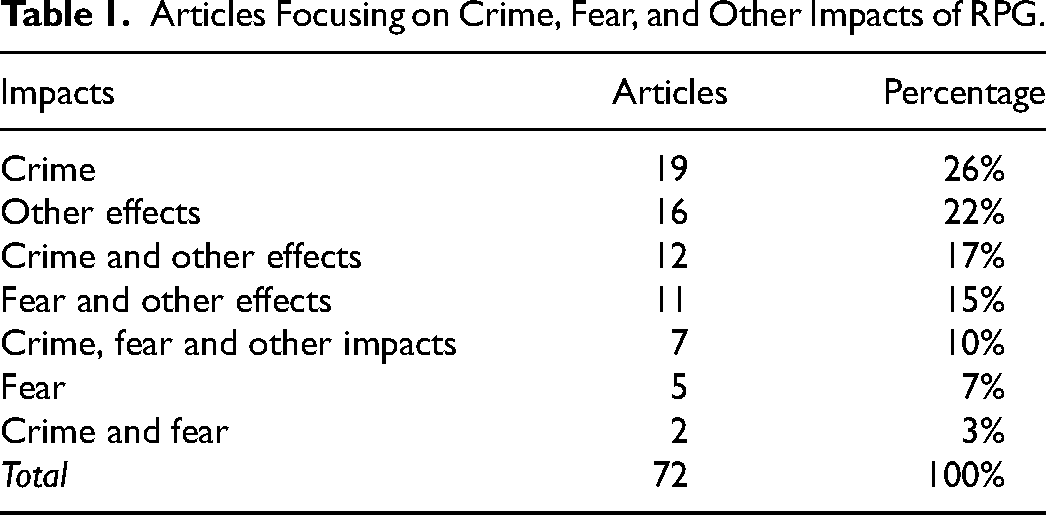
Table 1 summarizes the distribution of articles examining the impacts of RPG on crime, fear, and other effects. Most studies (26%) focus exclusively on crime, while 22% explore other effects unrelated to crime or fear. A smaller proportion of articles (17%) analyze crime and other impacts together, with fear-related studies making up a smaller share, including only 7% focusing solely on fear.
Articles Focusing on Crime, Fear, and Other Impacts of RPG.
Of the 72 publications, 41 articles (59 percent) investigated whether the rapid increase in population impacted crime levels. These studies searched not only for overall types of violence (e.g., fights, assaults), property crimes (e.g., burglary), child abuse and sexually related crimes, domestic violence (including rapes, prostitution), and drug-related crimes (e.g., cocaine trafficking, drug consumption) but also more specific types, such as aggression toward the police, bribery, and other financial offences, public drunkenness, vagrancy, and other offences relating to social order. There have also been studies that found increases in drug peddling (Irandu 2006) and cocaine trafficking (Britto 2016), organized crime (Jayasundara, Heitkamp, and Ruddell 2016), and disorderly conduct arrests during periods of RPG (Rhubart and Brasier 2019; Stretesky and Grimmer 2020).
Most studies reported an increase in one or more offences, followed by studies which found a reduction (22%); for example, there has been evidence that vagrancy decreased (Shakya and Sohag 2021). Quantitative studies that showed decreases in crime were generally found in post-boom communities or RPG communities in the Global South. Finally, quantitative and qualitative studies have shown indications of stability in crime levels following RPG, the former signaling that it depends on the types of crimes (19%). Three articles did not find statistically significant evidence that RPG increases violence. Brookshire and D'Arge (1980) did not find an increase in assaults, while Ruddell et al. (2014) found an increase in violent crime in oil and gas-producing US counties, but it was not statistically significant. A study on the impact of the meatpacking and slaughterhouse industry in the United States did not find any evidence of rapid industrial growth on violent crime (Artz, Orazem, and Otto 2007). Marais, Ndaguba, et al. (2022) saw that murder cases and robberies with aggravating circumstances were higher in cities with a decline in mining than those with a growth in mining. Most studies (80%) show that respondents feel more concerned about crime after RPG, suggesting a growing public perception of criminal activity or risks of victimization after RPG. Only a small proportion feels safer (15%) or unaffected (5%). For more details, see supplementary material.
- Crime trends as a result of RPG
Twenty studies (28%) investigated overall crime levels/rates associated with RPG. For example, Freudenburg and Jones (1991) found that rapid energy-related growth increased crime disproportionately to population growth. Stretesky and Grimmer (2020) carried out a systematic review of the potential impact of shale gas on crime. They found that shale gas activity was positively linked to increased overall crime. Similarly, Shakya and Sohag (2021) found that states in the United States with a fracking boom had higher overall crime than other comparative states. An increase in crime in energy-related boomtowns was also supported by Ruddell (2011), Marais et al. (2019), and Perez-Sindin (2021). Park and Stokowski (2009), compared rural tourist places at different growth levels, and found that population increase significantly affected crime rates. Interviews on the effects of tourism in coastal Kenya carried out by Irandu (2006) also pointed to an increase in crime.
Evidence is mixed about the impact of RPG. Brookshire and D'Arge (1980) found an increase in some types of crime and no effect on others. In their study on six mining town communities in Australia, Petkova et al. (2009) reported that while crime increased, the pattern varied across communities, most likely because crime depended on several factors. Clancey et al. (2017) also found an increase in crime but noted that there was no clear linear relationship between growth and an increase in crime due to growth having been ongoing in the municipality for over 20 years.
Contrary to previous studies, there has been evidence against the impact of RPG on crime or perceptions of crime in the international literature. In qualitative studies on Kigali, Western Australian and Swedish mining communities, and Hispanic boomtowns, links between RPG and an increase in general crime were not found (Carr, Lichter, and Kefalas 2012; Goodfellow and Smith 2013; Poelzer and Ejdemo 2018; Tonts, McKenzie, and Plummer 2016). Looking at perceptions of public safety in a Canadian boomtown municipality, Britto (2016) noted that rates were lower than the national average. Moreover, in suburban Frisco, in the United States, Barton, Njeh, and LaRose (2024) did not confirm the correlation between RPG and increases in crime. In the same municipality, O'Connor (2015) explored how young people perceive crime and risk in a boomtown, finding that the general perception was that crime had not increased. Interestingly, Marais, Cloete, and Lenka (2022) and Marais, Ndaguba, et al. (2022) found that crime rates increased in South African towns with a decline in mining and decreased in towns with growth in mining.
- Violent crime
Sixteen articles (22%) dealt with some form of violence in public places, here excluding gendered violence. Research from oil and gas fields pointed to an increase in violent crime (Gourley and Madonia 2018; Shakya and Sohag 2021; Stretesky and Grimmer 2020) such as homicide (Brookshire and D'Arge 1980; Lim 2018; Seydlitz et al. 1993) and aggravated assault (Archbold 2015; Lim 2018) as a result of RPG. Barcellos et al. (2010) found that homicide was higher in municipalities with large proportions of recent migrants in the Brazilian Amazon, and Schmutz (2023) study on the impacts of the construction of the Belo Monte dam, also in the Brazilian Amazon, revealed that the risk of homicide was higher in cities close to the dam. This risk was particularly high at the beginning and end of construction. Globally, Lee (2001) found that homicide increased indirectly because of population increase and greater inequalities, not necessarily RPG per se. In Australian mining towns, there was an increase in offences against people (Carrington, Hogg, and McIntosh 2011) and a perception of an increase in alcohol-fueled violence (Carrington, Hogg, and Scott 2016).
Three articles did not find statistically significant evidence that RPG increases violence. Brookshire and D'Arge (1980) did not find an increase in assaults, while Ruddell et al. (2014) found non-statistically significant increase in violent crime in oil and gas-producing US counties. A study on the impact of the meatpacking and slaughterhouse industry in the United States, which is also an industry associated with RPG, did not find any evidence of industrial growth on violent crime (Artz, Orazem, and Otto 2007). Marais, Ndaguba, et al. (2022) saw that murder cases and robberies with aggravating circumstances were higher in cities with a decline in mining than those with growth in mining.
- Gendered violence
Thirteen articles (18%) specifically addressed gendered violence such as rape, domestic violence, or other types of sexual violence. Of these, two saw a statistically significant increase in gendered crime, such as arrests for rape (Lim 2018) and domestic and dating violence, stalking, sex offences, and assaults (Stretesky and Grimmer 2020). Studies exploring the perceptions of crime among professionals and community members in boomtowns also found an increase in sex trafficking (Jayasundara, Heitkamp, and Ruddell 2016), domestic abuse and child abuse (Heitkamp and Mayzer 2018), and the severity of domestic abuse (Jayasundara, Heitkamp, and Ruddell 2016). Pippert and Schneider (2018) found that some women were experiencing street harassment when they went outside, Carrington, Hogg, and McIntosh (2011) observed an increase in breaches of domestic violence protection orders, and Goodfellow and Smith (2013) noted that despite overall low levels of crime in Kigali, sexual violence and rape remained high. While Archbold (2015) saw an increase in sexual assault, it was not a homogenous increase across the study area.
Only three studies saw stable or a reduction in gendered crime due to RPG. Lockie (2011) found that the incidence and prevalence of domestic abuse were similar to the national average percentages and, in the case of non-physical abuse, lower than the national average. Shakya and Sohag (2021) reported a decrease in domestic and child abuse incidents recorded, while Brookshire and D'Arge (1980) did not find an effect on rape cases. In their study on South African cities with substantial mining economies, Marais, Ndaguba, et al. (2022) found that rape and sexual assault were more prevalent in towns with a decline in mining than in those with growth in mining.
- Property crime
Eleven articles (15%) investigated the effect of RPG on property crimes, such as residential burglary or street theft. Out of these, seven saw a statistical increase in property crime (Archbold 2015; Gourley and Madonia 2018; Lim 2018; Park and Stokowski 2009; Ruddell et al. 2014; Stretesky and Grimmer 2020) or a perceived increase in property crime (Van Alstine and Afionis 2013). Conversely, Artz, Orazem, and Otto (2007) did not find an impact of RPG on property crime, whereas Clancey et al. (2017) reported a decrease in the categories “breaking and entering” and “stealing from dwelling” in their study area. Brookshire and D'Arge (1980) found an increase in larceny and burglary rates, but a decrease in robberies. Marais, Ndaguba, et al. (2022) found that property crime rates were higher in cities with a decline in mining than in cities with growth in mining.
- Substance abuse and addictions
Nine articles (13%) included drug and alcohol abuse as offences impacted by RPG. Several studies found that RPG led to an increase in alcohol or drug use (Carrington, Hogg, and Scott 2016; Ennis, Finlayson, and Speering 2013; Heitkamp and Mayzer 2018), addiction (Jayasundara, Heitkamp, and Ruddell 2016), and offences relating to drug and alcohol use (Park and Stokowski 2009; Rhubart and Brasier 2019; Shakya and Sohag 2021; Stretesky and Grimmer 2020). However, Rhubart and Brasier (2019) did not find any change in terms of drug abuse and public drunkenness.
- Fear of crime
Overall, 25 studies (35%) explored the impact of RPG on fear of crime and/or general safety perceptions, with most identifying a rise in fear of crime and other anxieties. Two studies showed that residents generally felt safe (Britto 2016) or that there was no change in the population's perception of crime levels (Forsyth, Luthra, and Bankston 2007). Among the 72 publications reviewed, 9 (13%) examined both changes in crime rates and fear of crime within the same study, with nearly all reporting an increase in crime accompanied by a decline in safety perceptions. This excludes studies on communities that had experienced the boom for an extended period of time or post-boom communities.
Many of the studies identified an increase in fear of crime, social disruption, or perceived crime rates (Archbold 2015; Carrington et al. 2012, 2016; Dalla et al. 2004; Fernando and Cooley 2016; Freudenburg 1984; Jayasundara, Heitkamp, and Ruddell 2016; Krannich, Greider, and Little 1985; Petkova et al. 2009; Smith, Krannich, and Hunter 2001) or an increase in police calls in regard to suspicious persons (Archbold, Dahle, and Jordan 2014; Dahle and Archbold 2015).
Evidence shows that fear of crime was not homogenously distributed among societal groups in communities that experienced RPG. Feelings of safety seem to be negatively correlated with fear of crime as a consequence of RPG (Hunter, Krannich, and Smith 2002; Mrozla et al. 2018). Mrozla et al. (2018) and Archbold et al. (2018) found that length of residence in the area was positively correlated with a fear of crime following RPG. Hunter, Krannich, and Smith (2002) failed to find evidence of respondents’ age correlating with fear of crime. In contrast, they found that high income was negatively correlated with fear, but homeownership was positively correlated with fear. Women tend to declare they are more fearful than men, as shown by five articles (Britto 2016; Carrington, Hogg, and Scott 2016; Little, Panelli, and Kraack 2005; O'Connor 2015; Pippert and Schneider 2018); Hunter, Krannich, and Smith (2002) also find such evidence. According to Pippert and Schneider (2018), men's perception of women's safety also decreased. Heightened masculinity in RPG-associated industries, such as oil and mining, exacerbated tensions and the presence of fear (Archbold 2015; Carrington, Hogg, and Scott 2016; Pippert and Schneider 2018). According to Archbold (2015), the perception of the police was that the media and rumors exaggerated reality during a boom period, which affected people's perception of safety. Finally, previous victimization was positively linked with fear of crime (Mrozla et al. 2018), but two studies found no impact (Krannich, Greider, and Little 1985; Little, Panelli, and Kraack 2005).
- Other impacts associated with RPG
As many as 46 articles (64%) out of 72 assessed other impacts of RPG in combination with crimes and/or fear of crime. They include tangible issues such as traffic accidents, a shortage of housing, and police resources but also issues involving community identity, residents’ quality of life, trust, social cohesion, social disorder, “othering” of FIFO workers, local culture, and masculine identity. Periods of RPG were also found to be related to increased anonymity in communities (Archbold 2015), an increase in suicides (Seydlitz et al. 1993), a perceived increase in racism (Foster and Taylor 2013; O'Connor 2015), and the population-gender imbalance and increased living costs (Carrington, Hogg, and McIntosh 2011). RPG was also linked to a decrease in wildlife populations (Brookshire and D'Arge 1980) and fear of environmental impacts ahead of an expected increase in population (Poelzer and Ejdemo 2018). These studies also provided examples of the positive impacts of RPG, including employment and economic opportunities (Carrington, Hogg, and McIntosh 2011; Irandu 2006; Poelzer and Ejdemo 2018). In the paragraphs below, we discuss these impacts in more detail.
a) Traffic and traffic accidents—Seven articles (10%) discuss traffic crimes and concerns, excluding Driving Under the Influence typically of alcohol or drugs (DUIs). Perez-Sindin (2021) found that traffic-related offences increased during RPG. Rolfe et al. (2007) and Petkova et al. (2009) discovered that an increase in traffic was a worry, while Britto (2016) noted an increase in traffic safety concerns. Poelzer and Ejdemo (2018) also found that traffic was a concern in anticipation of a boom.
b) Housing and community services—19 articles (26%) discussed the impact of RPG on housing availability/affordability or community services. Eleven articles specifically refer to a lack of available and/or affordable housing as a result of RPG (Carrington and Pereira 2011; Fernando and Cooley 2016; Haslam McKenzie and Rowley 2013; Jayasundara, Heitkamp, and Ruddell 2016, 2018; Keough 2015; Lawrie, Tonts, and Plummer 2011; Perez-Sindin 2021; Petkova et al. 2009; Rolfe et al. 2007; Weber, Geigle, and Barkdull 2014). Impacts of these housing challenges have been identified as an increase in temporary housing (Fernando and Cooley 2016; Perez-Sindin 2021; Weber, Geigle, and Barkdull 2014), lack of staff availability (Petkova et al. 2009), and an aggravation of many social challenges for vulnerable groups (Weber, Geigle, and Barkdull 2014). England and Albrecht (1984) found that RPG disrupts community services, which is echoed in the results by Heitkamp and Mayzer (2018) and Perez-Sindin (2021). Marais, Cloete, and Lenka (2022) demonstrated that issues of informal housing, service backlogs, and pressure on municipal finances were evident in cities with substantial mining economies, regardless of whether they were growing or in decline.
c) Resources and services—Studies show increased pressure on organizations (Petkova et al. 2009), reduced access to services (Heitkamp and Mayzer 2018), and insufficient police resources (Archbold, Dahle, and Jordan 2014; Dahle and Archbold 2015). Two articles noted a reluctance among decision-makers to invest in long-term infrastructure (Fernando and Hearne 2017; Weber, Geigle, and Barkdull 2014). However, two articles found that established residents believed that population growth led to better infrastructure (Irandu 2006) and better services and amenities (Poelzer and Ejdemo 2018), with Brown, Geertsen, and Krannich (1989) stating that public services had been upgraded in a boomtown.
d) Social ties and trust—21 of the articles (29%) relate to the impact of RPG on social ties and issues of public trust in authorities in communities. Tensions between newcomers and established residents are a recurring theme in the literature on RPG (Perez-Sindin 2021; Pippert and Schneider 2018). This includes several examples of “othering” outsiders coming into the community (Brown, Forsyth, and Berthelot 2014; Carrington et al. 2012, 2016; Little, Panelli, and Kraack 2005; Scott, Carrington, and McIntosh 2012) or using discourse that emphasized social upheaval (Tonts, McKenzie, and Plummer 2016). Four articles linked RPG with issues around community, such as a decrease in social cohesion (Archbold 2015; Brown, Geertsen, and Krannich 1989; Greider, Krannich, and Berry 1991; Parkins and Angell 2011) and an increase in social isolation for vulnerable groups (Foster and Taylor 2013; Freudenburg 1984; Jayasundara, Heitkamp, and Ruddell 2016).
Six articles (8%) found positive impacts of RPG on the community, a lack of negative impacts, or mediating factors. In Smith, Krannich, and Hunter (2001), not all dimensions appear to be negatively affected while well-being related social disruptions occur during boom periods. RPG was also found to not disturb social ties (England and Albrecht 1984) or community trust (Greider, Krannich, and Berry 1991). Instead, it is said that RPG may contribute to an increase in socioeconomic standing and contribution to higher social capital and social mobility for the children (Forsyth, Luthra, and Bankston 2007) or the creation of weak-tie networks, providing bridges between social networks (Brown, Forsyth, and Berthelot 2014). However, the latter was only activated by the perceived future reciprocity of the newcomers. Archbold et al. (2018) found that established residents who reported that they interact with new residents felt more integrated and had high levels of community trust and satisfaction. Looking at the factors that contributed to the legitimacy of a mining development in northern Sweden, residents expressed positive sentiments about potential newcomers (Poelzer and Ejdemo 2018).
- Post-boom effects
Seven articles (10%) fully or partially focused on communities who had already experienced a boom and were in transition to another phase of development. Impacts include a decrease in traffic collisions in the post-boom period (O'Connor and Ruddell 2021; Stull and Broadway 2001). In their longitudinal study, Stull and Broadway (2001) also saw that DUI arrests decreased post-boom but that many of the problems that occurred during the boom remained, such as housing shortages. However, as previously mentioned, in their study on South African mining towns, Marais, Ndaguba, et al. (2022)’s findings were that mining towns in decline experience more crime than those experiencing growth.
In terms of community cohesion, Smith, Krannich, and Hunter (2001) noted a consistent, sharp rebound with no evidence of lasting disruption. Similarly, Brown, Dorins, and Krannich (2005) found that three out of four of their social disruption indicators returned or even exceeded pre-boom levels. In a study on a boomtown in decline that was experiencing a mini-boom, individuals’ belief in the community to manage the boom was high (O'Connor and Ruddell 2021). Fear of crime also seems to rebound (O'Connor and Ruddell 2021; Ruddell and Ortiz 2015; Smith, Krannich, and Hunter 2001). Perez-Sindin (2021) found an increase in suicide post-boom.
Recommendations to Tackle Negative RPG Impacts
Table 2 provides a comprehensive framework for addressing negative RPG impacts across categories such as policy, education, funding, infrastructure, governance, and knowledge application. Among the policy recommendations, studies have focused on adaptable planning strategies that address both short- and long-term challenges, particularly during RPG. Note that these recommendations were selected to reflect the authors’ views only. Key points include preparing for housing crises, ensuring affordable housing options, and protecting vulnerable populations such as survivors of domestic violence and children. Policies advocate aligning corporate social responsibility with public objectives, enforcing non-discrimination laws, and promoting diverse housing solutions to meet fluctuating community needs.
Recommendations to Improve Crime Rates, Social Cohesion, and Housing Issues in Areas Experiencing RPG.
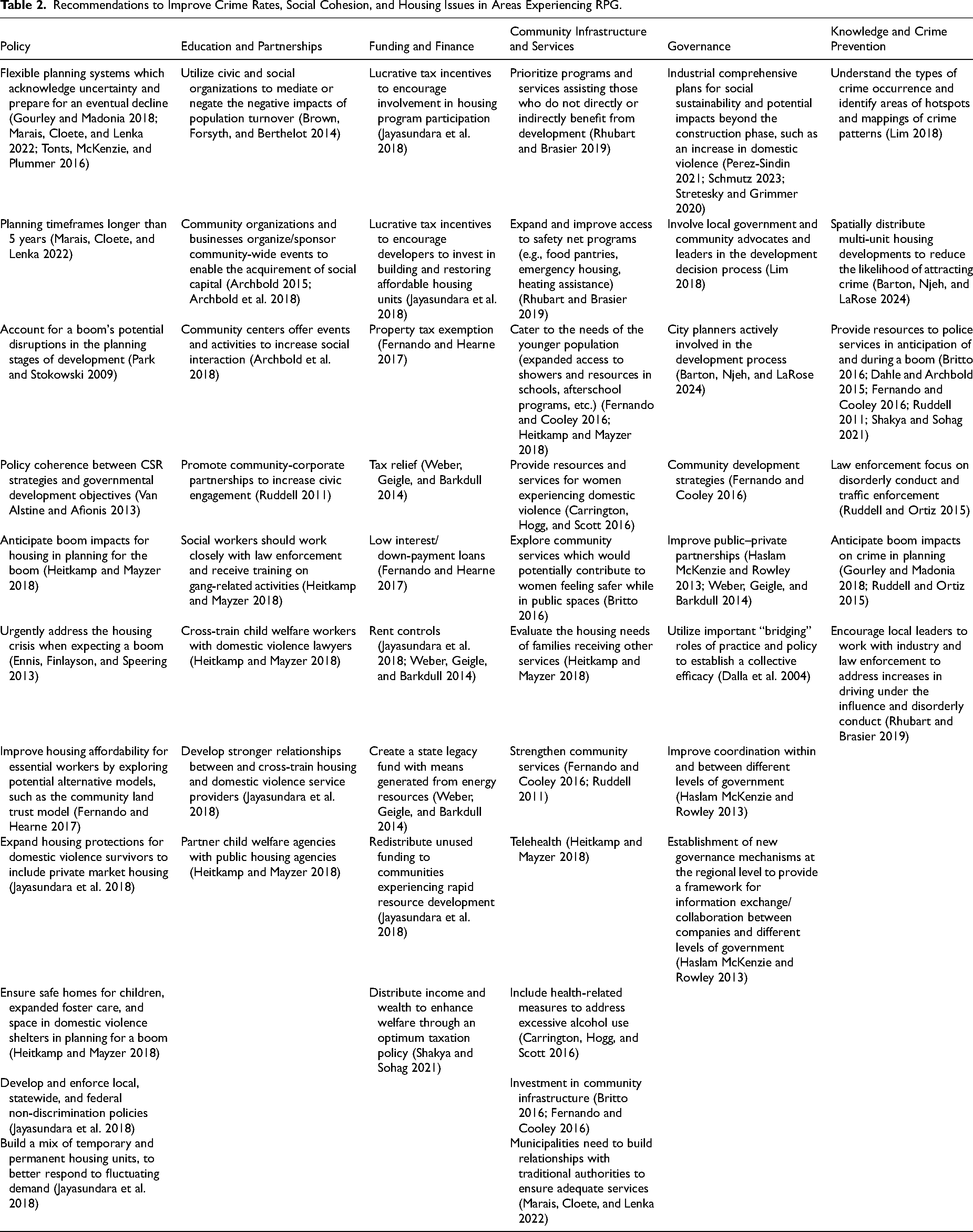
The second column of the table, “Education and Partnerships,” stresses the role of civic organizations and community partnerships in mitigating population turnover and building social cohesion. To improve collaboration and address social issues, they should promote community events, corporate partnerships, and cross-training among social workers, law enforcement, and service providers.
Regarding funding and finance, the international literature also recommends highlighting financial strategies such as tax incentives, property tax exemptions, and low-interest loans to encourage investment in affordable housing programs. Suggestions include using rent controls and creating a state legacy fund from energy revenues to support long-term development.
Alternatively, there have been suggestions to distribute income and wealth to enhance welfare through an optimum taxation policy. This is more evident in the fourth column of Table 2, which focuses on expanding support for underserved populations, such as youth, women, and families, while strengthening safety net programs and community services. These recommendations also highlight the need for investment in infrastructure and collaboration between municipalities and traditional authorities. Moreover, a few articles advocate improved public–private partnerships, enhanced coordination across government levels, and the establishment of regional governance mechanisms to facilitate collaboration and information exchange.
More specifically, in terms of crime prevention, studies suggest solutions such as better understanding of crime patterns and identifying hotspots to assist safety strategies. Additionally, they encourage collaboration between local leaders, industry, and law enforcement to address rising concerns such as driving under the influence and disorderly conduct. They also suggest distributing multi-unit housing developments to deter crime and providing resources for law enforcement in anticipation of population booms.
Discussion of the Results
This study aligns with planning traditions that analyze and manage the impacts of interventions on people's lives, communities, and their connection to place. RPG is an essential feature of boomtowns, which are communities experiencing sudden growth and economic expansion, often driven by traditional natural energy resource dependency (e.g., oil or gas) or, less commonly, by tourism. Most of the studies reviewed here focused on rural or small towns in North America, with a growing body of studies from Australia. None of these studies is devoted to RPG due to an increase in new sectors of the economy, such as green industries. In our search, we found 72 articles. About 60% of the publications found that RPG increases crime; the effect depends on the type of crime, but evidence shows that violence (including gendered violence), property crime, and organized crime are associated with RPG to some extent. Most studies indicate respondents feel more concerned about crime after RPG, reflecting an increasing public perception of safety risks, with only a few feeling safer or unaffected. Half of the studies are more quantitative, a fourth are mixed methods, and the remaining are qualitative, based on interviews and/or observational studies; the primary authors of these studies are more often written by men than women over the entire period. Moreover, the fact that male authors dominate the field could suggest a gendered bias in framing research questions. Longitudinal research can perhaps better capture how crime evolves as boomtowns transition from rapid growth to stabilization, focusing on the long-term effects of RPG on community safety.
Now we highlight the commonalities and conflicts across the literature in more detail. For instance, there is consensus that RPG pressures housing and essential services, contributing to overcrowding, regulatory violations, crime, and declining quality of life. By contrast, findings on gendered violence are less consistent. While several studies find increases in rape, domestic violence, and sex trafficking, others report no change or even reductions. These differences may reflect variations in data sources, definitions of violence, or the timing of data collection in the boom-bust cycle. In particular, there is a trend in which methods influence the framing and findings of RPG studies. While quantitative studies tend to identify statistically significant patterns, such as increases in specific crime types, qualitative and mixed-method research reveal more profound patterns in lived experiences, fear, and community tensions.
- Conflicting findings: Gendered violence and health outcomes
Evidence on gendered violence in RPG communities is mixed, with some studies reporting significant increases in domestic and sexual violence, while others show stable or even reduced levels. This variation suggests contextual or methodological differences across studies. A fifth of the reviewed articles addressed gendered violence in RPG communities, including rape, domestic violence, and sexual assault. Two studies found a statistically significant increase in crimes such as rape and domestic violence, while others reported increased sexual assault, sex trafficking, and domestic abuse in boomtowns. Street harassment and breaches of protection orders were also noted. However, three studies found stable or reduced gendered violence. It is also interesting that 13% of articles found that RPG contributes to increased drug and alcohol abuse, which can indirectly be associated with violence against women and domestic violence in general.
- Converging patterns: Crime, fear, and housing and other pressures
According to the “post-boom” section, post-boom communities appear to have more community cohesion, less fear, and a reduction in crime. However, there is little or no mention of how crime associated with RPG has evolved or whether there are differences in short-term versus long-term impacts. Fear of crime in communities experiencing RPG is not uniformly distributed. Factors such as length of residence in the area, gender, and previous victimization influence declared fear levels. At the same time, income and homeownership demonstrate that varying relationships with safety perceptions and heightened masculinity in RPG-related industries can exacerbate tensions and fear.
The literature also shows indications of other consequences on communities undergoing RPG, more than an increase in crime and fear of crime. We found evidence of problems associated with the increase in housing shortages and other services, traffic accidents, and suicide, as well as issues of community identity, trust, quality of life, social cohesion, and environmental impacts. Although it was not the focus of this study, future research should expand the investigation beyond traditional categories of crime, to include for example organized crime, corruption, fraud, and other financial crimes.
- Gaps and opportunities for future research
In sum, the literature reveals consistent associations between RPG and increased pressure on infrastructure, housing, crime and perceptions of crime. However, notable conflicting findings arise, particularly regarding gendered violence and health outcomes, highlighting the influence of context and research methods on findings. The data types used in the reviewed studies vary greatly, from official statistics and socioeconomic indicators to self-collected survey data, observational studies, and ethnographic analyses. This often results in a fragmented mix of approaches, sometimes complementary or inconsistent. While some studies offer reflections on methodological choices, there is limited critical discussion about the data's nature, accuracy, and reliability. A more explicit reflection on data sources and their limitations in each study would have helped us to compare them across studies. Data permitting, future studies should adopt comparative, longitudinal, and mixed-method approaches to better capture the complexity of RPG impacts, especially as new sectors like green industries drive growth in rural areas. Viewing communities as interconnected systems would help uncover how poverty and unemployment intersect with RPG and crime, particularly in post-boom towns navigating economic diversification or stabilization. Notably, the positive effects of RPG are rarely addressed in the reviewed literature, partly because our search focused on crime-related impacts. This gap underscores the need for broader research exploring challenges and opportunities associated with RPG.
Conclusions and Recommendations
This study set out to identify the main characteristics of a place undergoing RPG. It then discussed the expected impacts of RPG on crime and fear and other consequences, as well as the main recommendations for tackling these negative impacts pointed out by the authors of these studies. To answer these questions, we searched peer-reviewed articles across major databases—Scopus, Web of Science, and JSTOR—from 1980 to August 2024 and found 1364 relevant publications. These were later screened and selected, and 72 articles were identified. North American and Australian scholarship highly dominates the international literature. However, in recent years, a couple of countries from other parts of the globe have also focused on the effects of RPG on communities. Half of the studies are quantitative, a fourth are mixed methods, and the remaining ones are qualitative. RPG is widely acknowledged for putting pressure on housing and basic services, leading to overcrowding and declining quality of life. These studies show evidence that crime tends to increase. However, such an impact varies by crime type (e.g., gendered violence is inconsistent, with some studies reporting increases, while others show no change or even reductions) and study area. RPG may affect fear of crime; when it does, it does not affect the population homogeneously. These differences may be attributed to variations in data sources, definitions, the timing of data collection and other method-related issues.
The international literature highlights many suggestions regarding policy, education, funding, infrastructure, governance, and knowledge creation. Nevertheless, whether and how these suggestions more accurately reflect the North American and Australian contexts than any other global context is unclear. Therefore, future studies should focus on understanding the long-term impact of RPG on communities, looking at localities as systems (see e.g. Ceccato and Newton, 2024). This should influence how people work with crime prevention in practice by adopting a system-thinking approach and monitoring the process involving different stakeholders, encouraging collaboration between local leaders, industry, and law enforcement to address rising concerns. This approach can help RPG-affected communities address challenges while ensuring that interventions reduce crime and foster sustainable, resilient environments.
Supplemental Material
sj-docx-1-jpl-10.1177_08854122251362757 - Supplemental material for Rapid Population Growth (RPG) and Its Consequences—A Systematic Literature Review with a Focus on Crime and Fear of Crime
Supplemental material, sj-docx-1-jpl-10.1177_08854122251362757 for Rapid Population Growth (RPG) and Its Consequences—A Systematic Literature Review with a Focus on Crime and Fear of Crime by Vania Ceccato and Lovisa Carli in Journal of Planning Literature
Footnotes
Declaration of Conflicting Interests
The authors declared no potential conflicts of interest with respect to the research, authorship, and/or publication of this article.
Funding
The author(s) disclosed receipt of the following financial support for the research, authorship, and/or publication of this article: Funded by the Swedish National Board of Housing, Building, and Planning (Boverket), grant number 4800/2024.

Supplemental Material
Supplemental material for this article is available online.
Author biographies
Appendix
Summary of the Keyword Searches Used in the Review.
Database
Search Terms
Total
Web of Science
(population AND growth) AND (crim* OR fear* OR harm) AND (boom OR rapid)
212
Scopus
(development OR growth) AND (crim* OR fear*) AND (rapid*) AND (boom*)
16
JSTOR
(rapid* AND chang*) AND (population AND growth) AND (crim* OR fear*) AND (industr*) AND (housing OR accommodation) AND (demograph*) AND (community) AND (job OR employment OR labo*) AND (boom) AND (migra*) AND (small AND town)
1,136
Appendix 2 – Classification of Types of Study Areas in Systematic Literature Reviews
The reviewed studies are classified into the following areas across the rural-urban continuum:
1. Global cities and/or capital cities
Capitals and/or cities that influence and determine important aspects of cultural, scientific, social, and economic life on a global level. These are usually tourist destinations and key global financial hubs (e.g., Rio de Janeiro, London, Tokyo, NYC, Chicago, etc.).
2. Regional capitals
Cities with various economic activities that have significant cultural, scientific, social, and financial influence at the national and regional levels.
3. Local urban centers
Medium-sized cities or areas with regional capital influence, which culturally, scientifically, socially, and economically affect smaller and rural neighboring regions.
4. Small cities and/or communities
Small centers are either small urban areas embedded within a larger rural context or rural areas/communities.
5. Others
Indicates that the article does not specify which city is being discussed or refers to an area larger than a city—such as a country, multiple countries, or regions.
References
Supplementary Material
Please find the following supplemental material available below.
For Open Access articles published under a Creative Commons License, all supplemental material carries the same license as the article it is associated with.
For non-Open Access articles published, all supplemental material carries a non-exclusive license, and permission requests for re-use of supplemental material or any part of supplemental material shall be sent directly to the copyright owner as specified in the copyright notice associated with the article.
