



Abstract
Beauty has been an important, central concept since ancient times. Over the centuries, its status deteriorated until it became improper for academic discussion. In the last two decades, there has been a call to revisit beauty and aesthetic judgment in some disciplines. However, despite interest in urban design, the integration of beauty in planning theory and practice remains slow and partial. This paper presents the changing relevance of beauty in general academic discourse in four milestones before analyzing literature on planning and follows the changing attitude toward aesthetics. The conclusion points to a possible resurgence of beauty in planning literature.
Introduction
The beauty of cities occupies literature, poetry, and popular song lyrics; it comes up in the daily discourse of residents, merchants, business people, and especially politicians, real estate agents, and tourist guides. However, although the awareness of aesthetics and the visual appeal of places has increased, the term “beauty” is missing in both practical and theoretical planning discourse. It's more than the term: discussing and appreciating beauty is missing. In a recent paper, Araabi, Hickman and McClymont (2022) write: “… we are surprised that the subject of beauty receives relatively sparse coverage in planning literature. Is this perhaps because much of planning is focused on what is perceived, or defined, as objective, and accepted as part of the planning framework, even where value judgements are actually involved?”
Indeed, planning theorists do not write about planning or living in beautiful cities, and urban researchers neither compare the beauty of planning models nor use beauty as a criterion for good planning. In the practice of planning too, although aesthetical evaluation takes place in numerous countries, professional planners do not necessarily relate to urban beauty when discussing and authorizing development plans (Dawson and Higgins 2009; Scheer and Preiser 2012; Carr, 2022). Why? In addition to the relativist response suggested by Talen and Ellis (2002), this paper offers two intertwined answers: First is the disappearance of beauty, as a comprehensive understanding, from the academic discourse, which leaves us without a theoretical basis and vocabulary for properly discussing the subject; the second is the still-influential origin of modern planning, which did not consider beauty as an essential aspect of the built environment. Based on these understandings, we provide a concise description of the decline of beauty as a subject in the literature on urban planning and its recent resurgence.
When the term aesthetics was coined in Germany at the end of the eighteenth-century (attributed to Baumgarten 1750), European cities were dirty, smelly, and chaotic places (Maskit 2016). The crowded, unpleasant cities at the dawn of the Industrial Revolution did not encourage aesthetic judgment, and the urban environment was not part of the established discourse on human crafts and products. To the degree that beauty did exist in cities, it was attributed to prominent architectural buildings such as castles, cathedrals, palaces, and nurtured gardens. The arguments against a fair discussion on beauty are easily found: “beauty is in the eyes of the beholder”; “there is no accounting for taste”; and, the relativist query “whose taste is the better taste?” These sayings rest on belittling the role of cognitive appreciation of beauty, tying it with human emotions and an individual viewpoint. As Hoch (2006, 368) observes, “the influential method of experimental scientific inquiry relegates emotions and feelings to an inferior role in human judgment.” The discourse of beauty is affected by this tendency as well.
In the absence of an agreeable definition for urban beauty and in a professional climate that makes it challenging to have a concrete discussion of an irreconcilable concept, the term “beauty” remains, in most cases, out of the planning discourse. In related fields as well, various nuances of beauty are discussed, while the term itself is absent. Thus, the growing field of environmental aesthetics employs psychological understandings to classify types of aesthetical impressions of the built environment, assuming that groups of people experience aesthetics in similar ways and that the preferred urban qualities are identifiable. Kaplan and Kaplan's (1982) Preference Framework offers an understanding of the urbanscape based on two scales, the first ranging from legibility to mystery and the second from coherence to complexity (Heath 1988). Porteous (1982, 1996) presents four approaches to environmental aesthetics, including those of humanists, activists, experimentalists and planners. Comparing American and Japanese people, Nasar (1988) shows that despite cultural patterns of preference, numerous global qualities affect the perceived aesthetics of urban scenes, including increased diversity and contrast between buildings, good maintenance and vegetation, and reduced prominence of vehicles.
Since this paper focuses on integrating beauty and aesthetics into planning rather than judging the qualities of the built environment and how it is perceived, we do not adopt a specific definition of urban beauty. Instead, we see the term “urban beauty” as encompassing an entire impression of the aesthetics of an urban area beyond that of a single element and the contribution of good maintenance. Moreover, while the last two have recognizable criteria (Carr, 2022), we understand that urban beauty is (still) an elusive and undefined term and, therefore, inapplicable for planning. In search of deeper explanations for the contested way beauty is expressed in planning, we divide our investigation into the general academic field and planning practice. For the former, we follow the deterioration of the concept of beauty in Western-Eurocentric philosophical and intellectual discourse. The latter discussion focuses on how twentieth-century planning left beauty out of the rational, professional discourse, again relating to Western literature and professionalism.
The Dynamics of the Beautiful in Academic Discourse
The place of the beautiful in intellectual and academic discourse has undergone profound changes throughout history. In this part, we offer a concise presentation of this journey with the help of four main milestones.
First Milestone: Beauty as a Valid, Semilogical Concept
For a long time, beauty was a common, perceptible idea. Numerous writings discussed the centrality of beauty in both philosophy and everyday life. Beauty was conceived as having thoughtful, logical, and cognitive grounds. Thus, in the fourth century BCE, Aristotle (1974) referred to expressions of beauty through symmetry, clear order, and pleasing proportions and Vitruvius (Pollio 1931), in the first century BCE, defined order and symmetry as the basics of beautiful architecture. These principles were echoed in the Middle Ages, with Augustinos depicting an elements’ harmonious and proper proportions as a necessary feature of beauty (Hanfling 1999). In the thirteenth-century, Thomas Aquinas (Efrat 1998) embedded Aristotle's Theory of Perception in the philosophical culture, uniting the beautiful with the enjoyable. This way, classical aesthetics remained a safe and stable concept for many centuries.
Sometime during the sixteenth-century, the intensifying discourse on reason and perception that accompanied the dawning Age of Enlightenment, led to the two conflicting perspectives on the perception of beauty. The British conception emphasized the role of taste (Hume 2000) and the individual sense of beauty (Hutcheson 2014), in which beauty is a personal and cultural trait. Conversely, the German conception of beauty as a universal trait (Baumgarten 1750), rested on ideas of rationalism. Later, the perception of beauty gained enthusiastic support in the work of Immanuel Kant, who attempted to bridge the British-German divide. Kant's inquiry into human perception acknowledged the idea that pure judgment of taste exists, in addition to cognitive and logical intelligence, as an independent manner of understanding based on four principles (Brinker 1982):
Beauty as the source of disinterested pleasure. The enjoyment of perception, of viewing a real object or imitated figure. Joy that is true to itself. Beauty as distinguished from logical conceptualization, pleasure that is conscious but not reasoned. Beauty relies on cognitive principles, giving it universal validity, in addition to its dependence on subjective, personal taste. Beauty as a purposeless event, separate from the essence of the beautiful object; a “purposeless purpose” that may be exemplified in a natural stone shape. A century later, this idea inspired the aesthetic ideal in the Bauhaus school in Germany. Beauty as a commonly accepted notion. Aesthetic judgment requires a combination of reason and imagination. It does not rely solely on intelligible concepts that can be proven but also on subjective, emotional judgment. Therefore, the consent of the majority is required.
Through these principles, Kant (2000) acknowledged the legitimacy of aesthetic judgment and provided philosophical verification for spontaneous yet widespread way of estimation, existing despite its inherent subjectivity and lack of acceptable principles. Moreover, other forms of aesthetic judgment became common. During the eighteenth century, the discourse discovered The Sublime (Burke and Phillips 1998), described as qualities beyond human conceptualization. While beauty can be explained logically based on an object's coherence, the combination of colors and similar expressions of taste, the sublime is greater than human cognition and cannot be reasonably explained. It may include paradoxical beauty, inconsistent with human conceptualization (Bergman 1973). Perhaps the growing discourse on the sublime during the nineteenth-century contributed to the division between aesthetical perception and rational understanding.
Second Milestone: Dividing Aesthetic Judgment from Logical Perception
Kant's (1998) principal contribution to philosophy was defining the phenomenon, how a thing is conceptualized through the filter of the human senses, and the noumenon, the thing itself. In Kantian philosophy, understanding is limited by the knowledge grasped through the human senses and analyzed by cognition. From this viewpoint, the noumenon remains essentially inaccessible to the human mind. We know only what our senses reveal and what our minds process. Humans recognize only the phenomena; they need to apply cognition to understand the noumena indirectly.
Schopenhauer (Janaway 2010) suggested that the path to understanding reality involves aesthetic contemplation: a will-less, conscious-less, and reason-less state of mind, liberated from defined principles and logical judgment. This experience leads to an aesthetical conception different from the logical one.
These two ways of understanding reality and how the human mind conceives it played a central role in the philosophical discourse of the nineteenth-century. The Enlightenment established the autonomy of reason (Cassirer 1944). Enlightened thinkers believed that if humans freed their intellect from the shackles of superstitions and irrational perceptions, they could see the world and themselves in a new light. Simultaneously, new political doctrines and moral and humanistic horizons arose. Romanticism, an early nineteenth-century reaction to the Age of Enlightenment, soon adopted Schopenhauer's perspective (Berlin 1994; Mali 2019). Romanticism saw art as a tool for self-impression, exposing feelings, and inner worlds. Moreover, intuition and aesthetic understanding were presented as alternative knowledge, inaccessible to intelligible wisdom but offering necessary information. Isaiah Berlin called Romanticism “Counter-Enlightenment,” criticizing the alleged supremacy claimed by rationality. Romanticists warned that rationalist irony and the belittling of nonrational perception could distance humanity from innate forms of knowing (Mali 2019).
At the same time, Hegel (1991) suggested that aesthetic discussion should remain within the context of art, which he saw as the highest sensual expression of the human spirit, higher than religion and philosophy. Hegel was interested in the rational structure of human perception and dividing artistic expression by elevating it as part of the logical structure he endorsed. However, one of the side effects of Hegel's influence was confining the aesthetic discussion to the context of art. As part of this, Hegel called to remove natural beauty from the general discussion of aesthetic research because it is not created by conscious humans and, therefore, cannot be discussed in line with artistic creation (Kuisma, Lehtinen and Mäcklin 2019).
Logic and aesthetic perceptions were thus positioned on opposite two sides of a battlefield. Nietzsche (Golomb 1999), influenced by Schopenhauer, undermined the supremacy of rational and instrumental thinking and criticized what he considered treacherous hostility to the senses. Arguing that humans are called to feel and imagine, not only consider but also decide, he encouraged sailing back in time to the ancient tragedies celebrated in Greece, an entirely aesthetic occurrence, when aesthetics meant not only beauty but also the celebration of all senses. The twentieth-century Frankfurt School expanded Nietzsche's viewpoint, granting art and aesthetics an emancipatory status that liberates human beings from a state of dehumanization (Horkheimer 2010).
Third Milestone: Denying the Validity of Aesthetic Judgment
The slow yet stubborn Enlightenment-born tendency to belittle the role of aesthetic judgment finally triumphed. Since the late nineteenth-century, and to an even greater extent during the twentieth-century, rationalists’ ambition to set human perception on clear and logical foundations gained power. Lorand (2007) claims that excluding beauty and aesthetic considerations from academic and intellectual discourse stemmed from a combination of circumstantial and ideological causes. In addition to rationalist philosophy, changes in technology and lifestyle had a profound effect. The rapid development of innovations, particularly communication and transportation technologies, changed people's daily lives, highlighting the contribution of scientific knowledge and logical considerations to humanity. The idea that aesthetic knowledge is valid appeared naive, suitable only for unpractical romanticists.
Limiting aesthetic judgment to artistic creation meant that the general sociopolitical field was influenced by the deteriorating status of beauty within artistic discourse. In 1964, standing before Andy Warhol's Brillo Box, Arthur Danto declared the death of art as we knew it and the disappearance of beauty. In numerous works, Danto stressed that the twentieth-century had changed art profoundly, detaching it from beauty. He developed “the institutional definition of art,” meaning that art is what artists do and what museums present; neither is necessarily related to beauty (Danto and Goehr 2014). Weitz (1965) made a similar claim, mourning the end of aesthetic discourse, and recommended developing “smaller” discussions on the essence of the different kinds of arts: literature, music, theater, and the like (Lorand 2007). Goodman (1976) also sought to exclude the term “beauty” from aesthetic discussions; he found it confusing, misleading, and often meaningless. Goodman's argument was phrased like a mathematical theorem: if beauty is not equal to the ugly, and if works of art can be art even if they are ugly, then beauty and aesthetic value do not serve as a measure of art. Logically and linguistically, beauty cannot be ugly; therefore, beauty loses its discipline and becomes a completely useless term. Thus, the value of beauty in twentieth-century art gradually diminished. The artistic and aesthetic became disconnected; the ugly and grotesque became legitimate parts of the artistic endeavor (Zur 2014).
In line with this, beauty became a marginal subject in the general twentieth-century discourse. It was rarely discussed in American universities (Scarry 2013) and excluded from research, including in literature, music, arts, and the humanities (Lambert 1999). Nehamas (2000) related to this evaporation, saying “Beauty is the most discredited philosophical notion.” In his view, Kant failed to justify the existence of rational-aesthetic judgment, and his failure haunts modern aesthetics to this day. Nehamas further argues that the difficulty in determining aesthetic value stems from the very fact that it expresses something personal. While agreeing with Kant that judgment and taste rely on the pleasure arising from a disinterested observation of an object, Nehamas criticized the fact that the features explaining the formation of pleasure have never been identified and appear to be undefinable.
Fourth Milestone: The Resurgence of (A Different Stance Toward) Beauty
In the late twentieth-century, scholars started to reject the eighteenth-century Hegelian turn, limiting beauty to artistic activity and the exclusion of beauty from the discourse. The idea that beauty should be left for personal appreciation, and not discussed publicly and intelligently was similarly criticised. Wolterstorff (1987, 2015) placed the blame on the idea “that high culture in the West has a science side and an art/humanities side, and that these two coexist in tension” (Wolterstorff 1987, 153). Instead, he praised aesthetics that complement simple social practices, like “music to lull babies to sleep and to accompany the hoeing of cotton” (p. 156). The attempt to take the discussion of beauty out of museums and the art world started with Dewey's (1934) ideas of aesthetic experience resulting from the active involvement of the self and the environment. He claims that beauty emerges from ordinary activities, including practical and intellectual pursuits, and can be a part of everyday life. This approach is echoed in Rancier's (2009a) “Community of sense,” referring to the collective experiences “embodied in living attitudes, in the materiality of everyday sensory experience,” regardless of definitions of art and politics.
Influenced by these ideas and the pragmatic tradition of twentieth-century philosophy, Carlson (2010, 2014) discusses the contribution of environmental aesthetics, a new and rapidly growing field of study, to environmentalism. This discourse reconnects aesthetical judgment with a cognitive appreciation of beauty and opens the door to discussing the aesthetics of the built environment as well. Rancier (2009a, 2009b, 2011) Saito (2001, 2010), Berleant (1991, 2013) and Berleant and Carlson (2007) relate to the aesthetics of everyday life, including that of the urban environment. Their approach is assisted by an “aesthetic engagement” (Berleant 2013, 4) that “epitomizes a holistic, unified aesthetics in place of the dualism of the traditional account.” Brady and Prior (2020, 255) echo this approach: “There is strong agreement among philosophers today that aesthetic value is a form of intrinsic or non-instrumental value, where something is not valued as a means to some end, rather it is found to have value in and for itself.” This direction, also outlined by Wolterstorff (2015) and Hillman (2018), makes it possible, after a long hiatus, to address beauty in daily life. Important to our case, Brady and Prior (2020, 262) point that “environmental aesthetics literature has tentatively shifted its gaze towards urban landscapes.” The time is right to understand also the beauty of the built environment. The resurgence of beauty requires relating to another point, the issue of relativism, and the claim “beauty is in the eyes of the beholder,” a matter of personal taste that fundamentally lacks general principles. Scruton (2009), among others, explains that relativism has led to the abandonment of considerations of beauty because they are subjective and, as such, cannot be criticized. This approach has called into question many of the traditional fields of the humanities, including art, music, and architecture; freed from aesthetic judgment, they appear anchorless. Talen and Ellis (2002) expand on the problematic situation that the relativist approach posed for planning theory and practice, as discussed below.
Addressing the cultural component of beauty is one approach to overcoming the relativistic barrier. Rosenwein (2001) proposes the term “emotional community,” to describe a cultural group with spatial tendencies, shared history, and a world of concepts, including aesthetic judgment. In her view, emotional community members have similar responses to spatial and technological situations, including aesthetic norms. Therefore, the concept of beauty can be judged from the perspective of an emotional community while accepting the fact that other communities have different sense of beauty.
In short, although the four milestones condense the long, complex history of academic discourse concerning beauty they do provide a coherent narrative. Beauty was an essential quality addressed by human thought, a debatable yet largely consensual issue. Once philosophers tried to define beauty, mainly for the sake of anchoring its importance and legitimacy, it became an elusive quality. Thus, Kant's (Kant, Guyer and Matthews 2000) principles adhered to the legitimacy of aesthetic judgment while later writing turned the assessment of beauty into a personal matter, which led to deterioration in its status (Danto and Goehr 2014; Janaway 2010; Nehamas 2000). How can judgment based on taste be cognitively undefinable and at the same time valid and genuine? The seeds of doubt grew larger as Enlightenment and scientific thought were posed against aesthetical understanding. From the second half of the nineteenth century, and throughout the twentieth century, beauty was discredited and practically neglected in academic discourse. The reappearance of beauty in recent decades is slow and hesitant, yet evident. It offers a different discourse on aesthetic issues, making space for simple and common types of artistic and semiartistic actions. This trend both rejects the relativist approach to human taste and opens the door to deeply consider, for the first time, urban beauty and develop a discourse on the aesthetics of cities.
Beauty and Aesthetics in Urban Planning
Modern planning is a relatively new profession and field of knowledge, shaped in fewer than 150 years. Nevertheless, similar to general academic thought, the attitude toward beauty and aesthetics in the urban planning discourse has been through significant turns and changes, which we describe below as evolving through four major milestones.
First Milestone: The Beauty of Nonurban Cities
The rapid urban growth of European cities was accompanied by the crisis of familiar styles and the fear of abandoning urban beauty. Thus, Camilo Sitte's (1889/1979) volume titled City Planning according to Artistic Principles, published in Vienna in 1889, expressed both the intimidation and the desire to maintain the beauty, style, and enjoyment created by fine urbanism. Sitte related directly to creating urban beauty by analyzing familiar urban patterns and showing how to apply them (Collins, Sitte and Collins 2006). Emerging in an age of rational and scientific dominance, when aesthetic concerns were considered marginal, the origins of planning thought to lean on the urgent need to offer an alternative to the crowded, dirty, and inhuman industrial city. Each of “the seers” of urban planning, as named by Hall (2002), including Ebenezer Howard, Le Corbusier, Frank Lloyd Right and Daniel Burnham, offered solutions, models for the rapidly expanding urbanism. Indeed, the very essence of these theoreticians’ writings and thoughts rested on their contempt for what they considered the order-less crowding and sunless built environments resulting from the rapid urbanization of their times. Despite working separately, they all shared a desire to develop models of less-dense urbanism. Interestingly, did not hide the aesthetic perception that drove them, which was boldly antiurban.
Howard (1902/1965) witnessed the drastic urban change following the pre-World War I industrial revolution and experienced overcrowding and pollution in the cities of England. He proposed an alternative plan, which was later described in a derogatory manner as “utopian,” for urbanity approaching nature and moving away from industry. Howard's view of the industrial city, and the Garden City model he developed, integrated aesthetic understanding besides the concern for dignifying and healthy environments. He considered remoteness from nature and the density of cities as the source of human deterioration. The logic of his famous three-magnet scheme strove to enrich urban living with the qualities of the country (p. 4): There are in reality not only, as is so constantly assumed, two alternatives—town life and country life—but a third alternative, in which all the advantages of the most energetic and active town life, with all the beauty and delight of the country, may be secured in perfect combination.
Consistent with the spirit of his time, Howard did not find beauty in the contemporary city. The beauty of his “Garden City” stemmed from combining the town with the country, “The Country magnet declares herself to be the source of all beauty and wealth” (1902, 5).
Alongside the functional and economic logic on which he built his model, Howard described two principles of what he considered beautiful, desirable urbanism. First was filling the built environment with greenery, parks, and open spaces and allowing immediate access to natural, undeveloped areas in the green-belt surrounding the city. Second, he would assure land-use division by distancing housing, work, leisure, industry, and transportation from each other.
Le Corbusier (1931) was similarly aware of the problems created by the crowded, green-less, and beauty-less European cities of his time and added his contempt for neoclassical and other decorative styles that preceded it. His ambition to plan a healthier and logically grounded urban space came true in his grandiose plan for central Paris, Plan Voisin (Shaw 1991). As befits a modernist, who saw himself as beginning a new phase of history (Hegel 1991), Le Corbusier proposed erasing the historical center of Paris and replacing it with rows of formidable towers, lining freeways and wrapped in lush grasslands. His model of “the radiant city,” La Ville Radieuse, was based on principles of low land-cover managed through high-rise buildings, enormous open spaces, and wide roads for private vehicles, and again applying the timely division of land-uses to housing, employment, leisure, and transportation. Besides being precise, efficient, egalitarian, and ordered, this model offered new terms for urban beauty. Le Corbusier knowingly invented a new aesthetical perception: functional, decoration-less, “white.” He described its impact: The Architect, through the ordonnance of forms, realizes and order that is the pure creation of his mind; through forms, he affects our senses intensely, provoking plastic emotions; through the relationships that he creates, he stirs in us deep resonance, he gives us the measure of an order that we sense to be in accord with that of the world, he determines the diverse movements of our minds and our hearts; it is then that we experience beauty (1931, 34).
Frank Lloyd Wright's Broadacre City (1935/211) is another manifestation of applying efficient technology for creating comfort besides beauty (Dehaene 2002, McCarter 2006). Wright's rejection of dense urbanism led to an urban-less solution. His model's name refers to allocating an acre to each family house, thus creating a spacious low-rise landscape. The Broadacre City was also described in The Disappearing City (Wright 1932) as a city so immersed in greenery and nature that it is hidden and almost unseen. Like Howard and Le Corbusier, Wright (1932, 44) envisioned wide roads separating and uniting the variety of urban land uses: Unite and separate—separate and unite the series of diversified units, the farm units, the factory units, the roadside units, the garden schools, the dwelling places (each on its acre of individuality adorned and cultivated ground), the place for pleasure and leisure. No two homes, no two gardens, none of the three to ten acre farm units, no two factory buildings need to be alike. There need to be no special “styles,” by style everywhere.
Wright, too, then, related to aesthetics in his thought and depicted urban-less urbanism as the ideal image. No wonder that Wright was one of the vocal opponents of Daniel Burnham's City Beautiful Movement (Wilson 1994), whose aesthetic perception of desired urbanism was very different. Burnham believed in designing magnificent boulevards and elegant buildings to restore the city's lost visual and aesthetic harmony (Peterson 1976). The White City that Burnham presented at the World's Columbian Exposition held in Chicago in 1893 inspired many urban renewal projects across the United States, and the establishment of urban improvement groups and planning committees to restore dignity, health, and grace to cities. By 1905, there were nearly 2,500 urban improvement societies nationwide, and although spokespeople for the beautiful city movement never defined “beauty,” their aesthetic ideals were reflected in their urban features (Kim et al. 2014). Unlike Howard, Le Corbusier and Wright, and in accordance with the White City model, their projects were characterized by the aesthetics of classical buildings, shaped after Grecian-Roman architecture and the major cities of Europe. Their critics, Wright among them, disapproved of the return to the nineteenth-century and the ties to European culture, but Burnham was a great believer in the power of beauty to repair urban illness and construct a better society (Vernon 2014).
Thus, various models of urban beauty are reflected from modernist planning ideas, despite the general decline of the issue in academic and public discourse. The seers were critical of the aesthetics of the cities in their time and, each in their own way, offered a new ideal of modern(ist) urban beauty. However, modern planning practice expressed a different and purely rational language, free from aesthetical considerations. Excluding the City Beautiful Movement, early modernist ideas managed to transmit the rejection of dense urbanism to their successors, but direct attention to beauty decreased. For example, none of the 95 principles in the Athens Charter, the manifest of modern urbanism and planning articulated by the Congrès Internationaux d’Architecture Moderne (CIAM) and Le Corbusier, relates to beauty or aesthetics (Le Corbusier 1933).
Second Milestone: Modern-Rational Planning
The structure of post-war planning machineries in Europe, the United States and other countries around the globe marked the birth of a new urban era. For the first time in urban history, the development of the built environment was subjected to complete, semiscientific control, embracing every detail of private and public urban entities and aspiring the overall coordination of cities (Akbar 1988; Camhis 1979; Faludi 1973a). This change profoundly affected planning discourse. Firstly, the new planning laws were essentially procedural, defining statutory institutions, documents (plans) and the newly established apparatuses (Alfasi and Portugali 2007). Plans’ contents and qualitative attributes were defined case-by-case and not determined or indicated by planning laws. Secondly, the very fact that planning became a formal action with a massive transfer of planning powers to the state draws attention to the process of plan-making at the expense of discussing the characteristics of the desired urban environment. This is the background for Andreas Faludi's (1973a, 1973b) famous distinction between theory in planning that deals with “the contents of the planning process,” and theory of planning that “focuses on questions concerning precisely the form of the planning process.” Faludi thus distinguished substantive planning theory from procedural planning theory and showed that the second is—and in his view should remain—the core interest of planning theories. Although hoping that the distinction between content and form would not result in separation, Faludi further noted “planners should view the procedural theory as forming an envelope to substantive theory, […] rather than vice versa” (Faludi 1973b, 7).
The establishment of state-directed planning thus turned it into a technocratic activity centered on formal procedures and rational argumentation. While the planning discourse in the first half of the twentieth-century focused on developing models of desirable urbanism, the postwar planning approach abandoned its direct interest in the built environment and shifted to dealing with processes, decision-making powers and statutory validity. The image of the urban planner underwent what Taylor (1999, 330) saw as the complete turn “from the planner as a creative designer to the planner as a scientific analyst and rational decision-maker.”
Note that the newly launched planning systems were consistent with the values of the enlightenment era described as the third milestone, above, denying the validity of the aesthetic judgment. The contempt toward emotional bias and aesthetic evaluation was greeted enthusiastically as logical and ordered decision-making (Camhis 1979; Rothblatt 1971). Thus, in addition to referring to the seers of the previous stage as “utopians,” national planning cultures boasted of their own “rationality” (Eldredge 1967; Faludi 1973a, 1973b).
The critical discourse that developed immediately after constructing the national–rational planning apparatuses has also neglected the issue of urban beauty. Thus, prominent early critics, including Arnstein's (1969) ladder of public participation, Davidoff's (1965) advocacy planning, Lindblom's (1959) incremental planning, and Rittel and Webber's (1973) wicked problems, were concerned with planning processes and the distribution of powers. Friedman's (1987) and Sadnercock's (1998) radical planning, Healey's (1996) and Forester's (1998, 1999) communicative/argumentative planning, and Harvey's (1973, 1985) urban justice provided deep analyses of the structured powers that manage planning decision-making. To the extent that it was discussed, the built environment was reflected through the prism of administrative processes or power relationships, without any direct analysis. Thus, beauty and aesthetic appreciation did not interest both planning practice and critical discourse.
There were few exceptions during this period, thinkers and researchers who analyzed the urban space and linked it to planning processes. Jacobs (1961) was such an exception. Her The Death and Life of Great American Cities was an indictment against the products of rational-modernist planning activity, told from the viewpoint of urban dynamics. Although referring to beauty only occasionally, her analysis involved aesthetic judgment and explanations of emotional reactions. By scorning the aesthetical understanding of Howard, Burnham and other seers, she belittles the role of intended beautification and correlates the enjoyment from urban streets with diversity, connectivity, and interest: A visual street interruption which is also beautiful is great luck, but when we go after beauty too solemnly in cities we usually seem to end up with pomposity. Beauty is not around for the asking, but we can ask that visual interruptions be decent and even interesting. (Jacobs 1961, 383–384).
Christopher Alexander is another bold researcher tying the aesthetical aspects of the urban environment to planning. In The City is not a Tree (1965) and a series of further publications (1977, 1979), Alexander developed a vast corpus referring directly to aesthetic and emotional qualities of places and how planning may create or, alas, avoid them. Influenced by Sitte's patterns of beautiful urbanism (1889/1979), Alexander (1977, 29) enlarges on “the quality without a name.” He explains that it is nameless because “it is unerringly precise. Words cannot capture it because it is much more precise than any word.” Yet this quality embraces being alive, whole, comfortable, free, exact, and eternal, and even slightly bitter, as he explains. In Alexander's work, the aesthetics of the built environment are merged with functional aspects, culture and reason to form an inseparable unity, which culminate in The Pattern Language for planning places that encompass the quality without a name (Alexander 1979).
Kevin Lynch's writings also contributed to linking planning and qualities of the built environment. Looking at the “visual quality of the American city” and studying “the mental image of that city” drove Lynch (1960, 2) to develop a set of plannable qualities which he believed should be recognized by planners. By defining five legible qualities: Paths, Edges, Districts, Nodes, and Landmarks, Lynch attempts to develop planners’ knowledge and technical tools. His journey continues in the Theory of a Good Urban Form, based on the understanding that “anyone knows what a good city is. The only serious question is how to achieve it.” (Lynch 1980, 2).
However, bold and influential they were, these researchers did not initiate new, vivid discourse on the aesthetics of the urban or planning's role in this respect. The beauty of cities remained a marginal issue for planning theory and practice (almost) until the end of the twentieth century.
Two ways of dealing with the built environment have nevertheless persisted, both integrating urban beauty into the discourse of urban planning, particularly in the last 20 years. First is the ongoing design or aesthetic review practice, operating in several European countries, Japan, and the US as part of building permit protocol. Many scholars claim that the criteria for such “aesthetic evaluation” are technical, looking at anecdotal details and material definitions (Dawson and Higgins 2009; Scheer and Preiser 2012) while lacking a way of distinguishing “the wheat from the chaff“ (Stamps 2013, xi). Scheer (1999) observed that “the ideal building, as described in countless design guidelines, is subservient to context, drenched in natural materials, and extravagantly landscaped,” lacking “any public desire to support beautiful, meaningful, or enlightened design.” At the same time, other scholars see aesthetic and design reviews as tightly related to and affecting urban beauty. Thus, Carmona and Renninger (2017, 2018), who investigated the work of the Royal Fine Art Commission in England and Wales between the years 1924–1999, claim it gradually became a powerful tool that held and efficiently imposed concepts of urban beauty. Gassner (2021) too studied the impact of the Royal Fine Art Commission, focusing on the city of London and distinguishing between aestheticization, which is a type of design review that “opens up a space for marginalized and excluded voices” and beautification, which is “primarily for profit rather than for people.” This study also concluded that design control is fairly influential and has the power to choose between the two and affect the visual qualities of the built environment. Aesthetic and design review thus invites direct discussion of urban beauty as part of the planning practice.
Second is the ongoing discourse on urban design. Carmona (2014) describes this vivid field as a “mongrel discipline,” drawing its academic legitimacy from social sciences such as sociology, economy, political studies and related subjects, and studies of art, architecture, planning, landscape, and property. Again, urban beauty is entering this discourse. Thus, Wunderlich (2014) provides a single mention of “beauty” in Carmona's (2014) book and Madanipour (2006) surveyed the roles and challenges of urban design for space producers, regulators and users, and overlooking beauty or aesthetical values. Whereas Carmona (2021) shows a different attitude and intensely integrates the aesthetics—and precisely the beauty—of the built environment with the social, economic, and environmental aspects of urban design.
Third Milestone: Postmodernism and New Urbanism
Scholars of planning would have continued neglecting the aesthetic qualities of the built environment had the practice allowed it. However, toward the end of the twentieth century, interest in the qualities of the built environment started rising in a purely bottom-up manner. We attribute this emergence to two processes, “the postmodern condition,” described by Lyotard (1984) and Harvey (1989), and the rise of New Urbanism.
The postmodern approach is anchored in denying absolute truth and reason, implying that scientific thought is irrelevant to controlling society and space. Beyond the theoretical debate, though, Cooke (1990) marked the pragmatist reaction, defined by the willingness to act in the urban sphere with less ideological purposes, chase immediate results, and celebrate diversity. The pragmatic attitude highlighted the urban sphere as the center of the stage, an arena full of surprises, particularly in historic inner-city sites, which were also described by Goodchild (1990).
At the same time, a sheer bottom-up change shocked the world of urban planning. The website of The Congress of New Urbanism (n.d.) states: In the late 1980s and early 1990s, a large number of urban designers, architects, planners, developers, and engineers were frustrated with prevailing development patterns, which focused more on building dispersed housing far from traditional downtowns and Main Streets.
Professional planners and local decision-makers throughout the United States showed renewed interest in the qualities of the built environment, in the structure of cities and living places, means of transportation and the pace of the urban street. The New Urbanism movement was founded in 1993 and the Charter of New Urbanism was ratified in 1996. In the United Kingdom, following Deputy Prime Minister John Prescott's report on the sources of urban decline published in 1998, an Urban Task Force was appointed. Its report, Towards an Urban Renaissance (Urban Task Force 1999) offered planning tools and criteria for enhancing urban structure. Despite differences (Hall 2000), both documents direct practitioners regarding the spatial characteristics of cities, towns, and neighborhoods.
The scholarly discourse on urban planning soon followed with overwhelming enthusiasm, relinking planning discourse to attributes of the built environment. Researchers delved into the practice of the new urbanism while new theoretical insights developed within the academic sphere.
Critical viewpoints suggested that the new urbanism was blind to social aspects. Thus, Harvey (1997, 2) warned about “privileging spatial forms over social processes,” and Fainstein (2000, 465) cautioned that the new urbanist vision would replace the sensitive and engaging planner with “the messianic promise of the advocate who believes in a cause and eschews neutrality.” Yet, the academy boasted writings on urban features such as street networks, land use mixture and housing densities (Talen and Koschinsky 2014), their planning histories and the role of planning in their emergence and becoming (Habraken 2000; Hakim 2019; Talen 2012). Importantly, although the new urbanism promoted a specific type of built environment, academic research showed openness toward different urban settings. Moreover, despite being accused of blindness to social issues, the new planning discourse did indeed point out the ties between spatial attributes and social and environmental aspects (Talen 2002; White and Ellis 2007). That said, beauty and aesthetics remain marginal issues also in the renewed interest of the field of planning in models of urbanism, although it is drawing larger and larger attention. The next milestone indicates the reemergent interest in aesthetics and hints at future directions.
Fourth Milestone: The Resurgence of Beauty?
In 2002, Talen and Ellis published a call for reclaiming the search for good urban form. Their pioneering paper discusses the neglect of beauty in the world of planning, its causes and implications, noting that “beauty seems to have almost vanished from the planning literature” (Talen and Ellis 2002, 38). This resulted in the weakening of planning and planners, as well as the troubling opinion that “planning is bureaucratic, uncreative.”
Against the understanding that “current planning theories have very little to say about beauty or the underlying formal characteristics of great cities” (p. 46), Talen and Ellis (2002) propose an aesthetic framework for the new urbanism movement. In response to the concern that it might “just be discarded as one more fad, perhaps in 2020 or 2030” (p. 42), they suggested a careful analysis of past and present urbanism. Twenty years later, their call is far from being a fad. Alas, and despite the wide acceptance of the new urbanist framework as the basis of good planning, the call for linking beauty and aesthetic judgment with planning theory and practice still awaits wider attention.
In the 20 years since Talen and Ellis’s (2002) paper, the New Urbanist view canvassed the discourse of urban planning (Moore and Trudeau 2020). Compact and connected urban forms, mixed uses and housing types, walkable and bikeable streets became the leading urban and planning principles, in academic and practical discourses (Talen 2019; Nelson 2009). Still, as opposed to a growing body of literature regarding environmental aesthetics (Brady and Prior 2020), there has been little academic interest in the beauty of cities, and only a few scholarly writings manifest new viewpoints and understandings regarding the centrality of urban beauty and the role of planning in this regard. One of the prominent writers about beauty is, once more, Alexander (2004, 14), who admits: “I have tried to show how to make things, in our time, which are truly beautiful.” Alexander develops the idea of urban beauty as the union of form and function embedded, for example, in traditional urbanism and architecture. The mutual knowledge, manifesting generations of observations and experiments, leads to harmony with nature, which is the essence of beauty in his view. Alexanders et al.'s (2012) are dedicated to The Battle for Life, which is the battle for beauty in the built environment. This book challenges the ability to create new places expressing the beauty of daily life like traditional places did and encourages architecture to lean on human compassion as the source of inspiration.
Urban beauty appears central to other authors as well. Donovan (2018) places beauty as one of the essential needs of the compassionate city. In a large-scale study of US cities Florida, Mellander and Stolarick (2011) show that beauty and aesthetic characteristics significantly affect perceived community satisfaction. Similarly, Calafiore (2020) proposes an Urban Beauty Score, tested on London streets, suggesting that the most walkable, historically diverse and green areas are also the most beautiful. Interestingly, current proposals do not necessarily converge on an expected agreement. For example, Lindenthal's (2017) research concludes that architectural homogeneity, such as rowhouses surrounded by other buildings of the same shape, is valued positively in residential property markets, indicating its perceived beauty, while Cozzolino (2021) suggests urban complexity as a necessary framework for creating urban beauty. The latter claims that the joint yet individual action of numerous actors on various scales and with varied interests is the path to creating rich, coherent and harmonious built environments. In short, the discourse of urban studies, and particularly urban planning, invites deeper investigation into the meaning of beauty, the varied impact of aesthetics and the possible tools that planning could adopt in this respect. Conditions are ripe for this type of discourse because both urban features and the issue of beauty are again part of the scholarly and professional discourse after long neglect.
Besides environmental aesthetics, urban planning could be contributed by the growing discourse of biophilic architecture and design (Kellert, Heerwagen and Mador 2011; Kellert 2018). Similarly to Alexander's recent works (2004, 2012), biophilic design is interested in adopting natural and biological methods for creating human habitats, seeing the beauty of nature as a leading value. Considering that as a species humans have an innate connection to the natural world, biophilic urbanism contends that maintaining direct and immediate links with nature makes human beings happier and healthier (Beatley 2011). As Beatley (2017, 2) explains, “The vision of Biophilic Cities is of a blended nature in which remnant natural species and habitats mix with more human-designed forms of nature such as living walls, green rooftops, and skyparks.” The principles of biophilic cities include the incorporation of nature into the built environment (e.g., through the presence of water, natural vegetation and access to airflow), natural analogs (e.g., biomorphic building shapes, complex and fractal patterns), and sensitivity to the psychological effect of spatial configurations (e.g., allowing prospect through balconies and vistas, offering refuge in protected spaces, overhead canopies or lowered ceilings, and sense of mystery in winding paths and obscure features) (Soderlund and Newman 2015). Importantly, biophilic cities promote urban sustainability and resilience, strengthen residents’ commitment to the place, and enhance social capital and trust (Beatley and Newman 2013). The beauty of nature is thus part of the built environment both directly and analogically. Integrating this discourse could enrich planning thought and offer ways to relink planning with beauty.
Conclusion
The present article provides a double answer to the question of why beauty is not an integral part of planning theory and practice. First, on the general academic level, the demand to abandon the aesthetic debate stemmed from it being considered a purely subjective matter, especially based on Kantian ethics that distinguished between aesthetic and logical judgment. In planning theory and practice, the foundations of modern planning, including scientific structure and tools, left no room for discussing aesthetics. In both areas, four milestones mark the transformation toward beauty and emotional appreciation; at the fourth stage, the question of aesthetics returns to relevance (Figure 1).
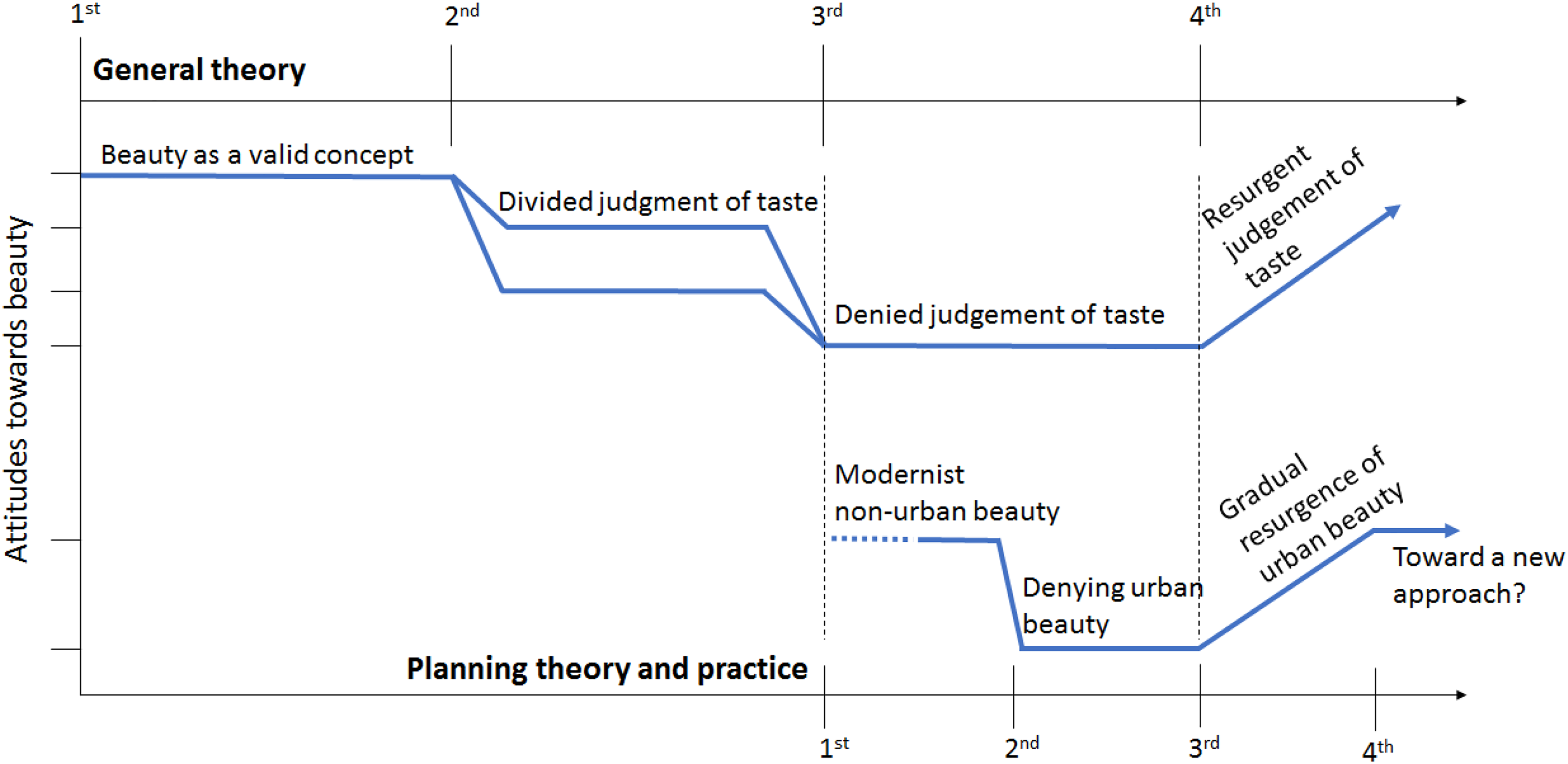
The path and major milestones in the changing relevance of beauty, focusing on general academic discourse (above) and planning theory and practice (below).
Defining beauty and recognizing sights that can be termed “beautiful” will probably remain elusive for a long time, but this does not mean that we cannot engage with the question of urban beauty, how it is created, its impacts, and various forms. Scruton's (2009) and Talen and Ellis’ (2002) rejections of the relativist barrier blocking the discourse of beauty show that there is a legitimate path for integrating aesthetic considerations in research and policy. This appears to be particularly relevant for planning theory and practice. The emotional aspect of urban living, the enjoyment, and attachment to the beauty of built environments, plays an important role in the lives of too many people. Therefore, it should be openly studied and discussed by scholars and practitioners.
The importance of planning, building, and living in beautiful cities is another aspect that requires research. An initial answer is found in the contemporary and resurgent discourse of beauty. Thus, writers in the field of environmental aesthetics contend that beauty has the power to reshape human–environmental relationships. As Carlson (2010, 307) explains, not from an anthropocentric, scenery-obsessed and superficial viewpoint but in a profound way that “helps to bring aesthetic values and environmental values more in line with one another.” Hillman (2018) sees beauty as having a healing power, expressing “anima mundi,” the soul of the world. According to him, appreciating beauty is an epistemological need; it is part of our way of knowing. Extending this viewpoint to the field of planning could reconnect people to their living places and make them feel responsible for nurturing and caring for the city as one cares for something appreciated and loved. Biophilic architecture and design likewise link people and their built environment, this time through the direct integration and the analogy between (the beauty of) nature and cities. Biophilic urbanism sees nature as the source of joy and sympathy and promises to cure cities of pollution, contamination, apathy, and antagonism. Regarding this, Lorand's (1994) analysis of the oppositions of beauty—the ugly, the meaningless, the boring and insignificant, and the irrelevant—manifests the dangers of neglecting beauty in urban planning.
The above analysis highlights the close relations between the urban beauty discourse and cultural, social, and communal aspects. Beautiful cities become recognized icons in our global world, and these are primarily places created before the construction of modern planning machinery. At the same time, dull, repetitive, standardized neighborhoods have become widespread. The elusiveness of beauty is mainly the result of lacking public and professional discourse. It is time to start talking.
Perhaps in the first stage, it would be worthwhile to start with research and apply for a phenomenologist position, giving precedence to finding the right language for speaking about urban beauty. The next step would probably lead to finding ways to create beauty, modeled both on past experiences and developing a new aesthetic language that is suitable for current cultures, emotional states, and visions.
Footnotes
Declaration of Conflicting Interests
The author(s) declared no potential conflicts of interest with respect to the research, authorship, and/or publication of this article.
Funding
The author(s) disclosed receipt of the following financial support for the research, authorship, and/or publication of this article: This work was supported by the Israel Science Foundation, (grant number 1232/20).
