



Abstract
Urban design is an essential component of planning for climate transformation. However, the concept of transformation in urban design is complicated by the problematic legacy of design-led mega-projects. Such projects, often called Haussmannization, are criticized as inattentive to existing landscape, built, and social environments. While corrective movements have partially addressed criticisms of Haussmannization, they can also hinder justice-centered climate transformation, by empowering already powerful interests to defend status quo conditions or justifying inequity-deepening interventions in the name of climate action, a phenomenon we label climate Haussmannization. We present a schema connecting transformative urban design with procedural, distributive, and recognitional justice.
Introduction
As this special issue demonstrates, calls for “climate transformation” in planning are growing louder (Bahadur and Tanner 2014; Childers et al. 2015; Romero-Lankao et al. 2018). Our focus is on the implications of climate transformation for urban design, a domain of planning that has had a complex and sometimes troubled relationship with the concept of transformation. In urban design, the word “transformation” has been used to describe a range of processes, from emergent and incremental shifts in urban form to designed projects to restructure cities, sometimes creating serious and uneven social and environmental harms. Building on calls for justice-centered “climate transformation” (Childers et al. 2015; Henrique and Tschakert 2021; Shi and Moser 2021), this Perspectives essay asks: Given the checkered history of transformative urban design interventions, how can urban designers play a meaningful role in planning for justice-enhancing urban climate transformation?
To address this question, we briefly introduce the core concerns and disciplinary positioning of urban design as a field linking planning to architecture and landscape architecture. We then discuss selected uses of the term “transformation” in urban design and highlight why urban design is relevant to planning for climate transformation. We then examine how past urban design mega-projects and efforts to redress their harms have shaped both the limitations and possibilities of urban design for climate transformation in three domains: built environments, landscapes, and social structures. We close by presenting a schema connecting transformative urban design practice in these three domains with the procedural, distributive, and recognitional justice aims of planning for climate transformation.
By virtue of the abbreviated format, this Perspectives essay cannot fully address all of the complexities raised by applying the concept of climate transformation to urban design. This essay is not intended to be a systematic literature review. Nor can it provide a comprehensive account of relevant practices in contemporary urban design. Although both are worthy future research endeavors, they are beyond the scope of this short piece. Our aim is to draw upon our own experience and other selected urban design research and practice to examine the possibilities and problematics of pursuing climate transformation through urban design given the discipline's complex history.
Urban Design and Climate Transformation
Urban design is a multi-scalar, multidimensional, and multidisciplinary process for intentionally shaping the space and form, the use and functions, and the meanings and perceptions of urban environments (Carmona et al. 2010). The professional and disciplinary identity of urban design is often regarded as occupying a liminal space at the intersection of architecture, landscape architecture, urban planning, and sometimes civil engineering (Lang 1994).
Because urban design is principally concerned with how urban form impacts human experience and behavior (see Lynch 1981), the field has direct implications for climate action, in the realms of both mitigation (reducing greenhouse gas (GHG) emissions) and adaptation (reducing the negative consequences of climate change and capitalizing on potential benefits) (IPCC 2022). The United Nations Environment Program estimates that buildings and transportation, sectors that directly relate to urban form, are responsible for 64% of global GHG emissions (UNEP 2020). Urban designers have proposed a range of strategies to reduce emissions, including compact urbanism, transit-oriented development (TOD), and ecologically-sensitive design (Pizarro 2009; Sharifi and Yamagata 2014).
Climate change is already altering climatic patterns with dire consequences for people, property, infrastructure, and ecosystems (IPCC 2022). Urban design can be central to adapting settlements to flooding, excessive heat, drought, wildfires, and other climate hazards, through such strategies as “blue” and “green infrastructure” (Coutts et al. 2012; Dhar and Khirfan 2016; Hill and Larsen 2013; Palazzo 2019), strategic arrangements of streets, buildings, and blocks (Dhar and Khirfan 2017), and managed retreat from vulnerable zones (Watson and Adams 2011).
Uneven and slow progress in mitigation and adaptation have led to calls for “climate transformation” across disciplines and professional practices (IPCC 2022). Here we focus on two dimensions of climate transformation. First, climate transformation entails taking decisive and systematic action rather than relying on fragmented and incremental change. Second, climate transformation is explicitly oriented towards advancing justice by addressing the roots of unequal vulnerability (Bahadur and Tanner 2014; Pelling 2011). Bringing these two elements together, Shi and Moser (2021, 372) argue that transformation entails “deliberately and fundamentally changing systems to achieve more just and equitable outcomes.”
Discussions of planning for climate transformation have focused primarily on institutions and governance (Castán Broto et al. 2019; McCormick et al. 2013) with less attention on urban form, the core concern of urban design. While we concur with scholars who call for change in urban climate governance to cope with uncertainty, inequity, and scalar challenges (e.g., Chu, Schenk, and Patterson 2018), we argue that urban design represents a necessary yet often overlooked domain of planning for climate transformation. Climate transformation entails both changes in institutions and governance and changes in urban form. Given the discipline's liminal position between planning and design disciplines, urban design is well positioned to contribute to these efforts. And yet, for urban design research, the invocation of “transformation” invites complex reflections on the discipline's past and future.
Transformation in Urban Design
The term “transformation” has been used widely in urban design research in recent decades, though its applications vary considerably and are not generally related to climate change. Between 1999 and 2014, three books by prominent urban design scholars included variations on the phrase “urban transformation” in their titles. In both Ian Bentley’s (1999) Urban Transformations: Power, People, and Urban Design and Peter Bosselmann’s (2008) Urban Transformation: Understanding City Form and Design, “transformation” is used to describe long-term, incremental changes in urban typologies (repeated patterns in built form) and morphology (spatial patterns of buildings, blocks, and streets). In his 2014 book Designing Urban Transformation, Aseem Inam (2014, 2) defined “transformation” in more active and normative terms as “significant and fundamental positive change.” While all three accounts recognize that urban form both reflects and shapes inequality, Inam's account explicitly frames urban design as a tool for redressing spatial injustice, demonstrating this potential through global examples, from rural south Asia to Barcelona's Olympic Village.
Other research on urban transformation explores the problematics of heavy-handed designed interventions. One especially prominent historical example is the reconfiguration of Paris under Georges-Eugene Haussmann in the mid-19th century to create new boulevards, parks, and modern infrastructure (Gandy 1999; Saalman 1971). Haussmann's interventions are often described as “transformations” (Darin 2014; Jordan 1995; Paccoud 2016; Saalman 1971). This form of urban design transformation – large in scale, rapid in execution, and guided by a singular vision – has been dubbed “Haussmannization” (Jordan 2004; Merrifield 2014). The term “Haussmannization” has been used to describe projects around the world, from commercial developments in Managua, Nicaragua (Rodgers 2012), to Beirut's Central Area Renewal (Gavin 2015), to New York City's mid-20th century urban renewal and highway projects (Caro and Dendy 1975), to redevelopment in fast-growing Chinese cities (Abramson 2008). While Inam and others focus on the potential of urban design to deliver benefits to the poor, many of these mega-projects have come with dramatically uneven costs. Haussmann's Paris transformations demolished 27,500 buildings and displaced 350,000 people, radically disrupting the lives of poor Parisians while benefiting the newly ascendant bourgeoisie (Byles 2005; Harvey 2005; Lefebvre 2003). The unequal costs of mega-projects are often justified by the invocation of crises (Klein 2008), including: public health threats and civil insurrection in 19th century Paris (Benjamin 1969; Gandy 1999), “urban decline’” and the nuclear threat in mid-20th century US cities (Beauregard 1993; Lamb and Vale 2019), and public infrastructure failures in Baghdad (Pieri 2015). If urban designers do not recognize this problematic tendency and chart a different course, they could play a part in justifying climate Haussmannization, a new generation of heavy-handed inequality-exacerbating interventions undertaken in the name of climate action.
Urban Design's Partial Correctives to Haussmannization
Since the emergence of urban design as a discipline in the mid-20th century, much research has sought to counter Haussmannization's worst impacts. Responding to mega-projects that were insensitive to existing landscapes, built environments, and socio-spatial relations, urban designers embraced a trio of responses: ecological design, typo-morphological incrementalism, and participatory planning and design. Below we describe these three movements and their contributions to countering Haussmannization. We also discuss how certain manifestations of these movements can undermine justice-centered climate transformation, by justifying climate Haussmannization or by enabling already empowered groups to resist transformative change and defend status quo conditions.
Responding to Landscape and Ecological Contexts
Ecological design emerged in the mid-20th century as an alternative to urban design mega-projects criticized for disregarding existing landscape and ecological processes. Spearheaded by landscape architect Ian McHarg, including in his seminal 1969 book Design with Nature, this movement argued that the design of human settlements should be rooted in analysis of landscape and climatic processes (McHarg 1969). McHarg's landscape suitability analysis for Staten Island, for example, proposed development patterns to reduce vulnerability to floods, a danger later demonstrated in Hurricane Sandy's impacts (Wagner, Merson, and Wentz 2016). More recent work that builds on McHarg's renders landscape and ecological functions central to urban design, including Sim van der Ryn and Stuart Cowan's 1996 book Ecological Design and the work of landscape urbanists like Charles Waldheim (2006).
While ecological design brought deserved attention to the relationship between urbanization and underlying landscape forces, McHargian ecological design and landscape urbanism are rooted in technocratic expert assessment of landscape and climate variables, from slope and soil types to prevailing winds and vegetation. Such analyses largely ignore the complex intertwining of social and ecological urbanization processes and leave little room for other ways of knowing or valuing places, including through indigenous and experiential knowledge (Fleming 2019; Friedmann 1973; Friedmann and Hudson 1974; Yli-Pelkonen and Kohl 2005). With mounting climate vulnerability, narrow expert-driven models of ecological design can lead to adaptation interventions that disproportionately burden already marginalized communities (Anguelovski et al. 2016; Sovacool, Linnér, and Goodsite 2015). For instance, McHargian landscape suitability analysis has been used to justify displacing low-income populations from flood prone communities in Dhaka, Bangladesh and New Orleans without adequate consultation or compensation (Lamb 2019). While climate adaptation that harms disadvantaged people has been given many labels, including “adaptation oppression” (Marino 2018) and “climate gentrification” (Anguelovski et al. 2019), we suggest climate Haussmannization as a fitting label for inequality exacerbating urban design interventions that may be undertaken in the name of climate action.
Responding to Built Environment Contexts
Much as the ecological design movement asserted the need for greater attention to landscape processes in urban design, a parallel movement rejected the view that pre-existing urban fabrics could be substantially ignored in the name of modernization and development. Beginning in the mid-20th century, urban design scholars began calling for meticulous “typo-morphological” analysis of ordinary built environments and their change over time to guide urban design interventions (Cataldi 2003; Conzen 1960; Hakim 2007; Kropf 1996; Moudon 1986).
While typo-morphological approaches can restrain some of the most extreme and violent impulses of urban design mega-projects, they can also devolve into formal fetishism and status-quo defending preservation (Cuthbert 2011). Slavish adherence to contextualism can hinder climate transformation, including by impeding emissions-reducing densification (Avrami 2016).
Responding to Social Contexts
Haussmannization-style urban design interventions are also often criticized for disregarding social contexts, ignoring resident desires and destroying the socio-cultural and economic structures of communities. Critiques of the social impacts of such interventions (Jacobs 1961) inspired new participatory planning and design practices. Although participatory practices were intended to enable impacted communities to shape interventions, many forms of participation have proven deeply unsatisfying or even exploitative (Arnstein 1969). Research has shown that citizen participation requirements are often leveraged by already empowered interests to protect unjust status quo conditions (Fainstein 2001; Innes and Booher 2004; Quick and Feldman 2011; Schively 2007). To counter these problems, designers and planners have pursued more inclusive practices that value plural knowledge and encourage genuine power sharing, aims that will be especially important in advancing justice-enhancing climate transformation (Barron et al. 2012; Bissonnette et al. 2018; Moser and Stein 2011; Wilson 2018).
Paths Forward
Much as critiques of context-ignoring Haussmannization projects prompted reforms in urban design practice, calls for climate transformation will require urban design researchers and practitioners to again reconsider their treatment of existing built environments, landscapes, and social structures. While 20th century responses to urban design mega-projects offer some useful guidance, these movements also come with their own constraints and problematics as described above. In the space that remains we consider paths forward to advance justice-oriented transformative climate action through urban design.
To realize the transformative potentials of urban design and to avoid the mistakes of past mega-projects, we argue that urban design itself must transform by embracing two essential commitments: (1) transcending the epistemological and methodological boundaries between urban design's constituent disciplines (principally: architecture, landscape architecture, and planning) and; (2) linking new modes of inquiry and action to the three pillars of climate justice (recognitional, procedural, and distributive).
While urban design continues to be defined and reinterpreted through the particular concerns of its constituent disciplines, climate transformation demands that we recognize the extent to which the different domains of urban design ‘context’ are intertwined. As generations of critical urban and environmental scholarship make clear, built environments, landscapes, and socio-spatial processes are all socio-ecological in character (Gandy 2002; Lefebvre 1991; Williams 1985). Urban design research and practice must continue to dissolve residual methodological and epistemological barriers between phenomena conventionally conceived of as belonging to the natural, social, and built environments.
We suggest linking this approach to transformation to multi-dimensional conceptualizations of climate justice whereby the triad of urban design transformations intersects with the three pillars of justice: recognitional, procedural, and distributive (Meerow, Pajouhesh, and Miller 2019; Mohtat and Khirfan 2021) (See Figure 1). In the context of urban design for climate transformation, recognitional justice requires that designers seek out, acknowledge, and respect the perspectives and historical experiences of people impacted by proposed interventions. Distributive justice requires considering how the distribution of the benefits and costs of climate action can advance equity and redress historical injustice. Procedural justice requires deep inclusion of people impacted by past, present, and future climate harms and adaptations.
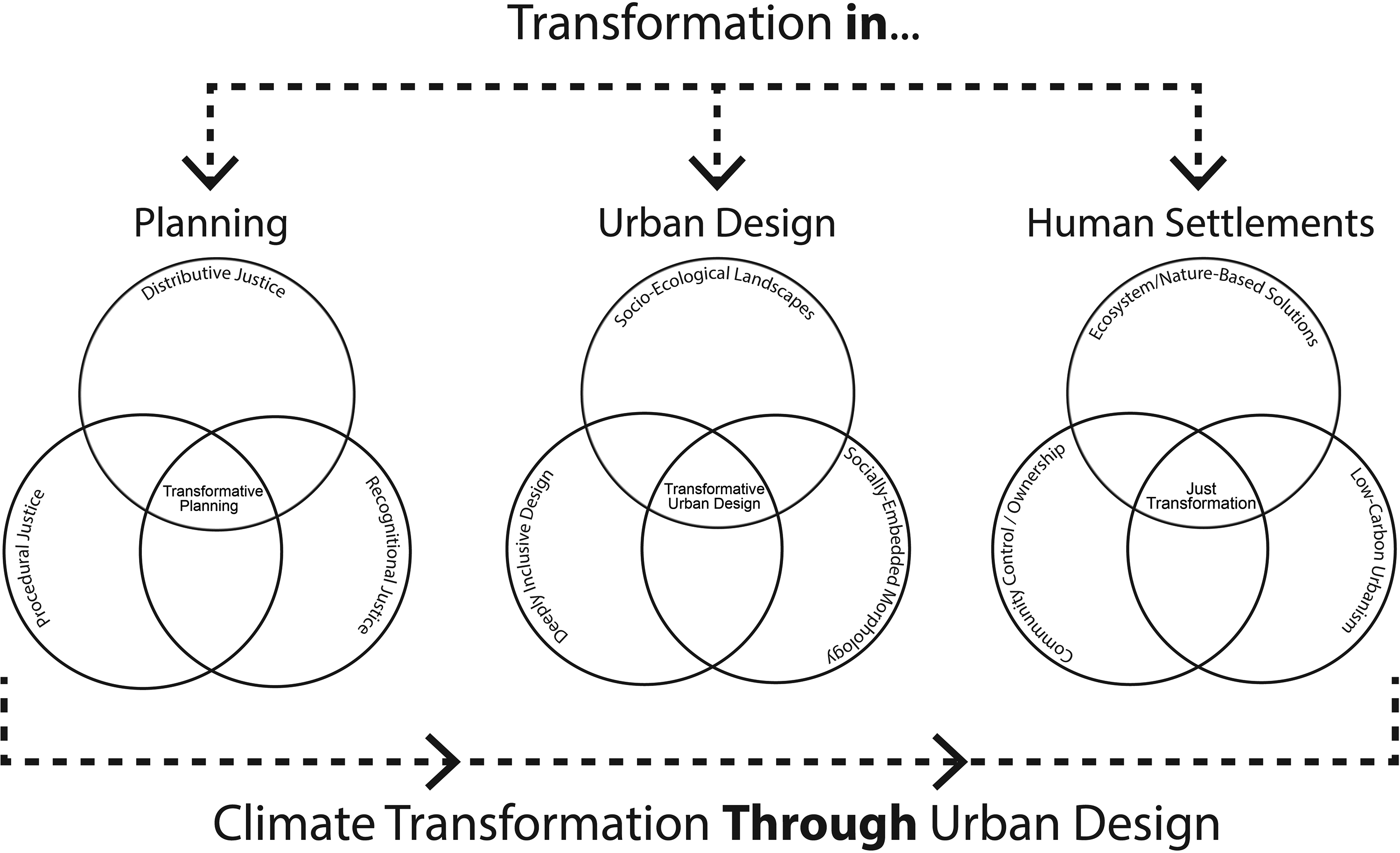
New design methods and applications should connect urban design interventions for transformative urban climate action with the three pillars of justice for impacted communities: distributive (equity in the distribution of costs and benefits of nature-based solutions), recognitional (socially-embedded typo-morphology), and procedural (deep inclusion and power sharing) (Mohtat and Khirfan 2021).
Landscape as Socio-Ecological Processes
While narrow technocratic applications of McHargian ecological design can privilege expert knowledge and ignore the ways that social and ecological processes are braided together in urbanization, other researchers and writers have expanded the tradition by engaging these complexities. Examples include research by Robert Bullard (Bullard et al. 2016; Lewis 2016), Julian Agyeman (2009; Agyeman, Devine-Wright, and Prange 2009; 2016), Sonja Klinsky and Anna Mavrogianni (2020), Stephen Gray and Anne Mary Ocampo (2017), and Anne Whiston Spirn (2005), all of whom address spatial (in)justice and the uneven hazard risks faced by the urban poor. Justice oriented climate transformation through urban design must build upon this socio-ecological understanding of landscape function and risk.
Our own international research on urban stream daylighting demonstrates the difference between green Haussmannization and socio-ecologically-informed and inclusive design. While the 2004 restoration of a stretch of the Cheonggyecheon stream in Seoul, South Korea has been widely celebrated for transforming the heart of downtown, replacing an expressway with public transit and a linear park (Busquets 2011; Khirfan et al. 2020), this project has also been critiqued for its environmental managerialism and for excluding local communities (Cho 2010). In contrast, in 1986, city leaders in Zürich, Switzerland adopted a policy that incrementally daylighted over 25km of buried streams in a process that was informed by extensive consultation with local communities (Conradin and Buchli 2004). The results yielded ecological, social, cultural, and economic benefits, including alleviating flooding during extreme weather events (Khirfan 2020).
Built Environment: Socio-Ecological Typo-Morphology
Much as transformation will require a socio-ecological understanding of landscape processes, urban design researchers and practitioners must also revise how they understand existing built environments. Existing urban environments should be regarded, not as physical artifacts, frozen in time for preservation and emulation, but as living material manifestations of their social and environmental contexts. Such approaches could draw on existing research traditions, including vernacular urbanism (Coch 1998; Nguyen et al. 2019), critical regionalism (Lefaivre and Tzonis 2003), and everyday urbanism (Chase, Crawford, and Kaliski 2008), each of which explores the relationships between built environments and dynamic social and ecological processes. They could also build on important work from post-colonial, feminist, and anti-racist researchers and advocates, including work exploring plans and counter plans in climate vulnerable post-colonial cities (Goh 2021), articulating Black ecologies of flooding and climate change (Hosbey and Roane 2021), and expanding and revising racist and colonial built environment histories (Bates et al. 2018; Herscher and Leon 2020; “Paper Monuments” n.d.; Roberts 2019; Tavares 2020). Such strategies suggest treating ordinary built environments as expressions of local knowledge, emphasizing the socio-ecological character of urbanism as a practice that is in a state of flux tied to changing environmental, governance, technology, media, and labor conditions.
Research on typo-morphology and vernacular built environments is rarely framed in relation to climate change. Nonetheless, many underlying principles align with climate mitigation and adaptation goals and may suggest new pathways towards justice-oriented climate transformation. Regionally inspired urbanism calls for design that responds to local conditions, including passive solar and natural ventilation strategies (Coch 1998; Dehghani-Sanij 2020; Hughes, Calautit, and Ghani 2012; Osman and Sevinc 2019) and using local materials (Kelbaugh 2004), which can reduce GHG emissions and support local livelihoods. Viewing existing built environments as living expressions of local ecological knowledge (LEK) can also highlight how responsiveness to environmental contexts (e.g., topography, landform, climate) (Canizaro 2007) can reduce vulnerability to hazards, including flooding, drought, and heat.
Social Environment: Deep Inclusion and Power Sharing
Developing justice-centered urban design approaches that reckon with the complex interactions of landscape, built environment, and social contexts will require new forms of deeply inclusive design and power sharing. Our global research suggests some areas for transformative practice in combining nature-based solutions, socially-embedded morphology, and deep inclusion for coastal adaptation in diverse settlements from the west coasts of Tobago (Trinidad and Tobago) and Negril (Jamaica) to Charlottetown, Prince Edward Island (Canada) (Dhar and Khirfan 2016; Khirfan 2014; Khirfan and El-Shayeb 2020; 2021; Khirfan and Zhang 2016). A recent study in Amman (Jordan) used a deliberative Q-Method 1 to assess local experts’ valuation of urban water features – a crucial ecological design element for Amman and other water-stressed cities (Khirfan and Peck 2021; Peck and Khirfan 2021). This research sought to develop a model for justice-oriented climate transformation addressing root causes of unequal climate change vulnerability (Shi and Moser 2021).
While participatory methods can integrate local knowledge into urban design interventions, ensuring that disadvantaged people enjoy the benefits of those interventions requires confronting the root causes of urban inequality. In the context of urbanization, property regimes are among the most basic drivers of uneven development. As such, transformative climate action will require reexamining the commodity treatment of urban land and development of “non-privatized tenure” regimes (Ghertner 2020) that de-emphasize individual capital accumulation, enable collective action, and respond to dynamic place-specific socio-ecological conditions. Our research, from urban villages in Shenzhen (Shi et al. 2018) to cooperatively owned mobile home parks in the USA (Lamb et al. 2022), suggests that alternative and collective property regimes hold promise for advancing transformative, equity-enhancing adaptation. To date, urban design scholarship and practice have not substantially addressed these issues. However, engaging alternative property regimes, from community land trusts to indigenous collective tenure, could challenge designers to think differently about spatial relationships in urban environments in pursuit of justice-centered climate transformation.
Transformation Through and In Urban Design
With calls for climate transformation growing, urban design researchers and practitioners face serious questions. How can a discipline with an historical track record of supporting unjust mega-projects avoid climate Haussmannization while addressing the conjoined crises of climate change and mounting inequality? How can research and practice in urban design contribute to and extend efforts towards climate transformation in planning more broadly? How can fetishism of existing built environments, narrow technocratic ecological design strategies, and superficial participatory design practices be reimagined to advance justice-oriented climate transformation?
We argue that urban design's potential to shape climate transformation can be achieved only if researchers and practitioners transform their own practices, bringing together socio-ecologically-embedded approaches to urban morphology and nature-based solutions, through deep inclusion, transferring real power and control to impacted communities to reshape “who has the power to act” in the face of climate change (Romero-Lankao et al. 2018, 754).
In search of planning strategies for climate transformation, we suggest that urban design can be a productive domain for investigating the relationships between built environments, landscape processes, and social formations. By treating landscape and climate conditions as integrally related to the social life of cities, designers can better understand the sources of uneven climate vulnerability to advance distributional justice. Typo-morphological analysis rooted in regional and vernacular urbanism, if understood as part of ongoing socio-ecological processes, can provide new forms of place-rooted recognitional justice. Finally, deeply inclusive design practices and alternative property regimes can advance procedural justice by widening the epistemological territories deemed legitimate to urban design and creating avenues for sharing or transferring power to impacted communities.
Footnotes
Declaration of Conflicting Interests
The author(s) declared no potential conflicts of interest with respect to the research, authorship, and/or publication of this article.
Funding
The author(s) received no financial support for the research, authorship, and/or publication of this article.

Supplemental material
Supplemental material for this article is available online.