



Abstract
While many policy tools can be used to develop spatial plans and implement their goals, there have been very few academic attempts to classify and illustrate the whole range of tools available. This article reviews the different ways in which planning tools have been conceptualized to date and highlights a wide variation in their interpretation. Building directly on literature from policy studies, a new classification is put forward which has many potential applications in studying spatial planning governance. As well as distinguishing between four main policy types (nodality, authority, treasure, and organization), the classification differentiates between procedural and substantive tools.
The governance of urban and regional planning (or spatial planning) has been analyzed and compared in a number of recent publications, each of which has highlighted the diversity of planning practices and approaches depending on specific social, economic, environmental, and social contexts (e.g., Knaap, Nedović-Budić, and Carbonell 2015; Reimer, Getimis, and Blotevogel 2014; Schmitt and Van Well 2016; Nadin et al. 2018). A relatively underdeveloped feature of this literature is the types of policy tools that are used (or could potentially be used) for spatial planning. In general, conceptual thinking about policy tools used in spatial planning is relatively limited and yet not always consistent. This review article illustrates the diversity of academic conceptualizations of spatial planning policy tools and identifies a new framework for categorizing, analyzing, and comparing spatial planning policy tools.
While the policy studies literature contains a number of extensive categorizations of public policy tools (e.g., Hood 1986; Howlett 2000; Salamon 2002), this literature has largely been overlooked or at least not explicitly mentioned in studies of spatial planning. Although many of the most frequently cited tools of spatial planning are regulatory (e.g., conservation orders, land appropriation, environmental impact assessment [EIA]), spatial planning involves a much wider range of policy tools than regulation alone, as proponents of communicative and collaborative planning theory have recognized for some time (e.g., Forester 1993; Healey 1997; Innes and Booher 2010). According to Rydin (1998), regulation is the “fundamental policy tool available to the planning system…[operating] at different levels and on different aspects of the built environment” (p. 754), but achieving planning goals such as sustainability and social cohesion requires much more than regulation alone: these goals demand additional policy tools beyond regulation. Studying policy tools therefore has value in terms of identifying how to address complex societal goals in spatial planning practices. From a more theoretical perspective, the classification of spatial planning policy tools is valuable for making comparisons and assessments of the governance of spatial planning in different contexts, which in turn can add more detail to studies of policy styles, professional cultures, and path dependence in spatial planning (Sorensen 2015; Stead, de Vries, and Tasan-Kok 2017; Stead 2018).
This review article advances knowledge and understanding of planning policy tools in three ways. First, it provides a detailed critical review, evaluation, and synthesis of existing literature on spatial planning tools. Second, it situates this literature in the context of more general theories on public policy tools from the policy studies domain. Third, it identifies and tests a new conceptual model for analyzing policy tools used in spatial planning. By bringing together a disparate set of literature, this article bridges a gap between spatial planning and policy studies literature and spans a divide between the more tractable, practical literature on planning procedures and the more complex, philosophical literature on planning theories and principles.
This article is divided into four main parts. It begins by reviewing academic literature in which typologies of policy tools have been discussed. This includes general typologies of policy tools from the policy studies literature as well as the more specific typologies of policy tools from the spatial planning literature. Next, it presents a new conceptual model for analyzing policy tools used in spatial planning and provides examples to populate the model. This article then reviews the issues of the calibration, combination, and choice of policy tools and considers their influence on policy outcomes. This article concludes by reflecting on the usefulness and potential application of the conceptual model.
Typologies of Policy Tools
While several recent studies have attempted to compare the governance of spatial planning in different contexts (e.g., Reimer, Getimis, and Blotevogel 2014; Knaap, Nedović-Budić, and Carbonell 2015; Schmitt and Van Well 2016; Nadin et al. 2018), very few offer a detailed examination of policy tools. As discussed below, some of the basic ideas about the nature of policy tools can vary substantially. Before reviewing the literature from spatial planning on the different meanings and taxonomies associated with policy tools, the section begins by synthesizing the wider literature on policy tools from policy studies.
Typologies of Policy Tools from Public Policy Literature
Various taxonomies for categorizing policy tools were developed and proposed during the 1980s and 1990s (see, e.g., Hood 1986; Vedung 1998; Howlett 1991). Four reasons can be identified for this work on policy tools. First was interest in classifying policy tools in order to be able to better understand and analyze the reasons for the use of different tools. Second, policy tools were categorized to help provide greater insight into the factors driving the policy process. Third, categorizations of policy tools were developed in order to analyze and characterize long-term patterns of public policy-making. Fourth, taxonomies of policy tools were proposed as a way of comparing policy approaches between administrations and for drawing lessons from different approaches (Howlett 2000).
Of the various taxonomies of policy tools that were proposed, one of the most well-known is the model developed by Hood (1986) which classified policy tools into four sets using the NATO mnemonic: (i) nodality (i.e., information-based), (ii) authority (i.e., regulatory), (iii) treasure (i.e., fiscal), and (iv) organization (i.e., direct action by government). Hood’s classification further distinguished between policy tools designed to effect change in a policy environment and to detect changes in it: “effectors” and “detectors” (Table 1). This model has since gained widespread use in many areas of public policy-making, although Hood’s classification of policy tools has seldom appeared in spatial planning literature to date. Meanwhile, Hood’s “effectors” and “detectors” have largely been replaced by the distinction between substantive and procedural tools (Howlett 2000). Substantive policy tools refer to those that directly affect the delivery of policy goals while procedural policy tools refer to those that affect the process and procedures of developing policy. These two types of tools are closely interlinked: procedural policy tools support the functioning of substantive policy tools. For example, procedural policy tools structure how policies are formulated, implemented, and evaluated by government actors and agents (Howlett 2000). In the context of spatial planning, procedural policy tools can be utilized to facilitate interaction and consensus-building between stakeholders in order to generate or strengthen support for policy goals or initiatives (Runhaar, Driessen, and Soer 2009; Macintosh, Foerster, and McDonald 2015).
Hood’s Taxonomy of Policy Tools with Selected Examples.a
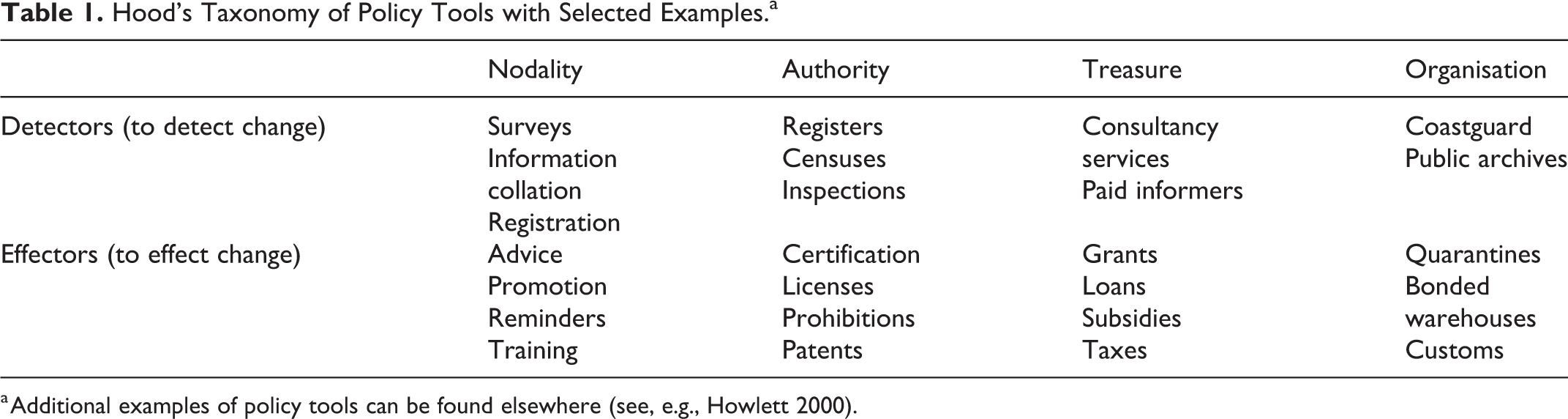
a Additional examples of policy tools can be found elsewhere (see, e.g., Howlett 2000).
Three of the four main types of tool (i.e., nodality, authority, and treasure) contained in the NATO model require little further explanation. However, a short explanation is provided about the tool of organization since its meaning is not straightforward to fully understand from its name alone. The tool has less to do with how government is organized or structured (as might be implied by the name) and more to do with the agencies, services, amenities, facilities, or infrastructure which governments provide directly. While recognizing that these type of tools often require a combination of nodality, authority, and/or treasure tools to put organization tools in place, Hood classifies them as separate and distinct tools and describes them in terms of the “stock of land, buildings and equipment, and…individuals with whatever skills they may have, in the government’s direct possession” (p. 72) which “enables government to act directly on its subjects, their property or their environment” (p. 73). Hood also refers to some examples of organization tools that are particularly relevant to spatial planning, stating that government “may provide for the welfare of its subjects in general by facilities such as parks, gardens, bridges, dykes and dams” (p. 80). In addition to these different forms of physical capital or infrastructure, it is important to note that organization tools related to spatial planning can also include the stock of human capital and skills in the government’s possession, notably the stock of public officials involved in developing, implementing, or enforcing spatial planning policy. In a number of contexts, the stock of human capital involved in spatial planning under the direct employment of government has been in decline in recent years and/or has been redistributed across public, private, and voluntary sectors as part of the hollowing-out, contractualization, and outsourcing of government (Grijzen 2010; Raco 2013; Lennon 2019).
Hood’s taxonomy, and others developed around the same time, generated a new academic literature on policy tools (Howlett 2000). Initially, the majority of this literature focused on substantive tools—those that directly affect the production and delivery of goods and services in society. Less attention was devoted to the systematic analysis of procedural tools—those intended to support substantive policy tools by, for example, managing state-societal interactions in order to assure general support for government aims and initiatives—despite the fact that they can be categorized in a similar way to their substantive counterparts, and have an equally important role in determining outcomes. Even now, attention to procedural policy tools in the academic literature is less prevalent than attention to substantive tools. This is true for the policy studies literature in general as well as the spatial planning literature in specific (discussed below). However, this is not to say that procedural policy tools have been completely neglected. Bressers and Klok (1988), for example, describe how various procedural policy tools involving the creation, provision, and diffusion of information to policy actors can affect the level of support for policy. Their work helps to identify a range of procedural policy tools, such as education, training, institution creation, the provision of information, formal evaluations, and hearings.
Typologies of Policy Tools from Spatial Planning Literature
Literature on spatial planning and governance contains surprisingly few definitions or taxonomies of policy tools. The situation is summarized by Van den Broeck (2008) who states that although “…planning theory is basically all about planning tools, there is, however, hardly any literature that theorizes the concept of planning tools” (p. 262). Leshinsky and Legacy (2014) and Carmona (2017) also confirm a relative scarcity of conceptual material on planning policy tools. Referring to planning tools as instruments which “fundamentally shape planning outcomes, both in what can be achieved and what is ultimately achieved” (p. 3), Leshinsky and Legacy (2014) distinguish between “substance-oriented” and “process-oriented” policy instruments but tend to give more attention to substantive tools. 1
Two related studies provide quite a different interpretation of planning tools than the one offered by Leshinsky and Legacy: “The EU compendium of spatial planning systems and policies” (European Commission 1997), which was commissioned and published by the European Commission; and the “Comparative Analysis of Territorial Governance and Spatial Planning Systems in Europe”, which was commissioned and published by ESPON EGTC (Nadin et al. 2018). Both reports present comparative reviews of spatial planning systems and policies across EU member states at two different points in time separated by two decades. Not only do these reports share some similarities in terms of scope and content, they also share a number of common authors, which helps to explain why the two reports adopt similar conceptualizations.
The first of the two reports, “The EU compendium of spatial planning systems and policies,” essentially equates a policy tool with a plan (i.e., a document containing a plan), referring to instruments in terms of “documents used to express planning policy as well as those commonly referred to as ‘plans’” (European Commission 1997, 51). The report categorizes spatial planning instruments into four main types “according to the form and general purpose of the instrument” (p. 51), as shown in Table 2. Essentially, it presents a classification of planning documents, rather than a classification of planning tools as understood by authors of public policy literature (see above). The EU report’s categorization of planning tools distinguishes between the spatial scale of policy application (e.g., local, regional, and national) and the extent to which the content of plans is binding or indicative. Although the “The EU compendium of spatial planning systems and policies” does not name them as procedural policy tools, it does nevertheless implicitly refer to some. For example, it refers to consultation with other tiers of government and official agencies in the plan-making process and also to the involvement of the public in this process. Specific examples of the latter include tools of nodality or authority according to Hood’s taxonomy: consultation between the public and the plan-making authority before proposals are drafted; consultation on draft proposals, public involvement in formal hearings and inquiries, public representation through formal consultative organizations, and opportunities for the public to legally challenge the content of the plan after its adoption.
Categorization of Spatial Planning Tools According to European Commission (1997).
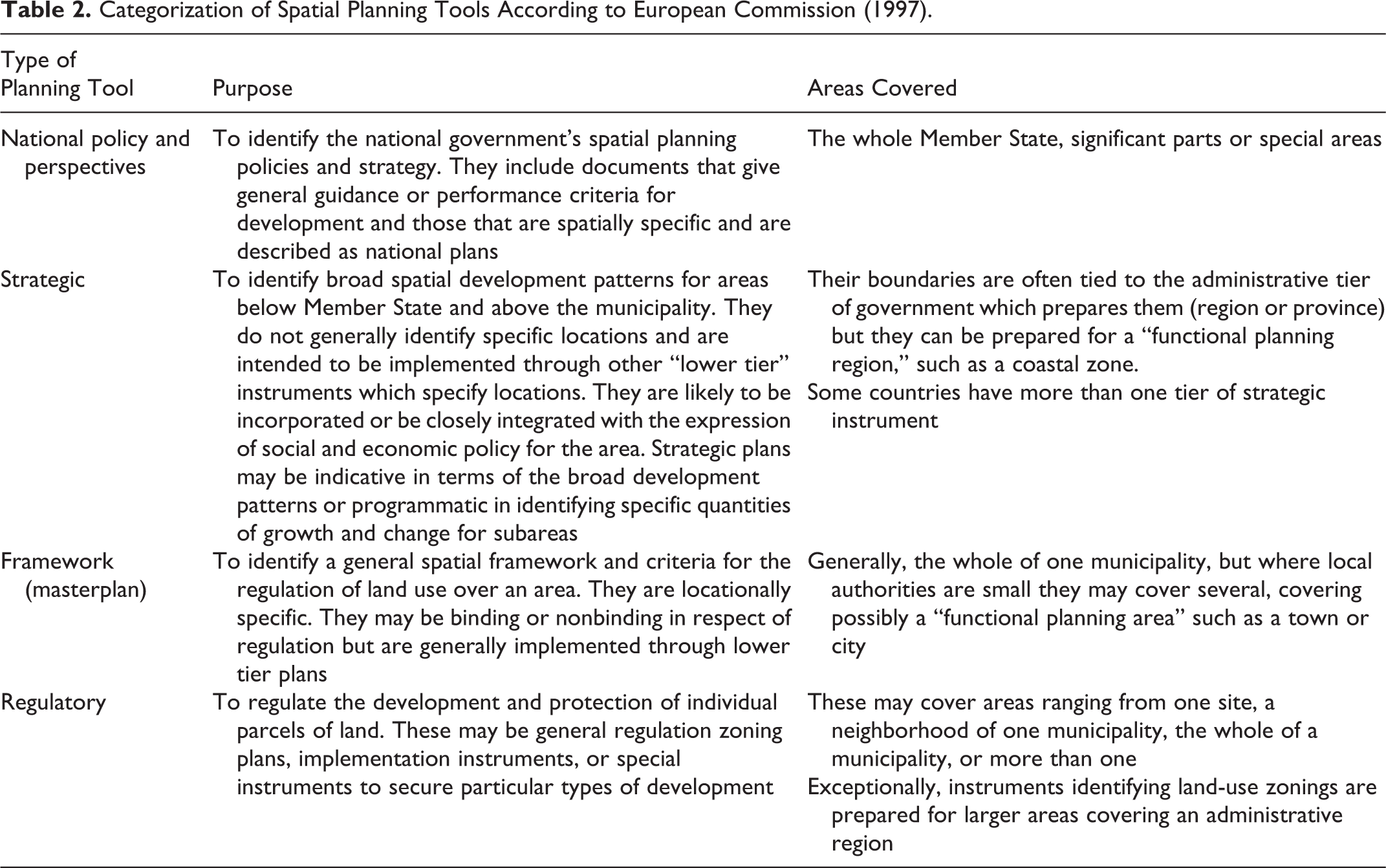
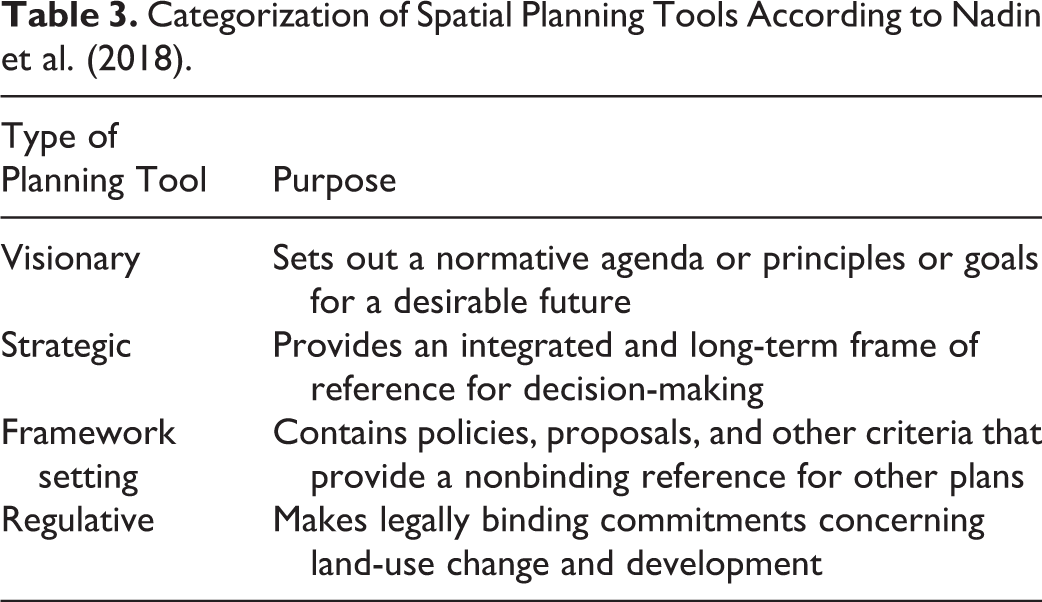
In common with “The EU compendium of spatial planning systems and policies,” the “Comparative Analysis of Territorial Governance and Spatial Planning Systems in Europe” also discusses spatial planning instruments primarily as different types of plans (Nadin et al. 2018), as illustrated in Table 3. Clearly, the names of the different types tools contained in Tables 2 and 3, as well as the descriptions of their purpose, are similar. At the same time, the report contains some references to policy tools which do not fit into their general classification. Examples include territorial impact assessment, foresight studies, technical assistance, information exchange (e.g., wiki-based platforms, glossaries, and collections of good practices), and networking of actors, which can be categorized as tools of nodality or authority according to Hood’s taxonomy.
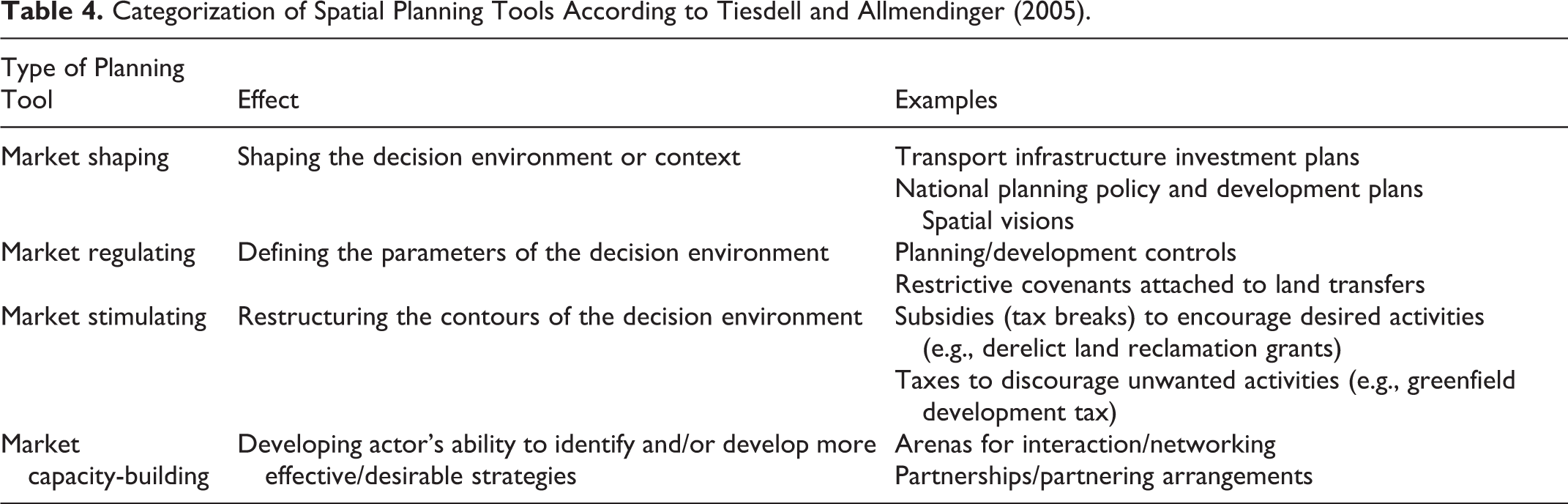
Meanwhile, Tiesdell and Allmendinger (2005) propose another way of categorizing policy tools for spatial planning by defining them as “policy actions or initiatives intended to affect the decision environment (and, in turn, the behaviour) of market actors and to achieve desirable societal objectives” (p. 58). In their definition, they contend that land-use regulation is merely one part of planning, stating that “planning has a crucial role…in shaping the…process of land and property development through, for example…providing more authoritative information, affecting the weighing of cost, benefits and risks of a particular action…and increasing or decreasing the number/range of participants in appraisal” (p. 58), highlighting the importance of nonregulatory tools, such as information provision, cost-benefit analysis, and participant involvement, as well as both procedural and substantive tools.
Categorization of Spatial Planning Tools According to Nadin et al. (2018).
Their typology of planning tools differentiates between four broad types based on how the tools influence land and property markets: (i) tools intended to shape markets, (ii) tools intended to regulate markets, (iii) tools intended to stimulate markets, and (iv) tools intended to develop the capacity of market actors (Table 4). Without referring to Hood’s taxonomy of policy instruments, Tiesdell and Allmendinger’s main types of policy tool are somewhat aligned with the NATO model: some of their market shaping tools closely resemble nodality tools; their market regulating tools resemble authority tools; and their market stimulating tools resemble treasure tools. However, few of the tools they mention resemble Hood’s organization tools.
Categorization of Spatial Planning Tools According to Tiesdell and Allmendinger (2005).
Linking planning tools to different types of plans, Tiesdell and Allmendinger (2005) recognize that the choice of policy tools is often related to the scale and type of plans, including their mode of implementation. For example, a plan may rely on voluntary action for implementation (because it is beneficial to a particular market operator) or rely on some form of compulsion (e.g., contractual regulation) or incentive or encouragement (e.g., financial inducements or other forms of market stimulation). This mode of implementation may have implications for the types of planning tools that are employed. For example, market shaping tools may be more prevalent in plans that rely on voluntary action for implementation, market regulating tools may be more prevalent in compulsory plans that specify land-use functions, and market capacity-building tools may be more prevalent in advisory “indicative” plans (where compliance with the plan’s objectives is not compulsory). Despite referring to some procedural aspects, Tiesdell and Allmendinger’s description of policy tools in spatial planning (and the examples to which they refer) favors substantive tools rather than procedural tools.
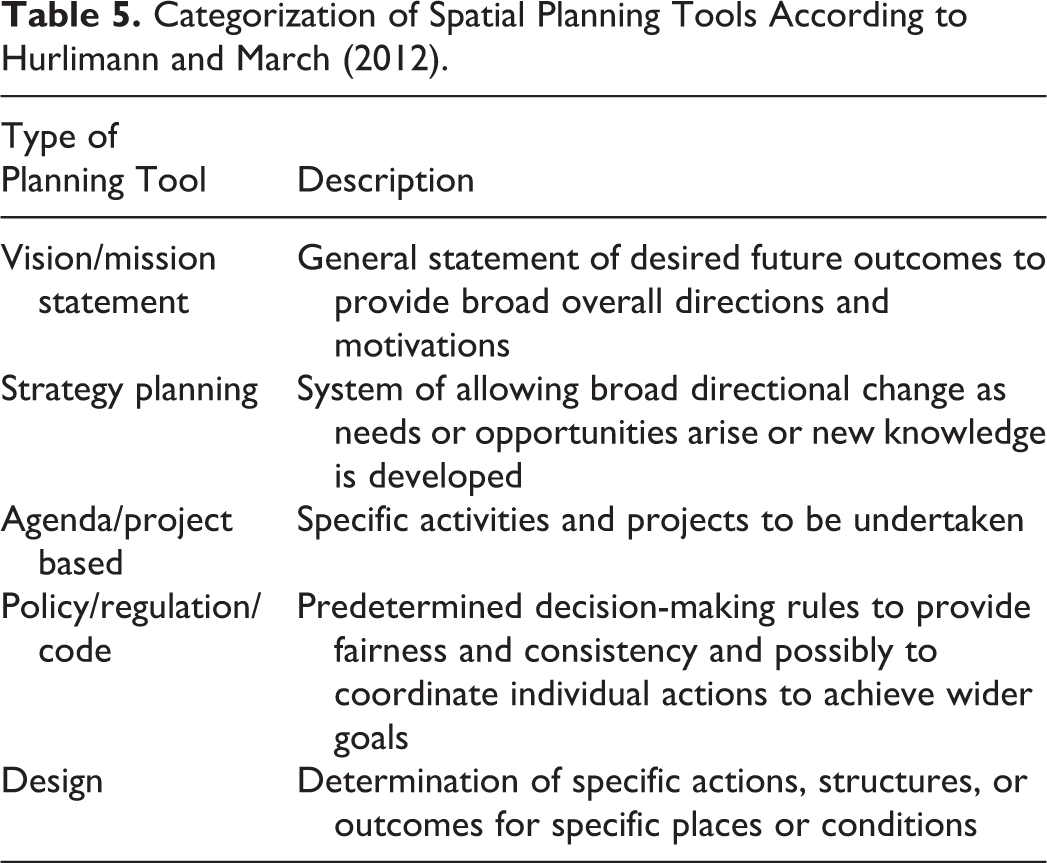
In common with Tiesdell and Allmendinger, Hurlimann and March (2012) propose a categorization of policy tools which primarily focuses on substantive rather than procedural tools. Defining planning tools in terms of guiding “urban change to achieve social, economic, and environmental benefits” (p. 480), Hurlimann and March propose a categorization of policy tools based on the material content or scope of a plan or document prepared to support a plan (Table 5), which has some similarities with the classifications proposed by the European Commission (1997) and Nadin et al. (2018) but has few similarities with Hood’s classification.
Categorization of Spatial Planning Tools According to Hurlimann and March (2012).
Referring to planning tools as “heuristics that assist planners in accomplishing their planning tasks,” Runhaar, Driessen, and Soer (2009, 418) distinguish between two types of planning tools: “substance-oriented” and “process-oriented” tools. While at first glance their terminology might seem consistent with the distinction between substantive and procedural tools outlined above, closer examination reveals that their interpretation is more limited. Runhaar et al. discuss “substance-oriented” tools in terms of information and knowledge about “the state of the urban environment in the form of indicators, GIS [Geographic Information Systems], and so on, and…tools for producing knowledge, such as EIAs [Environmental Impact Assessments] or health-impact assessments…” (p. 419). Meanwhile, they discuss “process-oriented” planning tools in terms of tools which facilitate dialogue and negotiation as a way of reaching consensus on a course of action or galvanizing support for action. As such, both categories are primarily concerned with tools of information or tools of nodality according to Hood’s classification.
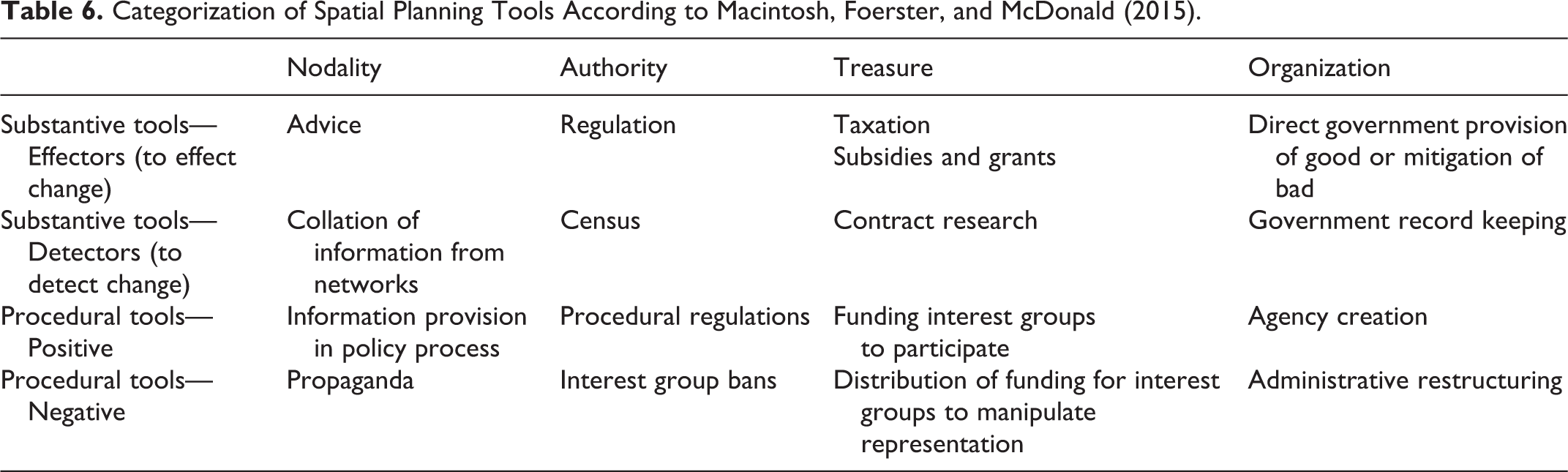
Drawing directly on literature from policy studies (including Hood 1986; Howlett 1991, 2000), Macintosh, Foerster, and McDonald (2015) categorize spatial planning tools by differentiating between substantive and procedural policy instruments and between mode of operation using the NATO model (Table 6). Their taxonomy, which is employed to analyze spatial planning tools for climate change adaptation in Australia, is not only one of the most detailed categorizations of planning policy instruments, it is practically the only paper on spatial planning policy tools to refer explicitly to the policy studies literature on policy tools. Given the theoretical underpinnings of Macintosh et al.’s categorization, it is therefore unsurprising that it closely resembles Hood’s classification. There is, however, one possible area of divergence related to organization tools. The examples that Macintosh et al. use suggest a more limited interpretation of these tools than outlined by Hood (1986): in general, their examples seem to be formulated in terms of how government is organized or structured, rather than agencies, services, amenities, facilities, or infrastructure which governments can provide directly (see above).
Categorization of Spatial Planning Tools According to Macintosh, Foerster, and McDonald (2015).
This review of literature on spatial planning policy tools not only indicates a diversity of categorizations of planning tools, it also reveals substantial variations in how policy tools themselves are understood. Moreover, the review highlights a relative scarcity of publications which consider spatial planning policy tools in a conceptual way, confirming similar observations by authors such as Van den Broek (2008), Leshinsky and Legacy (2014), and Carmona (2017). There are of course a range of publications which refer more briefly to different types of planning policy tools without expanding on their categorization or substance. For example, Gilg (2005) refers to a range of “delivery systems” for planning, which essentially equate to substantive planning policy tools. His “delivery systems” are closely linked to Hood’s NATO model (without explicitly referring to it) and comprise (i) voluntary methods based on exhortation, advice, or demonstration (often backed up with one or more of the other tools in this list); (ii) financial incentives to encourage production and/or desirable uses; (iii) monetary disincentives to discourage production and/or undesirable uses; (iv) regulatory controls, mainly negative, such as planning restrictions; and (v) public ownership or management of land. 2
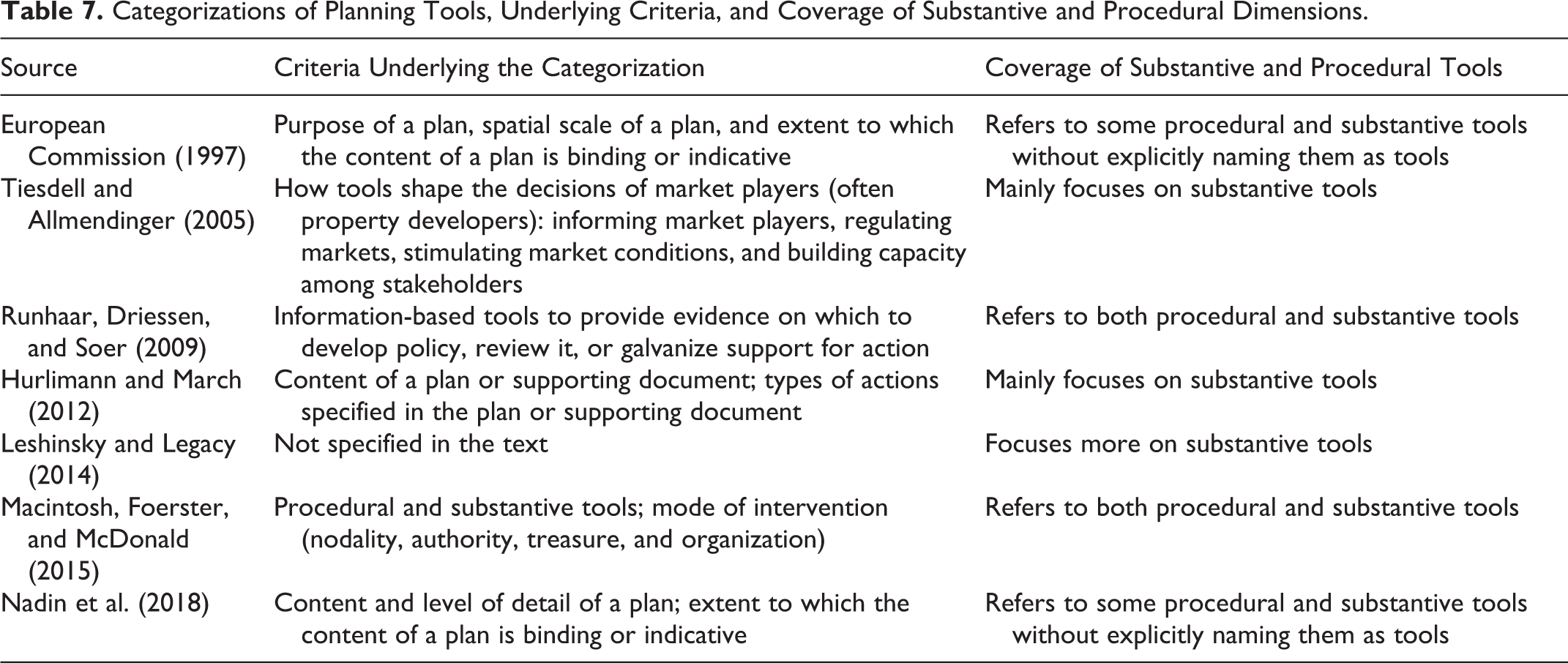
Most of the sources reviewed above place more emphasis on substantive rather than procedural tools, with the exception of Runhaar, Driessen, and Soer (2009) and Macintosh, Foerster, and McDonald (2015) who divide their attention more or less equally when discussing policy tools. Strikingly, only one of these categorizations refers explicitly to the policy studies literature (i.e., Macintosh, Foerster, and McDonald 2015). Table 7 summarizes the main criteria underlying these categorizations and the extent to which they consider substantive and procedural tools.
Categorizations of Planning Tools, Underlying Criteria, and Coverage of Substantive and Procedural Dimensions.
A Revised Taxonomy of Policy Tools for Spatial Planning
When considering procedural policy tools for spatial planning, a distinction needs to be made between the tools used by public officials for distinct parts of the process since different types of tools are required. In this article, a distinction is made between three parts of the process: (i) plan-making (and review), (ii) development control, and (iii) plan enforcement. Plan-making refers to the genesis, approval, and subsequent evaluation and revision of a spatial plan—the document which specifies the desired type, scale, and location of future development and which may also specify the policies or rules to be adopted in order to achieve this desired vision. Development control refers to the granting of permission for development, a process involving the assessment of the compatibility of the proposed development (e.g., residence, office, shopping center) with the aims and policies of the plan. Plan enforcement is concerned with ensuring that urban development takes place in line with a plan and, in cases where it does not, taking action to address the situation. In other words, there is one set of tools which can be used to influence the process of plan-making, a second set which can be used in the process of fulfilling or realizing a plan’s ambitions, and a third set which can be used to detect and act against contraventions to the plan. To date, such a distinction has not been made in the literature on spatial planning policy tools. Examples of procedural and substantive policy tools for plan-making (and review), development control, and plan enforcement are presented in Table 8.
Categorization of Procedural and Substantive Tools for Spatial Planning with Selected Examples.
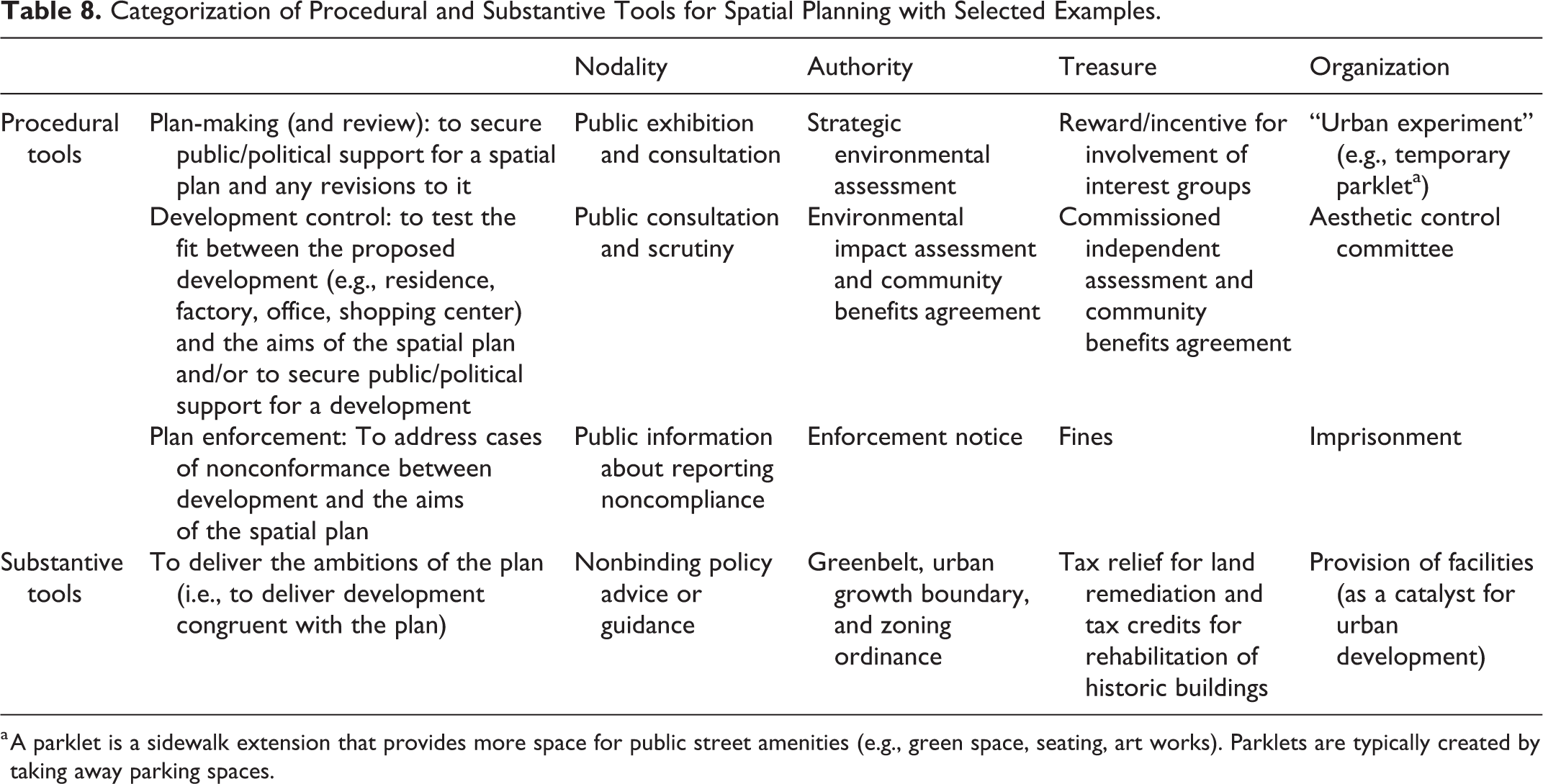
a A parklet is a sidewalk extension that provides more space for public street amenities (e.g., green space, seating, art works). Parklets are typically created by taking away parking spaces.
It should be noted here that the distinction made here between three aspects of the planning process (plan-making, development control, and plan enforcement) is separate to a distinction based on the main stages of the policy cycle (see, e.g., Howlett 2019). All three aspects of the planning process have their own distinct policy cycles, involving different starting points, stakeholders, and timescales. In the process of plan-making (concerned with the genesis, approval, and revision of a spatial plan), decisions are made regarding the content of a spatial plan (and accompanying policies) which typically has a time horizon of ten to twenty years. This decision-making process can involve several iterations before a plan is approved and may involve multiple inputs from a wide set of stakeholders, including citizens, businesses, and nongovernmental organizations (NGOs). This process may also involve inputs not only at the plan approval stage but also when a plan is periodically evaluated and revised (Alexander 2006). Meanwhile, the process of development control (concerned with granting permission for development proposals) is shorter in duration than plan-making, typically within a prescribed number of weeks after the submission of a planning application. Decision-making is instigated by the submission of a planning application: no decision is needed if no proposal is submitted. In this case, decision-making involves inputs from a less diverse set of stakeholders than the process of plan-making, often limited to those with a direct interest in the development being proposed (e.g., land-owners and residents directly adjacent to the proposed development). Thirdly, the process of plan enforcement is either instigated by the planning authority’s own monitoring activities (e.g., on-site checks) or via information from third parties (e.g., NGOs, neighbors). No decision about plan enforcement needs to be made until a policy breach is noticed and reported. Decision-making about plan enforcement involves relatively few inputs from stakeholders.
Procedural Tools for Plan-making
Procedural tools for plan-making refer to the tools which can be used to influence public or political support in the genesis and approval of a spatial plan (and any subsequent amendment). A range of nodality, authority, treasure, and organization tools, as outlined below, can be used for this purpose.
Nodality
There are several tools of nodality to secure public or political support for a plan, such as outreach activities to consult, inform, and persuade. Public consultations and exhibitions are typical examples where information can be gathered from stakeholders to generate (or cocreate) the ambitions of the plan before or during its formulation or where information can be presented to stakeholders to convince them about the content and direction of the plan. Clearly, the number and type of stakeholders involved in these processes, as well as the stage of decision-making during which they are involved, has an important impact on the level of support which can be achieved for the plan. Also crucial for the level of support for a spatial plan is the way in which the benefits or advantages of a plan are formulated and communicated to different stakeholders.
Authority
Strategic environmental assessment (SEA) is a statutory planning tool in many countries (including all European countries) which is designed to ensure that the environmental consequences of strategic decisions are identified and assessed during the plan preparation process and before plan adoption (Sadler et al. 2011). 3 A key idea behind SEA is that the technique improves the information basis for planning by providing insights into possible consequences, as well as identifying alternative options and measures that can avoid negative impacts. Clearly, the statutory requirement to conduct an SEA can lead to amendments during the plan-making process, thereby affecting the content of a spatial plan.
Treasure
Policy tools which provide rewards or incentives to promote the involvement of certain interest groups in plan-making can be classified as procedural policy tools related to treasure (i.e., fiscal tools). The state-funded Landcare Australia programme is an example of this type of tool, to which Curtis and Lockwood (2000) refer as a state-sponsored (i.e., state funded) mode of community participation. Landcare Australia is a government funded program which supports local Landcare groups, community not-for-profit organizations involving groups of volunteers who work on projects to repair and improve the natural environment. Representatives from these local Landcare groups are represented on regional Catchment Management Committees 4 and other important fora and make significant contributions to natural resource management decision-making (Curtis, Birckhead, and de Lacy 1995). Other fiscal tools that can be used to affect procedural aspects of plan-making include the hiring of planning consultants to organize citizen participation processes for urban planning (see, e.g., Grijzen 2010; Stapper, Van der Veen, and Janssen-Jansen 2020) and the use of financial incentives (e.g., prize draws) to encourage public responses to draft plans. 5 These tools not only influence the number and type of stakeholders involved in the plan-making procedure but also potentially influence the spectrum of responses that are submitted (as a consequence of who is included and excluded or supported and unsupported) in the participation process.
Organization
An organization tool “enables government to act directly on its subjects, their property or their environment” (Hood 1986, 73). This type of tool encompasses a range of possible interventions, including “urban experiments”—temporary physical structures that could be used to demonstrate the benefits or advantages of proposals contained in the plan and, as such, influence public or political opinion and support during the process of plan-making. One specific example of a temporary experiment is a parklet where new space for public street amenities (e.g., green space, seating, art) is created by removing existing carriageway or car parking spaces. This could be used to physically demonstrate the impact of extending pedestrianized areas and/or removing car parking. A separate example of an organization tool which can affect the plan-making process is the creation of new organizational structure or entity in government. For example, interdepartmental commissions have been employed alongside informal processes of consensus-building in the Netherlands as means of influencing and persuading ministers from other government departments to support national spatial plans (Grijzen 2010).
Procedural Tools for Development Control
Procedural tools for realizing the ambitions of the plan refer to the tools which can be used to test or shape the public or political acceptability of a new development proposal.
Nodality
Public consultation in spatial planning is generally not only limited to the process of plan-making, it also extends to the development control process. In most countries, the nodality tool of public consultation forms an important part of the process in which planning authorities (usually local governments) decide whether to grant permission for development. Applications for planning permission typically involve consultation with neighboring residents and businesses as well as statutory consultees (e.g., authorities responsible for environment, transport, archaeology). Seemingly simple rules about which residents and businesses are allowed to express their views about proposed development, and the way in which they are informed, can potentially have important impacts on the overall level of public or political support and acceptability for a development proposal. In the United Kingdom (UK), for example, local planning authorities have some choice in deciding how to notify neighbors for certain types of development (e.g., site notice or letter), which can potentially affect the number of responses.
Authority
EIA is applied to development control in a similar way that SEA is applied to plan-making (see above). It is an example of a procedural policy tool of authority that can potentially influence public or political support in the development control process. EIA is used to identify the environmental impacts of a development (during all its phases—construction, operation, and decommissioning) prior to decision-making. The tool seeks to predict environmental impacts before development starts, to identify ways of mitigating potentially adverse impacts, and to present the predictions and options to decision makers. In Europe, EIA is a statutory planning tool for development proposals of large projects such as power stations, refineries, chemical plants, airports, motorways, waste disposal installations, dams, quarries, and major power lines. While the content of EIAs is prescribed by regulation, the way in which the impacts and mitigation measures are presented can vary. Clearly, EIA is an important tool in shaping the public or political acceptability of a new development proposal. A second example is a Community Benefits Agreement (used in the United States), a contract between a property developer and community groups which binds the developer to provide specific amenities and/or mitigation measures to the local area in exchange for community support a development proposal or at least an agreement not to oppose it. When a Community Benefits Agreement is brokered by planners, it can be considered as an authority-related planning tool (i.e., setting binding conditions to accompany a development permit). If such an agreement entails funding (e.g., for a community organization or program), it could also be considered as a treasure-related procedural policy tool (see below).
Treasure
An example of a treasure-related procedural policy tool which can be used in the development control process is the commissioning of independent reports or assessments from specialist consultants on the impacts (economic, social, and environmental) of proposed development. These assessments may be externally commissioned by planning authorities for several reasons. One reason could be the lack in-house capacity (expertise and/or time). Another reason could be the objective of reaching a more independent, trusted assessment, particularly in the case of more contested development proposals where certain parties stand to gain or lose substantially from the development. A third reason could be that an independent assessment is commissioned as a way of reducing the likelihood of legal challenges (by the developer or the opposing party) after a decision has been made by the planning authority to grant or deny planning permission. Whatever the reason for commissioning these independent reports or assessments, their content is likely to sway public or political opinions to some degree about the acceptability of a new development proposal. A second example of a treasure-related procedural policy tool is a Community Benefits Agreement when it entails funding (e.g., for a community organization or program) since financial resources are employed to influence community support for a development proposal or at least secure agreement not to oppose it.
Organization
The inclusion of an aesthetic control committee or a similar body (e.g., architectural advisory panel, design review board, urban design panel) in the development control process can influence the final decision that a planning authority makes about a development proposal. It can also affect the conditions applied to development if planning permission is granted (e.g., building height, orientation, shape, materials). Various forms and remits of aesthetic control committees can be found in countries such as Canada, the Netherlands, New Zealand, UK, and the United States. In the Netherlands, aesthetic control committees, mainly comprising nominated independent experts in architecture and spatial planning, were made statutory by the 1962 Housing Act, 6 thereby introducing a new procedure for evaluating planning applications (Nelissen 2002). As with any committee, its composition (e.g., disciplinary representation, aesthetic preferences, expertise) can play an important role in the type of advice or recommendations that it provides.
Procedural Tools for Plan Enforcement
Most forms of physical development are subject to prior approval by the responsible planning authority (i.e., the granting of permission to develop). Certain categories of development are exempted, mainly in cases where development is minor (e.g., a small extension to a home). Where development has taken place (or is taking place) without necessary approval, the planning authority can take action to address the situation. 7 To do so, it can draw on a variety of policy tools that include nodality, authority, treasure, and organization. Since effective tools for the enforcement of planning control are generally considered necessary for increasing overall compliance with the planning system, all tools for plan enforcement can be considered as procedural in the sense that they are a precondition for substantive planning policy tools to function effectively (cf. Howlett, Bali, and Ramesh 2020).
Nodality
One example of a tool of nodality is the provision and promotion of public information about how to report suspected incidences of noncompliance. In some countries, public reporting (rather than official surveys or inspections) is one of the main ways of identifying noncompliance with planning rules.
Authority
Where development does not conform to the plan, or the conditions attached to planning permission, the planning authority often has statutory powers to take enforcement action, resulting, for example, in obtaining a court ruling requiring a retrospective application for planning permission to be made, or for actions to be undertaken in conformance of the conditions of the permission granted, or for the development to be removed and the site returned to its prior condition.
Treasure
Fines are also used as a sanction against development taking place without the necessary approval. In some cases, the calibration of the fine is related to the severity of noncompliance.
Organization
Although an extreme sanction, imprisonment can also be used as a policy tool (in addition or instead of a fine) in some countries where noncompliance is considered serious. 8
Substantive Tools for Planning
Substantive policy tools are more commonly discussed than procedural tools in the spatial planning literature. Although examples can be found which refer tools of nodality, authority, treasure, and organization, most of the examples cited in the planning literature refer either to tools of authority or treasure. Examples of tools from all four types are presented below.
Nodality
Higher levels of government in many countries prepare indicative policy guidance (and/or good practice guides) as a way of steering the content of lower-level plans. In cases where this guidance is indicative and nonbinding (which is implied by the term “guidance”), they can be classed as a nodality-related procedural policy tool (binding policy advice on the other hand can be classed as tools of authority 9 ). Policy guidance related to urban design and planning exists in a variety of forms, among which are local design guides, design frameworks, design briefs, development standards, design codes, design protocols, and design charters (Carmona 2017). It is useful to acknowledge here that these nodality tools cannot usually be relied upon in isolation, particularly where there is a substantial tension between public and private interests, as there often is in the process of urban development (Carmona 2017). Instead, a key function of these types of instruments is to internalize the desired behavior into corporate and individual decision-making. As such, policy guidance for spatial planning represents a policy tool that offers the potential to deliver the ambitions of the plan primarily by means of persuading stakeholders and agenda setting.
Authority
There are many examples of authority-based procedural policy tools that are used in spatial planning. One of the most important regulatory tools in the development management process is the restriction of development in specific areas in order to steer development in preferred locations (e.g., urban cores, new towns, industrial parks). These restrictions can take various forms including greenbelts, urban growth boundaries, and zoning ordinances. A greenbelt is a zone of largely undeveloped, wild, or agricultural land surrounding a city, which in principle enjoys regulatory protection against development. Greenbelts are used to restrict urban development around many cities around the world, including Adelaide, London, Hong Kong, Milan, Ottawa, Seoul, Toronto, Vancouver, and Vienna. Similar to greenbelts, urban growth boundaries delineate the extent to which urban areas are permitted to expand in countries such as New Zealand and the United States. Zoning ordinances are one of the most common regulatory tool contained in urban plans (LeGates 2004) and are used to distinguish between different types zones in the city (e.g., residential, industrial) in which certain land uses are permitted or prohibited. While greenbelts, urban growth boundaries, and zoning ordinances primarily regulate the location of development, other authority-based planning policy tools exist to control the scale, height, and orientation of development.
Treasure
Fiscal policy tools in the form of incentives can be used to attract development to locations of strategic interest and to encourage developers to take actions that improve the conditions of the built environment and protect the natural environment (such as redevelopment, conservation, historic preservation, and rehabilitation). For example, cities may seek to encourage urban regeneration by offering tax relief for land remediation, tax credits for the rehabilitation of historic buildings, or exemptions from local business taxes. Meanwhile, fiscal tools in the form of taxes and penalties can be used to discourage development in less favored locations. For example, cities may seek to discourage urban sprawl by means of property taxes, financial contributions for local infrastructure costs, or impact fees for development in “greenfield” locations. Tax incentives are generally more popular and well used than penalties (Adams and Tiesdell 2013).
Organization
Referring to policy tools of organization, Hood (1986) states that government “may provide for the welfare of its subjects in general by facilities such as parks, gardens, bridges, dykes and dams” (p. 80). Clearly, many of these type of facilities can be used as a catalyst to promote development in cities to underpin the objectives of a plan. Examples can vary from minor to major in size and impact. Frequently, major flagship projects are credited with significant impacts on urban development and change, such as the urban regeneration effects of the Guggenheim Museum in Bilbao, the Expo site in Seville, or the Olympic Park in Barcelona (Bell and Oakley 2015). However, direct introduction by government of much smaller facilities or physical urban changes, such as a pedestrianized street, a community garden, or a river walkway, can also act as catalysts for new urban development in their immediate vicinity, thereby contributing to the ambitions of the plan in specific locations in the city. 10
Calibration, Combination, and Choice of Policy Tools
Whenever or wherever a planning policy tool is employed, either in plan-making, development control, or plan enforcement, the role of calibration is crucial for its effect, as illustrated in the literature review below. In brief, the calibration of a policy tool refers to its severity, where and when it applies, and to whom. The calibration of policy instruments can address specific parts of the population (Martellozzo and Clarke 2011) and affect the distribution of burdens and benefits to different social groups (Merrill and White 2018) with subsequent implications for spatial development decisions. An example related to spatial planning is the level of funding that is made available for the remediation of contaminated brownfield land, which can have significant impacts on property developers’ decisions about the location of new development (Longo and Campbell 2017), as occurred in the UK soon after the Cameron government took office (Guardian 2016). Another example is the calibration of fines levied against unauthorized development (i.e., development which has taken place without necessary approval—see above). The calibration of fines can, for example, be linked to the severity and/or frequency of noncompliance, as is the case in Ireland as a way of deterring major repeated infringements (Department of Environment, Community and Local Government 2012).
Currently, the issue of policy calibration is insufficiently appreciated in the spatial planning literature. Clearly, the calibration of policy tools is influenced by a country’s socioeconomic situation, since decisions about meeting certain standards or norms, or introducing new taxes, fees, or subsidies, for instance, will have implications (i.e., costs and benefits) for the economy (Stead 2018). However, while the calibration of policy tools will certainly be partly based on budgetary constraints and the relative strength of the economy, it will often also be guided by social and cultural understandings of appropriateness (Lenschow, Liefferink, and Veenman 2005) and belief systems (Hogan and Howlett 2015). Consequently, administrations with different traditions or societal norms may adopt different types, combinations, and/or calibrations of tools to address a similar policy issue. These choices take place in a specific policy-making environment that is characterized by a certain governance mode or “policy style” (Howlett 2009). A policy style in this context can be understood as the combination of how spatial planning issues are framed, the strategies and tools that are used to solve these issues, the operating procedures for implementing policy tools, and the preferences of policy makers (Freeman 1985; Howlett 2000, 2009). Thus, policy tool choice, combination, and calibration can be seen as the product of a nested or embedded relationship within a larger framework of governance modes and policy regime logics.
The idea that policy tools are distinctively clustered across administrations is certainly not new. For example, Richardson et al. (1982) postulated the existence of policy styles as “different systems of decision-making’ and ‘different procedures for making societal decisions.” Hood (1983, 1986) observed that high-level government goals and implementation preferences are not random but cluster into favored sets of ideas and instruments which are used across a wide range of policy areas. Meanwhile, Forester (1984) argued that discrete decision-making styles exist due to a set of contextual variables. The notion of policy styles helps to explain that government policy officials (and politicians) typically work within a set of preestablished policy goals and implementation preferences. A number of authors point to the heterogeneity of policy tools and their framing for different policy sectors, as well as a relative constancy of policy tool choice with little direct relation with national political changes (e.g., Stead 2018).
The selection of policy tools is also influenced by a degree of inertia and path dependence. For example, the lack of time and information and an imperfect understanding of causal relations often result in policy officials relying on “standard operating procedures” (Richardson et al. 1982) and routinized behavior (Howlett 2009). Previously selected policy tools which turned out to be more or less successful tend to be repeated, policy officials tend to stick to more well-known solutions, and policy changes tend to be incremental and minimized as much as possible. New tools that break with established practices and procedures may not be considered since their introduction will generally involve additional time, personnel, and financial resources (Lenschow, Liefferink, and Veenman 2005). As such, there can be a substantial amount of inertia and resistance to changing policy tools, especially when the alternatives are less-familiar to policy makers (Pierson 2000). Certain policy tools may be excluded from the selection process because they are considered as unfitting or inappropriate (e.g., pose a high political risk or constitute a violation of policy-making norms). This policy “blinkeredness” or bounded rationality essentially means that some types of policies or instruments may never be considered, let alone introduced (Marsden and Stead 2011; Stead 2018).
In almost all cases, policy tools exist as packages (or bundles, portfolios, or mixes), rather than as individual tools (Howlett and Rayner 2013), which plays a crucial role on policy outcomes. For example, there may be synergetic relationships between tools that can improve their overall effectiveness and efficiency (Givoni et al. 2013). On the other hand, there may be contradictory relationships between tools, which could adversely affect outcomes. Despite its centrality and importance to public policy-making, the design and impact of these packages of tools remain in many respects a “missing link” (Alexander 1982), both in policy studies more generally and in spatial planning more specifically. What is known is that the choice of policy tools (and their combination) is not simply a rational process since public policy makers are not solely driven by concerns of theoretical purity but are often responding to a whole host of social, political, economic, cultural, and administrative concerns when selecting tools to achieve their policy goals (Howlett 1991). Moreover, policy design takes place in the context of a preexisting policy mix, where new designs are strongly influenced by policy legacies (Thelen 2003, 2004; Sorensen 2015). This means that studying the choice of planning policy tools and their impacts not only requires knowledge about the different types of policy tools but also a close understanding of their calibration, past performance, and legacies.
Conclusions
Bringing together disparate literature from the spatial planning and policy studies disciplines, this review article has not only identified the links between the two areas of study, it has contributed to new cross-disciplinary knowledge that can potentially inform both the theory and practice of spatial planning. This article’s contribution is threefold: firstly in providing a detailed critical review, evaluation, and synthesis of the existing literature on spatial planning tools; secondly in situating this literature in the context of more general theories on public policy tools from the policy studies domain; and thirdly in identifying and testing a new conceptual model for analyzing policy tools used in spatial planning. One important aspect of this conceptual model, which bridges the policy studies and spatial planning literature, is that it encompasses a wider range of policy tools than most literature on planning policy recognizes.
Studying spatial planning policy tools is important for identifying how to address complex societal goals in planning practice. Meanwhile, from a more theoretical perspective, the classification of spatial planning policy tools is important when making comparisons and assessments of the governance of spatial planning in different contexts, which in turn can add detail to studies of policy styles, professional cultures, and path dependence in spatial planning. As several researchers have observed, policy processes often exhibit a degree of path dependence (e.g., Hood 1986; Howlett 2009), which means that there is an increased probability that policy procedures or tools, once they have been used, will be repeated in future policy-making processes (Lascoumes and Le Gales 2007; Beauregard 2015; Valler and Phelps 2018). Studying policy tools therefore provides a means of observing some of the wider dynamics of public policy decision-making processes.
Reviewing the existing literature on tools of spatial planning reveals that few attempts have been made to classify these tools and that some quite different conceptions of policy tools exist. In setting out a new taxonomy of planning tools, this article not only differentiates between procedural and substantive issues, it also distinguishes between different groups of procedural tools related to three parts of the process of spatial planning: plan-making, development control, and plan enforcement. Each of these parts of the process requires the use of different tools, almost always in combination. To date, the combination of tools, and their calibration, has received little attention in the spatial planning literature despite the fact that they can have significant effects on policy outcomes and despite the recognition that achieving planning goals such as sustainability and social cohesion requires more than single policy tools (Rydin 1998).
The review and taxonomy presented in this article can be seen as a new point of departure for more fine-grained empirical research on the governance of spatial planning in the future. Focusing on the use and calibration of different policy tools provides a useful and practical way of assessing long-term temporal trends in spatial planning. At present, detailed empirical information about trajectories of change remains relatively sparse, especially when it comes to recent comparative evidence (Nadin et al. 2021). What is already known is that certain types of policy tools are being increasingly used across many countries while others are not. For example, many countries have witnessed increases in the trends toward a wider use of “softer” tools related to nodality (e.g., citizen engagement), while “harder” financial and regulatory tools have often been scaled back either in terms of their number or calibration (Schmitt and Van Well 2016; Nadin et al. 2018). While the link has already been made between the changing role of spatial planning and the skills that planners need (e.g., Ozawa and Seltzer 1999; Alexander 2007), there is still substantial potential in developing new research into the changing use of different types of policy tool (and their combination) and the skills that are required to use them. Ultimately, understanding the full range of policy tools, their calibration and combination is fundamental to being able to plan effectively, especially when dealing with complex societal goals.
Footnotes
Acknowledgments
Many thanks to the organisers of the 2020 University of Melbourne-NUS workshop on policy tools for giving me an invaluable incentive and, not unimportantly, a deadline for writing this article which I had been contemplating for quite some time. I am very grateful to the workshop participants for their useful feedback on the first draft of the manuscript. The workshop convenors, Azad Bali, Michael Howlett, Jenny Lewis and M Ramesh, deserve special mention in this regard. I would also like to extend my thanks to several cohorts of students at Delft University of Technology as well as my valued colleague Marcin Dąbrowski with whom I developed and tested various ideas and examples contained in this article. Finally I wish to thank three anonymous referees whose constructive comments on earlier versions of this article have also helped to improve the overall quality of the manuscript.
Declaration of Conflicting Interests
The author(s) declared no potential conflicts of interest with respect to the research, authorship, and/or publication of this article.
Funding
The author(s) received no financial support for the research, authorship, and/or publication of this article.
