




Abstract
This article surveys the literature to explore whether and how internet technologies and applications such as social network sites (SNS) support social interactions and, through them, knowledge transfers at different spatial scales and settings. By employing concepts from economic geography and combining them with ideas and empirics from urban sociology, business, and media studies, this article informs urban thinking about the underpinning mechanisms behind SNS-mediated vis-à-vis face-to-face knowledge-related interactions and how they mirror but also challenge established spatial patterns of knowledge spillovers.
This article exposes whether and how social network sites (SNS) support knowledge transfer and creation and whether such processes complement or supplement face-to-face (F2F) knowledge-related interactions that tend to take place in dense urban areas. Urban planners have traditionally been responsible for designing and intervening in neighborhoods and economic clusters to facilitate F2F interactions (Koo 2005). Building upon the strong social underpinning of knowledge and knowledge transfer processes, this article explores whether and how such internet technologies and applications support knowledge transfer and creation based on their capacity to support online interactions between individuals. By exploring the role of SNS in supporting knowledge transfer and creation, this article contributes to the literature that claims that although the internet has drastically increased the easiness to access and circulate information around the globe, accessing and transferring knowledge has, at best, not been drastically eased by digital technologies (e.g., Bathelt and Cohendet 2014; Faraj et al. 2016). Although research has explored how computer-mediated communications vis-à-vis F2F interactions can support knowledge transfer (Bathelt and Turi 2011), we know little about how distinct internet application, such as SNS, can assist these processes. We also know little about how such processes are reflected in space and cities. While the planning literature has raised the question of whether F2F communications will be supplemented or not by information and communication technologies (Rhoads 2010), it has not considered the affordances of SNS in this process and, more specifically, in knowledge-related interactions. To illustrate the above, key concepts from economic geography are combined with ideas and empirics from urban sociology, business and media studies. These research fields have offered substantial advances on understanding knowledge and knowledge transfer. Building upon the idea that platforms such as social media perform infrastructural functions, I connect these ideas back to urban planning.
What is interesting from an urban planning point of view is the spatiality of these processes. Knowledge has a strong spatial dimension because it is embodied in individuals who still have fixed addresses despite the increased physical mobility opportunities available today (Howells 2012; Healy and Morgan 2012). Therefore, sharing and creating knowledge is a geographical problem of facilitating interactions between individuals, something which is usually supported by their (permanent or temporary) collocation. Hence, knowledge and knowledge creation are characterized by specific geographies reflecting, to a certain extent, existing urbanization patterns as core urban areas are the places where the demand for complex and knowledge-intensive tasks is matched with the supply of individuals who carry high volume of complex and tacit knowledge. After all, knowledge spillovers is a driving force behind agglomeration externalities, and urban planners still aim to facilitate such externalities (Marshall 1890). This article adds to this discussion by illustrating how specific internet technologies and applications, which are included under the umbrella of SNS, may result to opposing spatial outcomes: while some internet applications can support knowledge-related interactions more intensively in cities and, therefore, further enhance agglomeration forces and act in favor of knowledge spillovers within core urban areas, other internet applications can transcend existing urbanization patterns, and actors engaging in such knowledge-related interactions can gain the same benefits despite their location in core or peripheral areas.
To exemplify how such recent internet technologies and applications can support knowledge-related social interactions at different geographies, the local buzz/global pipeline metaphor, which has been instrumental in understanding the spatiality of knowledge transfer, is employed (Bathelt, Malmberg, and Maskell 2004). Moreover, this article mirrors the work of Grandadam, Cohendet, and Simon (2013), which underlines the role of the middle ground as the level where creative externalities because of such interactions are materialized within cities. Middle ground is situated between the upperground, which includes formal organizations such as firm and researcher centers, and the underground, which is the level of the skilled individuals. While knowledge externalities are produced both in the underground and in the upperground, middle ground hosts communities of specialists, communities of practice, epistemic communities, and communities of innovation and creation (Grandadam, Cohendet, and Simon 2013). Hence, knowledge externalities generated at the middle ground are more intense than the externalities observed at the microlevel. As this article illustrates, interactions within such communities and therefore their outcomes are mediated by SNS.
The motivation behind this article lies upon the acknowledgment of the economic importance of knowledge and the widespread usage of SNS also for knowledge-related purposes. Knowledge, which is considered a commercialized entity and a stand-alone product (Drucker 1998; Quah 1998), is recognized in the postindustrial world as a production factor, and the work on endogenous growth theory underlined its role as a key determinant of productivity and economic growth (Lucas 1988; Romer 1986, 1990; Aghion et al. 1998; see also discussion in Huggins and Thompson 2014). At the firm level, the attraction and management of external knowledge flows has been recognized as a key element of the innovation process (Rigby and Zook 2002). Essentially, the firm evolved from a processor of information to a processor of knowledge (Amin and Cohendet 2004). Moreover, SNS usage increases not only among individuals—65 percent of US adults use Facebook (Gramlich 2018)—but also as an enterprise tool (Ellison, Gibbs, and Weber 2015). SNS are, in essence, tools that support managing and building social ties and interactions between individuals. Given the economic value and complexity of knowledge as well as the popularity of SNS, gaining an understanding of whether and how such digital tools can support knowledge transfer processes and also challenge or mirror established geographies of knowledge is an important economic geography research question with direct implications to urban planning.
The structure of the article goes as follows: Web 2.0, Web 3.0 from a Spatial Standpoint section provides a technical discussion of different internet technologies that underpin SNS and also illustrates their spatiality; The Sociality of Knowledge and Digital Technologies section discusses the social dimension of knowledge and the capacity of digital media to support its transfer when actors are not collocated; Buzz, Pipelines, and SNS section employs the local buzz/global pipeline metaphor to illustrate how SNS can enhance micro-interactions and support knowledge transfer; SNS and Knowledge-related Interactions: A Spatial Discussion section discusses how SNS-mediated and knowledge-related interactions mirror but also challenge established geographies of knowledge; the article ends with a Conclusions section that highlights again the importance for urban planning to understand these processes.
Web 2.0, Web 3.0 from a Spatial Standpoint
A prerequisite in understanding whether and how SNS can support knowledge transfer and creation as well as the spatiality of these processes is to understand the medium itself. The starting point is the World Wide Web (hereafter as Web) that Fuchs et al. (2010) recognize as the most prominent part of the internet and a techno-social system for human interaction. The Web cannot be understood neither in separation to the human and social realm nor without its technological/infrastructural underpinning: “the Web is a social system of mediated cognition, communication, and cooperation, which is based on this infrastructure as means of its realization” (Fuchs et al. 2010, 52). These three qualities represent different applications and stages of the Web, which coexist and do not replace each other. Namely, Web 1.0 refers to early cognition capabilities enabled by hypertext. In this “static” Web, users are mostly consumers of internet content. Web 2.0 was introduced in 2004 for that year’s O’Reilly (2009) Media Web 2.0 conference. On top of cognition, it introduces two-way communication capabilities which, according to Gulbrandsen and Just (2011, 1100), allow “the one [to interact] directly with the few, and indirectly with the many.” Although it does not represent radical technological advances, Web 2.0 enables internet users to also become internet content producers (Cormode and Krishnamurthy 2008), something which was termed by Ritzer and Jurgenson (2010, 19) as “prosumption.” Web 2.0 has become synonym for coproduction of information and social networking (Barassi and Treré 2012), and its applications including SNS, blogs, content communities, forums/bulletin boards, and content aggregators are very well embedded in everyday life (Rayna and Striukova 2010; Constantinides and Fountain 2008).
SNS are the most celebrated Web 2.0 element and are in essence global platforms that have been transformed from connection and socialization tools to social infrastructures, and, therefore, there is a broader call to start thinking about them infrastructurally (Gillespie and Ananny 2019; Plantin et al. 2018; Barns 2019). Kane (2017) considers the “reply all” email function as the first SNS and understands SNS as evolving affordances enabled by digital technologies that support communication and collaboration. boyd and Ellison (2010) define them “as web-based services that allow individuals to (1) construct a public or semi-public profile within a bounded system, (2) articulate a list of other users with whom they share a connection, and (3) view and traverse their list of connections and those made by others within the system” (p. 211). From a more inclusive standpoint, Light and McGrath (2010) understand SNS as socio-technical arrangements that support social relations and affiliations (Lingel 2017). Their approach, which is adopted for this article, enables to also include under the term SNS Web 3.0 applications that are designed toward cooperation and knowledge transfer. Specifically, Web 3.0 adds another layer on this techno-social system: cooperation between users which leads to the creation of new information, meaning, and knowledge (Fuchs et al. 2010; Barassi and Treré 2012). Interestingly, this layer is linked to technologies that enable the decentralized management of such activities (e.g., Bitcoin, the decentralized digital currency or GitHub, 1 a version control system), something which is different than the centralized nature of Web 2.0 applications (e.g., Facebook and Twitter) but very close to the original decentralized character of the internet (Vogel 2015). As Fuchs et al. (2010) highlight, these three qualities of the Web—cognition, communication, and cooperation—make it a dynamic knowledge system.
Economic and human geography research has explored the spatiality of different internet technologies demonstrating a digital turn in human geography (Ash, Kitchin, and Leszczynski 2016). For instance, early internet geography research explored the economic geography of the internet’s infrastructure (e.g., Wheeler and O’Kelly 1999; Moss and Townsend 2000; Tranos 2013) and the economic effects that such infrastructure can generate (Kolko 2012; Tranos 2012), while more recent research focused on the characteristics and the divides among internet users (Blank, Graham, and Calvino 2018; Singleton et al. 2017) as well as the internet broadband speeds they experience (Riddlesden and Singleton 2014; Oughton, Tyler, and Alderson 2015). The underpinning of this strand of research was that the internet is a general-purpose technology and, therefore, can generate productivity-related effects (Malecki 2002). Nevertheless, this strand of research ignored the capacity of internet technologies to support knowledge transfer and creation processes.
Media studies and urban sociology also adopted an infrastructural viewpoint to examine platforms. The latter is a hotly debated term that according to Gillespie (2010) describes “online services of content intermediaries” (p. 348). Platforms, such as SNS, enable social interactions, have the capacity to govern public action, and can do these things at great scales (Choudary, Parker, and Van Alystne 2015; Plantin et al. 2018; Barns 2019). They are programmable entities that enable users to extend the limits and objective of the original design (Bogost and Montfort 2019). These attributes qualify platforms and SNS to compete or even supplement infrastructures (Plantin et al. 2018).
The planning literature has approached platforms such as SNS as a tool to improve public engagement in planning procedures. Various studies explored the use of SNS in planning practice and how they have been used by urban planners in order to organize the public engagement (Afzalan and Evans-Cowley 2015; Evans-Cowley 2010; Afzalan and Muller 2018; Williamson and Parolin 2013). To illustrate digitally mediated community engagement with planning practices, Mandarano, Meenar, and Steins (2010) proposed the notion of digital social capital. In the same vein, planning literature recognized the capacity of SNS in supporting self-organized communities (Afzalan and Evans-Cowley 2015). Examples can be found in the literature regarding how SNS usage led to the jumpstart of failing structures such as neighborhood associations (Johnson and Halegoua 2015). The role of SNS to act as a disaster management tool has also been extensively discussed in the literature because of their capacity to communicate messages and coordinate collective actions (Zook 2017). More broadly, despite the complexities involved, city authorities have been utilizing SNS as a tool for place branding (Sevin 2016). Indirectly, SNS and the derived “big data” regarding SNS users and their whereabouts have been fed into urban analysis projects regarding, among others, activity patterns, land-use classification, and transportation behavior (Lin and Geertman 2019). Nevertheless, the planning literature has not yet considered how SNS may or may not tamper with the frequency and importance of F2F interactions as a knowledge transfer mechanism within cities and economic clusters (Rhoads 2010).
Recently, the availability of user-generated and geographically tagged online content and the easiness to create online maps, which were triggered by the broad adoption of Web 2.0 applications, led to a new human geography research stream. Geographers and geographic information scientists discussed the production of volunteered geographical information (Goodchild 2007) and the evolution of the Geographical Web (Geoweb; Haklay, Singleton, and Parker 2008). These changes, which are related with the partial transfer of the map-creating authority that geographers, cartographers, and computer scientists traditionally held to the public via crowdsourcing and participatory mapping, were coined as “Neogeography” (Batty et al. 2010; Dodge and Kitchin 2013; Elwood 2006). Such conceptual work was followed by empirical research, which aimed to understand the social interactions mediated by SNS. For example, while Twitter usage does not involve any distance-related costs, interactions and ties within this medium are characterized by a distance decay effect (Takhteyev, Gruzd, and Wellman 2012; Stephens and Poorthuis 2015). Moreover, well-known trade predictors including national borders and cultural and linguistic proximity also shape online interactions within this medium (Stephens and Poorthuis 2015; Takhteyev, Gruzd, and Wellman 2012; Kulshrestha et al. 2012). In general, SNS mirror existing socio-technical structures and geometries as the creation of georeferenced content is highly correlated with levels of education and occupation (Stephens and Poorthuis 2015; Li, Goodchild, and Xu 2013). Although this stream of research exposed the structure of individual interactions mediated by SNS, it did not focus on the content of these interactions and on their capacity to support knowledge transfer and creation, something which this article illustrates. To do so, the next section delves into the social dimension of knowledge and the capacity of digital technologies to support its transfer when actors are not collocated.
The Sociality of Knowledge and Digital Technologies
Knowledge creation and transfer processes have a strong social underpinning as they are dependent on interpersonal networks (Crevoisier and Jeannerat 2009). Research on individual interactions has exposed how actors and community-level attributes facilitate knowledge creation and mobilization. Knowledge is a collective activity embedded in social interactions within both economic and social contexts (Antonelli 2006). As Rutten (2016) highlights, knowledge creation happens in professional and social networks (Neyer, Bullinger, and Moeslein 2009), in epistemic communities and communities of practice (Wenger 1998), and in professional teams within and between organizations (Amin and Cohendet 2004). Knowledge creation and transfer also have a strong personal dimension because they involve experiences, interpretations, and meanings. Therefore, the contextual dimension of knowledge and knowledge creation in different economic activities has been highlighted in the literature (Moodysson 2008; Martin and Moodysson 2011; Asheim and Gertler 2005; Cooke 2007).
Commenting on the social dimension of knowledge, Westlund (2006) highlighted that the structure of social networks affects their capacity to support knowledge flow. Infrequent ties between heterogeneous groups or loose acquaintances, known as weak ties, can better facilitate the diffusion of nonredundant knowledge and ideas and prevent lock-in (Boschma 2005; Dettori, Marrocu, and Paci 2012; Granovetter 1983; Rogers 2010; Crescenzi, Gagliardi, and Percoco 2013). These ties are also known as bridging social capital because they bridge disconnected groups and enhance information and knowledge exchange between disconnected actors (Ruef 2002; Rainie and Wellman 2012). On the contrary, strong ties between homogenous groups, although linked to trust and support mechanisms, may result to circulation of redundant knowledge (Levin and Cross 2004). This type of social capital, which is also known as bonding type, may act as a barrier for innovative activities as it can restrict interaction with actors outside the trusted circle (Beugelsdijk and Van Schaik 2005; Dakhli and De Clercq 2004).
Knowledge creation and transfer can also be supported by SNS-mediated interactions. This is because of the increased media richness of modern digital technologies, which is a continuum that covers everything from F2F interactions to writing correspondence and is based on the presence of nonverbal cues (Bathelt and Turi 2011). The capacity of a medium to transfer such nonverbal cues decreases ambiguity (Song et al. 2007). For instance, while gestures and body language are evident during F2F interactions, they are not part of letter correspondence. Although the media richness of F2F interactions cannot be matched by any SNS, current digital technologies have increased capacity to transfer nonverbal cues (e.g., video-call applications).
The question of how, in general, digital technologies can facilitate knowledge transfer has been hotly debated in the management literature. While there is an agreement that explicit knowledge can be easily converted to bits, questions have been raised about the capacity of digital technologies to facilitate the sharing of tacit knowledge (Bathelt and Turi 2011). Explicit or codified knowledge refers to know-how type of knowledge that can be transmitted using formal and systematic language. Its transmission does not involve direct experience and can be transformed into blueprints or operating manuals. On the contrary, tacit knowledge cannot be codified and involves direct experience (Howells 2012). Acquisition of tacit knowledge is also related with “subception” that according to Polanyi (1966) refers to learning without having awareness that a learning process is taking place. Moving beyond this simplistic dichotomy of tacit/explicit (Chua 2001; Chilton and Bloodgood 2010), knowledge is understood nowadays as a continuum (Jasimuddin, Klein, and Connell 2005; Chennamaneni and Teng 2011) and can be characterized by different degrees of tacitness (Ambrosini and Bowman 2001; Panahi, Watson, and Partridge 2013).
Tacit knowledge is implicit, agent, and context-specific and, therefore, not easily transferable without F2F interaction, something which is the basis of industrial clustering. Although modern teleconference technologies can support tacit knowledge transfer, the superiority of F2F interaction, colocation of agents, and learning-by-doing cannot be questioned (Bathelt and Turi 2011; Song et al. 2007). Digital technologies cannot achieve the media richness of F2F communications, but they can effectively facilitate the sharing of knowledge with low-to-medium tacitness and even support knowledge sharing of a high degree of tacitness (Panahi, Watson, and Partridge 2013). Panahi, Watson, and Partridge (2013) used the knowledge creation model developed by Nonaka and Takeuchi (1995) to identify mechanisms through which SNS can support knowledge transfer from socialization (e.g., synchronous online communications) to externalization mechanisms (discussion forums and collaborative systems) and from combination (blogs/wikis) to internalization (visualization). Similarly, Chennamaneni and Teng (2011) proposed that SNS have the capacity to facilitate the transfer of knowledge of moderate tacitness. Nonaka, Toyama, and Konno (2000) based their updated model about knowledge creation on, among other things, the existence of a virtual space that facilitates knowledge flows, and Chatti et al. (2007) emphasized how SNS support this model. In the same vein, Vaccaro, Veloso, and Brusoni (2009) introduced the notion of super-tacit knowledge to illustrate the higher complexity and richness of the knowledge produced through virtual experimentation vis-à-vis knowledge produced through traditional collaboration practices.
To summarize, knowledge creation and transfer depend on interactions between individuals within social networks. While F2F interaction is the most efficient medium, digital technologies can also support knowledge creation and transfer. The next section explores further the role of SNS in such processes before the article continues with the analysis of the spatiality of the SNS-mediated knowledge-related interactions.
Buzz, Pipelines, and SNS
This section employs the local buzz/global pipeline metaphor (Bathelt, Malmberg, and Maskell 2004) to illustrate how SNS can enhance social interactions and support knowledge transfer. Despite some criticism (see the discussion in Vissers and Dankbaar 2016), this metaphor has been instrumental in understanding the spatiality of knowledge transfer. Figure 1 uses this metaphor to offer a typology of SNS-mediated interactions that have the capacity to facilitate knowledge transfer between individual actors. Figure 1 plots these interactions in two dimensions: accidental versus nonaccidental interactions and local versus global. Nonaccidental interactions refer to interactions that usually take place within an organized and structured environment such as a firm (intra-firm) or between firms (extra-firm). Such organized knowledge creation and transfer processes tend to be formal and goal oriented (Faulconbridge 2014; Nonaka and Von Krogh 2009; Tsoukas 2009; Rutten 2016). On the contrary, accidental interactions lead to the notion of buzz and unplanned interactions outside the firm within a less organized and structured environment (Storper and Venables 2004). Even though the literature has surpassed the binary understanding of local buzz/global pipelines, the literature agrees on the value of accidental and formal interactions at both local and global scales (Bathelt and Cohendet 2014).
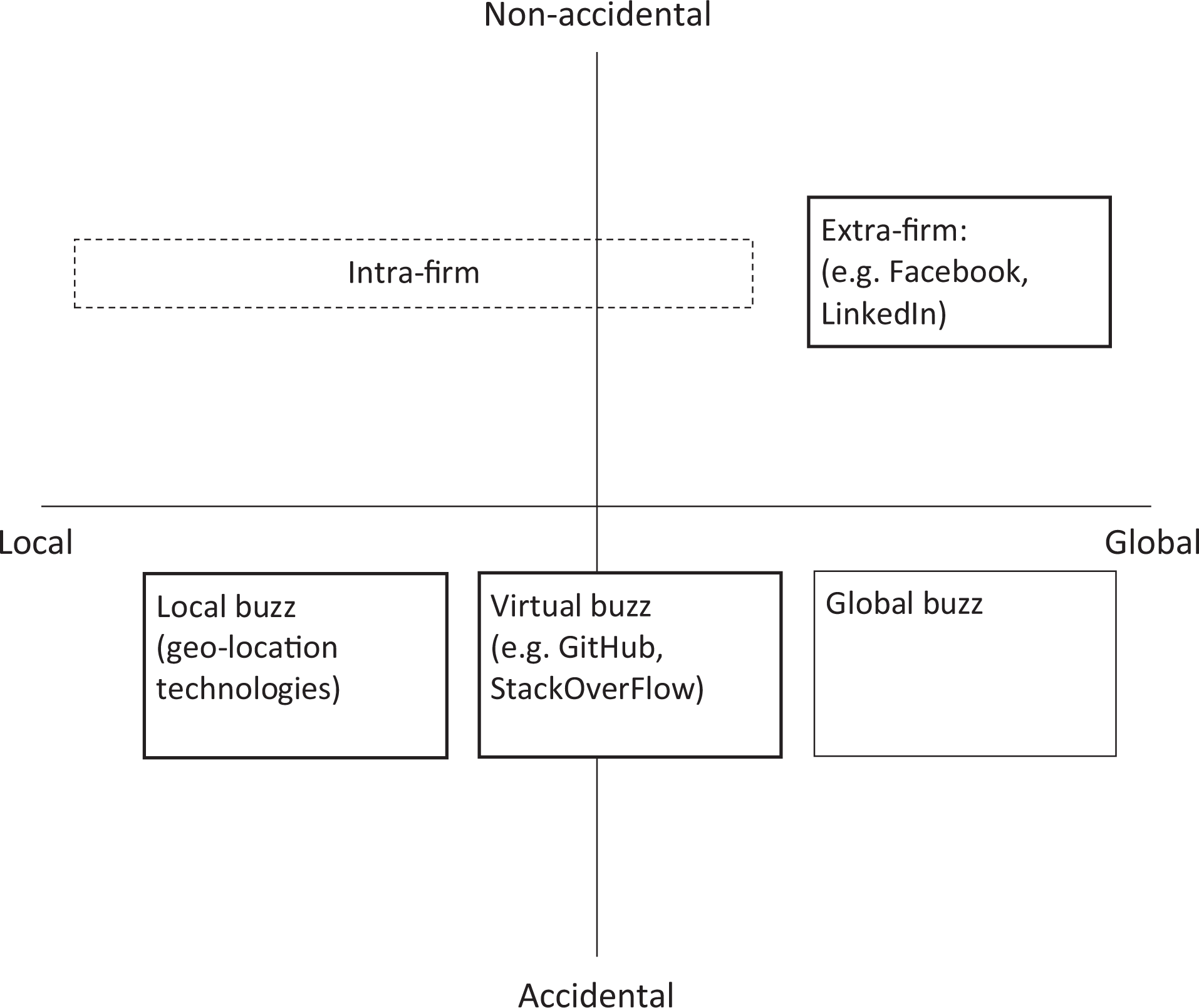
Knowledge transfer and social network sites.
Starting from the intra-firm individual interactions, although they could be unintended, they are usually formally organized and motivated and, therefore, not accidental. The management literature explores whether and how the flow of (tacit) knowledge within organizations can be supported by SNS (for a review, see Panahi, Watson, and Partridge 2013). Hildrum (2009) demonstrated the digitally mediated sharing of tacit knowledge within Cisco. More generally, knowledge-intensive companies have been using intraorganizational SNS as community-building platforms (Yardi, Golder, and Brzozowski 2008; Annabi et al. 2012; Grant 2016). Yammer (https://www.yammer.com/), for example, is an SNS for intraorganizational collaboration and Slack (https://slack.com/) started as such. LinkedIn (https://www.linkedin.com/), which is a professional SNS aiming to “[c]reate economic opportunity for every member of the global workforce through the ongoing development of the world’s first Economic Graph” (LinkedIn 2017), provides easily accessible professional information and networking opportunities for all employees of an organization, who are LinkedIn users. Grant (2016) reviewed several case studies of high-profile companies (e.g., Deloitte and Siemens), whose knowledge management strategies include SNS. Within the medical sector, Curran et al. (2009) found evidence that SNS facilitate knowledge transfer especially in areas with limited resources (e.g., in rural areas), and Hsia et al. (2006), Abidi et al. (2009), and Steininger et al. (2010) highlighted the role of digital technologies in tacit knowledge transfer. The adoption of SNS by companies, something which has been termed as “Enterprise 2.0,” is based on the idea that SNS facilitate knowledge exchange among employees and more effective knowledge leak in comparison to hallway conversations (McAfee 2009; Leonardi 2017). SNS improve communication and collaboration among staff; build relationships and communities within organizations; and establish a conversation medium that is transparent, visible to third parties, and persistent over time (Grant 2016; Leonardi 2017). Although the emphasis of management studies is on the organization of the environment where formal SNS-mediated and knowledge-related interactions take place, urban planning and economic geography benefit from such studies because they illustrate the underpinning mechanisms behind such interactions.
Having discussed organized knowledge-related interactions, the emphasis now turns to accidental interactions that are related to the notion of buzz (Bathelt, Malmberg, and Maskell 2004; Storper and Venables 2004). As Bathelt (2008) demonstrates, “buzz consists of specific information flows, knowledge transfer and continuous updates as well as opportunities for learning in organized and spontaneous meetings” (p. 169). Although buzz initially referred to externalities gained because of F2F interactions and colocation of actors, the literature nowadays offers a more nuanced understanding of buzz and distinguishes between local, global, and virtual buzz (Rutten 2016). Departing from the early Marshallian-based conceptualization, according to which economic actors gain access to tacit knowledge, information and even gossip by just being “there” (Gertler 1995), the literature recognizes the difference between the local dimension of knowledge and knowledge creation (Gertler 1995): while knowledge has local anchors because it is embedded in individuals who have relatively fixed locations (Howells 2012; Healy and Morgan 2012), knowledge creation lacks such a local character because social interactions, which are a source of knowledge creation, transcend local boundaries (Ibert 2007; Shearmur 2011). This enabled Bathelt and Schuldt (2008) to identify global buzz as the “specific information and communication ecology which develops in the temporary settings of international trade fairs and similar professional events” (p. 12). While global buzz is based on copresence and elbow rubbing, this is only temporary for as long as trade fairs last. Similarly, Jones, Spigel, and Malecki (2010) empirically identified a comparable elbow-rubbing process taking place in New York theatre blogs and coined it virtual buzz. Bathelt and Turi (2011) approached virtual buzz systematically and assessed how digital technologies can facilitate interactions between economic actors and knowledge transfer mostly in comparison to the capacity of F2F interactions. 2 Following M. Graham’s (2013) commentary on how geographical metaphors about the internet mask the underpinning power geometries and create an artificial distinction between virtual and real, virtual buzz is understood here as these accidental online interactions, which are mediated by tools such as SNS according to the definition adopted in The Sociality of Knowledge and Digital Technologies section, and do not involve physical copresence and F2F contact. Access to such tools and participation to such interactions do not cast away any real-world asymmetries.
Local buzz, as depicted in Figure 1, is characterized by strong spatial embeddedness. Localized knowledge spillovers are triggered by spontaneous meetings because of the colocation of actors (Storper and Venables 2004; Bathelt, Malmberg, and Maskell 2004). Although digital technologies do not have the capacity to supplement F2F interactions (Gaspar and Glaeser 1998), SNS facilitate such interactions through mobile internet and the check-in functions that are embedded in SNS (Ash, Kitchin, and Leszczynski 2016). Buzz involves “knowing what is happening” (Jones, Spigel, and Malecki 2010, 100) using a “densely knit web of gossip, opinions, and interpretations” (Trippl, Tödtling, and Lengauer 2009, 447; see also Grabher 2002). The 24/7 publication of our whereabouts, emotions, and personal and professional updates makes “knowing what is happening” much easier information to access. SNS increase the speed of information flow within cities because they support one-to-many communication channels and enhance search and match processes, even locally (Grabher and Ibert 2014). In essence, SNS can enhance the positive urban externalities that individuals and firms enjoy by being colocated within cities as they directly affect the micro-foundations of urban agglomeration economies: sharing, matching, and learning mechanisms (Duranton and Puga 2004). More specifically, SNS support the role that places and spaces perform for the middle ground. Places, which host local communities and the interactions among their members, can be more easily discovered by and shared within community members. Also, cognitive constructions such as spaces (Amin 2004)—for example, the various Meetup (https://www.meetup.com/) local communities—may only become activated because of SNS.
Virtual buzz refers to knowledge sharing and creation interactions, which are based exclusively on SNS, Web 2.0 and 3.0 technologies. For instance, GitHub is a well-known social coding platform that integrates workflows of code changing with online discussions on software issues and social networking. Any GitHub user can contribute to software building or seek for contributions, and the project leader can accept or not the edits (Goggins and Petakovic 2014). Similarly, Stack Overflow (http://stackoverflow.com/) is the most popular question and answer website for software developers. Both examples illustrate that SNS-mediated micro-interactions can support the transfer of not only static but also dynamic knowledge. While the former represents the transfer of existing knowledge elements between actors, the latter reflects collaborations, interactive learning, and knowledge creation processes (Camagni 1991; Lundvall 1992; Trippl, Tödtling, and Lengauer 2009). Pull requests in GitHub 3 and custom-made answers and conversations in Stack Overflow represent such dynamic knowledge exchanges that are the most effective form of knowledge creation according to Howells (2012). Both of the above examples can be seen as open markets for knowledge: “buyers” are looking for answers and solutions from “sellers,” who are being compensated with badges that increase their reputation within communities and offer professional credibility (Schenk and Lungu 2013; Goggins and Petakovic 2014). This gamification attribute has drastically affected the popularity of these websites and the creation of online communities, which obtain knowledge from this virtual buzz (Vasilescu et al. 2014).
Twitter also facilitates such accidental knowledge transfers between dislocated actors. Twitter, the microblogging and asymmetric SNS, is used as a medium to broadcast both professional and personal content (Archambault and Grudin 2012). Zhao and Rosson (2009) highlight the awareness it creates regarding what colleagues are working on (Utz 2016). The tagging of theme-specific tweets with a relevant hashtag lead to subject specific Twitter chats. These are “thematic multilogue[s] (i.e. a many-to-many conversation focused on a given theme/topic) often situated within a community of practice (CoP) and/or community of interest (CoI),” which can support “brainstorming, idea generation, idea development” and other knowledge-related interactions (Megele 2014, 14). As Jarrahi and Sawyer (2013) highlight, economic actors create geographically dislocated weak ties using Twitter, usually within these communities, in order to access knowledge. Despite the lack of a direct gamification effect, users are still motivated to participate because of the improved visibility they enjoy, which may be translated to a high number of followers and even work opportunities (Jarrahi and Sawyer 2013). Key characteristics of such online interactions is the ability of SNS to mask social and professional hierarchies, something which increases the potential of interaction and flow of knowledge (Bathelt and Turi 2011). This buzz-related knowledge transfer process, which is supported by SNS, can be viewed through the lens of social capital. All participants in such online communities represent latent ties that may be carriers of diverse knowledge. These are technically possible but not yet socially activated ties that are triggered by answering a question or contributing to a GitHub project and thus are transformed to weak ties (Ellison, Steinfield, and Lampe 2011; Haythornthwaite 2005).
The relation between social capital, online communities, and SNS is not uniform. While some SNS support online communities by promoting dense interactions, common norms, ethics, and vocabulary—see, for example, GitHub (Faraj et al. 2016)—other SNS lead to sparse interactions between week ties and, therefore, to lower potential for collaboration and knowledge creation—for example, Twitter chats. However, what is common for both cases is the capacity of SNS to enhance sociality by enabling actors to seek for other related actors and organically create social ties (Faraj et al. 2016). Hence, SNS enable and, to a certain extent, shape social relations instead of just transmitting them (Van Dijck 2012). Because of this attribute, SNS can reshape the middle ground as they enable cognitive spaces such as communities to operate online without the need for their members to be collocated.
Despite the broader benefits of virtual buzz, SNS have not substituted the costly settings of global buzz (Figure 1). Conventions, trade fairs, and similar events that enable temporary F2F interactions are growing in scope and attractiveness (Maskell 2014). Although SNS may have increased the visibility and are embedded in the organization of these events, they did not directly transform their underpinning processes that are based on the temporary colocation of actors with similar interests. SNS support the sharing and matching processes that take place during these events, but they did not alter their nature (Bathelt and Schuldt 2008).
Weak ties are also the pathway through which SNS support nonaccidental knowledge transfer at a global scale as depicted by the global pipe metaphor (extra-firm in Figure 1). As the literature illustrates, weak ties support knowledge transfer between firms even at the global scale (Yli-Renko, Autio, and Sapienza 2001; Anand, Glick, and Manz 2002; Inkpen and Tsang 2005; Wasko and Faraj 2005; Bharati, Zhang, and Chaudhury 2015). Personal and informal ties used to be part of only the local buzz conversation, while global pipelines were identified as formal ties (Fitjar and Huber 2015). Recent research has underlined the role of informal relationships in creating interorganizational collaborations (Allen 2000; Saxenian and Hsu 2001; Hansen 2014). Often, global pipelines are grounded on complex social processes and informal, personal ties (Fitjar and Huber 2015; Lorenzen and Mudambi 2013). Although both formal and informal global pipelines facilitate knowledge transfer, empirical results indicate that informal global links have stronger associations with product innovation than firm-level global partnerships (Fitjar and Huber 2015). Because they facilitate interactions between remote actors, such global links can support the transfer of diverse knowledge that is not locally accessible (Cohen and Levinthal 1990; Hansen 2014). Of course, the value of such ties is industry specific and is based on the firm dependence on external knowledge.
SNS can positively affect communication, collaboration, knowledge transfer, and innovation creation between individuals within organizations (Bharati, Zhang, and Chaudhury 2015; Jarvenpaa and Majchrzak 2010; Gray, Parise, and Iyer 2011; Meyer 2010). In the era of mass self-communication, SNS enable a global system of networked interactions (Van Dijck 2013; Castells 2009). They provide “identity information, enable […] communication between parties, and help […] bring together those with shared interests” (Ellison, Steinfield, and Lampe 2011, 15). SNS support the formation and the maintenance of informal knowledge communities that are embedded in social networks and transcend the spatial collocation of actors (Rosenfeld 2011; Grabher and Ibert 2014). For example, LinkedIn, “the largest professional matchmaker site in the world” (Van Dijck 2013, 207; Papacharissi 2009), facilitates the creation and maintenance of weak ties as its users tend to follow existing and past colleagues as well as key figures in their fields (Utz 2016). Moreover, LinkedIn is a “self-updating address book,” and individuals keep it even after they change jobs (Skeels and Grudin 2009, 98). Twitter chats perform a similar role, and as empirical research indicates, LinkedIn and Twitter users report higher informational benefits than Facebook users 4 (Utz 2016). While not many firms invest in creating constantly updated lists of potential future partners for, SNS enable the management of such latent ties and their convention to weak ones, which can enable access to diverse and locally unavailable knowledge (Maskell 2014).
The above analysis demonstrated that SNS support interactions that are able to carry knowledge, which take place within the various communities of the middle ground. Using the discussion in Grandadam, Cohendet, and Simon (2013) as a point of departure, SNS enhance the function of the middle ground because (i) they have the capacity to enrich and channel externalities produced in the underground (skilled individuals) into codebooks, scripts, and, more broadly, into forms that can be easily utilized by different actors; (ii) they support the diffusion of externalities produced by the upperground (firms); and (iii) they connect actors in different places and spaces and, in some cases, is the technology that enables the materialization of such externalities. SNS, just like other platforms, perform infrastructural functions. As Plantin et al. (2018) put it, “[d]igital technologies have made possible a ‘platformization’ of infrastructure and an ‘infrastructuralization’ of platforms” (p. 295). What has not been considered yet is whether and how SNS can challenge established geographies of knowledge and knowledge transfer. Urban planning needs to be aware of the nexus of SNS, knowledge, and interactions because of its role in designing economic clusters to facilitate knowledge spillovers through F2F interactions. The next section offers such a spatial discussion.
SNS and Knowledge-related Interactions: A Spatial Discussion
Using the typology introduced above, this section discusses whether the SNS-mediated and knowledge-related interactions mirror established geographies of knowledge and knowledge production or whether they have the capacity to challenge such patters. Howells (2012) emphasized the necessity to fully comprehend the microlevel of knowledge processes—that is how individuals interact to share and create knowledge—before attempting to make meaningful assertions about knowledge. It is not knowledge (including tacit knowledge) that is spatially sticky but the individual actors who engage in knowledge sharing and creation interactions (Rutten and Boekema 2013; Gertler 2003; Morgan 2004; Westlund and Adam 2010). Rutten and Boekema (2013) offer two dimensions to examine the geographical reflections of such knowledge networks: the spatial proximity between actors and the regional embeddedness of these actors. While the first highlights the premium for learning that spatial proximity offers, the latter highlights the spatial embeddedness of actors who engage in knowledge-related interactions.
Starting with the former, Shearmur (2011) questioned whether knowledge flows are (fully) determined by regional characteristics and highlighted the importance of spatial proximity to actors and institutions as determinants of knowledge flows. His “spatial analytic” approach in understanding the geography of knowledge-related interactions is useful in discussing whether there is a specific geography in how SNS support the local buzz type of interactions. Indeed, the effects of geolocation technologies on local buzz are characterized by size-related positive externalities. Because opportunities for social interactions scale with city size (Batty 2013), SNS can facilitate disproportionally more interactions in larger cities than in smaller ones. Both theoretical and empirical research support this argument. For instance, early work by Gaspar and Glaeser (1998) supports the idea that internet applications such as SNS can increase the demand for F2F interactions within cities and, therefore, increase the importance of cities as centers of interaction. Recent empirical research indicates that at a per capita basis, urban areas host more SNS users, more information, and higher quality of information than nonurban areas (Hecht and Stephens 2014). Therefore, the knowledge spillovers because of the dense and rich social networks within cities are further enhanced by the geolocation and information sharing technologies of SNS. Simply put, these technologies increase the pace of knowledge circulation much more in large urban areas, which already enjoy strong positive externalities, than they do in smaller urban areas.
Similarly, the use of SNS in order to create and support global pipelines of knowledge transfer enhances centripetal forces. SNS’s capacity to support global pipelines depends on absorptive capacity, which varies substantially across firms, but also places. This was originally defined as the ability of an organization to “recognize the value of new information, assimilate it, and apply it to commercial ends” (Cohen and Levinthal 1990, 128) by integrating “new pieces of knowledge into its own knowledge stock” (Fisher 2002, 114). The literature suggests that firms with lower absorptive capacity have the tendency to develop local networks, while those with higher absorptive capacity tend to develop global networks (Cohen and Levinthal 1990; Drejer and Vinding 2007; Geenhuizen 2008; Huggins, Johnston, and Thompson 2012). Using firm-level absorptive capacity as a point of departure, the notion of the aggregated absorptive capacity was developed (Miguélez and Moreno 2015) and is based on three components: the knowledge stock of the firms within a specific territory, their internal territorial links, and their external knowledge links (Giuliani 2005). Hence, the aggregated absorptive capacity of a region is something more than the simple summation of the local firms’ knowledge stock, but it is still highly dependent on it (Miguélez and Moreno 2015). It is also history dependent (Cohen and Levinthal 1990; Zahra and George 2002) and mediated by the broader territorial environment that firms operate within (Van Den Bosch, Volberda, and De Boer 1999; Giuliani 2005; Huggins and Thompson 2014). The above in combination with the cumulative nature of knowledge and innovation creation processes explain the spatially heterogeneous character of absorptive capacity (Iammarino and McCann 2006). Simply put, the ability to effectively utilize and generate new knowledge varies substantially across places (Capello and Lenzi 2014). Because of these complex, spatial processes, which shape the absorptive capacity of places, the effects of SNS on the creation of global pipelines differentiate across space. Cities which have developed an extensive knowledge base and absorptive capacity are in a better position to capitalize the new pipeline creation opportunities that SNS offer.
The SNS effects on local buzz and global pipelines are shaped by path dependencies and cumulative processes and, therefore, tend to work in favor of core areas. What escapes from this logic is the virtual buzz effects. The benefits by accidental, online knowledge transfer processes supported by SNS are less dependent on place attributes. A self-employed web developer or data analyst who works from home in a rural area can gain the same benefits by actively or passively participating in GitHub or Stack Overflow with someone located in a successful high-tech cluster. A firm which is not located in a vibrant cluster can use LinkedIn in order to find experts, reach out to them, broaden its horizon, and create weak ties (Jarrahi and Sawyer 2013). Such effects do not necessarily scale with size, and the network externalities related to these platforms are neither spatially bounded nor affected by spatial proximity. In essence, virtual buzz performs a role similar to the middle ground that is connecting the informal underground of creative individuals with the formal institutions of the upperground without the need for these layers to be collocated. For instance, both individual code developers and tech companies actively use GitHub to solve problems or deposit code; both employees and employers are active users of LinkedIn, something that enables firms to identify potential employees with the right skills based on the updated online curricula vitae even though these individuals are not necessarily actively looking for a job (Kane et al. 2016); firms connect with their customer base using various SNS and through these platforms customer communities can provide bottom-up product support, but also generate ideas for new products or solve design problems; and SNS-based platforms such as Innocentive and TopCoder crowdsource their assignments to a wide community of experts which only exists because of the SNS functionality of these platforms (Kane 2017). Following Bathelt and Turi (2011), the decentralizing role of virtual buzz can be further highlighted: “[i]n scenarios where proximity is simply untenable, the value of virtual interaction using modern information and communication technologies dramatically increases. In these cases, actors are quite willing to put up with and overcome the deficiencies of virtual interaction” (p. 528).
Although not spatially dependent, the above benefits depend upon the types of economic activities. Opportunities for SNS-mediated knowledge transfers increase with the level of digitization and sophistication of the industry or the profession. Similar observations have been made for the role of local buzz as specific industries are more dependent on accidental knowledge transfers, while in other industries (e.g., epistemic or knowledge intensive industries) nonlocal ties play a more important role (Moodysson 2008; Faulconbridge 2006; Bathelt and Turi 2011).
In agreement with the early work of Leamer and Storper (2001), this article supports the idea that SNS can affect both centripetal and centrifugal forces through their role in supporting individual interactions. The local buzz and global pipeline effects are in accordance with the early findings by S. Graham and Marvin (2001) about the splintering urbanism effect of the internet. However, the virtual buzz opportunities act as a balancing force enabling knowledge transfer–related benefits to occur in places that are not favored by strong agglomeration economies.
Conclusions
This article explores whether and how SNS support knowledge transfer and creation as well as how cities and spatial structure intervene in this process. Knowledge spillovers are often headline elements in urban planning and development strategies not only because they are tightly interwoven with economic outcomes such as productivity increase and innovation but, most importantly, because urban planners are asked to design urban neighborhoods to support the creation of economic clusters by enhancing such spillovers. However, how knowledge spillovers are affected by the increased interactions via SNS is not clear. Therefore, gaining an understanding of how widely used technologies such as SNS can support knowledge-related interactions is of great importance for the planning literature (Koo 2005; Rhoads 2010). In addition, illustrating how SNS can support knowledge transfer and creation enables us to better explain the transformative nature of digital technologies and inform the literature, which has highlighted the capacity of such technologies to support the circulation of information, but not necessarily of knowledge. Although planning research had focused on the internet early enough, it did not emphasize its role in supporting knowledge-related interactions neither the spatial reflection of these processes. Moreover, although the literature has examined the role of digital technologies in complementing or supplementing F2F interactions, it has not focused on the specific roles that SNS can perform. This article addresses the above gaps and contributes to this literature by offering an urban perspective of how these processes vary across space and whether they follow or challenge established geographies of knowledge.
The theoretical vehicle to explore these questions is the local buzz/global pipeline metaphor that offers a typology of SNS-mediated individual interactions that have the capacity to facilitate knowledge transfer between individual actors. Using this typology, this article brought together empirical literature from business studies, media studies, sociology, and economic geography to illustrate how specific SNS can support such knowledge-related interactions among individuals. This analysis was framed by the notion of middle ground that provided the necessary theoretical link between digital platforms such as SNS and the various knowledge communities that are supported by SNS. It indicated that SNS enhance the function of the middle ground and the externalities produced there. Interestingly, these processes are not equally distributed across space. On the one hand, knowledge-related interactions between individuals, which fit under the local buzz or the global pipeline typologies, seem to scale with population and have disproportionally higher effects in large urban areas following existing trajectories of knowledge production. On the other hand, purely online interactions, which fit under the virtual buzz typology, have the capacity to escape agglomeration forces and challenge established geographies of knowledge production. The above findings speak to Rhoads’s (2010) call to understand “whether face-to-face communication will be driven back or reduced by the convenience of computer-mediated communication” (p. 118).
The planning literature has praised the infrastructural functionality of SNS, which leads to increased public participation into planning processes, codesign of spaces, increased capabilities for disaster management, and place branding. However, platforms such as SNS also act as invisible infrastructures and either further enhance existing agglomeration externalities or provide a window of opportunity for places, which do not usually generate knowledge spillovers. The take-home message to the planning literature and practice is that SNS intervene with the mechanisms through which knowledge spillovers occur. Although the need for designing spaces that enhance human interactions in order to achieve knowledge spillovers has not been challenged by the extensive use of SNS and, often, SNS usage enhances these externalities, we now know that for some very specific cases, the absence of such spaces can be supplemented by current digital tools including SNS.
Footnotes
Acknowledgments
The author would like to thank Dr Max Nathan for his comments on a previous version of the paper, Prof Mark Graham for fruitful early discussions on this topic, the participants and the organisers of the 10th Geoffrey J.D. Hewings Regional Economics Workshop and the anonymous reviewers for their constructive comments.
Declaration of Conflicting Interests
The author(s) declared no potential conflicts of interest with respect to the research, authorship, and/or publication of this article.
Funding
The author(s) received no financial support for the research, authorship, and/or publication of this article.
