




Abstract
The housing choice voucher program was designed with two main goals in mind: to eliminate concentrations of poverty and the social problems it causes and to provide poor households with greater access to higher-opportunity neighborhoods. However, research suggests that voucher holders would like to move to higher-opportunity neighborhoods, but often are unable to do so. One of the most prominent reasons for this is that, in most cities and states, local law allows landlords to discriminate against potential tenants on the grounds of their “source of income” (SOI). This article reviews the literature on discrimination of voucher recipients and the potential for SOI antidiscrimination laws to mitigate some of these negative outcomes.
Keywords
Seeking a fundamental departure from the large-scale public housing developments that dominated housing provision for the nation’s neediest households through the 1960s, housing policy over the past thirty years has promoted poverty deconcentration (Galster 2013; Goetz 2003; Turner et al. 2004; Vale 2013; von Hoffman, Belsky, and Lee 2006; Williamson, Smith, and Strambi-Kramer 2009). The housing choice voucher (HCV) program (originating in 1975 as the Section 8 Existing Housing Certificate Program) was designed with two main goals in mind: to eliminate concentrations of poverty and the social problems it causes and to provide poor households with greater access to higher-opportunity neighborhoods (Basolo and Nguyen 2005; Hays 1985; Marcuse and Keating 2006; Pendall 2000a). Furthermore, vouchers were appealing because they, “Involve[d] less active interference in the production of housing by the private market than any other type of public subsidy” (Hays 1985, 140). Thus, vouchers provided a suitable alternative to the costly and unpopular government-sponsored production programs of the 1960s (Burchell and Listoken 1995; Krumholz 2004). Vouchers continue to enjoy popularity because they are recipient based, take advantage of private-sector housing, and eliminate the necessity of direct construction and management of housing by the government (Crump 2002; Johnson 2016; Matthews 1998; Orlebeke 2000; Turner 2003; von Hoffman 1996).
Numerous studies evaluate how well the voucher approach has succeeded in attaining its dual goals of mobility and poverty deconcentration. Primarily, these studies indicate that vouchers have only limited success in the realm of poverty deconcentration and access to opportunity (Carlson et al. 2008; McClure 2008; McClure and Johnson 2015; Varady et al. 2010). While theoretically, voucher holders can settle anywhere in the metropolitan area, research shows that recipients “are no more likely than nonsubsidized households to penetrate discriminatory market barriers and find rental accommodations in integrated living environments” (Carr 1999, 143). Furthermore, though many voucher holders end up living in moderate-income areas, most do not move far from their previous neighborhoods (Varady and Walker 1999). Moreover, there are deep racial divides regarding which households are more successful in finding housing in nonpoor neighborhoods (Basolo and Nguyen 2005; Briggs and Keys 2009; Pendall 2000a). Finally, nonwhite participants move to areas with greater concentrations of voucher holders and poverty (Basolo and Nguyen 2005; Guhathakurta and Mushkatel 2000; Lahr and Gibbs 2002).
While such patterns could be a result of choice on the part of the voucher holder to stay in familiar areas (Feins and Patterson 2005; McClure 2008), it has also been shown to be a response to discriminatory actions made by landlords (Charles 2003; Gilderbloom 1985; Pendall 2000a; Schwemm 2007; Turner 2003). The latter point is bolstered by analyses of voucher holders’ neighborhood preferences, which demonstrate that tenants’ stated desires conflict with their eventual choices (Wang 2016). Overall, the research suggests voucher holders would like to move to higher-opportunity neighborhoods but often are unable to do so (Bruin and Cook 1997; Kleit and Galvez 2011; Patterson and Yoo 2012; Pendall 2000a; Ross, Shlay, and Picon 2012; Turner and Ross 2005). One of the most prominent reasons for this is that, in most cities and states, local law does not require landlords to accept vouchers, thus allowing landlords to discriminate against potential tenants on the grounds of their “source of income” (SOI; Freeman 2012; Johnson-Spratt 1998). SOI discrimination has recently gained much attention in the fields of urban planning, public policy, and housing law, as cities and states struggle with how to deal with the problems of concentrated poverty, and advocates press for more protections against such discrimination (Turner 2015). This article reviews the literature on discrimination against voucher recipients and the potential for SOI antidiscrimination laws to mitigate some of these negative outcomes.
Desegregation, Poverty Deconcentration, and US Housing Policy
Segregation along race and wealth lines has a long history in the United States, and the stain of policies from decades ago—including the public housing program and Federal Housing Administration lending policies—continues to mar American cities (Briggs 2005; Collins and Margo 2000; Squires and Kubrin 2005). Institutional and governmental rules promoted investment in communities only available to whites, while divesting from low-income and minority neighborhoods (Jargowsky 2006; Squires and Kubrin 2005). Furthermore, “this isolation is perpetuated not only by the concentration of existing affordable housing in central cities and older suburbs, but by the barriers to developing affordable housing in most outlying suburbs” (Orfield 2006, 102). These patterns of segregation resulted in limited contact, and therefore increased mistrust, between different classes and races (Young 1999).
The limited legal tools available to promote inclusionary policies stymied efforts to remedy historical patterns of segregation. Over the past thirty years, the courts have grown increasingly hostile to compulsory school desegregation plans (Anderson 2002; Orfield 1995–1996, 2004). These changes in tone and content indicate that “the courts have turned away from racial integration as a positive ideal for civil society, narrowing their focus merely to remedying discrimination. This narrowing of vision ignores the ways segregation operates as an independent race-based barrier to equality of opportunity that is properly addressed by state intervention” (Anderson 2002, 1198). As a result, residential integration remains the most promising method of promoting equality of opportunity (Cashin 2004; Ellen 2000; Rivkin 1994). However, just as de facto school segregation continues, residential integration also faces considerable legal obstacles (Charles 2003; Pendall 2000a), primarily due to the fact that segregation does not raise constitutional issues unless it can be tied directly to a discriminatory act. Consequently, racial segregation remains a barrier to equal opportunity and the legal mechanisms available for dismantling it are steadily disappearing.
Yet, some policy mechanisms for facilitating desegregation do remain available. Federal housing policy has a strong formal position favoring the dispersal of affordable housing options throughout regions (Goetz 2003; McClure 2008; Schwartz 2014; Tighe and Mueller 2013). Two programs—Chicago’s court-ordered Gautreaux program and the Department of Housing and Urban Development (HUD) demonstration program, Moving to Opportunity (MTO)—tested the effects of moving poor families into nonpoor neighborhoods. Gautreaux and MTO provided low-income people with access to better schools and services in nonpoor neighborhoods and of exposure to middle-class peers and social norms (Galster and Killen 1995; Jencks and Mayer 1990; Levanthal and Brooks-Gunn 2000). The programs, while limited in scope, illustrated that improved neighborhood conditions do often result in benefits for many families (Galster 2005; Kleit 2001; Krumholz 2004; Rosenbaum 1995; Rosenbaum and Popkin 1991).
Housing policies increasingly seek to limit concentration of poverty and racial segregation through mixed income development strategies and vouchers (Imbroscio 2008; Squires and Kubrin 2005). Thus, “housing policy can be a tool for enhancing families’ economic opportunities” (Shlay 1995, 490). Conversely, poor-quality and unaffordable housing presents a significant barrier to educational achievement and self-sufficiency (Bratt 2002; Mueller and Tighe 2007; Shlay 1995). By improving the housing of low-income families, both adults and children can achieve greater success in work and in school activities (Braconi 1999; Bratt 2002; Morra 1994; Rumberger 2003; Sanborn et al. 2003; Turner et al. 2003; Wilson 1991; Young 2001).
Challenges for Voucher Holders Seeking Housing
Numerous factors limit voucher holders’ ability to find adequate housing. The foremost of these include market constraints (Devine et al. 2013; Kleit and Galvez 2011; Turner et al. 2000), use of information (Kleit and Galvez 2011; Pendall 2000b), and discrimination (Nguyen, Basolo, and Tiwari 2013; Tighe 2012). Yet all of these factors are intermingled: discrimination on the part of landlords will influence market constraints, expected or perceived discrimination will affect personal preferences, and access to information is dependent upon where landlords choose to advertise (or not) as well as how households hear about potential units. Each of these factors is shaped by real and perceived SOI discrimination.
Market Constraints and Vouchers
Of the 2,320 public housing authorities (PHAs) that offer HCV, all of them employ waitlists (Layfield 2016). At last check, approximately 75 percent of those PHA HCV waitlists are closed (Layfield 2016). While this number can vary due to region and housing market, this estimate is in line with what has been reported in other studies. A recent analysis of 83 “shrinking” cities found 80 percent of those cities had closed voucher waitlists (Tighe and Ganning 2016) and in Illinois, “51, or 72 percent, have closed voucher waitlists” (Fortino 2015, 1). While no systematic data are available regarding length of time an individual or family may stay on a waitlist, one study observes that in a number of large cities, individuals can wait on a list for a voucher for more than a decade (Tighe forthcoming). More than 5 million people in 2.2 million low-income families benefit from the HCV program (Center on Budget and Policies Priorities 2015), yet more than 10 million who do not receive any subsidy qualify.
As a result, in 2015, nearly half of all renter households were “cost-burdened”—meaning they pay more than 30 percent of their income toward housing (Joint Center for Housing Studies 2015, 30). This is especially challenging for low-income households: “In 98 of the 100 largest metros, more than three-quarters of households with incomes below $15,000, and more than half of those with incomes between $15,000 and $29,999, were housing cost burdened in 2013” (Joint Center for Housing Studies 2015, 31). Furthermore, the number of very low-income tenants who qualify for subsidies continues to grow, increasing by 18 percent between 2003 and 2013, so that only, “just over a quarter (26 percent) of eligible very low--income households received rental assistance” (Joint Center for Housing Studies 2015, 33) in 2013.
Numerous studies focus on the market constraints facing voucher recipients (Pendall 2000a; Williamson, Smith, and Strambi-Kramer 2009). Williamson, Smith, and Strambi-Kramer (2009, 120–21) discuss these constraints at length, concluding, “achieving the dispersal goal has been limited in some areas by shortages of available, affordable rental housing.” The same study estimates that 30 percent of voucher holders reside in units that are subsidized through another mechanism (typically the low income housing tax credit; Williamson, Smith, and Strambi-Kramer 2009). These data are bolstered by a report from HUD, which observes “In terms of units, we found that nearly half the units (44 percent) across all study properties either have project-based Section 8 or are occupied by voucher or certificate holders” (Buron et al. 2000, 40). These findings suggest that voucher holders, who are free to reside in any neighborhood or unit that accepts them, choose a unit in a subsidized development because few alternatives exist for them in the private sector.
Further complicating the process of renting a home using a voucher is the constrained time line placed on the tenant. HUD requires that a household finds a rental unit within sixty days of receiving their voucher. Failure to do so may result in forfeit of the voucher. While many PHAs employ more generous time lines (e.g., Chicago allows ninety days [Bowean 2016]), nearly all PHAs give voucher holders some sort of time limit in which they must find an apartment or risk losing their subsidy. Furthermore, HUD rates PHAs on their utilization rates. According to HUD guidelines, PHAs are expected to hold 98 percent utilization rates. Those that fall below 95 percent may lose the ability to add new vouchers, and those falling below 90 percent face fee increases (US HUD 2001, chap 24).
Thus, for those households lucky enough to have surmounted all of the obstacles discussed previously, which have made it off of the waitlist and obtained a housing voucher, there remains the difficulty of finding a unit which they can actually rent in a timely manner. This reality combined with the burden (perceived or real) that the inspection process places on landlords, has prompted Malaspina (1996) to criticize the role that PHAs play in the rental process, arguing that these agencies were created to operate supply-side housing, but now “inappropriate[ly] use supply-side housing policies in a demand-side program” (p. 289). Regardless of which element of the program is most onerous, it is clear HCV recipients face both market and program-level barriers to using their vouchers to relocate successfully to high-opportunity, desegregated neighborhoods.
Information Use and Misuse
For all tenants, but especially subsidized ones, choosing a rental home is replete with challenges. The rental market is characterized by imperfect information on all sides (Miron 1990; Raess and von Ungern-Sternberg 2002)—a tenant does not truly know the quality of potential homes or landlords and landlords do not truly know what kind of tenant the applicant will be. One way to address such information problems is by providing counseling. Studies demonstrate that voucher holders move to better neighborhoods more often when they receive counseling (Ladd and Ludwig 1997; Rosenbaum 1995). Yet counseling is not a required element of the HCV program, and thus many households may be at a disadvantage when seeking housing due to lack of information (Goetz 2003; Popkin et al. 2002; Powell 2005; Turner 2003). As Popkin et al. (2009) state, “While emphasizing vouchers, HUD should also require housing authorities to offer meaningful relocation counseling to help residents make informed choices and provide long-term support to help more families succeed in the private market” (p. 496).
Furthermore, some landlords use misinformation to limit the ability of voucher-holding tenants to rent from them. According to a study of race/ethnicity, age, disability, familial status, and HCV-status discrimination among HCV holders in Chicago, misinformation was one of the most robust tools used to discriminate (Chicago Lawyers’ Committee for Civil Rights Under Law, Inc. 2014). Voucher holders seeking housing found it difficult to get accurate information from owners or property managers when inquiring about housing. Furthermore, voucher holders also commonly encountered an unwillingness to make accommodations for a disability or children—both of which are protected classes under the Fair Housing Act of 1968.
Pendall (2000a) discusses how constrained markets and limited information often lead to a voucher holder choosing a distressed neighborhood, asking whether voucher holders “Should…confront discrimination by trying to move to one of the relatively limited number of rental dwellings in better neighborhoods? Or should they move to a rental in a distressed neighborhood, where landlords advertise that they welcome Section 8 tenants and where a higher proportion of residents are likely to be black?” (p. 26). A lack of information, therefore, leads to the potential for landlords to take advantage of tenants and tenants to choose what they know (their current neighborhood or a similar one), rather than risk moving to a new, higher-opportunity neighborhood where the outcome is less certain.
Discrimination
The literature on social policy preferences has long recognized that misconceptions, stereotypes, and ideology regarding the poor contribute to public support for or opposition to public policies, including refusal to accept or insure vouchers. This research suggests negative attitudes are often based on misperceptions and stereotypes of the people who may live there (Nguyen, Basolo, and Tiwari 2013; Pendall 1999; Somerman 1993; Takahashi 1997; Tighe 2010, 2012; Wilton 2002) and on assumptions made regarding the character of subsidized housing’s residents (Dear 1992; Tighe 2010, 2012; Wilton 2002). Often, the extent to which these residents are perceived as undesirable strongly shapes support or opposition to such housing (Dear 1992; Takahashi 1997; Wilton 2002). Research on attitudes people have about subsidized housing (and those living in such housing) indicates that they are most often not based on any reliable evidence, nor on the realities of subsidized housing today, but rather on stereotypes derived from past experiences with “project-based” housing (Dear 1992; Pendall 1999; Takahashi 1997; Tighe 2010, 2012; Wilton 2002).
Many Americans are not familiar with the considerable changes to “public housing” that have taken place during the last thirty years and, thus, do not understand the difference, for example, between public housing complexes and housing vouchers. Nguyen, Basolo, and Tiwari (2013) observe, “misunderstandings and misperceptions about affordable housing may exist, such as when affordable housing is mistakenly equated with public housing…Using the term ‘public housing’ is derogatory and elicits fears typically associated with older, high density and blighted housing developments that concentrate poverty” (p. 14). This lack of information and misconception of the goals and realities of housing programs furthers negative perceptions of subsidized rental housing tenants and can lead to discrimination.
In addition to discrimination based on stereotypes, families that receive a voucher often face challenges finding a rental unit due to legal discrimination against voucher holders—a practice termed “Source of Income Discrimination.” Federal law does not require landlords to accept HCVs, but many states, counties, and cities ban discrimination based on legal SOI, as discussed in greater detail below.
The result is that most voucher holders face lawful discrimination from landlords, leading to calls from some commentators for additional protections for this population, typically by an amendment to federal housing law (Beck 1996; Flagga 2011; Johnson-Spratta 1998). However, while discriminating based on SOI is legal in most jurisdictions in the United States, those who receive vouchers are disproportionately members of protected classes under the federal Fair Housing Act (which protects against discrimination based on race, national origin, gender, familial status, disability, and age) and similar state laws, suggesting discrimination against HCV recipients may be linked to a disparate impact against protected classes.
The US HUD has taken the position that defendants may be held responsible for the discriminatory effect of their actions that have a disproportionate adverse impact on a protected class, “even if the practice was not motivated by a discriminatory intent” (24 C.F.R. § 100.500). In 2015, the Supreme Court confirmed that the Fair Housing Act prohibited decisions that have a disparate impact on members of protected classes. 1 The current demographic breakdown of voucher holders is as follows: 38 percent adults with children, 21 percent elderly, 20 percent disabled adults, 12 percent childless adults, 8 percent disabled adults with children, and 1 percent elderly with children (Center on Budget and Policy Priorities 2015). Families, the elderly, and the disabled are all protected from discrimination under the Fair Housing Act. Thus, when discriminating against those with vouchers, there is often a disproportionate impact based on the tenant’s familial status, disability, or age.
Litigation arguing that landlords refusing to accept HCVs creates an unlawful disparate impact on protected classes have been met with mixed results, as tenants sometimes struggle with issues of proof (Hampton 2009; Rotem 2010). Yet lawsuits have been highly impactful in forcing local governments to adopt laws banning SOI discrimination in order to reverse racially disparate housing practices (Benning 2014). 2 This trend seems likely to continue as HUD implements its latest affirmatively furthering fair housing regulation when allocating federal funding to local governments (King 2013; Tegeler, Haberle, and Gayles 2013). 3
It is not only landlords who discriminate against voucher holders. A number of recent cases have accused insurers of discrimination that results in a disparate impact. One analysis completed by Dr. Calvin Bradford in the Jones v. Travelers case concluded, “A policy that restricts the provision of insurance to properties that do not rent to Section 8 (Voucher) households has a clear and consistent disparate impact on African-American households, households that are female-headed, female-headed households with children, and households where the head is 62 years of age or older” (Bradford 2015, 15). In denying a motion for summary judgment in the Jones v. Travelers case, the Court concluded that the insurer’s policy was motivated by stereotypes, and this policy fell disproportionately on protected classes of racial minorities, single mothers, the elderly, and the disabled. 4 This case was eventually settled, but the same insurer now faces a new lawsuit based on the same theory (Lee 2016). Therefore, there is a growing legal movement toward acknowledging the detriment discrimination against HCV recipients cause for protected classes.
SOI Antidiscrimination Laws
One policy solution for addressing the market constraints, information, and discrimination problems HCV tenants face is SOI antidiscrimination laws. Twelve states, Washington, DC, and many local governments have an SOI antidiscrimination law (Hatch in press; Poverty and Race Research Action Center 2016); however, the language of these laws vary. For example, Washington, DC, explicitly names voucher holders as a protected class (D.C. Official Code § 2–1402.31), New Jersey simply protects “source of lawful income” without defining the phrase (New Jersey Stat. § 10:5-12), while California protects SOI but excludes vouchers as a protected SOI (Cal. Gov. Code § 12955(p)(1)). 5 While Oregon has outlawed SOI discrimination since 1995, this protection explicitly excluded HCV recipients until 2014, when the exemption was repealed (Ore. Rev. Stat. § 659A.421). Conversely, in recent years, at least two states—Indiana and Texas—have explicitly prohibited cities from passing SOI discrimination ordinances. Table 1 contains a list of states with legislation addressing SOI discrimination. Dozens of local governments have also passed ordinances protecting SOI discrimination, including Chicago, New York City, and Seattle. A lengthy list of local ordinances has been compiled by Poverty and Race Research Action Center (2016).
States with Legislation Addressing Source of Income Discrimination.
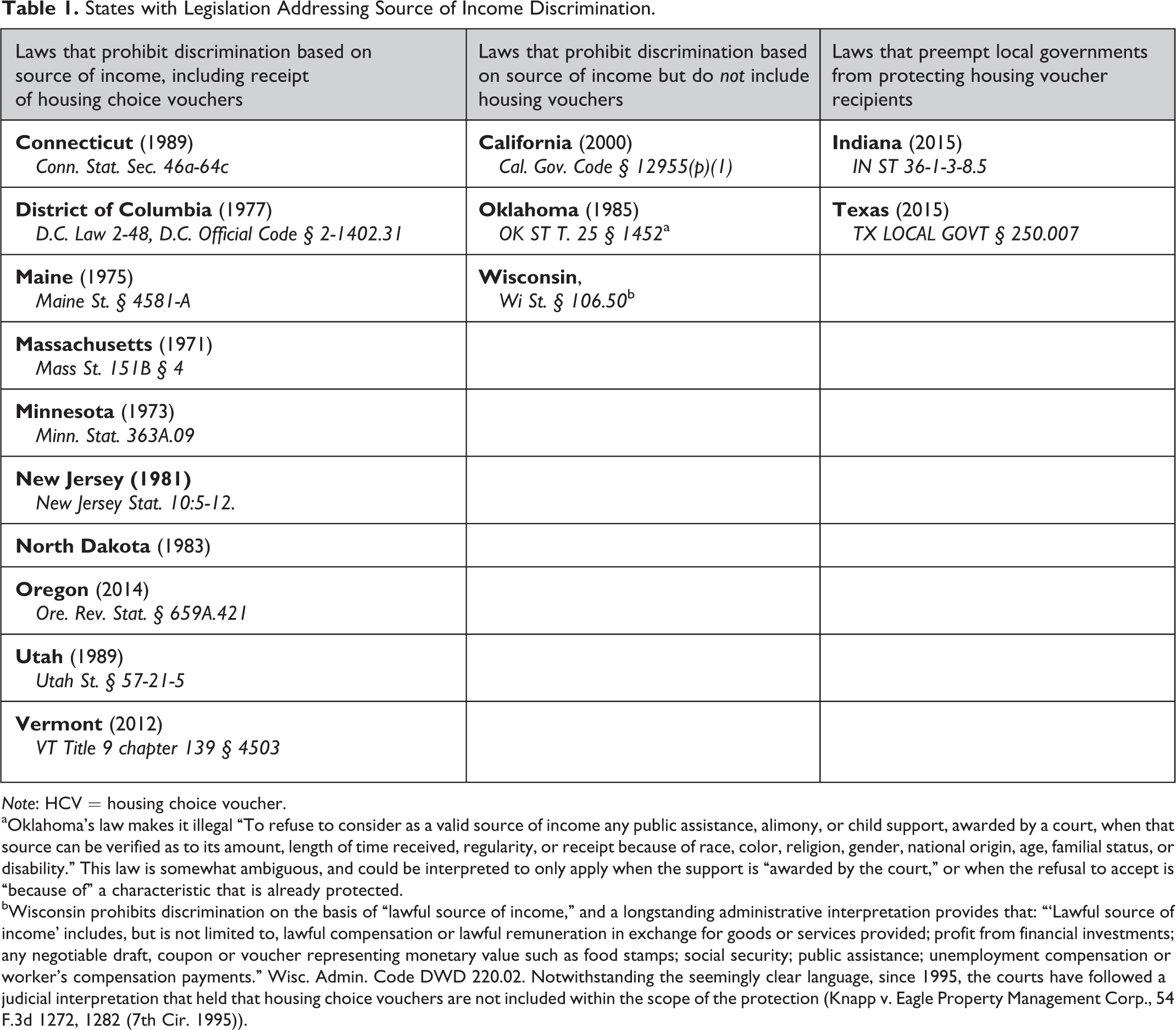
Note: HCV = housing choice voucher.
aOklahoma’s law makes it illegal “To refuse to consider as a valid source of income any public assistance, alimony, or child support, awarded by a court, when that source can be verified as to its amount, length of time received, regularity, or receipt because of race, color, religion, gender, national origin, age, familial status, or disability.” This law is somewhat ambiguous, and could be interpreted to only apply when the support is “awarded by the court,” or when the refusal to accept is “because of” a characteristic that is already protected.
bWisconsin prohibits discrimination on the basis of “lawful source of income,” and a longstanding administrative interpretation provides that: “‘Lawful source of income’ includes, but is not limited to, lawful compensation or lawful remuneration in exchange for goods or services provided; profit from financial investments; any negotiable draft, coupon or voucher representing monetary value such as food stamps; social security; public assistance; unemployment compensation or worker’s compensation payments.” Wisc. Admin. Code DWD 220.02. Notwithstanding the seemingly clear language, since 1995, the courts have followed a judicial interpretation that held that housing choice vouchers are not included within the scope of the protection (Knapp v. Eagle Property Management Corp., 54 F.3d 1272, 1282 (7th Cir. 1995)).
Places that prohibit SOI discrimination do so by including it as a protected class, alongside common categories such as race, sex, religion, and so on, in the government’s fair housing law. This allows an aggrieved tenant access to the state or local government’s enforcement mechanisms, which often include an administrative process and/or the ability to file a lawsuit.
The absence of state level protection in most states as well as the variation in language across statutes minimizes their effectiveness. This issue has led scholars (Bacon 2005; Beck 1996; Johnson-Spratt 1998) to call for a federal policy, either as an HUD regulation or an amendment to the Fair Housing Act, to limit confusion and ambiguity in language and interpretation and to offer uniform protections for all HCV recipients.
The arguments for SOI antidiscrimination laws center on the idea that they help the HCV program achieve its goals of mobility and poverty deconcentration. Such policies may eliminate barriers to matching HCV recipients with their preferred neighborhoods. Wang (2016) finds that while HCV recipients claim they prefer to live in safe neighborhoods in high-quality homes, their actual choices do not reflect these preferences. According to his survey, this is due at least in part to time limits, pricing, and landlords rejecting voucher holders. An SOI antidiscrimination law, therefore, would eliminate landlords’ ability to deny housing based on voucher status and increase the likelihood of success of finding a home in a desirable neighborhood (Daniel 2009).
Given the overrepresentation of racial minorities among HCV recipients, some have pointed to SOI protections as a mechanism for integrating neighborhoods (Beck 1996; Johnson-Spratt 1998; Krzewinski 2001). These questions have also been weighed in the courts: two prominent cases alleging that the government was not doing enough to combat racial segregation—one against Dallas, Texas, and one against Westchester County, New York—were resolved when the government defendants agreed to adopt SOI antidiscrimination laws (Benning 2014; see footnote 2). Thus, SOI antidiscrimination laws could serve to prevent disparate impact against protected classes while also decreasing segregation.
As Greenlee (2014, 11) explains, “voucher tenant selection is a landlord-driven process.” That means potential landlords have more information than tenants, and given this scenario, voucher holders are more likely to lose, for example, not locate housing. Through his interviews with landlords, Greenlee (2014) finds that landlords often have a hard time evaluating voucher recipients as potential tenants because they do not directly compare to market-rate tenants in terms of previous landlord references and the ability to pay. Given this difficulty, some landlords will take the more risk-averse path and not rent to HCV recipients. However, an SOI antidiscrimination law would prevent landlords from being able to take this path of least resistance, thus giving HCV tenants an opportunity to compete with market-rate tenants for units.
On the other hand, both economists and landlords raise objections to the spread of SOI antidiscrimination laws. In their review of the literature on the relationship between regulation and housing, Gyourko and Molloy (2014) present evidence that housing market regulation increases housing prices and rents. While these authors do not specifically mention SOI antidiscrimination regulations, these laws, like zoning, limit housing suppliers’ ability to provide housing in their preferred manner, and thus may lead to price distortions. Landlords and their advocates also argue against SOI antidiscrimination policies on the basis of free choice and equity. Landlords often claim they do not want to deal with the bureaucratic burden of being forced to take voucher recipients (Fernandez 2007; Marr 2005; Rotem 2010). They also express concern that they will lose money waiting for inspections to be complete and may have to accept lower rents than they would receive in the open market (Greenlee 2014). However, recent research from Milwaukee suggests that, conversely, landlords may actually overcharge voucher holders (Desmond and Perkins 2016). Sterken (2009) argues that, in some cases, accepting vouchers may pose an undue burden on a landlord, and, in very specific and rare situations, some landlords should receive exemptions from regulations forcing them to accept vouchers.
SOI antidiscrimination laws, therefore, are controversial. While advocates claim such policies will lead to better tenant outcomes, opponents express concerns about distorting the rental market through additional regulation. The evidence to support any of these claims is only in its infancy, and therefore, much more research is needed to evaluate their validity.
What We Know
Early research shows promise for SOI antidiscrimination laws both increasing the likelihood of HCV recipients finding a place to live and moving to a higher-opportunity neighborhood. In one of the only evaluations of these laws, Finkel and Buron (2001, 3–17) study forty-eight PHAs and 2,600 voucher households finding that, all else equal, the probability of successfully using one’s voucher within the program time frame (their definition of program success) was twelve percentage points higher in jurisdictions with an SOI antidiscrimination law. Freeman (2012) concurs, estimating voucher utilization rates increase by five to twelve percentage points when there is an SOI antidiscrimination law.
The effect of these laws on neighborhood quality, while also positive, is somewhat more moderate. Freeman and Li (2014) use a difference-in-differences approach and a border methodology to test whether voucher holders are more likely to move to low-poverty areas when they live in a municipality with an SOI antidiscrimination policy. These authors observe that between 1995 and 2008, voucher holders in places with SOI antidiscriminations laws were more likely to move to a neighborhood with a lower-poverty rate and a larger white population than recipients living in areas without an SOI law. This provides further evidence for Freeman’s (2011, viii) claim that “SOI law[s] do facilitate movement into more advantaged neighborhoods.” However, Freeman and Li (2014) caution they do not detect a decrease in the concentration of voucher holders in areas with SOI antidiscrimination laws. Why this is the case has not yet been studied.
Even in areas where there are SOI antidiscrimination laws, there is concern that nonexistent or unequal policy enforcement tempers potential positive outcomes. Nonprofit and watchdog agencies find discrimination against voucher holders still exist in places like Washington, DC (The Equal Rights Center 2005, 2008, 2013) and Chicago (Chicago Lawyers’ Committee for Civil Rights Under Law, Inc. 2014), even when there are local SOI antidiscrimination laws. For example, the Chicago Lawyers’ Committee for Civil Rights Under Law, Inc. (2014), performed fifty matched pair tests in suburban Cook County, Illinois, where there is an SOI antidiscrimination law. In 32 percent of the cases, landlords refused to rent to HCV participants. In addition, 18 percent of the time landlords only discriminated against black but not white, HCV participants indicating the intersectionality of discrimination based on race and SOI. The Equal Rights Center (2013), through testing between 2005 and 2012, observe incidence of SOI discrimination is decreasing, positing that education and outreach can reduce discrimination over time. Therefore, like most antidiscrimination policies, there persist deep concerns regarding how to enforce them effectively.
What We Do Not Know
Given the paucity of studies surrounding SOI discrimination and antidiscrimination policies, it is unsurprising that there is a lot we do not know. Based on our review, we suggest four primary areas for future research. First, more studies are needed on how SOI discrimination, both actual and perceived, affects the housing search process for voucher holders. Perceived (rather than actual) discrimination may be enough to alter HCV recipient behavior when searching for and choosing a place to live. We also need more qualitative and quantitative research on the effects of SOI antidiscrimination policies, especially in cases where there is strict law enforcement.
Second, while paired testing is often used to determine if landlords discriminate based on SOI (The Equal Rights Center 2013; Chicago Lawyers’ Committee for Civil Rights Under Law, Inc. 2014), this is complicated by the close relationship between SOI and racial discrimination (Galvez 2010). It is still difficult to distinguish whether broader patterns of discrimination and segregation are due to SOI, race, children, or another protected class. Further research needs to quantify and disentangle the effects of these various types of discrimination. This is an important first step to understanding both the scope of the problem and the effectiveness of public policy to address discrimination against HCV recipients.
Third, it is not at all clear how familiar either landlords or tenants are with SOI antidiscrimination laws. A cursory search of Craigslist advertising in a Midwest City with an SOI antidiscrimination law found that ten of the first seventeen nonduplicative advertisements stated “No Section 8” or a similar sentiment in violation of that municipality’s law—an observation corroborated by Freeman’s findings (2012). It is not clear whether landlords were aware they were violating local regulations, or whether enforcement is so lax or penalties so minor that they were comfortable flouting these regulations. Furthermore, it is unlikely outcomes will change unless knowledge of such laws is widespread. We have no evidence that municipalities that pass SOI antidiscrimination laws do any marketing or educating of landlords to promote compliance. Even if knowledge about SOI antidiscrimination laws is widespread, we do not know to what extent these laws are enforced, nor what penalties are levied.
Finally, while early studies (Finkel and Buron 2001; Freeman 2012; Freeman and Li 2014) indicate SOI antidiscrimination laws increase voucher utilization, especially to higher opportunity neighborhoods, more research in other contexts is needed to confirm these results. Why HCV recipients in areas with SOI antidiscrimination laws move to lower-poverty neighborhoods yet voucher concentration levels does not change (Freeman and Li 2014) remains unexplored. Furthermore, there are significant concerns about requiring voucher acceptance in very high-rent areas where the maximum rent allowances do not coincide with realities of the housing market. However, some municipalities have requested and secured higher maximum rent ceilings from HUD so voucher holders can remain competitive in the market and landlords will not be penalized for accepting them as payment (City of Santa Monica 2015). HUD is currently proposing changing the HCV rent determination from the current county level to the metropolitan area, what is called small area fair market rent, in certain locations (United States HUD 2016b). This would allow PHAs to pay higher rents in certain high-rent and high-opportunity neighborhoods. If HUD adopts this proposed rule change, large-scale evaluations will be necessary to determine the effect of more localized rent determination, and thus expanded opportunities in some neighborhoods, on the prevalence of SOI discrimination.
While literature on SOI discrimination is still in its infancy, it seems clear it is not a panacea for many of the problems faced by HCV participants discussed in this article. “Overt discrimination at lease-up represents only one of several ways in which landlords treat voucher tenants differently from market-rate ones” (Greenlee 2014, 19). There are still other market conditions and information problems that SOI antidiscrimination laws do not address. However, these policies may offer a starting point for policy makers concerned with helping voucher recipients find housing in low-poverty neighborhoods.
Conclusion
According to the US HUD, “The [Housing Choice Voucher] participant is free to choose any housing that meets the requirements of the program and is not limited to units located in subsidized housing projects” (US HUD 2016a, n.p.) Furthermore, all units, whether subsidized or not, “must meet minimum standards of health and safety” (US HUD 2016a, n.p.). Buildings must be certified as being in compliance with all building codes in the city. Thus, the only distinction between housing that HCV and nonsubsidized tenants live in is the method of payment—in this case, partial payment is made via a voucher provided by the government.
Despite evidence that subsidized housing residents cause no more problems than market-rate tenants; that the units rented to HCV tenants are certified as being up to code and located in and near other market-rate units and developments; and that overall, there is little to distinguish properties that rent to HCV recipients besides a willingness on the part of the landlord to do so, there is considerable evidence of discrimination against voucher holders (Bacon 2005; Galvez 2010; Krzewinski 2001; McClure 2008; Roisman 2004; Sard 2001). Housing researchers have committed considerable time and money to study the evidence supporting or refuting claims by those opposing subsidized housing—including both project-based housing and vouchers. For the most part, the research demonstrates that well-managed housing that fits the scale of the neighborhood seldom produces negative impacts (Freeman and Botein 2002; Galster et al. 2002; Nguyen 2005; Schaffer and Saraf 2003; Werwath 2004). Santiago, Galster, and Tatian (2001) specifically find that scattered-site housing (e.g., the type of housing where individual landlords accept vouchers) largely has a positive effect on neighboring property values.
However, most Americans do not know very much about subsidized housing, and are certainly not familiar with the changes in policy over time, nor the research demonstrating the lack of ill effects emanating from nearby subsidized housing (Nguyen, Basolo, and Tiwari 2013; Tighe 2012). When people do not have a lot of information about something—such as subsidized housing—they rely on cognitive shortcuts to make decisions (Lippmann 1922; McConahay 1982; Sears et al. 1997). A lack of information creates the need to infer from limited knowledge. One of the most pervasive cognitive shortcuts is stereotypes—particularly about different races and classes of people (Gilens 1996; Krysan 2000; Soss 1999). When people rely on stereotypes as cognitive shortcuts in their decision-making, it can result in discrimination and other action that limits or excludes subsidized housing (Tighe 2012).
Furthermore, the rules and regulations governing the HCV program limit the ability of tenants to find adequate housing. The sixty-day limit allowed by HUD is extremely short, given the market constraints and discrimination facing voucher holders. Enacting SOI discrimination bans can eliminate some of these barriers, although the effects may be small (Freeman and Li 2014). SOI antidiscrimination laws alone will not instantly eliminate all of the barriers facing low-income households; however, early research is promising that these policies may improve outcomes for HCV participants. We call for more research on these policies to evaluate whether they represent effective mechanisms for improving low-income housing.
Footnotes
Declaration of Conflicting Interests
The author(s) declared no potential conflicts of interest with respect to the research, authorship, and/or publication of this article.
Funding
The author(s) received no financial support for the research, authorship, and/or publication of this article.