




Abstract
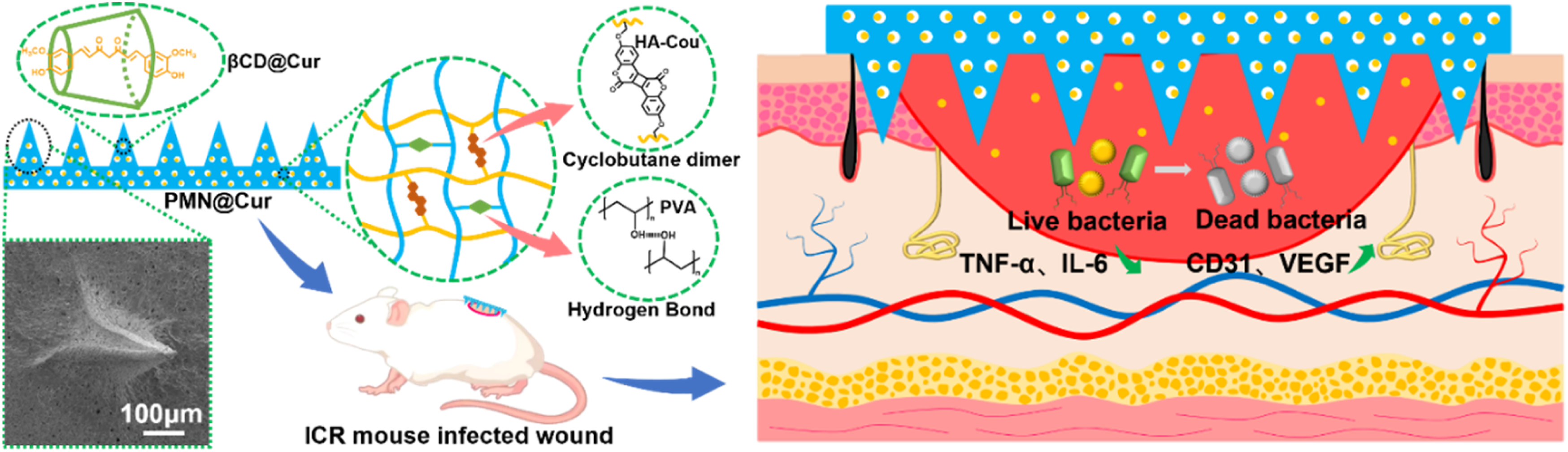
Porous microneedles (PMNs) can efficiently load drugs via capillary action within their porous structure and enable controlled drug release in deep wound layers, thereby significantly promoting wound healing. However, increasing the porosity of PMNs typically compromises mechanical strength, leading to needle tip deformation during skin penetration. To overcome this limitation, a mechanically robust porous microneedle (PMN) was fabricated by lyophilizing a chemically and physically dual-crosslinked hyaluronic acid/polyvinyl alcohol hydrogel formed in situ within a microneedle mold. The resulting PMN exhibited a single-needle bearing force exceeding the minimum threshold for skin penetration (>0.1 N) while maintaining a relatively high porosity (28.7%). Furthermore, a curcumin-loaded PMN (PMN@Cur) was easily prepared by adsorbing a curcumin/β-cyclodextrin complex solution into the abundant pores of PMN. The PMN@Cur showed sustained drug release, along with superior antioxidant and antibacterial activities. In infected wounds models, the PMN@Cur attained a wound contraction rate of up to 87.2% by day 14, demonstrating its high therapeutic efficacy in wound healing. These findings suggest that PMN@Cur, which combines high porosity with favorable mechanical properties, holds significant promise as a drug delivery system for advanced wound care.
Get full access to this article
View all access options for this article.
References
Supplementary Material
Please find the following supplemental material available below.
For Open Access articles published under a Creative Commons License, all supplemental material carries the same license as the article it is associated with.
For non-Open Access articles published, all supplemental material carries a non-exclusive license, and permission requests for re-use of supplemental material or any part of supplemental material shall be sent directly to the copyright owner as specified in the copyright notice associated with the article.
