




Abstract
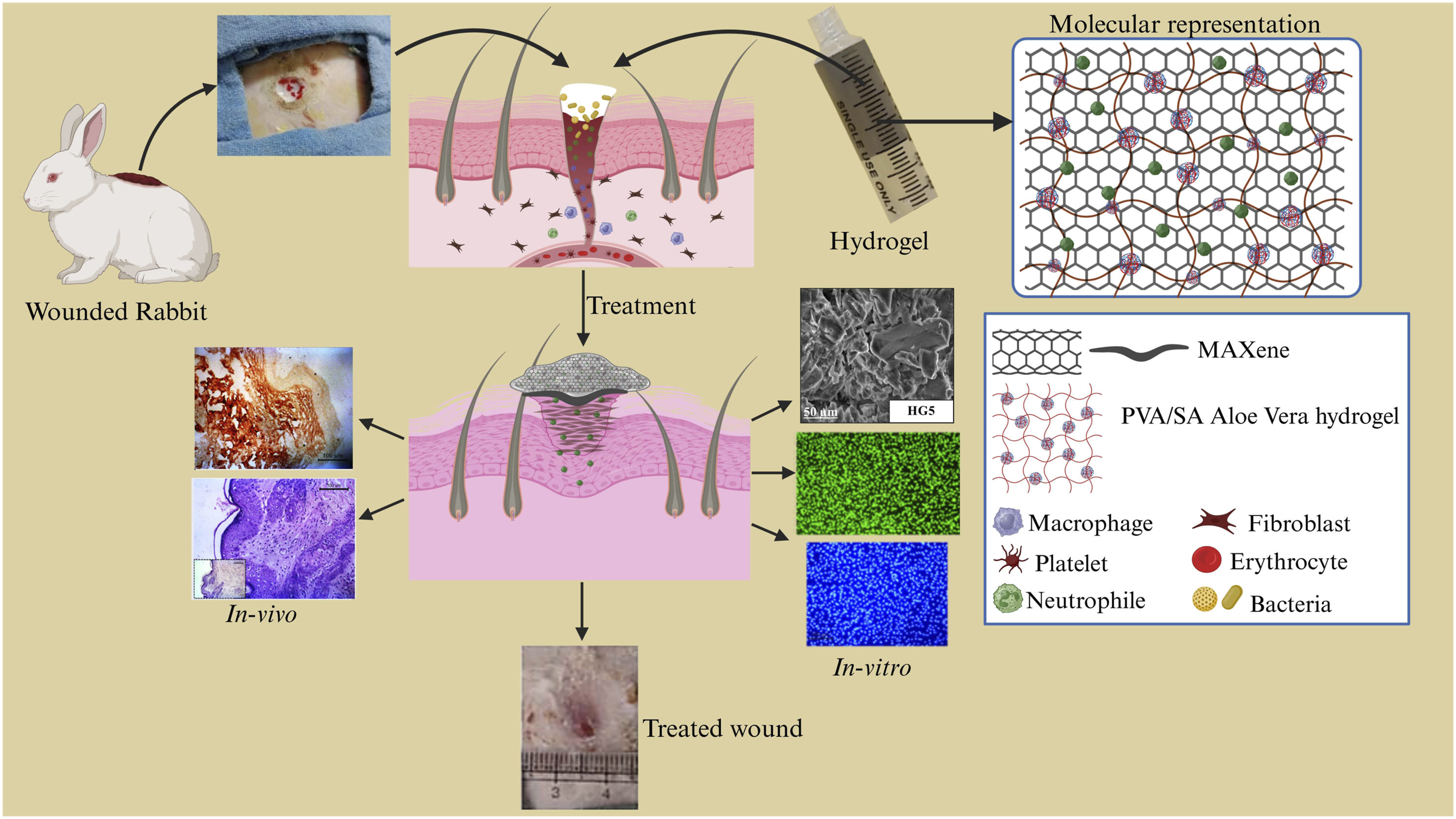
Chronic wounds represent a significant cause of amputations and mortality among patients worldwide. Wound healing materials are often inadequate to address these critical challenges. To this end, a potentially efficacious and cost-effective treatment modality was explored in this study through strategic material selection, optimised composition and systematic correlation of structure and properties. A series of novel hybrid hydrogels was developed using aloe vera, poly(vinyl) alcohol, sodium alginate and MAXene using a physical cross-linking method involving freeze-thaw cycles. A systematic study was then carried out to understand the microstructural, physical and biological properties and assess the in-vitro haemocompatibility and cytocompatibility of the developed hydrogels. A comprehensive in-vivo biocompatibility study was then carried out using rabbit model, to establish the efficacy of the hydrogels in wound healing applications. Fourier transform infrared (FT-IR) analysis confirmed interfacial chemical interactions in the synthesized hydrogels. Results from field emission scanning electron microscopy (FE-SEM) concluded that with increased Aloe Vera loading a more uniform surface morphology was displayed. Moreover, higher Aloe Vera loading indicated increased surface exfoliation of the composite hydrogel, indicating that Aloe Vera facilitated the process, a feature useful for early haemostasis. The pH study of the hydrogels in phosphate-buffered saline showed minimal deviation and an optimal pH range of 7.4–7.44 was maintained, indicating the cytocompatibility of the hydrogels. The shear thinning behaviour of the hydrogels was improved with increased loading of Aloe Vera and MAXene. All hydrogels were able to support their weight against gravity and demonstrated excellent self-supporting properties. In vitro haemocompatibility study of the composite hydrogels resulted in haemolysis values of ≤ 1%, while their cytocompatibility studies (MTT cell viability assay, FDA staining and cell nuclei study) demonstrated stimulated response of the L929 fibroblast cells, and enhanced cellular proliferation, indicating a promising potential of the MAXene-enabled aloe vera hydrogels in chronic wound healing. Finally, in-vivo biocompatibility histology (H&E staining, hydroxyproline), histochemical (collagen and reticulin) and immunohistochemical (CD-31 and type 1 collagen) demonstrated expedited wound healing, as compared to the commercially available Lycimond gel.
Get full access to this article
View all access options for this article.