



Abstract
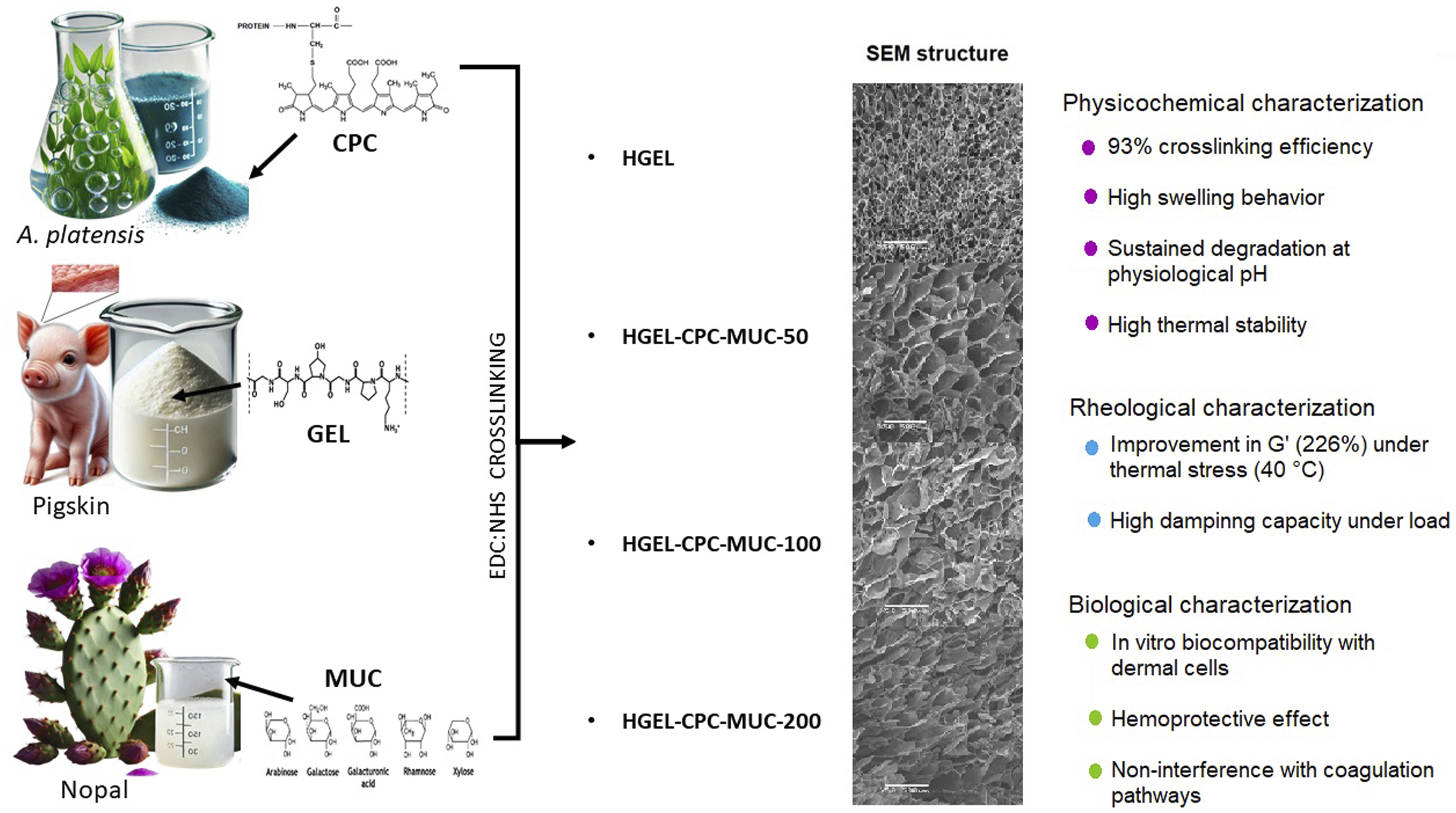
Healing persistent wounds is a current challenge for healthcare systems. Addressing this type of problem requires new and improved materials that activate regenerative processes without side effects. In this sense, in this study, C-phycocyanin (CPC), a bioactive pigment obtained from Arthrospira platensis, and nopal mucilage (MUC), a traditional Mexican element of ancestral medicine, were incorporated into gelatin (GEL)-based hydrogels and chemically crosslinked. These materials, referred to as HGEL-CPC-MUC, were prepared with varying concentrations of CPC-MUC (0-1 μg/μL of hydrogel), and their structural, physicochemical, rheological and in vitro biocompatibility properties were systematically evaluated. The main findings revealed that the incorporation of CPC-MUC into GEL-based hydrogels, significantly improves their physicochemical, mechanical and biological properties. These hydrogels exhibited a chemical crosslinking, achieving 93% crosslinking efficiency, high swelling behavior (∼1250%), rough porous surfaces, sustained degradation at physiological pH, and high thermal stability. Their rheological behavior showed an improvement in G′ (226%) under thermal stress (40 °C), along with high damping capacity under constant load with the addition of CPC-MUC. Notably, the presence of CPC-MUC imparted a hemoprotective effect, with hemolysis percentages decreasing proportionally to the CPC-MUC content and none of the hydrogels interfered with coagulation pathways. Furthermore, all hydrogels demonstrated excellent in vitro biocompatibility with dermal fibroblasts, showing no cytotoxic effects. These features become important in the context of a moist and refractory wounds such as foot ulcers and extensive burns, were moisture control, exceptional hemocompatibility and support for dermal fibroblasts viability are required, as well as the porous structure for nutrients and waste exchange. HGEL-CPC-MUC hydrogels represent a highly promising biocompatible and multifunctional scaffold for advanced wound care and regenerative medicine applications.
Get full access to this article
View all access options for this article.