




Abstract
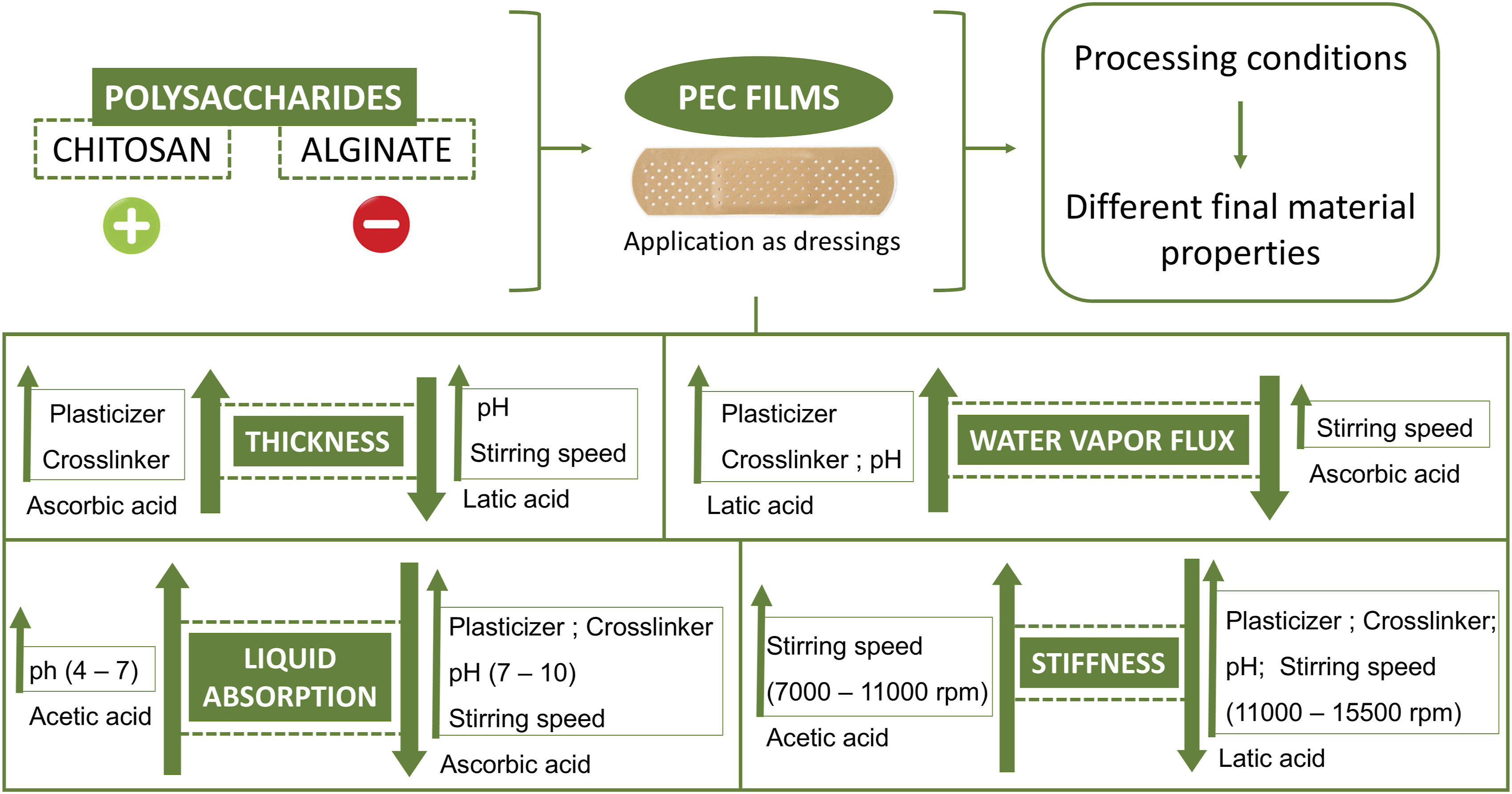
The combination of chitosan and alginate leads to the formation of polyelectrolyte complexes (PECs) that have been mainly used for applications such as wound dressings in biomedical areas. However, processing conditions can affect the resulting complex structure, influencing the final material properties. This work aims to evaluate the influence of processing conditions on the physical-chemical and mechanical properties of chitosan-alginate PEC films for wound dressing applications. The study was carried out using a Box-Behnken design, with controlled variables including pH, agitation speed, amounts of crosslinker and plasticizer, and the type of acid used in chitosan solubilization. Response variables were thickness, liquid absorption capacity, water vapor barrier, and mechanical properties, which are important characteristics in defining the applicability of dressings. All studied factors, as well as their interactions, showed significant effects on the properties of interest. The mathematical models obtained for the studied properties did not have a predictive character but rather a qualitative one, providing a good insight into the behavior of these materials regarding the modification of the evaluated experimental conditions, which strongly influence the characteristics of chitosan-alginate PEC films. Additional swelling and FTIR analyses performed for a selected sub-set of samples confirmed, respectively: (i) the high equilibrium values and stability at the equilibrium of the films regarding liquid absorption for both water and PBS; (ii) no degradation of the chitosan and alginate functional groups or loss of interaction between them under the considered processing conditions.
Get full access to this article
View all access options for this article.
References
Supplementary Material
Please find the following supplemental material available below.
For Open Access articles published under a Creative Commons License, all supplemental material carries the same license as the article it is associated with.
For non-Open Access articles published, all supplemental material carries a non-exclusive license, and permission requests for re-use of supplemental material or any part of supplemental material shall be sent directly to the copyright owner as specified in the copyright notice associated with the article.
