




Abstract
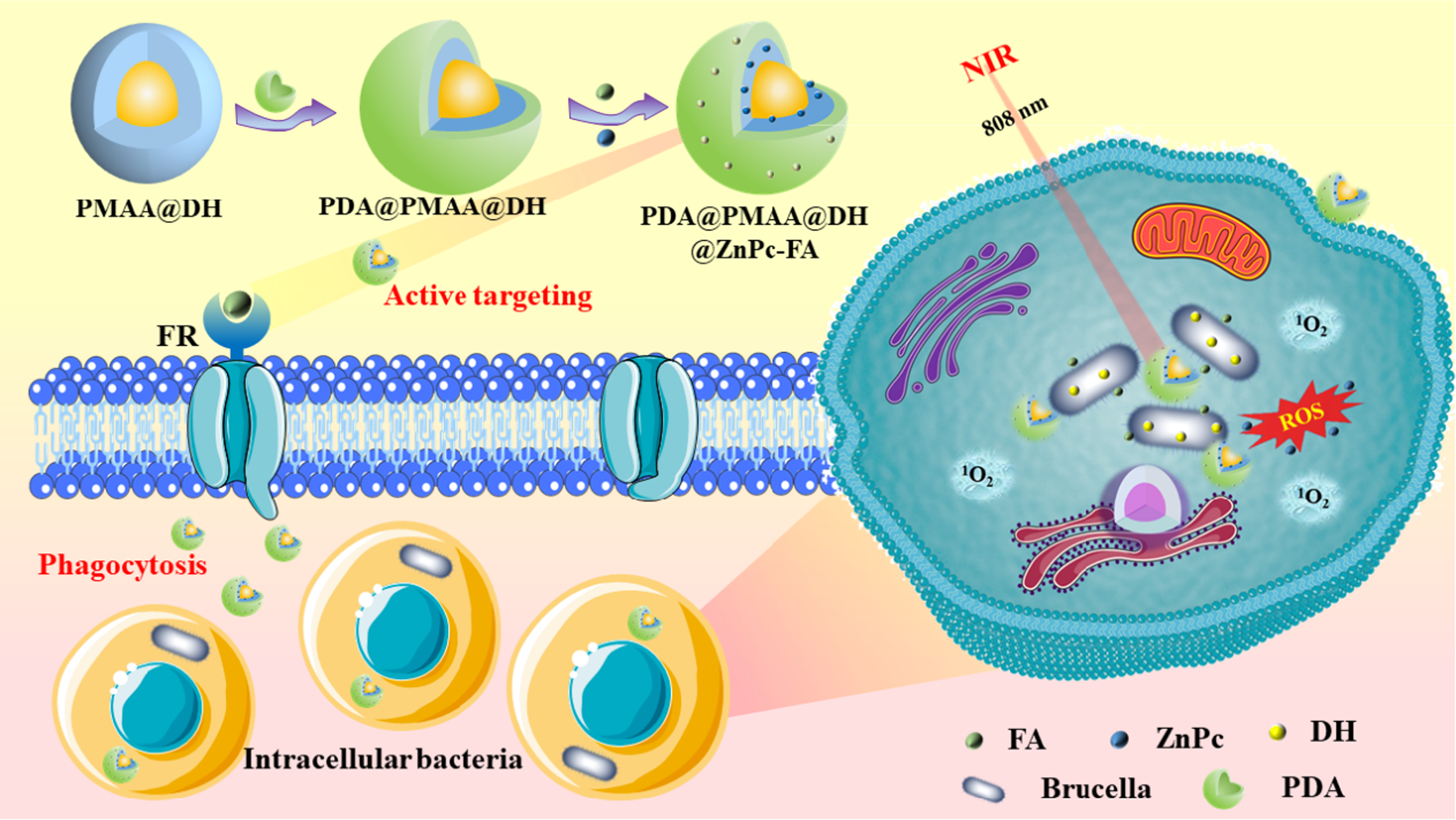
Brucellosis is an intracellular infectious disease that is primarily treated with antibacterial therapy. However, most antibacterial drugs struggle to penetrate the cell membrane and may be excluded or inactivated within the cell. In a recent study, researchers developed a nanogel coated with polydopamine (PDA) that responds to reactive oxygen species (ROS) and has enhanced adhesion properties. This nanogel encapsulates photosensitized zinc phthalocyanine (ZnPc) and an antibacterial drug, and is further modified with folic acid (FA) for active targeting. The resulting ROS-responsive nanogel, termed PDA@PMAA@ZnPc@DH-FA, can reach temperatures up to 50°C under near-infrared light, leading to a 72.1% improvement in drug release through increased ROS production. Cell staining confirmed a cell survival rate above 75%, with a low hemolysis rate of only 4.633%, indicating excellent biocompatibility. Furthermore, the study’s results showed that the nanogel exhibited stronger killing effects against Brucella compared to administering the drug alone. Under near-infrared irradiation, the nanogel achieved a bacteriostatic rate of 99.8%. The combined approach of photothermal therapy and photodynamic therapy offers valuable insights for treating Brucella.
Get full access to this article
View all access options for this article.
References
Supplementary Material
Please find the following supplemental material available below.
For Open Access articles published under a Creative Commons License, all supplemental material carries the same license as the article it is associated with.
For non-Open Access articles published, all supplemental material carries a non-exclusive license, and permission requests for re-use of supplemental material or any part of supplemental material shall be sent directly to the copyright owner as specified in the copyright notice associated with the article.
