




Abstract
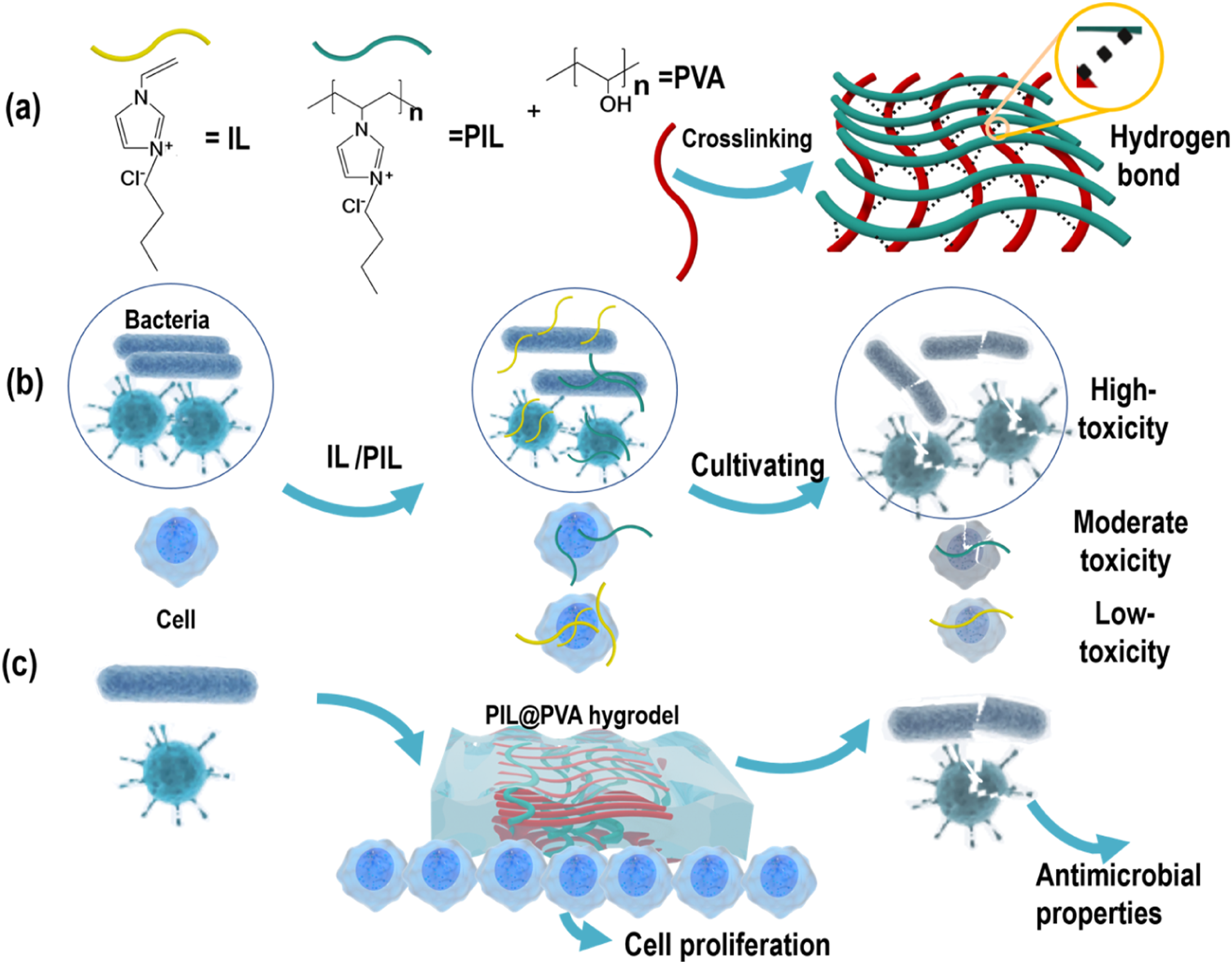
The release of antibiotics or anions by traditional bacteriostatic agents led to the development of bacterial drug resistance and environmental pollution. Ionic liquids (ILs) have become important choices for antibacterial agents because of their excellent physical, chemical and biological properties. In this paper, the bioactivities of 1-vinyl-3-butylimidazolium chloride ([VBIM]Cl, IL) and poly (1-vinyl-3-butylimidazolium chloride) (P[VBIM]Cl, PIL) were evaluated, and the potential antibacterial material was used to synthesize hydrogels. Using the colony formation assay and the Oxford cup method, antibacterial effect of IL and PIL were tested. Cell-Counting-Kit-8 (CCK-8) experiments were used to study the IC50 (half maximal inhibitory concentration) values of IL and showed 1.47 mg/mL, 0.35 mg/mL and 0.33 mg/mL at 24 h, 48 h and 72 h, respectively. The IC50 value of PIL were 12.15 μg/mL, 12.06 μg/mL and 11.76 μg/mL at 24 h, 48 h and 72 h, respectively. The PIL is further crosslinked with polyvinyl alcohol (PVA) to form a novel hydrogel through freeze-thaw cycles. The newly fabricated hydrogel exhibited a high water content, excellent water absorption properties and outstanding mechanical performance. Using the colony formation assay and the inhibition zone assay, the hydrogels exhibited favorable antibacterial effects (against E.coli and S.aureus) such that nearly 100% of the bacteria were killed in liquid medium while cultivating with H4 (synthesized by 0.5 g PIL and 1g PVA). In addition, the cytotoxicity of PIL was significantly reduced through hydrogen bond crosslinking. H4 showed the highest antibacterial activity and a good biocompatibility. The results indicated that the PVA&PIL hydrogels had great potential for wound dressing.
Get full access to this article
View all access options for this article.
References
Supplementary Material
Please find the following supplemental material available below.
For Open Access articles published under a Creative Commons License, all supplemental material carries the same license as the article it is associated with.
For non-Open Access articles published, all supplemental material carries a non-exclusive license, and permission requests for re-use of supplemental material or any part of supplemental material shall be sent directly to the copyright owner as specified in the copyright notice associated with the article.
