




Abstract
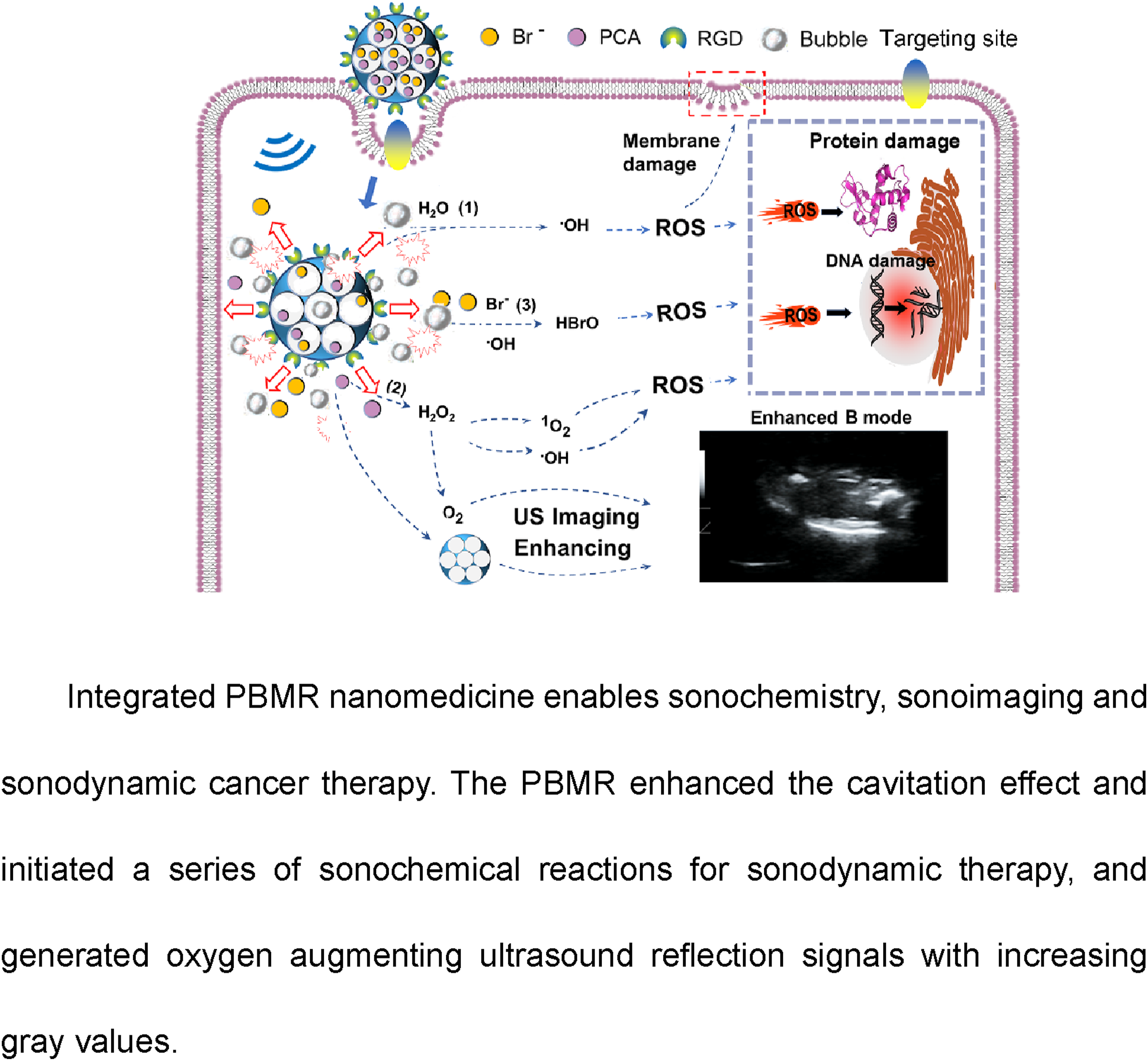
Sonography with its non-invasive and deep tissue-penetrating characteristics, not only contributes to promising developments in clinical disease diagnosis but also obtains acknowledgments as a prospective therapeutic approach in the field of tumor treatment. However, it remains a challenge for sonography simultaneously to achieve efficient imaging and therapeutic functionality. Here, we present an innovative integrated diagnosis and treatment paradigm by developing the nanomedicine of percarbamide-bromide-mesoporous organosilica spheres (MOS) with RGD peptide modification (PBMR) by loading percarbamide and bromide in MOS which were prepared by a one-step O/W microemulsion method. The PBMR nanomedicine effectively modifies the tumor acoustic environment to improve sonoimaging efficacy and induces sonochemical reactions to enhance the production of reactive oxygen species (ROS) for tumor treatment efficiency under sonography. The combination of PBMR nanomedicine and SDT achieved multiple ROS generation through the controlled sonochemical reactions and significantly boosted the potency of sonodynamic therapy and induced significant tumor regression with non-invasive tissue penetrability and minimizing damage to healthy tissues. Simultaneously, the generation of oxygen gas in the sonochemical process augments ultrasound reflection, resulting in a 4.9-fold increase in imaging grayscale. Our research establishes an effective platform for the synergistic integration of sonoimaging and sonodynamic antitumor therapy, offering a novel approach for precise antitumor treatment in the potential clinical applications.
Keywords
Get full access to this article
View all access options for this article.
References
Supplementary Material
Please find the following supplemental material available below.
For Open Access articles published under a Creative Commons License, all supplemental material carries the same license as the article it is associated with.
For non-Open Access articles published, all supplemental material carries a non-exclusive license, and permission requests for re-use of supplemental material or any part of supplemental material shall be sent directly to the copyright owner as specified in the copyright notice associated with the article.
