




Abstract
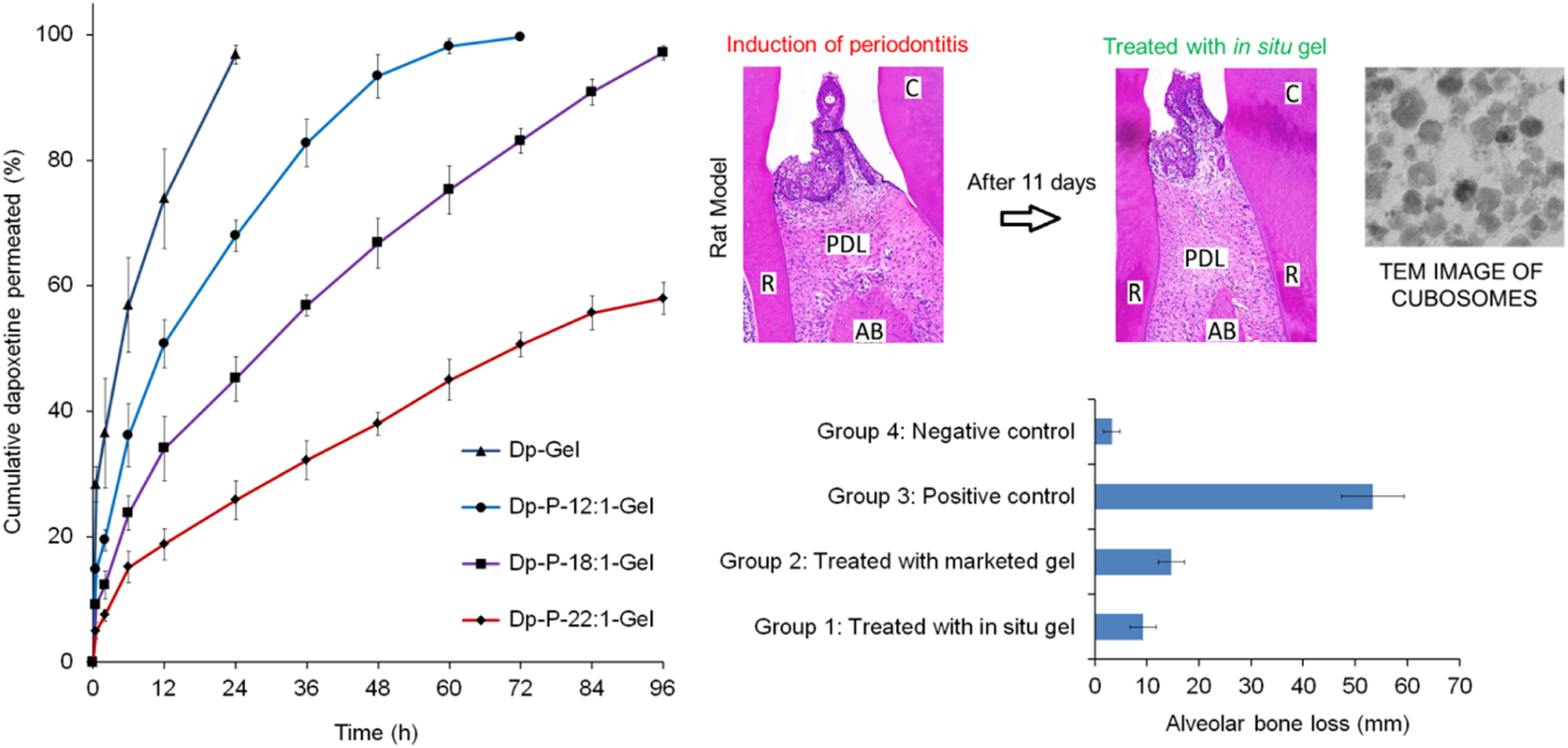
Periodontitis is a chronic inflammatory disease affecting teeth, periodontal ligament and alveolar bone. Current treatment options include surgery or oral antibiotics. Oral dosage forms shows systemic side effects due to frequent dosing and it failed to reach the therapeutic concentration in the periodontal cavity. In this work, a novel in situ gel loaded with azithromycin laden lipid liquid-crystalline nanoparticles (cubosomes) was formulated for effective treatment of periodontitis. Cubosomes were prepared using DL-α-monoolein (MO) and Pluronic®F-127, and characterized for size, zeta potential, shape, and entrapment efficacy. In situ gel laden cubosomes were evaluated for pH, drug content, viscosity, syringeability, mucoadhesive strength, texture profile, gelation temperature, gel strength, in vitro release profile, antimicrobial activity and in vivo efficacy in rat model. Cubosomal size (137–450 nm) and entrapment efficacy (74–88%) increases with increase in the level of MO. The in situ gel-cubosomal batches showed sufficient viscosity (878–956 cp), syringeability (125–150N), mucoadhesive strength (25.7–26.2 dyne/cm2), gelation temperature (34.3–35.3oC), gel strength (45–51 s), and texture profile for periodontal application. The in vitro release profiles showed sustain azithromycin release for 24h from the in situ gel-cubosomal gels compared to 4h from the marketed azithromycin gel. The in vivo studies (alveolar bone loss and histopathology) in rat model confirmed the efficacy of in situ gel to treat periodontitis at low frequency of dosing compared to marketed gel. In conclusion, the study demonstrated the potential of cubosomes to sustain the release of azithromycin from in situ gelling system for effective treatment of periodontitis.
Get full access to this article
View all access options for this article.
References
Supplementary Material
Please find the following supplemental material available below.
For Open Access articles published under a Creative Commons License, all supplemental material carries the same license as the article it is associated with.
For non-Open Access articles published, all supplemental material carries a non-exclusive license, and permission requests for re-use of supplemental material or any part of supplemental material shall be sent directly to the copyright owner as specified in the copyright notice associated with the article.
