




Abstract
Curcumin (CUR), obtained from turmeric, has biological advantages, but low aqueous solubility restricts its pharmaceutical applications. In the present work, a mixed polymeric nanomicellar formulation composed of bioactive Pluronic P123, Pluronic F68, and biocompatible phosphatidylcholine (PC) was designed and examined as the nanovehicles for overcoming the major barriers of poor bioavailability related to CUR. The CUR-incorporated P123/F68/PC mixed nanomicellar formulation (CUR-PFPC) was fabricated by the thin film technique and investigated in vitro. The fabrication of CUR-PFPC was optimized through D-optimal design. CUR-PFPC morphology, size distribution, zeta potential, drug encapsulating and incorporation efficiency, compatibility, and crystallinity were characterized using DLS, TEM, FTIR, XRD, and DSC analysis. Moreover, the cumulative drug release, antioxidant assays, and antimicrobial properties of formulations were also examined. The CUR-PFPC formulation exhibited a micellar size of 67.43 nm, a zeta potential of −15.1 mV, a PDI of 0.528, and a spherical shape. The mixed micellar formulation showed excellent compatibility and stability. The in vitro release profile of the CUR-PFPC reached over 60% in comparison to the 95% release of CUR, indicating a slow and sustained release. The DPPH assay showed that the CUR-PFPC had 96% antioxidant activity. Results show that the CUR-PFPC has powerful antibacterial and antifungal properties, which separates it from the free CUR. These findings suggest that the fabricated CUR-PFPC mixed polymeric nanomicellar formulation is thermodynamically and kinetically stable and may be considered a novel nanovehicle for hydrophobic antimicrobial drugs like CUR.
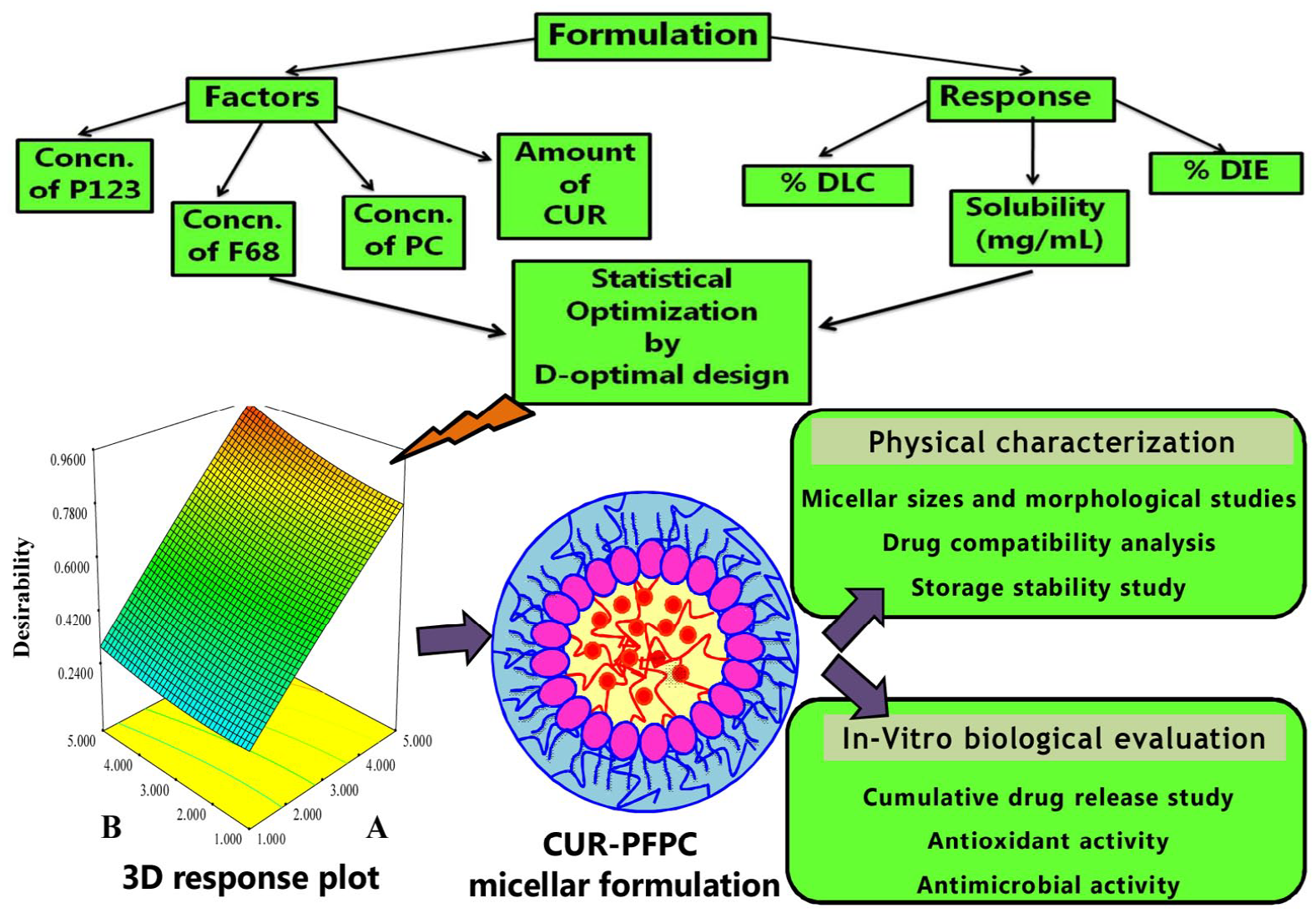
Graphical Abstract
Keywords
Get full access to this article
View all access options for this article.
References
Supplementary Material
Please find the following supplemental material available below.
For Open Access articles published under a Creative Commons License, all supplemental material carries the same license as the article it is associated with.
For non-Open Access articles published, all supplemental material carries a non-exclusive license, and permission requests for re-use of supplemental material or any part of supplemental material shall be sent directly to the copyright owner as specified in the copyright notice associated with the article.
