




Abstract
The Canadian Association of Radiologists (CAR) Incidental Findings Working Group has updated its guidance on the management of incidentally detected gallbladder polyps, originally published in 2020. Prompted by new evidence and recent international guidelines, the Working Group re-evaluated the literature and assessed both the 2022 Society of Radiologists in Ultrasound (SRU) Consensus Recommendations and the 2022 joint European guidelines. The updated guidance reflects a shift toward assessing polyp morphology and reduced surveillance and intervention for small polyps, endorsing the SRU’s evidence-based, risk-stratified approach over the more conservative European recommendations. This update aims to minimize unnecessary imaging and surgery for benign polyps while maintaining patient safety.
In 2018, the CAR Incidental Findings Working Group was formed and tasked with either adapting preexisting American College of Radiology (ACR) guidelines to meet the concerns of the CAR membership or authoring new recommendations. In 2020, the CAR Working Group reviewed the literature available at the time and endorsed the 2013 ACR White Paper on managing incidental gallbladder and biliary findings.1,2 Since the publication of the original 2020 Incidental Hepatobiliary Recommendations, new research and international recommendations have been published, prompting interval re-evaluation of the literature around the management of incidentally detected gallbladder polyps.
The original CAR Working Group recommendations included discussion regarding the previously limited research documenting demonstrated survival benefit with surveillance of small (<6 mm) gallbladder polyps as well as the uncertainty surrounding the natural history of gallbladder polyps from 6 to 9 mm. A large population-based study by Szpakowski and Tucker of over 600 000 patients demonstrated no increased relative risk of gallbladder carcinoma in those patients with asymptomatic gallbladder polyps compared to patients without gallbladder polyps. 3 This study clearly documents the absence of any survival benefit related to surveillance of small (<6 mm) gallbladder polyps, and contributed to the development of the 2022 Society of Radiologists in Ultrasound (SRU) Consensus Conference Recommendations on the management of incidentally detected gallbladder polyps.
The SRU Recommendations stratify gallbladder polyps into 3 categories: extremely low risk, low risk, and indeterminate risk based upon patient factors and polyp morphology, with corresponding management recommendations (Figure 1). 4 The SRU recommendations increased the size threshold of polyps requiring follow up or surgical management and should serve to decrease unnecessary follow up ultrasound examinations and cholecystectomies for benign gallbladder polyps. Further subsequent publications have clarifying common clinical scenarios 5 and confirmed a high inter-reader agreement when applied independent of experience, 6 ensuring ease of use across broad groups of patients and radiologists.
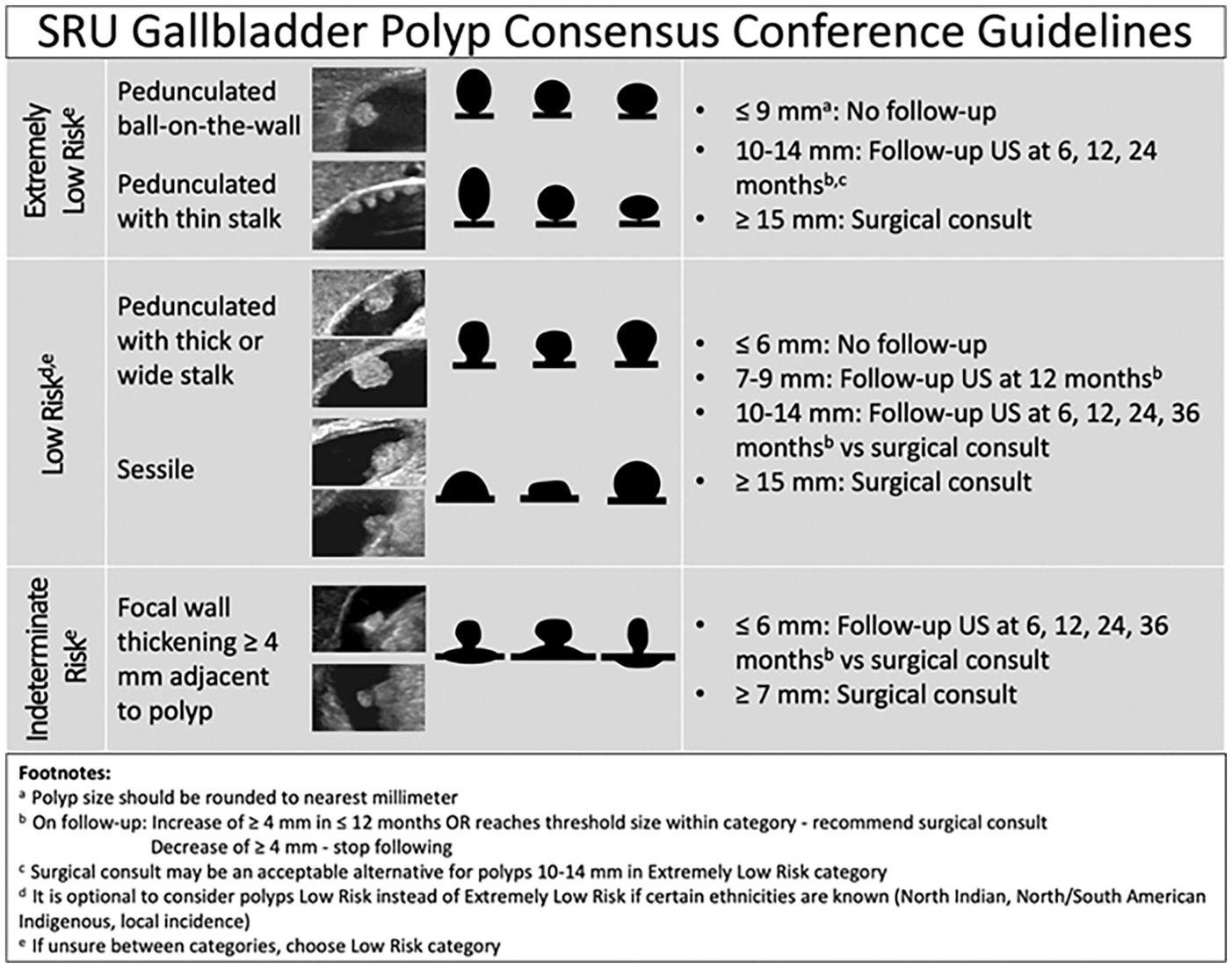
Summary of the 2022 SRU gallbladder polyp consensus conference recommendations.
Interestingly, joint guidelines from Europe including the European Society of Gastrointestinal and Abdominal Radiology (ESGAR), European Association for Endoscopic Surgery and other Interventional Techniques (EAES), International Society of Digestive Surgery-European Federation (EFISDS), and European Society of Gastrointestinal Endoscopy (ESGE), were concurrently published in 2022 7 separate from the SRU Consensus recommendations. The CAR Working Group previously elected not to endorse the 2017 European guidelines due in large part to the recommendations regarding follow up of polyps <6 mm in size. The updated 2022 European guidelines continue to recommend cholecystectomy for all polyps ≥1 cm (similar to the 2013 ACR White paper and unchanged from the 2017 European recommendations), polyps of any size with symptoms potentially attributable to the gallbladder, polyps with growth of 2 mm or more within a 2 year period, and in polyps 6 to 9 mm with risk factors for malignancy. Risk factors for malignancy were updated in the 2022 European guidelines to include age more than 60 years, history of primary sclerosing cholangitis, Asian ethnicity, or sessile polypoid lesion including focal gallbladder wall thickening >4 mm. In the absence of these risk factors, follow-up for polyps ≤5 mm is no longer recommended. The European guidelines, however, still recommend follow-up for polyps ≤5 mm when there are underlying risk factors for malignancy.
The CAR Working Group reviewed the 2022 SRU Recommendations as well as the 2022 European joint guidelines, as both major guidelines have been published since the original 2020 CAR recommendations were developed. The literature reviewed between the 2 publications were similar, though the ultimate recommendations differed with the European recommendations remaining much more conservative than the SRU with respect to both follow-up and the lower threshold for surgery. Given the continued low to moderate evidence surrounding the recommendations, and being cognizant of the systemic impacts of continued follow up and/or surgical management for likely benign pathology, the CAR Incidental Findings Working Group supports and endorses the SRU Gallbladder Polyp Recommendations, as summarized in Figure 1, over the European recommendations.
While supporting the 2022 SRU Gallbladder Polyp recommendations, the CAR Incidental Findings Working Group recognizes the need for further research to guide future iterations of gallbladder polyp recommendations, particularly around the natural history of small-moderate sized (6-15 mm) gallbladder polyps, focal gallbladder wall thickening/sessile polyps, and cost-effectiveness of surveillance recommendations to inform future iterations of the CAR, SRU, and European guidelines.
Footnotes
Declaration of Conflicting Interests
The author(s) declared no potential conflicts of interest with respect to the research, authorship, and/or publication of this article.
Funding
The author(s) received no financial support for the research, authorship, and/or publication of this article.
