



Abstract

Introduction
Many modern CT scanners have an under-utilized low-power mode which could result in significant cost, energy, and greenhouse gas emission savings if a CT scanner is placed in a low-power mode in non-operational hours.1,2 Our team of radiologists and imaging support staff modelled potential energy savings of using low power mode, when clinically appropriate, in our region, inclusive of a diverse network of Canadian public academic and community hospitals serving a major Canadian metropolitan area of 3.3 million people. In this initiative we incorporate vendor provided power use data and site-specific clinical use information to model available energy savings from powering down CT scanners in non-operational hours.
Methods
Of the 37 scanners in our region, 20 were excluded due to lack of a practical low-power mode (18/20) or lack of energy use data provided by the manufacturer (2/20). A practical low-power mode was defined as ability to both power down to lower power mode and to power up to ready to scan in less than 10 minutes.
Clinical use data was obtained from site specific data records between August and October 2022 for the remaining 17 scanners. Clinical use criteria were assessed during 6-hour evening (7 pm- 1 am) and/or night-time (1 am-7 am) weekday periods and a 12-hour 7 am to 7 pm period during weekends. Each CT scanner was placed into 1 of 3 groups based on average clinical-use in non-operational times: light-use for virtually no use on evenings and/or weekends; medium-use where fewer than one scan was performed every 2 hours evenings and/or weekends; heavy use where scans were more frequent than once every 2 hours in all time periods. The energy saved during a given off-hour period was calculated as:

where
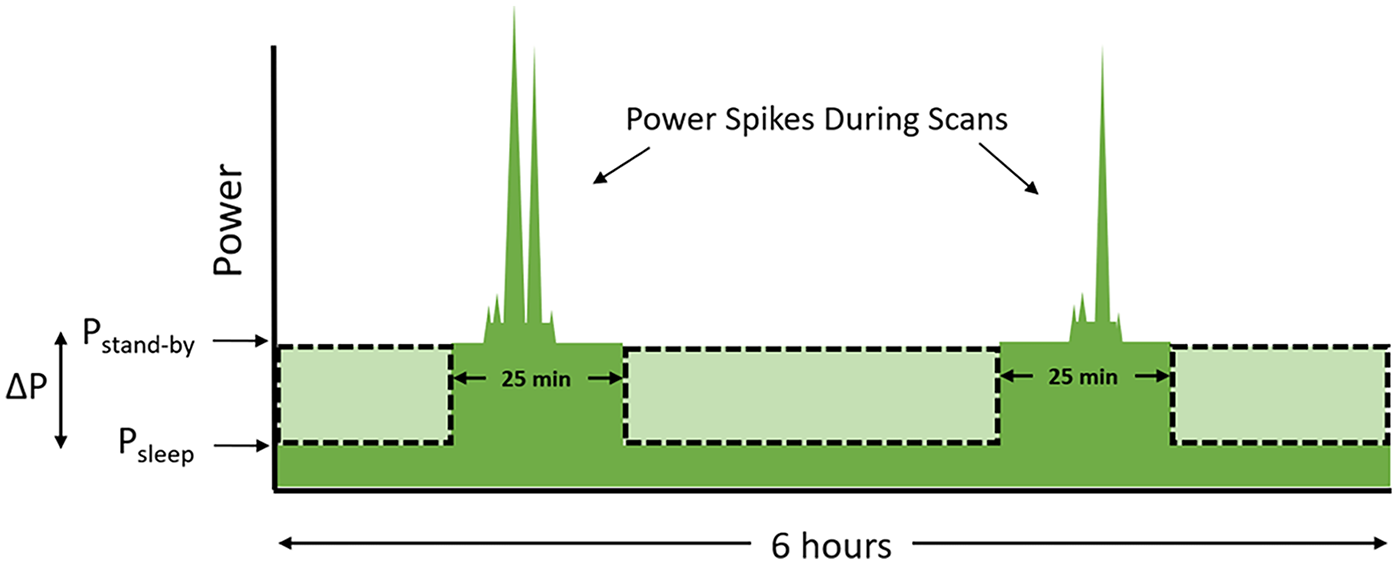
Schematic of off-hours CT Power Consumption. Light green is power savings when scanner is placed in low-power mode when not in use (not to scale).
Results
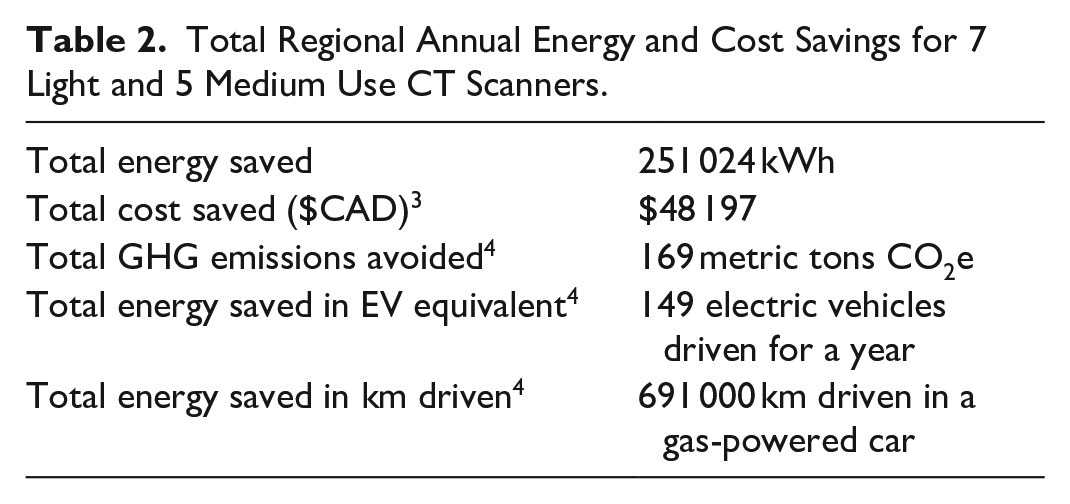
Of the 17 scanners considered, 7 were categorized as light use, 5 as medium-use, and 5 as heavy use and too busy for power-down. Table 1 shows annual time spent in low-power mode, annual energy savings, and equivalent cost and tonnes of green-house-gas (GHG) emissions saved. Regional savings for all CT scanners in light use (7) and medium use (5) clinical use categories available for participation in the study are summarized in Table 2. Equivalent cost and GHG emission savings were calculated using the US EPA equivalencies calculator.3,4
Estimated Savings From Powering Down CT Scanners Per Scanner Per Year.
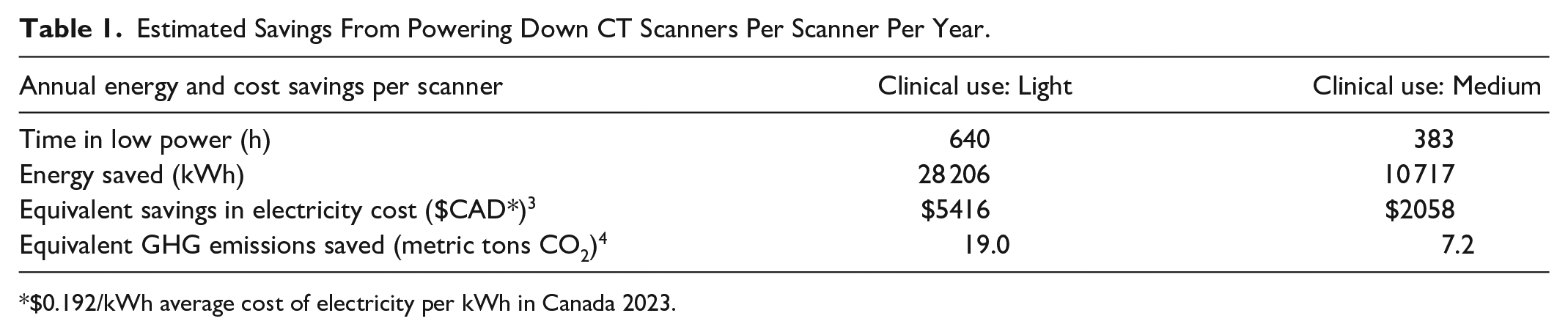
$0.192/kWh average cost of electricity per kWh in Canada 2023.
Total Regional Annual Energy and Cost Savings for 7 Light and 5 Medium Use CT Scanners.
Discussion
Our modelling study suggests significant cost and GHG emission savings are possible when CT scanners are placed in low power mode in non-operational hours, including clinical settings requiring intermittent use outside of regular operating hours. Currently, significant engagement of technologist and operations teams is required to recognize these savings. Future work with change management practices to optimize buy-in to establish new policies will be of interest. In addition, collaboration between radiologists and vendors to embed energy savings practices with clinical implementation of updated and new CT scan equipment will be essential for future responsible energy use.
Footnotes
Declaration of Conflicting Interests
The author(s) declared no potential conflicts of interest with respect to the research, authorship, and/or publication of this article.
Funding
The author(s) disclosed receipt of the following financial support for the research, authorship, and/or publication of this article: Doctors of BC, Specialist Services Committee grant.
