




Abstract

Introduction
Radiology, as a specialty, lacks gender diversity, both in trainees and at more senior leadership and academic levels. 1 Female representation at scientific conferences, an essential component of academic careers, is crucial for engagement and fostering inclusivity and equity. 2 Female representation amongst presenters, who are highly visible, can serve as role models to trainees and colleagues, and can potentially promote diversity in the field.2,3
This study aims to assess trends in gender representation at the Canadian Association of Radiologists Annual Scientific Meetings (CAR ASM) over the last 6 meetings.
Methods
Data, including numbers of total and female CAR members, CAR ASM attendees, and invited presenters between 2018 and 2024 were obtained from the CAR. No meeting was held in 2020 due to the COVID-19 pandemic resulting in a total of 6 scientific meetings analyzed. Meetings in 2021 and 2022 were virtual. Data was analyzed to identify trends in female representation in attendance (proportion of female attendees among female member of CAR) and invited presentations (proportion of female presenters among total presenters) in this period.
Results
The number of female CAR members, proportion of CAR attendees, and proportion of female presenters between 2018 and 2024 are presented in Table 1 and Figure 1 as previously described.4,5 The proportion of female attendees at CAR ASM among female CAR members increased from 23.4% (162/691) in 2018 to 42.0% (264/628) in 2024 (Table 1, Figure 1A). Similarly, the proportion of female presenters increased from 32.7% (35/108) in 2018 to 40.5% (45/111) in 2024 (Table 1, Figure 1B).
Female Representation in CAR and CAR ASM Between 2018 and 2024.
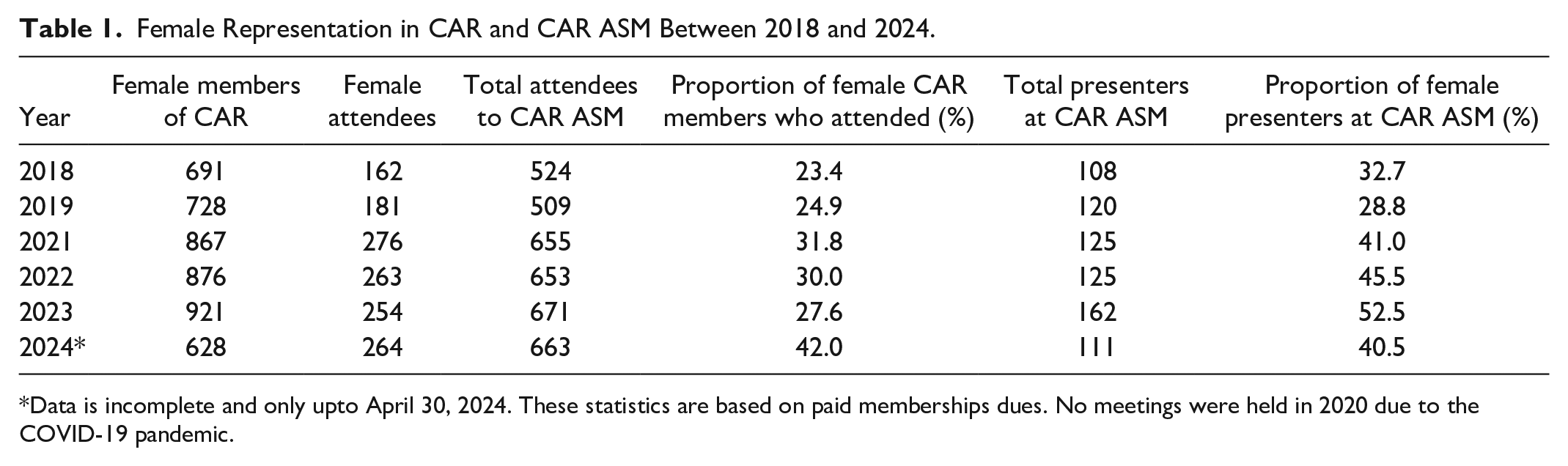
Data is incomplete and only upto April 30, 2024. These statistics are based on paid memberships dues. No meetings were held in 2020 due to the COVID-19 pandemic.
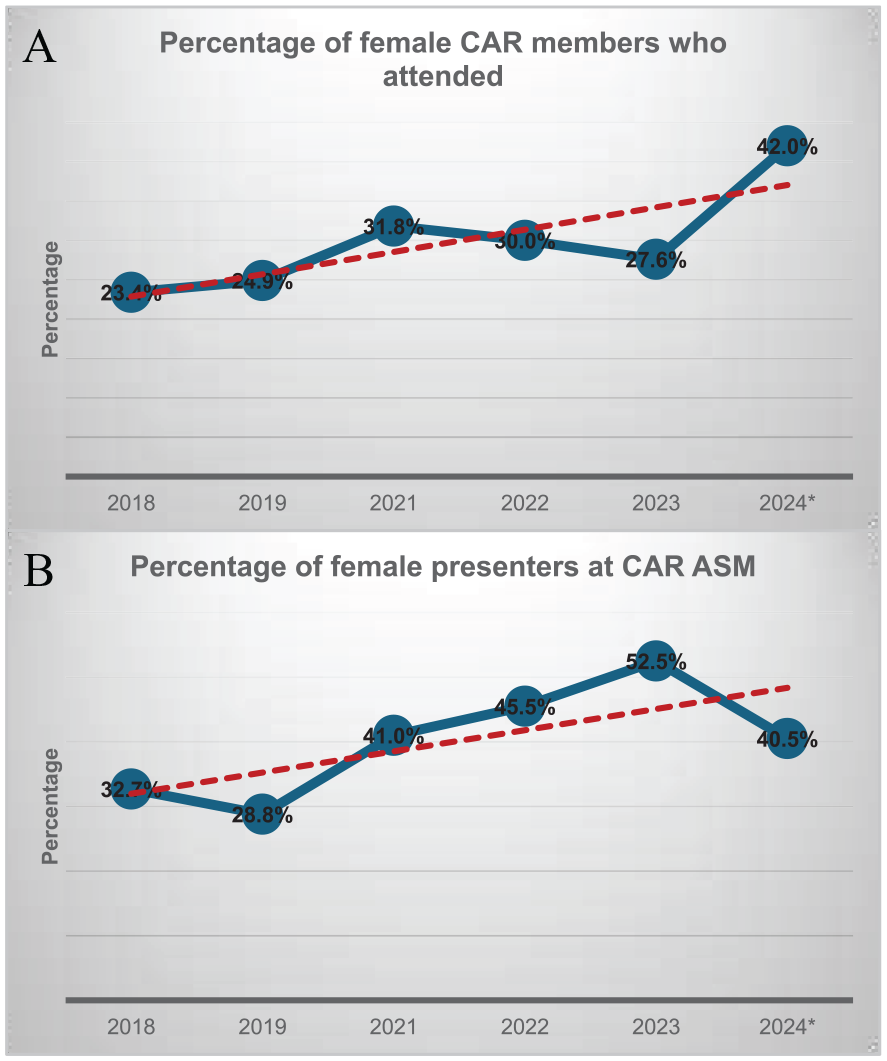
Female representation at CAR and CAR ASM between 2018 and 2024. (A) Temporal trends in proportion of CAR ASM female attendees among the female members of CAR with trendline (dashed red line). (B) Temporal trends of proportion of female presenters at CAR ASM with trendline (dashed red line).
Discussion
Female representation and visibility in Canadian Radiology facilitates professional advancement and enables development of female role models. Our findings indicate a progressive increase in attendance of women at the CAR ASM meetings between 2018 and 2024. The proportion of female invited presenters also increased during the same time period. This is notable given the historical underrepresentation of women in radiology and scientific communities at large.
The proportion of female radiologists in Canada is only 31.6%, which further declines with increase in academic ranking.6-8 However, female medical graduates now comprise a majority of total medical graduates, in some cases up to 65%. 1 In Radiology, increased female representation increases the number of potential female role models for trainees, and role-model intervention has been shown to have positive outcomes in other STEM fields. 9 Our data show a positive trend, with more female CAR members engaging with the conference, potentially reflecting broader efforts to promote inclusivity and provide a welcoming environment for women in radiology. The increase in proportion of female presenters highlights an improvement in the visibility of female experts and leaders in radiology. This could potentially be attributed to overall CAR strategic plan emphasizing diverse representation, increased representation of women in the CAR leadership, as well as targeted initiatives such as the establishment of an Equity, Diversity, and Inclusion Working Group of CAR in 2021.10,11
Limitations of study includes limitations to identify the number of females, and attendees who may not have been members of the CAR. Further research could explore the impact of increased female representation on the career trajectories of female radiologists, and the long-term outcomes of attendees and presenters in terms of academic and professional advancement.
In conclusion, the observed increase in female representation at the CAR ASM from 2018 to 2024 is an indicator of progress toward gender equity in radiology. Sustained efforts and targeted initiatives are essential to continue this momentum and achieve a diverse professional community.
Footnotes
Declaration of Conflicting Interests
The author(s) declared no potential conflicts of interest with respect to the research, authorship, and/or publication of this article.
Funding
The author(s) received no financial support for the research, authorship, and/or publication of this article.
