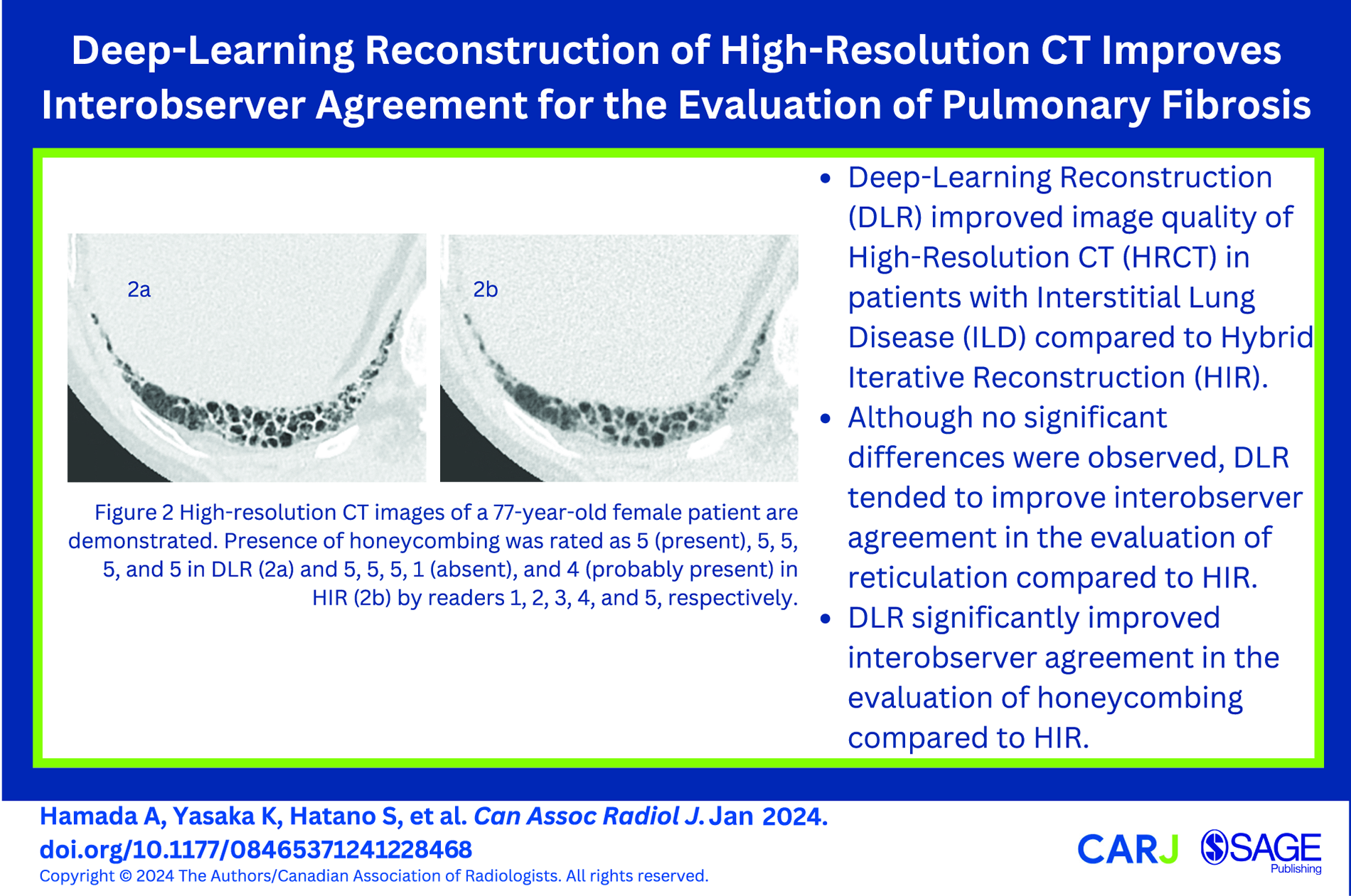
Objective: This study aimed to investigate whether deep-learning reconstruction (DLR) improves interobserver agreement in the evaluation of honeycombing for patients with interstitial lung disease (ILD) who underwent high-resolution computed tomography (CT) compared with hybrid iterative reconstruction (HIR). Methods: In this retrospective study, 35 consecutive patients suspected of ILD who underwent CT including the chest region were included. High-resolution CT images of the unilateral lung with DLR and HIR were reconstructed for the right and left lungs. A radiologist placed regions of interest on the lung and measured standard deviation of CT attenuation (i.e., quantitative image noise). In the qualitative image analyses, 5 blinded readers assessed the presence of honeycombing and reticulation, qualitative image noise, artifacts, and overall image quality using a 5-point scale (except for artifacts which was evaluated using a 3-point scale). Results: The quantitative and qualitative image noise in DLR was remarkably reduced compared to that in HIR (P < .001). Artifacts and overall DLR quality were significantly improved compared to those of HIR (P < .001 for 4 out of 5 readers). Interobserver agreement in the evaluations of honeycombing and reticulation for DLR (0.557 [0.450-0.693] and 0.525 [0.470-0.541], respectively) were higher than those for HIR (0.321 [0.211-0.520] and 0.470 [0.354-0.533], respectively). A statistically significant difference was found for honeycombing (P = .014). Conclusions: DLR improved interobserver agreement in the evaluation of honeycombing in patients with ILD on CT compared to HIR.
JohannsonKAChaudhuriNAdegunsoyeAWoltersPJ. Treatment of fibrotic interstitial lung disease: current approaches and future directions. Lancet. 2021;398:1450-1460.
2.
RaghuGRemy-JardinMRicheldiL, et al. Idiopathic pulmonary fibrosis (an update) and progressive pulmonary fibrosis in adults: an official ATS/ERS/JRS/ALAT clinical practice guideline. Am J Respir Crit Care Med. 2022;205:e18-e47.
3.
ReaGBocchinoM. The challenge of diagnosing interstitial lung disease by HRCT: state of the art and future perspectives. J Bras Pneumol. 2021;47:e20210199.
4.
TorresPRabahiMFMoreiraM, et al. Importance of chest HRCT in the diagnostic evaluation of fibrosing interstitial lung diseases. J Bras Pneumol. 2021;47:e20200096.
5.
FlahertyKRWellsAUCottinV, et al. Nintedanib in progressive fibrosing interstitial lung diseases. N Engl J Med. 2019;381:1718-1727.
6.
TaniguchiHEbinaMKondohY, et al. Pirfenidone in idiopathic pulmonary fibrosis. Eur Respir J. 2010;35:821-829.
7.
RicheldiLdu BoisRMRaghuG, et al. Efficacy and safety of nintedanib in idiopathic pulmonary fibrosis. N Engl J Med. 2014;370:2071-2082.
8.
WatadaniTSakaiFJohkohT, et al. Interobserver variability in the CT assessment of honeycombing in the lungs. Radiology. 2013;266:936-944.
9.
TangHYuNJiaY, et al. Assessment of noise reduction potential and image quality improvement of a new generation adaptive statistical iterative reconstruction (ASIR-V) in chest CT. Br J Radiol. 2018;91:20170521.
10.
ChartrandGChengPMVorontsovE, et al. Deep learning: a primer for radiologists. Radiographics. 2017;37:2113-2131.
11.
YasakaKAbeO. Deep learning and artificial intelligence in radiology: current applications and future directions. PLoS Med. 2018;15:e1002707.
12.
YasakaKAkaiHKunimatsuAKiryuSAbeO. Deep learning with convolutional neural network in radiology. Jpn J Radiol. 2018;36:257-272.
13.
UedaDYamamotoANishimoriM, et al. Deep learning for MR angiography: automated detection of cerebral aneurysms. Radiology. 2019;290:187-194.
14.
YasakaKSatoCHirakawaH, et al. Impact of deep learning on radiologists and radiology residents in detecting breast cancer on CT: a cross-vendor test study. Clin Radiol. 2024;79:e41-e47.
15.
YasakaKHatanoSMizukiM, et al. Effects of deep learning on radiologists’ and radiology residents’ performance in identifying esophageal cancer on CT. Br J Radiol. 2023;96:20220685.
16.
HigakiTNakamuraYTatsugamiFNakauraTAwaiK. Improvement of image quality at CT and MRI using deep learning. Jpn J Radiol. 2019;37:73-80.
17.
TatsugamiFHigakiTNakamuraY, et al. Deep learning-based image restoration algorithm for coronary CT angiography. Eur Radiol. 2019;29:5322-5329.
18.
OostveenLJMeijerFJAde LangeF, et al. Deep learning-based reconstruction may improve non-contrast cerebral CT imaging compared to other current reconstruction algorithms. Eur Radiol. 2021;31:5498-5506.
19.
OkimotoNYasakaKFujitaN, et al. Deep learning reconstruction for improving the visualization of acute brain infarct on computed tomography. Neuroradiology. 2024;66:63-71.
20.
OkimotoNYasakaKKaiumeM, et al. Improving detection performance of hepatocellular carcinoma and interobserver agreement for liver imaging reporting and data system on CT using deep learning reconstruction. Abdom Radiol. 2023;48:1280-1289.
21.
FujitaNYasakaKWatanabeY, et al. Detection of vertebral mass and diagnosis of spinal cord compression in computed tomography with deep learning reconstruction: comparison with hybrid iterative reconstruction. Can Assoc Radiol J. Published online October 5, 2023. doi:10.1177/08465371231203508
22.
FujitaNYasakaKKatayamaA, et al. Assessing the effects of deep learning reconstruction on abdominal CT without arm elevation. Can Assoc Radiol J. 2023;74:688-694.
23.
OhtakeYYasakaKHamadaAFujitaNAbeO. Effect of deep learning reconstruction on evaluating cervical spinal canal stenosis with computed tomography. J Comput Assist Tomogr. 2023;47:996-1001.
24.
MiyoRYasakaKHamadaA, et al. Deep-learning reconstruction for the evaluation of lumbar spinal stenosis in computed tomography. Medicine. 2023;102:e33910.
25.
HamadaAYasakaKInuiSOkimotoNAbeO. Comparison of deep-learning image reconstruction with hybrid iterative reconstruction for evaluating lung nodules with high-resolution computed tomography. J Comput Assist Tomogr. 2023;47:583-589.
26.
KandaY. Investigation of the freely available easy-to-use software ‘EZR’ for medical statistics. Bone Marrow Transplant. 2013;48:452-458.
27.
YamakuniRSekinoHSaitoM, et al. Prediction of anemia from cerebral venous sinus attenuation on deep-learning reconstructed brain computed tomography images. J Comput Assist Tomogr. 2023;47:796-805.
28.
EldevikKNordhøyWSkrettingA. Relationship between sharpness and noise in CT images reconstructed with different kernels. Radiat Prot Dosimetry. 2010;139:430-433.
29.
AbdulkareemNKHajeeSIHassanFF, et al. Investigating the slice thickness effect on noise and diagnostic content of single-source multi-slice computerized axial tomography. J Med Life. 2023;16:862-867.
30.
KimMLeeSMSongJW, et al. Added value of prone CT in the assessment of honeycombing and classification of usual interstitial pneumonia pattern. Eur J Radiol. 2017;91:66-70.