




Abstract

Introduction
When breast imaging practices fail to adopt gender-inclusive language, it perpetuates a sense of exclusion and alienation among patients, inadvertently deterring transgender men and women, non-binary individuals, and cisgender men from pursuing essential preventive care or diagnostic imaging. 1 This ultimately leads to disparities in healthcare access and outcomes for these individuals who may require breast imaging services. 2 The purpose of this cross-sectional study was to identify the proportion of vendors from the Radiological Society of North America (RSNA) 2022 Annual Meeting that used gendered terminology on their websites relative to those that used gender-inclusive terminology. We hypothesized that gendered language would be used more frequently by vendors with a focus in breast imaging.
Methods
The webpages of 312 vendors categorized under “breast imaging,” “ultrasound,” “magnetic resonance imaging (MRI),” and “bone densitometry” as per the RSNA 2022 Annual Meeting exhibitor list were included. They were evaluated for the use of gendered language, including “male,” “man,” “men,” “female,” “woman,” “women,” “she,” “her,” “women’s imaging,” “men’s imaging,” “women’s health,” and “men’s health.” Assessment of other language used pertaining to medical imaging was categorized as organ-based (eg, breast imaging, gynecologic imaging, cardiac imaging, neuroradiology, thoracic/chest imaging, abdominal imaging, musculoskeletal imaging, genitourinary imaging) and modality-based (ultrasound, MRI, mammography, radiography, computed tomography, nuclear medicine). The vendor’s country of origin and specialty, if applicable, were also recorded.
Results
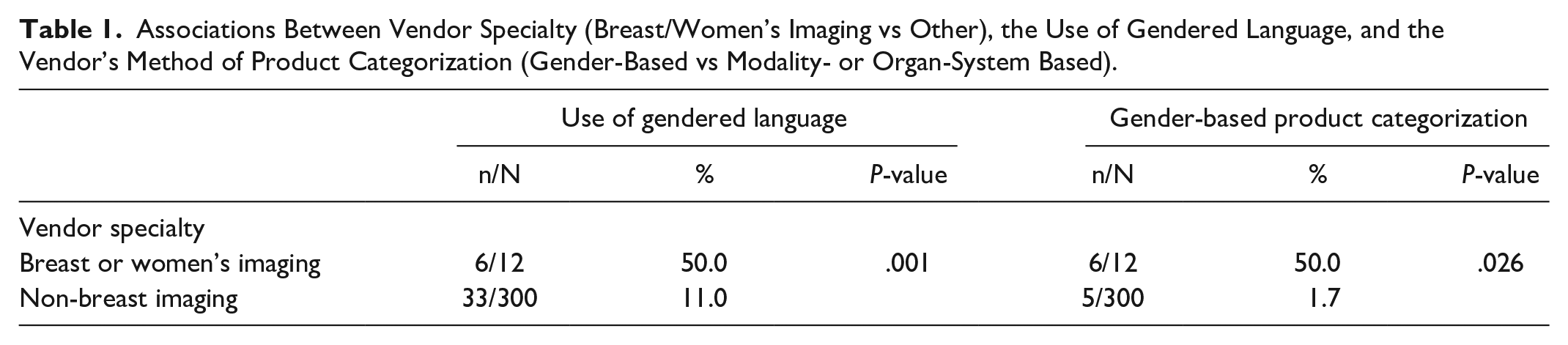
The use of gendered terminology was identified among 12.2% (38/312) of vendor websites. The websites encompassed 26 countries, with the majority of vendors being located in the United States of America (61.2%, 191/312). Direct gender-based categorization of radiological products and/or services was utilized by 2.2% (7/312) of vendors. A statistically significant association was identified between the use of gendered terminology and a vendor’s specialty (P = .001) (Table 1). There was a statistically significant association between a vendor’s specialty (breast/women’s imaging or other) and the vendor’s method of product categorization (gender-based, modality-based, or organ system-based) (P = .026) (Table 1). A total of 6/12 (50.0%) of vendors with a focus in breast imaging or mammography used gendered language for categorization of services (eg, women’s imaging or men’s imaging) compared to 5/300 (1.7%) of vendors who did not specifically focus on breast imaging or mammography (Table 1).
Associations Between Vendor Specialty (Breast/Women’s Imaging vs Other), the Use of Gendered Language, and the Vendor’s Method of Product Categorization (Gender-Based vs Modality- or Organ-System Based).
Discussion
Our study found the use of gendered language by over 12% of vendor websites. Of those, 50% of vendors had a focus in breast imaging or mammography. The persistent use of gendered language has been shown to have implications beyond nomenclature and amplification of stereotypes, inadvertently creating barriers in healthcare. 3 Simple yet transformative actions like using non-gendered terminology, respecting chosen names and personal pronouns, and allowing updates to sexual orientation and gender identity demographics within patient records can create an inclusive environment for everyone, spanning from patients and families to staff and trainees. 4 The use of gendered language further supports the need for revising and updating the linguistic approach in radiology to better serve all patient groups.5,6
Limitations to this study were that our analysis was limited to vendors participating in the RSNA 2022 Annual Meeting and our evaluation of gender-inclusive language was restricted to vendor web pages and did not extend to other forms of communication, such as advertisements, social media, or direct patient-provider interactions. This could potentially overlook other areas where gendered language is more, or less, prevalent. Adopting gender-inclusive language is not a mere nod to evolving societal norms, but a testament to the field’s dedication to equity, empathy, and excellence, ensuring that the fabric of radiological care is woven with threads of dignity, respect, and inclusivity for all its beneficiaries.
Footnotes
Acknowledgements
The authors would like to acknowledge Karen Hagglund, MS for her assistance with statistical analysis.
Declaration of Conflicting Interests
The author(s) declared no potential conflicts of interest with respect to the research, authorship, and/or publication of this article.
Funding
The author(s) received no financial support for the research, authorship, and/or publication of this article.
