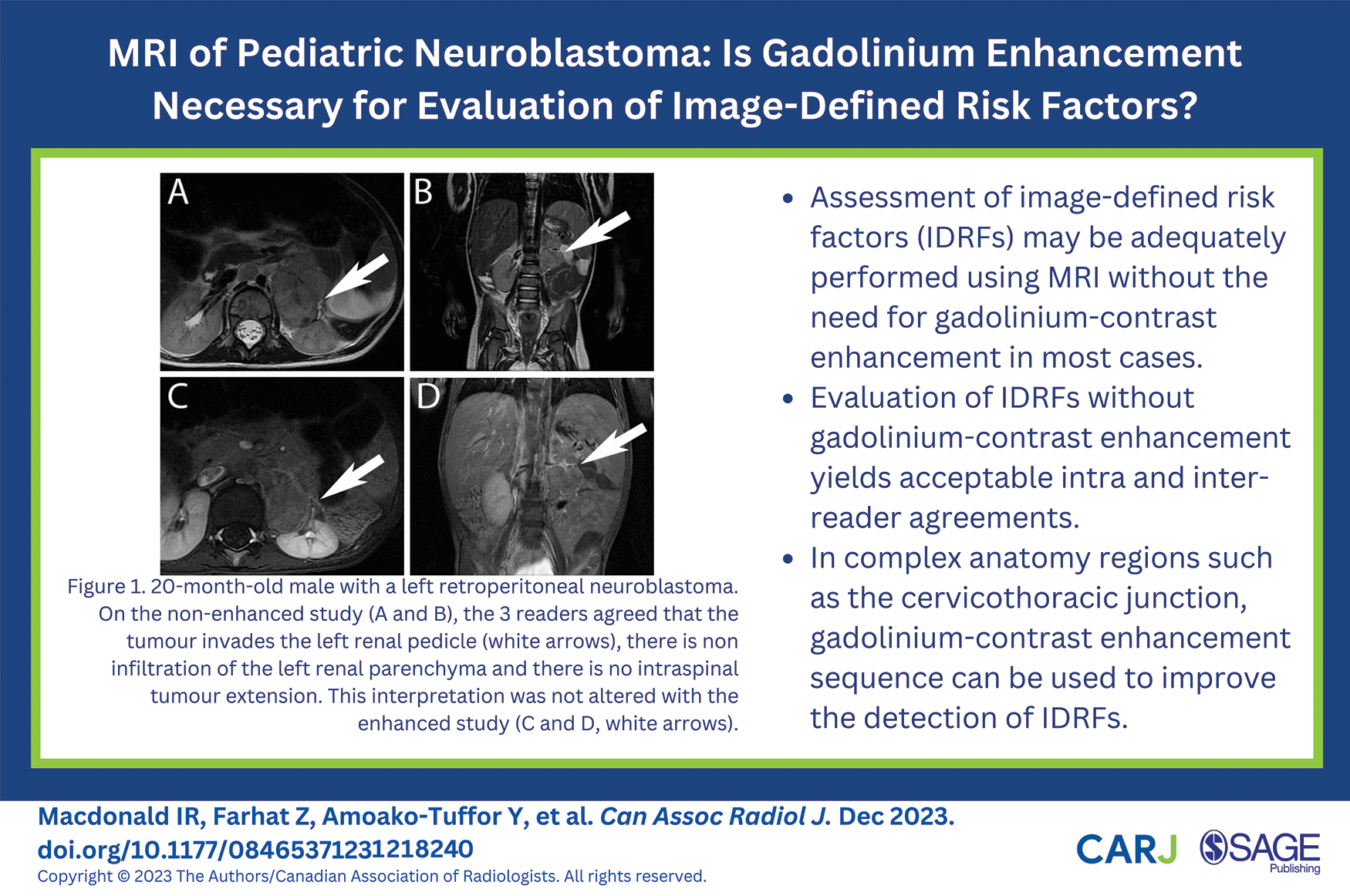
Background: Pre-treatment stratification and outcomes of neuroblastoma patients often depend on the assessment of image-defined risk factors (IDRFs) on MR Imaging, usually using Gadolinium-contrast materials which are cautioned in pediatrics. We aimed to address whether gadolinium contrast-enhanced sequences are necessary to identify the presence/absence of IDRFs. Methods: Patients with neuroblastoma with MR imaging were retrospectively identified from 2005 to 2021. Ninety confirmed IDRFs were evaluated in 23 patients. Corresponding MR studies were anonymized, randomized, and independently evaluated by 3 fellowship-trained pediatric radiologists. Each radiologist assessed the studies twice. At the first reading, all enhanced sequences were omitted, while in the second reading, the full study with enhanced sequences were included. Consensus reading was obtained among readers. Inter- and intra-rater agreements using Kappa statistics (κ) as well as the sensitivity, specificity, positive predictive value (PPV), negative predictive value (NPV), and accuracy of non-enhanced MR in assessing IDRFs with respect to enhanced MR were calculated. Results: There were substantial (ĸ: 0.64-0.73) intra-reader agreements, and moderate to substantial (ĸ: 0.57-0.62) inter-reader agreements among radiologists in identifying IDRFs using non-enhanced MR. Non-enhanced MR had a sensitivity of 87.8% (95% CI [79-94]), specificity of 93% (89-96), PPV of 82.3 (73-89), NPV of 95.4 (92-98), and accuracy of 91.6 (88-94) in identifying IDRFs. However, 5/23 patients (21.7%) had a change in staging with the inclusion of contrast sequences. Conclusion: Although contrast sequences have a role in IDRF assessment, the majority can be adequately assessed on MR without gadolinium-contrast enhancement. Validation in a larger cohort is an important next step.
LiangWHFedericoSMLondonWB, et al. Tailoring therapy for children with neuroblastoma on the basis of risk group classification: past, present, and future. JCO Clin Cancer Inform. 2020;4:895-905. doi:10.1200/CCI.20.00074
EvansAED’AngioGJPropertKAndersonJHannHW.Prognostic factor in neuroblastoma. Cancer. 1987;59(11):1853-1859. doi:10.1002/1097-0142(19870601)59:11<1853::aid-cncr2820591102>3.0.co;2-f
4.
CohnSPearsonALondonW, et al. The International Neuroblastoma Risk Group (INRG) classification system: an INRG Task Force report. J Clin Oncol. 2009;27(2):289-297. doi:10.1200/JCO.2008.16.6785
5.
MonclairTBrodeurGMAmbrosPF, et al. The International Neuroblastoma Risk Group (INRG) staging system: an INRG Task Force Report. J Clin Oncol. 2009;27(2):298-303. doi:10.1200/JCO.2008.16.6876
6.
ChenAMTroutATTowbinAJ.A review of neuroblastoma image-defined risk factors on magnetic resonance imaging. Pediatr Radiol. 2018;48(9):1337-1347. doi:10.1007/s00247-018-4117-9
7.
CecchettoGMosseriVDe BernardiB, et al. Surgical risk factors in primary surgery for localized neuroblastoma: the LNESG1 study of the European International Society of Pediatric Oncology Neuroblastoma Group. J Clin Oncol. 2005;23(33):8483-8489. doi:10.1200/JCO.2005.02.4661
8.
BrisseHJMcCarvilleMBGranataC, et al. Guidelines for imaging and staging of neuroblastic tumors: consensus report from the International Neuroblastoma Risk Group Project. Radiology. 2011;261(1):243-257. doi:10.1148/radiol.11101352
9.
PearceMSSalottiJALittleMP, et al. Radiation exposure from CT scans in childhood and subsequent risk of leukaemia and brain tumours: a retrospective cohort study. Lancet. 2012;380(9840):499-505. doi:10.1016/S0140-6736(12)60815-0
10.
BerringtondeGonzalezASalottiJAMcHughK, et al. Relationship between paediatric CT scans and subsequent risk of leukaemia and brain tumours: assessment of the impact of underlying conditions. Br J Cancer. 2016;114(4):388-394. doi:10.1038/bjc.2015.415
11.
SerinHIGorkemSBDoganayS, et al. Diffusion weighted imaging in differentiating malignant and benign neuroblastic tumors. Jpn J Radiol. 2016;34(9):620-624. doi:10.1007/s11604-016-0565-z
12.
StanescuALShawDWMurataN, et al. Brain tissue gadolinium retention in pediatric patients after contrast-enhanced magnetic resonance exams: pathological confirmation. Pediatr Radiol. 2020;50(3):388-396. doi:10.1007/s00247-019-04535-w
13.
RobertsDRLindhorstSMWelshCT, et al. High levels of gadolinium deposition in the skin of a patient with normal renal function. Investig Radiol. 2016;51(5):280-289. doi:10.1097/RLI.0000000000000266
14.
MurataNMurataKGonzalez-CuyarLFMaravillaKR.Gadolinium tissue deposition in brain and bone. Magn Reson Imaging. 2016;34(10):1359-1365. doi:10.1016/j.mri.2016.08.025
15.
MaximovaNGregoriMZennaroF, et al. Hepatic gadolinium deposition and reversibility after contrast agent-enhanced MR imaging of pediatric hematopoietic stem cell transplant recipients. Radiology. 2016;281(2):418-426. doi:10.1148/radiol.2016152846
16.
BoykenJFrenzelTLohrkeJJostGPietschH.Gadolinium accumulation in the deep cerebellar nuclei and globus pallidus after exposure to linear but not macrocyclic Gadolinium-based contrast agents in a retrospective pig study with high similarity to clinical conditions. Investig Radiol. 2018;53(5):278-285. doi:10.1097/RLI.0000000000000440
17.
ChehabeddineLAl SalehTBaalbakiM, et al. Cumulative administrations of gadolinium-based contrast agents: risks of accumulation and toxicity of linear vs macrocyclic agents. Crit Rev Toxicol. 2019;49(3):262-279. doi:10.1080/10408444.2019.1592109
18.
MartinDRKrishnamoorthySKKalbB, et al. Decreased incidence of NSF in patients on dialysis after changing gadolinium contrast-enhanced MRI protocols. J Magn Reson Imaging JMRI. 2010;31(2):440-446. doi:10.1002/jmri.22024
19.
BlumfieldEMooreMMDrakeMK, et al. Survey of gadolinium-based contrast agent utilization among the members of the Society for Pediatric Radiology: a quality and safety committee report. Pediatr Radiol. 2017;47(6):665-673. doi:10.1007/s00247-017-3807-z
20.
BehrGGZhengJCapanuMPriceAP.Is IV contrast necessary for MRI follow-up in children with abdominal neuroblastoma?Clin Imaging. 2021;79:259-264. doi:10.1016/j.clinimag.2021.06.017
VargasMIViallonMNguyenD, et al. New approaches in imaging of the brachial plexus. Eur J Radiol. 2010;74(2):403-410. doi:10.1016/j.ejrad.2010.01.024
25.
Mohd ZakiFMoineddinRGrantRChavhanGB. Accuracy of pre-contrast imaging in abdominal magnetic resonance imaging of pediatric oncology patients. Pediatr Radiol. 2016;46(12):1684-1693.
Supplementary Material
Please find the following supplemental material available below.
For Open Access articles published under a Creative Commons License, all supplemental material carries the same license as the article it is associated with.
For non-Open Access articles published, all supplemental material carries a non-exclusive license, and permission requests for re-use of supplemental material or any part of supplemental material shall be sent directly to the copyright owner as specified in the copyright notice associated with the article.