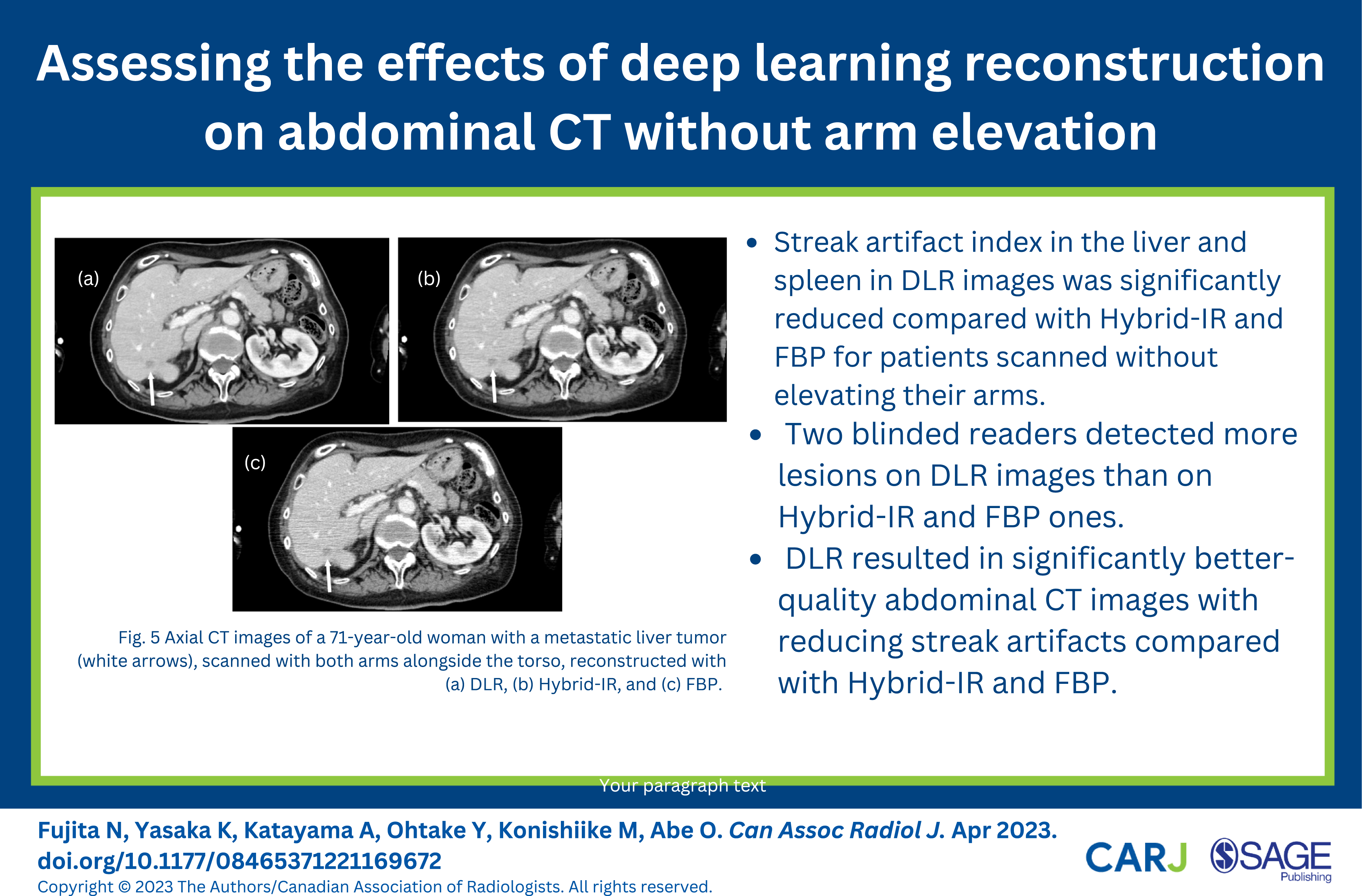
Purpose: To evaluate the effects of deep learning reconstruction (DLR) on image quality of abdominal computed tomography (CT) in patients without arm elevation compared with hybrid-iterative reconstruction (Hybrid-IR) and filtered back projection (FBP). Methods: In this retrospective study, axial images of 26 patients who underwent CT without arm elevation were reconstructed using DLR, Hybrid-IR, and FBP. Streak artifact index (SAI) was calculated by dividing the standard deviation of CT attenuation in the liver or spleen by that in fat. Two other blinded radiologists evaluated streak artifacts on images (in the liver, spleen, and kidney), depiction of liver vessels, subjective image noise, and overall quality. They were also asked to detect space-occupying lesions other than cysts in the liver, spleen, and kidney. Results: The SAI (liver/spleen) in DLR images was significantly reduced compared with Hybrid-IR and FBP. Regarding qualitative image analysis, streak artifacts in the 3 organs, qualitative image noise, and overall quality in DLR images were rated by both readers as significantly improved compared with Hybrid-IR (P ≤ .012) and FBP (P < .001). Both blinded readers detected more lesions on DLR images than on Hybrid-IR and FBP ones. Conclusion: DLR resulted in significantly better-quality abdominal CT images in patients scanned without elevating their arms with reducing streak artifacts compared with Hybrid-IR and FBP.
BrinkMde LangeFOostveenLJ, et al.Arm raising at exposure-controlled multidetector trauma CT of thoracoabdominal region: Higher image quality, lower radiation dose. Radiology. 2008;249:661-6.
2.
HinzpeterRBoehmTBollD, et al.Imaging algorithms and CT protocols in trauma patients: Survey of swiss emergency centres. Eur Radiol. 2017;27:1922-8.
3.
KahnJGruppUMaurerM. How does arm positioning of polytraumatized patients in the initial computed tomography (CT) affect image quality and diagnostic accuracy?Eur J Radiol. 2014;83:e67-e1.
4.
PartridgeLDeelenJSlagboomPE. Facing up to the global challenges of ageing. Nature. 2018;561:45-6.
5.
DeakZGrimmJMTreitlM, et al.Filtered back projection, adaptive statistical iterative reconstruction, and a model-based iterative reconstruction in abdominal CT: An experimental clinical study. Radiology. 2013;266:197-6.
6.
YasakaKFurutaTKuboT, et al.Full and hybrid iterative reconstruction to reduce artifacts in abdominal CT for patients scanned without arm elevation. Acta Radiol. 2017;58:1085-3.
7.
YasakaKAkaiHKunimatsuAKiryuSAbeO. Deep learning with convolutional neural network in radiology. Jpn J Radiol. 2018;36:257-2.
8.
YasakaKAkaiHAbeOKiryuS. Deep learning with convolutional neural network for differentiation of liver masses at dynamic contrast-enhanced CT: A preliminary study. Radiology. 2018;286:887-6.
9.
HigakiTNakamuraYTatsugamiFNakauraTAwaiK. Improvement of image quality at CT and MRI using deep learning. Jpn J Radiol. 2019;37:73-8.
10.
van StiphoutJADriessenJKoetzierLR, et al.The effect of deep learning reconstruction on abdominal CT densitometry and image quality: A systematic review and meta-analysis. Eur Radiol. 2022;32:2921-9.
TatsugamiFHigakiTNakamuraY, et al.Deep learning-based image restoration algorithm for coronary CT angiography. Eur Radiol. 2019;29:5322-9.
13.
OtgonbaatarCRyuJKShinJ, et al.Improvement in image quality and visibility of coronary arteries, stents, and valve structures on CT angiography by deep learning reconstruction. Korean J Radiol. 2022;23:1044-4.
14.
HamadaAYasakaKInuiSOkimotoNAbeO. Comparison of deep-learning image reconstruction with hybrid iterative reconstruction for evaluating lung nodules with high-resolution computed tomography. J Comput Assist Tomogr. 2023. Publish Ahead of Print. [Online ahead of print].
15.
KandaY. Investigation of the freely available easy-to-use software ‘EZR’ for medical statistics. Bone Marrow Transplant. 2013;48:452-8.
16.
SinghRDigumarthySRMuseVV, et al.Image quality and lesion detection on deep learning reconstruction and iterative reconstruction of submillisievert chest and abdominal CT. AJR Am J Roentgenol. 2020;214:566-3.
17.
OkimotoNYasakaKKaiumeMKanemaruNSuzukiYAbeO. Improving detection performance of hepatocellular carcinoma and interobserver agreement for liver imaging reporting and data system on CT using deep learning reconstruction. Abdom Radiol (NY). 2023. [Online ahead of print].