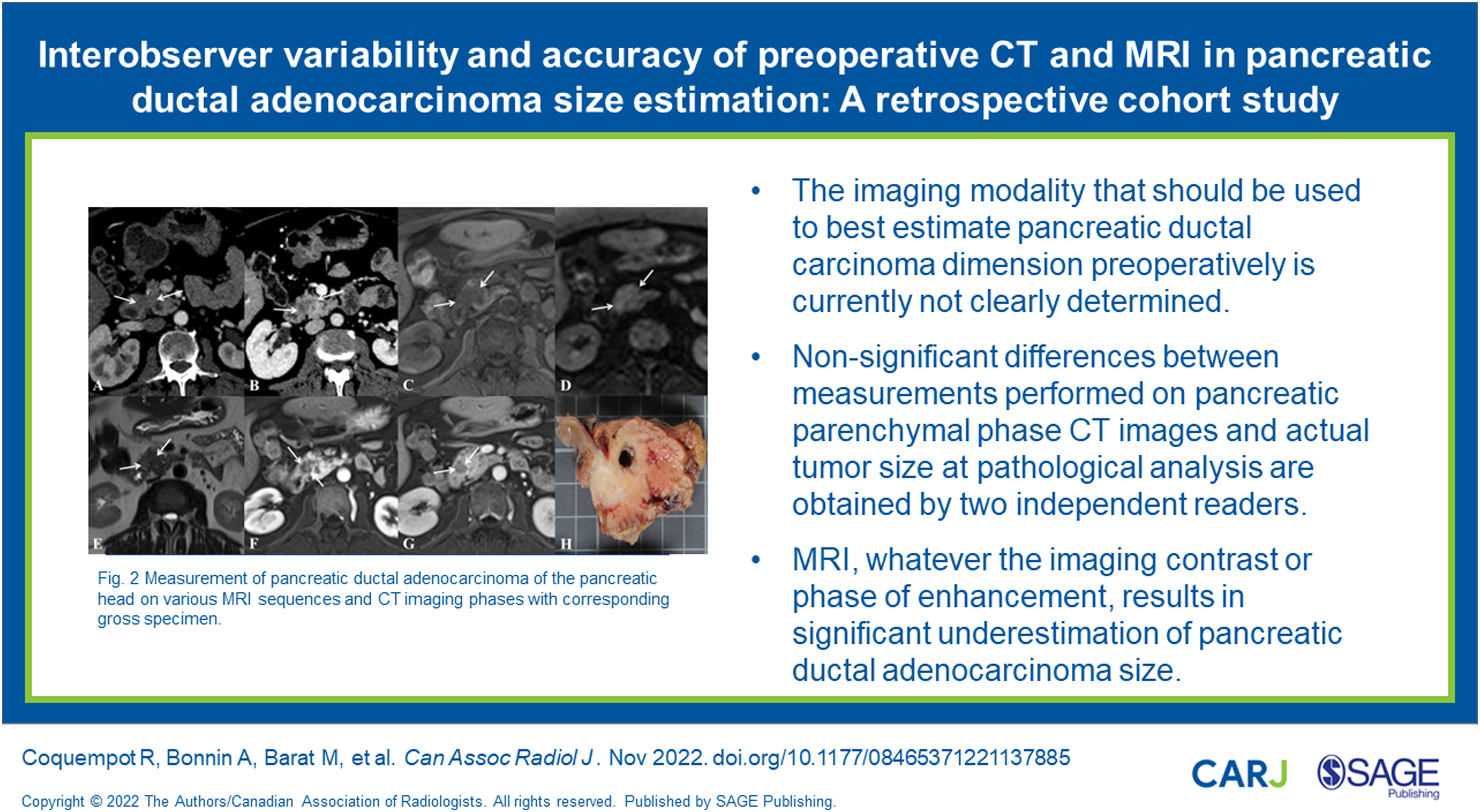
Purpose: To assess interobserver variability and accuracy of preoperative computed tomography (CT) and magnetic resonance imaging (MRI) in pancreatic ductal adenocarcinoma (PDAC) size estimation using surgical specimens as standard of reference. Methods: Patients with PDAC who underwent preoperative CT and MRI examinations before surgery were included. PDAC largest axial dimension was measured by 2 readers on 8 MRI sequence and 2 CT imaging phases (pancreatic parenchymal and portal venous). Measurements were compared to actual tumour size at pathologic examination. Interobserver variability was assessed using intraclass correlation coefficients (ICC) and Bland-Altman plots. Differences in tumour size (Δdiameter) between imaging and actual tumour size were searched using Wilcoxon rank sum test. Results: Twenty-nine patients (16 men; median age, 70 years) with surgically resected PDAC were included. Interobserver reproducibility was good to excellent for all MRI sequences and the 2 CT imaging phases with ICCs between .862 (95%CI: .692-.942) for fat-saturated in-phase T1-weighted sequence and .955 (95%CI: .898-.980) for portal venous phase CT images. Best accuracy in PDAC size measurement was obtained with pancreatic parenchymal phase CT images with median Δdiameters of −2 mm for both readers, mean relative differences of −9% and −6% and no significant differences with dimensions at histopathological analysis (P = .051). All MRI sequences led to significant underestimation of PDAC size (median Δdiameters, −6 to −1 mm; mean relative differences, −21% to −11%). Conclusions: Most accurate measurement of PDAC size is obtained with CT images obtained during the pancreatic parenchymal phase. MRI results in significant underestimation of PDAC size.
BrayFFerlayJSoerjomataramISiegelRLTorreLAJemalA. Global cancer statistics 2018: GLOBOCAN estimates of incidence and mortality worldwide for 36 cancers in 185 countries. CA A Cancer J Clin. 2018;68(6):394-424.
2.
LeonhardtCSNiesenWKalkumE, et al.Prognostic relevance of the revised R status definition in pancreatic cancer: Meta-analysis. BJS Open. 2022;6(2):zrac010.
3.
WeisbergEMChuLCParkS, et al.Deep lessons learned: Radiology, oncology, pathology, and computer science experts unite around artificial intelligence to strive for earlier pancreatic cancer diagnosis. Diagn Interv Imaging. 2020;101(2):111-115.
4.
BluemkeDACameronJLHrubanRH, et al.Potentially resectable pancreatic adenocarcinoma: Spiral CT assessment with surgical and pathologic correlation. Radiology. 1995;197(2):381-385.
5.
RheeHParkMS. The role of imaging in current treatment strategies for pancreatic adenocarcinoma. Korean J Radiol. 2021;22(1):23-40.
6.
HarringtonKAShukla-DaveAPaudyalRDoRK. MRI of the pancreas. J Magn Reson Imag. 2021;53(2):347-359.
7.
AminMBEdgeSBGreeneF, et al.Pancreatic adenocarcinoma. In: AminMB, ed. AJCC Cancer Staging Manual. 8th ed.New York, NY: Springer-Verlag; 2017:337-406.
8.
KassardjianAStanzioneNWangHL. Comparative accuracy of tumor size assessment and stage analysis by imaging modalities versus gross examination for pancreatic ductal adenocarcinoma. Pancreas. 2019;48(2):223-227.
9.
ChatterjeeDKatzMHFooWC, et al.Prognostic significance of new AJCC tumor stage in patients with pancreatic ductal adenocarcinoma treated with neoadjuvant therapy. Am J Surg Pathol. 2017;41(8):1097-1104.
10.
AllenPJKukDCastilloCF del, et al.Multi-institutional validation study of the American Joint Commission on Cancer (8th Edition) changes for T and N staging in patients with pancreatic adenocarcinoma. Ann Surg. 2017;265(1):185-191.
11.
HallWAMikellJLMittalP, et al.Tumor size on abdominal MRI versus pathologic specimen in resected pancreatic adenocarcinoma: Implications for radiation treatment planning. Int J Radiat Oncol. 2013;86(1):102-107.
12.
ArvoldNDNiemierkoAMamonHJFernandez-del CastilloCHongTS. Pancreatic cancer tumor size on CT scan versus pathologic specimen: implications for radiation treatment planning. Int J Radiat Oncol. 2011;80(5):1383-1390.
13.
MaCYangPLiJBianYWangLLuJ. Pancreatic adenocarcinoma: variability in measurements of tumor size among computed tomography, magnetic resonance imaging, and pathologic specimens. Abdom Radiol. 2020;45(3):782-788.
14.
von ElmEAltmanDGEggerM, et al.Strengthening the Reporting of Observational Studies in Epidemiology (STROBE) statement: Guidelines for reporting observational studies. BMJ. 2007;335(7624):806-808.
15.
BenchoufiMMatzner-LoberEMolinariNJannotASSoyerP. Interobserver agreement issues in radiology. Diagn Interv Imaging. 2020;101(10):639-641.
16.
GiavarinaD. Understanding Bland Altman analysis. Biochem Med. 2015;25(2):141-151.
BianYLiJJiangH, et al.Tumor size on microscopy, CT, and MRI assessments versus pathologic gross specimen analysis of pancreatic neuroendocrine tumors. AJR Am J Roentgenol. 2021;217(1):107-116.
19.
MichallekFHaouariMADanaO, et al.Fractal analysis improves tumour size measurement on computed tomography in pancreatic ductal adenocarcinoma: Comparison with gross pathology and multi-parametric MRI. Eur Radiol. 2022;32(8):5053-5063.
20.
BaratMMarcheseUPellatADohanACoriatRHoeffelC, et al.Imaging of pancreatic ductal adenocarcinoma: An update on recent advances. Can Assoc Radiol J. 2022:084653712211249. in press. doi:10.1177/08465371221124927.
21.
AlabousiMMcInnesMDSalamehJP, et al.MRI vs. CT for the detection of liver metastases in patients with pancreatic carcinoma: A comparative diagnostic test accuracy systematic review and meta-analysis. J Magn Reson Imag. 2021;53(1):38-48.
Supplementary Material
Please find the following supplemental material available below.
For Open Access articles published under a Creative Commons License, all supplemental material carries the same license as the article it is associated with.
For non-Open Access articles published, all supplemental material carries a non-exclusive license, and permission requests for re-use of supplemental material or any part of supplemental material shall be sent directly to the copyright owner as specified in the copyright notice associated with the article.