




Abstract
Introduction
Medicine has shifted from being a predominantly male profession to having greater gender diversity. For the past twenty years, over fifty percent of medical school graduates in Canada have been women. 1 In 2019-20, the Association of Faculties of Medicine of Canada (AFMC) annual report shared that 57% of undergraduate medical students were women, with 65% of the medical degrees awarded that year going to female graduates. 2 The Canadian Medical Association (CMA) also reported in 2019 that 42.7% of all physicians were female. 3 The Canadian Institute for Health Information (CIHI) reported that in 2019, 38.0% of specialist physicians were female; however, 50.0% of specialist physicians younger than 40 were female. 4
Despite these shifts, the same gender diversification has not been seen in radiology. In the 2019 CMA report, only 31.6% of radiologists were female. 3 Similar statistics have been shown at medical schools in the United States, with women representing 29.6% of radiology faculty. 5 Within radiology, many subspecialties are composed of well over two-thirds male radiologists.6-9 A 2018 review of academic musculoskeletal radiologists found that 69.34% were men and 30.66% were women. Similarly, studies by Battalgia et al (2019) and Ahmadi et al (2018) showed that academic emergency radiology and neuroradiology are predominantly male, with only 22.2% and 23.01% being female, respectively.7,8 Interventional radiology in Canada is dominated by male radiologists, with only 10.6% of interventional radiologists being female. 9
Maximizing equity and minimizing barriers in radiology are sufficient justification for action. This would include action towards the gender diversification of radiology departments and the progression of academic career trajectories of female radiologists. Benefits of addressing gender disparity are well established. Diversity in the workplace has been shown to improve innovation, creativity, problem solving, teamwork, and patient care.10-13 Female representation has been shown to result in more socially thoughtful decisions and less corruption. 10
The presence of female role models and mentors has been shown to improve gender disparity, in radiology and throughout medicine in general.13-15 Unfortunately, gender disparities in radiology become even more substantial at the academic and administrative leadership levels. A comprehensive review of leadership in radiological societies in North America found that there is a lower proportion of women holding leadership positions than the overall proportion of female members. 16 In Canadian academic radiology departments, the percentage of female radiologists compared to male declined with increasing academic rank. 17 This is also true of gender imbalanced radiology subspecialties, including neuroradiology and musculoskeletal radiology, in which the disparity further increases at the professorship level: for example, in Canadian and US academic neuroradiology departments, 23.01% of neuroradiologists are female, but only 12.5% of leadership ranks are held by women. 8 Even in breast radiology, a subspecialty relatively dominated by women, men are more likely than women to be full professors. 18
To address this disparity and increase gender diversity in radiology, more information is needed. The purpose of our study is to determine the current percentage of Canadian radiology faculty who are women, the current percentage of Canadian radiology residents who are women and to determine if the proportion of female faculty demonstrates any correlation with the proportion of female residents.
Methods
Institutional research ethics board approval was obtained.
Faculty Data
Faculty lists on the public websites of each Canadian diagnostic imaging residency program were reviewed from October to November 2020. We attempted to collect data on the number of female, male and non-binary faculty. Faculty gender was identified based on profile picture and pronouns used on the website when available; when unclear, gender information was obtained based on faculty name and the provincial physician registry. 17 Non-radiologist faculty were excluded based on indications in the faculty list, physician registry, and Google searches when no differentiation was provided.
Resident Data
Contact information for residency programs was obtained from the Canadian Residency Matching System (CaRMS) website and the survey was emailed to each Program Director and/or program administrator in May 2021, one month after the release of the CaRMS 2021 resident match results. Program directors and/or administrators were asked to state the number of females, males, and non-binary residents in each postgraduate year, including residents on leave, in combined nuclear medicine and radiology programs, and incoming residents for the 2021-22 year. Fellows were excluded. Programs without a response received a follow-up email two weeks later and a subsequent follow-up phone call. The survey email instructed programs not to provide any identifying information of individual residents. The results of the survey were anonymized at the point of data analysis.
Statistical Analysis
The data was analyzed using Microsoft Excel. Mean values, inclusive interquartile ranges and standard deviations were calculated for the resident and faculty data, with a sample standard deviation calculated for faculty and population standard deviation calculated for residents. Correlation was assessed using Pearson’s correlation coefficient (r). One-tailed t-tests were used to assess institutions with the least and most female residents when compared to the mean. All faculty data was gathered during the 2020-21 year, with analysis of 2020-21 and 2021-22 resident groups compared to this faculty data.
Results
Gender Distribution of Diagnostic Radiology Residents and Faculty at Canadian Universities.
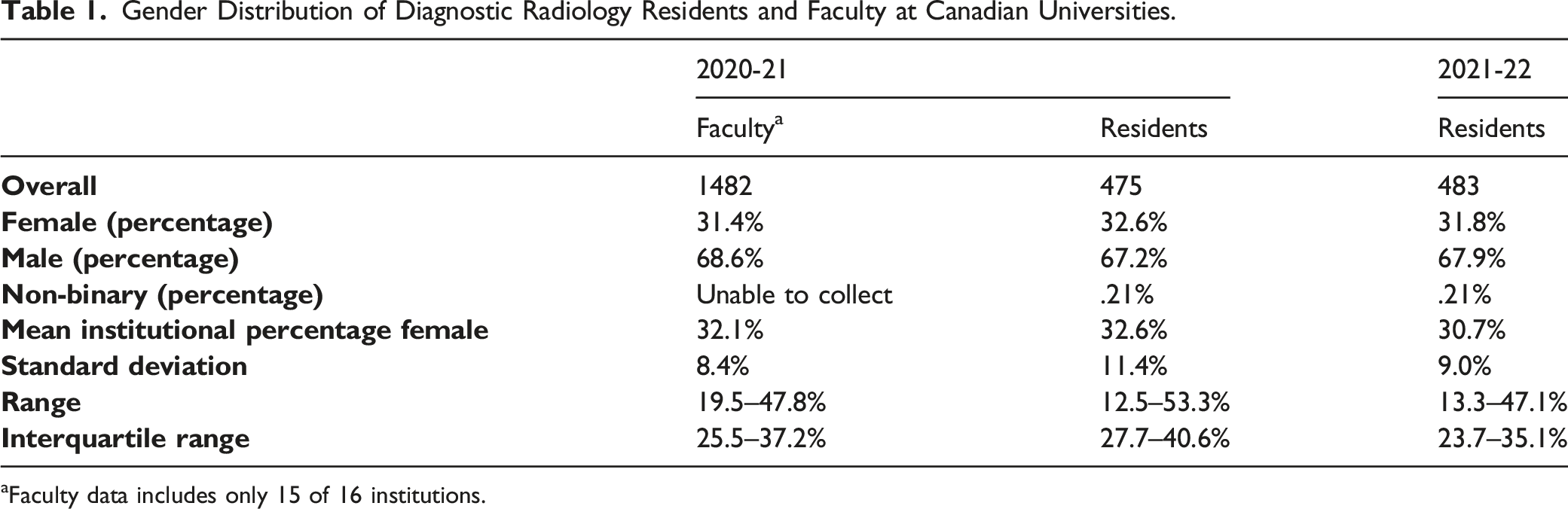
aFaculty data includes only 15 of 16 institutions.
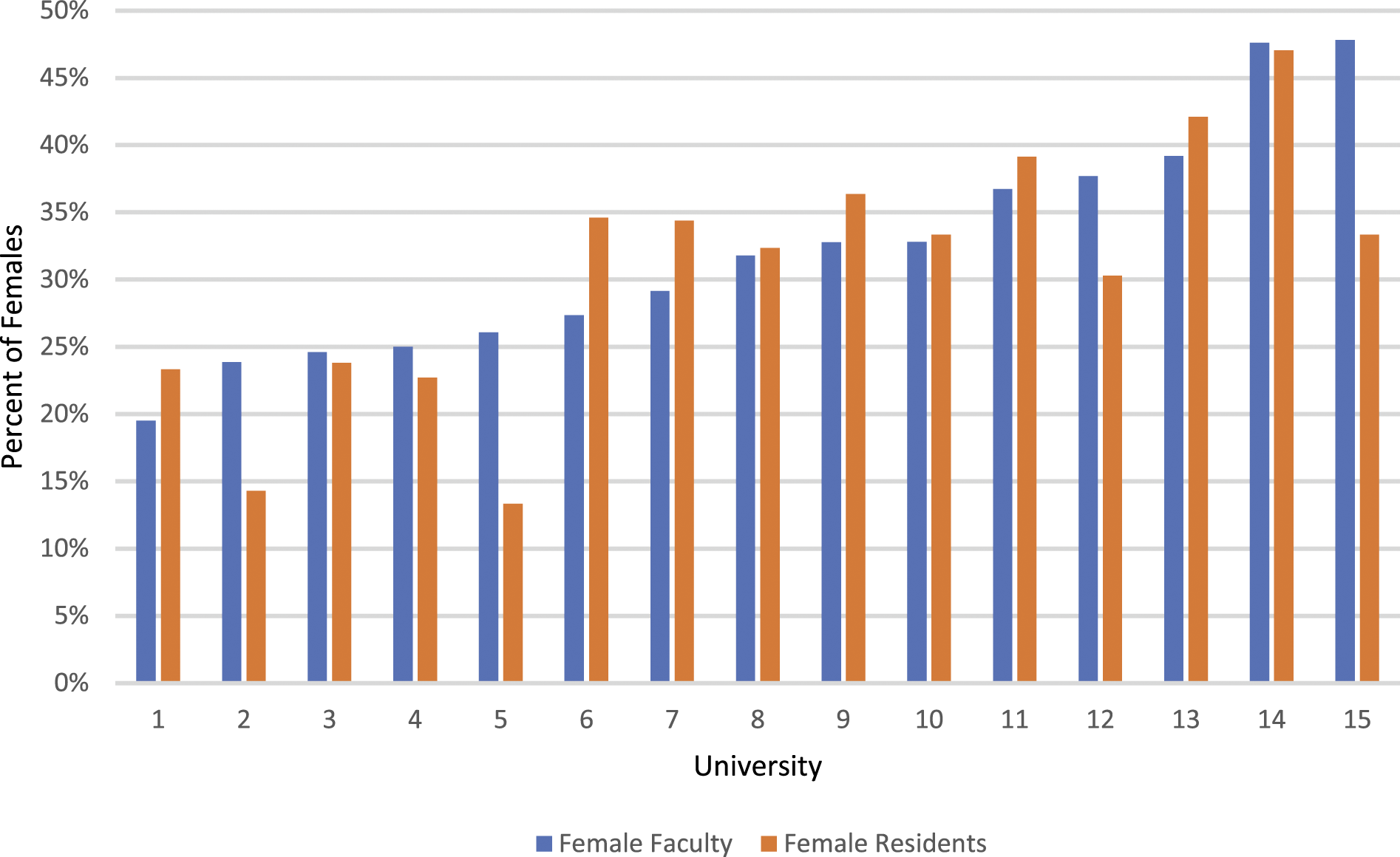
Percent of female residents and faculty at Canadian radiology residency programs by university, 2021-22.
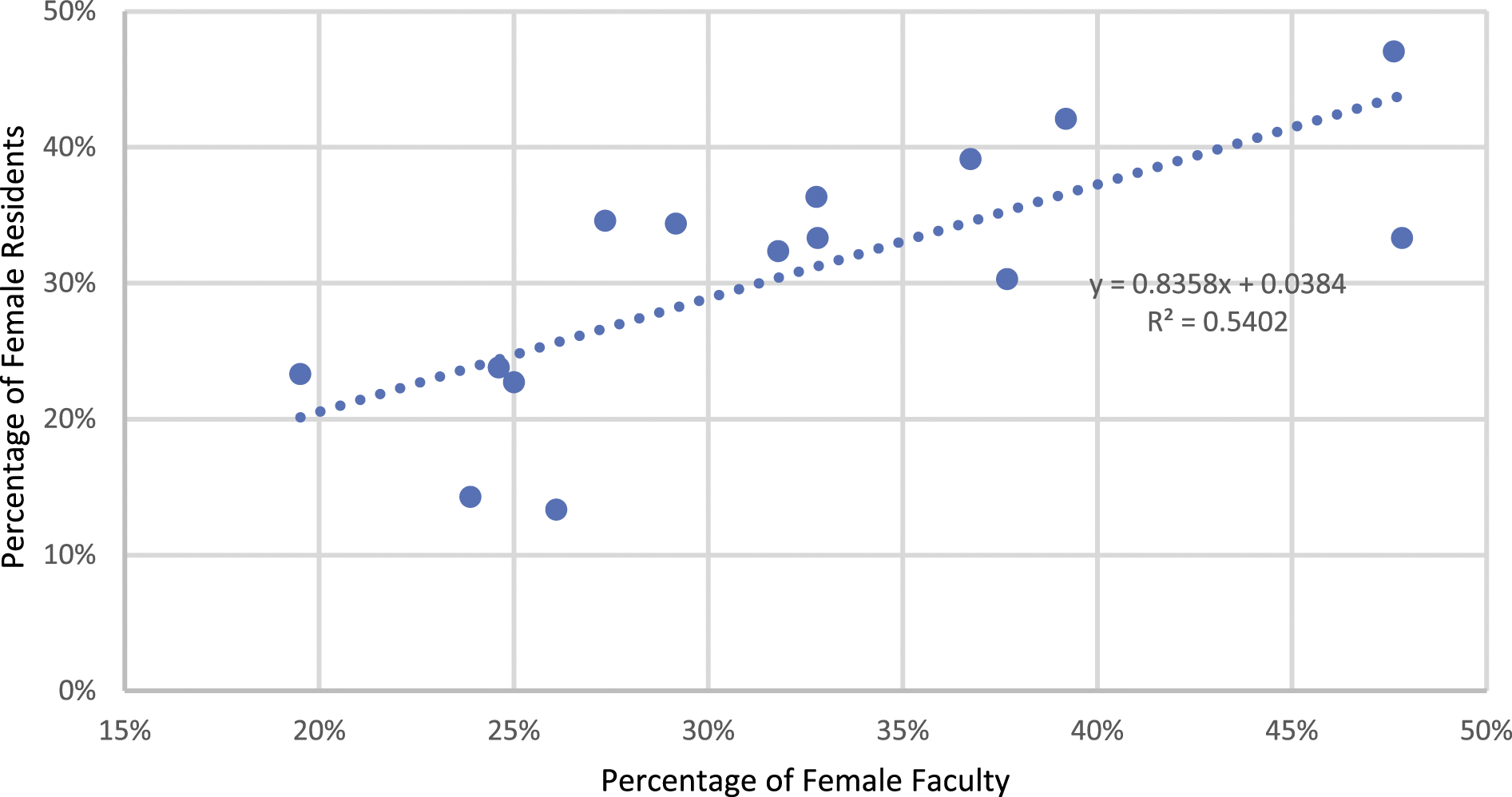
Correlation of female radiology residents and faculty at Canadian radiology residency training programs by university, 2021-22 (r = .73; R2 = .54; P = .002).
Our data collection included all current and incoming residents. With the cohort transition, there was an increase in the total number of radiology residents from 475 in 2020-21 to 483 in 2021-22. Across Canada, this included 29 graduating female radiologists and 28 incoming female medical students matched to radiology. Comparison of the resident data from the 2020-21 cohort with the faculty data found a moderate positive correlation with the percentage of female faculty (r = .62; R2 = .38; P = .01).
Proportion of Female Faculty: Comparison of the Mean of the Institutions With the Four Smallest and the Four Largest Proportion of Female Residents With the National Institutional Mean.

Discussion
Women represent approximately one third of radiology residents in Canada and one third of radiology faculty at Canadian academic radiology departments. Our results are consistent with prior published data regarding gender distribution in radiology in North America.3,5 To our knowledge, this paper is the first to demonstrate marked variation in gender distribution between individual teaching institutions.
When reviewing numbers by teaching institution, we found a statistically strong positive correlation between the percentage of female residents and the percentage of female faculty. Programs with fewer female faculty had fewer female residents. Residency programs with the lowest percentage of female residents all had a significantly smaller percentage of female faculty than the national mean. However, although the four programs with the greatest percentage of female residents had a percentage of female faculty above the national mean, this did not reach statistical significance. This raises the possibility of a critical threshold percentage of female faculty, below which female medical students may be less likely to match to those programs.
While the cause of the correlation cannot be determined by this study, the literature suggests that the presence of female role models may influence medical students’ decision to apply to specific residency programs.13-15,19,20 Institutions wishing to improve gender imbalance may want to consider ensuring female faculty are visible and accessible to medical students, and supported in this work. It is also possible that institutions that provide an academic environment supportive to women are also more likely to attract female radiologists. Finally, although bias training is becoming more widespread, unconscious bias in selection committees may continue to influence residency selection. 21
Our data showed a strong positive correlation between faculty and resident gender for the 2021-22 resident cohort but only moderate positive correlation for the 2020-21 cohort. Our faculty data from the 2020-21 academic year would be the distribution of female faculty present at institutions during the matching process for the 2021-22 resident cohort and therefore using the 2021-22 resident data is likely more appropriate. Some of the resident cohort in the 2020-21 year matched to radiology 5 years prior to our study. It is possible that the moderate degree of correlation for that cohort, rather than the strong correlation for the more recent cohort, reflects outdated faculty data.
This study is the first to publish data on the correlation between radiology faculty and resident genders, and uses resident data acquired directly from each program. Our ability to obtain complete nationwide data for residents and near-complete nationwide data for faculty is a strength. However, it is likely that some faculty members listed on the institutional website may no longer be practicing or may have appointments at more than one school. Given the size of our data set, we do not expect this to have a statistically significant effect on our results. Gender is not binary, however our ability to collect data on the number of non-binary faculty was unfortunately limited.
This research provides new data on the gender distribution of radiology residents and the correlation between gender of residents and faculty in Canadian radiology residency programs. Understanding the status of gender diversity among residents and faculty in radiology can help direct initiatives to improve gender diversity both at the institution level as well as overall within the specialty.
Footnotes
Acknowledgments
Mo Abdolell for assistance with statistical methods and analysis.
Declaration of Conflicting Interests
The author(s) declared no potential conflicts of interest with respect to the research, authorship, and/or publication of this article.
Funding
The author(s) received no financial support for the research, authorship, and/or publication of this article.