




Abstract

Introduction
The COVID-19 pandemic has widely disrupted healthcare systems throughout the world. On March 18th, 2020 at the onset of the COVID-19 pandemic all breast screening throughout the province of British Columbia (BC) was suspended. At the time of initial suspension approximately 19 000 appointments were cancelled or put on hold.
After a closure of approximately 10.5 weeks, on May 30th, 2020 breast screening sites throughout the province began a phased re-opening. Following guidelines from the BC Ministry of Health Medical Imaging Advisory Committee 1 and in keeping with the recommendations put forth by the Canadian Society of Breast Imaging, 2 upon re-opening enhanced safety practices were employed, including decreased screening volumes to allow for social distancing, increased time between appointments to facilitate additional cleaning, use of personal protective equipment for health care workers, and implementation of COVID-19 symptom screening.
Access to timely, high-quality breast screening programs remains essential to improved patient outcomes. 3 As such, we sought to evaluate the initial impacts of the COVID-19 pandemic on breast screening throughout the province of BC.
Methods
Breast Screening Program
In BC the BC Cancer Breast Screening Program provides population-based breast screening to individuals who meet established eligibility criteria. 4 Thirty-nine sites throughout the province provide breast screening, including 3 mobile units. Of these sites, 31 are operated by local health authorities while the remainder are operated by community diagnostic radiology clinics.
Data Sources
The BC Cancer Breast Screening database, a population-based database, was the primary dataset accessed. This database is regularly linked with the BC Vital Statistics death file to ascertain the vital status of those patients eligible to participate in the program. The Cancer Agency Information System, the electronic medical record in all 6 provincial cancer centers in BC, was used to ascertain referrals to tertiary provincial cancer centers.
Parameters Assessed
The initial impacts of the COVID-19 pandemic on breast screening were evaluated by assessing breast screening volumes, abnormal breast screening mammograms, and referrals to tertiary provincial cancer centers. These parameters were chosen as possible indicators of a negative effect of the COVID-19 pandemic on early breast cancer detection. Referrals to tertiary provincial cancer centers represent those arising from breast screening as well as direct referrals. Referrals to provincial cancer centers arising from breast screening denote that the patient had an abnormal breast screening mammogram within the past 6 months and positive diagnostic evaluation.
Statistical Analyses
Data were summarized and stratified by local health authority where indicated. Percent changes in indicators assessed were calculated.
Results
Breast screening volumes, abnormal breast screening mammograms, and referrals to tertiary provincial cancer centers are summarized in Table 1. The proportion of abnormal breast screening mammograms was relatively stable. Overall breast screening volumes did not recover to that observed the year prior by the end of the calendar year (Figure 1A) while the recovery of breast screening volumes in each local health authority was variable (Figure 1B-F). Provincial cancer center referrals arising from breast screening were strikingly reduced as compared to that observed the year prior (Figure 2A) while that arising from direct referrals remained relatively stable (Figure 2B).
Indicators of the BC Cancer Breast Screening Program Assessed.
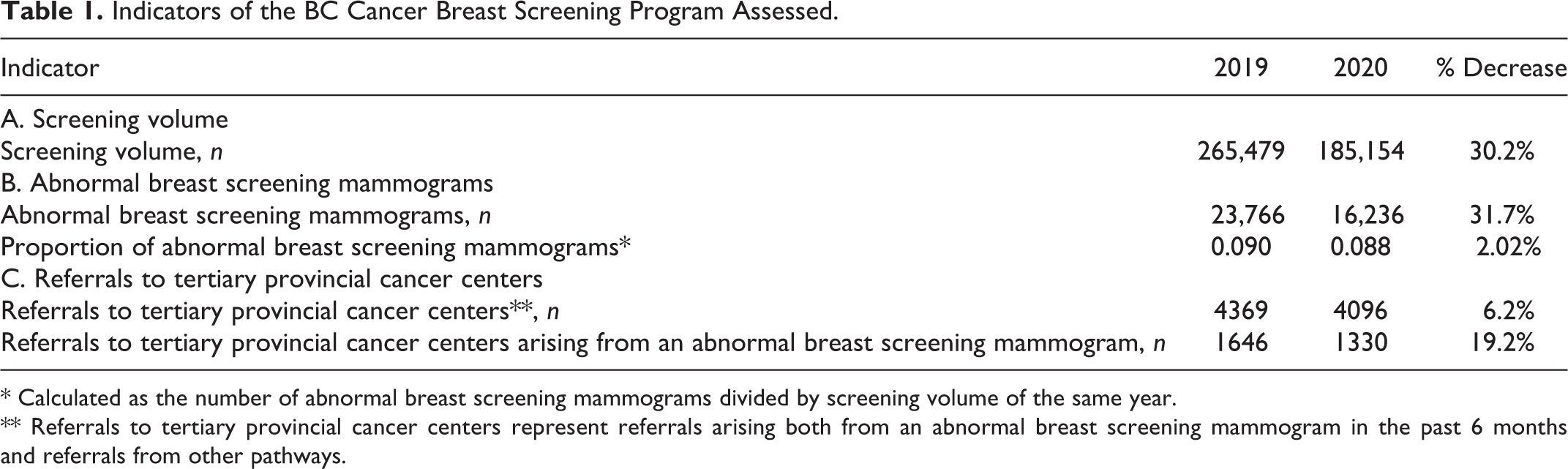
* Calculated as the number of abnormal breast screening mammograms divided by screening volume of the same year.
** Referrals to tertiary provincial cancer centers represent referrals arising both from an abnormal breast screening mammogram in the past 6 months and referrals from other pathways.
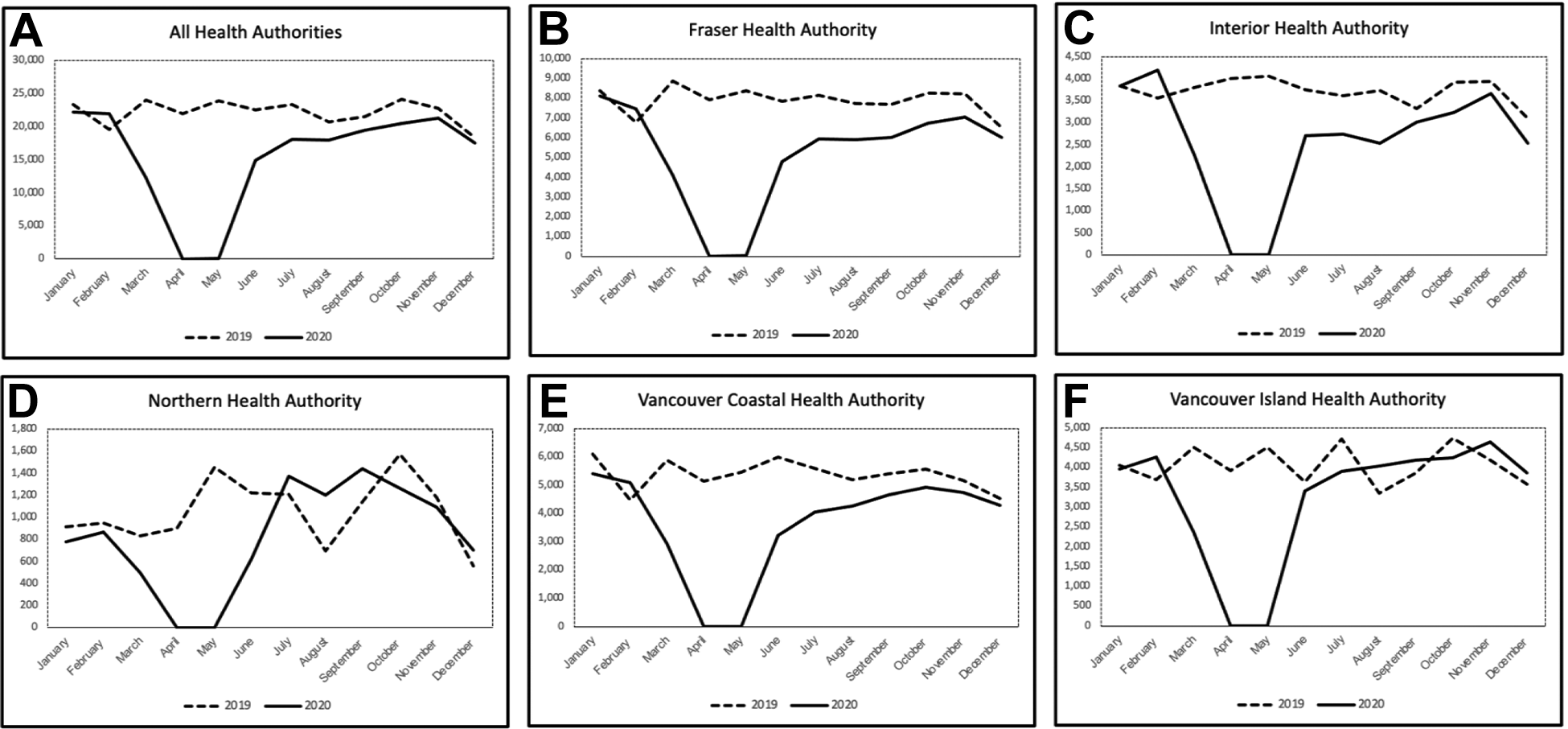
Screening volumes of the BC Cancer Breast Screening Program 2019 & 2020. A, Overall screening volumes of the BC Cancer Breast Screening Program in all health authorities in British Columbia. B to F, Screening volumes of the BC Cancer Breast Screening Program by health authority.
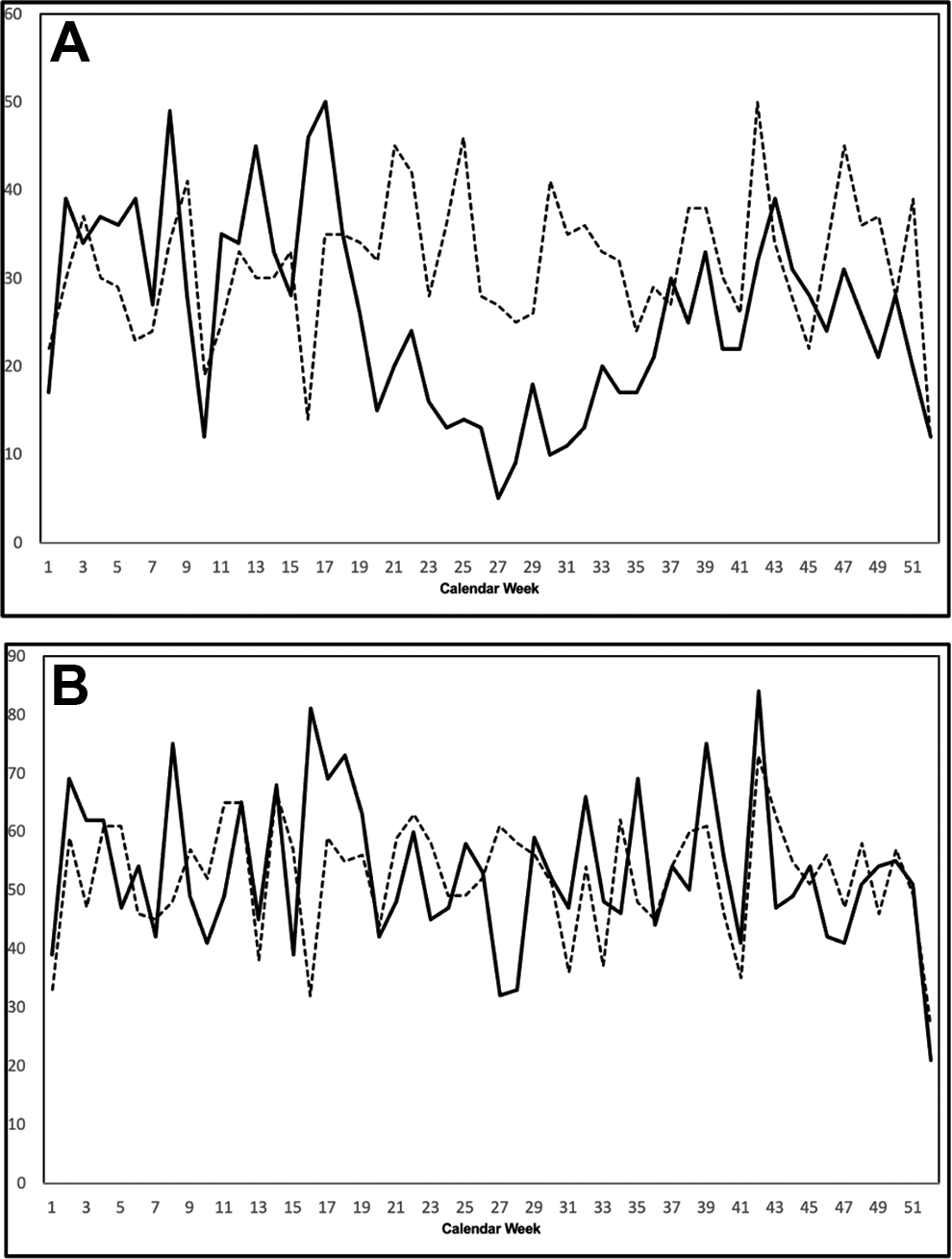
Referrals to tertiary provincial cancer centers in BC 2019 & 2020. Referrals to provincial cancer centers arising from breast screening (A) and direct referrals (B) in 2019 (dashed line) and 2020 (solid line). Referrals to provincial cancer centers arising from breast screening denote that the patient had an abnormal breast screening mammogram within the past 6 months and positive diagnostic evaluation.
Discussion
A notable decrease in breast screening volumes, abnormal breast screening mammograms, and referrals to tertiary provincial cancer centers arising from breast screening was observed. Monitoring to ensure maintenance of current screening volumes and employment of additional strategies to facilitate increased screening capacity to mitigate waitlists and to increase early detection are warranted. Iterative evaluation of enhanced safety practices shall be required. Targeted interventions to ensure equitable access to breast screening are recommended. Further investigation is required to determine the impact of the aforementioned on the subsequent clinicopathological outcomes of the program.5,6
Footnotes
Declaration of Conflicting Interests
The author(s) declared no potential conflicts of interest with respect to the research, authorship, and/or publication of this article.
Funding
The author(s) disclosed receipt of the following financial support for research, authorship and/or publication of this article: This study was supported with funding by the Michael Smith Foundation for Health Research (COV-2020-1048).
