




Abstract
This note presents preliminary results from ongoing research on the relationship between privateering and maritime neutrality, c. 1750–1815. Drawing on two sources – the records of the High Court of Admiralty and the Danish and Swedish Algerian Sea Pass Protocols – it argues that maritime neutrality channelled and constrained the impact of privateering as inter-European conflicts expanded in scope and destruction. Focusing on the activities of Britain, as a major belligerent, and Sweden and Denmark as small neutral states, the note uses two quantitative methods. Shipping output is estimated as the number of days vessels operated at sea during wartime, compared with days ‘lost’ through capture by privateers. Combining these sources and methods provides a new perspective on how rulers and economic actors transformed law and diplomacy into instruments of profit: through neutrality, privateering pressures were redirected into legally sanctioned forms of exchange that turned war into opportunity.
This note presents tentative results and methods from ongoing research on two key institutions in European wartime shipping, privateering and maritime neutrality. Both shaped commercial outcomes at sea, although the literature has emphasised them differently. Privateering is largely portrayed as commerce-impeding: either as a practice whose eighteenth-century decline lowered voyage costs, or as an economic inefficiency that, while creating temporary investment opportunities, curtailed trading activities. 1 In contrast, the view on neutral shipping is more mixed. Neutral-flagged ships enjoyed lower protection costs, insurance premiums and sailors’ wages than belligerent vessels. 2 Yet scholars debate the extent of this advantage; while some downplay its impact, 3 others note that privateers often disregarded their neutral status. 4 Nevertheless, these two institutions were closely connected. Without privateers threatening commerce, economic actors would have little reason to ship under neutral flags. How this relationship formed, however, and how it can be systematically analysed is not well understood. 5
Below, I will present results that indicate that privateering paradoxically contributed to the resilience of late-eighteenth-century neutrality. It did so by incentivising economic actors to make use of international institutions – the relatively stable norms and rules that governed international relations – to restrain commerce raiding of this kind. 6 As will be shown, to create this restraint meant adopting the diplomatic position of neutrality as a business strategy. As wars of the eighteenth century became more global and destructive, economic actors took to shipping under neutral flags to secure pre-existing supply lines and open new ones. In turn, these results suggest that neutrality functioned as an important input for eighteenth-century European shipping, in the sense of realising more transport capacity for wartime markets.
The case of Baltic exports and their payment pattern between 1750 and 1815 will serve as a limited case study to illustrate this point. This region was home to a global supply chain that supplied strategic raw materials (such as grain, iron, timber, hemp, pitch and tar) vital to European states and later Britain's industrial revolution. 7 Yet, during the late eighteenth century, the means of payment for these exports shifted; bullion, salt and wine gave way to colonial commodities such as sugar, coffee, tea and indigo. Exporting these goods to the Baltic reduced the need for net capital inflows and enabled Western states to sustain a positive balance of trade with the region. 8 Privateering and neutrality were integral to this shift in payment methods.
The analysis draws on two complementary sources. First, the Danish and Swedish Algerian Sea Pass Protocols, which recorded long-distance Scandinavian voyages, provide an unusually complete and well-tested record of shipping activity. 9 Second, records of Scandinavian ships seized by the Royal Navy and British privateers are preserved in the High Court of Admiralty (HCA) archives. These instances of captured ships under neutral flags allow systematic tracking of wartime losses from a major instigator of privateering.
In order to quantify the interaction between privateering and neutrality, I have constructed two datasets covering Scandinavian shipping activities between 1756 and 1815. The first captures 33,879 Algerian Sea Passes issued between 1747 and 1815 (with a Danish lacuna for 1772–1777), filtered to 31,442 individual voyages after removing issuing errors, shipwrecks and unused passes. 10 The second identifies 3925 Scandinavian captures (439 Swedish and 3,486 Danish) recorded in the High Court of Admiralty, as well as diplomatic records in Stockholm and Copenhagen, between 1756 and 1815. 11 Following a quantitative approach developed by Dan H. Andersen and Hans-Joachim Voth, shipping output is estimated as the number of days vessels were at sea during wartime, compared with days ‘lost’ through capture by privateers. Building on the argument that shipping output is fundamentally time-dependent, this framework provides a tentative assessment of how privateering and neutrality interacted to create resilience for European early modern shipping. While these results remain provisional as part of ongoing research, the methods may prove useful for other scholars seeking to quantify wartime shipping output and disruption.
Privateering, neutrality and restraint on the high seas
What, then, were the ideas behind privateering and neutrality, and how did the latter restrain the former? To begin with, privateering refers to the act of private and military ships attacking enemy shipping and seizing ships and goods as prizes, authorised in doing so by a sovereign through commissions. By the eighteenth century, this type of private naval warfare had become an international institution, operating largely beyond territorial waters and extending sovereign jurisdiction onto the high seas through the capture of other rulers’ subjects and property. Because these actions carried legal implications across borders, privateering rested on a recognised legal order. Most European powers maintained prize courts, specialised advocates and a distinct body of maritime law to adjudicate captures. 12
Neutrality was, similarly, another such international institution of the unowned sea. It was codified in what is known as the ‘free ship, free goods’ principle, which was a treaty provision that held that ships flying the flag of a non-belligerent should, in theory, cover the cargo from seizure by belligerents, regardless of who owned the goods (unless this cargo was contraband). Importantly, most European states had had this clause in their commercial treaties since the 1650s. 13 This made neutrality a part of the loosely defined body of the ‘law of nations’, as treaty provisions recurring across treaties usually did. 14 Yet such ‘law’ was not meant to be the great leveller among nations, nor instigating an objective system of rules which a community of states would recognise as regulating the actions of its members. The idea of international law, treaties and other international institutions is to increase the costs of sharp policy reversals and foster vested political interests that reinforce stable relations. 15 It is about creating restraint.
From the 1750s onward, however, European states began investing differently in these two institutions. Britain, which by one estimate employed 40–75 per cent of its merchant marine in privateering during eighteenth-century wars, was on the one end. 16 They sought to reshape the rules of international waters after gaining naval supremacy in the Seven Years’ War, introducing two new privateering doctrines aimed at neutrals. Roughly, these held that if a neutral served as a proxy for an enemy's colonial exchange, the neutral served the enemy's cause and therefore could be seized. This was done because their rival, France, had strategically begun to open its otherwise closed colonial ports to neutrals during wars. 17 Importantly, the colonial aspect was key. The target for the new doctrines was not neutrals carrying goods between European ports, nor neutrals conducting commodity exchange with, for example, France. The target was neutrals conducting colonial shipping services for Britain's enemies.
Scandinavian powers responded oppositely. Sweden and Denmark, with strong maritime traditions but limited colonial holdings, consistently invested in neutrality as a foreign policy from the 1750s onward. 18 Warfare gave their merchant marines a pretext to expand into colonial waters under both the protection of neutrality and, confusingly, the legal positivism of the new British doctrines. As stressed in the literature, British Prize Courts built their application on emphasising papers and documents to establish a trading voyage at sea as bona fide neutral trade, ushering in a ‘positivist theory of neutrality’. 19 Warfare could, in effect, be countered with ‘lawfare’: so the Scandinavians expanded their consular networks, introduced new laws on shipping documentation, and tightened up the use of merchant flags. 20 Moreover, Denmark and Sweden regularly coordinated their neutral stance through security alliances, 21 making their neutrality a collective strategy backed by arms and diplomatic efforts. This set them apart from free cities (such as Hamburg) or auxiliary neutrals (such as Portugal), whose neutrality was more dependent on the policies of major powers. 22 It is also why Denmark and Sweden should be studied together.
For economic actors, this set-up provided a straightforward but powerful mechanism. If a merchant of a belligerent sovereign, for instance, consigned goods or simulated a sale to a Scandinavian shipper, legal title to those goods shifted into the jurisdiction of the Danish or Swedish crown. A privateer seizing such a vessel was not only attacking foreign commerce but also challenging the sovereignty of a neutral state, which was a particularly contested issue if done on the high seas. For this reason, neutral flags gave privateering captains pause. Few would want to wait around for months to clear prize courts or face complicated appeal processes when they could choose the surer thing of belligerent ships (especially as the Scandinavian courts, at times, advertised paying for their shipper's legal costs). Put simply, neutrality was a deterrent to privateering – supposing, of course, that we can demonstrate its restraining qualities.
Measuring the economic impact of neutrality and privateering
Figures 1 and 2 show the result of the Scandinavian investments in maritime neutrality. On display in Figure 1 is the total number of entries in the mentioned database on Algerian Sea Passes Protocols, mined from the registers maintained by the Danish and Swedish Boards of Trade between 1747–1848 and 1739–1831, respectively. 23 These record special passes that identified ships bound for destinations beyond Cape Finisterre as protected under diplomatic treaties with the Barbary States (1729 for Sweden, 1747 for Denmark). To obtain a pass, shipowners swore an oath and presented documents proving that the ship was owned and fitted out by Danish or Swedish subjects. Officials then recorded the passport number, owner and master, ship's name, tonnage, home port, destination, date of issue and return and the date of oath. 24 The tonnage data presented in Figure 2 is also derived from the database on this source, converted into metric tonnes following standard practice in the literature.
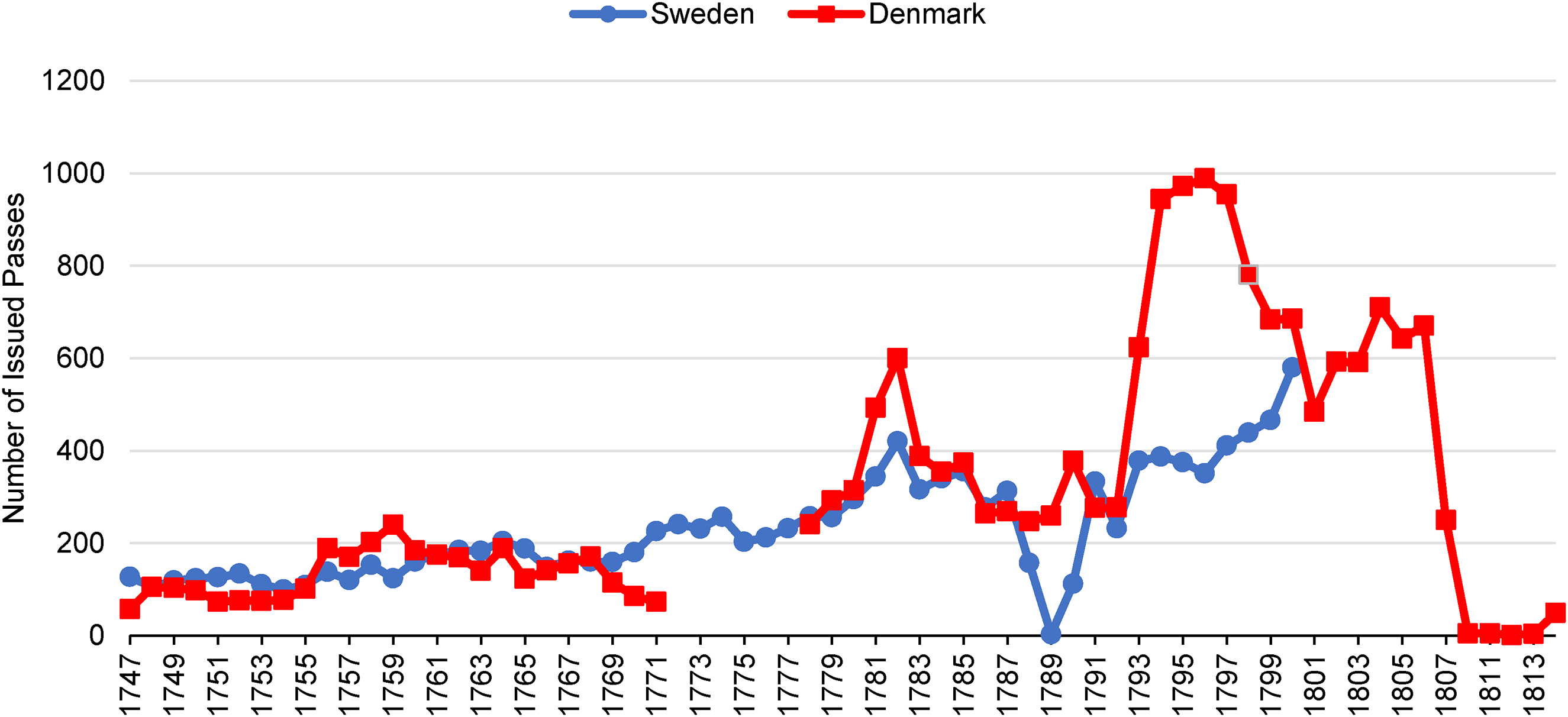
Database of Issued Danish and Swedish Algerian Sea Passes, 1747–1815. Source: Protocolle algierischer See-Pässe, 1747–1771, Kommercekollegiet, Tyske Sekretariat, Rigsarkivet, Copenhagen; Algiersk Pasprotokol, 1778–1848, Kommercekollegiet, Søpaskontoret, Rigsarkivet, Copenhagen; Algerian passport registers, 1739–1816, C II b., Kommerskollegium, Riksarkivet, Stockholm.
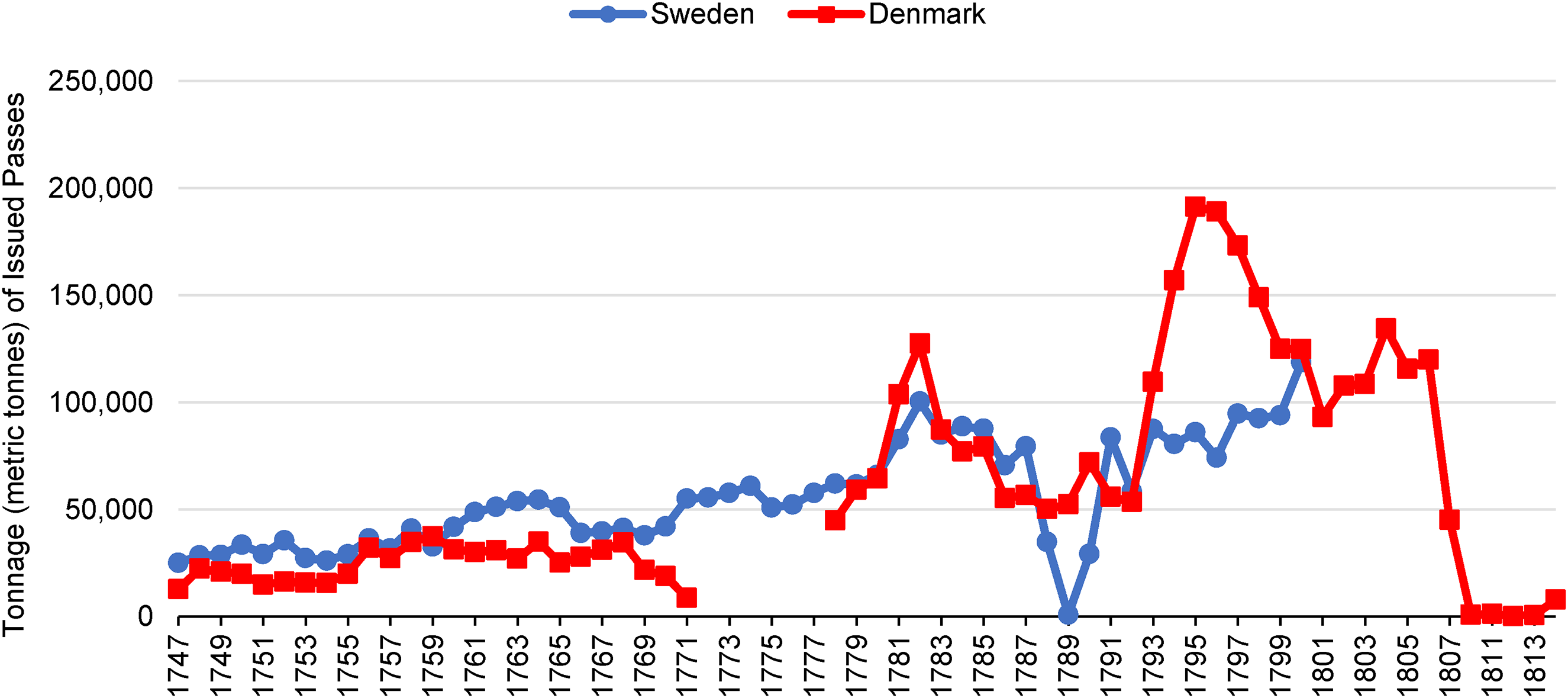
Tonnage of Issued Danish and Swedish Algerian Sea Passes, 1747–1816. Source: As in Figure 1.
The patterns reveal how neutrality translated into commercial activity. As seen in Figure 1, the Danish Board of Trade issued an average of 131 passes per year between 1747 and 1771, rising to 529 between 1778 and 1806. The lowest number was 57 voyages in 1747, while the peak came during the Seven Years’ War with 240 voyages in 1759. In the later period, the low point was 272 in 1786 (a peace year), and the high was 989 in 1796 at the height of the French Revolutionary Wars. Swedish shipping followed a similar pattern: an average of 144 voyages between 1747 and 1769, and 296 between 1770 and 1800. The lowest number was 100 in 1754, with 204 voyages in 1764 as the peak. During 1770–1800, the extremes ranged from only three voyages in 1789, when Sweden was at war in the Russo-Swedish War, to 580 in 1800. 25
A similar result emerges when applying a tonnage analysis to the data presented in Figure 2. The Algerian Sea Pass Protocols record tonnage for each voyage – given in svåra läster for Sweden (1 unit = 2,4 metric tons) and commercelæst for Denmark (1 unit = 2,6 metric tons). 26 By a secret royal decree of 1672, however, Danish ships had their official commercelæst reduced by one-sixth at Copenhagen to lower fees abroad, a manipulation that cannot be fully corrected. 27 Moreover, tonnage measurements varied across states and even within regions during the eighteenth century. As recent scholarship has stressed, tonnage should be treated as an approximation rather than a precise metric. 28
Even with these caveats, the results presented in Figure 2 show that Scandinavian shipping capacity expanded during major wars. Swedish tonnage increased by 17 per cent during the Seven Years’ War (from 311,025 to 366,492 tons), while Denmark's rose by 51 per cent (from 178,222 to 269,568 tons). 29 During the American Revolutionary War, Sweden expanded by 15 per cent (from 580,767 to 669,127 tons), and Denmark probably grew even more, although the 1772–77 lacuna prevents certainty. The most dramatic change came during the French Revolutionary Wars, when Danish tonnage surged by 116 per cent (from 537,169 to 1,161,841 tons). 30 Swedish figures are complicated by the Russo-Swedish War of 1788–1790, but if those years are counterfactually adjusted with a series mean, 31 tonnage still increased by 20 per cent between 1784–1791 and 1792–1800. 32
Table 1 further suggests that these neutral shipping activities were a particular boon on the routes connecting the Baltic to European colonies. For this table, this note calculated the ratio of wartime to peacetime mean tonnage for each route. 33 Denmark is the example here because, unlike Sweden, it lacked direct access to the Baltic's bulky exports but maintained possessions in the Caribbean, India and West Africa, which added to its colonial shipping potential. Importantly, the Mediterranean remained the backbone of Danish (and Swedish) long-distance shipping between 1747–1806. Yet the Caribbean and Indian Ocean routes show far stronger wartime responsiveness in Table 1, in some instances quadrupling relative to peacetime baselines. Such a surge in colonial tonnage cannot be explained by advances in cultivation or the demands of small Danish domestic consumption markets. 34 Rather, this pattern probably reflects the character of the conflicts themselves, as the Seven Years’ and the American Revolutionary Wars were primarily colonial in scope, creating demand for neutral carriers. Danish ships carried these imports to Copenhagen, the compulsory first port of call for all Danish colonial vessels, and where they were re-exported into Baltic and European markets. For this reason, the results also emphasise the link between neutral shipping and sustaining payments for Baltic exports.
Wartime-to-peacetime ratios of Danish tonnage, 1747–1806.
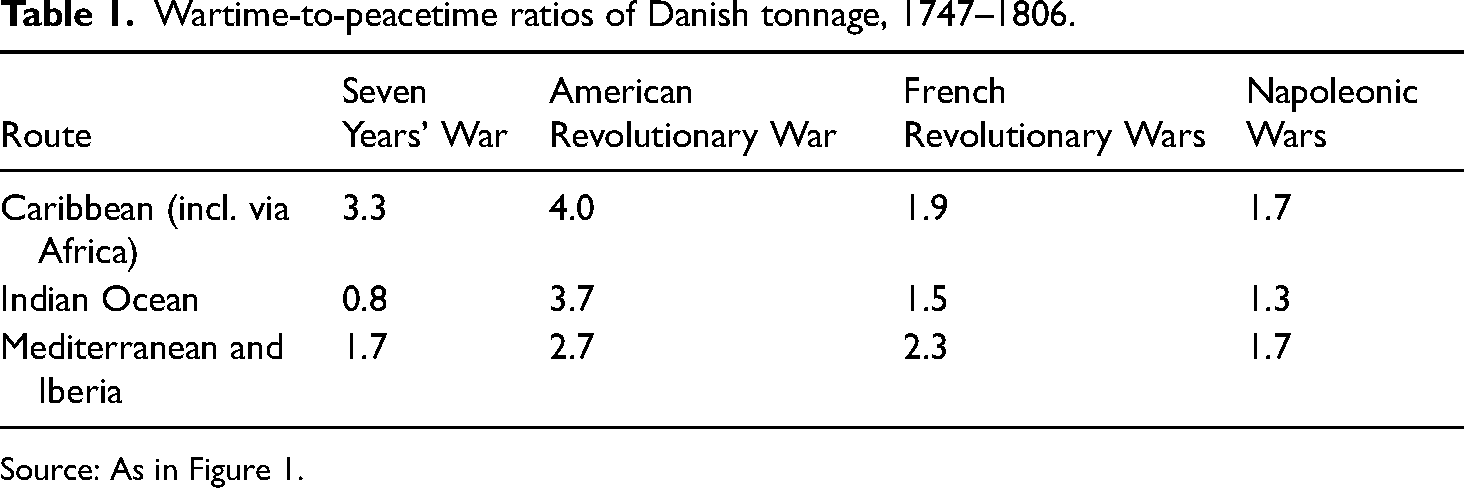
Source: As in Figure 1.
However, can we show that neutrality actually made Scandinavian voyages not just numerous but also generated more output, and, importantly, restrained privateers? To do this, this note proposes to do two things. First, applying the aforementioned index developed by Andersen and Voth to the Protocols. The index measures shipping output by multiplying the time a vessel was away on its voyage by its carrying capacity, thereby producing Q, or ‘tonnage days’. This captures the amount of shipping actually deployed in long-distance trade at a given moment. The fallout from these computations can then be checked against the outbreak of hostilities. In Andersen and Voth's work, the Protocols were used only for Danish voyages to the Mediterranean. Yet their study shows that neutral ships stayed out considerably longer during wars, taking advantage of buoyant freight markets. 35 This observation explains why a time-based metric is particularly well suited to measuring output in wartime shipping. Here, this method is extended to the larger dataset.
The method is also useful because it solves specific problems tied to the Protocols. It considers that the size of Scandinavian ships varied to fit a wide variety of tasks, much like all early modern vessels. The index also corrects for a possible misleading indicator of when ships were economically active. If, for example, a ship departed late during one year and returned in the following year or even the next year, then using the number of issued passes puts the bulk of this ship's output in the wrong year. This problem interrelates to a second issue, namely that the length of voyages of Scandinavian ships could vary significantly: from a shorter trip to the west coast of Iberia for a few months to an Indian Ocean journey that lasted for years. Measuring ‘tonnage days’ provides a more reliable indication of when ships were economically active, even if it cannot account for all interruptions such as repairs or turnaround times in port. In short, Q offers a device for how wartime freight markets shaped the output of neutral merchant marines, understood through tonnage capacity.
Secondly, this note propose to account for privateering's negative impact on neutral shipping output by computing tonnage days lost, or −Q. Such a measure captures the tonnage and time at sea removed from Scandinavian shipping by Swedish and Danish vessels seized and processed in British Prize Courts. To this end, a second database was constructed from multiple sources. First, data were pulled from search queries in the HCA catalogs (HCA 30, 32, 42, 45, 49) and checked for duplications where captures had been appealed. 36 To this was added seizures in uncatalogued printed appeals and in Scandinavian diplomatic archives, as well as captures listed in the literature. 37 In total, this resulted in the figures stated above. Moreover, verdicts were identified for about 70 per cent of all Scandinavian ships captured between 1756 and 1815; if the series is cut at 1807, when both Kingdoms abandoned neutrality, and were restricted to long-distance voyages, coverage rises to roughly 80 per cent. 38
The −Q calculation mirrors the Q index. For each captured ship, tonnage is multiplied by the number of days it was held from seizure until release or condemnation. When verdicts survive, the holding period can be dated precisely; where they do not, this note rely on averages from comparable cases (around three months on average between 1756–1815, with adjustments by war and destination). 39 If a ship was released, the master was normally reimbursed for freight, expenses and costs at the privateer's expense, meaning output was lost only for the time spent awaiting judgment. 40 If a ship was condemned, its tonnage was instead multiplied by the estimated duration it would have spent at sea had it not been seized – benchmarked against voyage averages drawn from the Protocols. 41 In cases of missing tonnage, mean substitution was applied. Where outcomes are unknown, this note have conservatively assumed condemnation to avoid overstating neutral resilience. 42 The resulting −Q values can then be directly compared with Q, providing a lower-bound estimate of how much Scandinavian shipping output privateering removed.
Figure 3 displays the result of Q and −Q for Scandinavian long-distance trade, 1747–1807, computed from the two datasets used in this note. It suggests that Scandinavian investments in neutrality made it into a powerful currency for economic actors during inter-European conflicts, particularly so after the introduction of a more ‘positivist’ or standardised practice during the Seven Years’ War. Importantly, the figure excludes captures from regional trades in the Caribbean and Indian Ocean, since such vessels typically did not requisition Algerian Sea Passes. An additional caveat concerns the Danish lacuna of 1772–1777. Because Q depends on measuring the interval between the issuance and return of each sea pass, the first years of each series start from ‘zero’, without carry-over tonnage days from voyages already underway. 43 This understates output for 1778–1782 in the Danish case. Even with these limitations, however, the results suggest that the common understanding of privateering as commerce-impeding is too narrow. Rather than disrupting trade, privateering helped drive it under neutral flags, transforming neutrality into a competitive advantage.
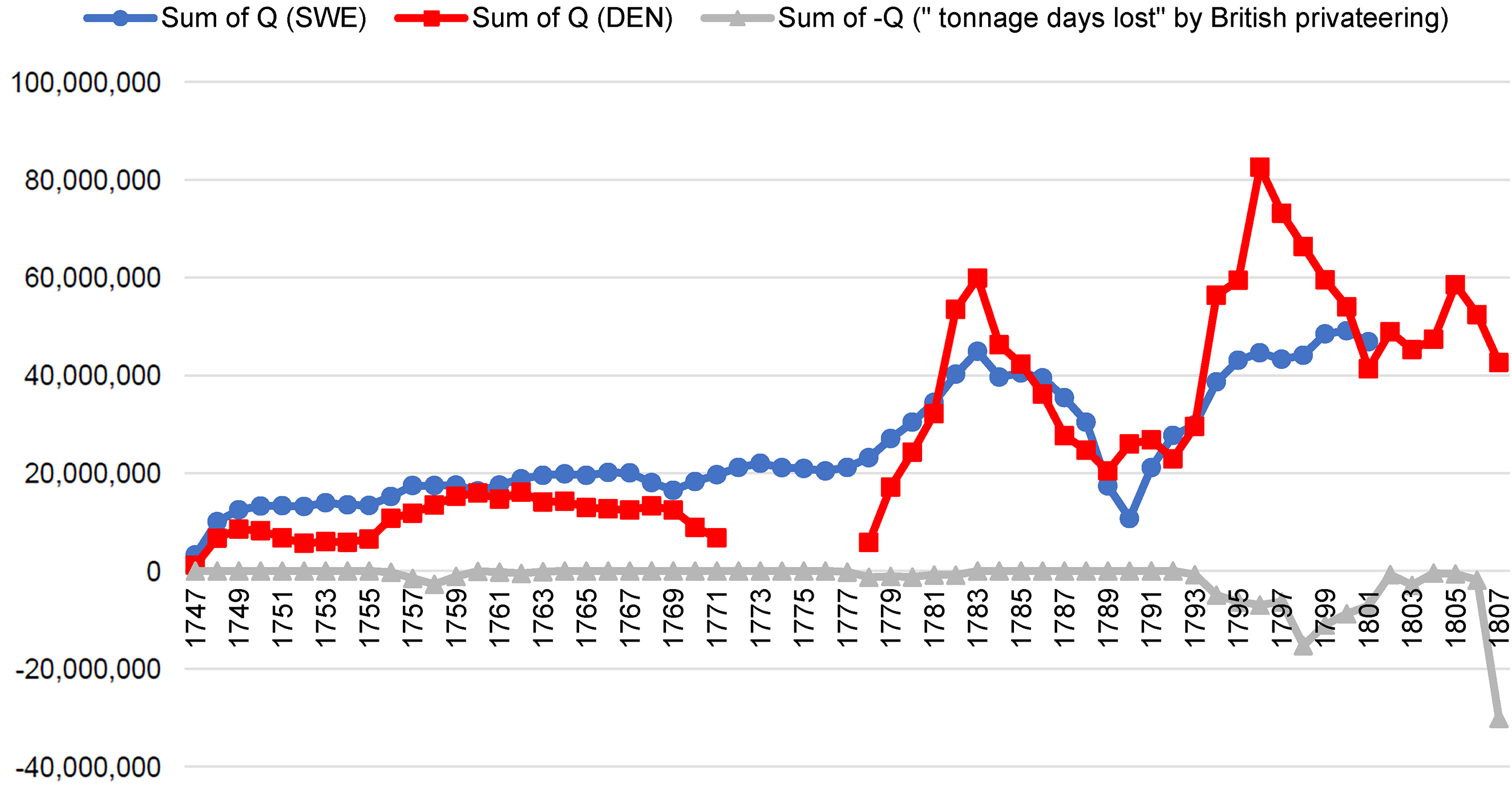
Q and −Q for Scandinavian long-distance shipping, 1747–1807. Source: Protocolle algierischer See-Pässe, 1747–1771, Kommercekollegiet, Tyske Sekretariat, Rigsarkivet, Copenhagen; Algiersk Pasprotokol, 1778–1848, Kommercekollegiet, Søpaskontoret, Rigsarkivet, Copenhagen; Algerian passport registers, 1739–1816, C II b., Kommerskollegium, Riksarkivet, Stockholm; HCA 30, 32, 42, 45, 49, The National Archives, Kew, London; ‘England, Akter vedr opbragte skibe 1756–1762’, Tyske Kancelli Udenrigske Afdelning, Rigsarkivet, Copenhagen; ‘Lista på upbragte Swenske Handels Skepp under Sju Årige Kriget uprättad år 1761’ and ‘Lista på upbragte Svenske Handels Skepp under det så kallade Amerikanska Kriget’, Diplomatica Anglica 443, Riksarkivet, Stockholm; ’Fortegnelser over de i England opbragte danske skibe (1793–1811)’, Kommercekollegiet (Udenlandske og konsulatssekretariatet and Handels- og Konsulatsfagets Sekretariat), Rigsarkivet, Copenhagen.
While Figure 3 provides new indications on the relationship between neutrality and privateering, the methods require a few clarifications. First, the Algerian Sea Pass Protocols, although unusually comprehensive, exclude short-haul trades and inter-regional voyages in the Caribbean and Indian Ocean, which were also exposed to wartime disruption. 44 Second, measurement noise is unavoidable. The Danish Protocols are most clearly affected, as the 6515 Danish entries between 1791 and 1800 are missing the date of return in all but 96 cases. To offset this distortion, this note applies series means for the 1778–1789 period (depending on voyage destination) that excluded passes for voyages that ended up in captures. 45 Third, the construction of –Q rests on counterfactual assumptions: condemned ships are treated as if they would otherwise have completed average voyages, which may inflate the estimated loss. Yet this assumption is arguably conservative, since missing verdicts have been coded as condemnations rather than acquittals. Finally, it bears stressing that Q and –Q capture shipping capacity in motion, not profit margins, insurance premiums, or reinvestment cycles. Nor does it capture how cargoes were adjudged, although such outcomes arguably meant less to a shipper. 46
A further issue concerns the question of the baseline. To say that neutrality ‘restrained privateering’ is to invite the response – compared with what? The obvious baseline is belligerent shipping. Despite impetus given towards neutrals, Danish and Swedish vessels made up no more than 3.4 and 1.5%, respectively, of the condemned vessels at the prize court in Doctors’ Commons, London, during the Seven Years’ War. These figures dropped to 0.9 and 0.3% between 1776 and 1783. 47 Although far from conclusive, such numbers can be compared with losses of the French mercantile marine, which consisted of the majority of condemnations during the eighteenth century, including the 1756–1763 war and 59.5% of the condemnations in the 1776–1783 conflict. 48 Another baseline is a counterfactual world of unimpeded trade, in which even neutrals would not have lost tonnage days to capture or detention. Yet taken together, the two datasets show not that neutrals escaped war unscathed, but that neutrality created a buffer that allowed shippers to better absorb shocks. The balance between Q and −Q shown in Figure 3 suggests that the international institution of neutrality provided a structural protection for shippers, which the Scandinavian merchant marines successfully exploited. The point is not that neutrality abolished privateering. Instead, it channelled and limited privateering's effect in a way that mattered for economic actors.
Conclusion
Applying a combination of datasets and methods, this note suggests a new lens for understanding how rulers and economic actors turned law and diplomacy into instruments of profit. Through neutrality, privateering pressures could be channelled into new, legally sanctioned forms of exchange that turned war into commercial opportunities. This dynamic explains the factors sustaining Baltic exports and shifts in their payment pattern during 1750–1815. It also helps us understand how Sweden and Denmark emerged as key neutral carriers after the Fourth Anglo-Dutch War, with merchant fleets well out of proportion to the size of their populations.
While this note focuses on Denmark and Sweden, the framework developed here is broadly applicable. Researchers examining shipping, wartime logistics, or maritime law in other contexts – whether Dutch, Portuguese, or American – can adopt similar strategies to assess shipping output and loss. The Q/−Q method, in particular, provides a scalable approach by focusing on tonnage days lost, which was likely a more consequential interruption than turnaround times in port or repairs. The methods and datasets presented here are intended to be built upon, contributing to a wider study of the wartime economics of global shipping.
Footnotes
Acknowledgements
The author thanks Jeremy Land, Fredrik Charpentier Ljungqvist, and Leos Müller for their valuable commentary on this text.
Funding
The author received no financial support for the research, authorship and/or publication of this article.
