




Abstract
The speed of ships is a crucial variable in shipping productivity. Despite the dominance of the Dutch East India Company (VOC) in Eurasian trade in the early modern era, its ships were generally slower than those of other companies. This article investigates the causes of this gap in shipping speeds. We dismiss reasons that highlight more numerous stops, longer routes, inferior navigation and restrictive instructions, and emphasize differences in ship design resulting from constraints imposed by the Dutch shallow inland waterways, and the slow adoption of copper sheathing in the late eighteenth century, as plausible explanations.
In the early modern period, shipping played an important role in the rise of world trade, and perhaps in a first round of globalization. 1 There is a long-standing debate on whether shipping productivity increased before the nineteenth century. 2 It has been suggested that it rose as the consequence of increases in ship size, better organization of shipping trade and more efficient use of ships. 3 A number of recent studies have emphasized that in the eighteenth century the speed of ships may have increased, with evidence of increasing shipping speeds derived from the Atlantic slave trade, on British East India Company ships and the ships of the Royal Navy. 4
This recent work on ship speeds has thrown up a puzzle: Dutch East India Company ships were generally much slower in getting to Asia than those of other companies. 5 As Table 1 shows, in the peacetime years of the early 1770s, Dutch ships took from a month to two months longer than did English ships. The English advantage then widened to two to three months in the peacetime years of the 1780s and early 1790s. In the 1780s, French ships also seem to have been significantly faster than Dutch ships, though the sample is small.
Duration of outward voyages to Asia.
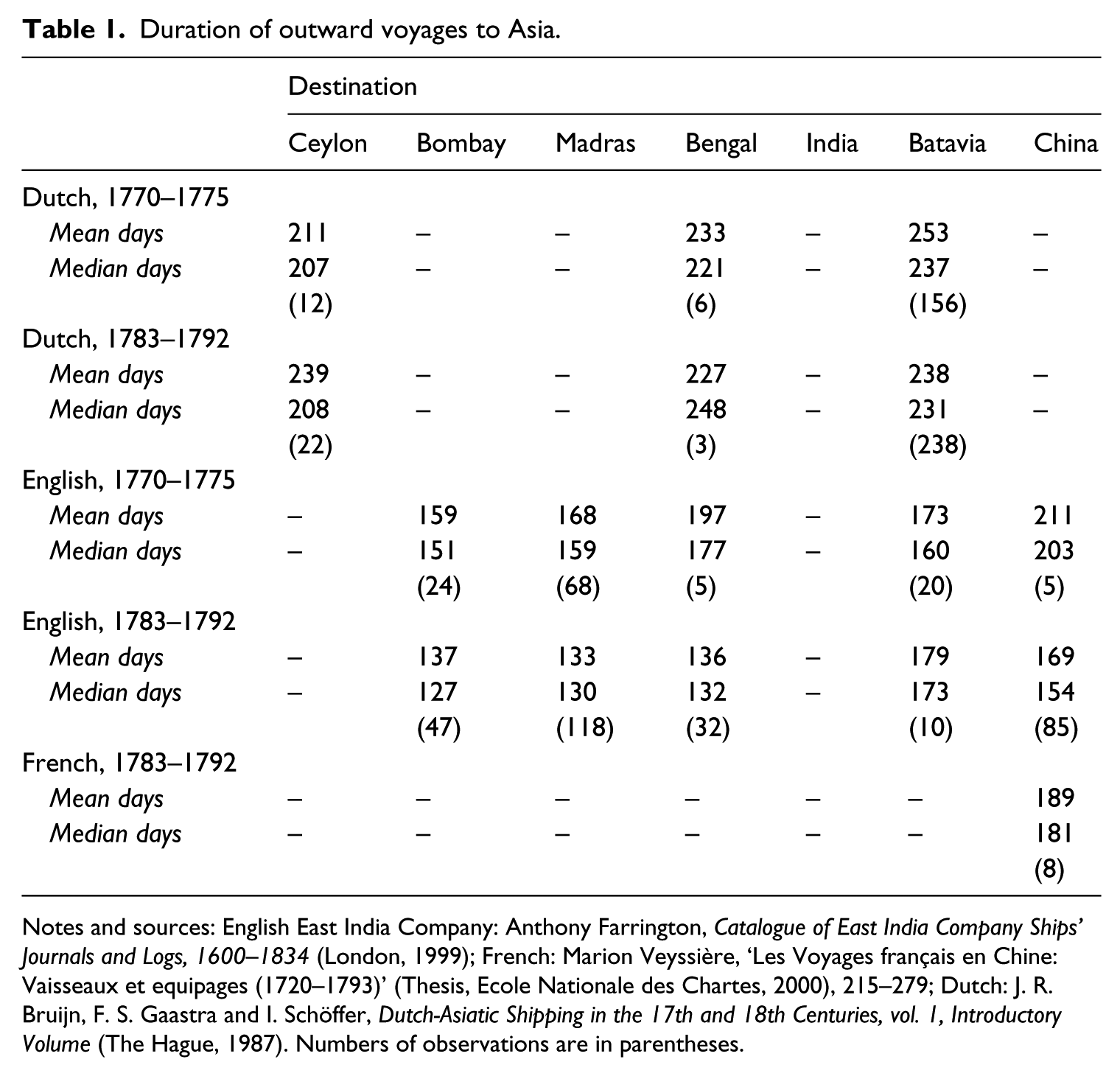
Notes and sources: English East India Company: Anthony Farrington, Catalogue of East India Company Ships’ Journals and Logs, 1600–1834 (London, 1999); French: Marion Veyssière, ‘Les Voyages français en Chine: Vaisseaux et equipages (1720–1793)’ (Thesis, Ecole Nationale des Chartes, 2000), 215–279; Dutch: J. R. Bruijn, F. S. Gaastra and I. Schöffer, Dutch-Asiatic Shipping in the 17th and 18th Centuries, vol. 1, Introductory Volume (The Hague, 1987). Numbers of observations are in parentheses.
The slowness of Dutch East Indiamen has not gone entirely unremarked. Bruijn et al. compared the China voyages of the Dutch, French, Danish and Swedish companies, and found that the Dutch were a month to two months later getting back to Europe. 6 But in subsequent work, Gaastra and Bruijn found that Dutch ships were, if anything, slightly faster than Danish ships on routes to India. 7 They explained the slow passages to China in part by the relative inexperience of Dutch captains on that route. English ships did not figure in these comparisons, so Bruijn and Gaastra understated the slowness of Dutch (and Scandinavian) ships on both India and China routes.
This article explores possible explanations for the slowness of Dutch East Indiamen. Did the Dutch take different routes from the English and the French? Did they lose time by stopping more frequently? Or were there deficiencies in Dutch ship design that made their East Indiamen less efficient sailers? The answers to these questions should be of interest not only to maritime historians. Slow ships increased the costs of trading with Asia and should thus have had implications for the competitiveness of the Dutch East India Company (VOC). Although the VOC had a monopoly on trade between the Netherlands and Asia, it still competed with the English and French companies in third markets in Europe. Moreover, if the Dutch made bad decisions about routes or ship design, it could be taken as further evidence for the ossification of the Dutch economy in the eighteenth century. Bruijn, in his study of East India captains, stresses the conservativeness of the VOC. 8
We approach the problem in two steps. First, we consider the widening of the gap from the 1770s to the 1780s. Then we take up the reasons for the initial gap in the 1770s.
Growing divergence in ship speeds from the 1770s
The widening of the gap between Dutch and English ships from the 1770s to the 1780s has a straightforward explanation. The English company, after some initial hesitation, adopted quite rapidly the most important innovation in maritime technology of the late eighteenth century, the copper sheathing of ships’ hulls. Copper sheathing had two great advantages. First, it protected the hull against the damage caused by ship worm (teredo navalis). These molluscs, which then were found mainly in tropical regions, burrow into wood and so threaten the structural integrity of the ship. Previous remedies, including sheathing with an additional layer of wood and/or coating with a variety of materials, had been largely unsuccessful. Other metals had been tried, but copper sheathing proved to be the answer. It extended the lives of English East India ships from an average of 12–13 years to more than 20 years, and may have reduced ship losses as well.
The other advantage of copper sheathing is that it prevented the accretion of seaweed and marine creatures on the hull. Copper-based paints are still used for this purpose. Fouling could significantly reduce the speed of ships through the water. Modern estimates put the reduction as high as 50 per cent. Less fouling also reduced downtime for maintenance. As a result, English East India Company ships were able to make not only faster voyages, but more frequent ones.
Copper sheathing had two distinct effects on the duration of voyages to Asia made by English ships. One was to increase the speed at which they sailed; the other was to allow them to make fewer stops. Solar and Hens show that, allowing for the variations in the number of stops as well as other characteristics of ship and voyage, the increase in speed was about 11 per cent, or roughly 18 days. 9 Their estimates also show that each stop cost slightly less than a month in voyage duration. English ships increasingly sailed straight through to their Asian destinations. They thus avoided the time lost in stopping and were able to take advantage of the optimal route, which was to follow the South American coast down to about 5 degrees latitude south of the Cape, then head east, only turning north somewhat before Australia. This allowed ships to benefit from the strong westerly winds between 40 and 50 degrees latitude. 10 Some English ships were already doing this in the early 1770s, but it became much more common in the 1780s. The average number of stops by English East Indiamen in peacetime periods fell from 1.27 in the early 1770s to 0.58 in the 1780s and 0.33 in the 1820s. These figures imply reductions in voyage duration of 20 and 28 days.
The return on copper sheathing was high. Solar estimates that over a somewhat longer period, from the 1770s to the 1820s, the innovation reduced the English company’s cost of shipping between Europe and Asia by about a third. 11 In the 1780s, this would have amounted to £5–6 per ton. Estimates in 1790 show that sheathing cost something close to £1 per ton, though other evidence indicates that this might have stretched to £2. These figures suggest that copper sheathing paid for itself in one voyage, though it was usually good for two or three voyages before it needed to be renewed.
Such high returns may not have been so obvious in the 1780s. The reductions in capital costs due to greater ship longevity and higher voyage frequency would have been observable only after a decade or two. The only immediate gains came from the reduction in labour and provisioning costs due to shorter passages. That said, the English shipowners took up the innovation very rapidly. By 1789, 78 per cent of ships hired by the East India Company had been coppered. 12 Of the ships built before 1780, only 58 per cent had been copper sheathed, whereas the proportion of those built after 1784 was 89 per cent. Only the owners of ships in the slave trade were more eager to adopt the innovation. The majority of slavers were already copper sheathed by 1780; the share exceeded 90 per cent by 1790. 13 The decisions of these shipowners may have been influenced by the alacrity with which the Royal Navy coppered its entire fleet around 1780.
Unlike the English company, the VOC built and owned its ships, hence the decision to copper or not was in the hands of its component admiralties. 14 Amsterdam and Maze experimented with copper-bottomed ships in 1777 and 1780, with Noorderkwartier and Zeeland following in 1783 and 1786. The results were deemed unsatisfactory because the work was not done well and the copper sheathing damaged the ships’ iron fastenings through galvanic action. 15 The VOC took up the issue again in 1788 when the council of the Heeren XVII (Gentlemen Seventeen) received a note from its officials at Canton. The note reported that English ships made the trip between Europe and Canton much faster for three reasons. First, the English vessels were copper sheathed. Second, English officers were free to set out their own course, whereas VOC officers were obliged to follow detailed sailing instructions. Third, the English employed only three-decked ships, which could continue to sail during storms and in high waves. 16
The note sparked a long discussion on copper sheathing as the chambers (Amsterdam, Zeeland, Delft, Enkhuizen, Rotterdam and Hoorn) were requested to examine the proposal of the Cantonese servants and report back in the spring of 1789. While the chambers unanimously concluded that copper-bottomed ships were indeed significantly faster, they noted that this advantage came at a cost. The Amsterdam chamber reported that the coppering would get damaged as ships went from inland ports out to sea. Ships could scrape against the bottom and sides of the canals. Moreover, shallow inland waterways meant that flotation devices known as camels had to be attached to large ships. The Delft chamber noted that the wood beneath the copper skin was more likely to rot due to lack of ventilation. In order to monitor whether the wood had rotted the whole copper skin had to be removed and then put back again after each trip, increasing maintenance costs. Delft finally suggested that as a result of corrosion on the vingerlingen, the rudder could get stuck. 17 Therefore, the Delft chamber suggested tin rather than copper be used for sheathing. Several chambers were concerned with the cost of copper sheathing. Sheathing a 150 foot ship was reckoned to cost 17,000 florins, which would work out to something like 20 florins per ton, or £1.80 per ton. The cost thus seems to have been similar to, or perhaps somewhat higher than, in England.
These reports led the VOC to postpone a decision on copper sheathing until the autumn of 1789 in order to let the chambers study each other’s reports. 18 Ultimately, it was decided that those chambers that did not make use of the camels, Zeeland, Delft and Hoorn, would build copper-bottomed ships and use them on the routes to Canton. Delft soon reported that its shipyard was not suited to copper ships and was allowed to withdraw from this experiment. 19 It was not until late 1791 that the first copper-bottomed Dutch East Indiaman, built by Hoorn, sailed for Asia. Only at the end of 1792 did the VOC request, but not require, that all newly built ships be sheathed with copper, and only in June 1794 did it become compulsory to copper all newly built ships. 20 The disruption of Dutch trade with Asia during the French wars meant that this request had only limited effect. The slow and incomplete adoption of copper sheathing and the extensive deliberations preceding it thus offers further evidence of the VOC’s conservatism.
Explaining the initial gap
The large initial gap in voyage durations between Dutch and English ships still requires explanation. One way of trying to investigate possible explanations is to explore when this gap first appeared. As shown in Figure 1, there was no significant trend over the late seventeenth and eighteenth centuries in the duration of Dutch voyages to Batavia. 21 The leg to the Cape may have become slightly shorter, that from the Cape to Batavia slightly longer, but the changes were not large. Data on the duration of voyages by English East Indiamen are relatively scarce for the seventeenth century, but more abundant in the eighteenth century. As shown in Table 2, the number of days to Asia was quite similar in the 1720s and the 1770s, which indicates that the large gap between English and Dutch ships prevailed through most of the eighteenth century. English ships do seem to have been slower in the second half of the seventeenth century, but the sample sizes are very small. But even if they were slower than in the eighteenth century, they were still 20 days or so faster than Dutch ships in the same period.
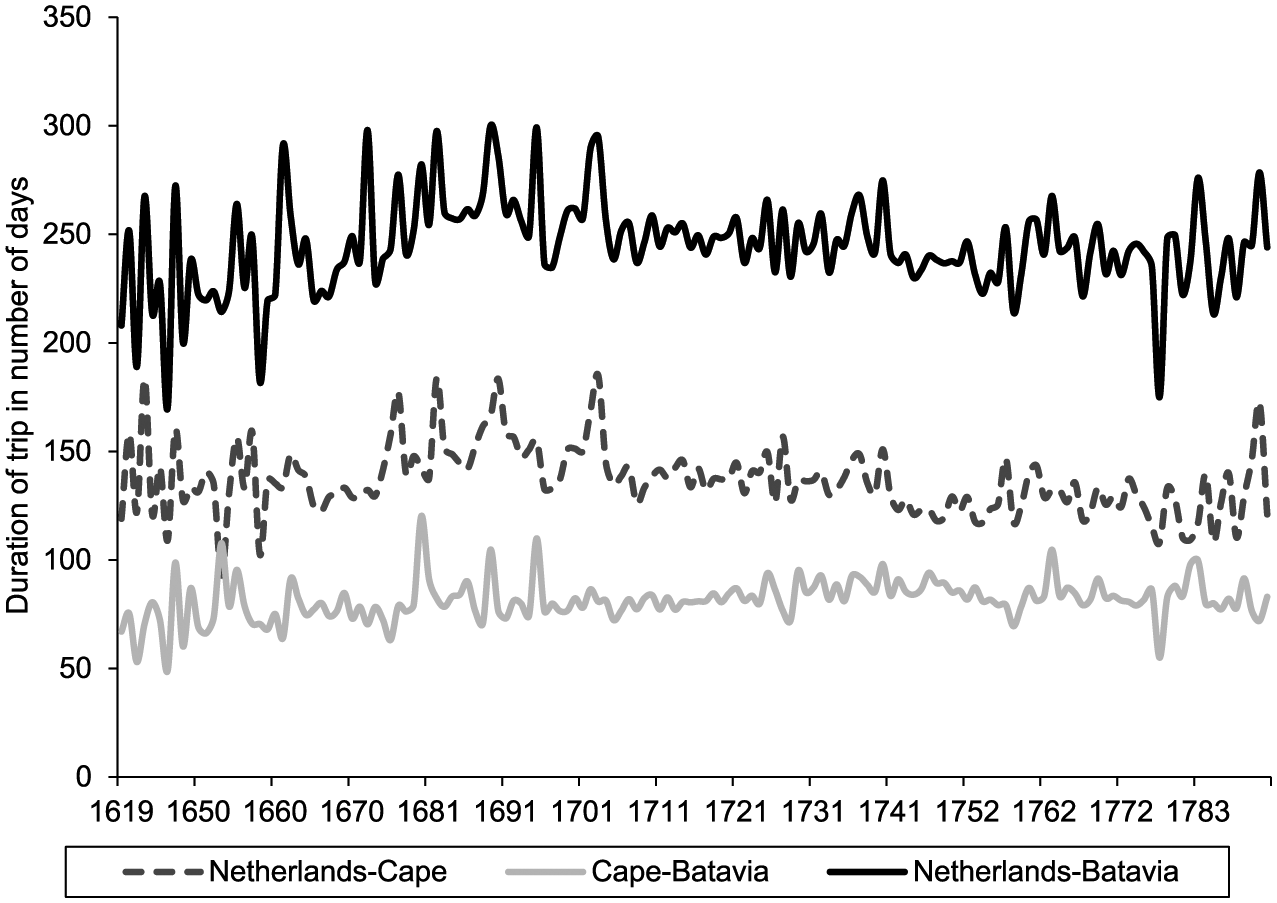
Duration of Dutch voyages.
Duration of outward voyages to Asia.
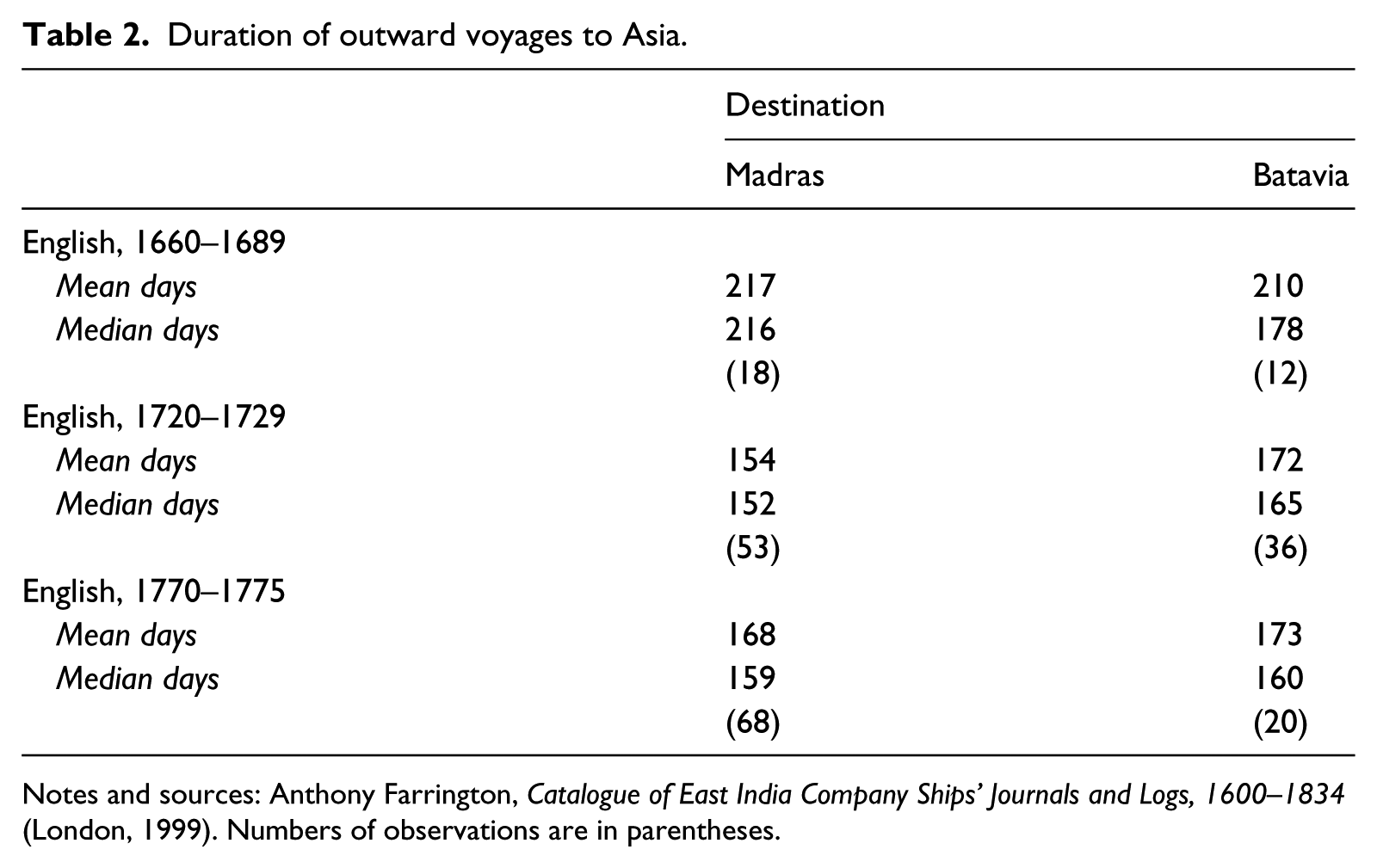
Notes and sources: Anthony Farrington, Catalogue of East India Company Ships’ Journals and Logs, 1600–1834 (London, 1999). Numbers of observations are in parentheses.
How can these long-term differences be explained? One explanation for the extra time taken by Dutch ships in the late eighteenth century can be dismissed rather easily. This is that they went round Scotland rather than by the much shorter route through the Channel. Dutch ships did occasionally use this longer route, but generally only in wartime and less and less so over time. 22 The logs of Dutch ships which have been digitized and mapped show no instances of it being used in peacetime and very few even in wartime. 23 Gaastra and Bruijn state that the ‘backway’ had gone out of use by the late eighteenth century. 24
A more serious contender is that Dutch ships made more stops. As noted above, analysis of English East India Company voyages to Asia shows that each stop added almost a month to voyage duration. 25 Dutch ships always stopped at the Cape, and generally spent about a month there. On their way to the Cape they occasionally stopped in England or in the Cape Verde islands. 26 But the VOC ships did not seem to make significantly more stops on the way to Asia. A number of logbooks have been digitized by the CLIWOC project. For the 31 VOC voyages between 1753 and 1791 for which the logbooks seem to be complete, the ships made only one stop in 24 cases, two stops in six cases and three stops in one case. 27 This works out to an average of 1.26 stops, almost identical to the average of 1.27 stops made by English East Indiamen in the early 1770s.
Differences in navigational technique, yet another possible explanation, are unlikely to explain the differences in voyage durations. Bruijn argues that in the 1740s there was a shake-up in the VOC. 28 The new Generale Lijst of 1747 provided for more navigational equipment as standard issue, charts were updated and published for the first time, and a naval academy was established at Batavia. But further innovation was limited from the 1750s to the 1780s, and in some respects, such as the closure of the academy, there was even regression. In England, there was also progress during the mid-eighteenth century, as naval chronometers came into use and charts were improved. But as an explanation for differences between English and Dutch ships the timing is all wrong. The gap in passage durations had opened up well before the 1740s and 1750s and did not widen significantly until the 1780s and 1790s.
Whatever their equipment, VOC captains were required to follow detailed sailing instructions, a constraint cited in the note from Canton in 1788. After deliberations, the VOC decided in November 1789 to maintain the existing regulations regarding shipping routes. It did note that the maps used by other countries were more detailed than those used by the VOC and proposed that new maps, based on French work, be issued. 29 However, it is not clear that the prescribed routes were suboptimal and if they were, why the VOC would have maintained them for almost a century. 30
Dutch ships may simply have been slow sailers. Here one of the constraints may have been the fact that Dutch East Indiamen were built at inland yards in Amsterdam, Rotterdam and other Dutch cities and they also served these same ports. As noted above, in order to reach and return from the sea through relatively shallow channels and the Zuider Zee, these very large ships had to be raised in the water using ‘camels’, buoyant vessels attached to the ship. Even though the Dutch did manage to get their East Indiamen to the sea, the problem was minimized by building them with wide waists and relatively flat bottoms. 31
Flat-bottomed ships were also in the tradition of the fluyt, the classic Dutch cargo ship. Such ships could carry large loads and were fine for conditions in the Baltic, but on the high seas they held course less well. Some fluyts were used in the East India trade and Bruijn et al. have shown that they sailed considerably slower than the East Indiamen, especially towards the end of the eighteenth century: after 1750, East Indiamen made the voyage to the Cape in 125–126 days, while fluyts made the trip in 161–197 days. On the return trips, the difference was less spectacular however: 105–120 as against 117–126 days. 32 While they were slower, they were relatively cheap and had considerable carrying capacity.
The Gentlemen XVII gave out general instructions about the ships, yet there was little unity among the ship design of the various chambers, especially in the seventeenth century. 33 In 1697, a resolution fixed the shape of the various sizes of the ships going to the Indies. Nevertheless, complaints by naval officers about the lack of speed of Dutch ships in the early eighteenth century led to new discussions about ship designs. It was noted that English ships were generally faster, and therefore English shipwrights were brought to the Republic by the Admiralty of Amsterdam, including Charles Bentam, who made the designs for East Indiamen that were adopted in 1742.
Despite these designs, many of the shipwrights took significant liberties in their shipbuilding, which was aided by the fact that they did not use technical drawings. Ship design was a compromise between carrying capacity, sturdiness and stability, speed and manoeuvrability. Bentam’s designs received considerable critique from Dutch master shipwrights; while his vessels were slimmer and sharper, it was noted that they laid too deep and were less stable. 34 Dutch shipwrights gave preference to more sturdy ships. Opposition to the English designs came in particular from Rotterdam, as, in order to reach the North Sea, ships from Rotterdam had to navigate through shallow waters that were also too narrow for the use of camels (see Figure 2).
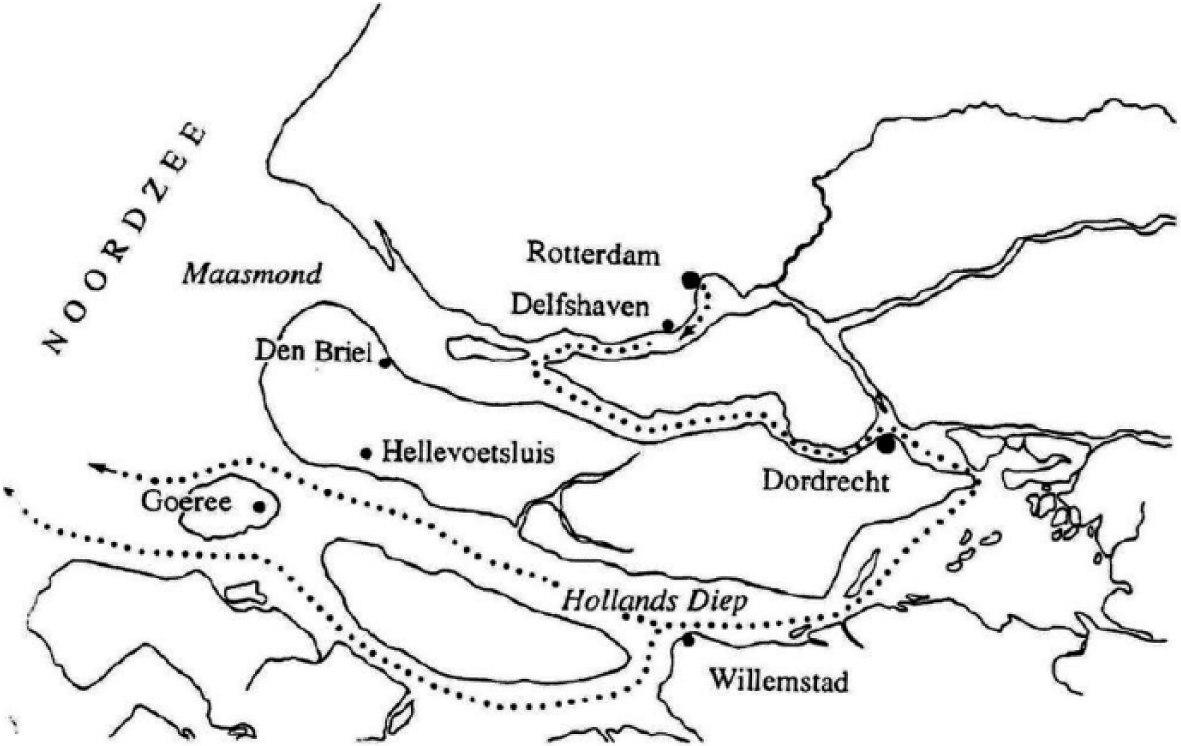
Route from Rotterdam to the North Sea.
Considerable independence of the shipwrights also meant that Bentam’s ship designs perhaps provide us with little information about the ships actually built, and that they could still differ among the chambers. The shipyard in Zeeland had direct access to the sea and shipbuilding was thus not constrained by shallow waters. Did Zeeland built faster ships? In the late 1730s, Zeeland built four ships specifically designed for fast sailing: the Arnestijn, Loverendaal, Ouwerkerk and Huis Ter Duine. 35 These ships sailed to the Cape in 127 days on average and to Batavia in 225 days, which is only slightly below the overall average of the 1740s (when these ships were taking an average of 127 and 241 days respectively). The experiment was considered a failure by the VOC, mostly because the ships had relatively small cargoes (they had a capacity of between 550 and 650 tons). 36
The Dutch-Asiatic shipping database allows the analysis of shipping speeds (in number of days) in relation to the shipyard where the ships were built (a dummy variable), the tonnage and the building year. 37 A regression analysis of these variables shows that ships built by Zeeland were on average not significantly faster, but instead had significantly higher capacity than Amsterdam (the reference category), and certainly than the other chambers who had considerably smaller ships than those built in Amsterdam (see Table 3). It seems that the VOC directors were more interested in the capacity of ships, rather than fast sailing. Surprisingly, ships from Delft were significantly faster, on average seven days, while ships from Enkhuizen and Hoorn were slower than the others on the voyage to Batavia. Interestingly, ships from Hoorn were significantly faster on the return trip. Yet overall it seems that differences between the ships built in the different chambers were small.
Regression analysis Dutch-Asiatic shipping.
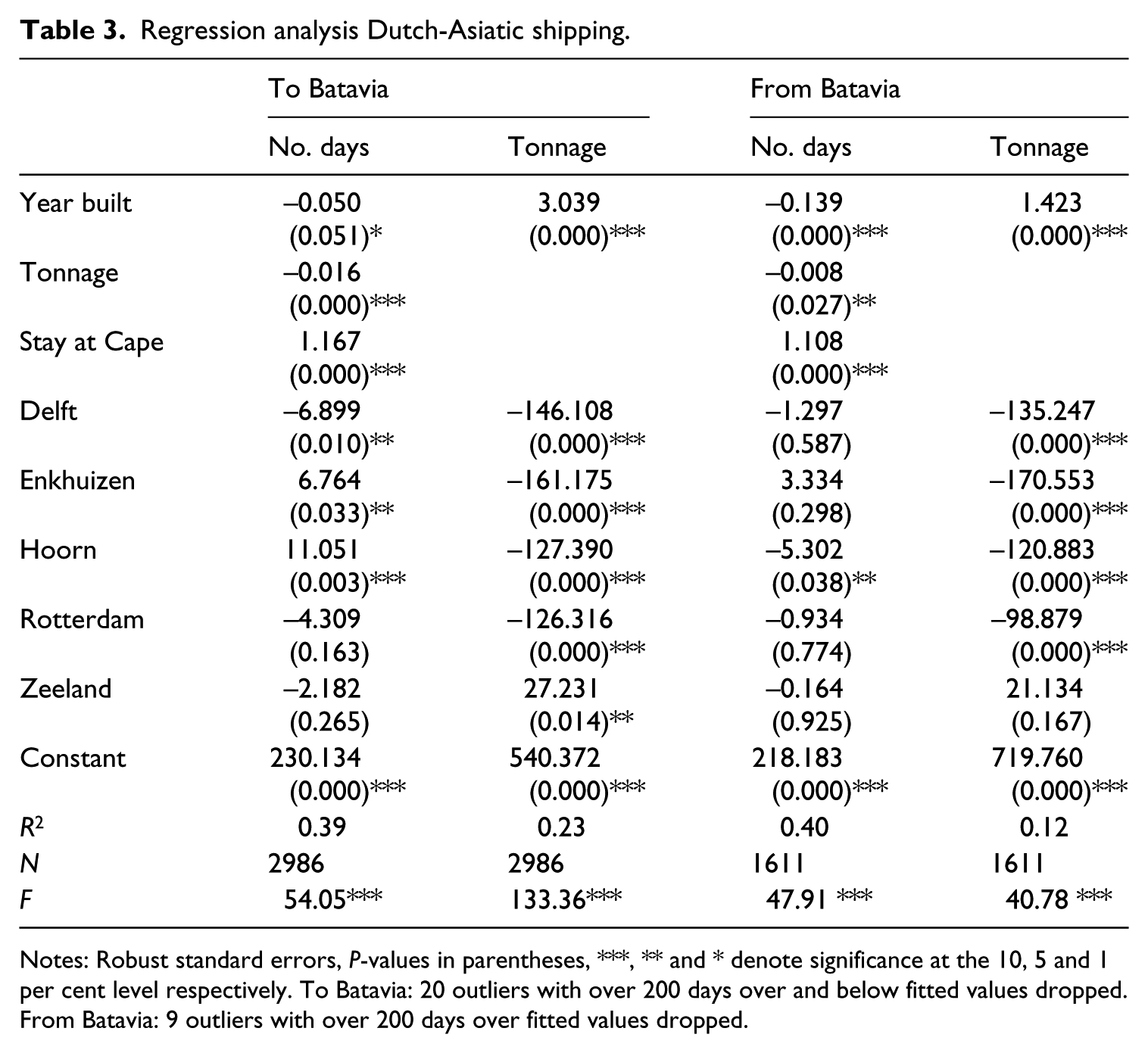
Notes: Robust standard errors, P-values in parentheses, ***, ** and * denote significance at the 10, 5 and 1 per cent level respectively. To Batavia: 20 outliers with over 200 days over and below fitted values dropped. From Batavia: 9 outliers with over 200 days over fitted values dropped.
Some indirect evidence for the inadequacies of eighteenth-century VOC ship design comes from the years after the demise of the Company. Already in 1802–1803 ships were making the trip to Batavia in 175–176 days, considerably faster than in the 1780s. 38 By the 1820s, when trade to Asia was no longer in the hands of the Company, there was little difference between Dutch and English ships in the time they took to reach Asian ports. As shown in Table 4, sailing times for the Dutch ships were almost the same as those for non-Company ships of a similar size sailing from Britain. The very large English East India Company ships were still faster, by 20 days or so, but larger ships do tend to be faster sailers.
Duration of outward voyages to Asia.
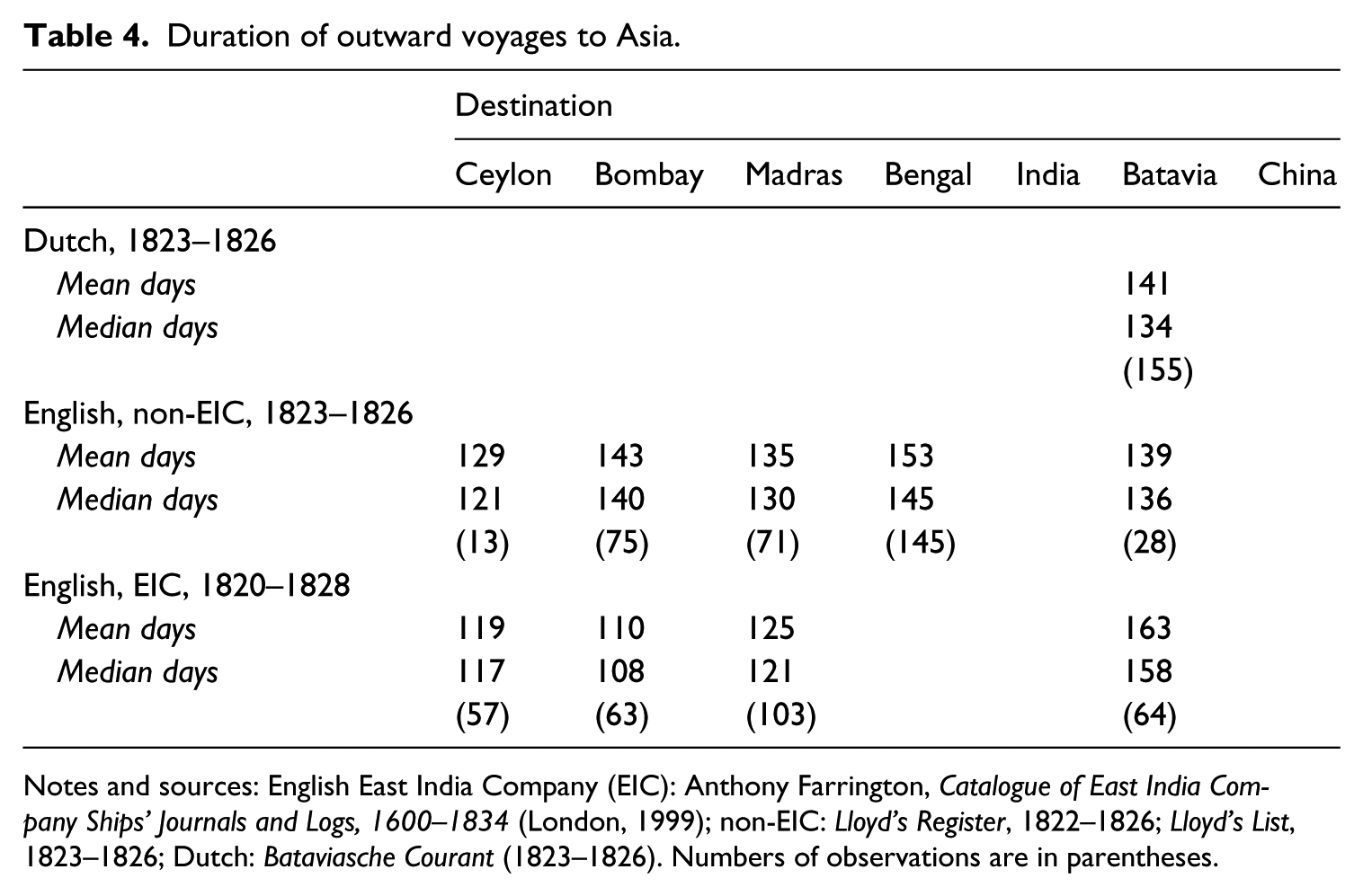
Notes and sources: English East India Company (EIC): Anthony Farrington, Catalogue of East India Company Ships’ Journals and Logs, 1600–1834 (London, 1999); non-EIC: Lloyd’s Register, 1822–1826; Lloyd’s List, 1823–1826; Dutch: Bataviasche Courant (1823–1826). Numbers of observations are in parentheses.
One reason that the Dutch ships may be so comparable to English ships is that after the wars the Dutch were using mostly foreign-built ships. In 1814, when the trade with the East Indies was re-opened, the Dutch merchant fleet was greatly diminished, as many of the VOC ships had been taken over by the British or had rotted away in harbour. 39 Of the 51 ships serving Batavia between 1823 and 1826 for which the place of construction is known, only 18 had been built in the Netherlands. Fifteen had been built in America; while the others were constructed in England, Asia and various European countries. 40 This dependence on foreign-built ships prompted the Dutch government to stimulate the Dutch shipbuilding industry by offering subsidies from the early 1820s. Almost all of these newly built ships were copper- or zinc-bottomed, as such ships received a larger premium.
The establishment of the Dutch Trading Society (Nederlandsche Handel-Maatschappij, NHM) in 1824 gave a further boost to Dutch shipbuilding. The NHM gained a monopoly on the trade with the Dutch East Indies and was required to rent ships from Dutch shipowners. It paid very high freight rates, about twice those paid on the free market. While these policies have often been blamed for the lack of technological innovation and the slow adoption of steam power later in the nineteenth century, 41 they gave an enormous boost to Dutch shipbuilding in the 1820s, 1830s and 1840s. Whereas in 1823 only nine Dutch ships were engaged in the trade with the East Indies, this figure increased to 49 ships in 1832 and 92 ships in 1835. Despite a lowering of freight rates in the 1830s, by the end of that decade there was an oversupply of shipping capacity, even with the rapid growth of cash crop production under the Cultivation System. 42
The majority of the new ships in the 1820s were built in Amsterdam, Rotterdam and Antwerp and the trade between the Netherlands and the East Indies was conducted only from the ports of Amsterdam, Rotterdam, Dordrecht and Middelburg. 43 While these continued to use the inland ports, the ships may have been more slender as the maximum capacity was set at 400 last (equal to about 756 tons), while VOC ships by the end of the eighteenth century were often 1000 tons. The ships built between 1824 and 1848 were also generally much more lean than those built previously: with a length–width ratio of 5/6 to 1, 44 whereas seventeenth- and eighteenth-century VOC ships had a ratio of 4 to 1. 45 As shipwrights continued to improve on the hull design, shipping speeds continued to increase over the remainder of the nineteenth century. Dutch merchantmen made shorter and shorter voyages, their duration declining from 121 days in 1830 to around 80 days in the late 1830s and 1840s. 46
Conclusion
This article has investigated why Dutch East Indiamen were much slower than their English counterparts in the eighteenth century, and why this gap increased in the closing decades of the eighteenth century. Some explanations for the initial gap – that the Dutch ships took a longer route and that they stopped more often – proved to be unsupported by the evidence. Others – that Dutch navigation was inferior and that their captains were hampered by restrictive sailing instructions – would seem to be implausible. We believe that the gap in voyage durations during the eighteenth century probably owes much to differences in ship design and that these differences stem from the constraints imposed on Dutch shipping by difficult access to inland ports. Where the ships did have direct access to the sea, in Zeeland, the VOC preferred to build larger, rather than faster, ships.
We are more certain about the reasons for the widening of the gap from the 1780s onward. This was the result of the slow adoption of copper sheathing by the VOC. Whereas 90 per cent of English ships were copper bottomed by 1790, the Dutch only adopted it on a large scale after trade to the East Indies was reopened after the French Wars. Initially, they used foreign-built vessels and later Dutch-built copper-bottomed ships. In addition, whereas VOC ships had been relatively wide and flat-bottomed, the ships used in the 1820s were smaller, longer and narrower.
Slower ships would have principally increased wage and provisioning costs for the VOC, but the effect on the prices of goods imported from Asia may not have been large. Labour costs, including provisioning, amounted to only about a third of shipping costs for the English East India Company. 47 In addition to transport costs, the VOC also had to factor in the costs of its mercantile capital and considerable administrative overheads in both the Netherlands and Batavia. Slow ships may have put it at a disadvantage in satisfying consumer demand. In the nineteenth century, clippers raced back to Europe in order to be first on the market with the new season’s tea. But none of this may have mattered much to the VOC, which had a near monopoly position for certain products. The quiet life of the monopolist may have allowed the VOC to continue its activities at shallow water ports and to build relatively slow, but large, ships there.
Footnotes
Acknowledgements
We are deeply grateful to Jaap Bruijn, Larrie Ferreiro, Ab Hoving, A. A. Lemmers, Claudia Rei, Richard Unger, Jelle van Lottum and Jan Luiten van Zanden for commenting on earlier drafts of this article; to Pieter Woltjer and Michalis Moatsos for assistance with the Dutch-Asiatic Shipping database data; and to Eric Vanhaute and Torsten Feys for providing us with some obscure data.
1.
Kevin H. O’Rourke and Jeffrey G. Williamson, ‘When Did Globalisation Begin?’, European Review of Economic History, 6 (2002), 23–50; Pim de Zwart, ‘Globalization in the Early Modern Era: New Evidence From the Dutch-Asiatic Trade, c.1600–1800’, Journal of Economic History, 76 (2016), 520–58.
2.
Douglass North, ‘Sources of Productivity Change in Ocean Shipping, 1600–1850’, Journal of Political Economy, 76 (1968), 953–70; Russell Menard, ‘Transport Costs and Long-Range Trade, 1300–1800: Was there a European Transport Revolution in the Early Modern Era?’, in J. D. Tracy ed., The Political Economy of Merchant Empires (Cambridge and New York, 1991), 228–76.
3.
See Klas Rönnbäck, ‘The Speed of Ships and Shipping Productivity in the Age of Sail’, European Review of Economic History, 16 (2012), 469–70.
4.
Rönnbäck, ‘The Speed of Ships’; Peter Solar and Luc Hens, ‘Ship Speeds During the Industrial Revolution: East India Company Ships, 1770–1828’, European Review of Economic History, 20 (2016), 66–78; Cormac O’Grada and Morgan Kelly, ‘Speed Under Sail, 1750–1850’, UCD Working Paper Series (2014).
5.
Peter M. Solar, ‘Opening to the East: Shipping Between Europe and Asia, 1770–1830’, Journal of Economic History, 73 (2013), 625–61.
6.
J. R. Bruijn, F. S. Gaastra and I. Schöffer, Dutch-Asiatic Shipping in the 17th and 18th Centuries, vol. 1, Introductory Volume (The Hague, 1987), 103–06.
7.
F. S. Gaastra and J. R. Bruijn, ‘The Dutch East India Company’s Shipping, 1602–1795, in a Comparative Perspective’, in Jaap R. Bruijn and Femme S. Gaastra, eds., Ships, Sailors and Spices: East India Companies and their Shipping in the 16th, 17th and 18th Centuries (Amsterdam, 1993), 205.
8.
Jaap R. Bruijn, Commanders of Dutch East India Company Ships in the Eighteenth Century (Woodbridge, 2011), chapter 16.
9.
Solar and Hens, ‘Ship Speeds During the Industrial Revolution’.
10.
Gerald S. Graham, The Politics of Naval Supremacy (Cambridge, 1965), 38–9.
11.
Solar, ‘Opening to the East’.
12.
Lloyd’s Register, 1789.
13.
Peter M. Solar and Klas Rönnbäck, ‘Copper Sheathing and the British Slave Trade’, Economic History Review, 68 (2015), 806–29.
14.
This and the following paragraph are based on Bruijn et al., Dutch-Asiatic Shipping, 51–2.
15.
J. C. de Jonge, Geschiedenis van het Nederlandsche Zeewezen (Haarlem, 1860), 8–9.
16.
Dutch National Archives (NA), The Hague, Archives of the Dutch East India Company (VOC) 1.04.02, inv. no. 198, 4 December 1788.
17.
NA VOC 85, 10 April 1789, documents added on to minute resolutions. The vingerlingen were the eyes to which the pins of the rudder were attached at the back of the ship.
18.
NA VOC 199, 10 April 1789.
19.
NA VOC 200, 10 May 1790.
20.
Bruijn et al., Dutch-Asiatic Shipping, 52.
21.
Bruijn makes much of the fall in passage durations between 1720–1749 and 1750–1779, but does not discuss the return to longer durations in the 1770s and 1780s. Bruijn, Commanders, 254.
22.
Bruijn et al., Dutch-Asiatic Shipping, 103–6.
24.
Gaastra and Bruijn, ‘Dutch East India Company’s Shipping’, 205.
25.
Solar and Hens, ‘Ship Speeds During the Industrial Revolution’.
26.
Bruijn et al., Dutch-Asiatic Shipping, 66–7.
28.
Bruijn, Commanders, 181–3, 283–93 and 308–9.
29.
NA VOC 199, 3 November 1789.
30.
Bruijn notes that in 1802, after the VOC went bankrupt, four Dutch ships sailed from Holland to Batavia in 175 days on average, including a stay at the Cape. The Indian Ocean was crossed in only 53 days. He pointed out that these ships were no longer hampered by the VOC’s outdated sailing instructions. See J. R. Bruijn, ‘Between Batavia and the Cape: Shipping Patterns of the Dutch East India Company’, Journal of Southeast Asian Studies, 11 (1980), 251–65.
31.
Andy Peters, Ship Decoration, 1630–1740 (Barnsley, 2013), 83; J. R. Bruijn, ‘William III and his Two Navies’, Notes and Records of the Royal Society of London, 43 (1989), 124.
32.
Bruijn et al., Dutch-Asiatic Shipping, 55.
33.
A. J. Hoving and A. A. Lemmers, In Tekening Gebracht: De achttiende-eeuwse scheepsbouwers en hun ontwerpmethoden (Amsterdam, 2001), 44.
34.
J. R. Bruijn, ‘Engelse scheepsbouwers op de Amsterdamse admiraliteitswerf in de achttiende eeuw: enkele aspecten’, Mededelingen Nederlandse Vereniging voor Zeegeschiedenis, 25 (1972), 21.
35.
Bruijn et al., Dutch-Asiatic Shipping, 45–6.
36.
Bruijn et al., Dutch-Asiatic Shipping, 45–6.
37.
J. R. Bruijn, F. S. Gaastra and I. Schöffer, Dutch-Asiatic Shipping in the 17th and 18th Centuries, 3 vols (The Hague, 1979–1987).
38.
F. J. A. Broeze, De Stad Schiedam: De Schiedamsche Scheepsreederij en de Nederlandse vaart op Oost-Indië omstreeks 1840 (The Hague, 1978), 152; Bruijn, ‘Between Batavia’, 261.
39.
Bruijn, ‘Between Batavia’, 1–2
40.
Bataviasche Courant (1823–1826), with places built from  . Broeze and Mansvelt discuss a list of 32 ships sailing between Amsterdam and Java between 1815 and 1824, only six of which were built in the Netherlands. Broeze, De Stad Schiedam, 2; W. M. F. Mansvelt, Geschiedenis van de Nederlandsche Handel-Maatschappij, vol. 1 (Haarlem, 1924), 146.
41.
Edwin Horlings, The Economic Development of the Dutch Service Sector 1800–1850: Trade and Transport in a Premodern Economy (Utrecht, 1995), 177. J. P. Smits, Economische groei en structuurveranderingen in de Nederlandse dienstensector, 1850–1913 (Amsterdam, 1995), 143–4, notes that in the second half of the nineteenth century the Dutch had comparatively small and slow ships.
42.
Broeze, De Stad Schiedam, 11.
43.
Mansvelt, Geschiedenis van de Nederlandsche. With the following shares: Amsterdam took 21/40 of all shipping; Rotterdam 15/40; Dordrecht 2/40; Middelburg 2/40.
44.
J. Oderwald, Nederlandsche Snelzeilers: De geschiedenis der snelle Nederlandsche clipperschepen, zooals zij gebouwd werden aan de groote stroomen in de negentiende eeuw (Amsterdam, 1940), 11–12.
45.
J. Oderwald, Het Nederlandsche Zeilschip van 1800 tot het einde (Amsterdam, 1939), 68–9.
46.
Oderwald, Het Nederlandsche Zeilschip, 150–3.
47.
Solar, ‘Opening to the East’, 641.