




Abstract
This article analyses a unique case of testimonials presented by seamen before the urban court of Danzig in 1564–1565. It argues that three factors played significant roles in how these statements were received and used in court: first, their overall status in society; second, their presence at the place of the contested events, which enabled them to provide relevant information; and third, the detail of their evidence, which owed much to their demonstrable experience of working at sea, and is largely unknown to modern researchers of the pre-modern maritime history of the Baltic region and northern Europe in general. The case therefore offers novel insights into maritime, social, and legal aspects of the life and work of mariners.
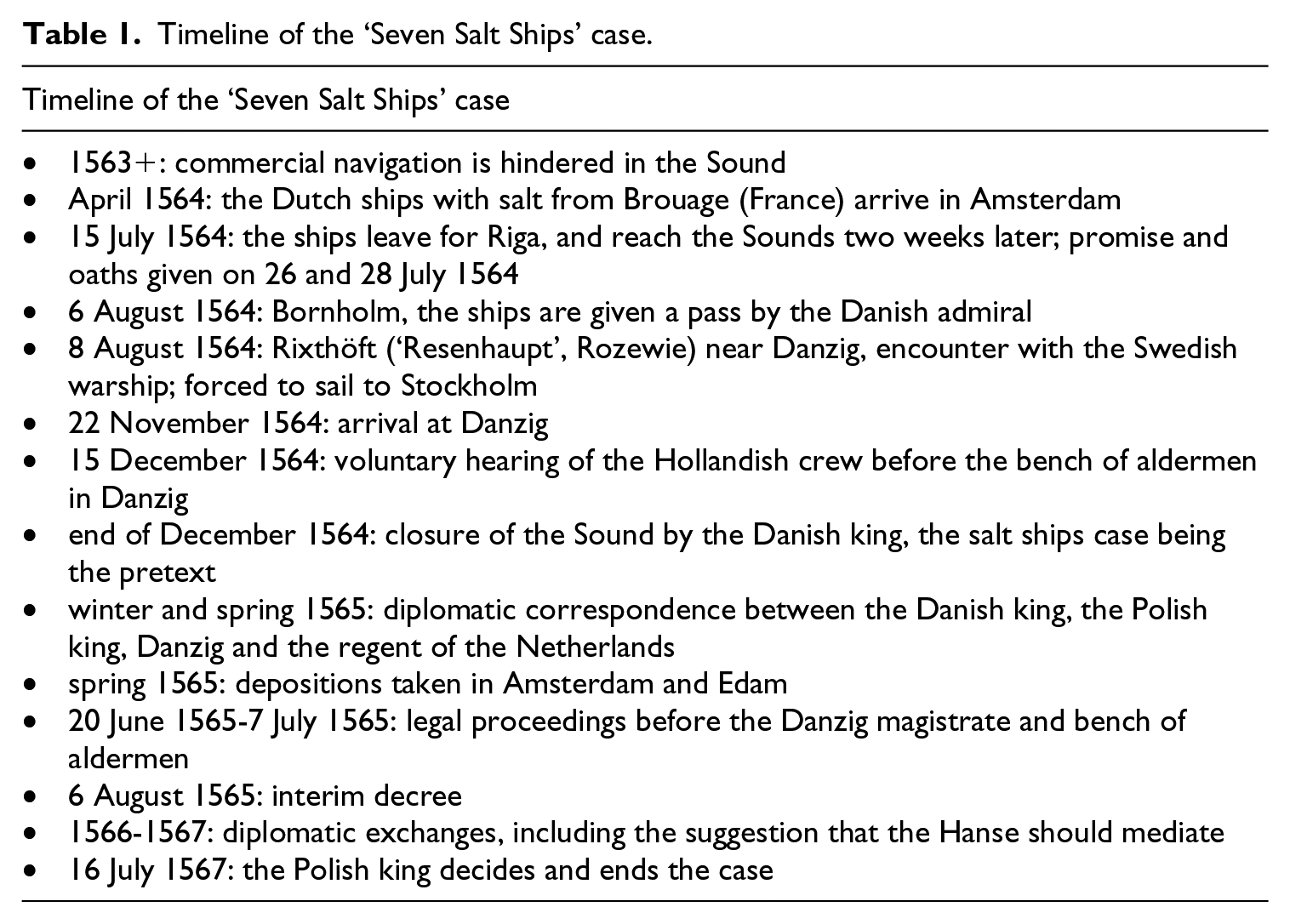
In June 1565, Reinert Pieterszoon, a 20-year old seaman from Stavoren, was testifying before Danzig (Gdańsk) town council in a rather curious case. 1 He was a member of the crew of the Moses, one of the seven salt ships from Holland, 2 which had – allegedly – been seized by a large, heavily armed Swedish man-of-war. Subsequently, the crews were forced to sell their salt in Stockholm. The whole incident had taken place almost a year earlier and was highly politicised from the very beginning (see Figure 1 and Table 1). Once the skippers (shipmasters) were allowed to leave Stockholm, they went to Danzig, where they were sued by a powerful opponent, the Danish king, on charges of breaching political agreements and illegal trade. The backdrop was the ongoing Northern Seven Years War (1563–1570) between Sweden and Denmark, with the Polish Crown and Lübeck allied to the Danes. The irony was that Hollanders strove to remain neutral during the conflict, and tried to resist pressure from belligerents. As a result of their suspicious sojourn in Sweden, Reinert Pieterszoon and other seamen were interrogated in Danzig by a Danish proctor (prosecutor), and by lawyers from Holland. The detailed questions and responses shed light on issues as diverse as the weather and the direction of the winds, distances, and sailing speed, the colour of the Swedish man-of-war who assailed them, the violence involved, and the ulterior motives the skippers and crew may have had. On some issues, Reinert pleaded ignorance due to his relative lack of experience. After hours of interrogation, the Danish proctor was not satisfied. He claimed it was all a scheme to sell the salt illegally, and he sought to undermine the veracity of the picture of the incident Reinert and the other seamen were painting. Specifically, he targeted the general reliability of the sailors as witnesses.
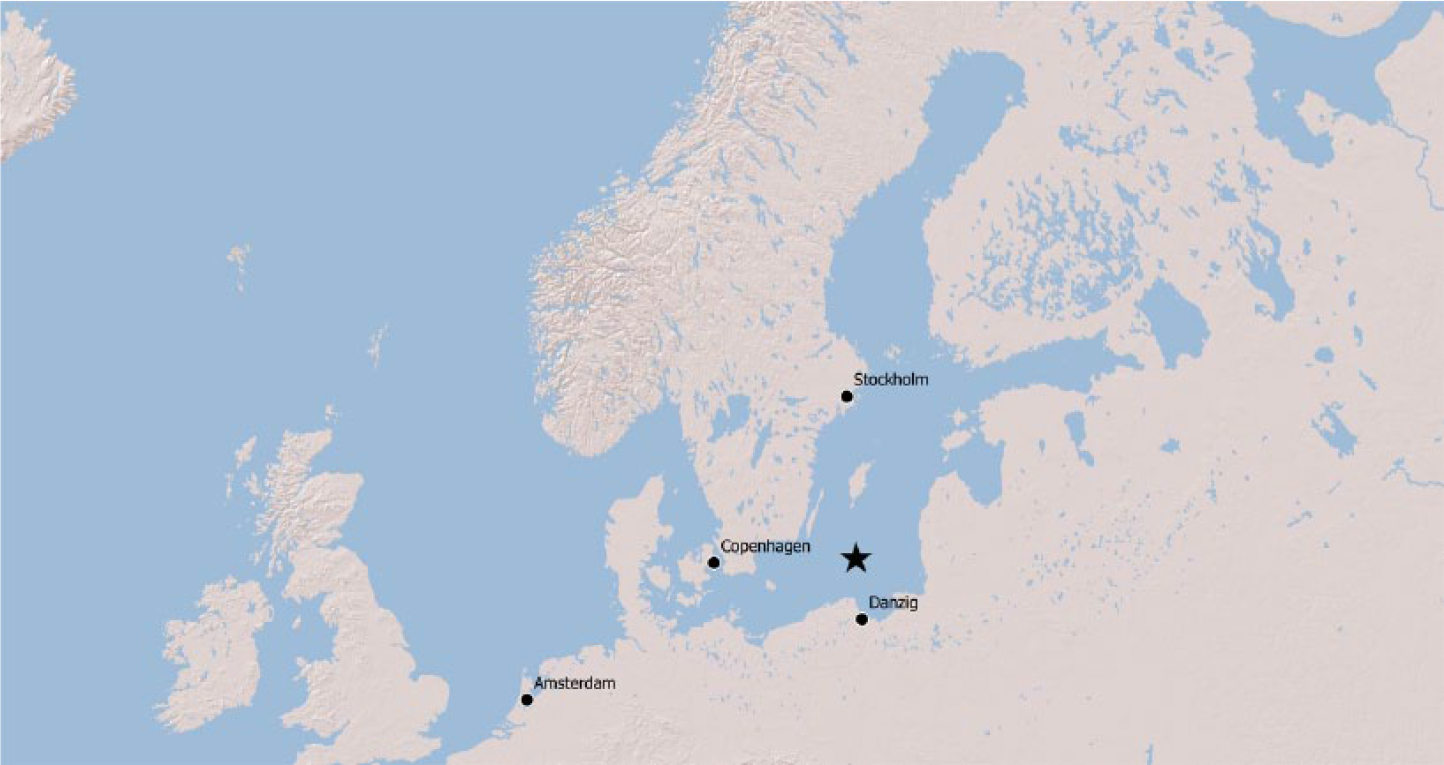
The approximate location of the seizure.
Timeline of the ‘Seven Salt Ships’ case.
This case has been analysed from various angles. It has been explored from the perspective of how diplomacy and jurisdiction were intertwined in order to function as a form of conflict management, 3 and how the concept of neutrality crystallized and was applied in various ways in the Netherlands and Danzig. 4 But there are more possibilities. This is an extraordinarily rich case, which obliged Danzig scribes to fill hundreds of pages, and prompted the Danish, Polish, and Swedish kings, and the Habsburg regent of the Netherlands (Margaret of Parma), as well as magistrates from Amsterdam and Edam, to issue numerous letters and written testimonials. There is also correspondence with the Spanish overlord of the Netherlands (Philip II) and the Emperor (Ferdinand II). In addition, the case left a rare imprint in the form of legal consultation with an attestation (subscriptio) from several Leuven University law professors. The unpublished sources generated by the case are housed in Municipal Archives in Gdańsk, Brussels, the Hague, and Copenhagen. 5 Some of the letters have been published as summaries or fragments. In many respects, this case is extraordinary for the period and the region.
One aspect that has remained unexplored is the maritime perspective that permeates the case in various ways: through the skippers and crew, many of whom are identified by name, origin, and sometimes age; through their ships, which sported names like The Flying Dragon or The Black Raven; through the mysterious and powerful Swedish warship from one of the most dynamically growing fleets of the second half of the 16th century; and through the evidence offered about sailing and working conditions in the North Sea and Baltic in the 1560s, a period for which our sources are relatively scarce. Especially valuable from a maritime point of view is the sworn testimony of the seamen, and the merchants who funded the venture, given to a voluntary hearing of skippers and crew in Danzig in December 1564, and the records of an interrogation to which chosen witnesses were summoned in June 1565, as well as further written testimonials sent to Danzig from Amsterdam and Edam, including a sea contract presented as evidence. 6
Hearings of witnesses, written down in the context of legal proceedings, have been recognized as valuable sources for the daily life and working conditions of seamen in the medieval and early modern periods. 7 Hearings of witnesses in premodern history in general have been the foundation of compelling historical analyses, especially microhistory. They have also sparked methodological debates on representativity and contextualisation. 8 It is therefore especially important to underline that the statements of maritime witnesses in this case are exceptional, but that they can and will be contextualised in this article. They are exceptional in terms of their extent, especially as this is still an early period for lengthy witness hearings in the Baltic. Many of the details are novel and fascinating. Moreover, the case includes a broad range of ‘witnessing’ – voluntary hearings, summoned interrogation, and written testimonials – which makes it possible to examine the relative weight given to the accounts of witnesses, and how seamen were assessed as witnesses in general. Still, they are part of ongoing political developments, and have therefore the aforementioned other sources, i.e., like letters and legal consultation, provide valuable contextualisation.
This article argues that three factors played significant roles in how the statements of seamen were received and used in court: first, their overall status in society; second, their presence at the place of the contested events, which enabled them to provide relevant information; and third, the detail of their evidence, which owed much to their demonstrable experience of working at sea. The status of common seamen, and also of skippers if they were not shipowners, was lower than that of merchants. In particular, Danish claims in this case indicate that this status might have been going downhill rapidly during this period; a process that had started in the 15th century. The matter of presence at the scene was obviously relevant when evidence had to be gathered. Yet this factor was quite complex and remarkable in the case of ships and the sea, much more so than on land: there were few, and sometimes no, uninvolved bystanders. Finally, experience could greatly influence the level of information that could be provided. Therefore experience could give seamen a unique position in court, as experts on subjects that town councillors, lawyers, or merchants had far more limited knowledge. 9 Such experience, however, could be used against the seamen, when questioning their decisions at sea. Conversely, lack of experience could discredit a witness. These three ‘maritime factors’, next to the more general issues at play in a court of law when witnesses were summoned – like witness bias and reputation, which are discussed at length in the primary sources – add extra nuance to the analysis of juridical practice at this time. Accordingly, the case sheds light on the social and legal angles of maritime history.
M oses and the six other ships caught up in the Northern Seven Years War, 1563–1570
The story of the Moses and the six other ships from Holland 10 that encountered a huge Swedish warship close to Cape Rozewie, close to the northernmost point of modern Poland, 11 is outlined in the timeline presented in Table 1. 12
The Northern Seven Years War was all about dominance in the Baltic, manifested in political takeover or influence in the harbours, and by a marked presence at sea. There was thus a critical, if not central, maritime angle to the conflict. 13 The war broke out after almost 20 years of peace between the two main belligerents, Denmark and Sweden. The two young kings and first cousins, Frederick II of Denmark (1559–1588) and Erick XIV of Sweden (1560–1568), clashed when the Swedes openly challenged the position of the Danes in the region. In 1561, Sweden became the overlord of the Hanseatic city of Reval (Tallinn) in the eastern Baltic, which gave the Swedish Crown an economic and political advantage. At the same time, Erick XIV invested heavily in developing the most advanced war fleet in Europe in terms of the number of ships, their size, and technical innovations. His prestige project was the Mars, which displaced 1,800 tons and was one of the largest warships in the Baltic and North seas. 14 To counter this expansion, Frederick II struck alliances with the Hanseatic city of Lübeck and the Polish Crown. He also tried to persuade the Regent of the Habsburg Netherlands, Margaret of Parma, to back him in the struggle with Sweden. This alliance would have weakened the overall political position of the Swedish king, and it would have deprived the Swedes of an important trading partner. But perhaps even more significantly, the Danish king hoped to be able to make use of the large Netherlandish fleet for war purposes. This would also have allowed him to outplay his cousin in terms of maritime prestige. Margaret of Parma, however, was less than willing to get involved, officially because the Netherlands had agreed in a 1544 treaty not to interfere in Scandinavian political affairs. 15 In staying neutral in this new Northern war, the Netherlands had learned from their earlier costly and protracted involvement in a Scandinavian succession struggle, and in the mid-century wars in the North Sea (the ‘herring wars’). 16 The economic reason was undoubtedly that the Regent wished to continue Baltic trade, and not take the risk of losing part of the Netherlandish commercial fleet for military purposes. 17 Now, Frederick apparently decided to circumvent the latter and he ‘borrowed’ Netherlandish ships when they stopped in the Sound, pretending that mutual agreements allowed the requisitioning of foreign ships, provided they were given back and the costs were covered. 18 This was a way to put pressure on the Regent to join the war as an ally, or at the very least to take advantage of large numbers of ships.
The salt ships incident should be seen in the context of this twofold strategy. Indeed, it became the very pretext for a total closure of the Sound for Netherlandish ships at the end of 1564, and one of the aims of the lawsuit was to obtain the ships for the Danes. 19 At the beginning of the war, Frederick had ordered that all the commercial ships from the Netherlands passing through the Sound must pay their dues and take an oath that they would refrain from trade with Sweden, including Reval. 20 When the seven salt ships arrived in the Sound in the end of July 1564, their skippers had to swear the oath before being allowed to sail into the Baltic and on to their final destination of Riga. In early August, the ships were given a pass by the Danish admiral at or near Bornholm. Not long after, some Lübeckers, Danish allies in the war, stopped the Moses and confiscated weapons on board. 21 Apparently, the day before the kidnapping incident strong winds had separated the ships. Being approximately 7.5 kilometres from each other, they could not form a flotilla to act in a concert. 22 On 8 August, a hot and windless summer day, the heavily laden ships were still dispersed and hardly moving. At sunset, a very large Swedish man-of-war (accompanied by a smaller ship) approached them one by one close to ‘Resenhaupt’ (Rozewie). 23 The skippers were fetched by the smaller ship to produce their sea letters for the captain of the warship. According to a later Netherlandish account, they were then taken hostage and replaced by Swedish seamen. 24 One ship (Moses) tried to escape, but after being shot at, she had to surrender as well. 25 All of the ships sailed to Stockholm, where the salt was sold – at a derisory price, which was lower than traders in Rostock obtained, according to the Dutch. 26
After a prolonged stay, the ships left and sailed southwards, arriving in Danzig at the end of November, only to be arrested by the officials of the Polish king because they emanated from enemy territory. The skippers subsequently held a voluntary hearing before the bench of aldermen in Danzig in order to have their story recorded. To no avail, as it turned out, due to the suspicions by the Polish Crown and the Danish king regarding dealings with their shared enemy, i.e., the Swedes. Through a representative (a proctor), the Danish king not only accused the Hollanders of violating the pledge they had made in the Sound in August, but also of a breach of the 1544 non-involvement agreement. His claim was that the whole incident was staged, with the Hollanders trying to hide their illegal trade with Sweden. The salt, the proctor argued, was not just any commercial good (i.e., a merchandise allowed to be carried and traded by neutral vessels), but a vital war supply for the Swedish king. Accordingly, the incident and the ensuing legal proceedings in the summer of 1565 were not just about the salt ships, but about the involvement of the Netherlands in the war. 27
The legal proceedings thus became an extra element of Danish strategy, next to political means. Frederick II wanted to coerce the Netherlands into taking sides, and at the very least incorporate the ships into his fleet. The closure of the Sound coincided with the Danish king granting plenipotentiary powers to his proctor, and the salt ships were explicitly used to justify his action. 28 Therefore the incident was taken very seriously by the Netherlandish Regent, who started an intensive diplomatic exchange with the monarchs involved, as well as sending lawyers to Danzig, with at least one of them from the Court of Holland (Hof van Holland). Both helped to steer the case to an interim decree in Danzig, which released the ships and cargoes on the posting of bail. 29 Their final acquittal, however, was not a decision of the town council, but of the Polish king. It was a political decision, taken at a time when the war had lost its impetus, 30 with legal proceedings, diplomacy, and advocacy intertwined. 31
The seven Hollandish ships and the Swedish warship
What do we know about the Hollandish ships, which suddenly became the centre of a political crisis? They were all of carvel type (i.e., with abutting planking), and at least one of them, the Moses, was large: an attestation from Amsterdam mentions 360 tons, or 180 lasts. 32 The tonnage of the other ships was not mentioned, although the size of their crews was reported as 14 to 16 seamen, accompanied by teenage apprentices described as ‘boys’. Normally, the ratio of men per ton was 1:10, which would mean the ships were up to 160 tons, or 80 lasts. Consequently, the Moses probably had a larger crew. 33 The sources make it possible to identify the places of origin of the ships, the ship names, the skippers, the shipowners, and in some cases the seamen on the vessels. Most, and possibly all, of the ships came from Amsterdam. They were called Moses (‘Den Meysses’), Angel (‘Engell’), Fortune, St. Christopher, Young Hillebrandt (‘den Jungen Hillebrandt’, possibly a reference to the name of the skipper), Flying Dragon (‘den Fliegendenn Drackenn’), and Black Raven (‘den schwartenn Rabenn’). The eighth ship that was captured, belonging to Bremen, was not identified by name. A seaman from this ship gave evidence in the case as his ship was also held in Danzig, but the accusations of the Danes were directed at the Hollanders. This shows again that the case was mainly about politics and exerting pressure on the Netherlands, rather than about ships and trade.
It is of major importance that the ships were presented throughout the case as merchant vessels. They sailed from Brouage, stopped over at Amsterdam, and were destined for Riga. Their planned return freight from Riga was not mentioned in the documents, but it might have been grain, wax, furs, or hides. 34 When leaving Stockholm after the allegedly unexpected detour, they bought Swedish iron at a very high price, as they stated. 35 The aim of the voyage was quite clearly commerce and not active participation in the war, but still they were sailing together for mutual protection and carried arms for defensive purposes, with skilled crew members – gunners (Büchsenschützen) – recruited to handle them. 36 The Lübeckers confiscated six iron guns (‘Büchssen’) and some spears (‘Spiesse’ and ‘Lanzen’) from the Moses. Initially, they also wanted to take the grating (‘Bovenedt’) – a net made of ropes, which was used to cover an opening in the deck 37 – but it was deemed too old and small to be of any use. 38 The other skippers therefore decided to hide their arms in the salt. 39 Yet as the Dutch side argued, they did not have any cannon on their ships, which indicated that their purpose was commercial. Not being prepared or trained for war, and not expecting the Swedes or the Danes to be their enemies, they did not use their arms at all and did not think they could or should resist. 40 The distance between vessels played a role, too. The sources repeatedly state that it was one ‘wecke sehes’ (c. 7.5 kilometres), which was a unit of measurement used in the Baltic by Hansards for ships without oars. 41 Apparently, Hollanders also used it when venturing to the Baltic, a detail that has not been noticed to date. 42
The sources also offer information on how the crews worked, and how the members were related to each other. There were specialised members of the crew: skipper (captain), his second in command, the helmsman, boatswains, carpenters, cooks, and gunners, 43 which was quite normal for the time. 44 It was also usual for crew members to carry some of their own merchandise to sell as portage (Führung, ‘voering’); in the case of a boatswain, for instance, it was half a last of salt. 45 For a seaman lower in the hierarchy, trade goods were less in volume and value. 46 This was congruent with the 1561 Danish sea law, where a hierarchy of portage was mentioned: a skipper could have one last in the ship, the scribe, carpenter, boatswain, and cook half a last, and a common seaman one tenth of a last. 47 It was a fringe benefit, payment to supplement the wages they received and the food and drink that the skipper was obliged to provide. 48 What might be seen as surprising is that one of helmsmen testifying in the interrogation was 61 years old, when most seamen had retired by their mid-40s. 49 While most of the owners of the ships were merchants in Amsterdam (the exception being the Black Raven), 50 many of the seafarers came from towns in Frisia and North Holland, including Stavoren, Purmerend, Alkmaar, and Edam, which were important maritime communities in the Low Countries. 51
Family relationships seem to have been limited to skippers and their sons, if we are to believe the answers to explicit Danish questions on this issue. 52 Reinert Pieterszoon from Stavoren, for example, was the son of Pieter Reinertszoon, the skipper of the Moses. The names suggest that traditions were upheld in this family. Possibly there were several generations of skippers. 53 Contrary to popular belief, seamen did marry and have families even at young age, which explains why fathers and sons could work on the same ship. 54 On the Black Raven, the skipper-owner, Jacob Clauszoon from Purmerend, was accompanied by his 22 year-old son, Jacob Jacobszoon, who was a boatswain on the ship. When this skipper was captured by the Swedes, he was allowed to return to his ship and pick up some clothes. According to a written deposition in the case, the skipper ordered the crew to try to escape and sail to Riga and his son was to step in as if he were in charge himself (‘of ick suluest present war’). The calm weather and bright moonlight, however, prevented the attempt or the possibility of forming a united flotilla again. His son later confirmed the account. 55
The name and rate of the Swedish man-of-war was not disclosed in the main source for this case, or in a letter sent by the Swedish king. 56 She was described as a black, impressive warship. 57 The Danish proctor was keen to find out what type of ship it was. He listed ‘Bercke, Krauel, Stangenkreger’ or ‘Pincke’ as possibilities, i.e., a bark (specialised warship, usually 100–150 tons), a carvel (carvel-built, large warship or merchantman), a crayer (larger two- or three-masted ship, common in the Baltic), or a pinke (two- or three-masted vessel typically of less than 100 tons displacement). 58 He kept the option open that it was a different vessel altogether and enquired as to what she was called in Sweden. 59 The answer was that she was a carvel, though this revealed more about the construction than of the size or specific type of vessel (this category was broad in the 16th century in northern Europe). 60 A significant part of the voluntary hearing, written testimonials and interrogation was indeed devoted to establishing the size of the ship, and to what extent she was capable of overwhelming eight ships. The testimony varied somewhat as to the size: 150 or 180, 170–180, or 200 lasts (i.e., up to 400 tons) were mentioned, and the witnesses underlined that it was a long ship with jib sails (‘Fock’) and topsails on the foremast (‘farmarss’). 61 This would mean that it was not (much) larger than at least one of the Dutch carvels. Still, since she was sailing in ballast, she could be packed with men: according to the witnesses, there were 300 armed men (crew and soldiers) aboard, and 36 pieces of heavy artillery, 14 of which were large cannon. 62 Also, the ship was not alone. She was accompanied by a smaller vessel with 62 men aboard, which proved to be instrumental in bringing the skippers to the warship. It was a cunning ploy of the Swedish captain: he obliged the skippers to bring their sea letters in person, and then kept them on the warship. 63
Swedish research on the development of the navy in the 16th century offers a clue to the identity of the ship. She was probably ‘(Gävle) Björnen’, that is the Bear from Gävle, one of the three largest merchantmen in Sweden, which was a gift from the town of Gävle to the King. Subsequently converted into a warship through the addition of cannon, the evidence suggests that she was ca. 450 tons (ca. 225 lasts, so even larger than the sailors’ estimates), and was added to the navy in 1563. The major lead here is the family name of the captain, Benedikt Ref (nowadays spelt ‘Rääf’), which means fox. 64 This Benedikt (Bengt), a cunning fox at sea, enjoyed wartime success, including the capture of the salt ships. As a reward, he was appointed commander of the strategic Kalmar castle, and a jumping fox still features in the family’s coat of arms, as shown in Figure 2. 65

The current coat of arms of the Rääf family. Photo: Riddarhuset, Sweden.
The social status of the seamen and other witnesses
The skippers of the Hollandish merchant ships were nowhere near the Swedish captain when it came to social status. Most of the skippers were working for merchants resident in the Netherlands and only one owned his ship (the Black Raven). 66 None of the skippers were of noble descent. The crew members were probably not particularly prosperous, though working at sea did offer them the possibility of social and economic advancement. 67 The definition of skipper and the status of seamen changed from the 15th century. For a long time, the boundary between skippers and merchants in the Hanse area was in flux: one person often combined both roles. 68 In the 16th century, as the main source for this article indicates, Hanseatic seamen carried some merchandise, which they sold themselves, even though they were not merchants. 69 Yet from the 15th century on, the boundary between merchants and skippers in the Hanse area seems to have become clearer, with skippers establishing their own guilds. 70 A sharp distinction emerged between those who worked at sea, often paid by others, and those who stayed at home providing the capital and owning the ships – a distinction that had an economic, as well as an occupational, underpinning. This was reflected in the social status of the two groups, with merchants forming a wealthier part of the society and being held in higher regard. A formal division between skippers and merchants in the North and Baltic seas had not been made when the salt ships were seized in the 1560s, although it was in place by the early 17th century. 71
Yet another source, partly related to this case, infers that the image of (ordinary) seamen was becoming more negative during the 16th century. In 1561, for instance, the Danish king, Frederick II, introduced a maritime law that was justified on account of the presumption that seamen were rowdy and prone to drunkenness on land and on vessels. Further in the text, parties and excessive drinking on ships were forbidden. 72 While rowdiness, insubordination, and outright mutiny were covered by earlier maritime laws, 73 the need to address the problem posed by ‘drunken sailors’ was a novel development in 16th-century maritime laws and regulations. 74 Earlier, the rules on alcohol (wine and beer) pertained to the amounts to which a seaman was entitled as part of his subsistence allowance. In other words, the regulation of consumption, rather than abuse, was deemed to be the key issue. 75 Obviously, drunkenness occurred in shipping during the Middle Ages, 76 but it is impossible to establish whether the problem had worsened, or whether the king wanted to frame the whole group as problematic and therefore an excuse for stronger (juridical) control was required. A study of the development of the image of seamen, from a quite important and neutrally presented group in the Middle Ages, to a brawling group of ‘drunken sailors’ in the modern era, socially distinct from merchants and sea captains and officers, is lacking. 77
By the 1560s, maritime laws, urban regulations, and other documents suggest that rulers and city magistrates considered seamen to be a distinct social group when they appeared in court. 78 But they also took the special conditions at sea into account, specifically that the number of people witnessing an incident was generally limited. Presence at the scene of events was thus seen as a paramount argument for trusting witnesses. Most space was devoted to problems like the necessity of taking down a mast, jettisoning cargo, and repairing hull damage. Here, experience in assessing the situation played an essential role. However, a skipper had to consult the crew about significant issues, and according to some maritime laws, the majority decided. The crew functioned as a corporation. 79 This is an important point, showing that experience and responsibility were treated as collective qualities. Consequently, the liability of the skipper was reduced, with three or four members of the crew summoned to testify about a contested issue when they reached land. 80 Also, in cases of collision, when all members were at the same time victims and/or perpetrators, they testified in courts, under oath. 81 This was connected to the fact that the objectives of the skippers and crew in times of danger was highly important, with a distinction drawn between intent and accident. 82 This was evaluated in courts. Jurisdiction, including the hearing of witnesses, was a land matter. Only to a limited degree was there jurisdiction on the ships, namely concerning day-to-day discipline. 83 In any case, these provisions show that crew members were considered suitable witnesses, even in cases where it could be pointed out that they were not bystanders, but participants. The bottom line here was pragmatism, as impartial witnesses were rarely available.
In general, a discourse about the reliability of witnesses developed in urban northern Europe in the 16th century. In the early years of that century, Filips Wielant, a lawyer and legal scholar in Mechelen, wrote an extensive overview of juridical practice (Practijke civile…). He argued that more trust should be afforded to the word of an emperor than a king, to a king than a chancellor, to nobles than non-nobles, and notably, more to the rich than to the poor because of possible corruption. However, a poor person with good reputation should be treated more seriously than a rich one with a bad name. Wielant underlined that once a witness committed perjury, he should never be trusted again. Moreover, if a witness presented a different story in court than in a tavern, he should not be believed any more. 84 Wielant’s points were adopted and extensively popularised by his countryman, Joost Damhouder, in a book published in 1566. Damhouder added reflections on witnesses, which are of interest here. Specifically, he emphasised that the oath should not be given under pressure or in a state of fear, while he also pointed out that not all witnesses should be given equal credence, as the hierarchy of authority applied. Research has shown that many people were broadly familiar with these works, even in cities with quite different law codes. 85 As we shall see, the ‘poor’ discourse also occurred in the rejoinder of the Danish proctor. All of these factors – the changing status of seamen, legislation that defined their role as witnesses in courts because of presence and experience, and general advances in defining able witnesses – played a role in how the testimony of the crews of the salt ships was received.
The voluntary hearing in 1564 and its interpretation
The voluntary hearing was held at the initiative of the skippers who wanted to record officially the seamen’s account of the arrest of the seven salt ships. The hearing took place in early December 1564, six months before the legal proceedings held before the Bench of Aldermen. 86 The skippers clearly felt that they might be charged by the Polish and Danish kings. The questions posed were: 1) whether it was a custom in the places where they came from (i.e., Amsterdam and West-Friesland) for a merchant or a skipper to certify before a voyage where the ship would sail, or whether this was up to the judgement of the skipper (‘datt enem jdernn bij en frij sei vp watt Stromenn edder ordenn he des Schepes vnde kopmanns besten wet tho finndenn tho segelenn’); 2) whether on arrival in the Sound the skippers had plans to sail to places other than Riga, whether the helmsman (second in command) had ever been to Stockholm, and whether there had been any secret talk of sailing to Sweden; 3) whether the ships sailed to Stockholm out of their own free will or were they forced to do so; 4) what were the details of the size and might of the Swedish ship; 5) the price obtained in Sweden for the salt; and 6) the skipper on the Moses, Pieter Reinertszoon, wanted specific information from his crew about the arms taken from his ship by the Lübeckers. 87 In a nutshell, the questions were designed to establish the theoretical freedom of action of the skippers, which in this case was violated. Moreover, the questions suggest that the crew as a whole would have known of (secret) plans, prices obtained and threats posed by foreign ships.
Thereafter, between four and six crew members from each of the seven ships testified, having sworn an oath. Different roles aboard the ship – helmsmen, boatswains, Buchsenschützen (gunners), cooks, carpenters, boslude (ordinary seamen) – were represented. On the first question, two crews answered that they were not aware of, or familiar with, rules concerning a pre-registration of the journey, while five confirmed that such flexibility was indeed usual: ‘ken gebruck, elck schipper mach segelnn woe he kenn wil’. This is an example of how the plurality of maritime laws and customs worked in practice: it was paramount to establish what rules applied where, and draw conclusions based on that knowledge to assess the specific situation. 88 All sailors confirmed that the plan had been to sail to Riga, and the crew of the Moses explicitly rejected the possibility that there was any secret scheming in the Sound. The crews were unanimous when it comes to the violence to which they were subjected in having to go to Stockholm (‘mit gewalt getrungenn’). The descriptions of the captor diverged somewhat when it came to its size (150–200 lasts). The seamen were unwilling or unable to state what type of ship it was, but they all agreed it was large and very well armed: a warship (‘schipp vonn Orleij’). Concerning the price of the salt, they all stated that it was fixed and low, namely eight Swedish marks (or two dalers) per barrel. The seamen from the Flying Dragon added sarcastically that if they had been able to get a better price, they would have gladly accepted it (‘hadden sie mehr kriegen khonnen sie hettent gerne angenohmmen’). This was in marked contrast to the statement in the letter of the Swedish king that the Hollanders could sell their salt at as high a price as they wanted. 89 Concerning the extra question, the crew of the Moses confirmed that Lübeckers had taken the arms, allegedly because they needed them. All in all, the answers were fairly unanimous, but not identical in wording. The image the witnesses wanted to convey was that seven separate crews were all telling the same story.
The weight of this voluntary hearing can be gauged from the fact that it was an important part of the evidence presented by the Dutch lawyers in the summer of 1565. But perhaps even more telling was the reaction of the Danes. The rejoinder of the Danish proctor to this evidence was essentially an attack on the hearing. He deemed the testimony as superfluous (‘uberflussig’) and invalid because the hearing was held before the formal charges were presented. He claimed that it was highly suspicious (‘mehr als vordechtig’) because all testimony was given by employees of the skippers (‘domestici’); on those grounds, it was invalid. The seamen were all partners in crime (‘socij et participes criminis’), and just furthering each other’s interests (‘in propria causa’). 90 The proctor underlined that the skippers had broken the pledge in the Sound that they would not sail to Sweden, called their story fabricated, contrary to nature (i.e., what could be seen as a logical sequence of events) and to truth, ‘ist der Natur vnndt warheijtt entgegenn’. They showed far too much trust in the Swedes by simply following the warship and, an argument which would return later several times, they were not unanimous as to the size of the Swedish ship. 91 They must have known that there was scarcity of salt in Sweden, and therefore trade would be profitable, so they proceeded in secrecy. 92 Moreover, they were really experienced enough as seamen to be able to get away. Accordingly, their account was fabricated, with the crewmen lying under oath. 93 This means that he called the skippers and crew liars, opportunists, and perjurers, a very serious charge that constituted a criminal offence and a damning critique of the honour and reputation of the skippers. He insinuated that the seamen were just like girls who would answer even a soft whistle, because they were so eager to dance. They were probably just sailing around in the Baltic, hoping to be taken by Swedes, he stated. If he were to consider the seamen as witnesses, he would have to obtain new testimony from them ‘per medium torture’. The disdainful tone of the Danish proctor formed part of a strategy to undermine the testimony of seamen, whose social status was significantly lower than that of the other witnesses. 94 The fact that they did not give the same estimates of the size of the ship led him to conclude that they were lying and the ship had not been that large. The fact that they did not escape, all despite being experienced seamen, proved that their claims were highly suspicious. All seamen, skippers and crew, were therefore liable in his eyes. They were to be punished to give a proper example to others (‘andernn zu einem exempel’). 95
The Dutch lawyers argued that the presence of the crew as witnesses was decisive in evaluating the weight of their voluntary testimony. The particular situation at sea was that the crew, even though they were employees of the skippers and victims of the capture, were the only witnesses of the events. The possibilities were limited of having someone else testify. In such a situation, stated the lawyers, it was legitimate to hear them and include their testimony as evidence. The pledge taken in the Sound, after all, was only binding for the skippers and it was therefore inappropriate to speak of the seamen as partners in crime. 96 They stated that when the Hollandish skippers came to Danzig, there were no formal charges against them and it was up to them to summon witnesses for the voluntary hearing (‘keijnenn klegerenn derzeitt gegenn sich gehabtt’). The crew were therefore suitable witnesses in a voluntary hearing. The lawyers called the rejoinder of the Danish proctor a peculiar account of the events, fashioned to serve his interest (‘eine besondere narration facti zu seinem vorttheil dienende’). 97
The tactic of the Dutch lawyers was to show the Danzig court the irrationality of the Danish claims and at the same time present the seamen as worthy witnesses. For instance, it was contended that the pledge made in the Sound had been extracted under pressure, after a prolonged stay, and even if it was considered valid, it did not oblige the skippers to engage in ‘extreme defence’, i.e., open warfare with the Swedes. As seamen on a mercantile vessel, they were not trained to fight a warship. In other words, they had no military experience. 98 With reference to the size of the Swedish ship, they pointed out that the Dane was downplaying it by calling the vessel a ‘Bincke’, or smaller type. 99 Concerning the contention that the ships could have escaped from the Swedish vessel, the Dutch lawyers stated that it did not make sense (‘menschlichenn verstandt zu wieder’) to imagine that heavily loaded ships could flee from a lighter vessel. 100 Here, the argument was that the practical judgement and expertise of the seamen should be deemed a sufficient argument as to whether an escape was possible or not. They emphasized that the seamen were witnesses in a civil case, not defendants in a criminal one, and torture was out of question. 101 All in all, the Dutch lawyers presented the seamen as men who stood by their word, who were not scheming, and who were experts in their trade and had no intention of undertaking belligerent activities. 102 Obviously, these were the clients of the lawyers, but it is striking that they were presented in a far more respectful way than in the rejoinder of the Dane. The additional depositions from Edam and Amsterdam, as well as the contract, added weight to this interpretation, according to the Dutch lawyers, because they corroborated the story, while the statements came from shipowners who were merchants of standing and honest reputation, given under oath (‘so vieler stattlichenn berumbttenn kauffleuthenn voreidetter attestation’; ‘omnes respectavi uiri et honestae famae mercatores sunt’). 103 The status of these merchants, which was higher in the eyes of the Dutch lawyers, permeated through their statements into the seamen’s testimony.
The interrogation in 1565
The interrogation of witnesses before the Danzig Town Council – and not the Bench of Aldermen, as was the case with the voluntary hearing – was the next stage in the legal proceedings. The source does not spell out who called in the witnesses, but most probably it was the Council. When comparing it to the voluntary hearing, it is clear that heed was paid to the criticism made by the Danish proctor. The witnesses now consisted not only of people who were participants in the incident, but a merchant from a ship that was close by was also called in, as well a seaman from the Bremen ship that was not facing similar charges from the Danes. No skippers were summoned. On the other hand, it is evident that the witnesses summoned by the Council were indeed called as witnesses, rather than potential defendants, as the Danish proctor would have had it. The choice of witnesses suggests that a balance was struck between wanting to hear different points of view, insiders and outsiders, different ages and levels of experience, and by summoning two sons of skippers.
Seven witnesses were cross-examined by the Dutch lawyers and the Danish proctor, with five testimonies remaining intact. In order of appearance before the town council, they were Johan Blancke (a seaman from Bremen, from the eighth ship); Arndt Johanszoon (a merchant originally from Ghent and living in Amsterdam, who was travelling on a ship that had not been part of the salt ships fleet); Siebrand Friedrikszoon (a seaman from Schoorl in West-Friesland, from a ship in ballast that had not been taken); Jacob Jacobszoon (from Purmerend, son of the skipper who was also the owner of the Black Raven); Dirck Willemszoon (boatswain and later skipper of the Flying Dragon, after skipper Pieter Rubin passed away in Stockholm); Reinert Pieterszoon (son of Pieter Reinertszoon from Stavoren, on the Moses); and Hermann the cook (on a unidentified ship).
The questions posed by the Dutch and Danish lawyers had different purposes. The Dutch lawyers asked about the weather, the issue of the dispersal of the ships, their course to Riga, the size of the Swedish ship and the weapons on it, the use of violence in summoning the skippers to the warship, whether there was a possibility of escape, and whether it was true that one of the ships (the Moses) was disarmed and the others had to hide their weapons. They were designed both to establish matters connected to the presence of the witnesses there and to elicit descriptions of their experiences at sea. By contrast, the aim of the Danish proctor was to undermine the credibility of the witnesses, and extract answers that would show it was all one big hoax. The Danish proctor’s cross-examination endeavoured to establish the age, from which region and city the witnesses hailed (‘Landtschafft’, ‘Stadt’), whether they were related to anyone who was part of the incident, details of the size of the Swedish ship and timing of the capture, whether it was first-hand knowledge, and what instructions the skippers had given to their crews. The witnesses were further asked who they wanted (‘gonnen’) to win the case, the skippers or the Danes, and whether they expected any favours from the skippers or merchants for testifying in this case. Also, the proctor enquired directly whether the witnesses had been instructed by the Danish lawyers. And another remarkable question was whether the Swedes, when entering the ships, were offered food and drink. Commensality would suggest treating each other as one group of allies, and as mentioned earlier, festive drinking on board of ships was frowned upon. 104 Interestingly, no questions were posed concerning the literacy of the seamen: perhaps it was not considered relevant here.
The answers of the witnesses suggested that they were indeed present at, or close to, the events, and that they were specific in establishing their expertise and its limits. The seaman from Bremen demonstrated that he was knowledgeable of estimating distances and giving other details on the direction of the wind and the interaction between skippers and crew. He was convinced that it was impossible to escape, despite the fact that the Dutch crews had been prepared to be brave (‘bereitt vnd tapfer’). 105 There had been no friendly commensality between the Hollanders and Swedes, but nor were they treated as enemies. 106 Concerning the violence involved, he stated that he was too far away to provide information on it. 107 The merchant from another ship testified what he had seen, stressing that he was not in the know on some of the details, as he had not been part of the fleet. 108 He did not give answers to the more maritime questions, and apparently he was not expected to do it – obviously, he lacked the expertise. The boatswain who stepped in as skipper, on the other hand, gave a full account of the navigational details. Also he underlined that in his view, it was impossible to escape due to the weather conditions, the heaviness of the salt ships, and the fact that the Swedish ship surpassed them greatly in terms of weapons and men. 108 The tricky question on who should win the suit was answered with a laconic statement that he would be happy to see either win (‘gunnett deme enen so fehle alss dem andern’) and that he did not expect any favours from the other skippers or from the merchants. 109 The impossibility of escaping was confirmed by another expert witness called in, the seaman from a ship in ballast that had been passing by. Sarcastically, he stated that if there had been an option, the Hollanders would have certainly escaped (‘wen de hollendischen schepe hadden kantt entkommenn se heddentt woll gedahn’). In the rest of the statement, he emphasized that he was no friend of the crews, nor did he own any part of any of the ships. He hoped that the winning side would be the one that had the right to win. 110
The testimonies of the sons of skippers are particularly interesting. Jacob Jacobszoon (22), the son of the skipper on the Black Raven, was obviously in the middle of the events and his impartiality was more questionable. When he was asked about the prospect of winning, he also answered the right party should win. Here, it was the only instance that the Danzig court visibly intervened: they would not believe that he would have liked his father to be disadvantaged. Jacob then admitted he hoped his father would win. 111 He gave information on the events, but he was less specific than the more experienced witnesses, and he insisted that he had not been coached by the Dutch lawyers. 112 Reinert Pieterszoon, on the Moses (20 years old), was most hesitant to give hard data. He pointed to his young age and thus relative lack of experience. For instance, when asked about the distance to Riesenhaupt (‘wo weitt se vann Resehofft gewesen weht he nicht denne he noch einn Jungk Sehemann’), he relied on the information given by more experienced members of the crew. 113 He pleaded ignorance several times, including the direction from which the wind was blowing: this had escaped his attention (‘is em enttgangenn’). 114 In comparison to others, he seems to have been the most reluctant witness. He could have hardly been much less experienced than the other skipper’s son, but apparently he decided to play the inexperience card to avoid questions that would make him liable.
The reactions of the Dutch lawyers and the Danish proctor show how they differed on the interpretation of the facts, and how they viewed the witnesses. The Hollanders saw it all as proof that the skippers had gone to Sweden unwillingly (‘die beclagte schiffer widder allen irhen vorsatz vnnd willen’). 115 Again, as in their treatment of the voluntary hearing, we must take into account that they spoke for their clients here. But even then, reading between the lines suggests that what they wanted to communicate to the court was that the seamen were just as credible as, say, the merchant from Ghent, living in Amsterdam. They insisted that in such a special case, even the witnesses implicated in the incident were legitimate witnesses. 116 The Dane, by contrast, dismissed the witnesses in this interrogation, because they were either employed by, or related to, the skippers, which disqualified them as witnesses, 117 and their answers resembled each other too much (implying that they had been prepared). 118 On the other hand, the young sailors were not experienced enough to be treated seriously: the proctor called one of them disdainfully ‘boy’, i.e., apprentice (‘Jungen’). 119 In the proctor’s opinion, the witnesses contradicted each other and this annulled both the argument of presence and of expertise. Instead, it showed they were lying. 120 Again he suggested torture to extract the truth. A very interesting point is that he stated that most witnesses were poor and therefore highly suspect (‘die gezeugen mest alle arm aus gar vil allegirten vrsach gros vordechtt sein’). 121 ‘Most witnesses’ probably meant that he excluded the merchant from his reasoning. His claim echoes Wielant and Damhouder regarding the low credibility of poorer witnesses, and shows that he considered the social status of the seamen quite low. He did not imply they were drunks, like the almost-contemporary Danish sea law source did, but the food and drink question suggests he thought they were in for a party with the Swedes, sealing an alliance. In any case, he did repeat the disparaging comment that they were just like girls waiting to be taken to a dance. 122 The disdain was obviously part of a strategy to seize the ships and have both the Dutch shippers and the Regent in Brussels punished for not joining in the war on the Danish side. But his tone implies that he obviously thought he was able to make such statements about seamen as witnesses, and make a distinction when it came to merchants.
Conclusions
The seven Hollandish ships were loaded not only with salt, but also with tons of information on political, juridical, social, and maritime aspects of life at sea and connections to land. In this article, the focus has been on the people aboard these ships, on their role as seamen and as witnesses in court. The central argument is that the weight of sailors’ testimony was directly connected to three factors: the changing status of seamen in society, the special conditions of their presence during the events, and the experience at sea, which was unique to this group.
The proceedings in the case are consistent with the overall picture emerging from research on the status of seamen in society in the 15th and 16th centuries. The roles of skippers and merchants were growing further apart, and both the comments of the Dutch and Danish lawyers show that seamen were considered lower in rank than merchants. This was, in turn, partly connected to their economic status. For the Danish proctor, it was an argument to undermine the veracity of statements made by sailors: as (in his opinion) relatively poor people, they were easily tempted by economic opportunity, they were likely to commit perjury to cover their tracks, and were altogether less trustworthy than merchants. The skippers of the merchantmen were also of a different social class than the captain of the Swedish man-of-war who came from a noble family: differentiation at sea was an ongoing process during this period.
The emphasis in the court proceedings on the presence of seamen at the scene of events is a notable aspect of how their role as witnesses was perceived. In short, it was a paradox. On the one hand, their presence was necessary to give an account: few objective onlookers were present, so the accounts of the crew were necessary to confirm events such as taking down a mast or jettisoning cargo, actions regulated by maritime laws, or in this case kidnapping. On the other hand, however, isolation at sea meant that seamen were at the same time witnesses and potential perpetrators, a circumstance that conflicted with how reliable witnesses were defined in law on land. The Danish proctor used this fact to discredit and dismiss the seamen in this case. However, the proceedings show that the specific maritime circumstances were taken into account in this urban court.
Finally, experience played a significant role. The expertise of seasoned seamen was considered a crucial argument in establishing what decisions were possible and what estimates were accurate; for instance, whether it was possible to escape and what were the weather conditions or distances involved, respectively. This factor made them different from merchants (who were not asked such questions), and implicitly also lawyers in the court. We see an emergence of expert witnesses here. On the other hand, relative lack of experience could be used as an argument to dismiss a seaman as a witness, or be a leeway for him. The lack of military experience of all sailors was a legal argument against holding them liable for the course of events. The glimpse of the sea that we catch through the expert eyes of the seamen is one full of paradoxes: swept by strong winds of political ambitions in the 1560s, and a scene of a heated, slow-motion story of changing social positions.
Footnotes
Acknowledgements
I would like to thank Richard W. Unger and Maryanne Kowaleski, as well as colleagues at the University of Amsterdam, for their comments on this paper.
1
For the medieval and early modern city, ‘Danzig’ is used in accordance with the dominant name in the sources. ‘Gdańsk’ refers to the modern city.
2
This means here the province of Holland (former county), which was part of the composite state most scholars refer to as Habsburg Netherlands.
3
Justyna Wubs-Mrozewicz and Alain Wijffels, ‘Diplomacy and Advocacy: The case of the King of Denmark v. Dutch Skippers Before the Danzig City Council (1564–1567)’, The Legal History Review, 84, No. 1–2 (2016), 1–53.
4
Justyna Wubs-Mrozewicz’, Neutrality Before Grotius: A City, a State and Seven Salt Ships in the Baltic (1564–1567)’, Journal of Early Modern History, 22 (2018), 1–29.
5
State Archives in Gdańsk/Archiwum Państwowe w Gdańsku (hereafter APG), 300,28/104, supplemented by 300,10/1, 300,27/28, 300,27/29, 300,27/30, 200,28/103, 300,53/795, 300,53/1164, 300 R/Vv 22; National Archives in the Hague (hereafter NA), Staten van Holland voor 1572, nr. 2402; Brussels, General Archives of the Realm (hereafter BGAR), 1074 nos. 209, 147, 149, 209; Danish National Archives (hereafter DNA), TKUA nr. 301.
6
The hearings, and most of the documents they generated, were in Low German and Dutch. The linguistic proximity meant that there was no language barrier between Danzigers (or Hansards in general) and sailors and traders from the Low Countries. See Agnete Nesse, ‘Trade and Language: How Did Traders Communicate Across Language Borders?’, in Wim Blockmans, Mikhail Krom and Justyna Wubs-Mrozewicz, eds., The Routledge Handbook of Maritime Trade Around Europe 1300–1600 (London, 2017), 106–20. In contrast, see Maryanne Kowaleski, ‘The French of England: A Maritime Lingua Franca?’, in Jocelyn Wogan-Browne et al., eds., Language and Culture in Medieval Britain: The French of England c.1100–1500 (York, 2009), 103–17.
7
Maryanne Kowaleski, ‘Working at Sea: Maritime Recruitment and Remuneration in Medieval England’, in Simonetta Cavaciocchi, ed., Ricchezza del Mare, Ricchezza dal Mare: Secoli XIII–XVIII (Florence, 2006), 912–13; Louis Sicking, ‘De Zaak Draeck: Antwerpen Tegenover Zierikzee. Een Interstedelijk Conflict Tijdens de Vlaamse Opstand’, in A. Marchandisse, B. Schnerb, P. Delsalle, and G. Docquier, eds., Pour la singulière affection qu’avons à luy: études bourguignonnes offertes à Jean-Marie Cauchies (Turnhout, 2017), 405–16.
8
See for instance Natalie Zemon Davis, The Return of Martin Guerre (Cambridge, MA, 1983) or Emmanuel Le Roy Ladurie, Montaillou, village occitan de 1294 à 1324 (Paris, 1975). Compare a different methodological approach in Daniel L. Smail, The Consumption of Justice: Emotions, Publicity, and Legal Culture in Marseille, 1264–1423 (Ithaca, 2013).
9
David Kirby and Merja-Liisa Hinkkanen, The Baltic and the North Seas (London, 2013), 186: in the 16th century, some believed that it was impossible for people who were not accustomed to the sea to understand its dynamics.
10
A ship from Bremen was also involved in the seizure: however, its skipper and crew were not accused by the Danes before the court in Danzig, an indication that this was a political, rather than a purely legal matter. See Wubs-Mrozewicz and Wijffels, ‘Diplomacy and Advocacy’. The number of ships, seven plus one, has led to some confusion both in the primary sources themselves, and in the source editions where the letters on the case appear. Sometimes, there are references to eight ships from Holland, but the whole line of argument, and the fact that seven ships are identified by name and as Amsterdam vessels, while the last one is an unnamed Bremen vessel, leaves little doubt about the numbers.
11
In German ‘Rixthöft’, but rendered as ‘Resenhaupt’ in the source. Possibly, there was a lighthouse there at that time.
12
This is largely based on the timeline in Wubs-Mrozewicz and Wijffels, ‘Diplomacy and Advocacy’.
13
The next two passages are largely based on Wubs-Mrozewicz and Wijffels, ‘Diplomacy and Advocacy’.
14
Jan Glete, Swedish Naval Administration, 1521–1721: Resource Flows and Organisational Capabilities (Leiden, 2010), 160, 358.
15
Rudolf Häpke, ed., Niederländische Akten und Urkunden (hereafter NAU), (Lübeck, 1913–1923), 2, nr. 226, 228, 258, 352, 507.
16
Wubs-Mrozewicz, ‘Neutrality’; Louis Sicking, Neptune and the Netherlands: State, Economy, and War at Sea in the Renaissance (Leiden, 2004); Rudolf Häpke, Die Regierung Karls V. und der Europäische Norden (Lübeck, 1914), 211–33; Aksel Christensen, Dutch Trade to the Baltic About 1600: studies in the Sound toll register and Dutch shipping records (Copenhagen, 1941), 43; Milja van Tielhof, De Hollandse Graanhandel, 1470–1570: Koren op de Amsterdamse Molen (The Hague, 1995), 118–20; Wim Blockmans, ‘Wie Beherrscht man eine reiche Peripherie? Integration und Widerstand in den Habsburgischen Niederlanden 1477–1581’, in J. Rauschert, S. Teuscher and T. Zotz, eds., Habsburger Herrschaft vor Ort-weltweit (1300–1600) (Ostfildern, 2013), 169–85; J. D. Tracy, ‘Herring Wars: The Habsburg Netherlands and the Struggle for Control of the North Sea, ca. 1520–1560’, Sixteenth Century Journal, 24, No. 2 (1993), 249–72; Marjolein ‘t Hart, The Dutch Wars of Independence. Warfare and Commerce in the Netherlands, 1570–1680 (New York, 2014); J. D. Tracy, Holland Under Habsburg Rule, 1506–1566: The Formation of a Body Politic (Berkeley, 1990).
17
On the fluid distinction between warship and cargo ship in this period, which was not a result of a lack of inventiveness, but quite the contrary, see Richard W. Unger, ‘Warships and Cargo Ships in Medieval Europe’, Technology and Culture, 22, No. 2 (1981), 233–52.
18
NAU, 2, nr. 224, 228, 233, 340, 501; Brussels General Archives of the Realm, 1074, No. 209 (henceforth BGAR), I 074, nr. 149 fol. 9–10.
19
NAU, 2, nr. 234, 310, 340, 352. DI nr. 4686; APG 300,208/104 fol. 188; NA, Staten van Holland voor 1572, 3.01.03, nr. 2402.
20
NAU, 2, nr. 340, 499; APG 300,1/3 fol. 1–25. The Swedish sovereignty over Reval had an impact on the commercial relations with the Netherlands, see, e.g., NAU, 2, nr. 213, 310; BGAR, I 074, nr. 149 fol. 16–19, 31–34.
21
APG, 300,28/104 fol. 137v.
22
APG, 300,28/104 fol. 94v, 121v.
23
APG, 300,28/104 fol. 34v–35v, 131v: 12–13 (sea) miles from the Cape are mentioned, so it was in open sea.
24
APG, 300,28/104 fol. 86, 135v.
25
APG, 300,28/104 fol. 31v–33, 122v, 124v, 129–129v. Reinert Pieterszoon is quite exact as to the moment of capture: according to him, it happened between four and five o’clock in the morning, fol. 133v.
26
APG, 300,28/104 fol. 31v–33.
27
APG, 300,28/104 fol. 2–5v. The Swedish king used salt as a currency for payment and to get support for expanding his navy, see Birgitta Odén, Kronohandel och Finanspolitik 1560–1595 (Lund, 1966), 167–73; Karl-Gustaf Hildebrand, ‘Salt and Cloth in Swedish Economic History’, Scandinavian Economic History Review, 2, No. 2 (1966), 74–102; Carl Magnus Stenbock, Konung Erik XIV’s Almanacksanteckningar, Dagböcker, Ritningar och Musiknoter (Stockholm, 1912), 37, on the case of 50 ships taken and prices imposed.
28
APG, 300,28/104 fol. 4–5v.
29
APG, 300,28/104 fol. 99–100v.
30
P. Simson, ed., Inventare Hansischer Archive des Sechszehnten Jahrhunderts. Bd 3, Danziger Inventar, 1531–1591 (Leipzig, 1913) (henceforth DI), nr. 4964, 5174, and 5189. The DI contains references to archival sources that were lost during the Second World War.
31
Wubs-Mrozewicz and Wijffels, ‘Diplomacy and Advocacy’.
32
APG, 300,28/104 19v.
33
APG, 300,28/104 fol. 123v, 129v, 135; Jan Lucassen and Richard W. Unger, ‘Labour Productivity in Ocean Shipping, 1450–1875’, International Journal of Maritime History, 12, No. 2 (2000), 134.
34
A. Caune and I. Ose, eds., The Hansa Town Riga as Mediator Between East and West (Riga, 2009); I. Misans and H. Wernicke, eds., Riga und der Ostseeraum: von der Gründung 1201 bis in die Frühe Neuzeit (Marburg, 2005).
35
Dirck Willemszoon, boatswain and later skipper on the Flying Dragon, bought a last of iron (osemunt) for his own portage; see APG, 300,28/104 fol. 128.
36
APG, 300,28/104 fol. 31v–40v.
37
For the most probable explanation of the term, see ‘bovennet’ in Middelnederlansch Woordenboek online: http://gtb.inl.nl/iWDB/search?actie=article&wdb=WNT&id=M011001. This mobile covering allowed air and light to come into the hold, while securing the people working on the deck.
38
APG, 300,28/104 fol. 31v, 86v, 120v, 132v; NAU, 2 nr. 316.
39
APG, 300,28/104 fol. 86v, 96v. A skipper from a ship that was not part of the salt fleet, Sibrandt Fredrickszoon, had also heard about the confiscation of the arms by Lübeckers and ‘vtt forchte’ decided to hide ‘sien geschutte’.
40
APG, 300,208/104 fol. 71, 72–73v; 86v, 93, 142v, 143v, 146..
41
APG, 300,208/104 fol. 94v, 111, 119v, 121v, 126v, 126, 131v, 134v; Kirby and Hinkkanen, Baltic and North Sea, 76: ‘It was a stretch of water covered before a change of oarsmen became necessary’. There seems to have been an ordinary and a large ‘weke sees’ (ca. 9.18 km, i.e., five nautical miles); see, for instance, ‘ene grothe weke sehes’, fol. 121v, and Albrecht Sauer, Das ‘Seebuch’: das älteste erhaltene Seehandbuch und die spätmittelalterliche Navigation in Nordwesteuropa (Bremerhaven, 1996), 147–51. On the Nordic roots of the distance and the connected interpretation of the etymology of the word Viking, see Eldar Heide, ‘Viking, Week, and Widsith: A Reply to Harald Bjorvand’, Arkiv för Nordisk Filologi, 123 (2008), 23–8, and Eldar Heide, ‘Víking – ‘Rower Shifting’?’ Arkiv för Nordisk Filologi, 120 (2005), 41–54.
42
See also Hanserecesse, 2nd series (Leipzig, 1876–1892), 4, nr. 250 § 7 (1454), a concept of a letter of Count Philip of Burgundy where this unit was used.
43
APG, 300,28/104 fol. 31v–40v.
44
Christina Deggim, ‘Zur Seemannsarbeit in der Handelsschiffahrt Norddeutschlands und Skandinaviens vom 13. bis zum 17. Jahrhundert’, Hansische Geschichtsblätter, 119 (1999), 10–15.
45
APG, 300,28/104 fol. 88v, 128. On portage, see Maryanne Kowaleski, ‘The Shipmaster as Entrepreneur in Medieval England’, in Ben Dodds and Christian Liddy, eds., Commercial Activity, Markets and Entrepreneurs in the Middle Ages (Woodbridge, 2011), 174.
46
See the testimony of the son of the skipper on the Moses, Reinert Pieterszoon, APG, 300,28/104 fol. 133.
47
This related to the westwards trade, see Jean Marie Pardessus, Collection de Lois Maritimes Antérieures au XVIIIe Siècle (Paris, 1831), III, 246.
48
Rose, England’s Medieval Navy, 100–1; Kirby and Hinkkanen, Baltic and North Sea, 199–203; Edda Frankot, ‘Of Laws of Ships and Shipmen’: Medieval Maritime Law and its Practice in Urban Northern Europe (Edinburgh, 2012), 8; Götz Landwehr, Das Seerecht der Hanse (1365–1614): Vom Schiffordnungsrecht zum Seehandelsrecht (Hamburg, 2003), 82.
49
Johan Blancke from Bremen, APG, 300,28/104 fol. 111; Kirby and Hinkkanen, Baltic and North Sea, 191; Kowaleski, ‘Working at Sea’, 915: most seamen were younger than 40.
50
APG, 300,28/104 fol. 23, 121. The Black Raven belonged to the skipper from Purmerend.
51
APG, 300,28/104 fol. 31v–33, 33–34. For an extensive discussion of maritime communities, see Maryanne Kowaleski, ‘The Demography of Maritime Communities in Medieval England’, in Mark Bailey and Stephen Rigby, eds., England in the Age of the Black Death: Essays in Honour of John Hatcher (Turnhout, 2012), 74–97.
52
APG, 300,28/104 fol. 87.
53
This was usual in the Baltic and North Sea areas, see Kirby and Hinkkanen, Baltic and North Sea, 193–4.
54
Manon van der Heijden and Danielle van den Heuvel, ‘Sailors’ Families and the Urban Institutional Framework in Early Modern Holland’, The History of the Family, 12, No. 4 (2007), 299.
55
APG, 300,28/104 fol. 28-29, 86v, 119, 121, 121v, 124v, 133, 137v. See fol. 127, 130 on the moonlight.
56
APG, 300,28/104 fol. 26–27.
57
APG, 300,28/104 fol. 118v, 135.
58
Glete, Naval Administration, 320–8.
59
APG, 300,28/104 fol. 90.
60
APG, 300,28/104 fol. 113
61
APG, 300,28/104 fol. 31v–33, 33–34, 34v–35, 118, 122, 126v, 132v.
62
APG, 300,28/104 fol. 11.
63
APG, 300,28/104 fol. 113. The number ‘62’ comes from a testimonial of a skipper from Amsterdam who had sailed with ballast and had not been taken by the Swedish ship, fol. 115v.
64
APG, 300,28/104 fol. 26v–27, 130. Benedict Rääf, see Axel Zettersten, Svenska Flottans Historia: Åren 1522–1634 (Stockholm, 1890), 416; Glete, Naval Administration, 690.
65
The coat of arms exists in various versions, here the modern one is represented. See also Arvid Ahnfelt, L. F. Rääf af Småland och Hans Literära Umgängeskrets. Bilder Från Flydda Dagar (Haeggström, 1879), 56.
66
APG, 300,28/104 fol. 23, 121. Compare this with Kowaleski, ‘The Shipmaster as Entrepreneur’, on ownerships of vessels by skippers (shipmasters).
67
Kirby and Hinkkanen, Baltic and North Sea, 188; Robin Ward, The World of the Medieval Shipmaster: Law, Business and the Sea c.1350–c.1450 (Woodbridge, 2009), 103.
68
Frankot, Maritime Law, 6.
69
For the aforementioned ‘voering’, see note 44, specifically APG, 300,28/104 fol. 88, 105v, 120, 128, 133.
70
Possibly, the difference between skippers and merchants was more fluid in the late Middle Ages in the Hanse area than for English cases. See Ward, Shipmaster, 50; Kowaleski, ‘Working’, 929–30; Thomas Brück, Korporationen der Schiffer und Bootsleute. Untersuchungen zu ihrer Entwicklung in Seestädten an der Nord-und Ostseeküste vom Ende des 15. Jahrhunderts (Weimar, 1994), 12, 176; Karel Davids, ‘Seamen’s Organizations and Social Protest in Europe, c. 1300–1825’, International Review of Social History, 39 (1994), 147–51, outlines the differences between guilds and confraternities of seamen in premodern Europe.
71
Brück, Korporationen, 17–8.
72
Pardessus, Lois Maritimes II, 248, 252: ‘nogen Baadsmand aff Skibet oc gioer sig wnyttig vdi Druckenskaff’.
73
Landwehr, Seerecht, 82–7; Maritieme Geschiedenis der Nederlanden vol. 1 (Bussum, 1976), 232.
74
Pardessus, Lois Maritimes vol. IV, 1551 ordinance: drunkenness as a problem when a seaman stays behind in a harbour. The ‘ship of fools’ trope, where drunkenness was one of the problems, originating from Plato’s Republic (Book VI) and made famous by the late medieval text of Sebastian Brant and the painting by Hieronymous Bosch, was an allegory of the society as a whole, not specifically seamen.
75
Pardessus, Lois Maritimes vol. I, Rôles d’Oléron, art. 17 and 32, 335–6 and 344–5; Vonnesse van Damme, XVII, 381, where drunkenness is discussed only in the sense that the skipper was not obliged to pay when a seaman incurred injuries while drunk, 374); Visby law, art. 26, 479, and 32, 483.
76
Kowaleski, ‘“Alien” Encounters in the Maritime World of Medieval England’, Medieval Encounters, 13 (2007), 104; Justyna Wubs-Mrozewicz, ‘Hopped Beer as an Innovation: The Bergen Beer Market Around 1200–1600 in the European Context’, in H. Brand, ed., Trade, Diplomacy and Cultural Exchange (Hilversum, 2005), 152–68
77
Robert Lee, ‘The Seafarers’ Urban World: A Critical Review’, International Journal of Maritime History, 25, No. 1 (2013), 23–64, presents a nuanced portrayal of the early modern and modern seaman, by contrasting the stereotype with evidence that seamen were embedded in social networks and urban life. An inclusion of the medieval image in a long-term analysis would be fruitful.
78
It is important to point out that there was not ‘one’ maritime law in premodern Europe, even though there were similarities; see Frankot, Maritime Law and Albrecht Cordes, ‘Lex Maritima? Local, Regional, and Universal Maritime Law in the Middle Ages’, in W. Blockmans, M. Krom and J. Wubs-Mrozewicz, eds., The Routledge Handbook of Maritime Trade Around Europe (London, 2017), 69–85. A somewhat divergent view, which in fact looks for common denominators in the maritime laws in the Hanse area, is presented in Carsten Jahnke, ‘Hansisches und Anderes Seerecht’, in A. Cordes, ed., Hansisches und Hansestädtisches Recht (Trier, 2008), 41–67; see also Maryanne Kowaleski, ‘Sources for Medieval Maritime History’, in Joel Rosenthal, ed., Reading Primary Sources: The Interpretation of Texts from the Middle Ages (London, 2011), 149–62.
79
Deggim, ‘Seemannsarbeit’, 27, on the basis of a survey of maritime laws.
80
Rose, Medieval Navy, 100; Kirby and Hinkkanen, Baltic and North Sea, 199: ‘The medieval law codes suggest a strong sense of collective responsibility on board ship, and a relatively egalitarian system of decision-making. They also reinforce the notion of seafaring as a ‘venture’, in which men willing to take risks and work hard might be rewarded’; Klaus Friedland, Mensch und Seefahrt zur Hansezeit (Cologne, 1995), 259; Julia Schweitzer, Schiffer und Schiffsmann in den Rôles d’Oléron und im Llibre del Consolat de Mar: Ein Vergleich Zweier Mittelalterlicher Seerechtsquellen (Frankfurt, 2007), 169; Frankot, Maritime Law, 9–10, 33, on the basis of 13th-century Norwegian law, where the majority decided, and the Rôles d’Oléron where the final decision was up to the skipper.
81
Schweitzer, Schiffer und Schiffsmann, 170–1; A. Cordes, ‘Flandrischer Copiar Nr. 9. Juristischer Kommentar’, in Carsten Jahnke and Antjekathrin Graßmann, eds., Flandrischer Copiar Nr. 9. See- und Schiffrechtsbestimmungen. Edition und Übersetzung (Lübeck, 2003), 139.
82
Frankot, Maritime Law, 32–3, 141. For a Danish maritime law passed in 1508, see Pardessus, Lois Maritimes, vol. III, 237.
83
Rose, Medieval Navy, 100; Frankot, Maritime Law, 3; Schweitzer, Schiffer und Schiffsmann, 86, 164–5, about how the skipper became subordinate to the urban courts during the course of the 14th century.
84
Briève Instruction en Causes Civiles of Philips Wielant (1441–1520), in L. H. J. Sicking and C. H. van Rhee, eds., 212.
85
On the poor, see Joost de Damhouder, Practycke in Civile Saecken: Seer Nut, Profijtelijck Ende Nodigh Allen Schouten, Borghemeesteren, Magistraten Ende Andere Rechteren (reprint Antwerpen, 1999), 445; Jos Monballyu, ‘Joos de Damhouder. Een Brugs Jurist Met Internationale Invloed’, in De Kunst van Het Recht: Drie Eeuwen Gerechtigheid in Beeld (Tielt, 2016), 107–18. On the importance of the works for historians, see Jan Dumolyn and Bart Lambert, ‘Cities of Commerce, Cities of Constraints: International Trade, Government Institutions and the Law of Commerce in Later Medieval Bruges and the Burgundian State’, Tijdschrift voor Sociale en Economische Geschiedenis, 11, No. 4 (2014), 95.
86
This was one of the judicial bodies in Danzig; see ‘Danzig (Gdańsk): Seeking Stability and Autonomy’, in W. Blockmans, M. Krom and J. Wubs-Mrozewicz, eds., The Routledge Handbook of Maritime Trade Around Europe (London, 2017), 260.
87
APG, 300,28/104 fol. 30–31v.
88
For a similar situation in Venice, see Maria Fusaro ‘The Invasion of Northern Litigants: English and Dutch Seamen in Mediterranean Courts of Law’, in Maria Fusaro, ed., Law, Labour, and Empire: Comparative Perspectives on Seafarers, c. 1500–1800 (London, 2015), 36.
89
APG, 300,28/104 fol. 26–27.
90
APG, 300,28/104 fol. 40v, 44–44v, 45-45v, 56.
91
APG, 300,28/104 fol. 48, 49v, 52.
92
APG, 300,28/104 fol. 42–42v, 59.
93
APG, 300,28/104 fol. 51v, 59
94
APG, 300,28/104 fol. 48–49v; repeated later in the case, after the interrogation, see fol. 194.
95
APG, 300,28/104 fol. 63v.
96
APG, 300,28/104 fol. 68–70.
97
APG, 300,28/104 fol. 70v.
98
APG, 300,28/104 fol. 72v–74v.
99
APG, 300,28/104 fol. 64v, 74.
100
APG, 300,28/104 fol. 75.
101
APG, 300,28/104 fol. 78v–79.
102
On the role of the expertise of skippers and seamen in privateering expeditions, see Kowaleski, ‘The shipmaster as entrepreneur in medieval England’, 181.
103
APG, 300,28/104 fol. 10v, 76.
104
Schweitzer, Schiffer und Schiffsmann, 166.
105
APG, 300,28/104 fol. 96v, 114.
106
APG, 300,28/104 fol. 114.
107
APG, 300,28/104 fol. 96v.
108
APG, 300,28/104 fol. 113.
109
APG, 300,28/104 fol. 125v.
110
APG, 300,28/104 fol. 128.
111
APG, 300,28/104 fol. 116v, 117.
112
APG, 300,28/104 fol. 125–125v.
113
APG, 300,28/104 fol. 21.
114
APG, 300,28/104 fol. 138.
115
APG, 300,28/104 fol. 139.
116
APG, 300,28/104 fol. 141–2; see Wubs-Mrozewicz and Wijffels, ‘Diplomacy and Advocacy’.
117
APG, 300,28/104 fol. 171v.
118
APG, 300,28/104 fol. 172.
119
APG, 300,28/104 fol. 174.
120
APG, 300,28/104 fol. 176.
121
APG, 300,28/104 fol. 183v.
122
APG, 300,28/104 fol. 194.