




Abstract
The Risky Business database is a newly created database that contains information regarding insurance contracts from the fifteenth to the nineteenth century from markets in Italy, the Netherlands and the United Kingdom. The database, which is accessible to everyone, is populated with data from existing data sets as well as data collected from primary sources. It includes information on the routes for which insurance could be bought, the premium percentages, and the types of cargo and ships. In addition to an interactive map that graphically shows the various routes, there is a search function to raise queries. The results can be downloaded and links to the original sources are provided.
Keywords
Introduction
Almost every researcher has data sets – stored in a cloud, on a drive or on paper – which are often forgotten after the completion of a project and thus regularly lost. The Risky Business database was created to prevent the loss of such data sets, especially those containing information about insurance markets.1 In the past, various researchers have collected data on a specific insurance market, time period or insurance company. When put together, these data sets have more value than the sum of their individual parts. By combining data from the Low Countries, for example, with data from Italy, valuable comparisons can be made. By recording insurance premiums over a period of four centuries (fifteenth–nineteenth), long-term trends can be identified. How did the use of marine insurance branch out from the Italian ports, where insurance was developed, through the Iberian Peninsula to the north? What was the premium for a cargo of wine from Bordeaux to Rotterdam in a given year? Was it cheaper to insure that cargo in Rotterdam or Amsterdam? Did premium rates in Livorno and Dubrovnik converge over time? These and other research questions can be answered with the new Risky Business database, which is freely accessible for everyone.
The Risky Business project team currently comprises Sabine Go (Vrije Universiteit Amsterdam), Giovanni Ceccarelli (University of Milan) and Antonio Iodice (University of Genoa). An international advisory board supports the project team. 1
The project
The goals of the project, which was funded by the Dutch Research Council (NWO), included: to locate existing data sets; to design a database in which the existing data sets and newly collected data could be merged; and to set up an international network of researchers. Initially, the idea was to organize workshops and visit archives to collect data. However, due to the COVID-19 pandemic, we had to adjust our plans. Instead of organizing workshops, the project team held online meetings every three weeks, often together with Italian information technology engineers.
As with any database project, choices had to be made – for example, about the language to be used, the level of detail of information, the representation of the data, and how to ensure data quality and reliability. The goal of the project was to develop a database that could be used by a wide range of people. We did not want a complex database that could only be used by highly experienced individuals.
As the Risky Business database encompasses a large geographical area as well as a long time period, there is great variety in the sources and data. A nineteenth-century policy is more detailed than a fifteenth-century record in a merchant book. How could we ensure that the information was comparable while still doing justice to the original sources? After numerous online meetings, we arrived at the following:
An insurance contract is recorded when we have a premium percentage, port of departure and arrival, and date. All other information – such as, for example, the name of the ship and master or the type or value of the cargo or ship – is recorded in as standardized a way as possible. If standardization is not possible, the information is included in the notes. A specifically created Excel template is used to enter the data before uploading it to the Risky Business database and website. For each contract recorded, we include information about the original source. Bibliographical references are included where the data has been retrieved from secondary sources. Links to repositories or scans are included for primary sources so that users can always review the original sources. We use the Gregorian calendar and, because we use GeoNames for the visualization of the Risky Business database,
2
we use modern geographical names in English. Thus, for instance, Ragusa is Dubrovnik. If we suspect any ambiguity, the original entry is included in the notes. We aim to record the data in the original language from the source. We have not translated ship names. Only rarely, when no misunderstanding is possible, have we translated certain types of goods. To ensure the reliability of the Risky Business database, we have a rigorous quality control procedure in place in the Excel templates before they are uploaded online. An international team of students has entered data from scans (supplied by various repositories) and other sources, for which we received additional financing from a private Dutch fund (Samenwerkende Maritieme Fondsen).
3
Current status
Currently (spring 2023), the network includes researchers from Italy, the United Kingdom, the Netherlands, Belgium, the United States and Germany. The Risky Business database is accessible via its website, which includes an explanation about the project, the team, the network and the advisory board, as well as a link to the interactive map (Figure 1). 4 The interactive map shows the user, for example, for which routes insurance was offered in Livorno or Amsterdam within a certain time frame. Via the interactive map, users can access the search function of the Risky Business database (Figure 2). The information, which is downloadable in various formats, is shown in a table with a link to the scan of the original source. Manuals and a video on using the Risky Business database can also be found on the website.
The database now contains information on more than 20,000 insurance contracts from markets in, for example, Dubrovnik, Livorno, Genoa, Amsterdam and Rotterdam from the late fifteenth century to the nineteenth century. Data from the famous Datini Archive will soon be recorded – this includes insurance contracts dating back to the 1380s. The Risky Business database contains thousands of ship names, approximately 700 geographical locations (ports, regions) and thousands of different types of goods. 5 The registered premiums range from 0.25 to 40 per cent. 6 In 2022, Antonio Iodice, a project team member based in Genoa, used the Risky Business database to analyse and visualize data regarding the Genoese insurance market, which he himself had added to the database. 7
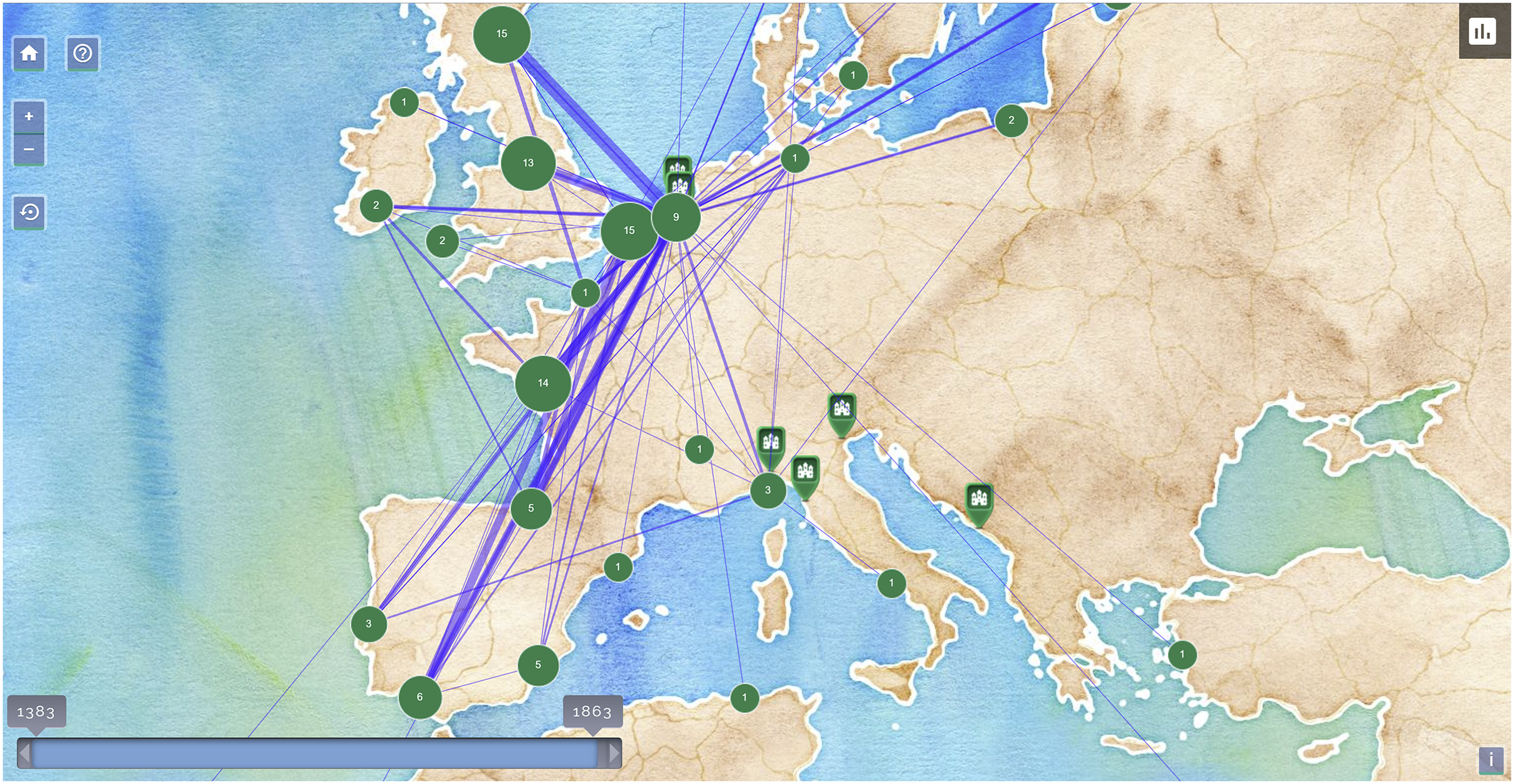
Risky business database interactive map, rotterdam market.
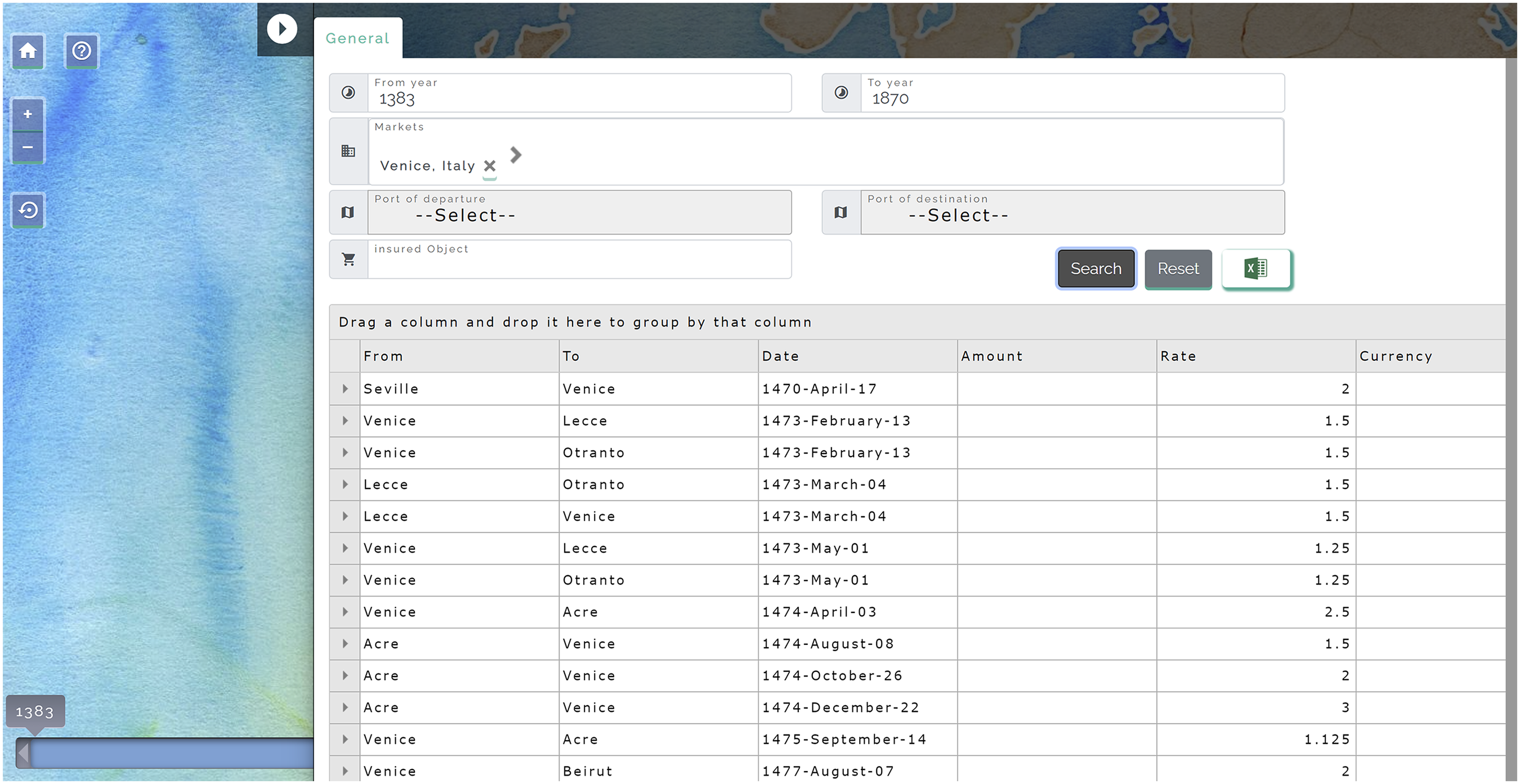
Risky business database example of search.
Future plans
The Risky Business database was formally launched in July 2022 at the ‘History of Insurance in a Global Perspective’ conference in Basel. We are currently working on adding data from ‘new’ markets (that is, London and Paris), as well as from markets that are already included in the database (eighteenth-century Genoa). The Risky Business database was originally limited geographically to Europe and chronologically until the nineteenth century. Recently, St. John's University (New York) has joined the project, which adds North American insurance markets as well as the (early) twentieth century to the scope of the database. Since its launch, we have been contacted by researchers who are interested in joining the network and contributing their data. 8 In the next two years, the Risky Business database will be further populated with fresh data thanks to a partnership with the research projects ‘Under Uncertainty’ and 'Winds, Waves and Storms', funded by the Italian Ministry for Universities and Research. 9 In addition, we are working on an advanced search option, the automated processing of handwritten tables and a new interface.
To conclude
The Risky Business database has evolved differently from our original plan, mostly due to the COVID-19 pandemic. Although we had to suspend the workshops, the pandemic also had positive outcomes. We had far more (online) meetings, which had a very positive effect on the depth of our collaboration and enabled us to respond quickly to issues. Our hope is that we can incorporate our positive experiences with online meetings with ‘normal’ gatherings again in order to expand our Risky Business database and strengthen our network. We invite you to have a look at our website and the Risky Business database, and to contact us if you have questions or would like to join our network.
Footnotes
Author note
Giovanni Ceccarrelli is currently affiliated with University of Milan, Milan, Italy.
Declaration of conflicting interests
The authors declared no potential conflicts of interest with respect to the research, authorship and/or publication of this article.
Funding
The authors disclosed receipt of the following financial support for the research, authorship and/or publication of this article: Dutch Research Council (NWO), Samenwerkende Maritieme Fondsen (grant number IG.18.031, 20.40).

Author biographies
Sabine Go is an assistant professor at Vrije Universiteit Amsterdam. Her research focuses on the emergence and development of economic institutions during early modern and modern times in the Low Countries. She is the principal investigator of the international ‘Risky Business’ project. Her most recent project focuses on the involvement of the Dutch insurance industry with slavery in the eighteenth and nineteenth centuries.
Antonio Iodice is a postdoctoral researcher at Roma Tre University, a contract professor at the University of Genoa and an honorary research fellow at the University of Exeter. He is a member of the European Research Council’s ‘HolyLab’ project, led by Felicita Tramontana (Roma Tre), and a former member of the European Research Council’s ‘AveTransRisk’ project, directed by Maria Fusaro (Exeter). He joined the ‘Risky Business’ project in 2021. His main research interests are early modern European maritime risk management, trade and mobility.
Giovanni Ceccarelli is Professor of Economic History at the Università degli Studi di Milano. Former Davis Fellow at Princeton University and senior visiting fellow at the University of Exeter, he previously taught at the University of Parma. His research interests include early modern commerce and finance, with a special focus on risk-management contracts; late medieval and early modern economic thought and culture; and food and retail history. His latest book is Risky Markets: Marine Insurance in Renaissance Florence (Brill, 2020). He is currently the principal investigator for the Italian Ministerial grant PRIN 2022 n. 2022SSZFT7, CUP D53D23000790006 ‘Under Uncertainty: Coping with Risks in the Mediterranean Maritime Business (Italy, 16th–19th Centuries)’.