




Abstract
There is a growing trend to conduct simulation-based mock-up evaluations as part of the process to design healthcare facilities. Health Quality Alberta (HQA) has published a framework to provide guidance for organizations wanting to integrate this evaluation methodology into their healthcare facility design process. Several national and international hospital design standards recommend using the framework. Simulation-based mock-up evaluations of various rooms (client rooms, washrooms, medication rooms, and dialysis stations) planned for a new complex continuing care facility were conducted. Healthcare delivery organizations CapitalCare, Alberta Health Services, and HQA conducted the evaluations collaboratively. The evaluations were intended to inform design modifications to enhance client and staff safety for the unique cohorts to be served at this continuing care centre. Observational assessments and staff/client engagement informed evidence-based recommendations that were incorporated into the planned design of the facility.
Introduction
Designing or renovating a built environment for healthcare is a complex process that is riddled with challenges and opportunities. Clinical personnel, such as care managers and staff, are becoming increasingly involved in the design process. There is a growing trend to conduct simulation-based mock-up evaluations as part of the process to design healthcare facilities. These individuals are often tasked with ensuring the design will support planned workflows and to proactively identify design elements that could have an adverse impact on provider efficiency and patient outcomes. Ensuring the design will support and facilitate patient care is critical as it could minimize or avoid 40 or 50 years of inconvenience for staff working in suboptimal space. 1
Clinical team members often review and provide feedback on proposed designs. When reviewing architectural drawings, difficulties conceptualizing how the actual space would look, feel, and support both current and new workflows may compromise feedback provided through 2D drawings. There is a growing trend to build full-scale mock-ups that allow clinicians to more clearly visualize the design by walking through a replica of the proposed space. These mock-ups can be simple (e.g., tape on the floor), detailed (e.g., plywood constructed walls and furnished), or virtual reality (e.g., fully immersive and photorealistic). While such mock-ups provide a better understanding of the space than 2D drawings, potential design issues may still remain hidden, especially if the space, once filled with equipment and supplies, is then used in unanticipated ways by other clinicians or clinical disciplines. Simulating various anticipated processes and procedures within the mock-up can help the design team understand the interconnectedness between clinical processes and the built environment as well as the implications when multiple clinical providers use the space simultaneously. Through this process, design issues can be uncovered and corrected, thus leading to improvements in both patient safety and staff workflow efficiency. HQA published the Simulation-based Mock-up Evaluation Framework 2 to provide guidance for organizations wanting to integrate this evaluation methodology into their healthcare facility design process.
What is the simulation-based mock-up evaluation framework?
A simulation-based mock-up evaluation involves creating a full-scale mock-up of a planned space and having end users enact realistic processes and procedures within the mock-up. Evidence-based data collected from the scenario enactments is used to develop recommendations to optimize the planned design. The Simulation-based Mock-up Evaluation Framework 2 and Guidelines 3 (available at https://www.hqa.ca/humanfactors) outlines an approach to plan, collect, and analyze data from these evaluations. The framework was developed in collaboration with experts in human factors, healthcare design, and patient simulation. It leveraged lessons learned from prior simulation-based mock-up evaluations.4-7 The framework and process has been incorporated into the National Standards of Canada regarding the planning, design, and construction requirements for Canadian Health Care Facilities (CSA Z8000-18). 8 The Facilities Guidelines Institute (FGI), publisher of FGI guidelines in the United States, promotes the framework as an FGI-supported resource on their website. 9 Organizations in both Canada 10 and the United States11-14 have published their use of the framework as part of their facility design process. The framework has also been adapted for post-construction (commissioning) evaluations which focus on evaluating planned clinical processes in both countries.15,16
Why is it important for patient safety?
Patient and staff safety, as well as other patient and staff outcomes, are strongly linked to the built healthcare environment in critical ways. Infections, surgical complications, medication errors, patient falls, and other complications of care are all affected by the built environment.17-20 Such adverse outcomes can be the result of decisions made during the design process that can inadvertently introduce design flaws, known as latent conditions. 21 All decisions, even correct ones, have the potential to introduce latent conditions. Basing design decisions on evidence-based data will improve outcomes. The cost effectiveness gained from identifying latent conditions has demonstrated positive return on investment ranging from $5.06 to $26.85 in savings for every dollar spent, after recovering the costs associated with conducting the evaluation. 3
Evaluation of a complex continuing care centre
Complex continuing care facilities are intended for individuals with intensive, high-level care requirements who are generally medically frail or have medical conditions that necessitate frequent, specialized nursing or medical attention. Designing to accommodate the clinical needs of these clients while simultaneously creating a home-like environment creates unique design challenges. By conducting simulation-based mock-up evaluations in such a space, the intent was to: • solve unresolved design issues, • determine optimal layout and space utilization, • better understand future workflows within the space, • enable cost savings by reducing the need for change requests during design and construction phases, • enhance client and staff safety through a detailed assessment of high-risk scenarios commonly associated with headwalls
1
and medication rooms, and to • assist in developing/optimizing staff workflows within each space.
Methods
The Gene Zwozdesky Centre at Norwood in Edmonton, Canada, was being designed as a state-of-the-art, innovative centre focused on excellence in continuing care. The new 40,000 square-foot facility was planned to accommodate up to 350 beds including complex and continuing care, post-acute and hospice beds, complex respiratory care, haemodialysis, and ambulatory clinics.
22
Simulation-based mock-up evaluations of various rooms planned for the new complex continuing care centre were conducted to assess the design of four room templates: client rooms, washrooms, medication rooms, and dialysis stations (see Figure 1). These rooms were selected because of the complex care provided in the rooms, the number of rooms that would be constructed with these templates, and to answer unresolved design issues and questions. Photos of the four mock-up rooms evaluated.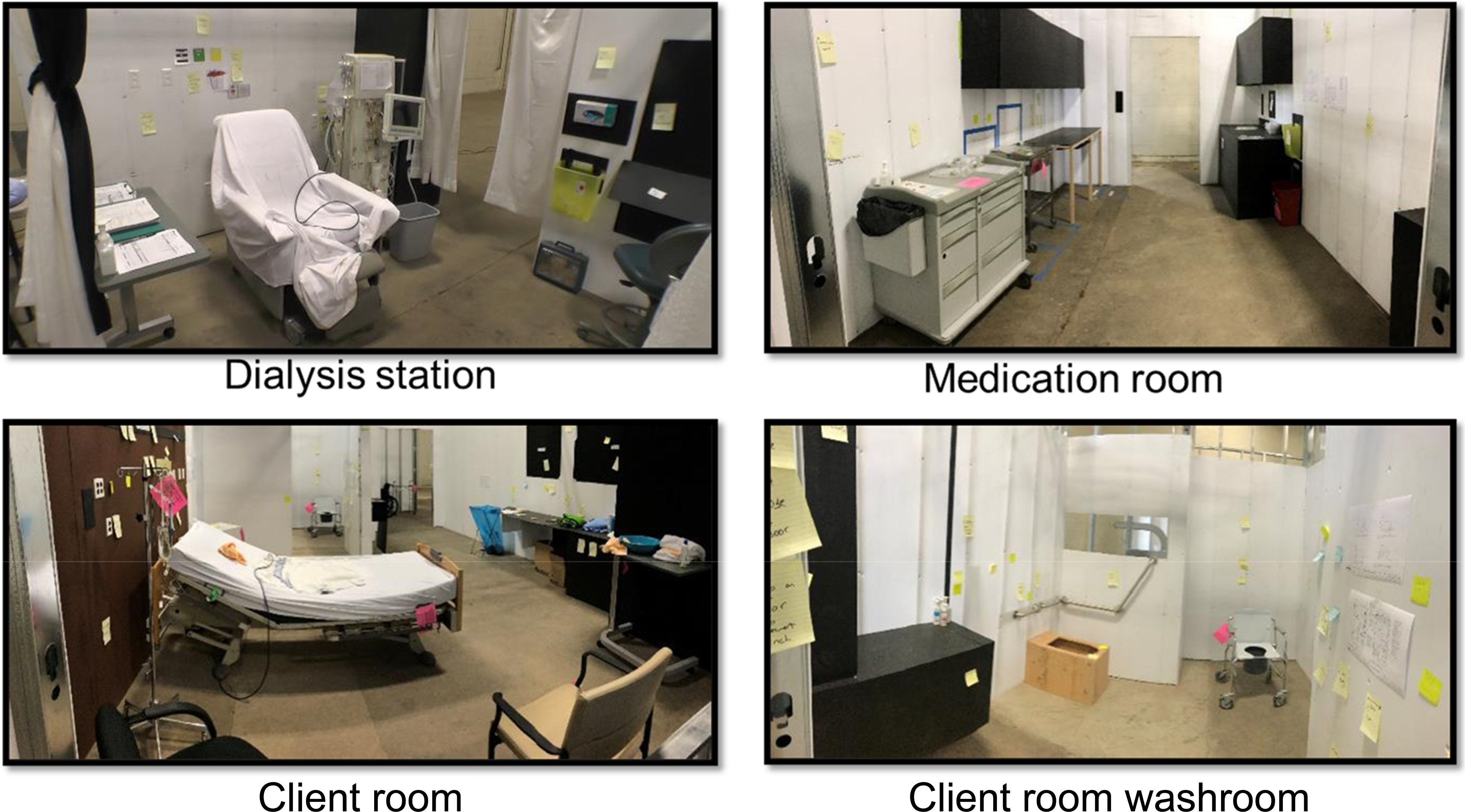
Simulation planning
An evaluation kick-off meeting, led by a human factors specialist, was held with operational leaders for each of the four room templates being evaluated. The intent of the meeting was to describe the evaluation process and to identify evaluation objectives. Additionally, the team worked together to define roles and responsibilities with respect to scenario development, participant recruitment, and staging the mock-ups. After the kick-off meeting, operational leaders led the development of simulation scenarios with the intent of assessing the evaluation objectives. Input was obtained from other project members through subsequent meetings.
Scenario enactments
Clients from a nearby continuing care centre were recruited to participate in the scenario enactments alongside planned users of the space including registered nurses, licenced practical nurses, healthcare aides, respiratory therapists, social workers, emergency medical service medics, and service workers. Scenario enactments occurred over 3 days. Scenarios involving the client room and client room washroom occurred on the same day.
Each day began with a pre-brief by the human factors specialist to describe the purpose and agenda for the day. The operational leader for that area provided a project update, described the scenarios, and oriented participants to the mock-up room and planned processes for the scenario enactment. Each scenario was then enacted by the scenario participants.
Client rooms
Healthcare professionals and clients enacted simulation scenarios which involved typical delivery of care to clients (scenario 1) and a fall recovery scenario in response to a client who fell in the doorway (scenario 2).
Client washrooms
Healthcare professionals and clients enacted a scenario in the washroom which involved providing support to a client during showering activities (scenario 1).
Medication rooms
Healthcare professionals enacted a scenario which involved preparing morning medications for administration to four clients (scenario 1). This scenario was re-enacted after re-arranging equipment within the mock-up to incorporate post-scenario enactment debrief feedback (scenario 2).
Dialysis stations
Healthcare professionals enacted scenarios which included providing care for a client with extreme hypertension (scenario 1), responding to a code blue (scenario 2), transferring a client (scenario 3), and recovering a client who fell (scenario 4).
Video and audio recordings captured the scenario enactments and debriefing sessions. Individuals not participating in the scenario enactments observed from outside the mock-up room. Each scenario enactment was followed by a debriefing session, led by the human factors specialist, with the participants and observers. A note taker transcribed debriefing comments. In addition, debriefing feedback was written onto sticky notes and posted on the walls of the mock-up spaces. Photos of the sticky notes were taken to capture the feedback.
Results
The evaluation resulted in numerous design modifications to enhance client safety and outcomes for a unique population. The results and evidence-based recommendations were generated based on the observational assessments made by the observers as well as debriefing feedback from the participants after each scenario enactment.
Client rooms
Findings from the observational assessment and post-scenario debrief led to extensive head wall reconfigurations and mill work adjustments, as well as location changes to plug-ins, oxygen, suction, light switches, and hand hygiene elements (sinks, soap, glove dispenser) to better accommodate the needs of clients and staff. The placement of room amenities such as televisions and clocks were also verified to ensure appropriate sightlines for clients who remain in bed.
Client washrooms
Modifications included relocating grab bars, plug-ins, hooks, and light switches as well as redesigning vanity cupboard/drawers for better accessibility. The placement of shower controls was also checked to ensure they could be used without staff getting wet.
Medication rooms
Modifications included relocating medication storage carts and associated power/data ports, adding electrical outlets, and redesigning shelves/supply storage areas.
Dialysis stations
Modifications included relocating suction/oxygen, adding emergency power outlets, and reconfiguring the charting station.
Discussion
The simulation-based mock-up evaluation provided an opportunity for evidence-based decision-making regarding the planned design of various rooms, which resulted in the incorporation of numerous design modifications into the final design. In addition to the design modifications described, the process enabled user engagement in the design process as well as opportunities to test and modify planned workflows.
Two opportunities to enhance the evaluation process were identified. First, including members from the equipment planning team would have better enabled the use of available equipment as part of the mock-up evaluations. And second, only one dialysis station was included in the mock-up. The design team noted that additional learnings may have precipitated if the mock-up included two dialysis stations, as workflow in one station may affect workflows in the adjacent dialysis station.
This evaluation provides a case study demonstrating utilization of the simulation-based mock-up evaluation framework in a unique clinical context. The availability of relevant case studies may help organizations generate support and receive guidance within their organizations to evaluate design prior to construction. Future research and facility design projects should continue extend use of simulation-based mock-up evaluations to novel clinical areas.
Conclusion
The findings suggest that conducting a simulation-based mock-up evaluation has the potential to produce useful design modifications to enhance client safety, outcomes, and staff engagement. Although this manuscript is not the result of broad research, the case study highlights an effective approach worthy of consideration for a broad myriad of facility design projects. The evaluation process engaged frontline staff and clients into the design process in a meaningful way, fostering evidence-based design making regarding design decisions.
Footnotes
Acknowledgements
We wish to thank all scenario enactment participants and collaborators who shared their time and feedback as part of the evaluations.
Declaration of conflicting interests
The authors declared no potential conflicts of interest with respect to the research, authorship, and/or publication of this article.
Funding
The authors received no financial support for the research, authorship, and/or publication of this article.
Ethical approval
The study was conducted after successfully completing the Alberta Research Ethics Community Consensus Initiative (ARECCI) screening tool. 2
Informed consent
Participants gave written consent before participating in scenario enactments.

Data availability statement
Qualitative data can be found by contacting the corresponding author of this study.