




Abstract
Patient and family engagement is crucial for a responsive health system and improves patient outcomes. However, few practical resources for purposeful engagement are available to health leaders. Over the past five years, BC Renal, the provincial kidney care network in British Columbia, developed, operationalized, and implemented a framework to enable meaningful patient and family engagement. An advisory committee, comprising patient partners and representatives from health authorities and the community, directs the outreach, resource development, and evaluation of patient and family engagement at BC Renal. Here, we describe how our network-wide patient engagement strategy was developed and expanded upon, and the progress so far. A 2022 survey reports that 95% were satisfied with the engagement opportunities, and narrative feedback suggests network members continue to adopt practical ways to collaborate more effectively. Health leaders, patient partners, and others continue to align operational and strategic activities to advance culture change in kidney care provincially.
Introduction
Patient and family engagement at individual, program, and system levels supports “true” person- and family-centred care responsive to what matters to the patient, as well as improves patient outcomes and experiences.1–5 It recognizes that patients and families have unique expertise from living with their health conditions and, as end users, are central within health systems. 6 Moreover, patient involvement can be perceived as a moral and ethical imperative, as care impacts their health and is publicly funded.7–9 It is evident that patients living with chronic conditions who play an active role in their healthcare decisions at the point of care (engagement at individual care level) are likely to have better health outcomes. 1 More strategies are needed to optimize the potential of patient and family engagement at program and system levels, but this requires thoughtful management and operational alignment.2,10
In British Columbia (BC), there is a movement toward incorporating patient and family voices at all levels of the healthcare system to support person- and family-centred care. This is evidenced through the BC Ministry of Health’s Patients as Partners Initiative,11–13 and the Patient Voices Network (PVN), 14 a patient engagement community administered by Health Quality BC, Accreditation Canada, 15 health authorities and other healthcare, and research organizations. Although these initiatives resulted in several theoretical frameworks and policies to support patient and family engagement in various settings, practical guidance and tangible resources for systemically integrating meaningful and purposeful engagement at a provincial network level were limited at the time.
BC Renal (BCR) is a provincial clinical network of the Provincial Health Services Authority (PHSA) and reports to the BC Ministry of Health. BCR is responsible for planning, coordinating, funding, and monitoring the delivery of kidney care services to patients with advanced Chronic Kidney Disease (CKD). Of note, direct kidney care service delivery is the responsibility of renal programs in the regional health authorities (Supplemental material). As a network, BCR serves more than 20,000 patients receiving dialysis and non-dialysis kidney care across the province, with a strong commitment to quality person- and family-centred kidney care. Provincial committees, comprised of health professionals, researchers, and patient partners from all regional health authorities, collaborate to plan, strategize, and continuously improve different facets of kidney care. These committees complement a nimble team of central office staff in achieving the BCR mandate. Work is also accomplished through collaboration with the Kidney Foundation of Canada (KFOC)—BC & Yukon Branch, 16 Can-SOLVE CKD Network,17,18 a national patient-oriented research network, and other partners.
Prior to 2019, patient and family engagement in BCR took place organically in ad hoc ways through a few committees and initiatives. During the development of the 2018-2023 strategic action plan, the network identified a need to formalize patient and family engagement to optimize patient experiences and outcomes. 19 This article describes the process, progress, learning, and future direction with applicability to other health networks planning to advance patient and family engagement at the system level.
Methods
Advancing person-centred care as a strategic priority
The catalyst for BCR’s patient engagement framework was the 2018-2023 strategic priority to “optimize patient experience and outcomes.” 19 In 2019, a working group of patient partners (anyone with lived experience of CKD), regional health authority representatives, and BCR staff conducted a comprehensive environmental scan, including literature review, curation of relevant resources and tools, and interviews with network members (health professionals and patient partners) to understand the benefits, challenges, and supports required to enable meaningful patient and family engagement. The framework development was built on the guidance documents developed by the BC Ministry of Health 4 and others, with input from PHSA Indigenous Health, PVN, and the KFOC, in addition to network members.
The BC Renal Patient & Family Engagement Framework
20
outlines a set of guiding principles to enable authentic and meaningful patient and family engagement in BCR, a 7-step engagement process (adapted from the PVN),
14
engagement planning considerations, and examples at various levels of engagement per the International Association for Publication Participation (IAP2) Spectrum of Public Participation.
21
It also defines how engagement with patients and families can take place in three domains: with input from, co-design, and capacity-building with patients and families. Figure 1 shows an infographic that summarizes the intent, guiding principles, 7-step engagement process, and the three domains in the framework. This framework is used by the leaders in implementing patient and family engagement initiatives at BC, including patient partnerships in provincial committees and various engagement activities in projects (more details below). Overview of BC Renal patient & family engagement framework.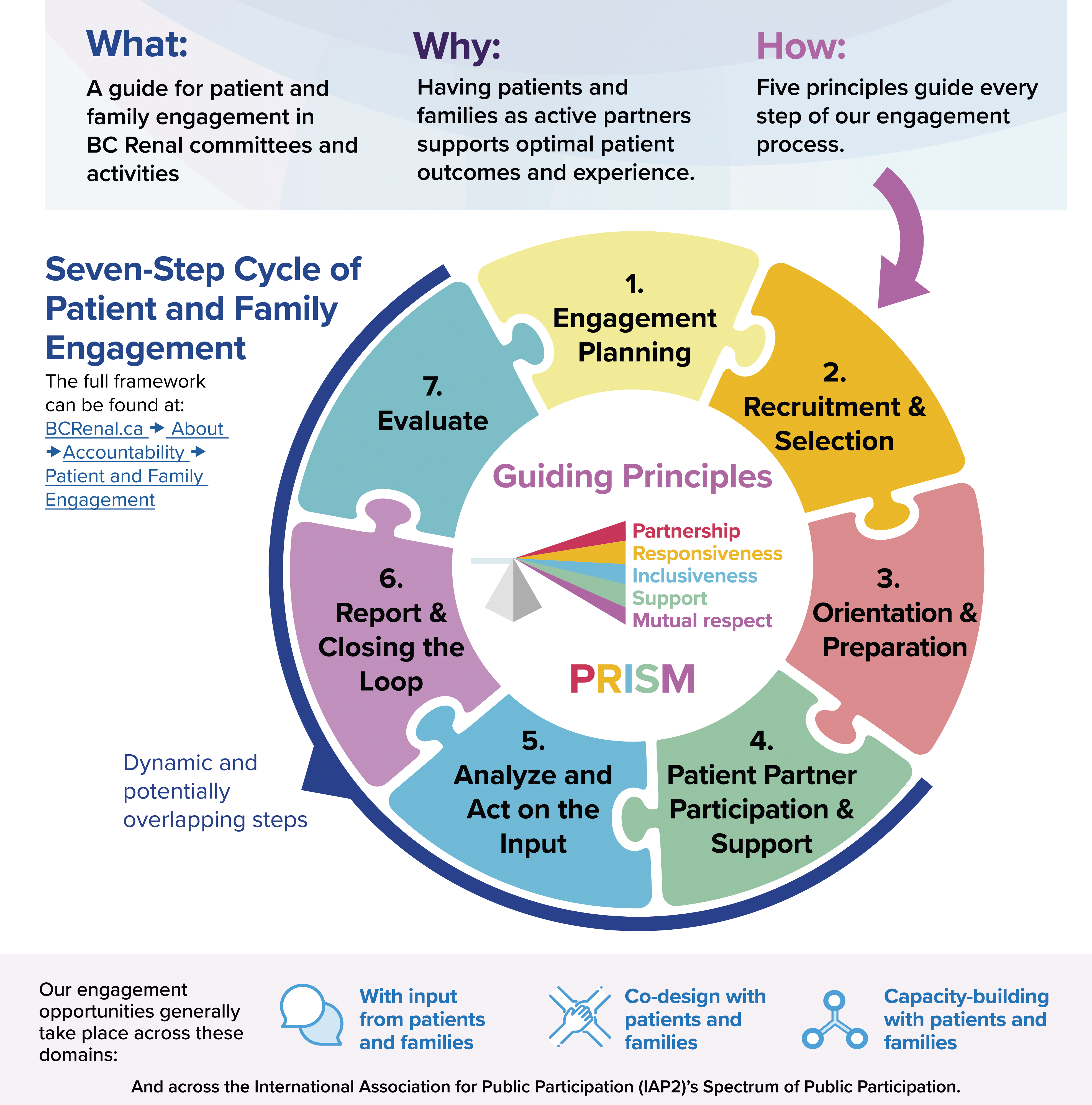
Standardizing practices
The initial working group transitioned into the BC Renal Patient and Family Engagement Advisory Committee, which now leads the ongoing operationalization and implementation of the framework. Committee membership includes patient partners and health professionals from all regional health authorities, BCR staff, and a KFOC representative. Like the working group, the committee is co-chaired by a patient partner. The committee directs the outreach activities, development of resources to promote patient and family engagement, evaluation, and other related activities to advance patient and family engagement within BCR.
The engagement operations and related activities are supported by one full-time equivalent (across two staff) and an annual budget. The BCR staff recruit, onboard, and guide patient partners, and provide training, consultation, and coaching to staff, health professional leaders, and others incorporating patient and family engagement into new or existing projects.
Promoting engagement opportunities
Engagement opportunities are publicly posted on the BCR web site, newsletters, social media as well as through the PVN 14 and KidneyLink, 22 an on-line platform created by Can-SOLVE CKD Network to connect Canadians who want to contribute to better kidney health. Additional outreach strategies include referral by kidney care providers, promotional materials shared within health authority renal programs, a postcard included in a provincial patient experience survey mail-out, and community events, among others.
Onboarding of and ongoing support for patient partners
BC Renal produced a specialized set of protocols and resources for everyone involved in its patient and family engagement, to complement the generic resources available through the PVN. The recruitment, selection, and onboarding of new patient partners are complemented with peer support and mentorship from experienced volunteers. Specifically, in the spirit of patient partnerships, experienced patient partners work together with staff to co-interview in recruitment and selection. To ensure new patient partners have an overview of how the provincial network functions, a clear understanding of role expectations and the support available to them and mitigate any potential risks due to conflicts of interest and for confidentiality breach, they attend an orientation and complete a declaration of interest form and volunteer agreement. The volunteer agreement outlines the shared commitment for patient engagement, BC Renal and volunteer responsibilities, and commitment to confidentiality. Ongoing support includes check-ins between meetings, reimbursement of out-of-pocket expenses, honorarium as a token of appreciation for participation, and additional training opportunities and coaching. In addition, tailored resources are developed for those who work with the patient partners; for example, guidelines for patient partner recognition and primary contact of patient partners in a committee/working group. These processes, protocols, and resources support effective engagement and ongoing feedback from different perspectives.
All patient partners who are active members of a BCR committee have attended an orientation. In some instances, they have also completed San’yas Indigenous Cultural Safety (ICS) training 23 offered through PHSA Indigenous Health. Likewise, all committee/working group chairs and staff with patient partners have been offered engagement training, San’yas ICS, and other cultural competency training. Coaching is available on request to all who are involved in engagement opportunities.
Evaluation and ongoing feedback
Progress is monitored through annual evaluation and ongoing feedback. Every year, patient partners are invited to complete a survey adapted from the Public and Patient Engagement Evaluation Tool, 24 while the committee chairs, project managers, and support staff are asked to complete a survey adapted from the PVN’s Patient Partner Check-in Survey. 14 Results are shared with all survey respondents and more broadly to the public in an infographic. Ongoing feedback is also collected through e-mails, phone/video calls, and event-specific surveys to enable timely reflection and discussion to celebrate and improve the process for future engagements.
Looping back and showcasing engagement efforts
For knowledge dissemination and growth of social capital, 11 committee and working group leaders are encouraged to share findings and outcomes as broadly as possible. This includes sharing with patients, families, and others who participated in the projects how patient voices have influenced the work and project outcomes throughout the stages of the project life cycle (e.g., during and/or after). In addition, the BCR communications team supports socialization of engagement stories via videos, presentations, newsletters, social media, and other communication channels to optimize their reach to various audiences, including health professionals and patients/families who may not be aware of patient and family engagement.
Results and progress
Figure 2A shows increasing integration of patient and family voices at BCR over the years. Despite the COVID-19 pandemic, interest in participating increased by 56%, most likely due to invitations mailed out with the provincial patient experience survey. Between 2020 and 2023, the number of patients and family members subscribed to receive patient engagement volunteer updates and educational opportunities increased from 61 to 130, and the number of active patient partners increased from 24 to 29. Evaluation of patient and family engagement in BC Renal. (A) Annual growth of the network of patients and family members and active patient partners who collaborated in BC Renal committees or working groups. (B) Highlights from patient partner experience survey. (C) Narrative feedback on patient and family engagement in BC Renal.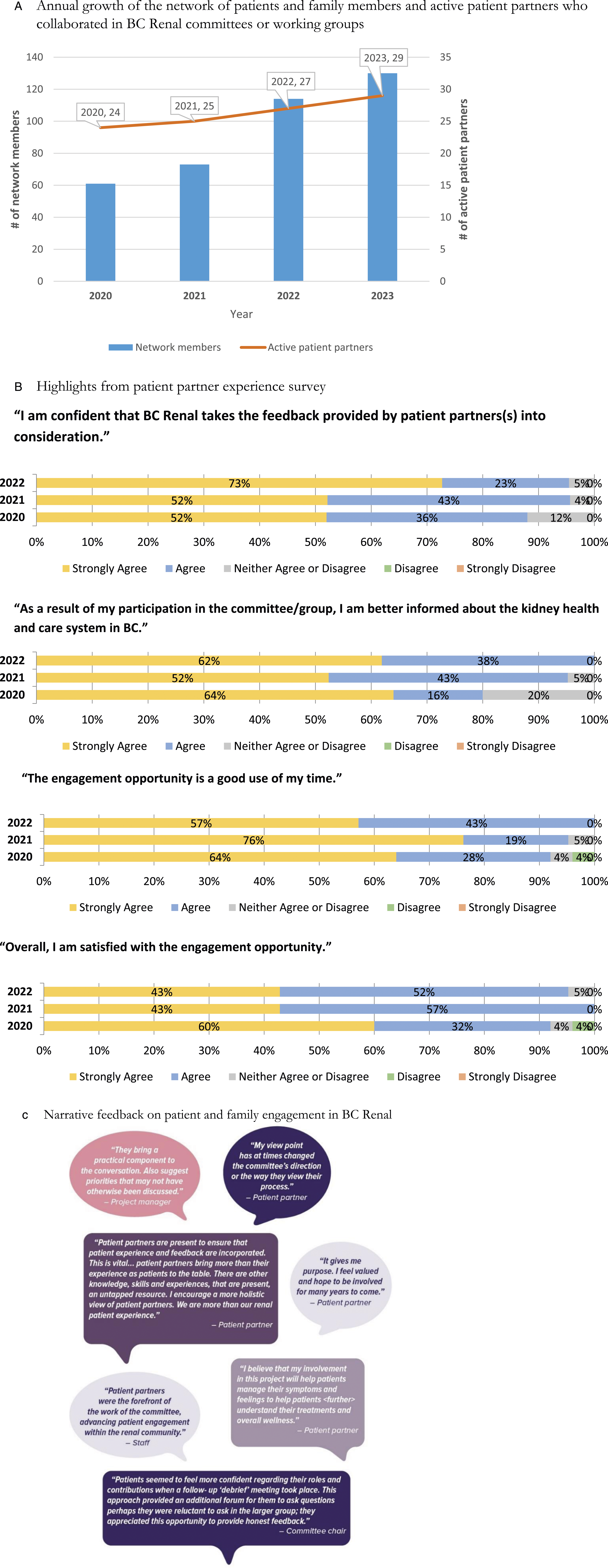
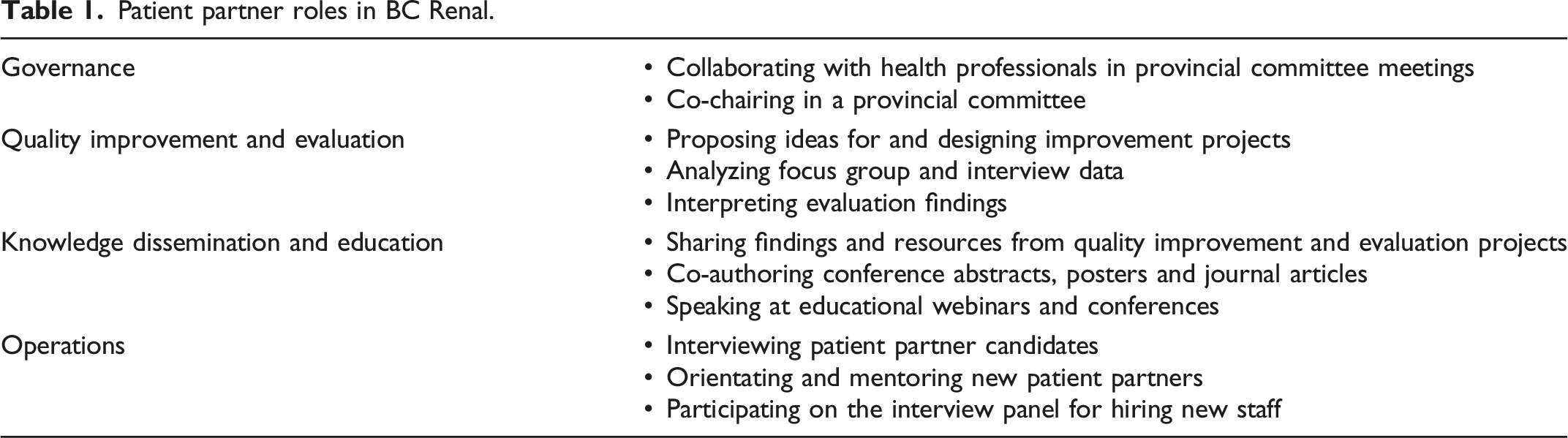
Patient partner roles in BC Renal.
Over recent years, the response rate of our annual patient partner survey has ranged from 85 to 100%, the results of which are described in Figure 2B. Notably, increasing proportions of patient partners “strongly agree” or “agree” they are confident BCR takes feedback provided by patient partners into consideration, report being better informed about the kidney health and care system in BC because of their participation, and consider the engagement opportunities a good use of their time. Almost all patient partners are satisfied with the long-term engagement opportunities at the collaborate level per IAP2 spectrum. As shown in Figure 2C, the narrative feedback from different perspectives involved in engagement opportunities shows provincial network members continue to adopt practical ways to listen, learn, and work together more effectively. Improvement opportunities identified include acknowledging the specific influence of patient partners, more role clarification for patient partners and those who support them, and creating space on meeting agendas for social connection.
Discussion
Impactful patient and family engagement at BCR is made possible through alignment of strategic and operational activities. Specifically, BCR leaders prioritize optimizing patient experience and outcomes, dedicate human and financial resources to formalize patient and family engagement, and practically help to overcome barriers along the way. The BCR Patient & Family Engagement Framework has helped formalize and enable purposeful and effective patient and family engagement across BCR committees and key activities, with ongoing guidance from the Patient & Family Engagement Advisory Committee.
We recognize that broader culture change toward patient-centred care and research, for example, by the KFOC and Can-SOLVE CKD Network, as well as the provincial health system, heightened the readiness of BCR network members in advancing patient and family voices. Simultaneously, these efforts by other organizations contributed to the pool of experienced patient and healthcare partners as well as engagement practices from which we could learn.
The integration of patient and family perspectives into BCR operations has supported network-wide culture change focused on the priorities of patients, families, and communities. This was made possible in two different ways. Firstly, patient partners are active members of BCR committees, which foster collaborations between patient partners and health professionals from various regional health authorities, enabling health professionals to witness how patient and family voices are integrated and influence provincial initiatives. For example, patient partners shared their insights on symptom management by shifting the focus from fear of healthcare providers’ inability to address all symptoms to the importance of transparent communication with patients in advancing a palliative approach to kidney care. 25 In addition, these learnings go beyond the provincial work and inspire local and regional patient and family engagement activities. This ripple effect originating from a system level is helping to influence local culture change for person- and family-centred care across the network at various levels.
Secondly, our approach to patient engagement has modelled the creation of safe spaces where all views are respected, and mutual learning and collaboration is valued among health professionals, patient partners, and other partners across the province, and within the committees, working groups, and various events. Consequently, these encounters also inspire other patient engagement activities beyond BC. Although we have made significant progress over the past five years, ongoing intentional efforts to counteract the power imbalance between patients and health professionals, clarify roles, and prioritize time for social connections on busy meeting agendas will further optimize the partnership experience for all.2,26
BC Renal is taking a further step by identifying equitable and optimal people-centred care—and the need for ongoing community engagement—as a foundational principle in the new 5-year strategic action plan. 27 This commitment involves elevating voices of underserved provincial populations such as Indigenous Peoples and communities, people of colour, and rural and remote communities. In turn, sustained effective and meaningful engagement practices will facilitate the pursuit of the Quintuple Aim 28 for better population health, improved patient and provider experience, lower costs, and enhanced health equity. In recognition of BCR’s success in formalizing patient and family engagement, PHSA has tasked our established patient and family engagement team to extend its support to the new Post-COVID-19 Interdisciplinary Clinical Care Network, a program managed by BCR under the PHSA umbrella. 29 In the years ahead, BCR will endeavour to demonstrate how patient and family engagement has yielded positive impacts on clinical care outcomes and experiences at a population level, the ultimate long-term goal of any patient and family engagement strategy.
Conclusion
To ensure “true” person- and family-centred care, formal and well aligned patient and family engagement mechanisms and support structures are needed. We describe an effective approach consisting of an orchestrated series of strategic interventions to achieve meaningful, impactful, and sustainable patient and family engagement within a provincial network. These include standardizing practices, promoting engagement opportunities, providing onboarding and ongoing support to patient partners, and gathering feedback from all involved for continuous adaptation and improvement of the patient engagement strategy. Such an approach can enable a culture shift toward people-centred care, where the voices that matters most—those of patients and the community—are a predominant and guiding influence in the delivery and evolution of healthcare.
Supplemental Material
Supplemental Material - Growing a provincial patient and family engagement network to optimize kidney care
Supplemental Material for Growing a provincial patient and family engagement network to optimize kidney care by Helen Hoi-Lun Chiu, Brenda Ken San Lee, Laura Lee Bennett, John Randy Spensley, William Walker Dear, Winphia Koo, Sushila Marie Saunders, and Gloria Teresa Freeborn, on behalf of the BC Renal Patient & Family Engagement Advisory Committee in Healthcare Management Forum.
Footnotes
Acknowledgements
The authors wish to dedicate this paper in memory of Dennis McCann, Lois Cossar and Sharon Waurynchuk, who were instrumental in advancing patient partnerships as members of the BC Renal Patient & Family Engagement Framework Working Group, Patient & Family Engagement Advisory Committee and other roles in BCR and beyond. Special thanks to all BCR leaders and patient partners for making the culture change possible. We are grateful for all past and current members of the BC Renal Patient & Family Engagement Framework Working Group and BC Renal Patient & Family Engagement Advisory Committee: Patient Partners—Bet Tuason, William Dear, Dennis McCann, Cathy Shotton, Laura Bennett, Lois Cossar, Neville Avison, Jana Sadler, Jared Provost, Randy Spensley, Sharon Waurynchuk, and Tiffany Bell; from Fraser Health—Clifford Lo, Darpanjot Bathal, Gurjit Pawar, Neelam Mann, Ruby Bajwa, and Sue Bal; from Interior Health—Christine Topley and Jesse Colbeck; from Island Health—Anita Kennett and Morag McGregor; from KFOC—Pia Schindler and Teresa Atkinson; from Northern Health—Deidra Goodacre, Fareen Din, Mandy Levesque, and Shelley Barwise; from Providence Healthcare—Julie Lajeunesse and Winphia Koo; from PHSA—Sue Fuller Blamey; from Vancouver Coastal Health—Deborah Litvack, Harjender Walia, Jenifer Tabamo, and Pam Papp; from BCR—Brenda Lee, Helen Chiu, Gloria Freeborn, Sanford Kong, and Sushila Saunders. We appreciate Stacey Richardson and Michelle Hampson for their support in manuscript preparation.
Declaration of conflicting interests
The author(s) declared no potential conflicts of interest with respect to the research, authorship, and/or publication of this article.
Funding
The author(s) disclosed receipt of the following financial support for the research, authorship, and/or publication of this article: BC Renal funded this work.
Ethical approval
Institutional Review Board approval was not required.

Supplemental material
Supplemental material for this article is available on-line.
References
Supplementary Material
Please find the following supplemental material available below.
For Open Access articles published under a Creative Commons License, all supplemental material carries the same license as the article it is associated with.
For non-Open Access articles published, all supplemental material carries a non-exclusive license, and permission requests for re-use of supplemental material or any part of supplemental material shall be sent directly to the copyright owner as specified in the copyright notice associated with the article.
