




Abstract
Health information system implementations are expensive and risky. They have the potential to transform healthcare when implemented successfully. Health leaders need to effectively engage physicians as an important constituent in the project. This can be accomplished by applying user-centred design principles, facilitating physician leadership, and planning for training. When done effectively, a sense of shared ownership and allegiance between management and the physician group is created that will lead to a successful project.
Introduction
Implementing a hospital or regional Health Information System (HIS) is one of the most time consuming and expensive projects in healthcare. These systems have the potential to be transformative, improve process efficiency, and patient safety. Poorly implemented, they do the opposite. 1 In any HIS implementation, the failure to engage physicians can prove deadly to the project. The recent problems with iHealth at Island Health are illustrative. The 2015 Cochrane Report made it clear that the project team did not involve the physician group early nor take their concerns seriously. 2 Subsequent attempts at engagement continued to struggle as outlined in the Ernst and Young report. 3 This was due to continued lack of trust between the project team and the physician group.
One of the key factors affecting physician satisfaction in HIS implementations is management support. 4 Strong management support requires effective engagement. There are many potential barriers to physician engagement; some of them implicit and hard to quantify. Years of medical training provides a very specific set of skills but not necessarily a broad base outside medicine. Health leaders cannot assume that physicians understand health information systems. Fear of appearing ignorant can also prevent physicians from asking basic questions leading to misunderstandings and disengagement. The impact of HIS on physician wellness is well documented in the medical literature, and this can lead physicians to be wary of the impact on their wellness. 5 Finally, while some physicians are innovators and early adopters, most physicians follow the same technology adoption life cycle as the general public. 6 This is demonstrated by the fact that practice changing medical research usually takes many years to become standard practice. 7
Three powerful tools for successful engagement are user-centred design, leadership, and training. In this article, we will discuss methods and recommendations for physician engagement using these tools. Figure 1 below provides a conceptual layout. The foundation to HIS implementation success is management support and physician engagement. Physician engagement can be built with user centred design, leadership, and training.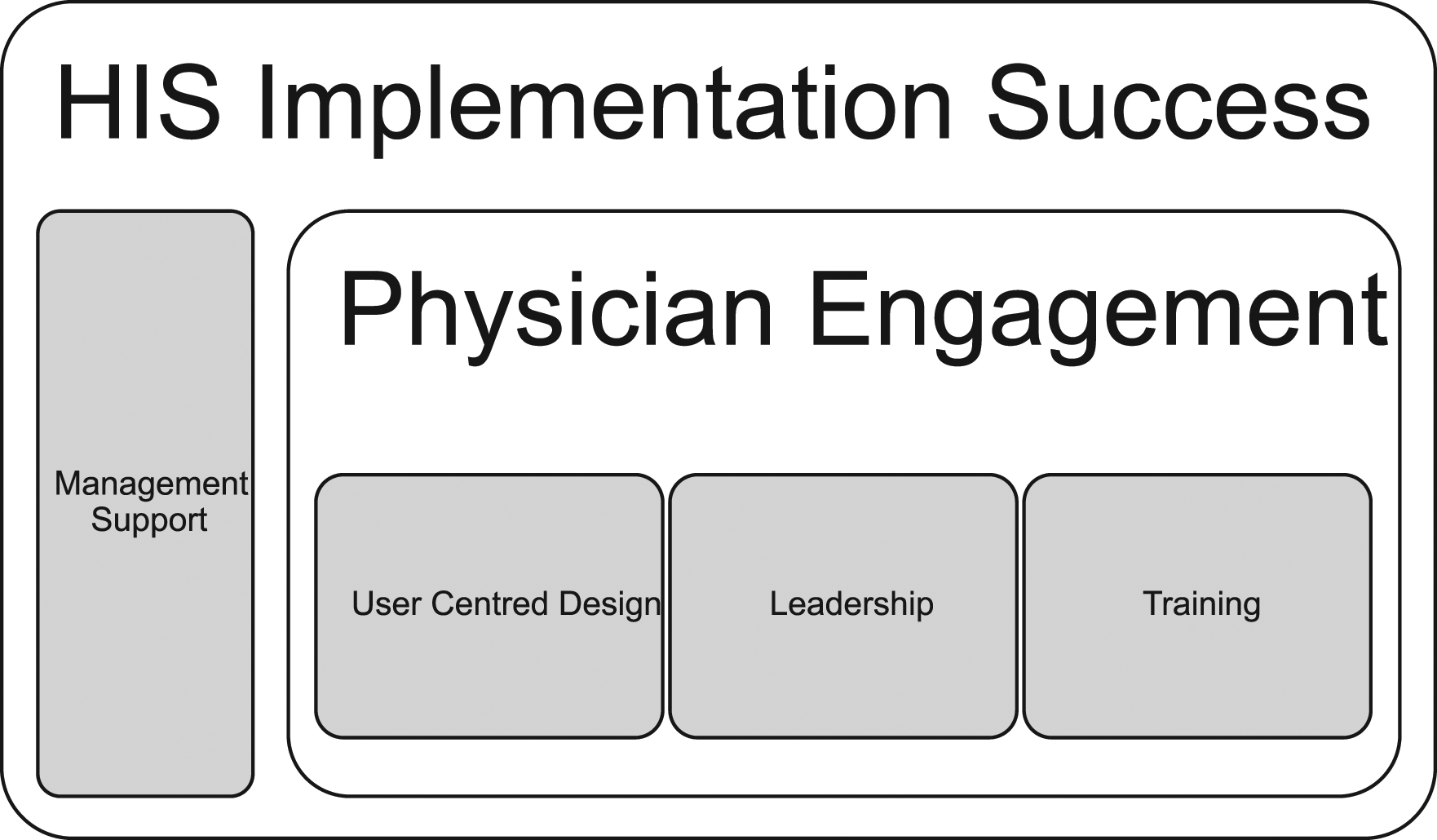
Design
There are many different design management approaches but, according to Kushniruk and Nohr, there are three ways to involve users in the HIS development based on the level of engagement and degree of involvement. 8 User-centred design involves an early focus in the development cycle on understanding the user's needs and environment using observation and iterative design. It uses evaluation methods such as ethnography and usability testing. Co-operative design involves having the designers and users work closely together throughout the development process. It utilizes methods including prototyping and simulation. Finally, user-driven innovation has the user in the key role as the primary innovator and designer. This requires constant input from users as they are the primary driver of the development. Within most healthcare contexts, both co-operative and user-driven designs are not practical as the time commitments for physicians are too burdensome and the core of the HIS has already been developed by a vendor. However, local customization provides an opportunity for user-centred design. These principles can be applied throughout the development cycle of the HIS.
Focusing on user-centred design starts by first understanding the workflows. Everyone is unique, but there are certain tasks that are common to all physicians. Patients are admitted to hospital, have medications ordered and procedures performed, have progress documented, and then ultimately discharged. It is critical to understand all the steps in patient care and document them in a workflow analysis. At first, this is strictly exploratory to understand the current state. It can begin before the HIS is selected and sends a message to the physicians that their workflows are important considerations. This is also the opportunity to identify inefficient processes, especially those that frustrate physicians, which could be improved by the new HIS.
In the early development phase, user-centred design focuses on workflow elaboration and user priority setting. Card sorting is an efficient method to discover how users think about their workflows, while interviews and surveys help set their priorities. On the other hand, interviews and surveys provide different information. Interviews take more time but offer a richer, deeper understanding of the user experience. Survey questions are more constrained but can be sent to the entire physician group. However, response rate may suffer and follow-up may be needed to ensure a representational sample.
As the final product takes shape, the methodologies shift to demonstrations, focus groups, and usability testing. Smaller group demonstrations and focus groups provide thoughtful feedback on the development, while large group demonstrations are less effective as user groups may not fully appreciate what they are seeing, not pay attention, or succumb to groupthink. Testing is critical as it identifies issues with workflow and errors before go-live. Post go-live problems are much more expensive to fix. The best testing is done by average as opposed to power users. It should be using a simulated environment to demonstrate that the system functions as expected. Using average users also helps so that physician input is valued and can generate word of mouth excitement about the system.
Leadership
A health leader has many roles in a HIS implementation including supporter, change manager, advocate, decision maker, facilitator, and champion. 9 When approaching physicians, the two most important roles are that of the advocate and change manager. The implementation is doomed to fail if the physician group feels that hospital management is not deeply committed to the project. Every though physicians are independent of hospital management, the health leader still has a key role as a change manager. Leaders need to effectively communicate the change and identify resistance within the physician group. While not responsible for the physician group, effective leaders can take an active role in resolving any conflict and mediating change.
The most crucial step that can be taken at the executive level is the creation of the chief medical informatics office. 10 The Chief Medical Informatics Officer should form a dyad partnership with the senior information technology leadership and empowered to manage the HIS from a physician's perspective. This permits two-way communication between physicians and information technology to address issues and prevent silos. The Chief Medical Informatics Officer should also be part of the medical leadership hierarchy, answering to the Chief Medical Officer or equivalent. Then, any serious issues with the physician group can be raised directly with the medical leadership. The chief medical informatics office should also be budgeted and staffed appropriately so it can be effective.
The next major step is to ensure that there is medical departmental leadership agreement. Each department head needs to be aware and understand the importance of the project. They are responsible for representing the interests of the physicians and serve as their voice. Therefore, when a department head raises issues or seem resistant, this must be treated seriously. On the other side, the department heads represent the project to their membership, so it is important that the department heads support the project and not send mixed messages. This is where the chief medical office may be necessary to resolve issue.
A final way that a health leader can facilitate physician engagement is providing compensation. Physicians working with the project team are taking time from other commitments and reasonable remuneration is important. In this way, the project can attract and retain dedicated physicians for important roles such as leadership and training.
Training
Involving physicians in training is another important opportunity for engagement. Training adequacy is recognized by the ARCH Collaborative as a key factor in physician satisfaction. 11 Typical workflows should also be included in the curriculum, in addition to any site-specific requirements such as required documentation. It should also be as speciality specific as possible since different specialities have different use contexts using the logical sequence of a patient journey. Completion of a basic training module should be a requirement to access the system to ensure baseline competence.
Training is most effective when it is delivered by colleagues. Physicians training other physicians are both more effective but also pay dividends in engagement, monitoring for resistance, and providing feedback on the system. 12 The first step is to recruit a group of physicians under the chief medical informatics office as training supervisors. These individuals take the lead in developing or modifying any pre-set curriculum. Within each speciality, another group of physician trainers should be recruited to deliver the material. These trainers are also invaluable during go-live as super user support.
Independent practice increases competency and physicians need time on their own to practice. Thus, there needs to be simulated practice environments available. They should mimic real patients and set up with realistic, speciality-specific data. There is a direct relationship between time spent in independent practice, competence, and satisfaction. The practice sessions can be guided by a workbook that provides additional information, memory aid, and usage tips.
After launch, it is still important to focus on training as ongoing training support is associated with increased physician satisfaction. 13 Training requires a different focus from new user and can include remediation, updates, and just in time training. Initial training occurs when the physician has no prior knowledge of the system and without independent practice time, training retention will slip below competence after launch. Some users may even fail new user training. Having remedial training is therefore necessary to address this issue.
Normally, the software vendor will release enhancement updates. Given the possible impact on workflow and improvements in the system, additional training and communication of the changes is necessary. Customization training should be available after basic training, but the work can be left to the individual. Physicians will commit time to customization as they discover ways the system can improve their workflow.
Finally, it is well established that the most effective learning occurs when the users is confronted with a problem. 14 Access to just-in-time training both increases retention and system satisfaction. 15 Building a just-in-time training system takes time and planning to identify consistent pain points. However, the payback is a significant increase physician satisfaction and engagement.
Conclusion
Physician engagement is a critical step in a HIS implementation. The literature is replete with the consequences of disengagement. While physicians are not the only stakeholders a health leader needs to consider, they are uniquely positioned to cause the most trouble given their relationship in the healthcare system. The astute leader will notice that these engagement areas will involve investing a significant amount of time and energy by the physician group and requires significant support from the health leader. This is purposeful as implementing a HIS is a major change that can only be accomplished by a creating a shared sense of ownership. The more physicians are involved in the implementation of the HIS, the more engaged in the change they will be. This can be accomplished by focusing on three areas.
User-centred design starts from understanding the workflows and involving users throughout the development cycle using a variety of methods. User testing is critical to identify issues and to generate excitement in the project. Supporting a chief medical informatics office will create an ally who can speak directly to and for the physician groups. Department heads need to be on board with the change as representatives of the physician groups. They can also address struggling members, encourage use the system, and address inappropriate dissent. Intensive peer-to-peer physician training is extended beyond basic user training. Physicians should be involved in the development and delivery of training material. There needs to be mechanisms for remediation as needed, update education, and just-in-time training. All training should be focused on the physician's specific workflow.
HIS implementation represents a major change in a healthcare system. Change can be frightening for anyone, but with an aggressive engagement strategy, the physician group can be a powerful ally for success.
