




Abstract
The aim of the study was to explore same-sex and opposite-sex friendship functions among 12 to 13- and 16 to 17-year-old Hungarian adolescents (n = 304). To explore perceptions of friendship functions, the McGill Friendship Questionnaire (MFQ, 30 items, 6 factors: stimulating companionship, help, intimacy, reliable alliance, self-validation, emotional security) was used. The confirmatory factor analysis did not support the theoretical structure of MFQ. Based on the exploratory factor analysis, the 26-item Hungarian version of MFQ can be used to measure adolescents (the original 6 factors were retained). The internal reliability indices of the MFQ versions (same and opposite sex) were adequate (Cronbach’s α: .69–.88). The results only partially confirmed the age and gender hypotheses. Based on the results, the older students are more likely to acknowledge the achievements and positives of a friend for both same-sex and opposite-sex friends, as well as intimacy for opposite-sex friends. Also among older students, we identified several significant gender differences: for girls, all features of friendship were more important, except self-validation in same-sex friendship. In the opposite-sex relationship, only stimulating companionship and reliable alliance are more important for girls. The results raise the possibility that friendship functions build on and reinforce each other with age.
Introduction
Adolescents who perceive themselves as having a satisfying friendship are able to acquire, actively formulate and effectively operate in this relationship norms, rules and ways of assertive communication, cooperation, help and problem-solving that take into account the interests of others, which will influence their later relationships with friends and non-friends (Finkenauer & Righetti, 2011; Way, 2013). However, only those friendships that are characterized by mutual support, recognition, affirmation and trust have a positive developmental significance (Zimmermann, 2004). Friendships in which conflicts are resolved on the basis of power (and sometimes force), relationships that lack support, a sense of self-validation and reciprocity, or which may encourage norm-breaking behavior, very often have a negative impact on personality development. Adolescents who report having no friends fail to experience many friendship functions in their social relationships (Mendelson & Aboud, 1999, 2014).
The generally accepted view is that friendship, like other social relationships, is both multi-component and multi-functional (Hartup, 1996; Hartup et al., 1988; Rose et al., 2016), and that it is fundamentally characterized by voluntariness, lack of formality and enjoyment. It usually does not involve sexual interaction, long-term cohabitation, and little shared responsibility between the parties (Graber et al., 2016). According to Helm (2013), the closest friendship between two people can develop when the relationship is essentially characterized by voluntarism (based on free choice, attraction and the discovery of similarities) and positive emotional involvement. A friendship may have a number of additional characteristics (e.g., frequent sharing of time, reciprocity, support), which depend, for example, on the age, gender, socio-cultural, micro- and macro-environment of the parties (Hartup, 1992; Newcomb & Bagwell, 1996).
Some Theoretical Models of Nature of Friendship
Several theoretical models have been developed on the nature of friendship, in particular on its formation, maintenance, active shaping, termination and the role of these in personality development, three of which (the family socialization, the need-satisfaction and the functional models) are supported by a large body of empirical evidence.
According to the family socialization approach to friendship (e.g., Rose et al., 2016), the patterns of reciprocity, trust and mutual respect that sustain friendship stem from parents: the social skills that are acquired from parents and siblings through modeling, conversations and shared interpretations of situations are the social skills that determine the experience and functioning of friendship in adolescence and adulthood. According to Rose et al. (2016), our conceptions of friendship and how friendships are formed, nurtured and lived are shaped by family experiences of social communication from birth. The acquisition of certain social skills, the way in which relationships are formed with people within and outside the family, the support of others, parental assistance in identity development and the form of introduction to the world of work are crucial determinants of children’s perceptions of friendship, and the formation and maintenance of their friendships. Empathy, cooperation, conflict resolution and ways of delaying experienced in the family are transposed to all friendships. If these social skills can be successfully applied to the friendship to the satisfaction of both parties, it will work, but if not, it is likely that the friendship will soon end. However, if it does persist, it will be destructive rather than constructive (Rose et al., 2016). In order to experience intimacy within friendships, it is important to know how children relate to people within and outside the family, how they care for others, how they support others and how much they trust others. Conversations and activities related to work, learning a trade or profession shape attitudes in the family which, in the case of friendships, can become a source of (free) time spent together at school or outside school.
Closely related to the family socialization approach to friendship model is need-satisfaction model of friendship (Helgeson & Lopez, 2010; Jordan, 2013): there are situations that are necessary for two parties to develop a friendly relationship, to nurture it and, in case of problems, to be able to manage it in order to survive, because they need each other, which satisfies and reinforces the need to belong to someone as a basic social motive (Fiske, 2006). Like other social relationships (e.g., parent-child, lovers), friendship can be interpreted along the lines of functions to be satisfied: why it is formed, for what purpose, what it provides for the parties, why it is important for the relationship to survive. According to the needs-fulfilment model, we spend a lot of time with those who are important to us, and in the time we spend together, many of our needs are met. However, there are some needs that we cannot or do not want to meet within the family, and then we look for an individual(s) with whom we can. According to Jordan (2013), this need—often resulting in conflict with parents—becomes prominent in early adolescence, and this is one reason why earlier perceptions of friendship change significantly at this time. Interests, leisure activities, emotional attachment, the need to belong, learning different social skills and intimacy are the areas where family inadequacy is most often identified in a young person in early adolescence. It is then that they realize that there are activities and situations that family members cannot provide for them satisfactorily and they seek the company of others. Helgeson and Lopez (2010) supported the validity of the need satisfaction model in several studies, while highlighting that it was typical of children who were able to take advantage of situations where they had a positive experience (they addressed their peers after good situational awareness), showed empathy in conversation, good communication and problem-solving skills, and a stable self-image.
Early research emphasized that the foundation for the development of friendship is prolonged positive interaction. During such interactions, members gradually cultivate increasing positive feelings toward each other, sharing emotions and thoughts (Pettigrew, 1998). Based on this, it was asserted that the components of friendship are primarily manifested in behavior. However, more recent studies (e.g., Graber et al., 2016) suggest, on the one hand, that friendship can form even in negative life situations, especially when one party suddenly requires assistance, and gratitude initiates positive feelings toward the other. On the other hand, friendship components may not always manifest in behavioral situations. Even if certain components have not been experienced in a social situation, individuals may still characterize their friendship using these components. This is frequently observed in the definitions of friendships among adolescents. One possible explanation is that, alongside experiences, they formulate expectations as definitions, with these expectations being grounded in situations experienced in other relationships, particularly supporting the validity of friendship interpretation based on family socialization processes (Rose et al., 2016).
A functionalist understanding of friendship (Mendelson & Aboud, 2014) differs from the needs-fulfilment theory (e.g., Helgeson & Lopez, 2010; Jordan, 2013) in that it places greater emphasis on the relationship between functions. According to Mendelson and Aboud (2014), friendship, like other relationships, can be understood as a relationship that allows for the fulfilment of different functions (the benefits of friendship in the social world). Functions can also be identified in the other two models (e.g., cooperation in the family socialization model, belonging in the need-satisfaction model), but these authors emphasize (which others have not done before or have done to a lesser extent) that the six functions they identify must be fully present and mutually reinforcing in a long friendship relationship (more than 6 months in their research). The six functions are: stimulating companionship (the positive aspects of spending time together), help, emotional security, intimacy, reliable alliance and self-validation. Prior to the research of Mendelson and Aboud (2014), several researchers had identified similar functions. Wright (1974) distinguished and considered as essential the functions of utility (providing help), ego support (revealing oneself to the other), motivation (sticking with the other), self-affirmation (self-esteem) and security (forming a trusting alliance). Similar components were identified by Davis and Todd (1985), and among the components is conflict.
Mendelson and Aboud (1999) and Laird et al. (2001) suggests that when basic functions are a persistent feature of a friendship, it is not only socially beneficial for the parties (not only does it involve the mutual satisfaction of certain functions), but also has a positive effect on academic and professional progress (because a sense of social security allows for relaxed learning and professional development).
Characteristics of Friendship in Adolescence
One of the most striking features of the transition from early childhood to adolescence is the separation from parents, which is essential for the long-term development of autonomy (Hartup, 1983). According to Steinberg and Silverberg (1986), achieving emotional independence from parents allows a sense of control over one1’s own life, which gives confidence and provides opportunities for self-regulation. Gradually, from adolescence onward, a balanced and simultaneous presence of autonomy and interdependence also becomes emphasized in friendships (Selman, 1981), which plays a significant role in the way in which disagreements are resolved: unlike in the earlier period of life, friends are very demanding in discussing different feelings and ideas, with the aim of finding common ground and resolving differences, which can strengthen the relationship, so that disagreements and disputes do not necessarily lead to the dissolution of the relationship, as was more typical in the earlier years.
From the beginning of adolescence, reciprocity, trust and mutual respect gradually become more important in friendships, alongside a continuous increase in time spent together, which are the pillars of adult friendship (Rose et al., 2016; Sullivan, 1953). From the age of 13 to 14 years, friendship is also a relationship that provides emotional security and intimacy, which greatly facilitates commitment to others, which plays a major role in resolving problems and conflicts within the group in school settings, as they tend to agree with those they consider friends or with whom they are emotionally close (Zimmermann, 2004).
Emotional security also increases the duration of the friendship. Research by Aboud and Mendelson (1996) has confirmed the hypothesis that friendship dissolution can begin as emotional security loosens. According to Bukowski et al. (1994), friendships with high emotional security (“likes,” “supports,” “helps in trouble”) are characterized by higher levels of trust and support than friendships with low emotional security. Mendelson and Aboud (2014) suggests that from mid-adolescence onward, in addition to the intimacy and emotional security provided by ongoing companionship and support, persistence (strong commitment to the friend) and recognition of the other’s achievements, knowledge and personality become very important in friendships.
Cross-cultural analyses (e.g., Harkness & Super, 1985, in Lassú, 2004) confirm that at the age of 12 to 13, both boys and girls already designate friends of the opposite gender, laying the foundation for adolescent romantic relationships. However, boys and girls alike tend to choose friends more often from among their own gender. Maccoby (1990) attributes this to the significantly different communication styles of boys and girls: boys exhibit a more restrictive style, while girls lean toward an empowering-interaction style. The restrictive style is most notably characterized by a desire for control over the other party during interactions, interrupting the other during conversations, and directing speech acts, potentially leading to the other person withdrawing. Girls strive to listen to others, seek agreement with their conversation partner, and avoid hindering ongoing activities (except when it strongly conflicts with their intentions), preferring to continue. In communication situations between boys and girls, the boys’ style generally dominates, with girls subordinate, eliciting feelings of vulnerability and leading girls to prefer forming friendships with other girls. While numerous observations support Maccoby’s (1990) findings, Rose et al. (2016) draw attention to the fact that this sharp contrast in communication styles between boys and girls may become a breeding ground for stereotypical thinking. After all, boy can have also a submissive communication style, or a girl can be dominant in interactions with partners of the same or opposite gender. Additionally, it is observed that from mid-adolescence, friendships between opposite genders can transform into romantic relationships, with the degree of intimacy playing a crucial role in this process (Camirand & Poulin, 2019).
Friendship Measurement Methods
The quality of friendships and friendship’ features can be measured with different tools. For example, Berndt’s (1982) assessment friendship features which have measured the positive (self-disclosure, prosocial behavior, self-esteem support) and negative features (conflict, rivalry) of friendship. The measurement also contains a scale to examine the frequency of interactions. Friendship Qualities Scale (Bukowski et al., 1994) examines five features of friendship (security, closeness, companionship, help and conflict). In Friendship Quality Questionnaire (Parker & Asher, 1993) six features are assessed (help and guidance, validation and caring, intimate exchange, companionship and recreation, conflict and betrayal, conflict resolution). Friendship Questionnaire (Furman & Adler, 1982) asseses 16 features of friendship. The features were collected from previous literature, and it is similar to the siblings relationship measurement or to parent-child measurement. While the Network of Relationships Inventory (Furman & Buhrmester, 1985) primarily examines the broader social network, it can be useful for measuring friendships as well. The questionnaire helps understand the quality and nature of individual relationships.
McGill Friendship Questionnaire (Mendelson & Aboud, 2014) is able to explore the perceptions of friendship functions. We adapted this questionnaire in our study. Because, until now, it has not been available in the Hungarian language, and through its use, we can obtain a detailed understanding of the function of adolescent friendships. The detailed description of the questionnaire can be found in the methods section.
Aims and Hypotheses
The aim of the study was to explore the characteristics of friendship functions among 12 to 13- and 16 to 17-year-olds (6th and 10th graders) along same- and opposite-sex friendship relationships. To explore perceptions of friendship functions (how often the function appears in the friendship relationship), we used the McGill Friendship Questionnaire (MFQ, Mendelson & Aboud, 2014), which reflects a functional approach. To the best of our knowledge, this questionnaire has not yet been used in Hungary to compare same-sex and opposite-sex friendships by function.
It was assumed that the Hungarian version of the MFQ has adequate psychometric properties, so that the data obtained are suitable for the interpretation of developmental and social psychological phenomena. Based on the results of previous research (e.g., Mendelson & Aboud, 1999; Rose et al., 2016), we hypothesized that for both 12 to 13- and 16 to 17-year-olds, an important friendship function is stimulating companionship and help, whether to a friend of the same or opposite sex. Both of these reinforce intimacy and emotional security, and because they are closely related, we hypothesized that no age difference would be identified in these areas (Mendelson & Aboud, 2014). Given that previous research suggests that, in contrast to these functions, reliable alliance and self-validation are more important for older adolescents (Mendelson & Aboud, 1999; Selman, 1981), we hypothesized that more gender differences could be identified in older children: each of these functions is more important for girls in a friendship relationship, which could be explained, among other things, by gender differences in the development of social-emotional skills (Mendelson & Aboud, 2014).
Method
Participants
Hungarian 6th (12–13 years old) and 10th (16–17 years old) grade students (n = 307) participated in the study (6th grade students are primary school students, 10th grade students are high school students). All students’ mother tongue is Hungarian. The selection of the two age groups was justified by the results of developmental and social psychological research on the development of friendships, as described in the theoretical background. The survey was planned to be conducted on a larger total sample of nearly 500 students, but school restrictions due to the COVID-19 outbreak in 2020 did not allow this. After data cleaning, three students’ data sets had to be deleted due to incomplete or missing questionnaire completions, resulting in a final sample of 304 students. The mean age of the sixth graders (n = 138, boys = 62, girls = 76) was 13.09 (SD = 0.89) years, and the mean age of the 10th graders (n = 166, boys = 70, girls = 96) was 16.18 years (SD = 0.52).
Due to the nature of the study, it was not always possible to carry out analyses with the full sample population. Friendship characteristics were also explored in relation to same-sex and opposite-sex friends, with the questionnaire asking students to indicate whether or not they had same-sex and opposite-sex friends. Four students in grade 6 (1 boy and 3 girls) and six students in grade 10 (2 boys and 4 girls) indicated that they did not have a same-sex friend. The number of students who indicated a lack of an opposite-sex friend was much higher: 41 (32 boys and 9 girls) in grade 6 and 38 (23 boys and 15 girls) in grade 10. There were no students who indicated a lack of friendship in both cases. All these results suggest that the analyses were conducted for the same-sex friend with 134 students in grade 6 and 160 in grade 10, and for the opposite-sex friend with 99 students in grade 6 and 128 in grade 10.
Data Collection and Ethical Permission
The data collection started in February 2020, but was interrupted in the second week of March due to the coronavirus outbreak, but still has a completion rate of nearly 70%. The questionnaires took two teaching hours to complete. In all cases, the students’ work was supervised by teachers. At the beginning of the first session, students were given a short written briefing on what a friendship is generally considered to be, and what characterizes a friendship. The briefing was formulated based on the factors of the questionnaire used. This was necessary in order to tune the children in to the areas on which they would form an opinion about their friendship. They were then given a questionnaire measuring friendship functions related to same-sex friends and were asked to declare whether they had such a friend (if they thought they did not, they wrote an X in the designated questionnaire section). If they thought they did not, they were deemed to have completed the survey and were allowed to leave the classroom. On the second occasion (the week after the first completion), they completed a questionnaire measuring friendship functions with a friend of the same sex, and the instructions also specified what to do if they did not have a friend of the opposite sex.
The study was approved by the United Ethical Review Committee for Research in Psychology in Hungary (bo_41_19). The participants and parents of the students received written information consent about the aims and implementation of the research. We requested an intention to participate in writing from the participants and the parents of the students. Data collection was anonym and was supervised by their teachers. We assured the participants, both in written and in spoken form, that their participation in the study would not influence the evaluation of their performance or their academic results, and that they would be able to stop participating at any time.
Instrument
We used the McGill Friendship Questionnaire (MFQ, Mendelson & Aboud, 2014). This is the first time the MFQ has been used in Hungarian research, we are not aware of an earlier version in Hungarian. The questionnaire was translated (from English to Hungarian) and translated back by professional translators, and the items of the Hungarian questionnaire were finalized by the authors of the study.
The MFQ contains 30 items, measures the characteristics of friendship functions along six factors (five items per factor): stimulating companionship (e.g., He makes me laugh.), help (e.g., S/he helps me when I need it.), intimacy (e.g., I can tell him/her my secrets.), reliable alliance (e.g., S/he would want to stay my friend even if we fought.), self-validation (e.g., S/he makes me feel smart.) and emotional security (e.g., S/he helps me calm down when I’m nervous.). Statements are rated on an eight-point scale (never [1]–always [8]).
The stimulating companionship factor measures the extent to which an individual desires to engage in as many activities as possible with a friend (e.g., studying, having fun); the extent to which he or she believes that joint activities elicit positive feelings; and the extent to which he or she seeks to maximize time spent together (Buhrmester, 1990). The help factor items capture the extent to which the parties provide help to each other based on need and possibility; and the extent to which they believe that the giving of help should be reciprocal. The intimacy factor items measure the extent to which the parties accept each other’s feelings and thoughts; the extent to which they support each other, which creates opportunities for the parties to express their feelings and thoughts openly and honestly about themselves, each other, and those outside the friendship (Wright, 1991). The emotional security factor items measure the extent to which the friendship relationship is capable, in both problem and non-problem situations, of enabling the parties to give pleasure and comfort to each other and to keep each other’s secrets (Wright, 1991). The reliable alliance factor measures the strength of the friendship relationship, which requires mutual loyalty and constant availability to maintain; it also reveals the strength of will to seek the most effective solution to problems, disappointments and disputes within the relationship in order to maintain it (Selman, 1981). The self-validation factor refer to the extent to which members of the relationship reinforce each other’s self-image, how they express criticism, and how inspirational and upwardly-comparative rivalry between members is manifested (Bukowski et al., 1994).
Statistical Procedures
In a first step, confirmatory factor analyses were used (separately for the two cohorts) to detect the existence of the dimensions represented in the MFQ six-factor theoretical model. Maximum likelihood estimation (with robust standard error) and theta parameterization were used in the analyses (Muthén & Muthén, 2010). Among the goodness-of-fit indicators considered were the Tucker-Lewis Index (TLI), Comparative Fit Index (CFI), Root Mean Squared Error of Approximation (RMSEA) and Standardized Residual Mean Squared Error (SRMR). Values of the CFI and TLI above 0.9 and 0.95, SRMR of 0.08 or below, and RMSEA of less than 0.06 or 0.08 indicate model fit (Byrne & Stewart, 2006; Vandenberg & Lance, 2000).
Principal Axis Factoring (PAF) was used in the exploratory factor analysis of MFQ with a “promax” (Kappa = 4) rotation (factor loading 0.4). To assess the applicability of the data in factor analysis, Bartlett’s test of sphericity and Kaiser–Meyer–Olkin (KMO) sample adequacy index were used. As an indicator of internal consistency reliability, we chose Cronbach’s α (with McDonald’s omega omega), which according to Nunnally (1978) is acceptable from 0.7 and good from 0.8. To detect differences by age and gender, we used the Mann-Whitney U test based on the data from the normality test using the Kolmogorov-Smirnov test. A Cohen’s d-score was calculated to estimate the effect size of the differences. GLM (generalized linear model) analysis was used to explore the interaction effect (age × sex). Confirmatory factor analysis was performed using Mplus 6.11 (Muthén & Muthén, 2010), and other analyses were performed using SPSS 24 statistical software.
Results
Psychometric Properties of the MFQ
The original MFQ contains 30 statements, grouped into six factors. When adapting the questionnaire, a confirmatory factor analysis was first performed on the same-sex and opposite-sex friend versions separately (hereafter referred to as friendship types). Due to the epidemic situation, it was not possible to perform a second measurement for all classes, so a regular analysis with data from two measurements was not performed. The model fit reported in the literature is not reported for both types of friendship, and the fit of the theoretical factor structure is not satisfactory for the questionnaire variants (Table 1).
Results of Confirmatory Factor Analysis.
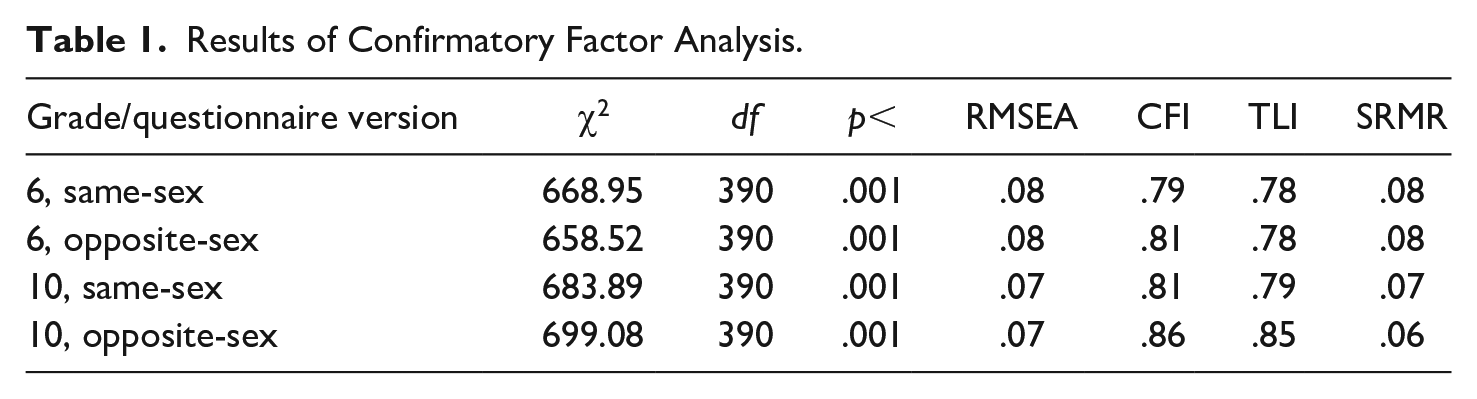
For both age groups (Table 1), the values for the same-sex friend questionnaire variables are close to acceptable, but not for the opposite-sex friend variables. However, the close values of the CFI and TLI at both ages suggest a positive trend and justified not excluding these data from the analysis.
Since the results of the confirmatory factor analysis did not support the theoretical factor structure of the MFQ, exploratory factor analysis (Principal Axis Factoring, eigenvalue greater than 1, factor weight ≥ 0.4) was used (Table 2). As a result, the original six factors were discrete for both age samples and friendship types, however, four of the 30 items (11, 14, 19, and 24) had low factor loadings for each subsample, and two of these (11, 14) strongly impaired the internal consistency of the factor. These items were therefore dropped, leaving 26 items for further analysis. The 26-item Hungarian MFQ has acceptable reliability indicators for both age and friendship type.
Results of Exploratory Factor Analysis.
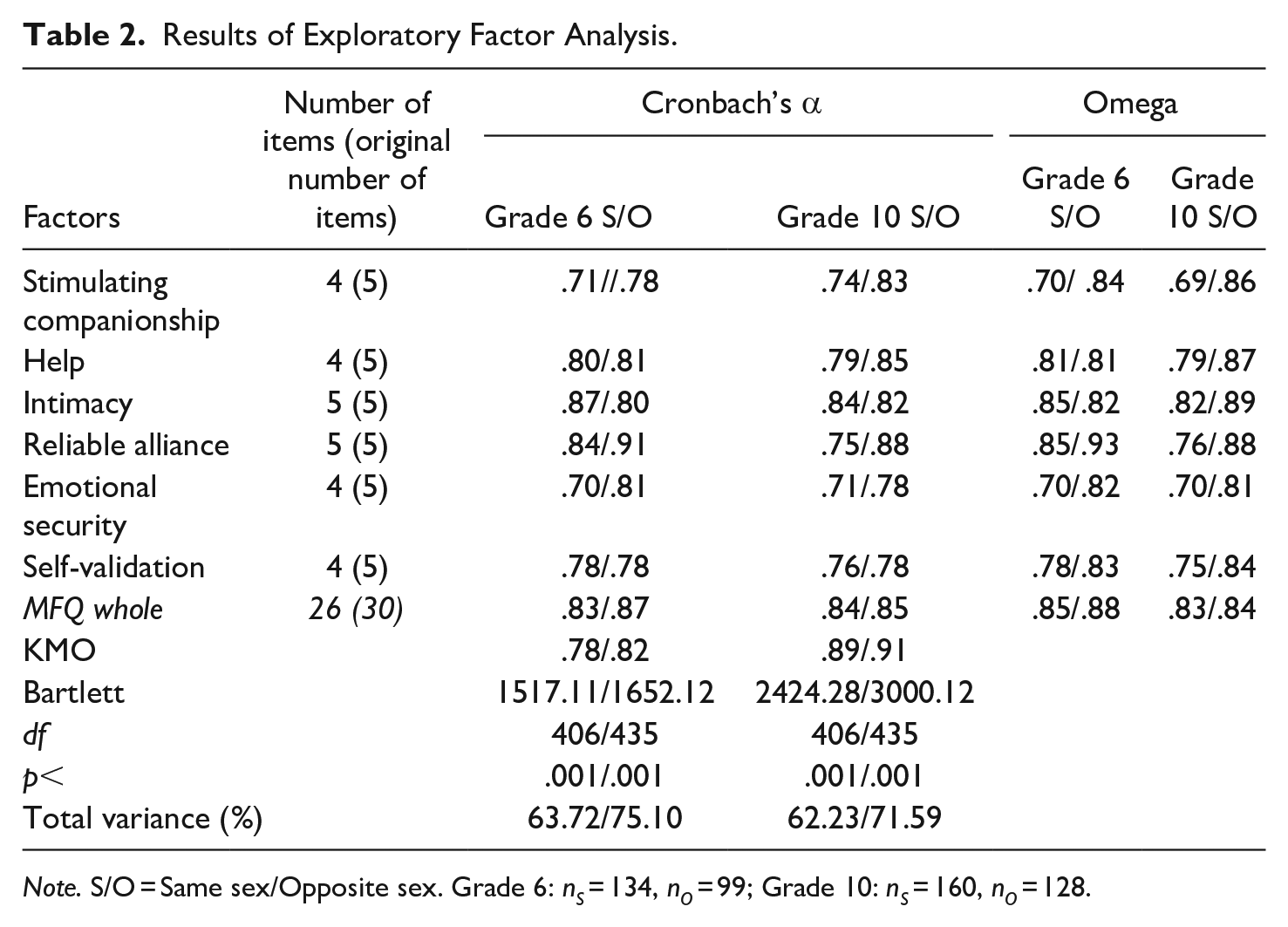
Note. S/O = Same sex/Opposite sex. Grade 6: nS = 134, nO = 99; Grade 10: nS = 160, nO = 128.
Perceptions of Friendship Functions—Age and Gender Differences
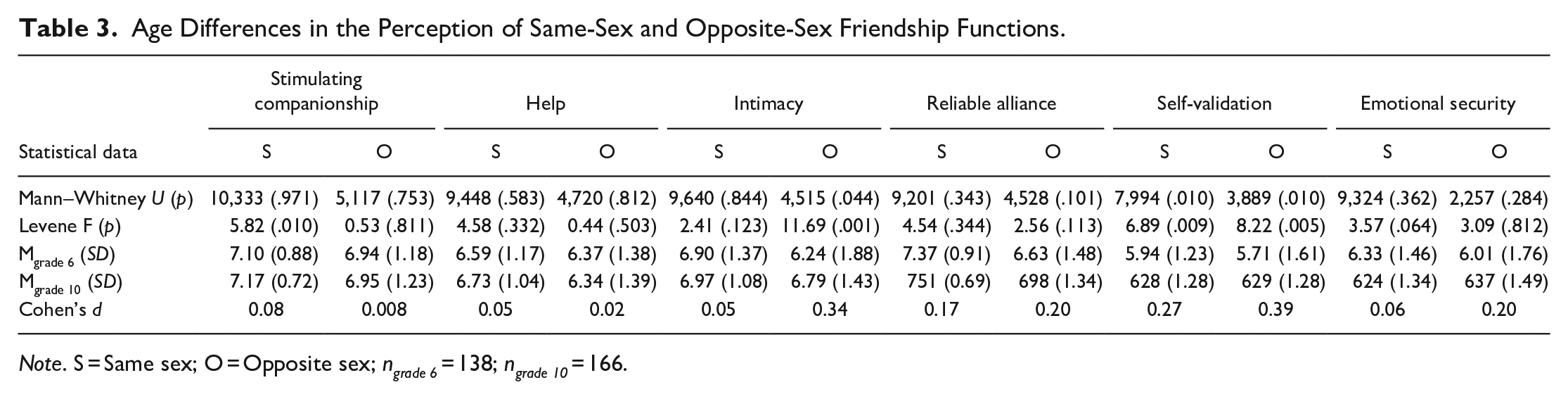
The characteristics of friendship functions were analyzed by age and sex. Based on the results of Kolmogorov-Smirnov test, the sample is not normally distributed, so we used the Mann-Whitney U-test to detect age differences and Cohen’s d to detect effect size (Table 3).
Age Differences in the Perception of Same-Sex and Opposite-Sex Friendship Functions.
Note. S = Same sex; O = Opposite sex; ngrade 6 = 138; ngrade 10 = 166.
Table 3 shows that both same-sex and opposite-sex friends have higher mean scores on the self-validation factor for grade 10 students, this friendship function is considered more important by grade 10 students. In the case of the opposite-sex friend, intimacy is also more prevalent for older people. In all three cases, the Cohen’s d is low (0.27, 0.34, 0.39). The standard deviation values show the extent of individual differences within the subsample: for both same-sex and opposite-sex friendships, the value is higher for younger people for almost all factors.
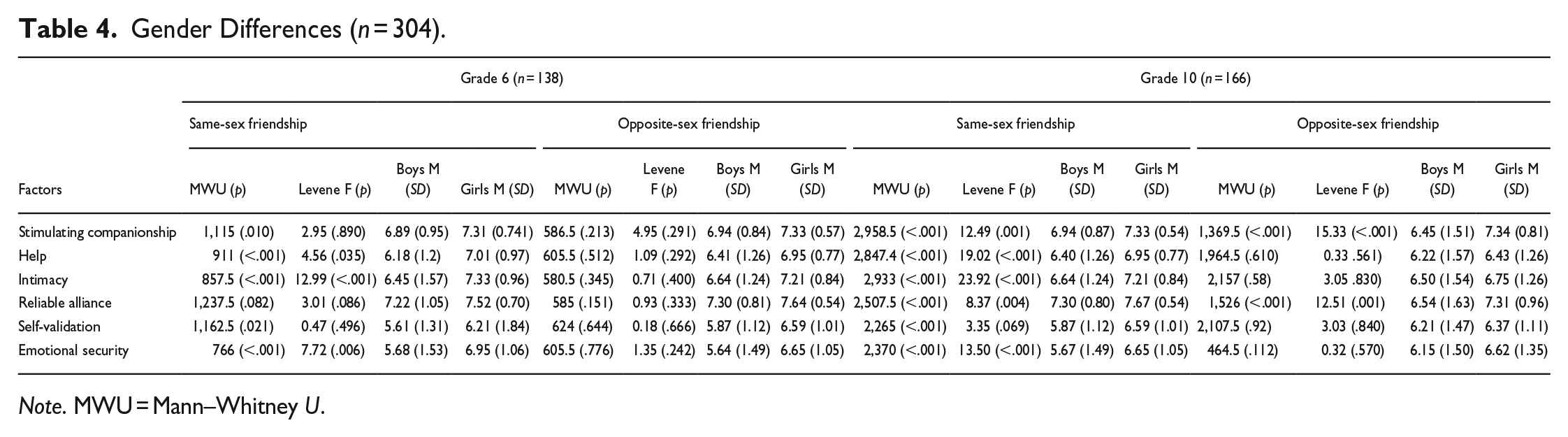
Table 4 shows the results of the Mann-Whitney U-test and the corresponding statistical analyses used to analyze the gender differences by age.
Gender Differences (n = 304).
Note. MWU = Mann–Whitney U.
Table 4 shows that for the same-sex friends in grade 6, there is a significant difference between boys and girls on all factors except reliable alliance, with girls scoring higher. For grade 10, there is a significant difference between boys’ and girls’ scores on all factors and, as with younger children, girls are more likely to rate these friendship functions as important than older children. There is very little difference in the scores for opposite-sex friendship functions among grade 10 students, with only stimulating companionship and reliable alliance being more characteristic of girls. In grade 6, there are no factors for which there is a significant difference in the functional friendship ratings of boys and girls. Since we hypothesized that an interaction effect (one explanatory variable modifies the effect of the other variable, the effect of the latter depending on the value of the former) between age and gender (age × gender) could be identified, we also conducted a GLM analysis. However, no significant results were obtained for either factor, so these data are not reported.
Discussion
The aim of the study was to explore the characteristics of friendship functions among 12 to 13- and 16 to 17-year-olds. In the study the MFQ (Mendelson & Aboud, 2014) was adapted into Hungarian. The research investigated (1) whether the adapted MFQ is applicable at the selected ages and (2) how students describe their relationships with friends of the same and opposite sex, and whether there are significant age and gender differences in their perceptions.
The applicability of MFQ. The first step of adapting the MFQ was carried out, which resulted in the Hungarian version of MFQ with 26 items, and its factors are the same as the original questionnaire. Already during the data collection, which was interrupted by the epidemic, we knew that the sample size sensitive indicators of the confirmatory and exploratory factor analysis would indicate a problem. But sample size may not be the only reason why the confirmatory factor analysis results for the opposite-sex friend variant did not show good model fit. Mendelson and Aboud (1999, 2014), as well as Camirand and Poulin (2019), also point out a drawback of questionnaire-based research on friendship: questionnaires (including the MFQ) are basically designed and constructed to assess the characteristics of same-sex friendships, in a strong tradition of friendship research. This may also be a reason why, in the case of friendships with people of the opposite sex—where more or less different dynamics operate, different functions may predominate and often gradually develop into a love relationship in older people—the questionnaire measures less well, or more precisely, it cannot measure the same as in the case of same-sex friendships. Nevertheless, we did not exclude from the analysis the data on the perception of the opposite-sex friend, which can be interpreted in the light of and within the framework of the characteristics of adolescent friendship that have been identified so far. Mendelson and Aboud (2014) investigated the characteristics of the experience of features among mostly same-sex friends among adolescents and young adults at the time of questionnaire development and subsequently. However, the statistical indicators are not a major concern and, returning to the sample size, it is possible that a larger sample size would provide an adequate model fit. If not, the content of the factors may explain why, for example, in the case of an opposite-sex friend, these statements are less meaningful to adolescents, perhaps not necessarily the ones that are important and determinative.
Perceptions about friendship functions among adolescents. The research did not ask for information on how long the relationship has been going on and at what stage (e.g., recently formed, long-standing, about to break up, experiencing a period of conflict or no conflict), so the characteristics of the friendship functions in the two age groups were not analyzed in detail. Based on previous research (e.g., Mendelson & Aboud, 1999; Selman, 1981), which mainly analyzed the characteristics of same-sex relationships, we hypothesized that there would be no significant difference between the two age groups in the case of trustworthy alliance and self-evaluation of the other, since Mendelson and Aboud’s (2014) research suggests that these two characteristics become very important in friendship from mid-adolescence onward, but a strong foundation is needed. This basis is based on emotional security, intimacy and stimulating peer relationships and their close relationship. Although the age differences found in the present study, with both same-sex and opposite-sex friends showing that recognition is more important for older people and intimacy for opposite-sex friends, suggest that these functions are interdependent, further studies will be needed to analyze and prove this in more detail. The results of the present study suggest that reliable alliance is not, but self-validation is more important for both same-sex and opposite-sex friendships in Year 10, and intimacy is more important for the latter age group. The higher value placed on intimacy in the case of opposite-sex friendships among older children may reflect the idea put forward by Camirand and Poulin (2019) that from mid-adolescence onward, a significant proportion of opposite-sex friendships may develop into love relationships, and that the degree of intimacy plays a very important role in this process.
As for the difference between boys’ and girls’ perceptions, it was hypothesized that the difference would be more pronounced in Year 10, with girls scoring higher, they would be more likely to value these friendship functions. According to Zimmermann (2004), from the age of 13 to 14 years, friendship can provide adolescents with a very strong emotional security and intimacy, which greatly facilitates their commitment to others (thus, the above-mentioned functions are assumed to be interdependent in this process).
Previous research suggests that the need for this is stronger among girls, which may be due to the fact that girls experience them mainly in couples and small groups, while boys prefer larger groups where they are less able or willing to experience them (Zimmermann, 2004). The results of our study show that girls in Year 6 value help, intimacy and emotional security with a same-sex friend more than boys. These functions are fundamental to friendship (Mendelson & Aboud, 2014), and their development depends to a large extent on the social skills of the individual, which have been shown to be more developed in girls in numerous studies both at home and abroad, which may be related to the family-based concept of friendship, as girls’ education emphasizes the development of social and emotional skills, whether consciously or unconsciously, and their behavior is more often evaluated on these basis (Rose et al., 2016; Rose-Krasnor, 1997). For opposite-sex friends, there is no difference in friendship ratings between boys and girls in Year 6. For girls in Year 10, all features except reliable alliance are more characteristic of a same-sex friend, but only reliable alliance and stimulating companionship are more characteristic of an opposite-sex friend.
The results of the present study are useful from both a methodological and a developmental and social psychological point of view. They can serve as a starting point for further studies and as a basis for school development. The results confirm that thinking about and experiencing friendships changes significantly during adolescence and that there are differences in perceptions of these functions between boys and girls. In addition, the data also show that thinking about friendship functions is different for same-sex and different-sex friendships. The characteristics identified are certainly worth taking into account when designing and implementing different social competence school programs (e.g., gender stereotypes, prejudice, cooperation, tolerance, empathy) and should be taken into account in everyday school life, such as when forming groups in educational context.
Limitation
As a result of this research, we have a Hungarian version of the MFQ, whose psychometric indicators are encouraging. Further analysis is needed to make the questionnaire more reliable. Most importantly, it will be necessary to carry out a confirmatory factor analysis in a regular procedure (on a different sample than the one used for the exploratory analysis), which was not possible at this time due to the sudden halt of the data collection procedure caused by the coronavirus epidemic. The age and gender characteristics and their associations identified were not identified in a representative sample, so this will need to be done in the future, and we believe that friendship types and their background characteristics may be a baseline for the sample design.
Conclusion and Future Research
Overall, the questionnaire worked reliably on the Hungarian sample, so we consider it applicable for future domestic research. The Hungarian version is not fully consistent with the original questionnaire, for a number of reasons, such as cultural differences (cultural differences in the interpretation of friendship). Nevertheless, the results on the characteristics of friendship functions, age and gender differences confirm previous (non-Hungarian) research data. The data raise the question of the role of intimacy in the transition from friendship to love, and it may be worth exploring the interdependence and interconnectedness of friendship functions in order to identify which functions can create or help which ones to develop. This would also shed light on the pattern of functions at different stages of adolescence.
Footnotes
Compliance With Ethical Standards
The work has not been published previously and is not under consideration for publication elsewhere. The submitted paper includes the results of our research. The manuscript has been seen and reviewed by all authors. On behalf of all authors, the corresponding author states that there is no conflict of interest. We have parental permits: all children’s parents allowed pedagogical evaluation and they have also verified their participation in the study and the evaluation their children with their signature (based on Hungarian Ethical Norms for Psychologist).
Declaration of Conflicting Interests
The author(s) declared no potential conflicts of interest with respect to the research, authorship, and/or publication of this article.
Funding
The author(s) disclosed receipt of the following financial support for the research, authorship, and/or publication of this article: At the time of writing this paper, László Kasik was holder of János Bolyai Research Fellowship of the Hungarian Academy of Sciences. László Kasik had two projects (ÚNKP/Bolyai+ Research Fellowship of the Ministry of Innovation and Technology; Hungarian Academy of Sciences—University of Szeged School Failure Prevention Research Group, Hungary). The research was supported by the ICT and Societal Challenges Competence Centre of the Humanities and Social Sciences Cluster of the Centre of Excellence for Interdisciplinary Research, Development and Innovation of the University of Szeged. László Kasik and Zita Gál are members of the New Tools and Techniques for Assessing Students Research Group.
