




Abstract
Anxiety disorders have been on the rise among adolescents over the past decade. The COVID-19 pandemic appears to have contributed to this increase, putting further pressure on often already overburdened health systems. Universal prevention programs may offer a potential solution, but few have been evaluated in the context of a pandemic. The objective of this article is to measure the impact of a universal prevention program—the HORS-PISTE program—on several anxiety-related variables in the context of a pandemic. The HORS-PISTE program consists of 10 workshops spread over the two first years of high school, secondary 1 and 2 (grade 7 and 8 equivalent). Workshops are held in a classroom setting and focus on the development of psychosocial skills. The study was conducted in Quebec with 1,202 secondary 1 and 2 students (48.7% girls, 51.3% boys) with an average age of 12.58 years (SD = 0.75). They completed an assessment protocol before and after participating in the HORS-PISTE program in the autumn of 2020. Their answers were subjected to descriptive analysis and multivariate analysis of variance. Results indicate a significant decrease in symptoms for several of the measured variables between the two measurement times, such as those associated with panic disorder, generalized anxiety disorder, and test anxiety. The results also show a decrease in some variables related to the interference of anxiety symptoms and the cognitive and behavioral vulnerabilities targeted by the program. The discussion highlights possible explanations for the results, as well as how universal prevention programs may contribute to the prevention of anxiety during adolescence, especially in a pandemic context.
Introduction
Anxiety in Adolescents and the Impacts of the COVID-19 Pandemic
Anxiety is among the most prevalent mental health problems—diagnosed or self-reported—among adolescents in North America (Merikangas et al., 2010) and its prevalence has been rising over the past decade. In a survey conducted by the Institut de la statistique du Québec (ISQ), 17.2% of high school students in Quebec reported having an anxiety disorder diagnosed by a health professional in 2016 to 2017, whereas this rate was only 9% in 2010 to 2011 (ISQ, 2018). This situation is especially worrisome, given that anxiety can have deleterious effects on students, specifically in the realms of behavior (Bittner et al., 2007; Nepon et al., 2010; Sartor et al., 2007), psychology (Shanahan et al., 2014), relationships (Brumariu et al., 2013), and academics (Nail et al., 2015). In particular, the inability to focus on schoolwork, fall asleep at night, or make friends are impacts of anxiety reported by nearly half of adolescents (Langley et al., 2004). These types of impairments interfere with the performance of tasks critical to normal development and can have long-term or permanent effects (Silverman et al., 2001).
The COVID-19 pandemic and associated public health measures have contributed to the exacerbation of some mental health issues among adolescents. Several studies have identified an increase in symptoms of anxiety and depression (Ellis et al., 2020; Tardif-Grenier et al., 2021). Among the other deleterious effects on adolescent mental health, studies have noted increases in time spent on social media or technology in general and in number of days of alcohol or cannabis use (Ellis et al., 2020; Moore et al., 2020), as well as a decrease in time spent outdoors or engaging in physical activities (Ellis et al., 2020; Moore et al., 2020). Other studies have reported more nuanced effects, highlighting negative consequences in the lives of some adolescents, while also noting the presence of a positive or neutral effect of the pandemic in the lives of others (Cost et al., 2022; Lane et al., 2022).
Some studies have noted that girls are more affected than boys by anxiety symptoms in the pandemic context (Ellis et al., 2020; Lane et al., 2022; Tardif-Grenier et al., 2021) and that these symptoms appear to increase with grade levels (Lane et al., 2022). However, these anxiety-related factors are similar to what was observed prior to the COVID-19 pandemic (ISQ, 2018). Numerous individual factors have been linked to anxiety in adolescents, including low self-esteem (Maldonado et al., 2013; Van Oort et al., 2011), intolerance of uncertainty, negative problem orientation, cognitive avoidance (Gosselin et al., 2007), high perfectionism (Damian et al., 2017; Smith et al., 2018), high problematic Internet use (Dufour et al., 2019), and low self-efficacy (Raknes et al., 2017). Social factors have also been linked to anxiety, including low familial support (Curson et al., 2019), conflictual relations with parents (Shanahan et al., 2008), and overprotectiveness (Ginsburg & Affrunti, 2013).
These studies show the numerous factors associated with anxiety during adolescence and support the importance of considering them to understand the particularities of this mental health problem. They also provide avenues to consider in preventing the emergence of anxiety in adolescents. Some of these factors were investigated during the pandemic and showed similar results. For example, they have found that adolescents presenting high levels of self-efficacy appeared to report fewer symptoms of anxiety and depression in the context of pandemic and confinement and more positive coping strategies for managing negative emotions (Cattelino et al., 2023). Targeting such psychological factors may therefore be relevant to help adolescents in a pandemic context. Indeed, self-efficacy influences many spheres of adolescents’ lives, such as their behavior, perseverance, overall resilience, stress, and perception of themselves (Bandura, 1977). Several studies also supported the fact that self-efficacy is considered as an essential component contributing to adolescent’s overall well-being, as it acts as a psychological mediator in their mental health (Armum & Chellappan, 2016; Muris, 2001).
The Contribution of the School Setting and the Impact of Universal Prevention Programs in the Pandemic Context
The overall increase in mental health problems during the pandemic has put significant pressure on health systems, which were already struggling to meet demand (Hamoda et al., 2021). Adolescents frequently identify the school as a relevant location for promotion, prevention, and early intervention for mental health problems, including anxiety (Werner-Seidler et al., 2017). The school’s role as a place of learning could facilitate students’ acquisition of skills (e.g., managing emotions related to anxiety in the COVID-19 context), in addition to mitigating several impediments related to intervening with youth, such as stigma, transporting them to the intervention site, and cost (Werner-Seidler et al., 2017).
According to Hamoda et al. (2021), one mean of promoting adolescent mental health in this context is the implementation of universal prevention programs. These programs are usually delivered to all individuals regardless of their needs or risk levels in a prevention perspective. In a school setting, they are typically delivered to an entire grade or school (Werner-Seidler et al., 2017). The most frequent theoretical approach is cognitive-bahavioral therapy (CBT), but some programs are based on integrated psychological therapy, wellbeing therapy or mindfulness-based cognitive therapy. They generally produce a significant decrease in anxiety symptoms among adolescents, despite small effect sizes (Feiss et al., 2019; Werner-Seidler et al., 2017). Werner-Seidler et al. (2017) point out, however, that this small effect size might be due, at least in part, to the fact that universal programs target all students, without taking into account their initial anxiety level. The small effect sizes observed could be due to an observable floor effect, that is, a large proportion of students initially having no or few symptoms. It is thus normal that, for these students, participation in the intervention would have little effect.
Even though school-based universal prevention programs have been shown to be beneficial, to date few studies have evaluated their effects in the context of a pandemic (COVID-19 or other). Before the COVID-19 pandemic, some authors pointed out that the implementation of these programs in schools is not simple and has obstacles (Turgeon & Gosselin, 2016), including the fact that they are not implemented systematically (Piché et al., 2017). Considering these issues, some authors suggest that more research is needed to evaluate the implementation of these programs in educational settings (Werner-Seidler et al., 2017).
The pandemic has made it more difficult to implement such programs in schools. Several authors have focused on the adaptations that have been necessary to either implement or transition to online and distance programs (e.g., Gould, 2020; Power & Hanna, 2020), but few have reported evaluation results showing the effects of these initiatives on participating individuals. One program evaluated during the current COVID-19 pandemic is the Royal Melbourne Institute of Technology (RMIT) Together program, which was implemented to support the well-being of university students (Gresham et al., 2021). The intervention addressed several themes related to mental health, such as academic stress, living with isolation and loneliness, and the importance of self-care, compassion, and mindfulness. This content was delivered through online meetings that alternated between theory and practice. The program was evaluated through online surveys completed by 256 people. The results indicated that, for over 80% of students, these meetings allowed them to better understand and take action to improve their well-being, as well as to feel more connected to others.
Also during the COVID-19 pandemic, the Koru Mindfulness intervention was implemented to support the psychological wellbeing of college students (Mirabito & Verhaeghen, 2024). The intervention addressed several themes related to mental health, such as mindfulness, physical activity, worry, mood, anxiety, acceptance and environmental mastery. This content was delivered through online meetings, with an emphasis on practice. The program was evaluated through questionnaires completed before and after the intervention by 111 participants (58 in the experimental group, 53 in a control group). The results showed a diminution of stress and anxiety in college students.
With high school students, the Unified Universal Prevention Program for Diverse Disorders was implanted during the COVID-19 pandemic to help students with their anxiety (Kishida et al., 2023). The intervention addressed several themes related to mental health, such as social skills training, relaxation, exposure, problem-solving and cognitive restructuring. This content was delivered in person, with an emphasis on practice. The program was evaluated using standardized questionnaires measuring emotional and behavioral difficulties, self-efficacy, anxiety, depression and anger. The results showed significant diminution of anxiety and anger in high school students.
Another example is the Playing to Live program, implemented during the Ebola pandemic to help children build healthy relationships, develop skills to manage trauma effectively, and have a safe space to express themselves (Decosimo et al., 2019). To achieve the program’s goals, children were invited to participate in activities that incorporated art, play, and yoga. The program was evaluated using questionnaires on psychological stress symptoms, specifically crying, anger, detachment, worry, eating problems, violence, and bed-wetting. Two program lengths were evaluated: the 3-month program was evaluated with 123 children, and the 5-month program was evaluated with 223 children. Results indicated that, for both intervention durations, the overall score for the seven stress symptoms decreased significantly between T1 and T2.
Thus, the few universal prevention programs evaluated in a pandemic context would appear to support the relevance of using this type of program in the current context. However, the number of studies on the subject is limited, and those that have been conducted present methodological limitations, notably the use of non-standardized data collection instruments, small samples or implementation with volunteers only. This suggests that participants to these programs had a prior need or interest toward them, while universal programs are rather addressed to all people, regardless of their initial symptom level (Werner-Seidler et al., 2017). Most of them were also offered online, or to a limited number of individuals. While the online mode was privileged—or forced—during lockdown periods, it also means that the delivery of these programs was affected, as the authors had to quickly adapt them for this format (Weinberg, 2020). These findings suggest further research is needed to confirm the positive potential of implementing this type of intervention on a large scale and to continue building the body of knowledge. Consequently, implementing and evaluating a program to develop and promote psychosocial skills that are crucial to adolescent health and well-being in several high schools during the COVID-19 pandemic would make it possible to evaluate the potential contribution of universal prevention programs in the context of a pandemic. Psychosocial skills such as self-efficacy, as noted earlier, are therefore relevant here, as it has been shown in previous studies to have positive effects on adolescents’ anxiety symptoms (Armum & Chellappan, 2016; Gaudiano & Herbert, 2007). The objective of this article is to analyze the changes in anxiety symptoms and their correlates in high school students participating in a school-based anxiety prevention program (HORS-PISTE) during the COVID-19 pandemic in Quebec.
The HORS-PISTE Program
The HORS-PISTE program, 1 developed by the RBC Centre of Academic Expertise in Mental Health, aims to develop and foster psychosocial skills that are crucial to the health and well-being of adolescents, notably stress management, self-awareness, communication, and empathy (Luis & Lamboy, 2015). Developing these skills helps preventing anxiety disorders and anxiety-related risk factors. The program also aims to contribute to reducing the incidence of anxiety-related problems, and thereby to lessening the impact of anxiety on students’ lives, especially in the academic, social, and family spheres.
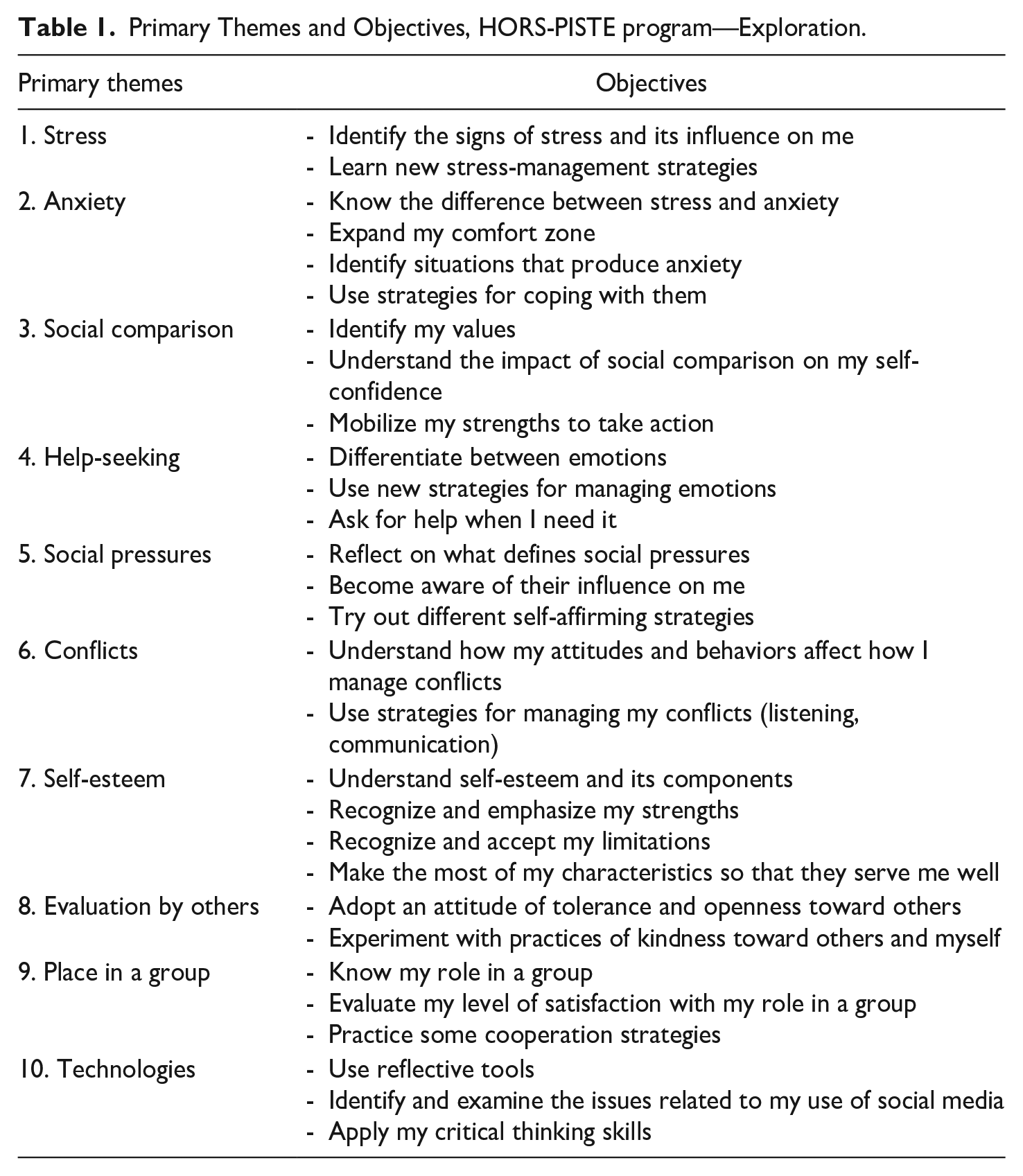
HORS-PISTE—Exploration 2 is a universal prevention program, developed for the first 2 years of high school (grades 7 and 8 in Quebec). It consists of five 60-min workshops for each of these two grades (for a total of 10 workshops, given over two school years), facilitated in classroom groups by teachers or by intervention professionals working in schools or community organizations. These persons have been trained to facilitate the program by members of a program implementation support team set up to assist schools in the roll-out. Workshops are held every 2 weeks and focus on the development of one psychosocial skill using a variety of strategies (e.g., role-playing, group discussions, videos). Table 1 presents the themes and objectives of the workshops offered to students.
Primary Themes and Objectives, HORS-PISTE program—Exploration.
Previous evaluations of the universal prevention component have shown a decrease in symptoms related to various anxiety disorders, as well as reductions in perfectionism, intolerance of uncertainty, cognitive avoidance, and impact of anxiety on school and social life, along with an increase in feelings of self-efficacy (Therriault et al., 2023). The program was implemented in more than 20 high schools during the COVID-19 pandemic, and the objective of the present article is to measure its contribution in the pandemic context to several anxiety-related variables, specifically: (1) anxiety symptoms and interference; (2) cognitive and behavioral vulnerabilities targeted by the program; and 3) associated symptoms and behaviors.
Materials & Methods
Participants and Procedures
The study population was Secondary 1 and 2 students in Quebec. Our convenience sample is composed of 1,202 students (48.7% girls, 51.3% boys 3 ) with an average age of 12.58 years (SD = 0.75). They came from 10 high schools in different regions of Quebec (Estrie, Montérégie, and Mauricie-Centre-du-Québec). The schools were selected on a voluntary basis to participate in the HORS-PISTE program. The participants were from intact families (66.6%), blended families (20.5%), single-parent families (7.1%), and “other” family structures (5.7%). The participants were not asked if they had an anxiety disorder diagnosed by a health professional. The implementation took place in the fall of 2020, between October and December. During this period, private gatherings, and group activities (e.g., sports) were prohibited in Quebec and no vaccine was available (INSPQ, 2021). The students were in school full time despite the pandemic but were required to wear masks in class, so the HORS-PISTE program was delivered in person.
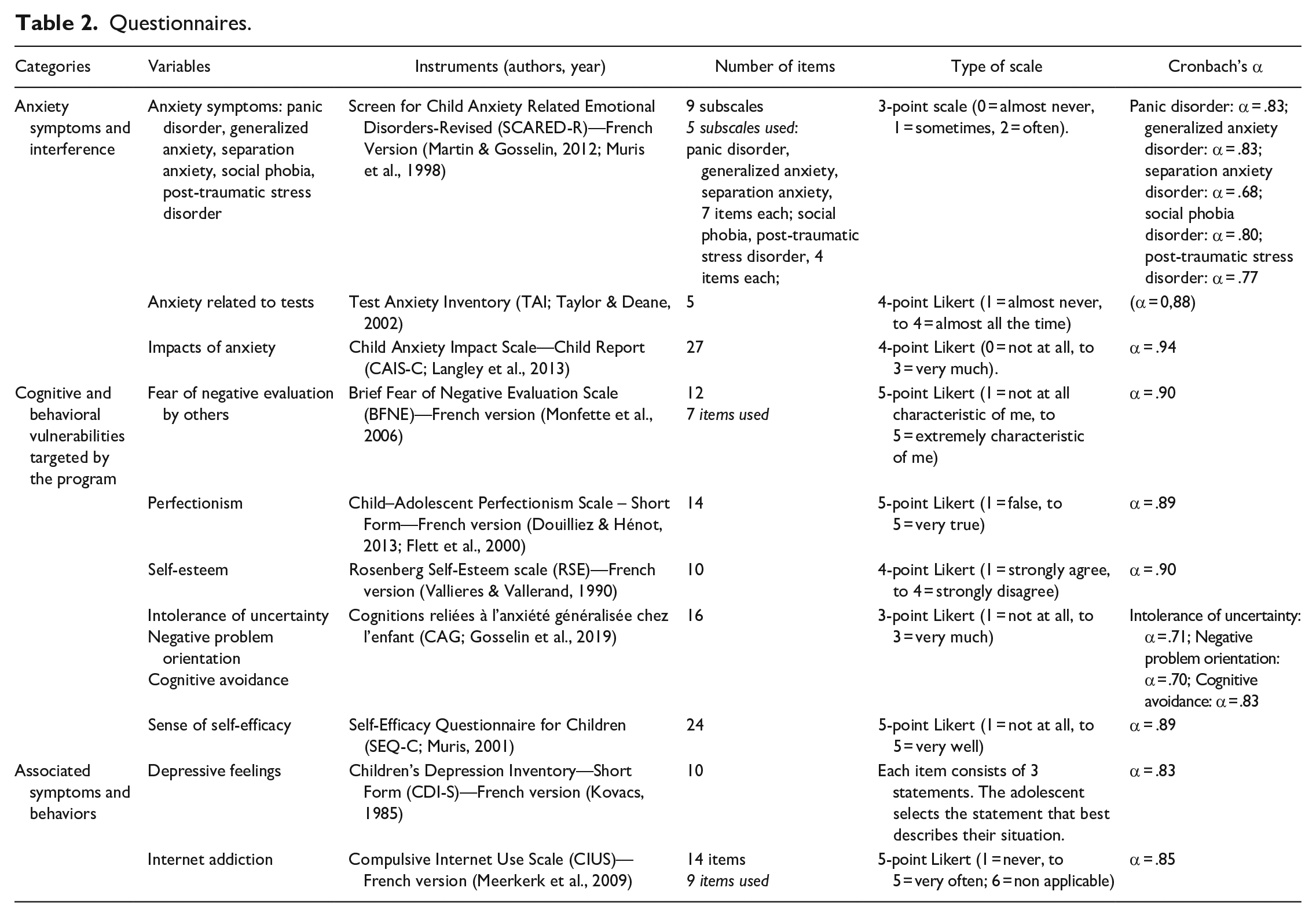
Students were surveyed in the classroom on two occasions, using either a paper-based or online evaluation protocol, depending on schools’ preference, that included several measurement instruments. In both cases, a teacher or facilitator was present to supervise the administration and provide essential instructions. These measured students’ anxiety symptoms, key proximal risk factors for anxiety, the effects of anxiety in their lives, and their sense of self-efficacy. All variables were self-reported. The questionnaires making up the evaluation protocol are presented in Table 2. The two administrations took place within a 12-week time span, before and after the 5 workshops planned for each school level.
Questionnaires.
Parental consent was obtained for students under the age of 14, while those 14 and older were able to consent on their own, as established by the Tri-Council Policy Statement (Government of Canada, 2022). No financial compensation was provided to participants. This project was approved by the Education and Social Sciences Ethics Committee of the Université de Sherbrooke.
Plan of Analysis
All statistical analyses were performed using Statistical Package for Social Sciences (SPSS) v.25 software (IBM). Descriptive statistics were calculated for all variables of interest, for time 1 and time 2 of data collection and for boys and girls. To distinguish differences over time, a multivariate analysis of variance for repeated measures (MANOVA)—followed by ANOVAs—was conducted with each variable of interest: panic disorder, generalized anxiety, separation anxiety, social phobia, post-traumatic stress disorder, test anxiety, fear of negative evaluation, perfectionism, depressive feelings, self-esteem, problematic internet use, intolerance of uncertainty, negative problem orientation, cognitive avoidance, impact of anxiety on school, social, and daily activities, and sense of academic, social, and emotional self-efficacy. The obsessive-compulsive disorder scale was not included in the analyses because of its poor internal consistency. Gender and time effects were included in the model as main effects, as well as the time*gender interaction effect, to examine whether boys and girls progressed differently between the two measurement times. The Wilks’ lambda statistical test was used to verify that significant differences were observed between groups and across time.
Results
Table 3 presents descriptive statistics related to the different variables, as measured for boys and girls before and after their participation in the HORS-PISTE program. For all variables, higher scores indicate higher levels of the variables measured. The matrix of Pearson correlations between all variables for T1 (above diagonal) and T2 (below diagonal) is presented in Appendice A (see Supplemental Material).
Descriptive Statistics at T1 and T2.
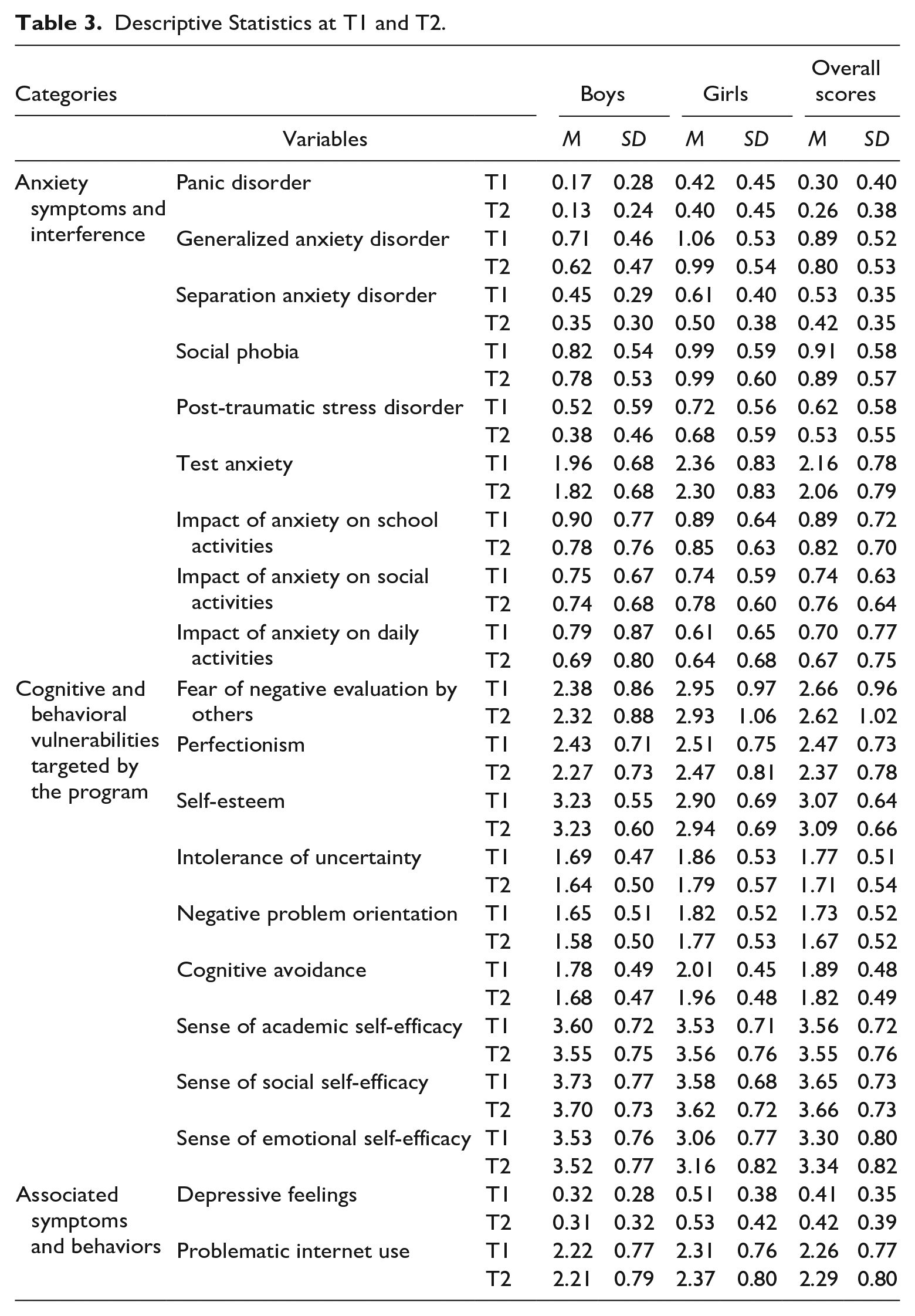
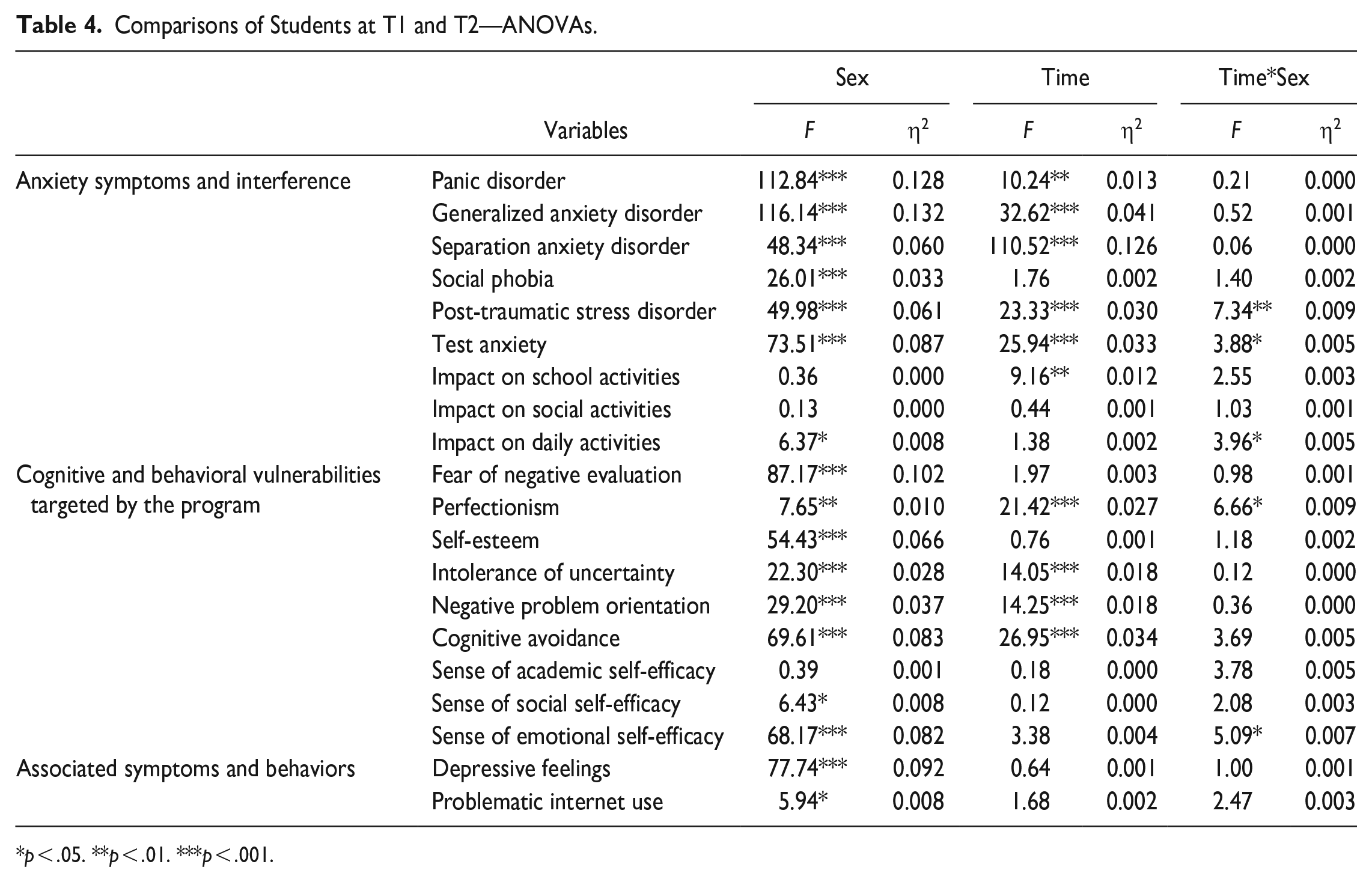
Table 4 presents the results of the repeated measures MANOVA for sex and time effects as well as for the time*sex interaction effect for the variables of interest examined. The Wilks’ lambda test showed significant effects for sex (F = 15.86, p < .001, η2 = 0.30), time (F = 9.08, p < .001, η2 = 0.20), and time*sex interaction (F = 1.85, p = .013, η2 = 0.05).
Comparisons of Students at T1 and T2—ANOVAs.
p < .05. **p < .01. ***p < .001.
Examination of univariate sex effects showed that boys and girls reported significantly different scores on the different evaluations for the majority of the variables of interest, in all three categories. In fact, boys reported lower scores than girls for all the anxiety symptoms examined at T1 (panic disorder; F = 112.84, p < .001; generalized anxiety disorder; F = 116.14, p < .001; separation anxiety disorder; F = 48.34, p < .001; social phobia; F = 26.01, p < .001; post-traumatic stress disorder; F = 49.98, p < .001; test anxiety; F = 73.51, p < .001), but a higher score on one type of interference, that is, the impact on daily activities (F = 6.37, p < .05). Boys also reported lower scores than girls on the majority of the cognitive and behavioral vulnerability variables targeted by the program (fear of negative evaluation; F = 87.17, p < .001; perfectionism; F = 7.65, p < .01; intolerance of uncertainty; F = 22.30, p < .001; negative problem orientation; F = 29.20, p < .001; cognitive avoidance; F = 69.61, p < .001) and higher scores on positive cognitive and behavioral variables (self-esteem; F = 54.43, p < .001; sense of social [F = 6.43, p < .05] and emotional [F = 6.43, p < .05] self-efficacy), with the exception of academic self-efficacy, where no difference is observed. Boys also reported lower scores on symptoms and behaviors associated with anxiety (feelings of depression; F = 77.74, p < .001; internet use; F = 5.94, p < .05).
In terms of changes between T1 and T2, examination of the univariate time effects showed several significant differences between data collected before and after participation in the HORS-PISTE program, particularly in the categories of anxiety symptoms and interference, and cognitive and behavioral vulnerabilities targeted by the program. The results indicated a significant decrease in symptoms of panic disorder (F = 10.24, p < .01), generalized anxiety disorder (F = 32.62, p < .001), separation anxiety disorder (F = 110.52, p < .001), and post-traumatic stress disorder (F = 23.33, p < .001). The results also showed a significant decrease in test anxiety (F = 25.94, p < .001), perfectionism (F = 21.42, p < .001), intolerance of uncertainty (F = 14.05, p < .001), negative problem orientation (F = 14.25, p < .001), cognitive avoidance (F = 26.95, p < .001), and the impact of anxiety on school activities (F = 9.16, p < .01).
The significant time*sex interactions showed that boys reported more pronounced decreases than girls on different variables in the categories of anxiety symptoms and interference, and cognitive and behavioral vulnerabilities targeted by the program. The significant variables in this regard were symptoms of post-traumatic stress disorder (F = 7.34, p < .01), test anxiety (F = 3.88, p < .05), and perfectionism (F = 6.66, p < .05). Boys also reported a more marked decrease than girls in the impact of anxiety on daily activities (F = 3.96, p < .05). Finally, girls reported greater improvement in their sense of emotional self-efficacy (F = 5.09, p < .05) between T1 and T2, compared to boys.
Discussion
Research shows the implementation of universal prevention programs in schools presents obstacles (Turgeon & Gosselin, 2016) and the pandemic has made it more difficult. However, this study demonstrates the relevance of implementing such programs in this context. The results showed that students’ participation in a universal prevention program in the pandemic context notably led to a significant decrease in symptoms associated with panic disorder, generalized anxiety disorder, separation anxiety disorder, post-traumatic stress disorder, and test anxiety. These findings are supported by other studies conducted in the pandemic context (Decosimo et al., 2019; Gresham et al., 2021; Mirabito & Verhaeghen, 2024). They are also supported by the results shown in an evaluation of the program carried out before the pandemic that suggest that the program contributes to a positive change regarding the anxiety and depression symptoms, as well as key proximal risk factors, as Therriault et al. (2023) showed.
Potential Explanations for the Findings
For all significant variables, the observed effect sizes over time were small, which is typically observed in universal prevention programs targeting anxiety (Werner-Seidler et al., 2017). Students with low anxiety also participate in these types of programs, which may weaken the effect size. Nonetheless, several studies have pointed out that, despite small effect sizes, universal prevention programs can contribute to the development of life skills that can benefit students for the rest of their lives (Feiss et al., 2019; Werner-Seidler et al., 2017). The smaller effect size might also be due to the fact that the public health measures implemented in the fall of 2020 gradually became more restrictive over the following months (INSPQ, 2021), which may have contributed to an escalation in youth anxiety symptoms, in tandem with the decrease observed before and after participation in the HORS-PISTE program.
In a pandemic context, where symptoms of anxiety and depression are on the rise (Ellis et al., 2020; Tardif-Grenier et al., 2021), participation in this type of program may be particularly beneficial for students, whether or not they suffer from anxiety. In addition to the observed decrease in several variables associated with the different anxiety disorders, the results also indicated a decrease in some variables related to the interference of anxiety symptoms (impact of anxiety on school activities among girls and boys, impact of anxiety on daily activities among boys) and to the cognitive and behavioral vulnerabilities targeted by the program (emotional self-efficacy among girls).
For the variables post-traumatic stress disorder, test anxiety, and perfectionism, boys showed a more marked decrease than girls between T1 and T2. Two possible explanations can be proposed to explain these results. First, this might be due to the protective effect of boys’ self-esteem and sense of social and emotional self-efficacy at T1, which were higher than those of girls. Indeed, Cattelino et al. (2023) found that adolescents presenting a high level of self-efficacy appeared to report fewer anxiety and depressive symptoms. This finding is consistent with one of Muris’s study in 2001, where he explains that a low self-efficacy could indicate future potential anxiety disorders. However, it has been noted that we should be careful with this interpretation, since we don’t know the sense of this relationship; we don’t know if it is a low self-efficacy that led to an increase of anxiety symptoms or the contrary (Bandura et al., 2003). These results might also be explained by the fact that girls already appeared more precarious at T1 than boys for most of the variables measured. These results, combined with the fact that girls appeared to have been more affected than boys by the pandemic context (Ellis et al., 2020; Lane et al., 2022; Tardif-Grenier et al., 2021), could explain why the girls were less receptive to the program than usual.
Finally, we propose that these positive changes can also be explained in part by the program’s design process, which was carried out to make sure the HORS-PISTE program aligns with the needs and contexts of young people and schools. This innovative process, supported by implementation science, was designed to create optimal conditions for the adoption, sustainability and scaling-up of the program in several schools (Lane et al., in press). In addition, right from the start of the program’s design work, we carefully elaborated the program’s theory to ensure that the action model (the program’s various components) and its change model specified the changes expected, both proximally and distally (Tougas et al., 2021). These upstream actions certainly go some way toward explaining the positive changes this program seems to be bringing about.
Implications, Strengths, and Limitations of the Study
One strength of the study is that it highlights the potential contribution of universal anxiety prevention programs in the context of a pandemic that may have long-term effects on adolescent mental health. This supports Hamoda et al.’s (2021) suggestion that the use of such programs may be beneficial, given that the rise in mental health issues over the course of the pandemic—which may persist—puts a strain on health systems.
The many variables addressed at T1 and T2 were measured using instruments with good or acceptable psychometric qualities, which gives the study good validity. In addition, measuring a large number of variables—and grouping them into different categories—provides a clearer picture of which ones are most affected by program participation, and thus a more comprehensive assessment of the effects of the HORS-PISTE program on students. This picture can then be used to better develop and adapt universal anxiety prevention programs for high school students in a pandemic context.
However, the results must be considered in light of certain limitations. First, all of the data collected is self-reported. It would also have been interesting to ask the participants if they had an existing anxiety diagnosis, though the questionnaire does measure their anxiety levels during T1 and T2. Also, the lack of a control group, despite efforts made during school recruitment, limits the scope of effects observed at pre- and post-testing, as it is not possible to compare them to results that would have been obtained from students who did not participate in the program. The pandemic context did not allow for collection of data from control groups, as schools were reluctant to collaborate in this type of project due to the workload involved in adapting to constantly changing public health measures. Finally, the pandemic context and its volatility complicate the understanding of the program efficacity, as some variables specific to this context could not be measured.
Relevance to the Practice of School Psychology
This article highlights the importance of preventing anxiety in adolescents, particularly in an exceptional situation such as the COVID-19 pandemic. Implementation of the HORS-PISTE program in this context—and in a school setting—seems to have had positive effects on the anxiety felt by the students. Therefore, it may be relevant to explore early intervention programs to see how they can contribute to sustain good mental health in adolescents, in a pandemic context or not. As health systems worldwide are struggling—and were struggling even before the pandemic—universal prevention programs in schools appear to be an interesting way to promote adolescents’ mental health. The HORS-PISTE program is one of the programs that could be used in that sense and the results show that school is indeed a relevant environment for universal prevention of anxiety, as it removes the need for screening, minimizes risks of stigma as no students are singled out, and includes participants that do not have symptoms, but could develop some in the future (Werner-Seidler et al., 2017). This universal prevention program could also be used by school mental health professionals to identify students experiencing more anxiety and offer them targeted intervention.
Supplemental Material
sj-docx-1-cjs-10.1177_08295735241240672 – Supplemental material for Changes in Anxiety Symptoms and Their Correlates in Adolescents Participating in a School-Based Anxiety Prevention Program During the COVID-19 Pandemic
Supplemental material, sj-docx-1-cjs-10.1177_08295735241240672 for Changes in Anxiety Symptoms and Their Correlates in Adolescents Participating in a School-Based Anxiety Prevention Program During the COVID-19 Pandemic by Audrey Dupuis, Danyka Therriault, Julie Lane, Jonathan Smith, Patrick Gosselin, Martin Drapeau, Eliane Saint-Pierre Mousset, Pascale Morin, Isabelle Thibault, Magali Dufour, Chantal Viscogliosi and Félix Berrigan in Canadian Journal of School Psychology
Footnotes
Declaration of Conflicting Interests
The author(s) declared no potential conflicts of interest with respect to the research, authorship, and/or publication of this article.
Funding
The author(s) disclosed receipt of the following financial support for the research, authorship, and/or publication of this article: This research was made possible through the financial support of the Public Health Agency of Canada’s Mental Health Promotion Innovation Fund and the Réseau universitaire intégré de santé et de services sociaux de l’Université de Sherbrooke (RUISSS).
Ethical Statement
All ethical guidelines were followed as required for conducting human research.
This article has not been published and is not currently being considered for publication elsewhere.

Supplemental Material
Supplemental material for this article is available online.
Notes
Author Biographies
References
Supplementary Material
Please find the following supplemental material available below.
For Open Access articles published under a Creative Commons License, all supplemental material carries the same license as the article it is associated with.
For non-Open Access articles published, all supplemental material carries a non-exclusive license, and permission requests for re-use of supplemental material or any part of supplemental material shall be sent directly to the copyright owner as specified in the copyright notice associated with the article.
