




Abstract
This study investigated the contribution of fine and gross motor skills to academic and attentional performance at school entry among 832 boys and girls. Children were tested on their fine and gross motor skills (locomotor, object control) and their academic performance in receptive vocabulary, number knowledge, and attentional skills at 6 to 7 years old. Results from ordinary least square models adjusted for family income, maternal education attainment, and early cognitive skills at 41 to 48 months revealed that fine motor skills significantly predicted receptive vocabulary, number knowledge, and attention skills. The associations between fine motor skills with receptive vocabulary and attention were stronger for girls than boys. Better performance in locomotor also significantly predicted higher levels of receptive vocabulary while object control was positively associated with attentional skills among girls only. Children with better motor abilities, especially fine motor skills, are more likely to be successful in the areas requiring language, numeracy, and attentional skills. Thus, motor skills should be a focus of interest for increasing academic and attentional skills level at school entry, particularly in girls.
Keywords
Children’s motor skills reflecting the sequences of movements that produce smooth and efficient action have been linked to academic performance and social behaviors in elementary school (Grissmer et al., 2010; Pagani et al., 2010; Van Der Horst et al., 2007). Gross motor skills, referring to the body’s core muscles, pertain to locomotor, balance, posture, and coordination (e.g., jumping, walking), and have been associated with complex skills related to playground activities, physical fitness, and sports (Viegas et al., 2021). Previous studies have shown that child gross motor skills are strongly associated with physical well-being, activities of daily living (e.g., putting on shoes and pants) and engagement in sports and social activities (Cameron et al., 2016; Houwen et al., 2007). Fine motor skills, which is related to the coordination of small muscle movements in hands, fingers, and thumbs are also critical for children to develop manual dexterity for proper pencil grip, drawing, writing, and playing an instrument (van der Fels et al., 2015). Fine motor skills are particularly associated with emergent literacy (i.e., emergent writing and letter knowledge) and numeracy skills, such as writing letters and numbers or solving numerical problems (Cameron et al., 2016; Case-Smith, 2000; Grissmer et al., 2010a; Øksendal et al., 2022).
Although correlated, gross and fine motor skills make distinct contributions to learning and academic outcomes (Gonzalez et al., 2019). These distinct associations are possibly related to separate interactions of fine and gross motor skills with different cognitive processing. Well-developed motor abilities facilitate the development of language and numeracy skills by increasing children’s opportunities to interact with their physical and social environment (Houwen et al., 2016). Neurological perspectives suggest that motor-cognitive coupling, which involves the activation of overlapping brain areas during the performance of motor and cognitive tasks, could explain the co-occurrence of motor and cognitive proficiency. For instance, the prefrontal cortex, a brain area involved in various cognitive functions (e.g., working memory, executive function), is activated during a locomotor task, a component of gross motor skills (Al-Yahya et al., 2019). In contrast, the cerebellum, which is known to regulate both fine and gross motor movement, is also activated during verbal fluency task (Diamond, 2000). Moreover, certain fine motor skills (e.g., drawing a line while listening to the teacher) are also strongly associated with cognitive functions such as visuospatial organization, attention, and executive function (Cameron et al., 2016). Executive functions help children plan, evaluate, and revise their motor behaviors, while attention makes children focus and fully engaged with the task. This, in turn, accelerates the learning process related to the fine motor task and eventually increases children’s attentional span.
Differences between boys and girls in performing gross and fine motor tasks could also contribute to distinct predictions and variations in academic performance (Junaid & Fellowes, 2006; Kokštejn et al., 2017). One longitudinal study showed that 3 to 5 years old girls performed better than boys in fine (i.e., manual dexterity) and gross motor skills (i.e., aiming/catching, balance), but that boys outperformed girls by age six in both manual dexterity and aiming/catching (Kokštejn et al., 2017). The significant sex-based difference was also reported in the gross motor learning process. Girls had more significant gain, retention, and automaticity than boys while practicing maintaining balance at the age of 8 (Schedler et al., 2020). Differences in attentional behaviors could explain these differences between boys and girls in gross motor skills. Girls were more focused during the balance test, while boys had more distracting behaviors, such as turning their heads to look around while balancing or asking questions to the experimenter (Schedler et al., 2020). Elementary school-aged girls and boys also differ in their ability to use visuospatial organization (Newhouse et al., 2007), and showed distinct performance in multi-digit number comparison tasks (Räsänen et al., 2021). Boys aged 8 to 10 years showed superior performance in spatial learning and memory compared to girls, as evidenced by shorter latencies and stronger preferences to find a hidden platform in a virtual water maze (Newhouse et al., 2007).
In the current study, we investigated the relationships between fine and gross motor skills (object control, locomotor) and academic performance (receptive vocabulary, number knowledge, attentional skills) at school entry as a function of the child’s sex. One methodological limitation of prior studies examining these associations is that they did not control for core cognitive and academic-related abilities prior to school entry (Fischer et al., 2018; Gonzalez et al., 2019). Controlling for these initial abilities is important to strengthen existing evidence that fine and gross motor skills are genuinely related to academic performance at school entry. This study overcomes this limitation by statistically controlling for early vocabulary, numeracy, and visuospatial skills. We also accounted for key demographic characteristics such as the family income and the mother’s educational attainment. Furthermore, this study extended previous findings by disentangling which dimensions of gross motor skills (e.g., object control, locomotor) associated with later academic performance, and by examining if the sex of the child moderates the associations between motor skills and later academic performance. The latter is crucially important to apply distinctive strategies for improving the academic performance of boys and girls when deemed necessary. At last, this study also advances knowledge by focusing on the academic performance at school entry, a developmental period when most children make important strides in learning how to read, write, and develop numeracy skills.
Materials and Methods
Study Design and Participants
Data are from the Quebec Longitudinal Study of Child Development (QLSCD), a birth cohort of children followed longitudinally from 5 months of age onward. Participating families were randomly selected from the Québec live birth registry between 1997 and 1998 in Quebec (Canada). The children born on Cri and Inuit territories, on Indian reservations, or in the Northern region of Québec were excluded (2.1% of children in the birth registry). Babies born before 24 weeks or after 42 weeks of gestation (0.1%) and those with unknown gestational age (1.3%) were excluded. The initial sample included2,940 singleton children. Informed consent was provided by2,675 parents (verbal consent through a phone call), and2,120 signed the informed consent form. Ethics approval was obtained from the Direction Santé Québec of the Institut de la Statistique du Québec and the Faculty of Medicine of the Université de Montréal (Rouquette et al., 2014).
This article describes the findings of 832 children (52% female) with available data on motor skills at school entry and academic outcomes in Grade 1 (N varying between 709 and 826 depending on the measures; age: M = 7.08, SD = 0.25). The proportion of missing data on outcome variables ranged from 0.6% to 14.5%. Missing data were examined with the MVA module in SPSS. According to Little’s missing completely at random (MCAR) test, children with available motor skills data did not differ from those without these data concerning household income, maternal education, attentional skills, and number knowledge. However, children in our analytical sample had higher receptive vocabulary levels than those missing on this variable (χ2 = 31.65, df = 16, p = .011). A series of t-tests revealed that children whose locomotor and object control scores were missing tended to have a lower score in receptive vocabulary ([t = 2.2, p = .026] and [t = 2.1, p = .035], respectively). In order to reduce the effect of bias due to sample attrition and to maintain statistical power (Cummings, 2013), we conducted multiple imputations using SPSS. Results represent pooled estimates over five estimated imputed data sets.
Measures and Procedure
Table 1 provides details of the measures and psychometric properties for predictors and outcomes. Data were collected through structured interviews in the home of children. The interviews were conducted with the person most knowledgeable about the child (the mother in 98% of cases). During the home visit, trained research assistants conducted direct assessments of motor skills, the receptive vocabulary, number knowledge, and visuospatial organization. The attentional skills of the children were measured with a questionnaire completed by the child’s teacher.
Children’s Predictors and Outcomes and Child’s Age at Assessment.
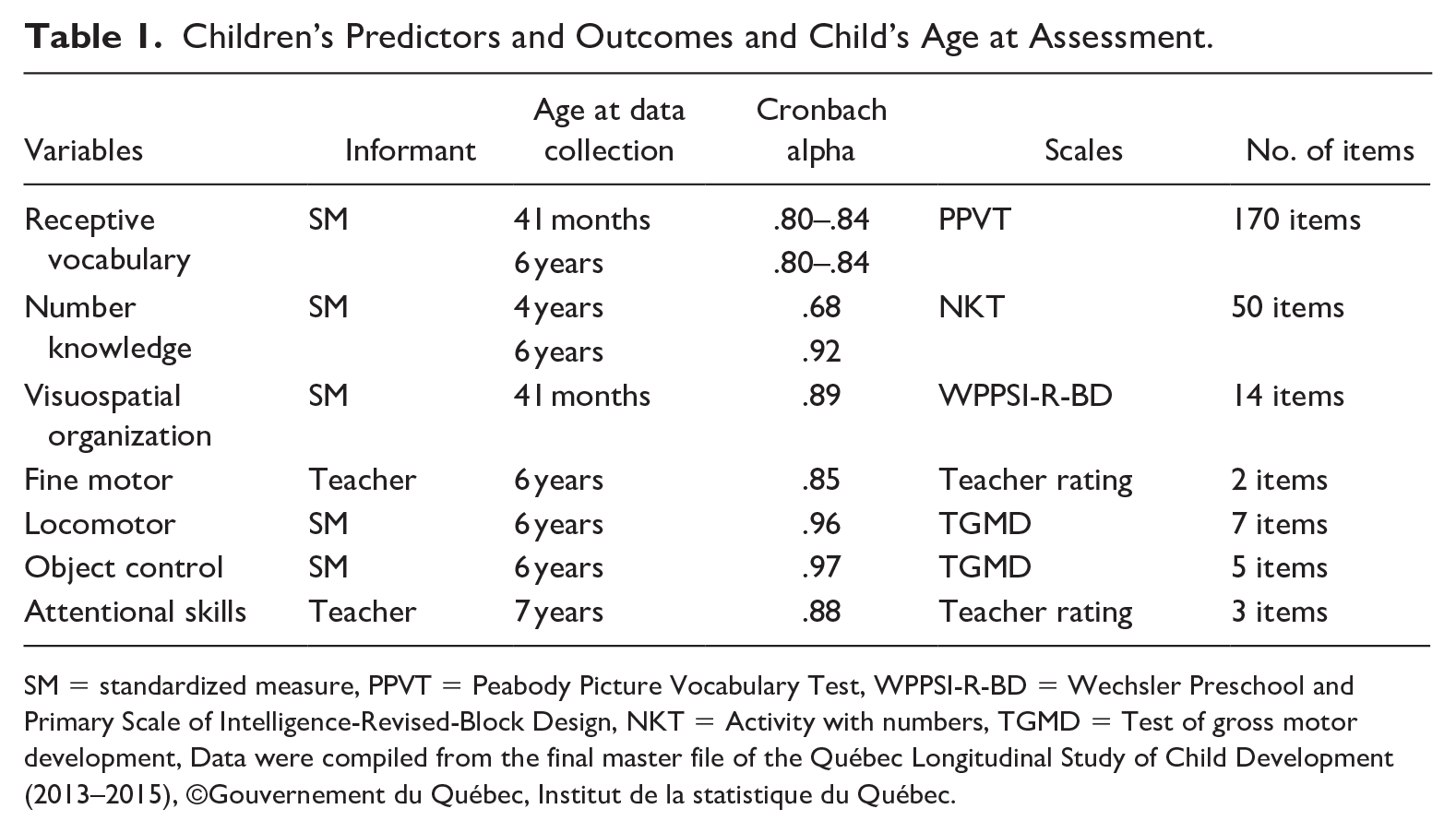
SM = standardized measure, PPVT = Peabody Picture Vocabulary Test, WPPSI-R-BD = Wechsler Preschool and Primary Scale of Intelligence-Revised-Block Design, NKT = Activity with numbers, TGMD = Test of gross motor development, Data were compiled from the final master file of the Québec Longitudinal Study of Child Development (2013–2015), ©Gouvernement du Québec, Institut de la statistique du Québec.
Motor Skills
Teacher ratings of the child’s assessed fine motor skills included (1) proficiency at holding a pen, crayons, and a brush; and (2) their ability to manipulate objects (r = .85). Items were rated on a five-point scale ranging from very poor (1) to excellent (5). Locomotor and object control were directly assessed using the performance-based Test of Gross Motor Development (TGMD) (Ulrich, 2013). This test evaluates 12 gross motor skills that were frequently taught to children in preschool and early elementary school. The locomotor subtest measures the performance in running, galloping, hopping, leaping, horizontal jumping, skipping, and sliding. The object control subtest measures the performance of two-hand striking, stationary bouncing, catching, kicking, and overhand throwing. The age equivalent score of locomotors for 6 years old is 36 to 37 for both girls and boys, and the age equivalent object control score for 6 years old is 30 for girls and 35 for boys (Ulrich, 2013).
Academic Outcomes
Children’s receptive vocabulary was evaluated with the Peabody Picture Vocabulary Test-Third Edition (Dunn, 2007; Dunn et al., 1965). This standardized language test measures phonological recognition and semantic understanding of words upon hearing them. It includes 170 test items increasing in difficulty. Each item consists of an illustration representing a word. Participants had to select the picture best representing the meaning of the word prompted by the examiner.
Numeracy was measured with the Number Knowledge Test (Okamoto et al., 1996). This test consists of a total of 50 items which are arranged in four levels. Level 0 measures the child’s ability to count and quantify small sets of objects when concrete objects are available and can be touched and manipulated. Levels 1, 2, and 3 assess children’s knowledge of the number sequence and the ability to handle simple arithmetic problems. The test stops if the child makes three consecutive errors. The total score across levels was computed by summing the number of points the child received across all test levels.
Attentional skills were calculated as the sum of three items (listening carefully, being easily distracted, and being an inattentive child) reported by teachers on a 3-point scale going from one (never) to three (always). The three items were highly correlated (Cronbach alpha = .88, Correlation coefficient = .70-74).
Covariates
The family income and the educational attainment of the mothers when the child was 5 months old were dichotomized as follows: income = 0 (if < 30K/year) and income = 1 (if 30 K or higher per year), and educational attainment = 0 (if high school diploma or lower) and =1 (if a college or higher level of the diploma). The receptive vocabulary (mean age = 3.4 years) was measured with the PPVT, the number knowledge (mean age = 4.1 years) was measured with the NKT, and the visuospatial organization (mean age = 3.4 years) was measured with the Block design subset of Wechsler Preschool and Primary Scale of Intelligence—Revised (WPPSI-R) (Buckhalt, 1990) were also controlled in the analyses.
Data Analysis
The normality of the data was inspected visually through a histogram and QQ plot. The collinearities among independent variables were tested with Variance Inflation Factor (VIF). The VIF value for each predictor was lower than two, indicating no collinearity (Vatcheva et al., 2016). First, t-tests were performed for each variable to estimate the average difference between boys and girls aged six or seven. Second, three hierarchical regression models were conducted to predict each academic outcome (receptive vocabulary, number knowledge, and attentional skills) from fine motor skills, locomotor, and object control. These models controlled for the sex of the child, family income, educational attainment, preschool receptive vocabulary, number knowledge, and visuospatial organization. Third, we also estimated sex-based effects on the association between motor skills and academic-related outcomes by computing interactions between the sex of the child with each motor skill. These interaction terms were tested one at a time in the regression models, using the macro-PROCESS for SPSS. Prior to analyses, each model was inspected visually for linearity and heteroscedasticity. All the analyses were done through SPSS statistical (version 25) software.
Results
Table 2 shows the descriptive statistics for all variables (original and imputed data) by sex. Girls had higher scores in fine motor skills and locomotor than boys (p < .001), while boys outperformed girls in object control (p < .001). Girls also had greater attentional skills than boys (p < .01). No significant differences on average were found between girls and boys on their levels of receptive vocabulary and number knowledge at age six. Pearson correlations between variables were provided in Supplemental Material, Table S1.
The Mean and Standard Deviation or Frequency Distribution (n, %) of the Original and Imputed Variables by Sex.
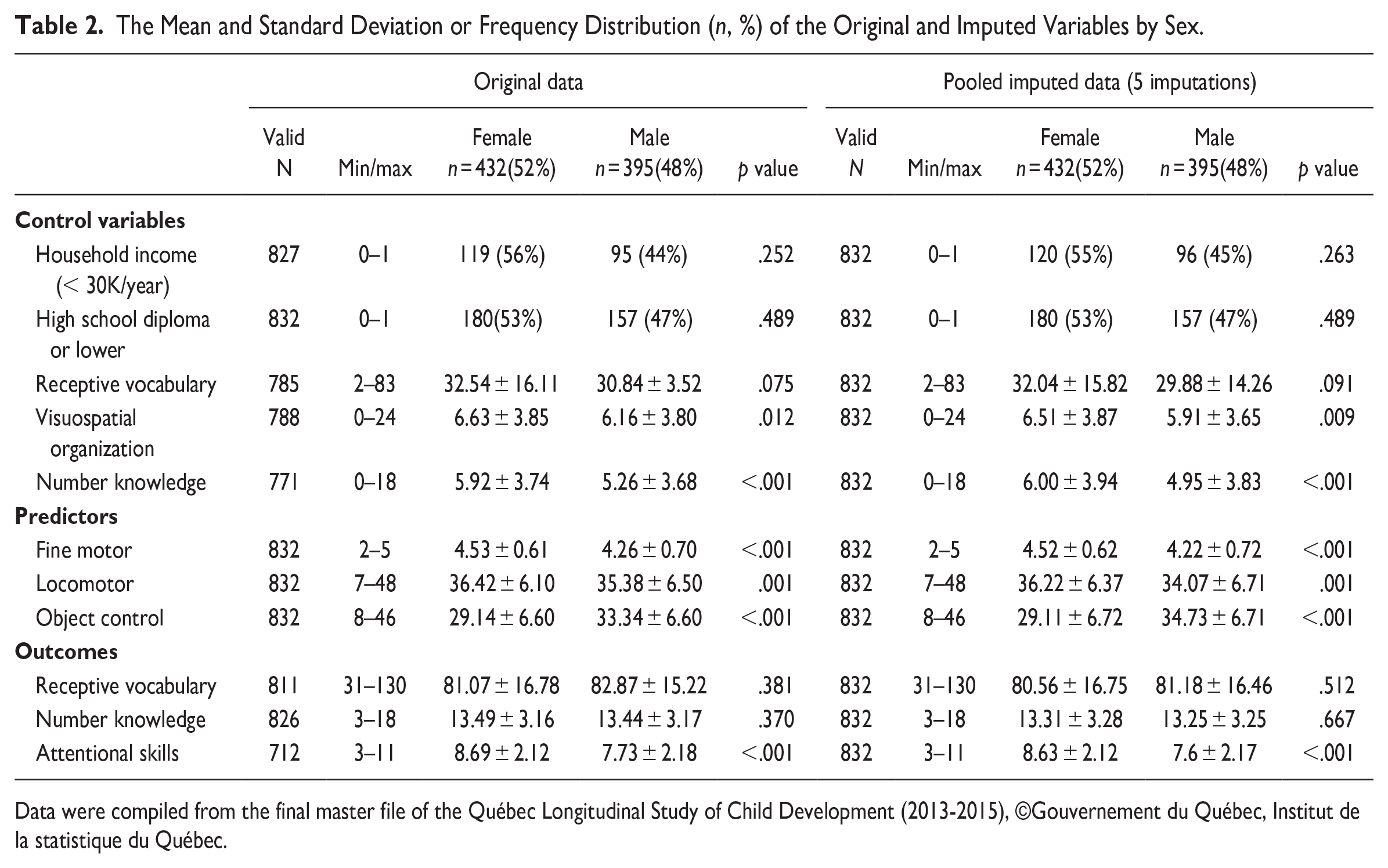
Data were compiled from the final master file of the Québec Longitudinal Study of Child Development (2013-2015), ©Gouvernement du Québec, Institut de la statistique du Québec.
Associations Between Motor Skills and Receptive Vocabulary
Results from the hierarchical regression model are shown in Table 3. Fine motor skills (β = 2.54, p = .001) and locomotor performance (β = .22, p = .009) significantly predicted receptive vocabulary, suggesting that improvements in these skills contribute to higher receptive vocabulary scores. Object control, however, did not significantly predict receptive vocabulary. Although significant, the regression model revealed that fine and gross motor skills explained only 3.0% of the variation in receptive vocabulary (p < .001), once controlling for early vocabulary, numeracy, visuospatial organization, family income, and maternal education. One significant interaction, depicted in Figure 1, revealed that the association between fine motor skills and receptive vocabulary was stronger for girls than boys. No other significant interaction was found in the prediction of receptive vocabulary.
Predicting the Relationship Between Motor Skills and School-Related Cognitive Functions by Sex.
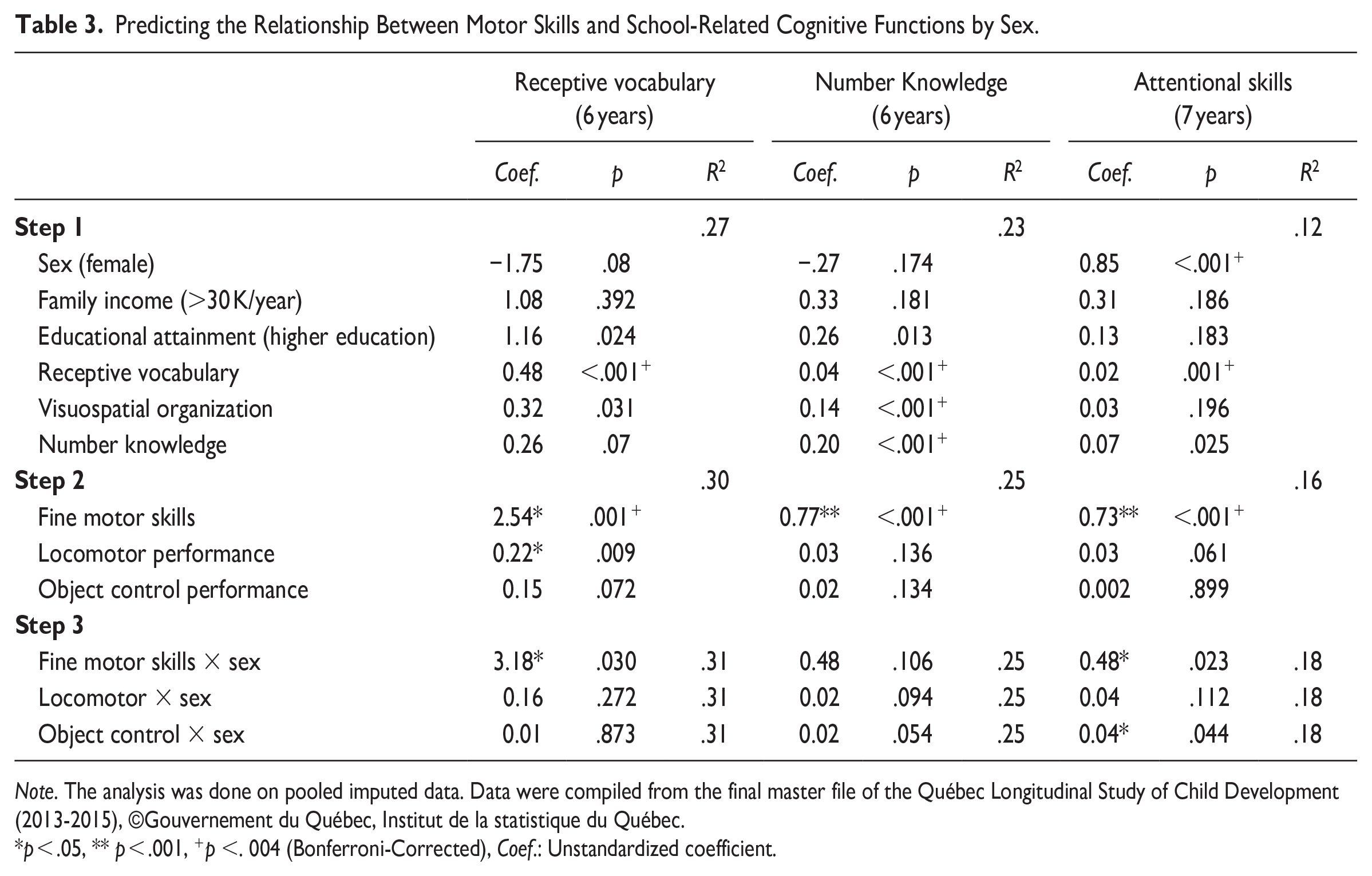
Note. The analysis was done on pooled imputed data. Data were compiled from the final master file of the Québec Longitudinal Study of Child Development (2013-2015), ©Gouvernement du Québec, Institut de la statistique du Québec.
p < .05, ** p < .001, +p <. 004 (Bonferroni-Corrected), Coef.: Unstandardized coefficient.
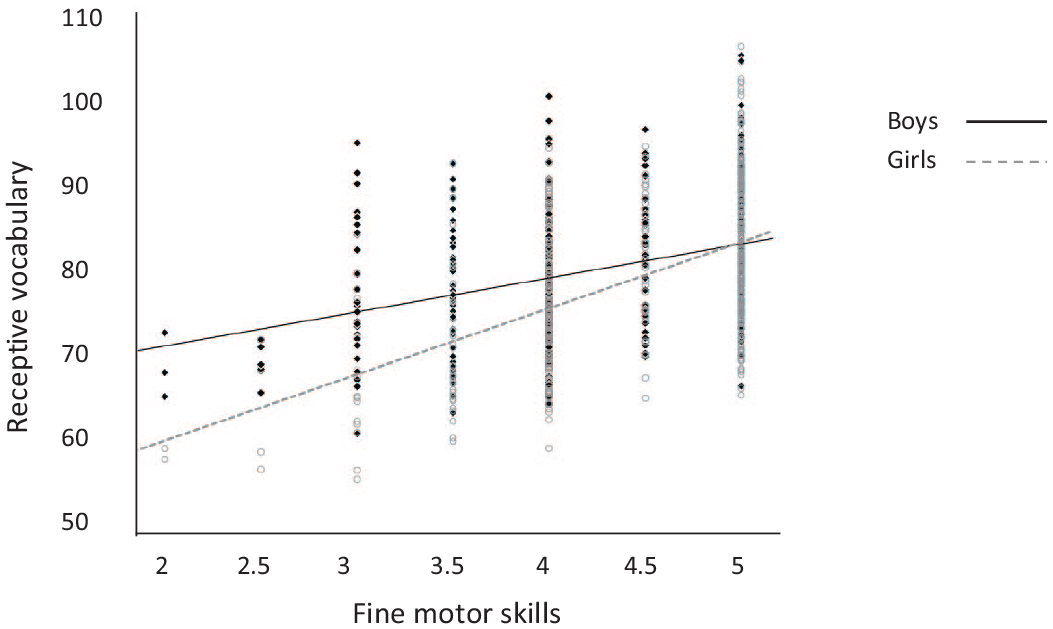
The relationship between fine motor skills and receptive vocabulary by sex.
Associations Between Motor Skills and Numeracy
As shown in Table 3, fine motor skills significantly predicted the number knowledge scores (β = .77, p < .001). This was not the case for locomotor and object control skills, where no significant associations were found with number knowledge. Fine motor skills explained 2.0% of the variation in number knowledge (p < .001). No significant interactions between sex and motor skills were uncovered in the prediction of child numeracy skills.
Associations Between Motor and Attentional Skills
Fine motor skills were positively associated with later attention skills (β = .73, p < .001). Locomotor and object control, however, did not significantly predict attentional skills. Fine motor skills uniquely explained 4.0% of the variance in attentional skills (p < .001). As shown in Figure 2, fine motor skills were more strongly associated with attentional skills in girls than in boys. An interaction between the sex of the child and object control also revealed that object control was significantly linked to attentional skills in girls but not in boys (Figure 3).
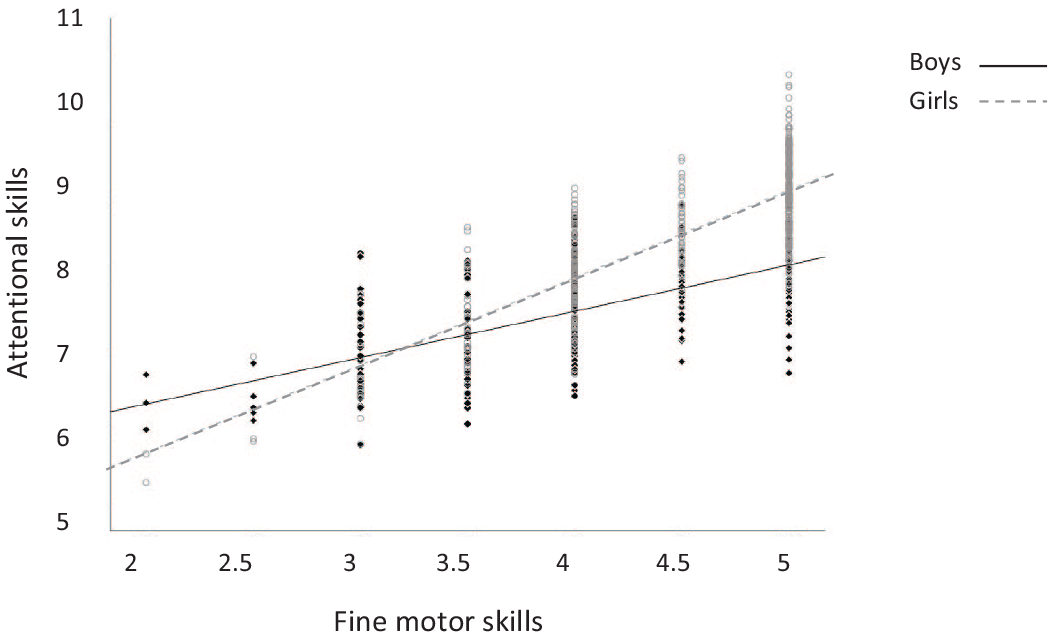
The relationship between fine motor skills and attention by sex.
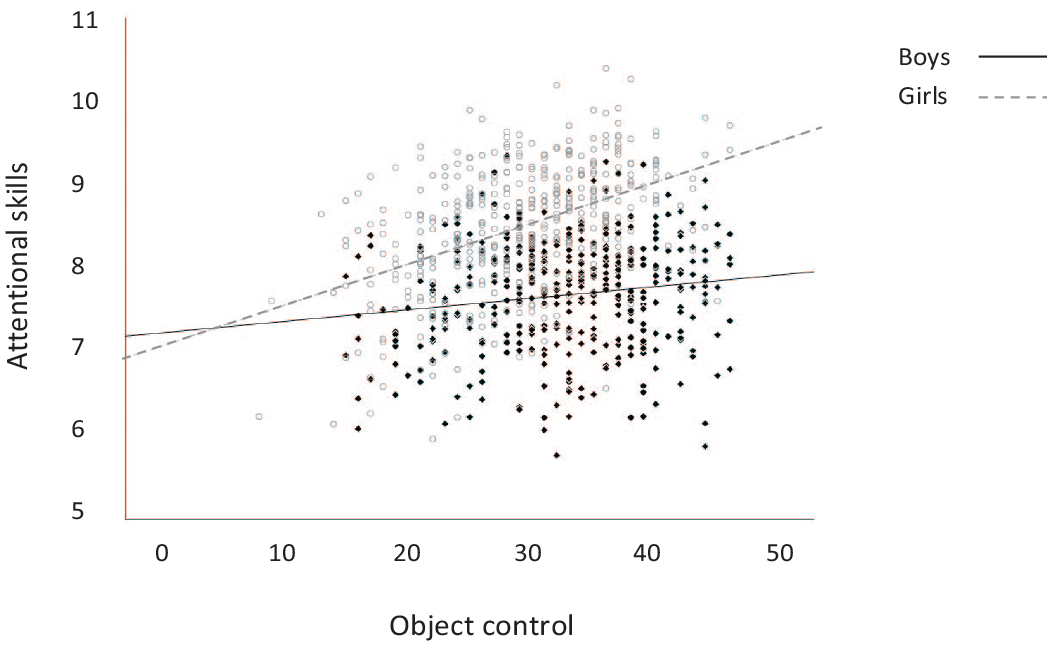
The relationship between object control and attention by sex.
To limit possible Type 1 error, we also reported findings once adjusted for Bonferroni correction (p < .004), in Table 3. Fine motor skills were still significantly associated with receptive vocabulary, number knowledge, and attentional skills (p < .001), but the interaction between sex and fine motor skills were not significantly related to any of the outcomes after adjusted for Bonferroni correction (p > .004).
Discussion
This study replicated and extended some prior findings supporting how motor skills contribute to academic performance at school entry. These associations were unconfounded by earlier preschool cognitive abilities, family income, and the educational attainment of mothers. As expected, fine motor skills showed a stronger association with academic performance than gross motor skills. An increase in fine motor skills was associated with higher performance in receptive vocabulary, number knowledge, and attentional skills. These associations with receptive vocabulary and attentional skills were stronger in girls than boys.
A considerable proportion of time (46%) is devoted to fine motor activities in a kindergarten classroom, including activities related to teaching letters and numbers to preschool children (Marr et al., 2003). This learning typically occurs through activities requiring cutting, placing, marking, pasting letters, using manipulatives to do mathematics, or clapping their hands to learn syllables. The acquisition of shapes and numbers is also commonly practiced at school via activities that involve fine motor skills, such as cutting out shapes or building blocks (Pitchford et al., 2016). Since fine motor skills are prominent in these activities, children with better fine motor skills are likely to experience an advantage in learning letters and numbers, in turn, contributing to receptive vocabulary, and number knowledge (Pitchford et al., 2016). In addition, children’s ability to move their fingers (e.g., finger counting) may also help them build mental representations of numbers (Fischer et al., 2018).
Fine motor skills also predicted better attentional skills during school activities, especially for girls. One randomized-controlled trial (RCT) study found that girls assigned to 15 min per day of fine motor activity, such as using a tweezer, tongs, or spoons to manipulate various objects for 6 months, significantly improving their attention skills (Stewart et al., 2007). For boys, increased fine motor activity was associated with decreased attention span (Stewart et al., 2007). One possible explanation for this finding is that fine motor activities might be less appealing for boys than girls, which may lead boys to disengage their attention during these activities. Meanwhile, it is important to note that this study did not indicate strong evidence for the role of sex in the association between fine motor skill and child’s attentional and academic performance. Thus, the finding of this study needs to be supported with further evidence.
Evidence also suggests that fine motor and attentional skills might be developmentally interlocked (Sobe, 2004; Stewart et al., 2007). Fine motor and attention skills are highly correlated across childhood, and the relationships between the two skills are believed to be bidirectional (Top, 2023). It is argued that when children execute an enjoyable fine motor task, they fully engage and focus their attention during the task. They also want to repeat the task over and over again, making them to sustain their attention for a long period (Stewart et al., 2007). Alternatively, an inverse association is also possible whereby better attention skills may underly children’s performance on fine motor tasks. Previous studies conducted on children with attention deficit hyperactivity disorders (ADHD) consistently show that they underperform in fine and gross motor tasks when compared to non-ADHD children (Flapper et al., 2006; Piek et al., 2004). Future studies should disentangle the direction of the association within a longitudinal framework.
Our findings also revealed that gross motor skills contributed to attentional skills and receptive vocabulary. The higher score in the object control subtest was associated with better attentional skills, but only for girls. Most of the girls in this study scored at their age-appropriate level at the object control subtest, while most boys performed lower than expected. Thus, it might be that girls have already improved their attentional skills by reaching their maturity at object control, while boys are still improving their attentional skills.
The child’s locomotor skills were also significantly related to later receptive vocabulary. This result parallels the findings of another study, showing that children’s abilities in sitting were significantly associated with their performance in receptive vocabulary (Gonzalez et al., 2019). One potential explanation for this association is that locomotion provides children with increased opportunities to interact with their social and physical environments (Anderson et al., 2013). At school entry, gross motor skills play a significant role in peer interaction by allowing children to participate in group games and sports (Westendorp et al., 2011). Over time, these peer interactions benefit child communication and language skills. Locomotor skills also allow children to experience various visual, auditory, proprioceptive, and linguistic input that contribute to language development (Oudgenoeg-Paz et al., 2012). For instance, a child with highly developed locomotor skills is more likely to interact with new objects and places and receive inputs from surrounding people (e.g., do not climb up the stairs, you might fall, or this is a scooter). Though, future research is needed to uncover the mechanisms explaining the association between locomotor and academic performance.
Practice Implication in School Psychology
This study has several implications for clinical practices. Despite the small but significant associations (explaining 2% – 4%), our study suggests fine motor skills as one potential way to improve children’s academic outcomes in school setting. For instance, when improving fine motor skills from poor to excellence on fine motor skill scale, children experience one standard deviation change in number knowledge and attentional skills. This means that children with high motor skills (above 1 SD from the mean) is more likely to reach the 84th percentile (Wang & Chen, 2012) on the number knowledge and attentional scales. Thus, improving fine motor skills might be one way to cross one major percentile line and ultimately, to improve attentional skills and number knowledge during early school years. In contrast, children with low motor skills (below 1 SD from the mean) are more likely to struggle in terms of academic performance.
For these children, improving fine motor skills could be one way to improve child learning potential. Both cognitive and motor function activate similar brain areas including frontal lobes, cerebellum, and basal ganglia (Leisman et al., 2016). Activating these areas through fine motor activities could improve child ability to solve problem, facilitate executive function, decision making, and judgment (Leisman et al., 2016), also linked to academic performance (Willoughby et al., 2019). Another way to enhance fine motor skills and thus, academic performance, is through collaboration between school-based occupational therapists and teachers. Recent research and guidelines (e.g., Partnering for Change) suggests that collaboration between occupational therapists and teachers help children improve their motor skills (Boudreault & Lessard, 2020; Wilson & Harris, 2018).
Despite these new insights, results should be interpreted with caution. In the current study, fine motor skills were measured with a questionnaire, using only two items, rather than a performance-based test. Also, both predictors (motor skills) and outcomes (number knowledge and receptive vocabulary) were measured at concurrent time-point, limiting our ability to ascertain the direction of the effects. To overcome this limitation, we controlled for prior receptive vocabulary, number knowledge, and visuospatial organization, strengthen existing evidence that fine and gross motor skills are genuinely related to academic performance at school entry. Moreover, this study did not take into account other variables contributing to both motor skills and academic performance, such as brain processing regions for both academic and motor skills, environmental factors (e.g., school environment), and social factors (e.g., having siblings). Despite these limitations, our study provides robust findings likely to inform school-based clinicians and educators about the role of fine motor skills in academic performance.
Supplemental Material
sj-docx-1-cjs-110.1177_08295735231173518 – Supplemental material for Motor Skills are More Strongly Associated to Academic Performance for Girls Than Boys
Supplemental material, sj-docx-1-cjs-110.1177_08295735231173518 for Motor Skills are More Strongly Associated to Academic Performance for Girls Than Boys by Eda Cinar, Caroline Fitzpatrick, Maíra Lopes Almeida, Chantal Camden and Gabrielle Garon-Carrier in Canadian Journal of School Psychology
Footnotes
Declaration of Conflicting Interests
The author(s) declared no potential conflicts of interest with respect to the research, authorship, and/or publication of this article.
Funding
The author(s) disclosed receipt of the following financial support for the research, authorship, and/or publication of this article: The Québec Longitudinal Study of Child Development was supported by funding from the ministère de la Santé et des Services sociaux, le ministère de la Famille, le ministère de l’Éducation et de l’Enseignement supérieur, the Lucie and André Chagnon Foundation, the Institut de recherche Robert-Sauvé en santé et en sécurité du travail, the Research Center of the Sainte-Justine University Hospital, the ministère du Travail, de l’Emploi et de la Solidarité sociale and the Institut de la statistique du Québec.

Supplemental Material
Supplemental material for this article is available online.
Author Biographies
References
Supplementary Material
Please find the following supplemental material available below.
For Open Access articles published under a Creative Commons License, all supplemental material carries the same license as the article it is associated with.
For non-Open Access articles published, all supplemental material carries a non-exclusive license, and permission requests for re-use of supplemental material or any part of supplemental material shall be sent directly to the copyright owner as specified in the copyright notice associated with the article.
