



Abstract
The relationship between Emotional Intelligence (EI) and numerous positive outcomes has sparked considerable interest from educators and researchers in training and promoting various emotional and social competencies in youth. The present study evaluated the effectiveness of a new school-based program for elementary school students designed to develop various EI-related competencies in children—the “Umbrella Project.” Five hundred and twenty-nine students (44% boys) who attended six schools in the Waterloo, Ontario area, completed a self-report measure of EI before and after participating in the unique training program. Total EI and a majority of EI subscales showed significant improvement from pretest to post test. Girls also showed higher total EI and interpersonal scores regardless of assessment session. The results are very encouraging and suggest regular classroom-based resources and curriculum activities can foster the development of a cross-section of emotional and social competencies.
Collectively known as emotional intelligence (EI), emotional and social competencies such as the ability to identify, understand, express, and regulate emotions are increasingly recognized as important aspects of positive lifespan development, linked to successful performance, resilience, and wellbeing (Keefer et al., 2018). Individuals who possess a better developed repertoire of EI-related competencies tend to experience less stress and higher quality interpersonal relationships, achieve higher academic and occupational attainment, and suffer from fewer mental and physical health problems (Malouff et al., 2014; O’Boyle et al., 2011; Perera & DiGiacomo, 2013). Given the growing evidence that EI-related competencies significantly contribute to both educational and occupational performance, it is hardly surprising that there has been widespread implementation of psychoeducational programming to enhance these competencies in school-aged children (Durlak et al., 2011; Schutte et al., 2013; Taylor et al., 2017).
Background on EI
EI has been broadly defined as a range of competencies related to identifying, understanding, expressing, and managing emotions in the self and others (Keefer et al., 2013). EI theory suggests that being highly skilled and feeling self-control over one’s own motivation, behavior, and social environment should enhance problem solving and goal achievement. Over the past two decades, EI has generated consistent empirical support for its positive link with well-being, occupational success, academic achievement, and health outcomes (Keefer et al., 2013; Malouff et al., 2014; O’Boyle et al., 2011; Perera & DiGiacomo, 2013).
Within the broader EI literature, there is a fundamental distinction between specific models of EI (Petrides & Furnham, 2001). Namely, ability EI, which belongs to the domain of intelligence and is evaluated through maximum performance tests that measure actual abilities, and trait EI, which belongs to the domain of personality and is evaluated through self-report measures that assess typical behavior. Despite these distinctions however, all EI models posit that individuals low in EI manifest difficulties in the accurate appraisal and expression of emotions, in the effective regulation of emotional experiences, and in the ability to use feelings to guide behavior (Parker et al., 2001). One of the most widely used trait EI models within the EI literature is the Bar-On model (Bar-On & Parker, 2000). This multidimensional model of trait EI consists of four overlapping dimensions: Intrapersonal (involving abilities related to recognizing and understanding one’s own emotions), Interpersonal (involving abilities related to recognizing and understanding others’ emotions), Adaptability (abilities related to adjusting one’s emotions and behaviors to changing situations), and Stress Management (abilities related to resisting or delaying impulses) (Bar-On, 1997, 2000).
Teaching EI
As noted earlier, developing and promoting EI-related competencies in school aged children has been found to facilitate academic learning and offers an essential support to the educational mission of most schools (Zins et al., 2007). Teaching children core EI competencies fosters academic learning by increasing students’ feelings of safety, motivation, attentiveness, and engagement in their schoolwork (Zins et al., 2007). Intervention programs have been developed largely under two approaches, either targeting specific at-risk populations or universally providing programming to all children in a specific school (Taylor et al., 2017). The later approach, sometimes referred to as the “whole school approach” (Oberle et al., 2016), attempts to make the teaching and development of various emotional and social competencies a core goal of school staff, parents, and children.
Among educators and researchers, there is growing consensus that whole school approaches have a number of positive advantages compared to programs that target sub-groups of children (Greenberg et al., 2003). Along with maximizing the impacts to the broadest number of children, whole school approaches are less expensive compared to targeted programs (Greenberg et al., 2017). These programs do not need specialized resources and/or services to identify at-risk youth, and consequently do not need to exclude children who are not currently experiencing emotion-related problems.
Gaps in the Intervention Literature
Although many psychoeducational programs have been created to develop and promote EI-related competencies (Durlak et al., 2011; Schutte et al., 2013; Taylor et al., 2017), empirical data is often lacking with respect to whether, and by how much, these programs improve the targeted competencies (Zeidner et al., 2012). Psychoeducational programs are often not connected to established conceptual models of EI and are vague regarding the specific EI-related competencies being developed. Moreover, studies often lack the use of reliable and valid assessment tools to allow for targeted competencies to be properly monitored for improvement (Humphrey et al., 2007; Parker et al., 2009; Zeidner et al., 2002). Many intervention studies also lack details on how specific competencies were trained. For instance, Durlak et al. (2011) have identified numerous programs targeting EI-related competencies where there were no training guides or manuals available for review. This lack of clarity regarding how interventions are conducted constitutes a considerable problem in the current literature as it prevents greater understanding and evaluation of what kinds of programs are effective in producing positive change in EI-related competencies.
Present Study
The present study extends previous work on psychoeducational programming for EI-related competencies by addressing some of the previously mentioned research gaps. More specifically, we sought to evaluate the effectiveness of the Umbrella Project, a relatively new 6-month intervention program designed by Forristal (2017) to develop and enhance a specific cross section of EI competencies explicitly linked to the Bar-On model of EI (Bar-On, 1997, 2000). The present study examined a range of EI competencies before and after the program was implemented in a large sample of elementary school students (grades 3 to 8), across several schools within the Waterloo, Ontario area. To evaluate the impact of the program, we used the short form of the Emotional Quotient Inventory—Youth Version (EQ-i:YV-S), a well-validated measure of EI linked to the Bar-On model (Bar-On & Parker, 2000), to assess core EI competencies. One of the unique features of the Umbrella Project is that it uses school-based resources (i.e., programming taught by regular teachers in their home classrooms), rather than depending on unique resources that need to be brought into specific schools.
Based on previous research on the effectiveness of similar programs using a whole school approach (Greenberg et al., 2017), we predicted that students would report significant increases in EI competencies following the end of the program. However, given many inconsistencies regarding gender differences in the effectiveness of EI-related intervention programs (Rowe & Trickett, 2018) and the need for more studies to consider differences in program effectiveness across grades, schools, and school boards (Durlak et al., 2011), we also explored the moderating effects of gender, grade, school, and school board in our analyses.
Method
Participants
The sample consisted of 529 students (231 boys, 290 girls, and 8 students who did not report a gender) attending six schools in the Waterloo Regional District School Board and the Waterloo Catholic District School Board. All students participated in the Umbrella Project during the 2018 to 2019 academic year. Only students who completed an EI measure before and after the EI-related program (Time 1 and Time 2) and could be matched using codes provided by school officials were included in the present study. The students ranged in age from 8 to 14 years at Time 1: the mean age of boys was 11.09 (SD = 1.45) and for girls was 10.97 (SD = 1.42). The number of participants varied considerably across the six schools (28–178).
Measures
The Emotional Quotient Inventory—Youth Version Short Form (EQ-i:YV-S) is a brief 30-item self-report measure of EI designed to assess emotional and social competencies in children and adolescents. Respondents rate each item using 4-point Likert scales ranging from 1 (“very seldom true of me”) to 4 (“very often true of me”). Items are distributed among the four broad dimensions of the Bar-On model of EI: Intrapersonal, Interpersonal, Adaptability, and Stress Management. Together, the four scales indicate total EI. A high score on any individual scale reflects a high level of social and emotional competency. At Time 1 and Time 2, the Cronbach’s alpha coefficients for each of the scales were .87 and .86 (Total EI), .72 and .77 (Intrapersonal), .76 and .75 (Interpersonal), .86 and .84 (Adaptability), and .79 and .79 (Stress Management).
Intervention
The umbrella project is an interactive, inquiry-based program developed by Forristal (2017). This teacher-led curriculum and school-based program was designed to reframe challenges as opportunities and strengthen well-being skills. Teachers who adopt the program were trained to teach a broad range of social and emotional competencies to children ages 8 to 14 (grades 3–8). These students learned a new skill each month for an entire academic year. Lesson plans were delivered in the classroom by teachers, who received a how-to guide and attended a 20-minute overview session prior to the intervention. Students attended two 30- to 50-minute sessions a month. Schools had two options; to follow the prescribed lesson plan or customize their own lessons that followed the umbrella project’s set of recommendations.
In total, the curriculum had 19 lesson plans: one intro session and 18 skill modules. The skills covered in this program were: gratitude, grit, self-compassion, resilience, mindfulness, autonomy, intrinsic motivation, integrity, mastery/hope, empathy, growth mindset, cognitive flexibility, authenticity, purpose, kindness, self-efficacy, optimism, and lifestyle. The intro session focuses on students becoming familiarized with the concept of well-being. During this lesson, the goal was for students to understand what the umbrella term is, why it matters, and are able to recognize it in their own experiences. This provides an important foundation before introducing students to the specific umbrella skills. Each subsequent lesson plan covered one skill following the same format: defining the skill, explaining its relevance to well-being, and giving examples of the skill in videos and handouts. Students were asked to collect and share personal stories that demonstrate the skill, and with direction from teachers they discussed how and why the skills work.
Results
Table 1 presents the means and standard deviations for all EQ-i:YV-S scales by gender and time point. To assess the effects of time, student characteristics (i.e., gender, grade) and group variables (i.e., participant, school, board) on students’ scores on the EQ-i:YV-S scales, time and student characteristics were entered as fixed effects in a hierarchical linear model, with participant (N = 259), school (N = 6), and school board (N = 2) entered as random effects. For each of the EQ-i:YV-S scales, an unconditional means model (Model 1) was examined with only group variables entered as random effects in the model, followed by an unconditional growth model (Model 2) with the fixed effect of time added to the model. Finally, a full model (Model 3) examining the fixed effects of gender and grade on EQ-i:YV-S scores was performed. Results for each of the hierarchical linear models are presented in Table 2.
Means and Standard Deviations for EQ-i:YV-S Scales by Gender and Time.
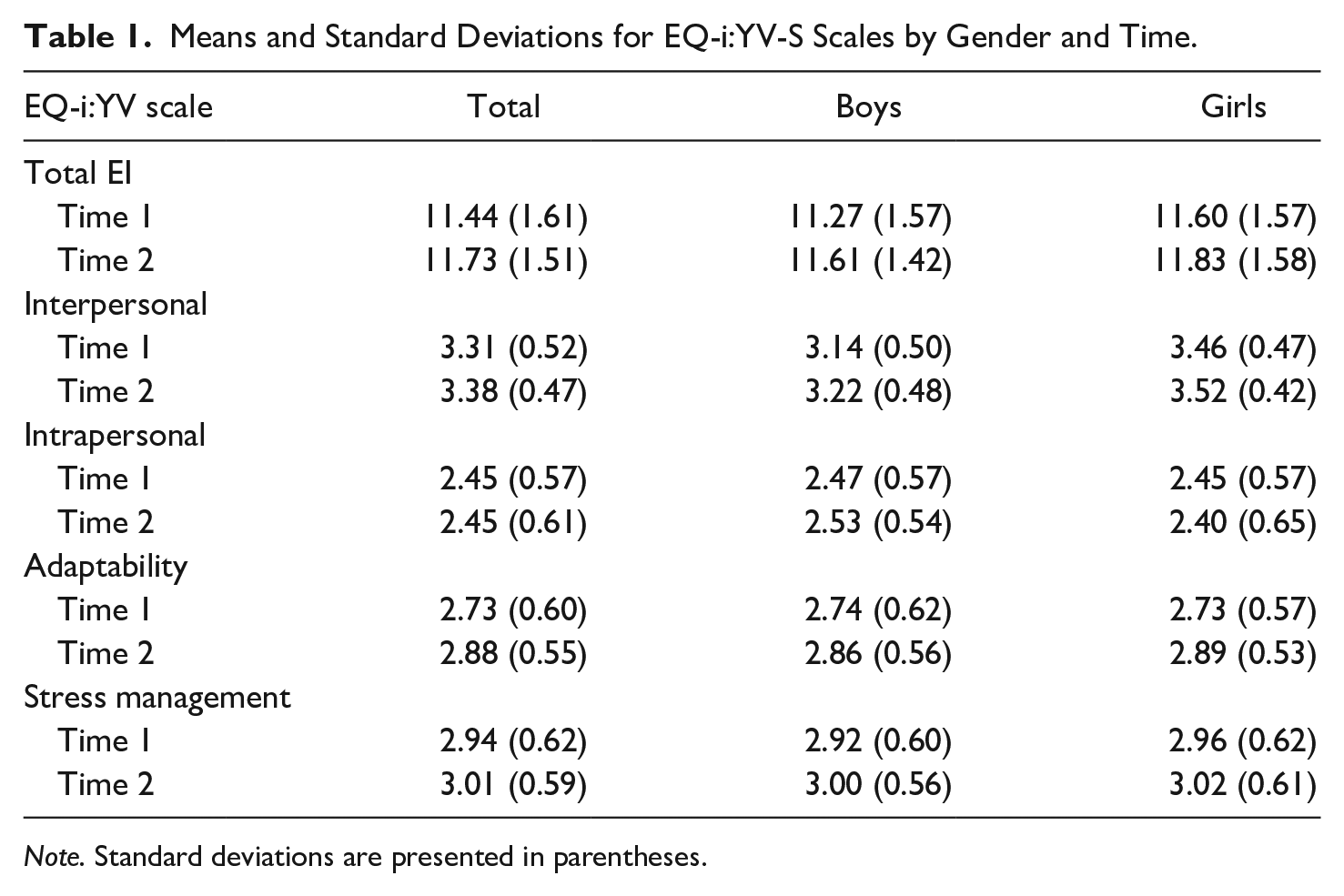
Note. Standard deviations are presented in parentheses.
Results of Hierarchical Linear Models Predicting Change and Group Differences in Trait Emotional Intelligence (TEI) Following SEL Programming.
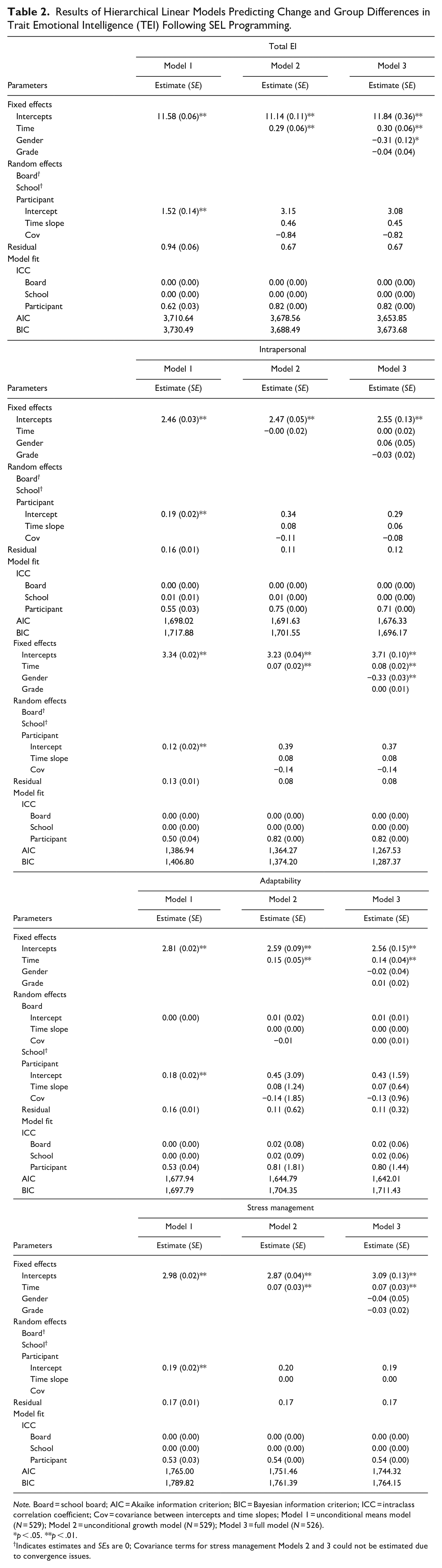
Note. Board = school board; AIC = Akaike information criterion; BIC = Bayesian information criterion; ICC = intraclass correlation coefficient; Cov = covariance between intercepts and time slopes; Model 1 = unconditional means model (N = 529); Model 2 = unconditional growth model (N = 529); Model 3 = full model (N = 526).
p < .05. **p < .01.
Indicates estimates and SEs are 0; Covariance terms for stress management Models 2 and 3 could not be estimated due to convergence issues.
The most significant influence on EQ-i:YV-S scores across most models was the fixed effect of time. Students’ scores on the total, interpersonal, adaptability, and stress management scales significantly increased with time. Gender also significantly predicted differences in students’ scores on the total and interpersonal scales, with girls having significantly higher scores than boys on both scales, regardless of time. No significant effect for time was found for the intrapersonal scale, and there were no significant gender differences observed for the intrapersonal, adaptability, or stress management scales. There were no significant group differences between grades, schools, and school boards on any of the EQ-i:YV-S scales. Both school and board variability in the rates of change for students’ scores on the EQ-i:YV-S scales were also near zero and not significant.
Discussion
The present study sought to examine the effectiveness of the Umbrella program in enhancing trait EI in elementary school children. The results showed significant improvements in Total EI and three out of four EI dimensions across multiple school boards, schools, and grade levels. While the effect sizes for these significant findings were modest, they do exceed those reported for the relationship between total EI and age in the original normative sample for the EQ-i:YV (Bar-On & Parker, 2000). For example, using data from Bar-On and Parker (2000) for children 8 to 14 years of age (the same range as children in the present study) the coefficient of determination (r2) for 6,455 children was as follows: Total EI = 0.009, Intrapersonal < 0.0001, Interpersonal = 0.004, Adaptability = 0.007, and Stress Management = 0.001.
Specifically, the present findings suggest that the new intervention program successfully increased elementary children’s abilities to: identify emotions, understand their meaning, express them in socially appropriate ways, and effectively regulate emotions (Salovey & Sluyter, 1997). This increased knowledge in social and emotional competencies also indicate that children showed positive participant responsiveness and engagement with umbrella materials (Mattingly & Kraiger, 2019). These are important program outcomes that relate to quality program delivery and implementation (Dowling & Barry, 2020), and therefore are an encouraging sign for the effectiveness of the Umbrella Project.
Students’ improved EI competencies may be, in part, due to the sufficient time spent by the Umbrella Project team developing the program and properly training school teachers to teach the curriculum. Indeed, the current literature suggests that younger children require a longer time to fully process and understand complex emotional skills (Durlak et al., 2011). Thus, the Umbrella Project took this developmental feature into account by focusing on only one specific EI-related competency for multiple weeks over the length of the 6-month program.
Students showed significant improvements in stress management and adaptability scores from pre-test to post-test, suggesting participants felt more confident to problem solve, adapt to change, and cope with stressful situations. Consistent with the current literature, students who feel better school adjustment often experience better peer relationships (Keefer et al., 2009). Having friends is associated with good adaption skills, better academic success, and a higher sense of self-esteem (Wentzel et al., 2004). Therefore, the Umbrella Program’s engagement of students with other peers within the classroom during programming may be an important factor that has allowed students to better adjust and cope with stressors associated with school (Durlak et al., 2011; Hymel et al., 2018). The program’s focus on well-being in each umbrella lesson may also be a reason students felt better able to manage their emotions following the intervention. Often individuals with high stress management scores experience reduced emotional stress and better mental health (Mahoney et al., 2018). This is consistent with Viguer et al. (2017), who found a steady increase in stress management scores across 2 years of their EI-related intervention (Viguer et al., 2017).
Another important feature of The Umbrella Project likely related to its effectiveness was the program’s lessons specifically related to problem solving, an important aspect of the adaptability dimension of EI. For instance, students were encouraged by teachers to share stories from their own personal experiences that could be analyzed and reframed into an opportunity for learning. The purpose of improving this competency was to help prevent the occurrence of negative mental health outcomes (Hymel et al., 2018), by reframing challenges and finding better solutions to anxiety-provoking situations. This notion is consistent with previous research by Linares et al. (2005) that found enhanced pro-social problem solving in students was fostered through a program involving hypothetical classroom vignettes. Specifically, teachers rated students after the program as being more emotionally skilled, responsive, and non-disruptive.
Students in the present study also showed significant improvements in interpersonal scores following the Umbrella Project. This suggests that children felt more confident in their abilities to recognize and understand the feelings of others and better able to develop and sustain meaningful interpersonal relationships. Although the Umbrella Project did not enhance children’s abilities in recognizing and understanding their own emotions (i.e., the intrapersonal dimension). It appears that umbrella lessons involved with kindness and empathy indeed aided children in taking the perspective of other people, especially in terms of their emotions. This is important because when children develop better social skills in terms of understanding other people, it often helps advance other competencies involved with adaptation, self-control, and emotion management (Mahoney et al., 2018).
Interestingly, the present study showed that even though boys and girls improved at the same rate in all EI-dimensions, with the exception of the intrapersonal dimension, girls continued to have higher total EI and interpersonal scores than boys. This is not surprising, however, given that previous research has similarly found girls to possess more interpersonal skills and competencies than boys (Catalano et al., 2003; Coelho et al., 2015; Taylor et al., 2002; Wyman et al., 2010). This gender difference in interpersonal competencies is likely, at least in part, due to differences in socialization among girls and boys. For instance, Brody and Hall (2010) argue that gender differences in emotional expression and other interpersonal competencies may be fostered as a result of traditional gender role expectations that necessitate reading the emotional signals of others, as well as differences in adults’ behavior toward girls and boys as a result of these expectations (e.g., parents talk more frequently about relationships with their daughters than sons).
Relevance to the practice of school psychology
The present study extends current literature on the effectiveness of school-based interventions to enhance EI-related competencies in young children (Durlak et al., 2011; Sklad et al., 2012), by clearly demonstrating the effectiveness of the Umbrella Project, a 6-month intervention for EI-related competencies in elementary students. Our findings demonstrate that the Umbrella project was effective in improving EI-related competences, regardless of gender, grade, school, and school board. These results provide further support that EI is teachable and can be developed in young children through appropriate interventions that are properly coordinated, monitored, and evaluated overtime (Dowling & Barry, 2020; Greenberg et al., 2003). This practicability of teaching EI (Durlak et al., 2011), and its linkage to various life outcomes (Keefer et al., 2009), should encourage school boards and educational institutions to continue to promote and utilize these types of psychoeducational programs in elementary school classrooms.
Strengths, limitations, and future directions
An important strength of the present study is our use of the EQ-i:YV-S (Bar-On & Parker, 2000), which is a well-validated and widely used measure of EI. Having a high standard of measurement is important when evaluating program outcomes to determine whether specifically targeted competencies are actually being improved. However, as noted previously, many prior studies often lack the use of reliable and valid assessment tools to allow for the targeted competencies to be properly monitored (Humphrey et al., 2007; Zeidner et al., 2002).
The present study also has strong ecological validity, due to our evaluation of the effectiveness of the umbrella project in a real-world school context with children from multiple schools and school boards. However, a limitation of taking this approach is the lack of randomization and a control group. Since our study’s design is not controlled, there is no way to know for certain that the positive effects and increased EI levels observed were from the Umbrella Project, and not caused by a variety of other influential factors (e.g., normal maturation). Although, as noted above, the magnitude of the effect for time in the present study exceeded the relationship between age and total EI scores in the normative sample used with the EQi:YV-S manual (Bar-On & Parker, 2000). Additionally, as the Umbrella Project was specifically designed for children ages 8 to 14 years, future studies would benefit from utilizing a sample with a broader age range than our present sample to extend the generalizability of our findings to other age groups, including younger children and older adolescents in high school.
Footnotes
Declaration of Conflicting Interests
The author(s) declared no potential conflicts of interest with respect to the research, authorship, and/or publication of this article.
Funding
The author(s) received no financial support for the research, authorship, and/or publication of this article.
