




Abstract
This article discusses the central importance of Adorno in the development of my feminist research practice as ‘ethno-mimesis’, the combination of ethnographic, biographical and arts-based research, operationalised by working with artists at the borders of art and ethnography, as critical theory in practice. The concept of ethno-mimesis emerged from my engagement with Adorno's work across five main pathways (non-identity thinking, aesthetics and politics, micrology, the importance of the critical recovery of history, in ‘living a damaged life’) and is informed by my reading of Negative Dialectics and the central dialectic in Aesthetic Theory of mimesis and constructive reality, that speaks to the relationship between art and society. Two key ethno-mimetic examples are used to explore this journey with Adorno: Not all the Time…But Mostly… and The Bosnian's in Nottingham. I argue through these examples that Adorno's work is as important now as it ever was, and the concept of ‘ethno-mimesis’ can articulate Adorno's value to sociology both theoretically and methodologically by facilitating understanding of: (i) the contradictions of oppression and the utter complexity of our lived relations, the inter-relationship and mediation between the ‘micrology’ of lived experience and broader structures of power, domination and control; (ii) the importance of continuously challenging identity thinking (as Adorno articulates it) of opening and keeping open space for critical discourse and dialogue towards a radical democratic imaginary and (iii) demonstrating through ethno-mimesis the transformative role and potential of art in countering social pathologies.
Introduction
Introduced to Adorno's Negative Dialectics (1973) and Aesthetic Theory (1984) as a third-year undergraduate student by a tutor, Dr Conrad Lodziak 1 I was immediately grabbed by the critical importance of Adorno's sociology, of working through and with the past in the context of his writings on ‘living a damaged life’, 2 the negative power of capitalism and fascism, and importantly his writings on the transformative potential of art. Adorno took dialectics beyond Marx and Hegel and argued that there was no identity between subject and object, no teleological thinking, that history could not be synonymous with progress, and indeed this meant the loss of hope in history as progress, alongside the growing commodification of culture and reification as instrumental reason. Yet, despite this, Adorno never gave up hope for transformation through critical theory and art as unintentional truth.
Later in my critical engagement with Adorno for my PhD I focused on his writings on culture and his relentless attack on essentialising the feminine that led to analysis of Adorno's works from a feminist perspective and the transformative potential and role of art. Art, for me, was critical theory in practice, offering a change causing gesture, a vehicle for the critical analysis of society, making visible what the dominant consensus obscured, and facilitating (not giving voice to) the voices and experiences of those who are silenced ‘within the framework of the existing hegemony’ as counter hegemonic practices that were also feeling forms (Witkin, 1974). My subsequent work developed at the intersection of critical theory, lived experience and arts practice, especially through combining ethnographic, life history and biographical work with arts practice, working with artists and marginalised communities to address sexual and social inequalities to both better understand and counter social pathologies.
Combing ethnographic research with arts practice led me to the concept of ethno-mimesis, 3 drawing upon Adorno's use of ‘mimesis’ heavily influenced by Walter Benjamin (1985, 1992) I argued that working in the hyphen between ethnographic, biographical research and art making opened a ‘potential space’ for transformative possibilities and counter hegemonic politics as praxis, as a critical theory in practice. This is not to reduce art practice or art making to method as in visual ethnography, but rather, working in collaboration with artists, with makers, the inter textuality of artmaking and storytelling unfolds in the space between ethnographic research and arts practice. I have defined this as ‘ethno-mimesis’ a counter hegemonic space, practice and process.
The foundations for the development of ‘ethno-mimesis’ are constituted by three core themes around which Adorno's critical analysis unfolds in both texts: negative dialectics and non-identity thinking, that help us to understand and counter the growing instrumental reason and reification of social life, working against the forces of totalitarianism, sexism, racism and othering; kulturkritik, that helps us to analyse the impact of the culture industry, the commodification of culture and using ‘micrology’ understanding lives in process; and the transformative role of art and critical thinking, for the task of the artist and critical theorist was to reveal the unintentional truth of the social world and preserve independent thinking.
For Adorno, ‘autonomous’ not ‘committed art’ and critical analysis could be held up like a mirror to society, thus potentially serving a critical transformative role (O'Neill, 1999; see also Honneth, 2009). As Buck Morss argues: ‘His was a negative anthropology, and its knowledge was to keep criticism alive’ (Buck Morss, 1977: 186). This negative anthropology and critical approach was important to my developing feminist consciousness because Adorno drew attention to the contradictory nature of social and sexual oppression and the ‘correspondences between gender hierarchies and social hegemonies’ (O'Neill, 1999). For example, the dominance gender hierarchies involved in sexual and social inequalities, in violence against women and specifically, in the example discussed later in the article, violence against sex workers.
Engagement with Adorno's work, for me, both opened a critical space theoretically and methodologically and enabled me to keep that critical and imaginative space open across a number of empirical and theoretical projects, through a combination of ethnographic, biographical and arts-based research that I defined as ethno-mimesis and I will share in the next section. This is supported by Shierry Nicholsen (1997: 3–4) who writes that the importance of Adorno for us today includes exploring the connection between his work on the aesthetic dimension and a non-discursive form of truth, which means looking at the role of the subject and subjective experience, particularly the imaginary/imagination.
Hence, three aspects of Adorno's work have travelled with me over the intervening years: (i) the vital importance of critical theory, of negative dialectics or non-identity thinking and the central dialectic of mimesis and constructive rationality in Aesthetic Theory, through the works of Adorno, Benjamin and feminist scholars, a key influence being Shierry Nicholsen; (ii) the importance of engaging with lived experience, through ethnographic and biographical research especially in actioning kulturkritik; and (iii) the possibilities for praxis, or purposeful knowledge, the potential for social change through arts-based research as unintentional truth-given the totalising nature of what Shierry Nicholsen (2018) calls (drawing upon Robert Lifton) ‘malignant normality’. 4 For Adorno, it is only by saying the unsayable, the outside of language, the mimetic, the sensual, the non-conceptual that we can approach a politics which undercuts identity thinking, which refuses to engage in identity thinking but rather criss crosses binary thinking/territories and remains unappropriated. Art as unintentional truth (not committed arts as Brecht discussed) fulfils this for Adorno. My argument here is that through ethno-mimesis, as critical theory in practice—by working with artists at the intersections of art, ethnography, biographical sociology and critical theory, influenced by Adorno, we can open and keep open space for countering social pathologies through the transformative role of art and facilitate the critical oppositional in societies ‘where every critical gesture is quickly recuperated and neutralised by the dominant powers’ (Adorno, 2005; Mouffe, 2019).
These three concepts or building blocks are summarised briefly below in order to define the foundations on which my argument is based.
Negative dialectics
In Adorno's work Negative Dialectics is presented as an anti-system, in reaction to prevalent norms and values of society on the grounds that they have come to legitimize a society which in no way corresponds to them—they have become lies—this is evidenced most clearly in Adorno's writings but also in Nicholsen's (2018) analysis of Minima Moralia using the concept of ‘malignant normality’. Negative Dialectics (Adorno, 1973) looks to Marxism as method and dialectical thinking as the core of the method and is a tool for the critical analysis of society, through the negation of the negation. Adorno's aim was the explosion of reification, for concepts as ordinarily used mask the truth (influenced here by Lukacs, history and class consciousness and also by Nietzsche), they have become lies. Truth and identity do not consist of a correspondence between concepts and their objects; for Adorno to engage in correspondence thinking is to engage in identity thinking never more been further from the truth. Gillian Rose articulates this most clearly and for her identity thinking is the way unlike things appear as like and the mode of thinking that considers them as equal which constitutes reification as a social phenomenon and as a process of thinking (Rose, 1978; O'Neill, 1999, chapter 3). Buck Morss (1977: 80) articulates Adorno's ‘immanent criticism’ as a materialist dialectic that contains a constructive as well as destructive moment; as the decaying categories can be refunctioned for illuminating the unintentional truths of society.
Contra Marx, Adorno's theory never included a theory of political action, he writes against commitment, against committed art, for example in the lectures on Brecht, and nowhere in Adorno's work do we find mention of a collective revolutionary subject, which inspired backlash against him from the student movement at the time. However, he never gave up hope for social transformation and this is expressed through critical theory and art (see Aesthetic Theory) and imagination. Nicholsen (1997) writes that Adorno's term ‘exakte Phantasie’ marks ‘the conjunction between knowledge, experience and aesthetic form’ pointing ‘“provocatively and explicitly to the relationship between exactness—reflecting a truth claim—and imagination as the agency of a subjective a conceptual experience…it designates a non-discursive rationality” (1997: 4). For Gillian Rose (1978), Adorno's Hegelianized Marxism is reintroduced on the basis of a Nietzschean inversion. Adorno called the project of Negative Dialectics dialectical and materialist and he put it to good use in his analysis of the ‘culture industry’ as ‘mass culture’ which has resonance today, in what has come to be known as ‘post truth’ society.
Kulturkritik
The development of administered society, identity thinking and the growth and popularity of ‘mass culture’ were for Adorno synonymous, ‘the culture industry perpetually cheats its consumers of what it perpetually promises’ (Adorno & Horkheimer, 1995: 139). For Adorno, the culture industry the entertainment industry demand little in the way of effort and our reactions are prescribed; and in turn it helps to underpin capitalism as the administered society and hastens the take-over of instrumental reason, ‘even the most extreme consciousness of doom threatens to degenerate into idle chatter…Cultural criticism finds itself faced with the final stage of the dialectic of culture and barbarism. To write poetry after Auschwitz is barbaric…Critical intelligence cannot be equal to this challenge as long as it confines itself to self-satisfied contemplation’. (Adorno, 1995: 34)
Stephen Crook (1994) argues that Adorno raises unsettling question about contemporary culture; ‘how far dependency has become the typical condition of the “self” in advanced societies, how deeply authoritarian currents run through our superficially pluralist cultures, and how free our beliefs and opinions are from the pervasive undercurrents of irrationalism’ (p. 28). In his work on the culture industry Adorno stresses the mediating role played by art and aesthetics in negating the effects of the culture industry. Following Brecht, Adorno tells us that after Auschwitz the culture industry is indeed built on dog shit; and given the relationship between culture, the culture industry and reification the need was for immanent dialectical criticism; the attempt to say the unsayable, the un utterable, to undercut cultural criticism with dialectical criticism. In Nicholsen's words Adorno offers a ‘non-discursive rationality’ as an alternative to ‘a dominating systematizing rationality that is the counterpart of an administered world’ (Nicholsen, 1997: 3). This non-discursive rationality is best described through the concept of art as unintentional truth.
Unintentional truth
The issue for many in the late 60s was that Adorno's dialectical criticism showed no ‘commitment’ to transformative politics at the level of action and Adorno was critical of both Brecht and Benjamin for their commitment to action. Adorno's essay ‘On commitment’ in Aesthetics & Politics (Adorno, 1980) shows that suffering can be consumed through art as enjoyment and in being consumed it is transfigured, something of its horror is removed; he also calls this the de-substantialization of art. For Adorno, autonomous art invokes ‘tremor’ as ‘concern’ ‘frisson’, or ‘shudder’ and the ‘autonomous’ escapes being neutralised or recuperated or incorporated in the concept of the ‘new’ (Adorno, 1997: 20–24). ‘Only in the new does mimesis unite with rationality without regression’ (Adorno, 1997: 20). Otherwise for Adorno, art survives in reified society as cultural heritage, as affirmative pleasure or as business for profit—this is what he means by the de-substantialization of art, Entkunstung. ‘when genocide becomes part of the cultural heritage in themes of committed literature, it becomes easier to play along with the culture that gave birth to murder’. (Adorno, 1980:188–189)
The difference he describes as follows: Brecht's Mother Courage demands a change of attitude, however, what he calls autonomous art and Picasso's Guernica, is given as an example, compels a change of attitude. Critical of social realism, he argued that art should be allowed through form to present the sedimented stuff of society as ‘unintentional truth’ (see O'Neill, 1999). Hence, for Adorno, the notion of a message in art even when politically radical already contains an accommodation to the world. Adorno compared artworks to picture puzzles or rebuses and the artwork is a cipher of the social and via the tension between mimesis and constructive/instrumental rationality the constructive moment occurs when the mind strives to know it in thought—truth resides in the form and is activated and reached vis interpretation—every artwork is the product shaped by its own consistent logic and an element in the complex of spirit and society.
Importantly, for Adorno, coming to know a work of art, the work involved in analysis or interpretation is attained through: interpretation, commentary, and criticism via immersion, objectification and disassociation (Adorno, 1984). This also describes how we teach and conduct ethnographic and biographical research. Immersion means getting the feel of the piece or life trajectory, experiencing ethnographically, the spirit of the individual or group through the senses and the social environmental context. Objectification and disassociation involve gaining a critical distance, without losing connection, to do the work of interpretation. Here in the dialectic of ‘mimesis’ and ‘constructive rationality’ (Hegelian and Kantian themes in Adorno's work) we can experience the tension between sensuousness/playfulness/imagination and constructive rationality in art works and subjective experience, biographical analysis. Adorno also stresses the mediating role played by art and aesthetics in negating the effects of the culture industry.
To summarise this section, Adorno's work through these three key concepts was concerned with: deconstructing identity thinking (the way unlike things appear as like); deconstructing ideology as reification (uncovering the perceived naturalisation of that which is socially produced or constructed); defining the relationship between psychic, social and cultural processes and practices; the intersection of sociology, philosophy and aesthetics and illuminating the contradictory nature of social oppression. He also never gave up hope for the transformative possibilities of social critique, and particularly of the liberating potential of art and aesthetics. These three concepts are foundational to my work on ethno-mimesis as a politics of feeling through a feminist lens and consciousness.
I want next to provides a feminist reading of Adorno before sharing two examples of ethno-mimesis in action, re-presenting life story interviews in performance art and photographic form and installations, within the context of participatory action research (working with communities to create change). Through Not all the Time but Mostly (1999–2001) a collaboration with Sara Giddens and The Bosnians in Nottingham (1995–2000) a collaboration with Bea Gianquinto and Fahira Hasedzic, I argue that Adorno's work is as important now as it ever was. Moreover that the concept of ethno-mimesis can articulate Adorno's value both theoretically and methodologically, taking us beyond binary thinking using non-identity thinking and the dialectic of mimesis and constructive rationality, 5 to understand the contradictions of oppression and the utter complexity of our lived relations, the inter relationship and mediation between the ‘micrology’ of lived experience and broader structures of power, domination and control. So that we may challenge identity thinking (as Adorno articulates it), and demonstrate through critical theory in practice (ethno-mimesis), the transformative role and potential of art, working at the borders of art, ethnography and biographical research, through a feminist lens, to quote Shierry Nicholsen (1997: 2 in ‘imaginatively appropriating his work’).
Ethno-mimesis—A feminist re-booting of the central dialectic of mimesis and constructive reality in aesthetic theory
“The splinter in your eye is the best magnifying glass”. (Adorno, 1973)
Adorno was very much aware of the contradictions involved in lived relations and the power of bureaucracy, the state, cultural institutions and he was also very much concerned with the inter-relationship and mediation between the ‘micrology’ of lived experience and broader structures of power, domination and control—the power of hegemony. He is also concerned with the mediation between subject and object, the absence of reconciliation (see Gudrun Axeli Knapp, 1999), and the mediation between the particular and the general; and importantly, as the quote above tells us, by focusing upon the small scale, what is ordinarily overlooked, we can often reach a broader understanding of societal issues (O'Neill, 1999).
The central dialectic of mimesis and constructive reality in Aesthetic Theory has been a key focus of my work then and now, as is the importance of understanding the tension between emotion, feeling, spirit/subjectivity—our ‘out there’ sense of being in the world as well as our psychic/inner worlds. At the outset of my journey with Adorno this central dialectic of mimesis and constructive rationality elicited a renewed methodology I call ethno-mimesis, that combined socio-cultural theory; experience (ethnographic research and biographical research/life stories); and practice (art/exhibition/performance) to explore and better understand key themes and issues related initially to sex work and later to forced migration and later still, borders, risk and belonging.
I argued that by undertaking ethnographic and life history research with sex workers and by experiencing women's stories represented through artforms, in this early example through live art, we can further our understanding of the complexity of sex, sexualities, desire, violent dominance hierarchies, and the relevance of the body—the gendered body, the imaginary body, the performative body, the social body—within the context of post-modern times, de-traditionalization, post-structuralism at the intersection of contemporary feminist theory, socio-cultural research and experimental/alternative forms of re-presentation/interpretation.
A feminist reading of Adorno
To better understand Adorno's social theory on the relationship of art to society we need to engage with Aesthetic Theory, but I have argued (O'Neill, 1999) that in working with Adorno and feminisms we need to question the social theory, for his social theory revolves around the totalising power of reification, defined as the ideology/knowledge axis. If we give central place to the ideology/knowledge axis as in Adorno's work it is only ‘autonomous art’ and ‘dialectical criticism’ can see through the ‘efficious reality’. However, If we instead situate power, subjectivity, difference and the body in its place (as some feminists have done, see Becker-Schmidt, 1999: 34–35), then we can call into question the totalising power of reification and instead focus on reification as one aspect of the centrality of power, difference and hierarchical domination. This serves to free this aspect of Adorno's work that drove him (for Benjamin) into a ‘one way street’ given the totalising power of reification and the ensuing destabilisation of art and it enables various art forms to be defined as a form of unintentional truth not just ‘autonomous art’.
This is supported by developments in the sociology of knowledge and the work of feminists. For example, in the years since Adorno passed we have seen a shift away from focus on needs (western Marxism) to desire and the body (Foucault and French feminisms) and from post structuralism to an age of anxiety apocalypticism—post-viral and post-human analysis (Haraway). These shifts calls into question Adorno's focus on the totalising power of reification in our social worlds, and instead reification is one aspect of power and difference. For example in Nomadic Subjects Braidotti (1994: 1) draws attention to ‘the nomadic mode’ for contemporary subjectivity, seeking ‘ways out of the phallocentric version of the subject’ and in doing so questions identitarian thinking, celebrates nomadic subjects that escape appropriation, and the kind of politics that can emerge from feminist work on subjectivities, bodies, difference and power; although ideology/knowledge is important it does not have the same central focus as in Adorno's work. This also enables various forms of art such as film (Min-Ha) performance art and theatre to be seen as unintentional forms of truth, transgressive, transformative, disruptive and change causing.
The two examples below evidence that art can offer a change causing gesture, be a vehicle for the critical analysis of society, making visible what the dominant hegemony obscures and facilitating (not giving voice to) the voices and experiences of those who are silenced ‘within the framework of the existing hegemony’ as counter hegemonic practices that are also feeling forms. Combining ethnographic research with arts practice working in the hyphen between ethnographic, biographical research and art making opens a ‘potential space’ for transformative possibilities and counter hegemonic politics as praxis—a critical theory in practice. This is not to reduce art practice or art making to method as in visual ethnography, but rather, working in collaboration with artists, with makers, the inter textuality of artmaking and storytelling unfolds in the space between ethnography and arts practice that is a counter hegemonic space, practice and process. The two examples below emerged in our research at the intersection of contemporary feminist theory, socio-cultural research and experimental/alternative forms of re-presentation/interpretation.
Ethno-mimesis: Exemplar 1. Not all the time…but mostly…
Ethno-mimesis emerged from my analysis of Adorno's aesthetic theory and the desire to operationalise critical theory through the intersection between ethnographic and socio-biographical work (life histories) and art forms, working in the hyphen between art and ethnography/biography. The relationship between the dialectic of mimesis and constructive rationality in Aesthetic Theory, is important drawing attention to the centrality Adorno placed on subjective experience and the importance he placed in Critical Models on working with and through the past.
The theory, concept and practice of ethno-mimesis was piloted first of all in 1997-1998 in collaborative work with live artist Sara Giddens. We were Introduced by a mutual friend and colleague Barry Smith in 1997. Sara was working in the field of live art and movement related performance for many years, and through her project ‘Bodies in Flight’ was interested in the challenge of developing hybrid live art forms in response to ‘real’ life stories. Sara brought dancer Patricia Breatneach and sound artist Darren Bourne, photographer Simon Howell and film maker Tony Judge into the collaboration. The aim was to operationalise ethno-mimesis, to develop alternative representations of women's life stories in order to transgress stereotypes, to say what cannot be said through words alone, and to open this work to a wider audience through artistic forms challenging dominant stereotypes and binary thinking around sex work and sex workers.
For example, through non-identity thinking we can think critically against the grain and come to understand that the sale of sex is associated in law and the public imagination with moral deviance. Regulation of women and women's bodies takes place through enforcement of laws and in the process a particular ideology is reproduced, sectional interests are presented as universal, there is a denial of contradictions and concealment of unequal sexual and social relations. Exclusionary discourses emerge around victimhood, responsibilisation and rehabilitation of sex workers, rooted in a deviancy and criminal justice model of regulating sex work, that is deeply structured by capitalism, commodification, sexuality and sexual relations. This process reinforces cultural value patterns that reinforce mis-recognition of sex work/sex workers, who in turn are not treated as full citizens but rather given partial citizenship and their access to justice is circumscribed.
Methodologically, anonymised life story interviews that Maggie had conducted with sex workers were shared (with permission) with Sara and together we read, analysed and interpreted the narratives. Sara created a live art performance using dance/choreography in dialogue with Patricia and myself, an accompanying sound scape was produced by Darren Bourne, played during the dance performance, based on slowed down readings of the narratives. Photographer Simon Howell and videographer Tony Judge shot and filmed the live art performance. Not all the time…but mostly. We shared the performance with sex workers and gained their consent to perform and publish the work; the sex workers Maggie worked with loved the performance.
Experiencing women's (sex workers) life story narratives through the live art form facilitates multi modal access to understanding the complexity of women's lives, sex, desire, violence and the gendered body, imaginary body, performative and social body, beyond the binary logic of sex worker as good/bad woman. Experiencing the live art performance takes our access to understanding beyond binary thinking and creates space for thinking otherwise, and challenges identity thinking/identitarian thinking in sensory, feeling and thinking ways.
The performance text both embodies and makes apparent the ethnographic text/interview material, but not as vraisemblance, because the material/narrative transcripts are interpreted through the playfulness and creativity of the artist/performer (Sarah and Patricia) who create the artistic form.
Ethno-mimesis as a renewed methodology argues that art is a product of society in that it is formed from the objective demands of the material, the historically given techniques and means of production, the subjective experiences and playfulness of the artist and at the same time is an independent force in society—it is constitutive, it brings something new into being. In this case a radical re-envisioning of sex work that challenges binary and identitarian thinking, and through art as a form of unintentional truth, the sedimented stuff of society emerges in the art form showing the utter complexity of sex workers lived lives in the context of violent dominance hierarchies. In John Lowman's (2000) work sex workers are constituted in the public imagination by a discourse of disposability, which shapes hostility towards them, their social outcast status and subsequent criminalisation and associated policing. This in turn undermines safety, heightens vulnerability to targeted violence and also acts as a barrier to reporting, leading to reduced access to justice, public protection and the erosion of rights.
The live performance includes text from the transcript's, spoken live into a portable mini camera, with a built in microphone. Focusing upon one (anonymised) transcript in particular we looked for themes and images, rhythms and patterns that resonated. The mini camera is used to frame parts of the dancers (Patricia) body, and the image is relayed to the audience via a large projection, which is later subsumed by the pre-recorded video. The video made in April 1998 is structured into six dances created by Sara, Patricia and Tony, each constructed around a ‘commodified’ body part and played against a soundscape of recorded fragments of interviews and sounds made by the performer as she executes the movement. The layering of voice/soundscape, visual image/dance and the movement of, predominance form, the live to the pre-recorded aims to reflect the complexity ad multiplicity of bodies whilst making apparent the tension between the real and re-presented and imagined (Figure 1).
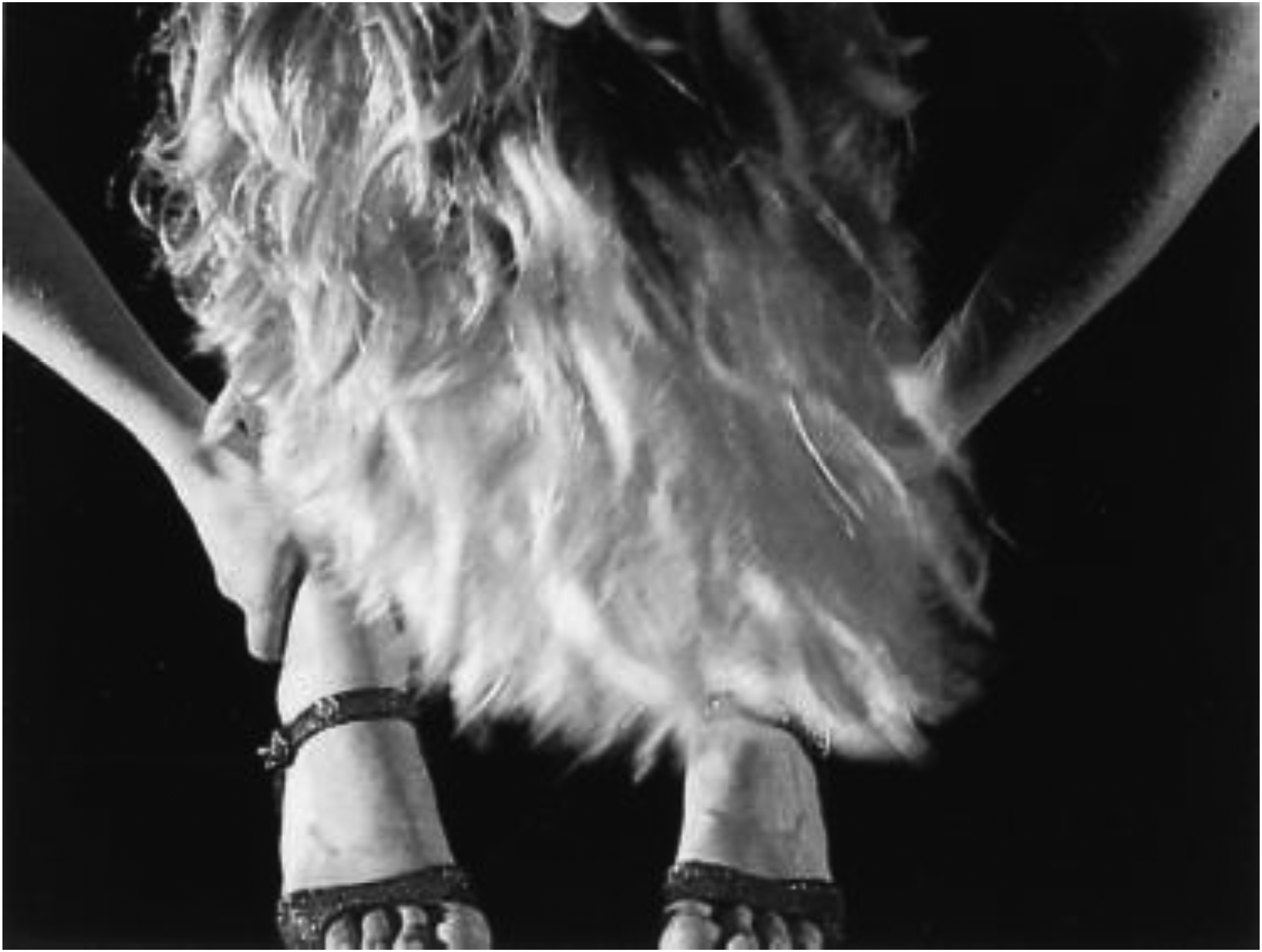
Shoes and hair.
Representing women's stories and lived experiences through art forms as ethno-mimesis we argued facilitates a better understanding of sex work beyond the tired old stereotypes and binaries of good/bad woman, Madonna/whore, thus challenging identitarian thinking, the concealment of unequal sexual and social relations and the historically enduring stigmatisation and ‘othering’ of sex workers and sex work as social pathology.
Roland Munro's (1998: np) review in the leaflet/publication
6
that accompanied the video is instructive in that he interprets the commodification's performed by the sex worker into the commodification's we all make in our lived lives and working lives, thus providing an excellent example of kulturkritik and shifting our attention to wider social structures and processes of late capitalist society. He states: For all its occasional frission, most performance art has us hanging around…Not all the time…but mostly…while an attempt to renew the methodology of social science research is also one of those rare performances that works aesthetically, emotionally, and intellectually. The stunned silence that greeted it's the first showing of the multi media performance at the BSA conference on the Body, was reminiscent of the long pause that met the curtain of waiting for godot, the audience coming to terms with the performance. Instead of theory was like having watched a play without anything having happened. Except for the uncomfortable fact of ones own arrival somewhere else.
Munro reads the performance aesthetically and in relation to the ethnographic depth and importance of the narrative, as well as the impact on the audience. Through critical theoretical interpretation he identifies the way that the operation of the exchange principle reduces all our encounters to thing like equivalences, not just the sex worker. Of course the sex worker is indexical, she exchanges sex for money, and as Benjamin identified she is both a subject and an object, a commodity in one. Munro comments on the performance, on the script, on the verbatim narrative from the sex worker as she recounts how she stops seeing people for people and sees them as prospective clients, like the gas man. Munro states that the crisis in the work, ‘the moment when performance turns audience into participants—is when this working mother recollects thinking about how to turn the gas bloke into a “regular”. And then sums up how this way of looking at people has changed her world’. Moreover this defining herself a prostitute, for Munro opens the critical space to see this way of conducting ourselves. He states that this ‘is the chiasm in which we all live: seeing others as friends one moment and crossing them into prospective clients, a regular, the next. In our readiness to make someone a mark and turn a trick for them, here are some of the crossings we make: the colleague who is our friend (might advance our career); the participant in our study with whom we empathise (the gold that gets a paper into a top journal). We are all at it’ (Munro, 1998: np). Yet this fragmenting of others—and then enrolling the bits into our interests—has us in strict denial: immediately we are refracting our commodification's back into friends/good blokes/lovers—forms that still carry the acceptable face of society. Moving chameleon like under the cover of culture and convention, we not only criss over, we cross back-using the ferryman of class, gender, personality, to forget our own fetishisizing of exchange. (Munro, 1998: np)
In response to Munro's review it is argued that the live performance and the video are examples of critical theory in practice, the combination of ethnographic, biographical, life story narratives and re-presented through the live art form enable us and wider audiences (other than those that might read our sociological and performance papers) to access lived experience, mediated subjectivity and the sensuousness of a sex worker's experience; that in turn, challenges the binary, stigmatised and heavily gendered ‘othering’ of sex workers and serves also to humanise those who sell sex.
Sex workers are heavily stigmatised, especially so in Irish society, what a sex workers does is read as who she is, the category ‘prostitute’ defines her (FitzGerald et al., 2020; O'Neill, 2001; Scoular and O'Neill, 2007). The ethno-mimetic collaboration with Sarah troubled this stereotype, this banal reduction of a human being to a thing like equivalence; and enabled us to see the complexities of women's lives including being a mother, daughter, being poor, living with stigma, through sensory and critical engagement with the performance—a combination of reading through head, body and heart. It also shifted our attention away from the individual, the category ‘prostitute’ to the broader social conditions which are usually ignored in mediatised and some feminist reports on sex work—where the sex worker is individualised and responsibilised; and as Munroe states draws attention to our own fetishisizing of exchange.
This collaborative research, the combination of critical theory, ethnography, biographical work and art forms (ethno-mimesis) operationalises non-identity thinking and the relationship between art and politics or social justice outcomes, by undertaking micrology, through the critical recovery of history in life story research, and acknowledging the importance of subjective experience, especially for Adorno in understanding the contradictions of oppression and ‘living a damaged life’. Thus through these five inter-connecting pathways, we might better understand the complexity of our lived relations, the tension or mediation between ‘micrology’ and broader structures of power, domination and control; and the importance of opening and keeping open spaces for critical thinking and dialogue through ethno-mimesis as critical theory in practice, in understanding and countering social pathologies. Indeed we argued that this work opens a radical democratic imaginary, 7 but as we know from the intervening years and work in the area, the neutralisation and recuperation of this work is ever-present (Mouffe, 2019) and so we need to keep on keeping open spaces for critical ethno-mimetic work.
This first collaboration across sociology/arts was further developed in subsequent ethno-mimetic collaborations with artists and migrant communities using sensory and performative methods and biographical research, as critical theory in practice in the United Kingdom and Ireland (Kaptani et al., 2021; O'Neill and McHugh, 2024). The second example below sought to further advance the methodological approach.
Ethno-mimesis 2: The Bosnians in Nottingham
‘what recommends itself then is the idea that art may be the only remaining medium of truth in an age of incomprehensible terror and suffering’. (Adorno, 1984: 27)
The second example took a participatory arts approach and worked with a Bosnian community and artists connected with or based at a community arts organisation, from research design through to dissemination. The project led to a decade of work in the East Midlands of England in collaboration with Bea Gianquinto an artist and manager of City Arts community arts organisation, Fahira Hasedzic, secretary of the Bosnian Association in Nottingham (made up at the time of 150 Bosnian refugees in Nottingham, who had arrived from red cross camps in Croatia) two artists working with City Arts, Karen Fraser, Simon Cunningham and Maggie Milner, a freelance artist/photographer. As defined earlier, ethno-mimesis is a theory, process and a practice, rooted in a dialectic of non-identity—a feminist dialectic of mutual recognition; that engages with kulturkritik and processes of commodification and facilitates space for the role of art and art as unintentional truth in critical collaborations across the arts and social sciences, as critical theory in practice. In the process of ethno-mimesis we aimed to produce critical reflective texts that might challenge and change dominance hegemonic ideologies and racist attitudes towards the Bosnian community.
The Bosnian community in Nottingham experienced some of the worst atrocities of war in the break-up of Yugoslavia. Most were from Banja Luka or Prijedor and most were Muslim. Their suffering was extreme. In the essay ‘On Commitment’ in Aesthetics & Politics Adorno asks Is there any meaning in life when men exist who beat people until the bones break in their bodies? Is also the question whether any art has a right to exist…When genocide becomes part of the cultural heritage in themes of committed literature, it becomes easier to play along with the culture that gave birth to murder. (Adorno, 1980:188–189)
One participant/community member described the situation in his village: around 12th April it all started in Prijedor… most of the people were Muslim…even though it was multi-ethnic…like there were also Serbs and Croats and Czech and Ukraine…in the former Yugoslavia you didn't really know who was who…they started the ethnic cleansing…the people who lived in the village they just ran away they were hiding in the fields and hills…and after two days because the Serbs they had bases all around the people couldn't go anywhere …amd then because people couldn't run away women and children died…they were just firing on people and they didn't have anywhere to run…the people who survived they took the women to Trnopolye a concentration camp…and the men were in another camp called Omarska.
Omarska concentration camp
He was taken to Omarska with one of his son's. His wife and youngest son were sent to Trynopole. in Omarska and Kerater…it was terrible hard…beatings…lots of people died from beating…or no food…they lost so much weight…some lost 30–40 kilos…some could hardly walk anymore…they couldn't wash…there was like an epidemic…nits…some people were very hurt aswell…and on some occasions they were cutting a cross in the skin on the chest or and there was nothing to put on…sometimes they got maggots in the wounds…there were few soldiers that were OK but most were really nasty…sometimes they would cut someones ear just to check if the knife is sharp enough…and you had to watch…after all that time they were not even scared anymore…waiting everyday to have their turn.
Given the principles underpinning participatory research: inclusion, participation, valuing all voices and action oriented interventions and taking an ethno-mimetic approach, a series of meetings with the association, chair and secretary took place that led to public meetings with all members of the community. After much discussion the members agreed that the association would work on the project in collaboration, using participatory ethno-mimetic methods. We began the methodological process with oral history/biographical interviews, followed by and alongside arts workshops.
In the participatory arts workshops facilitated by Bea Gianquinto and the artists we experienced a range of artists work, looked through art books and exchanged ideas before deciding what to make, sparked by themes from the biographical interviews. The image below was created first as an installation, then digitally photographed and developed in photo shop. The narrative in English and Bosnian tells that Fahira's neighbours held a meeting and decided to protect the three non-orthodox, Muslim families in the block. She needed the key of her neighbour for a long time and would hide in her neighbours flat when soldiers were looking for Muslims. She baked bread for her neighbour (having had supplies from the Red Cross) and took the bread to her neighbour. A soldier was in her neighbours flat asking for the Muslims; the neighbour kept silent. The soldier asked ‘who are you’ and Fahira replied ‘you know who am I, I would not be here if I were Muslim’. Karen Fraser supported Fahira in the process of representing her experiences, in the installation and photo shop art work.
The image and text tells of the possibility and actuality of a greater humanity, than experienced by many during the war, of protection, care and thanks, offered through gifts to her neighbour—the good things denied during war and sanctions—bread, chocolate, lights, fruit—it is a hopeful image. A crucial point here is that in her experience of being ‘protected’ by her neighbours Fahira's Muslim identity was acknowledged, and she was able to hold on to this. The art work represents this experience, as well as the emotions involved, in the intersection of the image, form and the text (Figure 2).
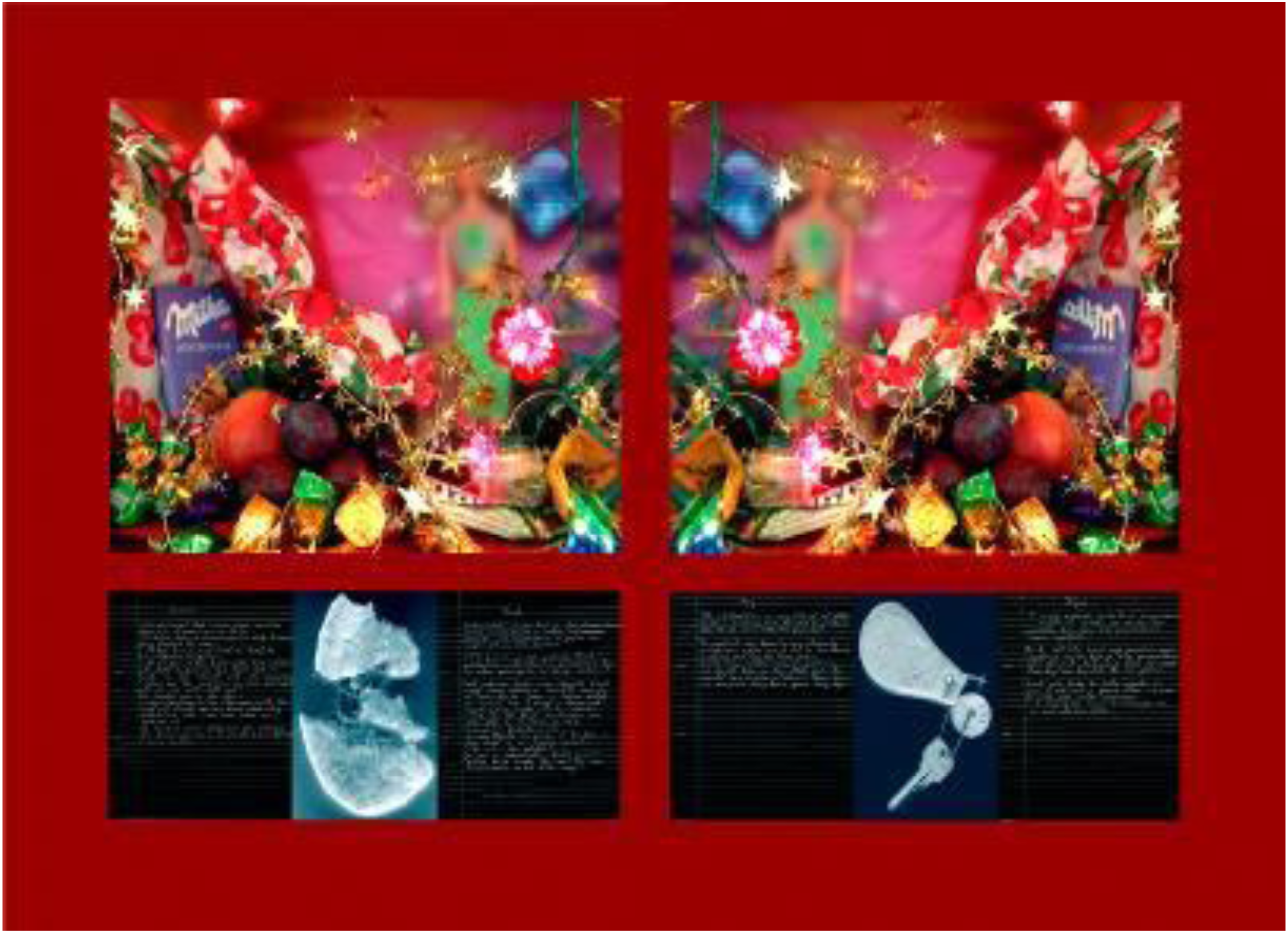
Good neighbour. Image: Fahira Hasedzic.
This project was exhibited in galleries and community centres, reported on in the local press, and it helped to challenge attitudes, myths and stereotypes about ‘asylum seekers’ and ‘refugees’. At one exhibition in a community centre a woman clearly moved by her experience of seeing the work and the portraits of the community members who took part, said to us this could be us, my family, my grandchild. We followed this up with a follow on arts project The Bosnians in Nottingham a collaboration with artist, photographer Maggie Milner, training the community in photographic skills and spending time with the community in the community centre, on their allotments/gardens and in the community association meetings.
Our collaborative work also led to awareness that refugees and asylum seekers should be included in arts and cultural infrastructures in the region. A subsequent research exchange project (between Bea and myself) Towards a Cultural Strategy for the inclusion of Refugees and Asylum Seekers in the East Midlands led to the development of a cultural strategy. Supported by the arts council, funding was later provided for a conference ‘the long journey home’ that led to the development of an artists in exile regional support organisation and funded post. The research also fed into other policy and practice discussions in the region and dissemination of the exhibition and text-based outcomes and presentations by the team meant that the importance of arts and culture in integration processes were considered, in addition to the pressing issues of housing and health policies for new arrivals. 8 These first two participatory action research projects led to a ten year trajectory of research in the East Midlands with groups and emerging communities, artists and individual asylum seekers, refugees, migrants, including undocumented people, funded by the AHRC ‘A sense of belonging’ and knowledge exchange networking project that used walking as arts practice to conduct the biographical and ethno-mimetic research.
Twenty years after we had first met and the first ethno-mimetic project Fahira, Bea and I met to go for a walk as part of a Leverhulme Fellowship (O'Neill et al., 2019). We met at Fahira's flat and shared our stories of the intervening years. We had kept in touch via Christmas cards and facebook. It was as though the intervening years had not happened, we fell into conversation and sharing and Fahira made Bosnian coffee once again.
The resonance of fleeing Bosnia and her arrival in England with her husband, a year after her 16 year old son arrived (Fahira sent her children aged 16 and 18 away as the ethnic hostilities advanced—to save their lives; her son found his way to England and her daughter to Sweden) was still very present as was the memory and impact of the trauma experienced.
In the ethno-mimetic examples shown here, we experience the importance of biography, the critical recovery of history through socio-biographical work, in the process and practice of ethno-mimesis, at the intersection of critical theory, ethnography/biographical research and art forms-art practice. In the two collaborations with artists and communities, ethnographic, biographical work is re-presented in art forms, using sensory and performative methods as critical theory in practice. The performance and exhibitions of work reached a wider audience than we might reach with a journal article and this is crucial to the social justice imperative that the works elicit and hold onto, including opening and keeping open a radical democratic imaginary.
Combing ethnographic research with arts practice led me to the concept of ethno-mimesis, drawing upon Adorno's use of ‘mimesis’ heavily influenced by Benjamin. I argued that working in the hyphen between ethnographic, biographical research and art making opened a ‘potential space’ for transformative possibilities and counter hegemonic politics as praxis—a critical theory in practice. This is not to reduce art practice or art making to method, but rather, working in collaboration with artists, with makers, the inter textuality of artmaking and storytelling unfolds in the space between. Art as a ‘feeling form’ is created in the act of sensuous knowing, between the creativity and playfulness of the artist/producer and the techniques of production at a given point in time, marked by social, cultural and political forces. The stories we tell about ourselves are how we share and make sense of our social worlds, as part of human understanding. We lead storied lives (Benjamin, 1992; Bruner, 1997).
This journey with Adorno has included work with sex workers, performance artists and sound artists; migrants and refugees and un-documented people, mothers with no recourse to public funds and collaborations with theatre makers as well as artists and photographers. And more recently young people in direct provision (O'Neill et al., 2023). The ethnographic, mobile and biographical elements of sociological research are for me vital to the project of feminist critical theory, precisely because we can access lived experience, mediated subjectivity and the sensuous aspects of lived experience through time and in space/place.
Performing justice: What is the relevance of Adorno's work today?
The usefulness of Adorno's oeuvre is that he gives voice to the critical, oppositional and creative potential of non-identity thinking, kulturkritik and the social role of art in dialectical tension with the role of subjective experience within the context of a social world marked by identity thinking and instrumental reason; in Nicholsen and Lifton's terms ‘malignant normality’ as exemplified in Adorno's auto-biographical text on living a damaged life Minima Moralia (Adorno, 1996). Adorno's work, helps us to focus on what is overlooked—the micrology, the small scale, the minutiae of lived experience—and only by trying to say the unsayable, the outside the language, the mimetic, the sensual, the non-conceptual can we approach a ‘politics’ that undercuts identity thinking—and crisscrosses’ binary thinking and resists appropriation, for a while, before recuperation and neutralisation (see Mouffe, 2019).
Ethno-mimesis is a combination of ethnographic, biographical research and artforms. Mimesis is not to be understood as imitation or vraisemblance—but rather the sensuousness, playfulness ‘spirit’ of art making in tension with constructive rationality. In both Not all the time…but mostly…and The Bosnian's in Nottingham, re-presenting social research in art form can create multi-vocal texts, making visible ‘emotional structures and inner experiences’ that may ‘move’ audiences through sensuous knowing—in feeling forms—that may puncture us and ‘bring us in touch with intractable reality’ in ways we cannot forget (Nicholsen, 1999).
In an edition of the art magazine The Long Glass Mouffe (2019) makes two points: first, critical artists must be aware of the need to engage the passions and ‘affect’ ‘to bring about a transformation of subjectivity’. Second, ‘it is by their articulation with affects that ideas can gain real force and crystallize in desires’. Hence, the impact of critical art should not simply be at the cognitive level, at the level of concepts, and rational understanding, but engage affect, ‘mobilising the passions’ in order to deepen democracy and counter hegemonic struggle.
This article has argued that through non-identity thinking, micrology and art as form of unintentional truth defined as ethno-mimetic research, we can open and keep open spaces for critical theory in practice. That this combination of art/mimesis and biography or oral history opens a potential space, a dialogic space and reflective space that is also a counter hegemonic space (in Mouffe's terms ‘agonistic’) but, in my own analysis, one that can open a radical democratic space offering a radical democratic imaginary (O'Neill and Perivolaris, 2020).
A central message of Adorno's Aesthetic Theory is that ‘if artworks have any social influence at all it is not by haranguing, but by changing consciousnesses in ways that are so very difficult pin down’. This is how the mediation of art and society unfolds, speaks and shudders in artforms. For me the work of sociologists and artists is interpretive, it helps to counter identity thinking, hegemony, makes critical interventions, enables us to get in touch with our social worlds in ways that demand critical reflection. Moroever, it fosters counter hegemonic articulations and re-articulations by facilitating, and keeping open, space for radical democratic thinking, radical democratic imaginaries.
In conclusion, the importance of feminist analysis of Adorno is hopefully made clear in this article. Over the past 30 years, 5 key pathways based on my reading of Adorno's work have emerged as a guide for the development of theoretical and mostly participatory empirical work constituted through ‘ethno-mimesis’. (1) A focus on critical theory, critical thinking based on negative dialectics and non-identity thinking; (2) the central importance of art, aesthetics, the transformative role and possibilities of art, aesthetics as praxis; (3) a focus on micrology, the small scale, the minutiae of lived experience; and related to this; (4) the critical recovery of history—through lived experience, through biographical research and (5) taken all together, these four inter-connecting pathways create a fifth important focus on better understanding and addressing the realities of living a damaged life in societies that are marked by ‘malignant normality’ (Nicholsen 2018) through ethno-mimesis as a politics of feeling and an exemplar of performing social justice.
These five pathways are underpinned by three central concepts and theories from Adorno's work that have informed my feminist analysis: negative dialectics and non-identity thinking: kulturkritik; and unintentional truth and the transformative role of art. This article has argued that Adorno still matters and through ethno-mimesis the critical creative potential of art and sociological/feminist research enables us to resist identitarian logic, identity thinking and in the words of Engh (1999) we may ‘jam the political machinery’ and offer a change causing gesture, in current troubled times, to counter social pathologies and violence dominant hierarchies.
Footnotes
Acknowledgements
This article is deeply indebted to academic, choreographer and co-director of Bodies in Flight Sara Giddens and Fahira Haszedic, BiH choreographer and designer, both wonderful artists and friends who passed this year, and is dedicated to their memory. Thanks to Bea Gianquinto whose collaboration over the years is deeply appreciated with love, solidarity and respect.
Declaration of conflicting interests
The author declared no potential conflicts of interest with respect to the research, authorship, and/or publication of this article.
Funding
The author received no financial support for the research, authorship, and/or publication of this article.
