



Abstract
When we ask people to tell us the story of their lives, it is not the full extent of their biographies that we have access to, but only a partial version of it. Biographical narratives are permeated by processes of selection that imply highlighting some things while omitting others. Most of the time, what is left unsaid cannot be fully acknowledged, precisely because it is not explicitly verbalised. In the scope of the research project Biographical echoes, we were able to identify significant events and relationships in a person’s life that were not disclosed in autobiographical accounts but were unveiled in hetero-biographical ones by close people who were interviewed about that person’s life. The triangulation of data allowed us to access elements of a biography that would otherwise have remained unseen. By taking omissions as units of analysis, we characterised their main features and identified three distinct profiles of omissions using a Multiple Correspondence Analysis: relational, light and taboo. We argue that the act of omitting something is a meaningful social action with implications at both the biographical and analytical levels.
Introduction
The study of people’s biographies implies observing, often in a mediated and a-synchronic manner, how those lives are defined and structured, in both their objective and subjective dimensions. In biographical research, the most common way to access them is through interviews where people tell us what happened over time, and what they think and feel about it. This process of telling a life is, mostly, one of creating a biographical narrative, where events, people, interpretation and emotions are mixed. It is, above all, a subjective, incomplete and context-dependent process (Gubrium and Holstein, 2012). Subjective because it relies on people’s perceptions of what happened, of how it occurred and with which implications (material, relational and emotional). The process is incomplete because it is impossible to cover every aspect of someone’s life. And it is context-dependent because what is told during an interview always depends on the interaction at play between the researcher and the participant. In this sense, we can never observe life as a whole or a total life (Bruner, 1987; Rosenthal, 1993). As Bruner (1987: 13) puts it, when ‘somebody tells you his life (. . .) it is always a cognitive achievement rather than a through-the-clear-crystal recital of something univocally given’. The idea of ‘life itself’ (Bruner, 1987: 13), the features of which are absolutely static and once and for all defined, just expecting to be extracted and told as ‘finished products ready to be “served up” on demand’ (Rosenthal, 1993: 4) is nothing more than utopic.
We cannot think the life of an individual as disconnected from the interpretation that that person makes of it. Hence, the relevance of Bruner’s (1984) distinction between life as lived (what actually occurred), life as experienced (perceptions towards what happened) and life as told (biographical narrative). We can only fully access the first two through the latter. The production of this narrative, the life story, in an interview context, acts as an important exercise to organise memory, to operate processes of selection of what to share, to assign meaning to events and relationships and to give coherence, sense and unity to timings and experiences that can be, in their essence, fuzzy and potentially contradictory. It is shaped by people’s memory, also by the cultural narratives and scripts circulating in their social environments and by their linguistic tools, which are inseparable from people’s socioeconomic backgrounds in the structuration of their dispositions and reflexivity (Andrews et al., 2004; Spector-Mersel, 2011). Basically, the way people tell their lives structures the perception they have of the life they lived. This is the rationale behind the idea of storied selves (Andrews et al., 2004: 100) and of individuals being the stories they tell about their lives (Bruner, 1984, 1990), with autobiographical narratives playing a central role in the processes of identity construction and expression (Holstein and Gubrium, 1999; Spector-Mersel, 2011).
Acknowledging that narratives provide us a ‘plausible version’ of the reality of a life (Lahire, 2011 [2001]: 215), a partial vision of the whole, according to how the kaleidoscope – to use here Stanley’s (1987) metaphor of biography as kaleidoscope – is positioned in relation to the light, implies being aware that there may be many things left out from the stories people tell us in interviews. Regardless of being originated from memory issues, circumstantial reasons or conscious decisions, what is unsaid is as much a part of narratives, as what is narrated. Based on the research findings of the project Biographical echoes, focussed on the study of life stories through multiple accounts (auto and hetero), we present an empirical analysis of the unsaid.
The sound of silence in the literature
There is a general acknowledgement in the field of biographical research that what we come to know about a person’s life depends on the interview context, the research relationship, as well as on memory and selection processes, which make omissions, gaps and silences common ingredients of the autobiographical narrative. However, despite this consensual idea, it is not that common to find empirical work specifically directed at these elements. This is not certainly a result of a lack of interest on the topic. There are real logical reasons for it: if something is not told during an interview, researchers are unlikely to be aware of those omitted issues and, thus, unable to observe them. Nonetheless, we can already find a rich body of literature that provides key analytical elements to problematise the importance of the unsaid, either in a research context, or in ordinary daily life.
Among these reflections, a myriad of concepts is used to refer to what is not verbalised, such as omissions, unsaid, unsayable, unspoken, secrets or taboos. Despite the links between them, they are not necessarily synonymous. The common feature of most of these references is the notion of silence that even being approached in different ways, is generally understood as an integral part of social existence and relationships. The two basic ideas that bring together these various ways of conceptualising silence are that, despite implying, by definition, the absence of words, it does not encompass absence, per se, of meaning or relevance, and it is not opposite to words, that is, an antonym of narratives (Blix et al., 2021; Lechner and Solovova, 2014). Considering the ‘faded out’ aspects of a biography (Kaźmierska, 2004: 186), ‘shadow stories’ are formed (Medeiros and Rubinstein, 2015). As Scott (2018: 14) puts it, ‘Paradoxically, silence speaks volumes: by saying nothing, a voice sounds all the more audibly’. What is not said can be just as important as what is verbalised. It is a form of communication (Ben-Asher et al., 2020; Kawabata and Gastaldo, 2015; Rogers et al., 1999), an ‘unspoken conversation’ (Zerubavel, 2006), a ‘relational phenomenon’ and, as such, ‘a way to express experience’ (Blix et al., 2021: 11).
Saying nothing, understood as a practice and not absence of action, can occur either intentionally or involuntarily. First, it can be a non-conscious act resulting from memory gaps or ‘unconscious acts of sorting, filtering, and selecting from the immense stockpile of biographical “raw material” contained in our life history’ (Spector-Mersel, 2011: 174). It is a passive act of omission, in Scott’s (2018) sense. Negative emotionally charged past experiences can also result in non-conscious processes of omitting information as a mechanism of self-protection (Kaźmierska, 2004).
Second, not talking about something can be intentional, a choice, with agency mechanisms playing a key role in this regard. Individuals can consider irrelevant to mention specific facts in a given context, with specific people (Medeiros and Rubinstein, 2015). There is also the case when something is omitted because it can contradict the person’s argument or the image one wants to convey of oneself (Kaźmierska, 2004; Rogers et al., 1999; Spector-Mersel, 2011), involving, for instance, shame or embarrassment (McLean et al., 2007; Zerubavel, 2006), or it can relate directly to an individual or collective secret (Meah et al., 2004; Scott, 2018; Smart, 2011). In other situations, it is a way of avoiding taboos, and hurting or confronting other people by expressing sensitive perceptions and ideas (Ben-Asher et al., 2020; Huckin, 2002). Being silent, as a choice can also be understood as a form of empowerment, through resistance or protest (Fivush, 2010; Motsemme, 2004; Scott, 2018).
And finally, the unsaid can be an expression of being silenced, involving a more collective dimension of power relationships (Fivush, 2010; Scott, 2018). In these situations, silence is imposed from above, even if not always in a direct and conscious manner. It can be socially shared, as a mutual denial of the obvious, as Zerubavel (2006) puts it. It can also be the result of the embeddedness of power asymmetries in the face of prevalent forms of dominance (Ben-Asher et al., 2020; Lechner and Solovova, 2014; Murray and Durrheim, 2021).
Regardless of the different ways of conceptualising silence, as something unsaid, omitted from others, either intentionally or involuntarily, the idea of its social and sociological value is particularly evident. Instead of signifying absence, it is, in itself, a ‘meaningful social action’ (Scott, 2018: 13), a way of communicating, with a relational character, producing real effects in interaction contexts, inner life and also macro dynamics of power.
Observing the unsaid
We believe there are social mechanisms behind the act of omitting something during the autobiographical narrative that are important both to the analysis of the biography as such and to the understanding of the way people talk about their experiences. But studying omissions encounters one major initial concern. If an omission is, by definition, something that is not verbally expressed and thus not ‘materialised’ during an interview, is it possible to observe it? And, if so, how can we access it? This concern does not obliterate the acknowledgement of the multiple ways in which what is not verbalised can be studied, such as non-verbal communication, namely, facial expressions or body hexis. But even in situations where we can infer, by the expression of the interviewees or by their discomfort in approaching a certain subject, that something is being left out of the narrative, or when they explicitly tell us they do not want to talk about a given topic, we cannot know the specific and detailed content of the omitted issue if it is not verbalised in some way.
With the project Biographical echoes: triangulation in the study of life histories, we were actually able to explore this. The main goal of this research is the study of life stories from the testimonies of several interlocutors, using triangulation of data (Denzin, 1970; Flick, 2004). Its foundational premise is the articulation between the internal view of one’s life with the external perspective that significant others have about that person’s biography. We worked with 16 biographical cases, in Portugal, each one consisting of an interview with a 65- to 75-year-old person who we called the nuclear participant (NP), and four interviews with close people to the NP (family members, friends, colleagues and neighbours) designated by network interviewees (NIs), who described and shared with us their views on the NP’s life. The age group criterium in the selection of the NP results from two major concerns. First, we intended to explore longer life spans, from people who had gone through different stages of life, social roles and experiences. And second, these people lived during an extremely dense period in Portuguese history: the dictatorship, the colonial war, the democratic transition, the integration of Portugal in the EU, the 2009 crisis and austerity period and, more recently, the COVID-19 pandemic. We wanted to get close to the ‘historicality of the individual’ (Abbott, 2005), grasping the links between subject, history and society. Adding to the age interval criterion, we interviewed people residing in different locations in Portugal and stratified the sample in terms of sex, education and occupation to ensure some socioeconomic diversity that would allow us to analyse the impact of social differentiation processes in the constitution of a biography.
Due to the complexity implied in such a difficult recruitment process, involving an intricate network of relationships, we relied on a market research company to identify the NPs. The NIs were then explicitly appointed by the NPs, who explained to them what their role would be, of sharing their knowledge on the NPs’ lives. The company served also, in this sense, as intermediary to ensure the compliance with criteria that allowed for social diversity, such as different kinship (up to two family members and two friends/colleagues/neighbours), generation (from different cohorts) and sex (as gendered balanced as possible) of the NIs. The research was always presented by the research company (following our guidelines) and by the research team as having the goal of studying the lives of people from that generation, from their own points of view and from the testimonies of close people.
In terms of procedures, we first interviewed the NPs, who shared with us the events, relationships, emotions and views on their biographies. The interview script encompassed the different life stages and spheres, such as family, education, work, love and marital relations, health, leisure and sociabilities. During the interview, they helped us fill in their life calendar, with the timings of their life events, and they also commented on five pre-selected photographs illustrating important moments of their biographies, explaining why they were selected, describing what was portrayed and its significance. These three different types of tools provided interrelated complementary information. Only afterwards (in the same week) were the NIs interviewed about the NP’s biography (using the same interview script), also filling in the NP’s life calendar and reflecting on the five photos. Despite the atypicality of being interviewed about someone else’s life, at no time, did we feel they were displeased or participating out of constraint. There was even frequently a latent sense of pride for having been chosen as trustful close relatives or friends to talk about the NP.
All participants were informed about the goals of the project, about what their participation involved and about the use of the collected data. We also shared our ethical procedures in terms of confidentiality and of anonymisation, namely within the network and when presenting results. Their consent was expressed through a traditional consent form, but it was also negotiated continuously every step of the way. We believe that this approach contributed to trustfully shape a comfortable and secure research relationship.
With this research design, we were able to collect different testimonies on the same person’s life. Our main goal was to understand the relational nature of biographies and how auto and hetero-biographies are narratively built. By comparing accounts, additional biographical elements, gaps and contradictions emerged. When realising that the NPs did not approach specific issues of their biographies that the NIs talked about, we were confronted with the analytical potential of discerning what is usually not visible and materialised in research. We perceived it as a unique research opportunity. The project’s singular methodological design created favourable conditions to observe the unsaid (at least part of it) quite explicitly, even if this was not originally planned. In this sense, the notion of omission is understood as an event, a relationship, or a phase of the nuclear person’s (NP) life that was not explicitly shared with us in the interviews. It is, thus, a definition that relies (1) on the NP’s life story, as it is something unsaid in the life as told by the NP, and (2) on the information provided by one or more NIs that allows us to acknowledge that something relevant was left out from the NP’s narrative. In fact, we only considered it an omission if it was something with biographical meaning, that is, with relevance to analyse the life story and to better understand how certain things happened, or why that person has a certain perspective on a given subject. We should highlight, however, that our goal was never one of putting participants to the test, either the NPs to see what they were not telling us, or the NIs to assess their degree of knowledge on the NP’s life. The unsaid became visible, and we were able to give shape to omissions as a consequence of the triangulation of five narratives on the same life; it was not as an end in itself.
The project’s methodological design has important underlying ethical issues. Focusing on omissions as a topic with analytical potential in the scope of this research, we are bringing to the forestage things that, in many cases, the NP may not have wanted to share with us. They may also not be aware that one or more NIs disclosed that specific information during the interviews. So, how can we sociologically analyse and approach the topic of the unsaid without compromising the participants’ protection, in the sense that if they chose to hide something, they have the right to not want that issue connected to their lives? And how can we make sure the relationship between NP and NIs is not damaged if the NP became aware that the NIs disclosed something they wanted to keep hidden?
We developed three strategies for ensuring the safeguard of everyone involved without jeopardising the study of omissions. First, the golden rule during the fieldwork: we made sure there would be no spill-over dynamics on our part, that is, no information shared with us either by the NP or the NIs circulated within the same biographical case. All participants were aware of this since they were recruited. Second, specifically for this analysis of the data: instead of working with each participant as unit of analysis, we transferred that focus to the omission itself. This transposition required a multi-stage process. The first step involved comparing the NP and NIs’ versions of the same life, using MaxQda (CAQDAS), which facilitated the identification of the omitted issues and their coding in the NIs’ narratives, according to their main features (topic, life sphere, timing, impact, hesitation and secrecy). In a second moment, an Excel database was built switching the unit of analysis from the individual to the omission, based on the thematic content analysis developed in MaxQda. By doing so, we were able to quantify omissions, globally and by biographical case, also adding relevant variables, such as who omitted (in terms of sex, age, education and occupation), who disclosed (in terms of sex, age, relationship with the NP, education and occupation) and the number of repetitions of the omitted issue. This database was then exported to SPSS, where we carried out statistical analyses. And third, in the dissemination of results, the data are presented with a concern of anonymisation and with omissions as units of analysis, which allows us not to link a specific omitted issue either to the correspondent NP or to the NI who disclosed it. We also opted for a scarce use of interview quotations. We do not understand these strategies as analytical limitations of the research; they safeguard the participants’ rights embedded in the trustful research relation that we nurtured since the very beginning.
At the centre of this analysis, and of biographical approaches in general, is the sense that what participants tell us about their lives is real. However, we do not engage with the naïve idea of a ‘true story’ (Plummer, 2001), nor were we looking for one. The idea of truth is actually problematic in the context of biographical research. The processes of impression and information management are always present in the way people present themselves, namely, in an interview, and may involve deception and concealment (Goffman, 1959). According to Plummer (2001: 155–159), there are always three sources of bias in life stories emerging from the researcher, the participant and the interaction between them: which condition, what is told and how it is told. These biases are integral parts of biographical research and should not be understood as merely an obstacle to study the links between biography and society.
If our focus is on the life as told, on the sense people make of their lives, then the idea of ‘truth’ rests on what individuals believe is real at the time of telling (Plummer, 2001: 239). As Denzin (1989: 25) puts it, ‘True stories are stories that are believed in’. In this sense, given the research design of the project and our goal to study a life through different testimonies, our focus is on the relational subjective construction of a life story. We do not aim to critically check the veracity and authenticity of the facts disclosed by the NI or make any kind of moral judgement on the act of omitting, but rather to acknowledge that a person close to the NPs identified specific events or relationships as important to describe and interpret their lives, when the NPs themselves had not. We argue that this has sociological value and is the basic idea behind the notion of omission in our analysis.
Giving shape to the unsaid
This is a qualitative research at its core. The specificity of the methodological design and the ethical issues involved in the study of omissions imply, however, a not so typical way of looking at qualitative data. We base our analysis on people’s accounts but by developing an approach in which quantification plays a key role in the understanding of omissions. A traditional means of analysing and presenting the results would jeopardise, or at least put at risk, the anonymity and confidentiality of the participants, as well as the commitment of not disclosing information on the NPs’ biography within each case. As previously explained, this was the main reason behind the option of working with omissions as units of analysis instead of individuals or cases. In this way, we can put into practice a more robust strategy of protecting the respondents.
We then give shape to the unsaid using mainly numbers and statistical analyses. That does not compromise, however, the qualitative nature of the research. In fact, the difference between quantitative and qualitative approaches does not correspond to the direct distinction between numbers and words (Maxwell, 2010). The analysis of qualitative data commonly implies counting or making claims about the frequency of social behaviour, configuring what Becker (2017 [1970]: 31) calls ‘quasi-statistics’. We argue that the qualitative core of our approach lies on the focus in understanding the social meanings and significance of omissions and in our qualitative reading of the data. What matters the most is how numbers are used in the scope of our argument, more than the simple fact that we use them.
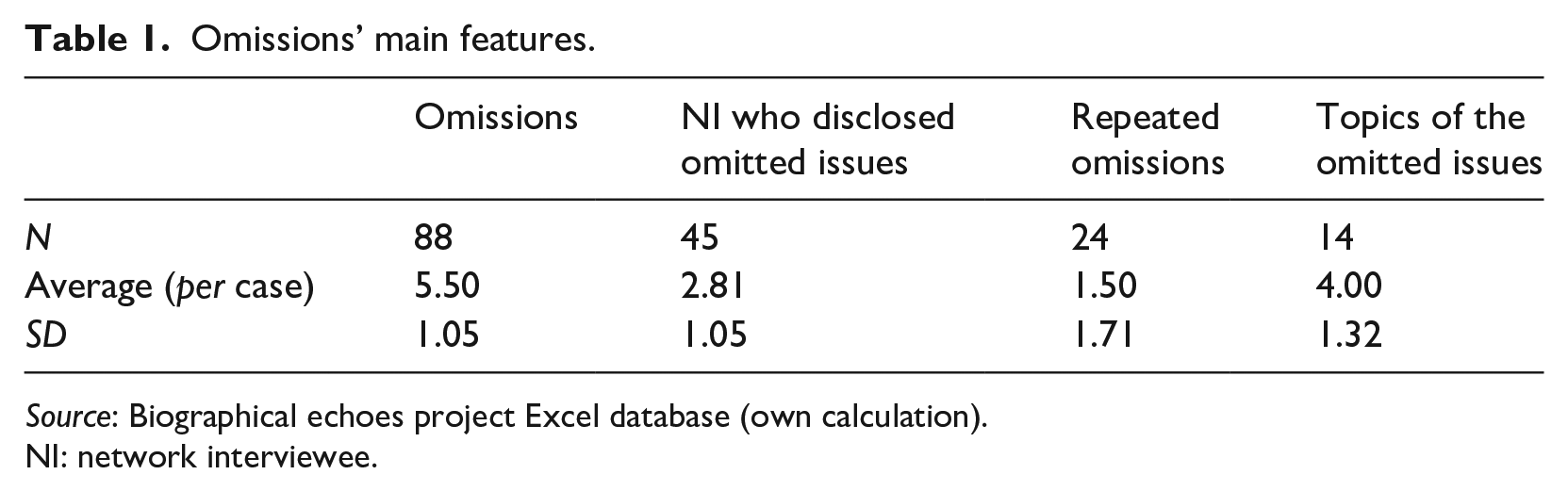
With only 16 biographical cases, we were surprised to find that all NPs omitted something in their autobiographical accounts, with a total of 88 omitted issues with biographical relevance, not included in the NPs’ self-narratives, which were disclosed by at least one NI (Table 1). A depression diagnosis, the lack of family support or the membership to a right-wing party are some examples of the things that were not revealed by the NP. The fact that all 16 NPs omitted events is a first indicator of omissions being part of people’s narratives and a transversal practice in the way they tell their lives. We did not find any specific social patterns in terms of sex, educational levels or occupational groups that differentiate who omits.
Omissions’ main features.
Source: Biographical echoes project Excel database (own calculation).
NI: network interviewee.
The high density of omissions is reinforced by the fact that there is an average of nearly six omissions per case (Table 1). We interviewed 64 NIs and 45 of them (70.3%) disclosed issues omitted by the NPs. On average, almost three NIs, per case, shared with us something that was not mentioned by the NP. Most of the NIs are family members, though closely followed by non-family individuals. Forty-three omissions (48.9%) were disclosed only by relatives, 27 only by non-family (30.7%) and 18 by both (20.5%). Within the family, there is a predominance of closer and intimate relationships, such as spouses and children. Within the non-family network, almost all interviewees disclosing omitted issues are friends. Family and friends, as privileged locus of proximity and intimacy, thus occupy a similar and central place in the knowledge they have on the NP’s life. In this sense, the type of relationship is not sufficiently differentiating to determine a clear pattern of omission.
This comprehensive awareness of the NPs’ biographies is reinforced by the fact that approximately a third of the omissions are repeated, that is, more than one NI is talking about a specific event or relationship of the NP’s life that did not come up in the autobiographical narrative: an average of 1.5 omissions were disclosed by at least two network individuals per case (Table 1), which points to the biographical relevance of what was omitted, as it also lends reliability to the account.
The unsaid concerns a wide and diverse range of topics, being 14 in total, and four, on average, per case (Table 1). Family issues (19.3%) are the most represented, followed by work (14.8%), health (14.8%), marital issues (11.4%) and family relations (9.1%). Despite the centrality of the family sphere (encompassing 43.2% of all omissions), in fact, what was not told by the NPs relates also to other key dimensions in their lives, such as love (25%), work (14.8%), health (6.8%), education (2.3%), politics (2.3%) and residential (2.3%) spheres. Severed relationships with close relatives, a kin’s health condition that changed the NP’s daily life, previous relationships, the current husband not being the father of the NP’s son, problems in getting pregnant, or conflicts at the workplace are all examples of undisclosed relevant topics. This transversality is also visible in the distribution of omissions across all age groups in which the omitted events took place in the NPs’ lives. Nonetheless, most of the untold happened when the NPs were between 61 and 70 years of age (28.4%). The omissions that refer to recent or even current biographical facts are more common, probably due to a memory effect, to the temporal proximity in which the events happened. The other higher concentration of omissions (21.6%) refers to a stage of life (21–30 years old) that is particularly dense in terms of events, usually corresponding to the transition to adulthood, where important decisions, such as moving out from the parents’ home, starting a family or the beginning of a professional career take place. We found no generational differentiating patterns regarding the NIs who disclosed omitted issues.
Basically, with this general overview of the omitted issues’ main features, we find within each case numerous omissions told by several people regarding a diverse range of topics and relating to various spheres of life. The recurring nature of omissions in these accounts point to four key aspects. First, omitting things is part of the exercise of presenting oneself to others. There are always processes of selection and filtering involved in autobiographical accounts. Second, the omitted issues have an almost unavoidable character in the process of telling someone else’s life story. The NIs were not able to share the knowledge they have on the NP’s life without tackling these things. Third, in an interconnected way with the first two, the omitted issues concern biographically important elements, being incorporated in the chain of events and relationships that make sense of a biography. The absence of key biographical topics in the NPs’ accounts that would help us to better understand their lives, as well as the number of repeated omissions emphasise even more the importance of what was omitted. And fourth, there is a discrepancy between the auto-perception that the NPs have on their biographies when telling their lives, and the hetero-perception that others have on those same biographies. So, despite the degree of knowledge of the NIs on the NP’s life, it is interesting to see that close family and friends do not have the same kind of concern over the image that is being conveyed of that person. The social and personal consequences of sharing something about one’s life are actually not the same as the ones of disclosing something about other people’s lives. And that may be the main reason behind this discrepancy.
Profiles of omissions
The frequency and transversality of the 88 omissions identified in the 16 biographical cases are key to understanding the unsaid as a common narrative feature in the process of telling a life. However, omissions can also be characterised by what differentiates them, both internally and externally. To move beyond a broader descriptive analysis of what these omissions are, we developed a Multiple Correspondence Analysis (MCA) to explore, quantitatively, if any privileged associations existed between the categories of a set of pertinent variables, thus configuring profiles of omissions, which could be approached qualitatively.
Five variables were included in this analysis: topic of the omission, omission acknowledged as a secret, the existence of hesitations by the NIs while disclosing the omitted issue and both the emotional and the relational impact of what was omitted. The selection of these variables results from the hints raised by the interpretation of the descriptive and bivariate exploratory analyses of the data, which pointed to these indicators as being potentially the most differentiating ones. Figure 1 presents the way the privileged associations between the categories of these variables are structured by two dimensions (impact and secrecy), configuring three distinct profiles of omissions: relational, light and taboo omissions.
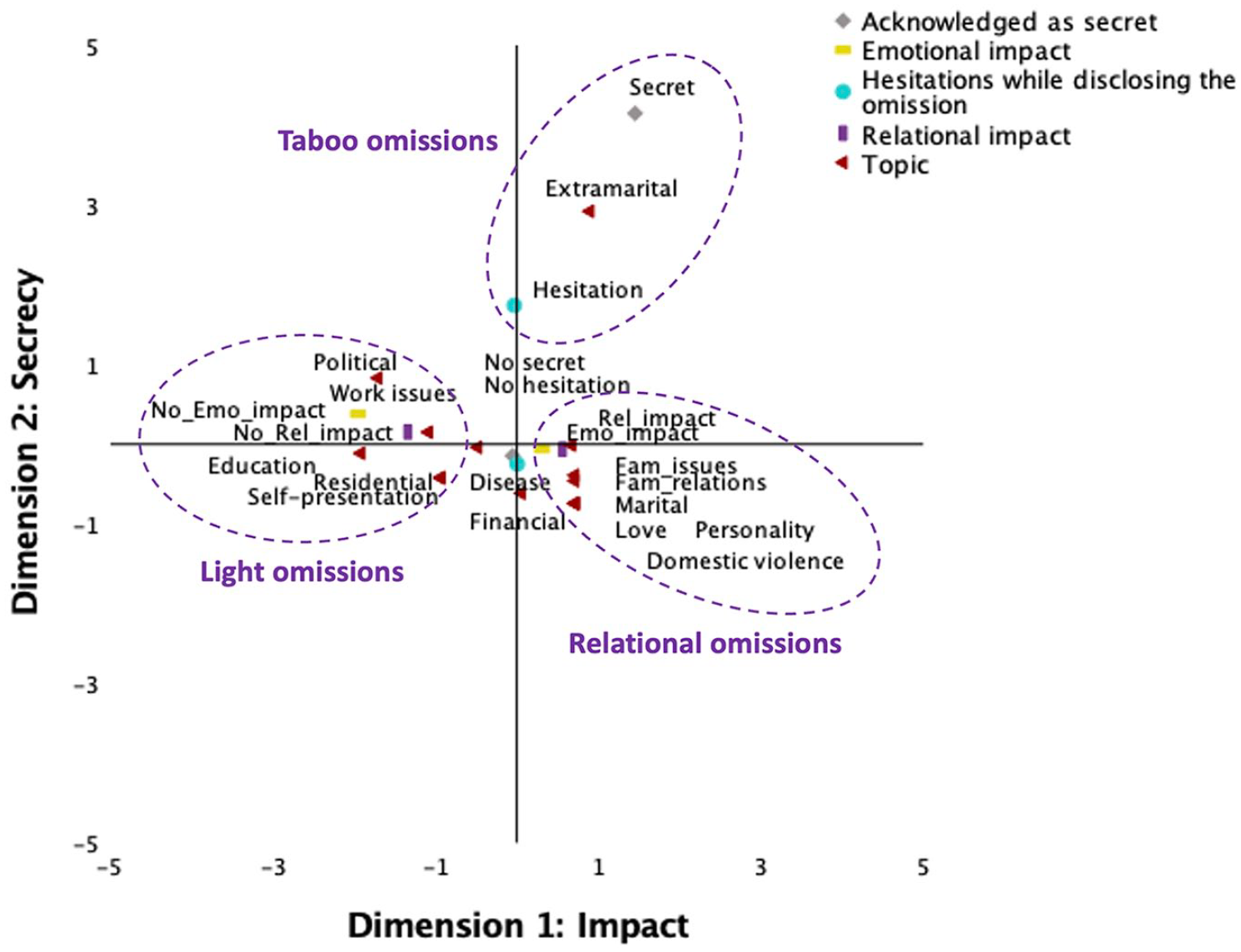
Profiles of omissions (Multiple Morrespondence Analysis).
Relational omissions are the core omissions. This is a homogeneous and not very distinctive profile, as can be seen both statistically, by the proximity to the centre and to the axes of the two dimensions in the matrix, and substantively, because it comprises most omissions out of the 16 cases. These omissions are characterised by three main features: they are interpersonal, private and highly impacting. First, they are interpersonal because they concern mostly issues connected to the NP’s close relationships. Second, these relationships refer to private domains of the NP’s life, which are usually only shared and known by those involved or very close people. This is also an indicator of the level of intimacy of the relationships between NPs and NIs. Family- and love-spheres-related topics prevail in this category, such as marital problems, family issues and relations, love relationships, domestic violence and personality traits. And third, these omissions refer to events and relationships likely to have a high impact on the NPs’ lives, given the centrality they have on their biographies. Here, we find occurrences with consequences in what the NPs feel and how they relate to others. The impact is then both on emotional and relational levels and reinforces the biographical significance of the untold. The husband who discarded his parenting responsibilities, a strained marriage or the way divorce affected the relationship with the children are examples of marital and family issues, while the reasons for never leaving the parents’ home or lacking proximity with relatives illustrate the family relationships’ topic. In terms of love, amid the untold are previous and unassumed romantic relationships. Having a child victim of domestic violence or the escape attempts from a violent marriage are issues related to the domestic violence topic. Regarding personality traits, for example, an NP omitted that having a short temper paid a relational toll with the family.
This type of issues is most likely omitted intentionally, given its private, relational and impactful nature. These are omissions frequently related to secrets (Meah et al., 2004; Scott, 2018; Smart, 2011) or sensitive topics (Ben-Asher et al., 2020; Huckin, 2002), deeply connected to other people and with the potential to negatively impact, namely in emotional terms, relationships, the self-image and the image of others (Kaźmierska, 2004; McLean et al., 2007; Spector-Mersel, 2011; Zerubavel, 2006).
The second profile encompasses what we call the light omissions. These are omitted issues with a low impact level, both emotionally and relationally, that concern events occurring in more public dimensions of the NPs’ social life. Most of the 88 omissions relate to events or relationships that had consequences in the NPs’ lives due to their biographical significance. However, a lower impact tends to be connected to occurrences in spheres of life with a more public nature, such as topics related to residential, educational and work trajectories, as well as self-presentation preferences and political statements. Buying a house but never moving there, the reasons for dropping out from Law school (which did not impede a successful career), a forced resignation from a job (with no effects in the occupational trajectory), feeling uncomfortable with the physical appearance (without implications in the social and love life) or taking part in a political revolutionary group (with no negative consequences) illustrate this profile. These omitted issues, concerning what happened in the public eye, and often witnessed by the NI, do not have the same degree of effects in the relationship with others and in terms of emotional balance, as the ones relating to more private and intimate dimensions of the biographies. For this reason, they are probably, in higher number, non-intentional and result from the combination of a dual dynamic. On one hand, the NPs may have not talked about a specific issue either because they did not remember its occurrence, or due to what they considered its lack of relevance. On the other, the NIs did not consider problematic sharing among such topics because the probability of negatively affecting the image conveyed of the NPs was low.
This profile of light omissions, which concentrates fewer cases, is more distinctive than the relational one. Both have in common the fact that the omitted issues were disclosed by the NIs without hesitation and with no sense of secrecy. There was no indication, both verbally and in terms of body language, that the NIs knew they were approaching a potentially sensitive topic that should not be told about the NP’s life. These subjects were tackled similarly to others during the hetero-narratives. This may be due to the mismatch between the internal (NP) and external views (NI) on the same life, that is, the NIs do not use the same evaluation grid as the NPs, in many cases not assigning the same emotional weight and negative burden to a specific occurrence in terms of self-image, even if they have a general concern of protecting the NPs’ privacy and image. There may be, in fact, omitted issues that we did not identify precisely because the NIs were aligned with the NP in the decision not to disclose something. But the frequency of omissions detected shows us that this is not always the case. There may also be a temporal factor at play in this process. Most omissions refer to situations that happened in the past, in many cases decades ago (around 60% took place up until the NPs’ 50s). The sensitive nature of some events and relationships that were omitted could have faded and lost expression, at least partially, over time, appearing, in the eye of third parties, as non-problematic issues.
The absence of hesitations and sense of secrecy in the disclosure of omitted issues are actually two of the features that characterise most omissions, so it is not surprising to find them both contributing to simultaneously define the two profiles (relational and light). Since they are not differentiated by the dimension relating to secrecy, what separates them is their position regarding the dimension of impact. Private, more intimate omitted aspects of the NP’s life are globally more impactful than the ones with a more public nature. Financial- and health-condition-related omitted topics are the only issues that are transversal to both profiles, since they encompass matters that can assume either a public or a private character. Having bought a house that turned into an unsuccessful real estate business or a wife suffering a stroke are omitted issues that have a more public nature, being known and testified by a wide array of people, while being financially aided by a son, or a wife having two abortions take on a more private and intimate character.
Finally, the third profile concerns taboo omissions. These omitted issues are mainly defined by the secrecy dimension. While disclosing them, contrary to what happened with the omissions from the other two profiles, the NIs showed a different attitude and behaviour: they were hesitant, unsure, carefully measuring their words, trying not to go too far and deepen the subject more than necessary, and explicitly acknowledging the subject as a secret, something significant that not everyone knows about the NPs’ lives, while also trying to protect the NPs, many times by justifying their actions and options. They did not spend much time approaching these issues, even if recognising their significance to the NP’s biography. Most taboo omissions relate to extra-marital relationships that happened in the past and their disclosure was generally surrounded by some secrecy and hesitation. These issues are typically viewed as reprehensible behaviour and are emotionally charged. This may explain and add yet another layer of sensitiveness to the topic, due to the perceived harm that its disclosure can bring to the NP’s image and to the family involved. These are, as such, issues with a high level of potential impact in both emotional and relational terms.
The low level of concentration of omissions in this profile is an expression of the sensitiveness of these topics, probably referring to issues that were intentionally left out of the autobiographical narratives. It can be understood as a protection effort from the NPs, who may have avoided disclosing information that could jeopardise a coherent, morally acceptable image of themselves (Ben-Asher et al., 2020; Huckin, 2002; Kaźmierska, 2004; McLean et al., 2007; Spector-Mersel, 2011). The selection of information is, moreover, an exercise of agency, control and power (Fivush, 2010; Motsemme, 2004; Scott, 2018; Zerubavel, 2006). It also indicates that this type of omission is harder to observe. These may well be the issues in which NPs and NIs are more aligned in terms of what should and should not be revealed about the NP’s life, sharing personal and cultural frameworks of what is socially and individually acceptable to disclose about a biography. We may have accessed only the more public and tellable ones.
The sociological significance of omissions: plausible final notes
Omitting something means something. The characterisation of the omissions and their structuration in three profiles point precisely to the importance of the act of not talking about a specific issue while people are presenting their lives. Omissions have, thus, both a social and a sociological meaning. From the analysis of the data, we can explore that significance at two levels: (1) the first one at the biographical level, regarding the social processes of identity building, and (2) the second one at the analytical level, concerning the very structuration of the life stories.
Behind the act of not addressing a given occurrence or relationship while a life story is being told are important social mechanisms that play a biographical role (Figure 2). First, the life as told is a way for people to present their lives, providing an opportunity to convey a certain image of the self. While doing this, by putting together and giving order to a diverse array of experiences, with different temporalities, in multiple spheres of life, they are also narratively building and reinforcing their auto-perception (Bruner, 1987). So, omitting something can be an exercise of controlling the self-image, both for themselves and for others. All the three omissions’ profiles testify to this. The control that results from this act can also be a way of assigning coherence to the life story, by avoiding issues with the potential of making the autobiographical narrative inconsistent with what was already told (Kaźmierska, 2004; Rogers et al., 1999). The singleness of the self is a socially well-founded commonplace illusion that allows people to feel themselves and their lives as coherent and consistent entities, despite the plurality and heterogeneity that characterises their dispositions, perceptions and practices (Lahire, 2011 [2001]: 11–26). And, finally, control as a way for people to detach themselves from a specific role they are playing or have played that has a negative burden to it (Goffman, 1961). For example, the NPs who had affairs might not want to present themselves as cheaters, not only because they might feel embarrassed about their actions, but also because they may not identify themselves with the social meanings and implications of that role. Putting a distance between practices and the interpretation of those actions can be a vehicle for ensuring ontological security (Giddens, 1991).
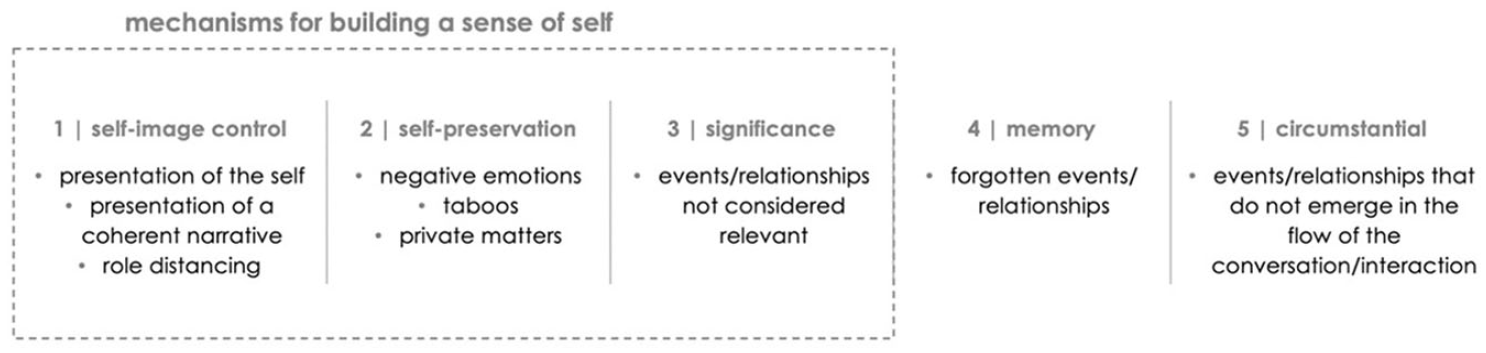
Biographical meaning of omissions.
Second, the control exercised over the self-image is indissociable of a certain effort of self-preservation. The issues that were omitted were frequently connected to private matters and negative emotions with direct impact in people’s lives. Talking about it would imply reliving uncomfortable and even harmful experiences potentially causing them anxiety (McLean et al., 2007; Zerubavel, 2006). There are also social, as well as emotional consequences of people telling certain things about their lives to others, namely, to relative strangers, as we, researchers, were to them. It must also be taken into consideration that we were going to interview people close to the NPs. So, by omitting something, they were also protecting themselves, their relationships and emotions from those effects. The profile of taboo omissions is probably the one where it becomes clearer how omissions can act as a self-preservation tool, but it can also frequently connect to the issues in the relational profile.
Third, and in parallel, while telling their life story, it is virtually impossible for people to cover the whole of their lives in an interview (Bruner, 1987; Rosenthal, 1993). They choose what they consider to be most significant to present themselves and their biographies as a response to the questions asked (Scott, 2018; Spector-Mersel, 2011). In this sense, some events and relationships, regardless of their profile, may be omitted simply because of those inevitable selection processes.
Fourth, memory also plays a central role in an autobiographical narrative. Memory is built over time, structured by experiences and contexts, and also prompted by certain stimuli. During an interview, individuals do not always remember every single occurrence, people and detail from their lives (Andrews et al., 2004; Spector-Mersel, 2011). They may forget specific events, especially the most trivial ones, and also fail to mention something relevant in the urgency of the moment. The light profile may be the most prone to this type of memory effect, if we consider more probable the possibility of people forgetting issues with less impact and emotional charge.
And finally, the act of omitting something might be circumstantial, in the sense that what people tell us is also dependent on the context, on the interaction, and on the flow of the conversation. If we do not ask people about specific things, chances are that they might not have the opportunity to talk about them. If the course of the narrative is going in a specific direction, it might not go other places. This may be the case for all types of omissions, despite their positioning in the private-public domains continuum.
We believe that, in many cases, the reasons for omitting something result from a mix of these different elements. Some of them are more connected to conscious and intentional processes, others to non-conscious dynamics. In most cases, it is most likely a combination of the two. In the same autobiographical narrative, some things are intentionally left out, while others forgotten. Furthermore, people may consciously decide not to tell something, but they might not be fully aware of the reasons behind it. Nonetheless, from these five dimensions, the first three are the ones that link directly to identity construction processes. The way people control the image they convey to others, how they try to preserve themselves and the selection they make while telling their life stories are, above all, mechanisms for building a sense of a coherent self (Holstein and Gubrium, 1999). Our analysis contributes precisely to understand how these identity processes, generally pointed out as key in the literature (Ben-Asher et al., 2020; Meah et al., 2004; Spector-Mersel, 2011), are empirically consubstantiated. Omissions play, fundamentally, an identity role and that is what grounds their sociological relevance. They are a biographical tool because they allow individuals to manage and control their self-image and self-presentation. We argue that by understanding what they are about, in which number, of what type and with what impact, we are able not only to reinforce the consensual idea in the literature that the unsaid, being an inherently communicative practice, is socially and sociologically meaningful (Blix et al., 2021; Kawabata and Gastaldo, 2015; Rogers et al., 1999; Scott, 2018), but also add to the discussion the notion that omitting something in the process of narratively building a sense of self is a socially differentiated practice that can be analytically typified.
The importance of studying omissions in sociology is also related to the contribution it gives to better understand how life stories are structured. Even though the existence of omitted issues is generally acknowledged in the literature of biographical research (Kaźmierska, 2004; Rosenthal, 1993), their real importance and weight in the way people tell their life stories can only be fully understood if we have the means to observe them, as we did using triangulation. Even if some aspects related to non-verbal communication are problematised in the literature (Ben-Asher et al., 2020; Blix et al., 2021; Lechner and Solovova, 2014), without specific ways of identifying and exploring the unsaid, it is not always possible to approach it. That is one of the main contributions of this analysis. Omissions are perhaps more frequent than we, as biographical researchers, might imagine. There are always ‘no-go zones’ (Zerubavel, 2006: 27) in life stories. The omissions observed in the Biographical echoes project testify their transversality and biographical relevance. If we were already open to that notion and fully aware that there are things not talked about during an interview, this study reinforces the key idea that when we analyse someone’s autobiographical narrative, we are fundamentally looking at snapshots that show us segments of life, which allow us to have a sense of the whole, but there are also aspects, relevant ones, left out of the picture or at least hidden within it. The life as told, in Bruner’s (1987) sense, is always a partial version of a biography. It is like looking at the negative of photographs, where the darkest areas suddenly appear lightest. Omissions basically come to light with this exercise. They may be of different types and have different weights, as we saw, but they help to bridge gaps we did not even know existed.
Footnotes
Acknowledgements
The authors would like to thank their friends and colleagues in the Echoes project, Magda Nico and Anabela Pereira, for the shared and enriching debates, the critical reading of this article and the companionship.
Funding
The author(s) disclosed receipt of the following financial support for the research, authorship and/or publication of this article: This work was supported by Fundação para a Ciência e a Tecnologia (PTDC/SOC-SOC/29117/2017).
