




Abstract
This short article reviews some of the colonial underpinnings of the field of Medieval Irish Studies (a subdiscipline of Celtic Studies), using the career of Whitley Stokes (1830–1909) as a case study in the entanglements between British colonial activity in India and the development of philological research on medieval Irish literature in the 19th century. It then proceeds to use autoethnographic reflections from graduate students in the field of Medieval Irish Studies whose backgrounds locate them at various intersections of race, ethnicity, gender, sexuality, and class. These reflections offer constructive pathways toward working to decolonise the discipline.
Our purpose in writing this article is to reach out to colleagues, not only in our own discipline, but in other disciplines across the humanities and social sciences, in order to engage with a wider conversation on decolonial discourse and praxis. We seek to elucidate the colonial origins of our own discipline (Medieval Irish Studies) and interrogate the effects of those origins on power relations, minority experiences, and anticolonial strategies in the discipline today. We situate these within the context of the modern, western European, neo-liberal university system within which we work. Like many academic disciplines which developed in western European universities in the 19th century, the discipline of Celtic Studies, within which sits the subdiscipline of Medieval Irish Studies, is rooted in ideologies which cannot be disentangled from discourses of race, empire, and colonisation. In the first part of this article we will set out a brief history of our discipline and its multifaceted colonial entanglements; we will then use one particularly influential scholar as a central case study, before moving to look at here and now, based on the autoethnographic experiences and reflections of the doctoral researchers in the Maynooth University Department of Early Irish who are the co-authors of this article. We suggest that the colonial roots and hegemonic framing of Celtic Studies shape the intersectional experiences of researchers today. We conclude by reiterating the urgency of decolonisation and suggesting possible directions for future work. We offer this article as a collective work and, in order to protect Early Career Researchers, the experiences and views reported in this article are anonymised insofar as it is possible for the experiences of six people to be ‘anonymous’: perhaps it is better to say simply that these views are offered collectively, by us all, without attribution to any individual.
Developments in linguistic science from the late 16th century onwards determined that there was a family of related languages which were given the designation ‘Indo-European’. Within the Indo-European language family, which includes Hindi-Urdu, Spanish, Russian, Armenian, English, and French, was identified a subgroup of languages given the name ‘Celtic’. Within the Celtic language family are several languages which are now extinct, in addition to the living but vulnerable languages of Irish, Welsh, Scottish Gaelic, Cornish, Manx, and Breton (Russell, 1995). The study of these languages, and the historic literatures written in them, formed the basis of the discipline of Celtic Studies and, within that, Medieval Irish Studies. That these languages are in some way related is not in doubt; neither is the fact that they share some linguistic roots with many other languages of the northern Indian subcontinent, Eurasia, and Europe. Colonialism in the early modern era also led to Indo-European languages such as French, English, Spanish, Dutch, and Portuguese being implanted in large parts of the Americas, Africa and elsewhere, and the European origins of these diasporic, colonial languages is uncontested. However, the problems with the Indo-European model, particularly as deployed in scholarship in the 19th and 20th centuries, are manifold and go to the heart of the colonial roots of the discipline of Celtic Studies.
Ananya Jahanara Kabir (2023) has shown the problematic nature of the ‘family tree’ model in forming ideas of linguistic hierarchy and linguistic purity. In relation to hierarchy, some languages are represented and perceived as being ‘core’ (i.e. major branches, often closer closer to the ‘trunk’ of the tree), and thus more significant and culturally important. It is fair to say that the Celtic language family is very much perceived as a peripheral and minor branch of Indo-European family tree, more an archaic object of scholarly curiosity than a living linguistic organism. In relation to purity, the nature of the ‘tree’ model is that distant branches do not touch in the present—they connect back to shared hypothetical historical roots, but are represented as distinct and unconnected in the reality of today. Languages are thus depicted as growing quite separately, ‘uncontaminated’ by quotidian contact with each other across branches. Kabir argues for a ‘creolising’ model, based in the scholarship of the German linguist Hugo Schuchardt (1842–1927), as a useful heuristic for critiquing the generalising claims which underpin the Indo-European frame; she shows how language contact in its various manifestations can fundamentally disrupt Indo-European ‘arboreal taxonomies’ (Kabir, 2023: 222). The effect of the direct contact between, say, Spanish and the indigenous languages of central and south America, can be more revealing of linguistic change and development than the fact that the latter languages do not share Spanish's Indo-European roots. This ‘creolising’ impact on language can be seen today in the distinct form of English used in Ireland, which brings a Celtic language (Irish) and a Germanic language (English) into a symbiotic relationship, albeit one with distinct cultural and hegemonic inequalities. The modern development of Hiberno-English, with its distinct grammar and vocabulary shaped by the Irish language, could be argued to be far more significant than any putative moment of prehistoric linguistic unity or ancient shared linguistic origins between the two languages (before their hypothesised ancestor language diverged into proto-Celtic and proto-Germanic, respectively).
Indeed, there is much that can be gained when historical linguists working on Irish and other Celtic languages look out from the Indo-European paradigm and consider the possibilities offered by different linguistic models. One might compare the work of the 19th-century Romanian Jewish philologist, Lazare Sainéan (born Eliezer Schein) (1859–1934), for example, who argued that dialects, creoles and minority languages—such as Yiddish, in a European context—were equally as deserving of study as ‘pure’ literary languages, such as German (Davis, 2022). Yiddish offers an excellent case study for looking beyond Indo-European models, since it results from direct encounters between Indo-European and Semitic languages. Sainéan was resisting the dominant trends in philology: in the words of Alex Drace-Francis (2023):
As linguists borrowed templates from simultaneous discoveries in the natural sciences—particularly geology and palaeontology—some envisaged words as fossils encasing deep clues as to primordial forms, scarcely subject to the varying verbal weather conditions of recent centuries. Long-term factors such as phonological and morphological change were privileged over the agency of individual speakers, and enshrined as invariable laws of word formation, impossible to contradict through the invocation of isolated instances.
Sainéan sought to place individual human agency at the heart of language change and language development, just as Kabir's ‘creolising’ approach foregrounds dynamic human contact and experience over abstract linguistic rules.
However, in critiquing 19th-century philological discourse it is crucially important to be mindful of the racialising dimension, since it is clear that much philological scholarship in the 19th and 20th centuries that focused on minority or marginalised, and even creole, languages was still embedded in nationalistic projects that did not seek to disrupt assumptions about racial hierarchies. Sainéan sought to reimagine what it was to be Romanian in the 19th century, with projects on Romanian language and literature which expanded its canon and elucidated its cultural diversity, and yet he fell foul of antisemitic citizenship rules and was denied citizenship of his own country because he was Jewish. The legal and social rehabilitation of the Irish language was integral to the vision of a postcolonial independent Ireland in ways that intersect with the rehabilitation of marginalised languages in other colonised societies, but are not identical to that of, say, postcolonial Kenya or India or Barbados, where racialisation went hand in hand with the British colonial project. We are mindful of Ireland's position as a white majority country where scholars who are (or pass as) white may have a substantially different experience to those who are racialised. As will be seen in what follows, we are also mindful of Ireland's dual position as both colonised and coloniser, which further impacts considerations of decolonisation in the field of Medieval Irish Studies.
Colonialism and Celtic Studies
Celtic Studies, and its subdiscipline of Medieval Irish Studies, have been acutely shaped by 19th-century philological methods. One resulting problem has been the way that, in the 19th and early 20th centuries, ‘language’ was generally equated with ‘culture’. Scholars expounded theories based on the idea that if a group of people shared a language then they must surely share other characteristics, including social, religious, and cultural practices. Similarities between Medieval Irish and Welsh literatures, for example, were regarded not as the result of direct cultural contact between Ireland and Wales in the Middle Ages, but as proof of a shared, culturally homogeneous, ancient ‘Celtic’ past. On a broader level, the Indo-European family of languages was most notably situated in opposition to the Semitic family of languages, including Hebrew and Arabic, and a cultural hierarchy was created which viewed a homogeneous Indo-European culture as superior to its Semitic equivalent. 1 Thus in India, under British colonial rule, this manifested as a contrast between the ‘noble savages’ who were (Indo-European) Hindus, and merely ‘savage’ (Semitic) Muslims, with fatal consequences which continue to be felt to the present day. 2 (Indigenous languages of the Americas, Africa, and Australasia were treated with yet greater disdain: see, for example, Gilmour, 2007; Meakins and O'Shannessy, 2016.) These global questions offer important context for our focus on the role of the Celtic language family, and specifically medieval Irish, within that discourse. Even within the Indo-European language family, hierarchies were created, and cultural prejudices and inequalities were given ‘scientific’ support by philologists who pitted the ‘rational’ and ‘manly’ speakers of the Germanic language family (which includes not only German but also, crucially, English) against the supposedly ‘irrational’ and ‘infantile’ speakers of the Celtic language family, who needed the civilising influence of English colonisation (Brown, 1996). Herein lies one of the most important and complex aspects of the relationship between Celtic Studies and colonialism, namely that while the Celtic-speaking peoples of Ireland, Wales and Scotland were active participants in the colonial violence of the British Empire, those same peoples had in the case of Ireland (and arguably also in the case of Wales, though much less so in the case of Scotland) also themselves been colonised. Ireland was England's first colony, from the 12th century onwards, and yet Ireland, and Irish people, played an active role in British imperialism in the early modern and modern eras (for the early colonisation of Ireland see, e.g. Gillingham (2014); for Ireland's role in British imperial expansion and consolidation see most recently O’Leary (2023)).
Following the publication of Edward Said's seminal work, Orientalism, and the intensification of attention to the framework of postcolonial theory, some scholars working in the field of Celtic Studies turned a critical eye on their own discipline. This was most notably marked by the publication in 1996 of a volume of essays edited by Terence Brown and, very deliberately, entitled Celticism. However, while it offered an important intervention in questioning the romantic-nationalist stereotypes of medieval Ireland as being ‘mythical’, exceptionally ‘creative’, more ‘artistic’ than their rational Germanic-speaking counterparts, and pulled apart some of the problematic paradigms which had arisen from equating language with culture, it did not address Ireland's own role as an integral part of the British colonial project elsewhere in the world. Furthermore, it is notable that in recent years there has been a regression in this regard, as a slew of popular, bestselling books about the Irish language and Irish cultural history have returned to equating language with culture, evoking ‘our ancestors’ and ‘our landscape’ as particular points of access to an Irish cultural inheritance which is allegedly mediated through the Irish language and is thus less accessible to non-Irish-speaking people in Ireland, an idea which buys into a repackaged version of the colonialist concept that the Irish language is inherently more ‘poetic’ or ‘mystical’ than English, which is ‘rational’ and ‘modern’ (see, e.g. Magan (2020); Magan (2022)).
In the words of one of our authors: Colonialism touches every aspect of medieval Irish historiography: the field itself was born of debate between nationalistic pro-Ireland scholars on one side, attempting to revive an idea of ancient Celtic exceptionalism; and pro-colonial power on the other, countering these ideas and arguing historical need for the “civilizing” efforts of colonialism.
Case study: Whitley Stokes (1830–1909)
One of the most enduringly influential scholars in the field of Medieval Irish Studies is the philologist and colonial jurist, Whitley Stokes. Born in Dublin in 1830, Stokes spent 20 years in India working to codify Anglo-Indian law. He had studied law in London in the 1850s and returned there in the 1870s, until his death in 1909. During his lifetime, he published some 30 books and 300 scholarly articles, predominantly editions and translations of medieval Irish texts (for a bibliography see Ó Cróinín (2011)). The choice of Stokes as a case study is a crucial one, not only for his embodiment of the colonial roots of the study of medieval Irish literature, in his juridical career in India, but—more urgently—because we are still, in the 21st century, hugely reliant on his editions and translations of (literally) hundreds of medieval Irish texts—editions and translations which have still not, a century and a half later, been superseded. In innumerable cases, Stokes' edition and translation of any given medieval Irish text remains the only edition and translation to have been published.
Ananya Jahanara Kabir has encapsulated the way in which Stokes' seemingly distinct intellectual activities—philological and legal—in fact were deeply entangled: ‘In the ostensible division of his labours as well as in their deeper affiliations … Stokes exemplified the consolidation of what I call “imperial medievalism”, or the mutually formative relationship between the construction of the European Middle Ages and the governance of the British Empire. Imperial medievalism crystallises along three axes: land, law and language. Holding all three together is comparative philology, the central discipline of the long nineteenth century’ (Kabir, 2011: 79). Kabir considered what she termed the ‘entanglement of Celtic, Saxon and Hindu in the imperial domain and imaginary’ (Kabir, 2011: 79), through the lens of Stokes' scholarly and legal activities, demonstrating the inextricable links between empire and philological inquiry, as embodied in the figure of Stokes himself. She referred to two striking pieces of evidence: one visual, another textual. The visual evidence is a photograph of Stokes and an unnamed Indian clerk (reproduced in Chancellor, 2011: 76, and shown below). In this portrait, Kabir writes, ‘Celt and Oriental stand side by side in his [i.e. Stokes'] universe without exchanging glances’ (Kabir, 2011: 83). In this respect, the image depicts, in portrait form, the arboreal linguistic model: the languages descended from Stokes' Germanic and Celtic, and the clerk's Sanskrit, ancestors do not ‘exchange glances’, so to speak: despite the influences of loan words and other forms of language contact, they are depicted as distinct entities which do not touch or interact in any way. They are juxtaposed but unconnected, except through deep and unseen roots.
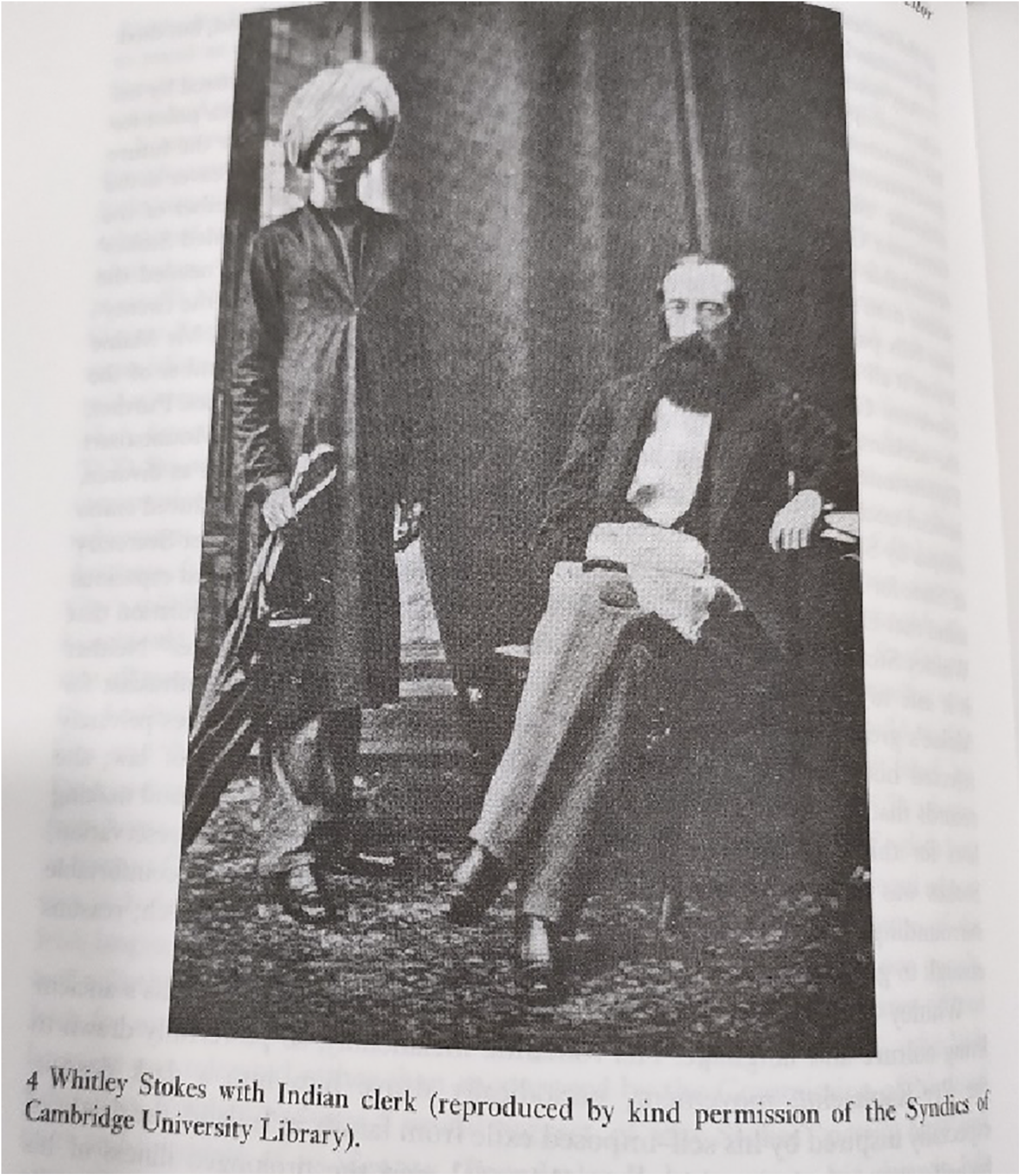
If the image of Stokes and the unidentified Indian clerk provide a defining image of the colonial basis of Medieval Irish Studies, then the defining words are perhaps to be found in a piece of textual evidence at the end of Stokes' edition of the medieval Irish adaptation of the Troy narrative, Togail Troí ‘The Destruction of Troy’ (Stokes' additional text published and discussed in Boyle and Russell (2011: 1–3); with further analysis by Kabir (2011: 92)). Stokes writes, in an artificial form of Old Irish, a colophon to his work which can be translated thus: This little work has just been finished in Simla, in the land of the five rivers, on the twenty-first day of the month of September in the year of the age of Christ 1881, by the eldest son of William Stokes, chief physician of Ireland in his time, of Dublin. And my heart is heavy, for my wife—who would have loved this little book—is dead, and my dear little daughter, i.e. Medb, is ill, and many of my friends are dead, and my friends who are alive are few, and Ireland is sad from the traps and deceits and kin-slaying, and the outrages which evil men are doing, both English and Irish. (Stokes, 1881)
Our discipline stands on the shoulders of an Irishman whose professional career as a lawyer was devoted to the codification of Anglo-Indian law and thus the jurisprudential cementing of British colonial power in India. Even as new generations of scholars enter the field of Medieval Irish Studies from ever more diverse backgrounds, these colonial disciplinary roots need to be considered in active and engaged ways, because they can still shape the experiences—both intellectual and practical—of scholars working within the discipline today. In the final section of our contribution we move to look at how scholars from various marginalised backgrounds experience the field of Medieval Irish Studies in the present, and we propose ways in which decolonisation could be deployed as a vital tool for our discipline.
Decolonising a colonial discipline
Listening to personal experiences is one important way in which we can be mindful of the way historical colonisation impacts awareness of the colonial roots of the discipline, and thus we base this final section on autoethnographic experiences. One of our authors states: My parents were refugees from Vietnam, which for centuries was either under French or Chinese rule and, being from Australia, I am aware of the British exploitation and violence towards Aboriginals because of colonisation. Korea (both north and south) was colonised by Japan. In Korea we study Japanese colonialism at school, but Japanese schools do not teach the period of colonialism between 1910–1945 … Why don’t they teach it? It's important to focus on power discourse, invisible power, hegemony, and cultural hegemony.
likes to deny having anything to do with colonialism (a.k.a. “we didn’t have any colonies because colonies are supposed to be overseas!”)
the colonial violence in Brazil against natives and enslaved Africans, mostly performed by Portugal, is deeply rooted within our society. Echoes of the so-called “civilising” and “salvational” project range from the dismissal and justification of the impacts of colonisation to the current non-recognition of native land rights.
Intersectionality is another key point, and colonial and racial power cannot, we would argue, be singled out without consideration of other factors including class, sexuality, gender identity, and, specifically within academia, one's perceived status in the academic hierarchy. One of our authors, who is not white, observes that some of the most hostile treatment that they have received has been about status rather than race: the closest I came to being angry at my treatment was when I was at a conference and an older academic thought it was beneath them to speak to students. my general experience is that male scholars do not take sexuality research seriously and rather repeatedly attempt to categorise me as a gender scholar or imply that I study women's history. It is a strange, paternalistic attitude that remains in the field, that women should somehow be protected from “sex” and be contained in the parallel field of gender, which male academics can perhaps more comfortably discredit.
One suggestion applies to all academic subjects in Ireland and not just our own. As one of our authors states: Students from non-EU countries face a lot of difficulties in obtaining scholarships for European programmes. This can be seen with the IRC Postgraduate Scholarship which states that “While the majority of scholarships will be awarded to applicants who fall under category one, a proportion of scholarships will also be made to exceptional applicants who fall under category two”. Category one refers to EU students and category two refers to non-EU students. The IRC states that in 2020, the success rates for Arts, Humanities and Social Sciences for combined categories one and two was 18% and for category two only 8%. In relation to Medieval Irish Studies, this discourages potential students from other regions of the world such as Asia and South America from studying the field and gives the perception that the EU only wants white Europeans … If we are to make the field of Medieval Irish Studies more diverse then we need to broaden the geographic area that we accept students from so that we can go beyond Eurocentric analysis of the field. as with so much of Eurocentric scholarship, Irish Studies seems to mostly attract scholars of a particular background (based in Europe or North America, middle class, white). … I have met scholars from other parts of other world, such as China, Japan and Brazil. But I feel like it's more difficult for those people to establish themselves in the field simply because it is so centred around European and American universities. This problem also extends to conferences, which are mostly held in the EU or USA making it harder for other students to attend. Even though these were made more accessible after the pandemic, the cost of attending such a conference is, for some students, too high. The minimum cost for a conference such as IMC Leeds would cost a Brazilian student 25% of a minimum wage, while it would cost 5% of the minimum wage for an Irish student. Conferences of such magnitude can and should reserve a number of free slots for non-western countries to promote new scholars and perspectives.
Another key proposal is the more open-minded yet judicious use of comparative study. One of the major problems of the Indo-European linguistic model, as noted at the outset of our paper, is that 19th-century scholars mapped ‘language’ onto ‘culture’. This has meant, in the long term, that comparative studies of medieval Celtic literatures have tended to place them in conversation with the literatures of other Indo-European languages. People have identified similarities between Sanskrit literature and medieval Irish literature, or between Classical Greek literature and medieval Irish literature, and used those similarities to posit shared Indo-European roots for more than just languages—these shared roots allegedly encompassed literary motifs, social institutions and narrative patterns. But the argument is circular: if you only compare medieval Irish literature with other Indo-European literatures, then you will only find similarities with other Indo-European literatures. However, comparing other literatures can yield fascinating insights. Current ongoing comparative research by Seungyeon Lee at Maynooth University on medieval Irish and Korean literature is revealing a multiplicity of commonalities. Are these similarities indicative of shared, universal concerns? Are they indicative of the comparability of medieval Ireland and Korea's geopolitical situations, as ‘peripheral’ kingdoms at the edge of large, powerful empires—Christian Rome and its successor states in the case of Ireland, Buddhist China in the case of Korea? Many questions remain unanswered at this stage, but one thing is for sure: looking beyond the limitations of the Indo-European model and outwards toward other medieval cultures is offering new insights to medieval Irish literature.
Similarly, in the linguistic field, one of our authors points to research which compared aspects of the grammar of Old Irish with that of the language of the North American First Nation band, the Odawa (or Ottawa), whose territories cross the modern colonial border of the United States and Canada (Bowers, 2015). And this article has suggested that alternatives to the arboreal Indo-European model, such as the ‘creolising’ framework elucidated by Kabir, might offer another promising avenue. One of our key proposals, then, is to lift our eyes beyond Indo-European horizons and to take a sensitive global approach, which recognises difference while also offering new insights to our field and to the cultures with which medieval Irish sources are being compared. We use terms such as ‘judicious’ and ‘sensitive’, because we are also skeptical of the value of tokenistic comparative research where scholars do not have access to the primary languages of all the cultures being compared. There has been a recent trend in medieval studies more broadly to highlight the so-called ‘global middle ages’. The best research in that area is truly groundbreaking, but a significant amount of the ‘global’ comparative work that is being done is mediated through English translations, many of which were themselves produced in colonial contexts. We find this deeply problematic. Of course it is not always possible for an individual to master several languages (although to generalise somewhat, monolingualism does seem to be a peculiarly Anglocentric problem!), but in those cases we propose collaborative work with those who do have direct access to primary sources in their original language(s). We might point, for example, to the Network for the Study of Glossing, based at the University of Galway, but including researchers in countries ranging from Argentina and Brazil to Korea and Japan, working on medieval cross-cultural reading practices (see http://www.glossing.org/).
The study of the construction of race, and the history of racism, in the European Middle Ages is a vibrant area of study, particularly in relation to medieval England, and there is much that can be done to bring Ireland into this discourse (for a range of approaches to premodern racism, see Heng (2018); Whitaker (2019); Seth (2020); Ndiaye and Markey (2023)).
Several of our authors want to emphasise the importance of ethical citation and inclusive readings lists (on these questions, see Smith et al. (2021)): One way to decolonize the subject matter is to have a more diverse reading list for modules and I think this is particularly true for medieval Irish history and literature. While I do understand that there are influential or fundamental works in Medieval Irish Studies that a student should read, you mostly see the same scholars’ names appear repeatedly on reading lists; and these names are mostly of white male academics, particularly those who are British or Irish … Thus, it would be nice to have more female academics and non-Irish/British academics on the reading lists, particularly as the latter can offer a non-Eurocentric perspective. But, of course, to have a more diverse reading list, we need a more diverse cohort of scholars studying the field. I believe that Medieval Irish Studies has almost unlimited creativity in how it could be studied, and we are long past the need for reliance on nationalistic and Eurocentric exceptionalism in how we frame and promote our research. Medieval Ireland was part of, and actively interacted with, a huge network of ideas across the world, and it is not only limiting to ignore these connections, it is inaccurate.
Footnotes
Declaration of conflicting interests
The authors declared no potential conflicts of interest with respect to the research, authorship, and/or publication of this article.
Funding
The authors received no financial support for the research, authorship, and/or publication of this article.
