




Abstract
Peacebuilding in contested societies is a cross-sectoral enterprise in which young people are primary stakeholders. Multilateral state-sponsored programmes and philanthropic agencies have resourced a vibrant youth sector delivering peacebuilding initiatives in Northern Ireland and the border counties. Despite billions in investment and a rich tapestry of transformative practice, a visionary peacebuilding strategy co-created with young people has remained elusive. As a result, youth sector peacebuilding in Northern Ireland is inhibited by an obstacle facing civil society peacebuilding across the globe – an ill-articulated vision resulting in pockets of disparate practice. Based on empirical research involving 43 youth work practitioners, this article offers a novel and rigorous methodological framework and sociological analysis to support researchers, policymakers and practitioners in contested societies to advance conceptualisations of peacebuilding. Freeden's framework of morphological analysis is operationalised through Q methodology leading to the identification of four distinctive orientations to peacebuilding. Bourdieu's concepts of capital and field are drawn upon to analyse the four perspectives, framed within a new sociopolitical model of youth sector peacebuilding. Tensions between harmonising versus politicising propensities are discussed as a substantial divergence variously incentivised or neglected by powerful actors within the field with significant implications for the trajectory of practice.
Introduction
This article presents a new lens through which to conceptualise and critique peacebuilding work with young people in contested societies. Utilising an innovative integration of conceptual, theoretical and methodological tools, distinctive co-existing perspectives on peacebuilding that have not been adequately articulated or analysed within the youth sector are drawn out. A novel sociopolitical model of youth sector peacebuilding that frames the discussion of findings from this study with 43 youth work practitioners is significant in the context of increasing demands for quantitative measures of peacebuilding outcomes with young people. A new language is offered underpinned by empirical evidence as a vehicle for practitioners, policymakers and academics to better articulate and debate the various approaches that are valued or indeed devalued in the way youth sector peacebuilding is funded and held to account.
Youth work and peacebuilding in Northern Ireland
Throughout the past half century in Northern Ireland, peace work has featured as an integral aspect of youth work (McCready and Loudon, 2020). This work is situated in the context of conflict legacies arising from protracted ethno-political violence dominating the latter three decades of the 20th century, claiming the lives of more than 3600 people. Young people aged between 20 and 24 years accounted for the highest proportion of deaths by age group (20.2%; Smyth and Hamilton, 2003). More than 40,000 people are estimated to have been injured during these years known as the Troubles, formally ending in 1998 with the signing of the Belfast/Good Friday Agreement (Smyth and Hamilton, 2003). The impacts of the Troubles were and continue to be acutely felt in a region making up <3% of the UK population (NISRA, 2022). Segregated social housing and education persist as a legacy of conflict (HENI, ca.2022; Milliken, 2021) and paramilitary-killings, while far from the levels of pre-1998, have not been entirely eradicated. Tackling paramilitary violence remains a pertinent policy focus (DoJ, 2018). Trauma related to the troubles is prevalent and has been found to have a significant impact on children and young people through transgenerational transmission (O’Neill, 2015).
Youth work practice has evolved and adapted in response to a fluctuating sociopolitical climate, where society is transitioning from conflict towards a sustainable peace. Interventions have ranged from peacekeeping on the streets amid civil unrest to community and good relations initiatives premised on the hypothesised benefits of contact between antagonistic groups (Allport, 1954; Hamilton and McArdle, 2020). Affinity between peacebuilding and youth work in the region is embedded through policy (DE, 2011), curriculum (DE, 2003) and youth work training (Hammond, 2008). Substantial funding for the youth sector to deliver peace programmes has further guaranteed the association. The European Union (EU) Peace4Youth (P4Y) programme invested €37.6 million covering the period 2014–2020 (SEUPB, 2016). The EU PEACE Plus programme seeks to build on P4Y and has an indicative budget of €123 million for the period 2021–2027 under the theme ‘Empowering and Investing in Our Young People’ (SEUPB, 2021: 3). Despite substantial investment and a principled connection between youth work and peacebuilding (Magnuson, 2007), a long-term strategy, co-created with young people at the local level, has not been generated. Youth sector peacebuilding in Northern Ireland therefore mirrors the challenges of civil society peacebuilding across the globe – a disparate practice swayed by funding imperatives and characterised by technocratic rather than locally driven propensities (Firchow, 2018; Heathershaw, 2008; Mac Ginty, 2012).
Redressing these challenges requires critical dialogue across the triangle of policy, practice and scholarship (Simpson, 2017). To facilitate such dialogue effectively an appreciation of the multiple perspectives on peacebuilding that co-exist is required. A contemporary analysis of distinctive and competing perspectives of peacebuilding within the youth sector, or indeed within civil society more broadly, is absent from both reflective practice and public debate. In the context of Northern Ireland, the most recent contribution of this nature was Fitzduff's (1991) typology of Approaches to Community Relations Work. Fitzduff's typology offers an overview of different types of work (mutual understanding, anti-sectarianism, justice and rights, political options, etc.). Absent from the typology is a sociological analysis on the differentiation between and implications of these various conceptions of community relations work. Analyses have been produced that consider the multifaceted nature of individual concepts related to peacebuilding, such as Hamber and Kelly's (2004) work that identifies five interdependent strands of reconciliation. Distinctions between a human rights and reconciliation orientation towards peacebuilding have also been outlined (Beirne and Knox, 2014). A more holistic investigation into peacebuilding as a contested concept, rather than a unified notion, is an overdue and important contribution from scholarship to facilitate more meaningful dialogue across and between the fields of policy and practice.
Peacebuilding as a contested concept
Freeden's (1996, 2013) conceptual framework of morphological analysis frames how the notion of peacebuilding has been interrogated in this study. Freeden begins with the premise that political concepts are shared across different ideological traditions, yet they are interpreted and applied in sometimes quite radically different ways. The level of prominence a concept is given within a particular ideology and its proximity to other concepts brings clarity to how that group of people interpret the concepts. Freeden calls this mapping process morphological analysis involving the identification of core, adjacent and peripheral concepts across different ideological structures. Applied to this study, a morphological analysis of peacebuilding is conducted by mapping how practitioners from varied youth work contexts arrange and prioritise ideas related to integral peacebuilding concepts including reconciliation, trust, justice, rights, citizenship and well-being. Morphological analysis invites an examination of different ideational structures representing multiple ways of interpreting and approaching peacebuilding. Before advancing to a methodological operationalisation of morphological analysis, the significance of Bourdieu's theory of capital is explored as a means of examining the existence and implications of differentiated perspectives on peacebuilding.
Capital in the field of youth sector peacebuilding
Youth sector peacebuilding in Northern Ireland can be understood as a distinctive field of practice, located within broader intersecting fields of civil society and education. Fields are underpinned by unwritten rules and taken-for-granted ideas regarding legitimate discourses and ways of being that signify the competence and credibility of individuals and groups who make up the field (Thomson, 2012). Ruptures occur when heterodox discourses gain momentum within a specific social space. Reicher's (1986, 2007) challenge to Allport's (1954) contact hypothesis can be viewed as a pertinent example of this. Reicher calls for a collective resistance approach to peacebuilding that is at odds with the dominant practice of contact work. Rather than seeking to reduce prejudice through supporting the development of amicable interpersonal relationships, Reicher believes: Negative attitudes, even hatred toward the majority, are necessary for the minority to initiate the conflict necessary for social change. (Pettigrew, 2010: 421)
Alongside such ruptures, fields of practice are sites of perpetual competition (Thomson, 2012). While not always explicit or conscious, individuals and groups are drawn into a game of securing the best possible position and status that appears available to them within the fields they encounter as mediated through the habitus – understood in short as ‘internalised behaviours, perceptions, and beliefs’ (Costa and Murphy, 2015: 3). The structure of the field informs the nature of the game. The field of youth sector peacebuilding is one replete with precarious fixed-term contracts and intermittent funding cycles based on targeted interventions with predefined outcomes (Harland and Scott-McKinley, 2018; Milliken, 2020). Succeeding as a practitioner in this context requires ability to negotiate this reality and adapt to the requirements of various funding bodies and multiple organisations.
Thomson (2012: 67) emphasises that ‘at stake in the field is the accumulation of capitals’. Inter-state institutions and philanthropic organisations distribute vast sums of economic capital into peacebuilding, positioning them as powerful actors. Organisations compete to secure a proportion of this funding, conferring to them power to expand their workforce, creating competition for jobs as individuals in turn seek to benefit from this transmission of economic capital. Social capital plays a significant role for both organisations and individuals as they seek to establish their position in the field. Possessing a ‘durable network of more or less institutionalized relationships of mutual acquaintance and recognition’ (Bourdieu, 1986: 247) has many advantages including the likelihood of success in accumulating economic capital through funding bids or employment opportunities. While economic and social capital are crucial factors, for the purposes of this study the focus is on cultural capital and its conversion into symbolic capital. Symbolic capital denotes how power, prestige and legitimacy are conferred through various accumulations of capital (Bourdieu, 1986: 247).
Cultural capital is institutionalised by agencies that have been awarded peace monies in the past and cultivated reputable project management expertise delivering and accounting for peacebuilding targets. At the practitioner level, an embodiment of cultural capital can be observed in the language that is used to talk about peacebuilding work with young people. In this study, embodied peacebuilding capital as a particular species of cultural capital is made visible. Significantly, this illuminates particular stakes at play within the field inviting an analysis of how these embodied assets might be incentivised, monopolised or devalued by powerful actors endowed with significant stocks of symbolic capital. To apprehend various forms of embodied peacebuilding capital held by practitioners, Q methodology was employed.
Q methodology
Q methodology generates statistically informed shared perspectives that exist in a dataset, interpreted with ‘a high level of qualitative detail’ (Watts and Stenner, 2012: 4). The stimulus material for a Q methodology study is a collection of items that can be ranked by individual participants. These items are referred to as a Q-set. In this study, the Q-set consisted of 48 statements (detailed in Table 5) that participants sorted in response to the question ‘What should be the main focus of peacebuilding with young people in Northern Ireland today?’ Each participant ranked the statements on a forced choice sorting grid depicted in Figure 1. While not explicitly using the terms core, adjacent and periphery, this grid resembles the structure of Freeden's morphological analysis moving from core through to more peripheral concepts.
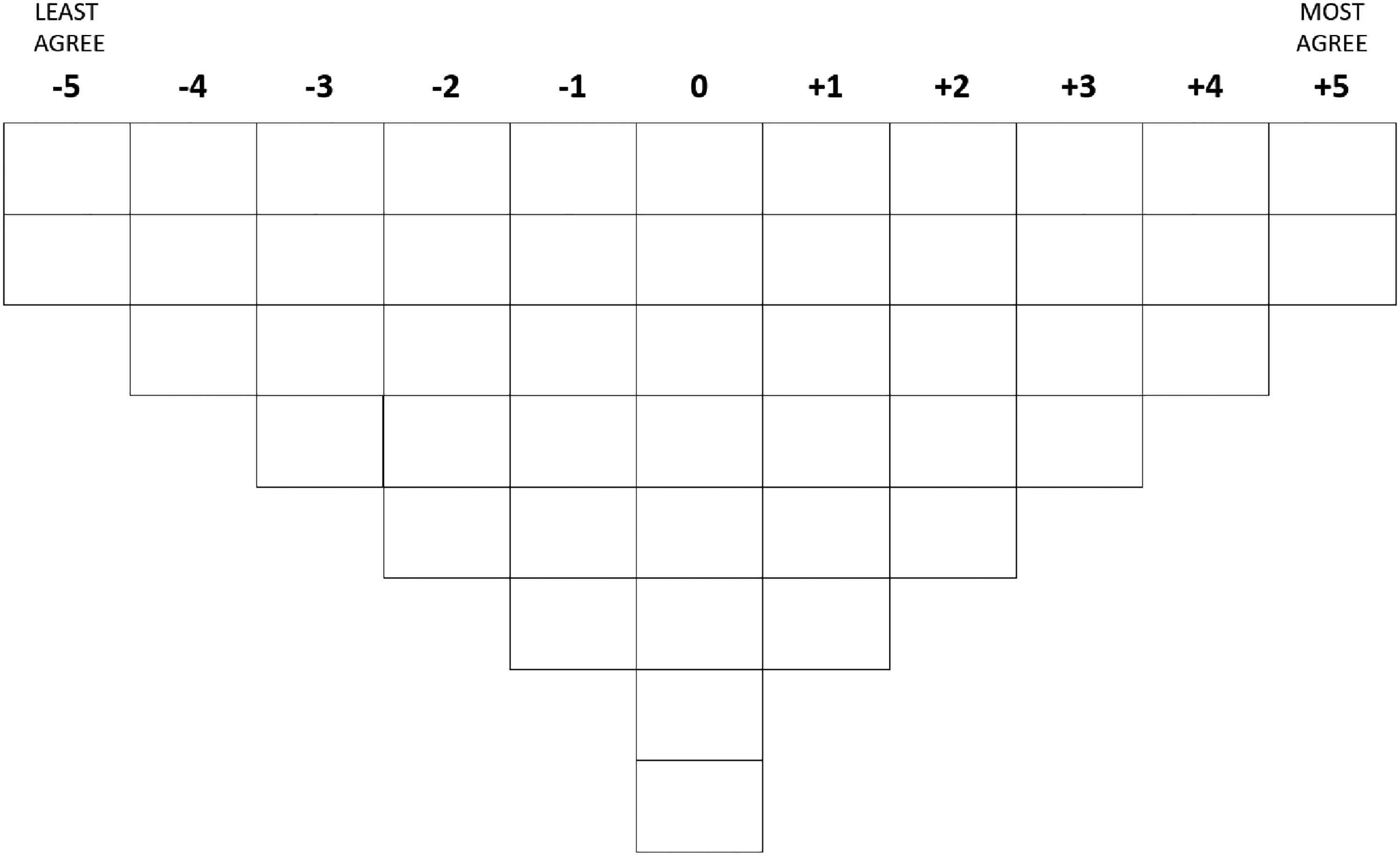
Q-sorting grid for Q-set made up of 48 statements.
A ‘pluralistic’ narrative literature review was undertaken, incorporating a wide array of materials compared with the more ‘highly structured and protocol driven’ method of systematic literature reviews (Efron and Ravid, 2019). From this broad literature, and through workshops and a pilot study with practitioners and academics, 48 statements were devised, capturing a diverse range of ideas on approaches to peacebuilding work with young people. Figure 2 overviews the Q-set compilation process.
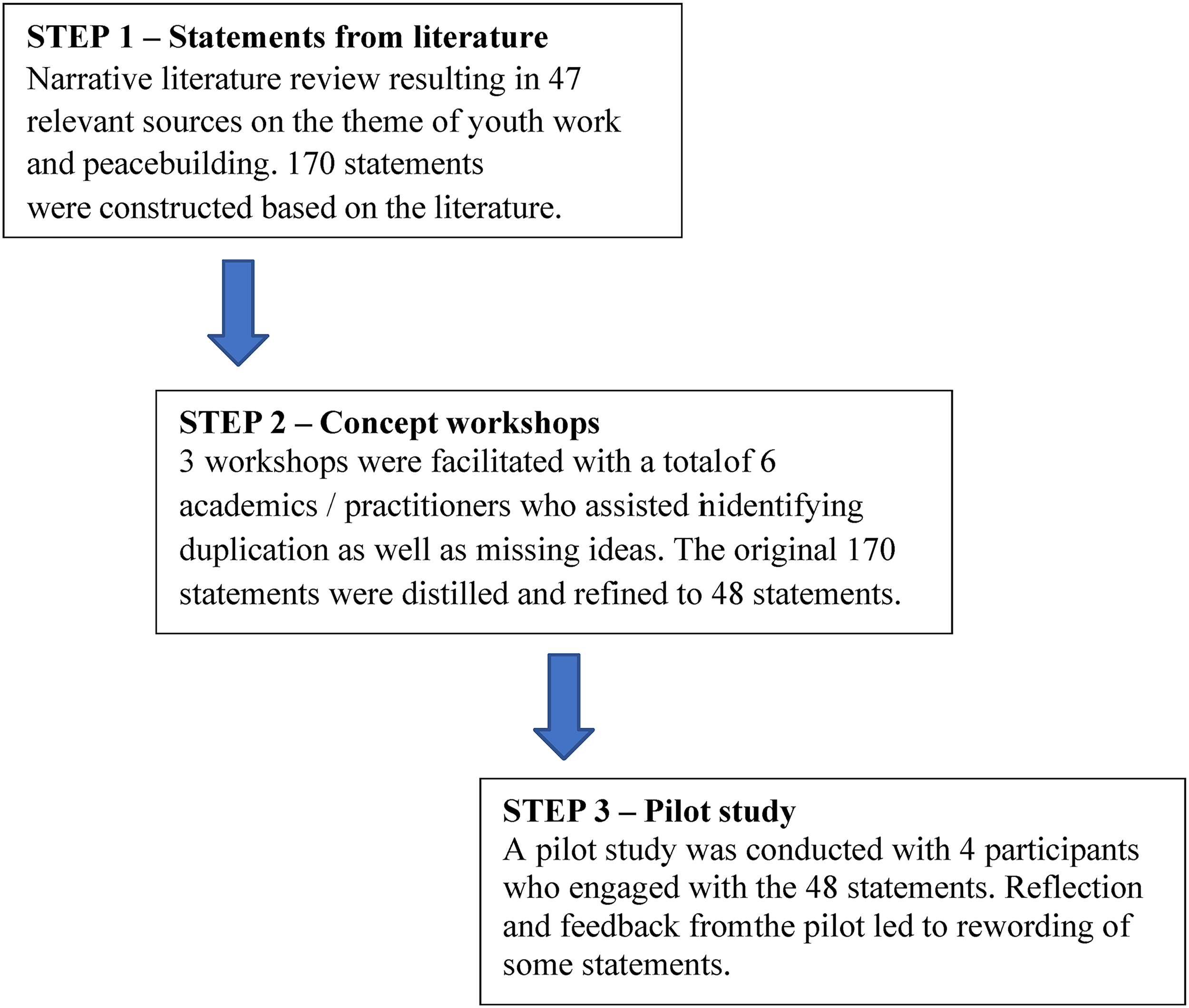
Steps to compiling Q-set.
Sampling
In total, 43-degree qualified youth workers participated in the study. Attention was paid to ensuring a balance of gender perspectives and cultural–political backgrounds. At the time of the study, 200 youth workers from across 11 regional youth work organisations were employed in various programmes funded by the EU P4Y programme. This was an opportune population to recruit from for the study and 31 practitioners took part identified through a strategic purposive approach, referred to as the P4Y cohort. To mitigate potential bias towards an EU version of peacebuilding in the findings, a further 12 practitioners were recruited to the study who were explicitly not funded under EU peace money, referred to as the non-Peace4Youth cohort (non-P4Y). The researcher also completed a Q-sort which was used in the study as part of a reflexive process, discussed in more detail in the reflexivity section.
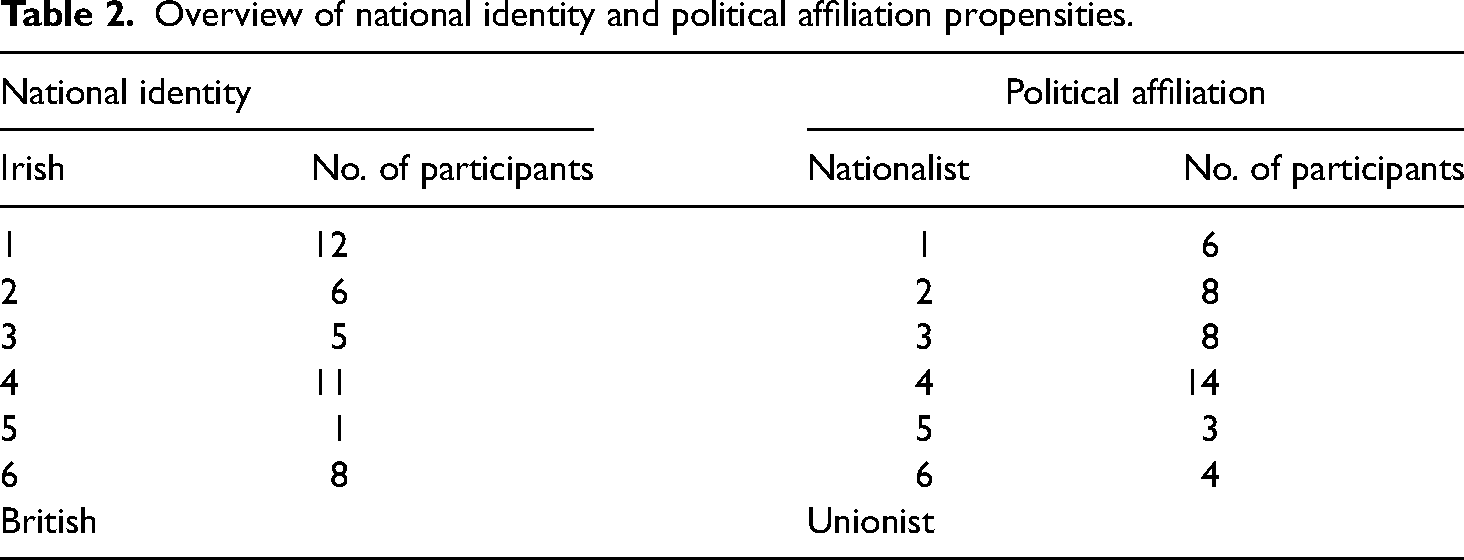
While there were more practitioners who identified as Protestant than Catholic as shown in Table 1, there was a stronger balance in relation to national identity and political affiliation as indicated in Table 2. Practitioners selected one point on a 6-point scale to indicate whether they oriented more towards an Irish or British identity and again if they oriented more towards a Nationalist or Unionist political affiliation.
Overview of participant demographics.
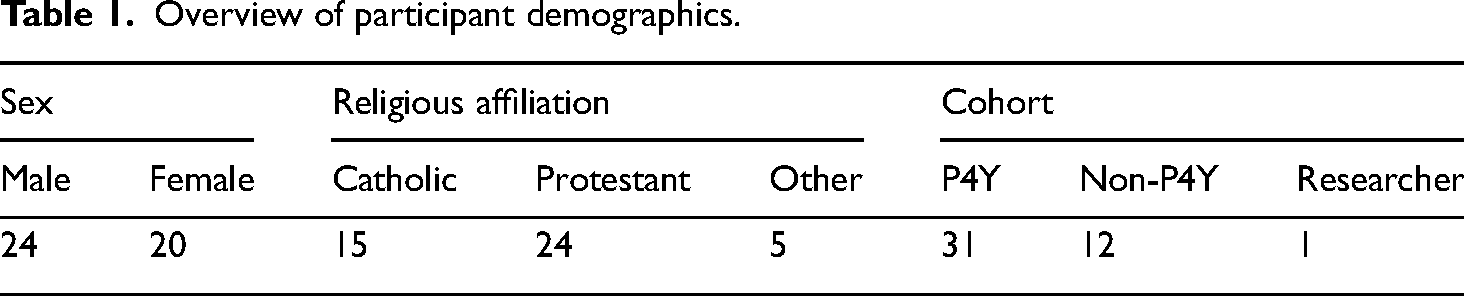
Overview of national identity and political affiliation propensities.
Participants spent up to an hour ranking the statements followed by a semi-structured interview. This procedure demonstrates the value of Q methodology as a reflexive tool where practitioners drew on their past and present encounters in a contested society mediating how they make sense of and approach youth work and peacebuilding. While the stimulus statements were constructed from the literature by the researcher and a small number of practitioners and academics (see Figure 2), study participants applied their own meaning by rank ordering the statements in reference to their own perspective. The interview aspect brought rich qualitative reflections. Practitioners talked about times where their approach and values conflicted with that of the organisation for which they worked. At times they felt like a fish out of water (Bourdieu and Wacquant, 1992). This qualitative aspect further revealed practitioners' sense of place within the field and how they understood their articulation of peacebuilding to be a credible one.
The completed Q-sorts were submitted to Q factor analysis. Four factors were extracted and rotated using Principal Component Analysis and varimax. These four factors are groupings of completed Q-sorts where participants have sorted the statements in such a similar way that they can be considered to represent a shared perspective. Table 3 shows the number of participants loading on each factor and Table 5 shows the ranking of each statement across each of the four factors. The four confounded sorts loaded significantly on two factors, as indicated in Table 3, and therefore were not assigned to either. Five Q-sorts did not reach the significance level of 0.43 and are labelled ‘non-significant’ in Table 3 with their highest factor loading detailed.
Overview of factor loadings.
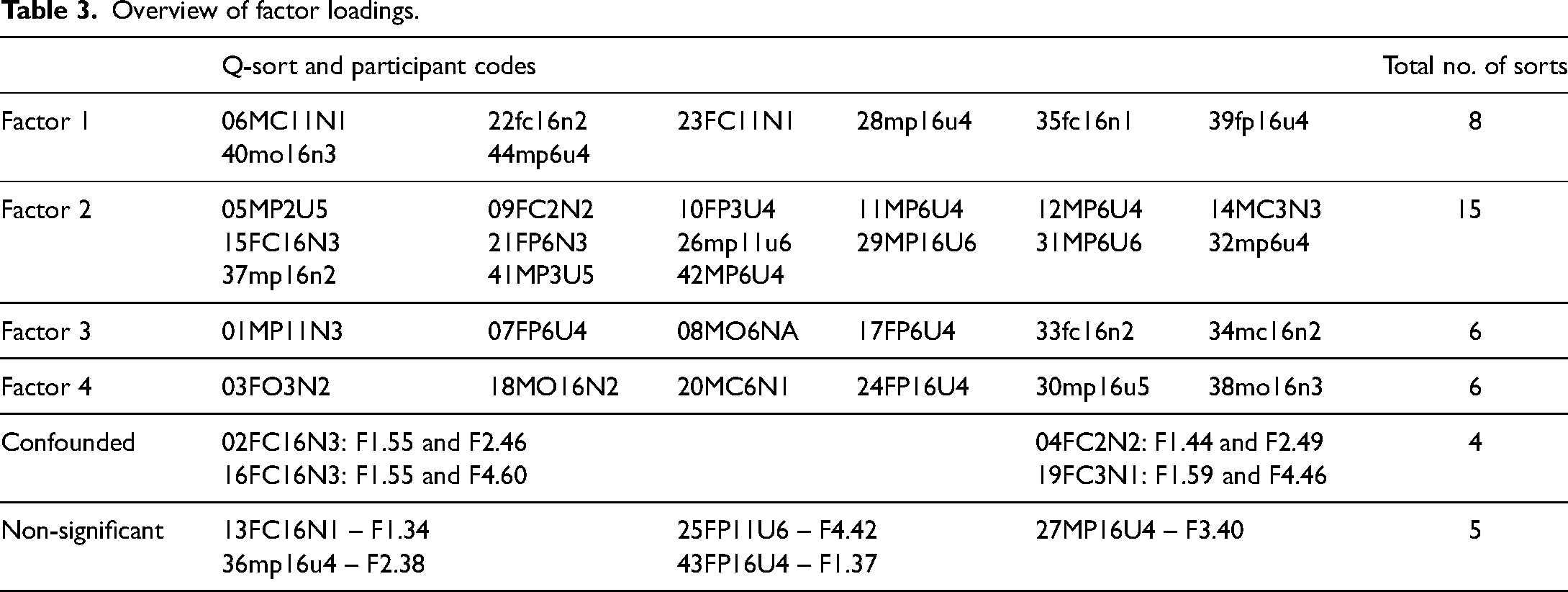
The codes in Table 3 contain demographic information for each participant as follows:
Participant Number (01–44) Male or Female (M or F) Catholic, Protestant, Other (C or P or O) Years of experience: 2 (representing 2 or less), 3 (representing 3–5), 6 (representing 6–10), 11 (representing 11–15), 16 (representing 16+) Nationalist or Unionist (N1, N2, N3, U4, U5, U6) scaled 1 for Nationalist and 6 Unionist: N1 = most aligned as nationalist, U6 = most aligned as unionist UPPERCASE = European Union Peace4Youth-funded worker, lowercase = non-European Union-funded worker.
Correlations between the four factors are presented in Table 4. Factors 1 and 4 are most alike statistically, with a score of 0.59. Factors 1 and 3 are least alike, with a score of 0.37.
Correlations between factor scores.
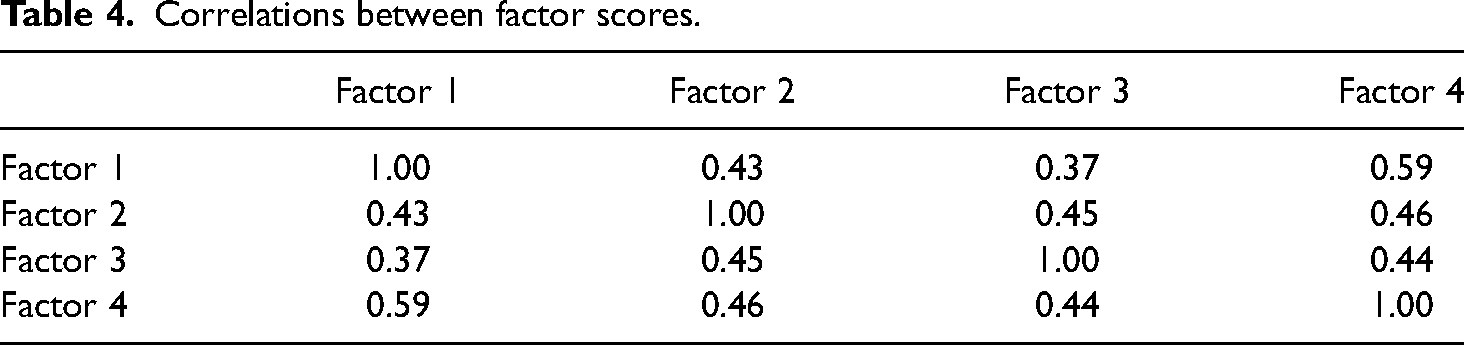
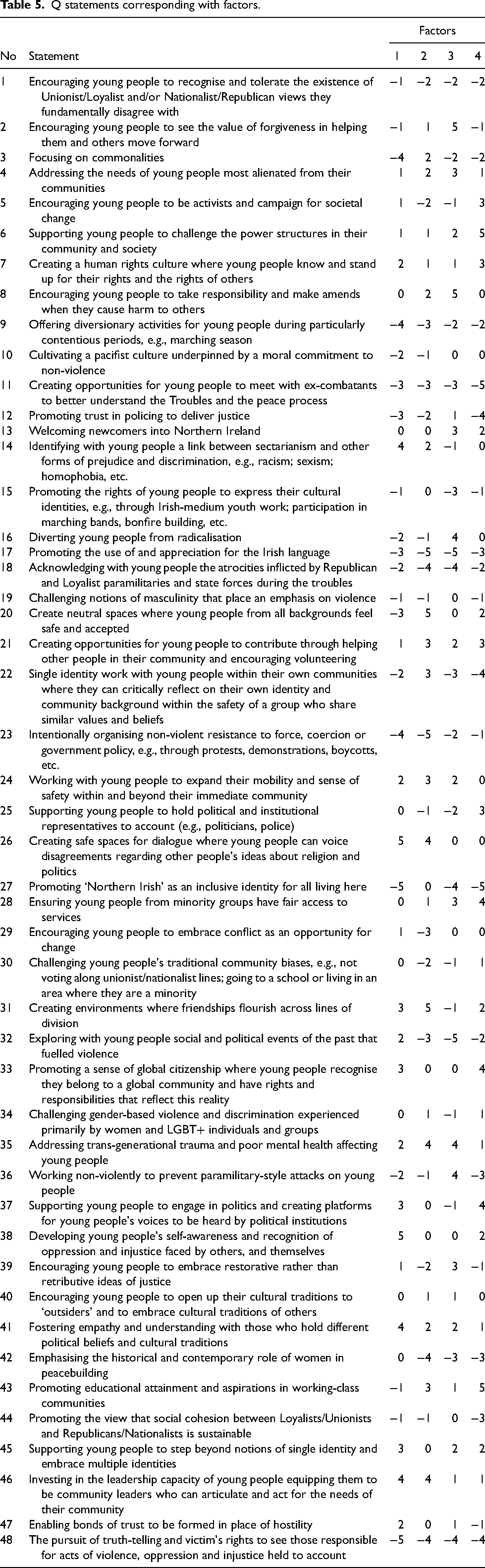
Table 5 contains the specific wording of all 48 statements used in the study and identifies where the statement was ranked in each factor array from −5 to +5.
Q statements corresponding with factors.
Analysis of interview data
The post-sort interview data were analysed drawing on principles of Braun and Clarke's (2020) reflexive thematic analysis (TA). The interaction between the factors and interview data made the application of Braun and Clarke's (2020) method bespoke to this study deviating from a purely TA approach and involving a dialectical engagement between Q factor analysis and TA. An inductive approach was adopted in the initial phases where the results of Q factor analysis were deliberately put to one side. In the latter phases of TA, developing and reviewing themes, and refining, defining and naming themes, there was alignment of themes with the four factor arrays which were labelled:
Critical Thinking and Dialogue Mutual Understanding Social Cohesion and Restoration Political Engagement and Social Justice.
Reflexivity
The research was conducted from a ‘hybrid’ position (Read and Proctor, 1995), involving familiarity with the field of youth sector peacebuilding while not researching immediate colleagues' practice (Jootun et al., 2009). The hybrid position enabled a vantage point to apprehend nuances and underpinning agendas of each factor more perceptively. Exploring our own dispositions and propensities as researchers facilitated ‘a better position to approach the topic honestly and openly’ (Jootun et al., 2009, p. 43). This involved recognising our own professional development trajectories, having been involved in much community relations work focused on bringing together groups from divided communities to promote greater understanding and enable cross-community relations to flourish. For the first author, critical reflection as a practitioner in recent years stimulated a sense that the relational emphasis of their practice lacked a political edge geared towards engaging young people in transformation not only at the personal level but on a wider and more collectivist community and societal scale.
As part of the reflexive process, the lead researcher completed a Q-sort (included in the data as YW44). This was completed after the 43 other Q-sorts had been submitted to factor analysis and the four-factor solution established in preliminary form. The researcher's Q-sort revealed alignment with the Critical Thinking and Dialogue ideational structure. This insight brought to consciousness potential bias towards this perspective and presented an ongoing challenge to represent each viewpoint fairly, aided by input from colleagues. The reflexive approach to factor interpretation was a ‘common and shared effort’ (Deer, 2012: 198) carried out in collaboration with a diverse research team.
A reflexive approach was applied to developing the 48 statements for the study. While constructed largely from literature, these were influenced by practitioners and academics with a strong practice background, who actively contributed to the condensing and rewording of a final Q-set of 48 statements. There are opportunities in future research to expand this reflexive process by involving more stakeholders (young people, policymakers and funders) in constructing the statements for similar studies.
Ethics
The sensitive nature of research in contested societies necessitates thoughtful application of research ethics. Ethical approval was obtained from Ulster University in February 2019 adhering to principles of informed consent and a no harm approach. Appreciating that practitioners were offering insights into their own personal and professional convictions and orientations towards peacebuilding in what can be a volatile sociopolitical context, there was a commitment to ensuring a person-centred approach was adopted by the researcher. This involved being intentional about validating the contributions of practitioners and facilitating a reflective space that was empathic, respectful and enabled practitioners to take ownership of what they shared in the post-sorting interview. All of this was framed within a context of confidentiality where the anonymity of research respondents is protected, and data are held securely.
Findings: four perspectives on youth sector peacebuilding
The four perspectives have been labelled below to indicate their main emphasis. The numbering of ideational structures 1–4 is simply for ease of referring to each perspective without always using the full title:
Ideational Structure 1: Critical Thinking and Dialogue Ideational Structure 2: Mutual Understanding Ideational Structure 3: Social Cohesion and Restoration Ideational Structure 4: Political Engagement and Social Justice
Following the exemplary format used by Watts and Stenner (2005), the specific statements that correspond with the narrative commentary are cited in brackets, and their ranking relative to the ideational structure under discussion is indicated. When, for example, referring to statement 3, ‘Focusing on commonalities’ in ideational structure 1, the citation would take the form (3: −4). Table 5 is a useful cross-reference that contains the specific wording of each statement.
Ideational structure 1: critical thinking and dialogue
The first viewpoint, or ideational structure, to be discussed is titled Critical Thinking and Dialogue, reflecting the essence of this perspective (26: +5). Practitioners who align with the viewpoint believe that creating a safe space for dialogue is an essential prerequisite for engaging young people in developing a critical consciousness that challenges taken-for-granted assumptions about the social world and raises awareness of inequalities and unequal power relations (38: +5). This criticality involves helping young people make connections between sectarianism and other forms of prejudice that reproduce discrimination (14: +4) and recognising the fallacy of neutrality (20: −3). From this perspective, peacebuilding begins when young people recognise themselves as interdependent agents capable of critical insights within inequitable and unjust social structures.
This approach to peacebuilding involves both introspection (38: +5) and cultivating friendships across diverse sociopolitical and cultural backgrounds (31: +3). The strength of these relationships lends itself to increasingly intentional dialogue capable of dealing with contentious issues and unique to this perspective is the prioritisation of critically exploring the past (32: +2). Trust acts as both a catalyst and outcome of these dialogical processes, and caution is taken not to exacerbate tensions (47: +2; 26: +5). Rather, the desire is to disarm the power of taboo topics around the past and current hostilities and recognise conflict transformation as a tool for social change (29: +1). While trust is important, this is counter-balanced with a criticality that applies a scrutinous lens over powerful institutions such as policing (12: −3).
Youth worker 28 reflects on these themes concluding, So that's really at the core of what I’m doing, which is about really learning from the past, not just learning about the past, trying to deconstruct that and give young people kind of critical consciousness to be able to make different choices in the present. (YW28)
Equipped with an expanding critical consciousness, peacebuilding work addresses the power imbalance between adults and young people by elevating youth voices (37: +3; 46: +4). Young people are to be active in political arenas (37: +3), they are to speak up regarding their rights and the rights of others (7: +2), and they are to have a role as community leaders who advocate on behalf of others (46: +4).
Intentional political actions may emerge through the process of engaging young people in dialogue and critical thinking (5: +1; 6: +1; 25: 0); however, from this perspective, these are not considered as primary methods or objectives of the work. Purposeful political organisation to show resistance and subvert oppressive structures is deemed unnecessary and perceived as an oppositional strategy to engaging young people in existing political mechanisms to challenge institutions (23: −4). Focusing on commonalities and diversionary work are perceived as strategies for avoiding meaningful engagement and difficult conversations (3: −4; 9: −4).
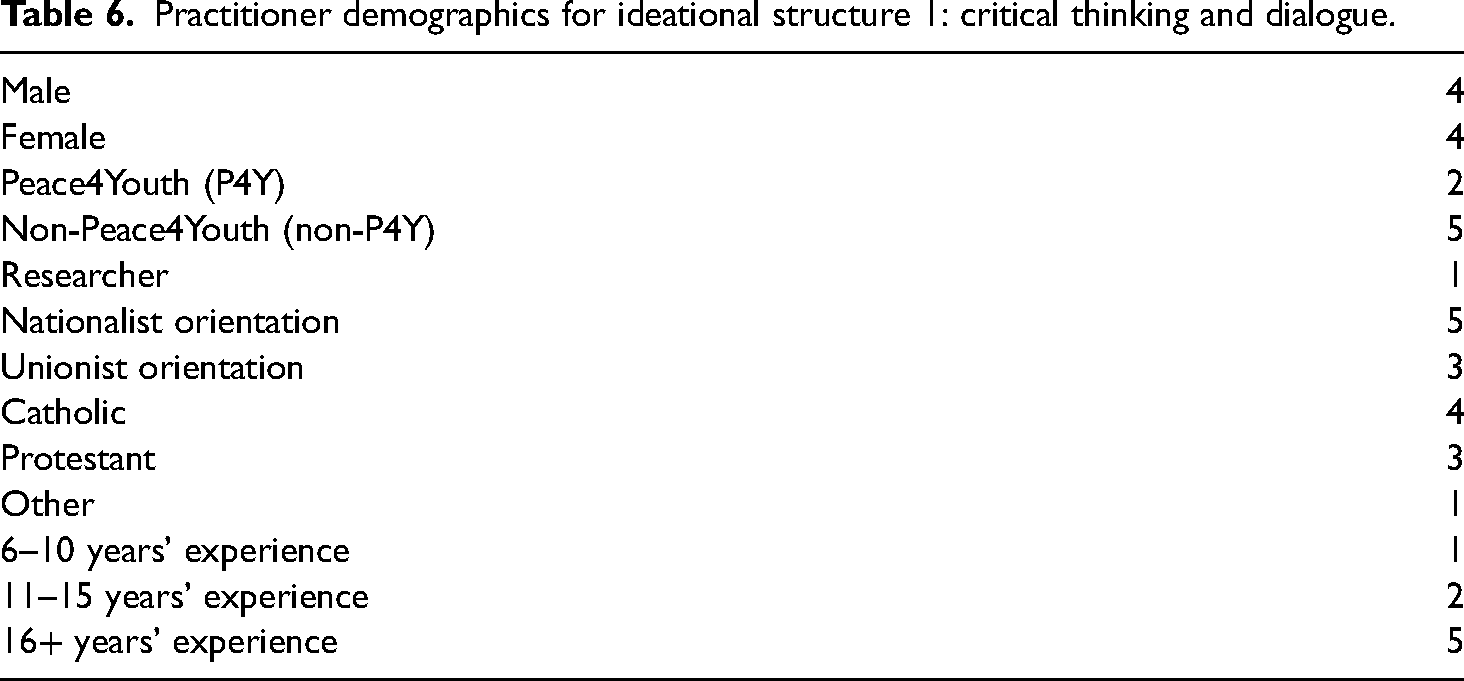
Eight participants (seven practitioners plus the researcher) are aligned with ideational structure 1 Critical Thinking and Dialogue. While generalisable conclusions cannot be drawn from the demographic composition of each ideational structure, several insights can be inferred from Table 6, adding to the interpretation of the factor array.
Practitioner demographics for ideational structure 1: critical thinking and dialogue.
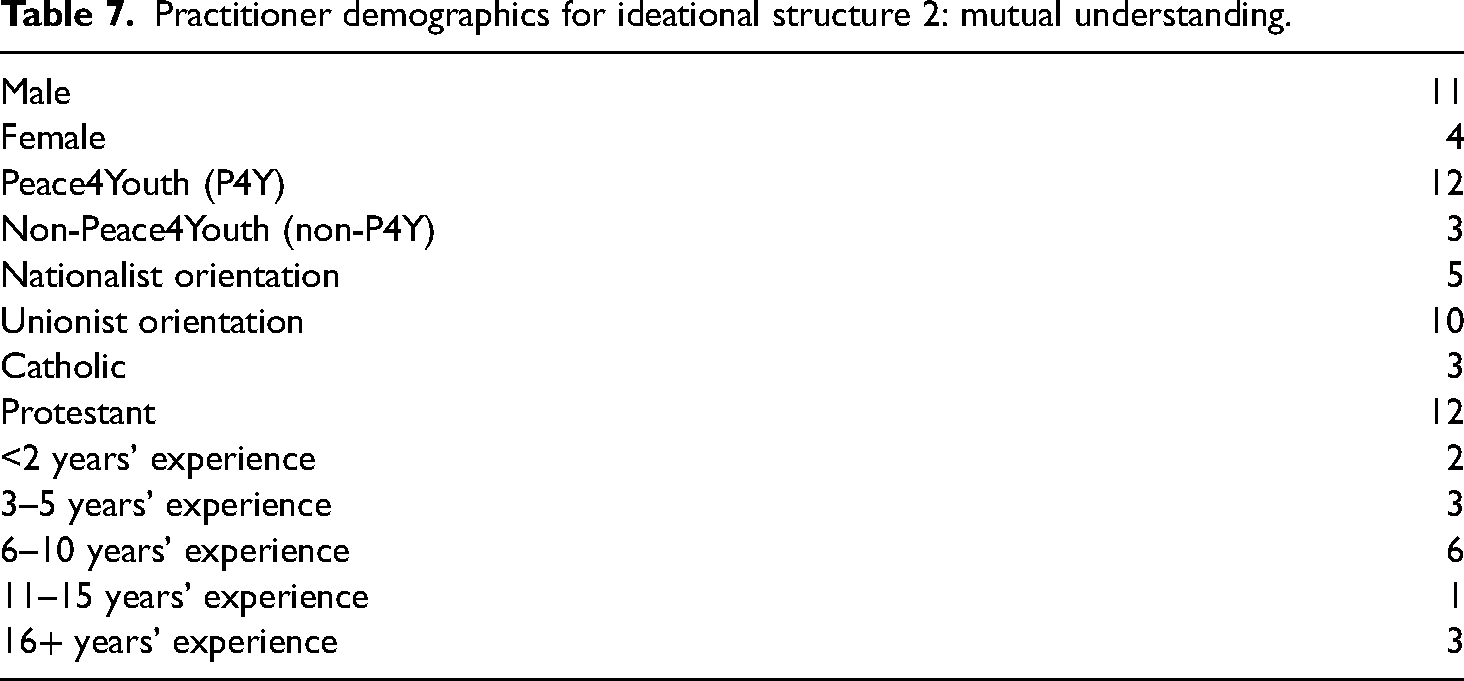
Practitioner demographics for ideational structure 2: mutual understanding.
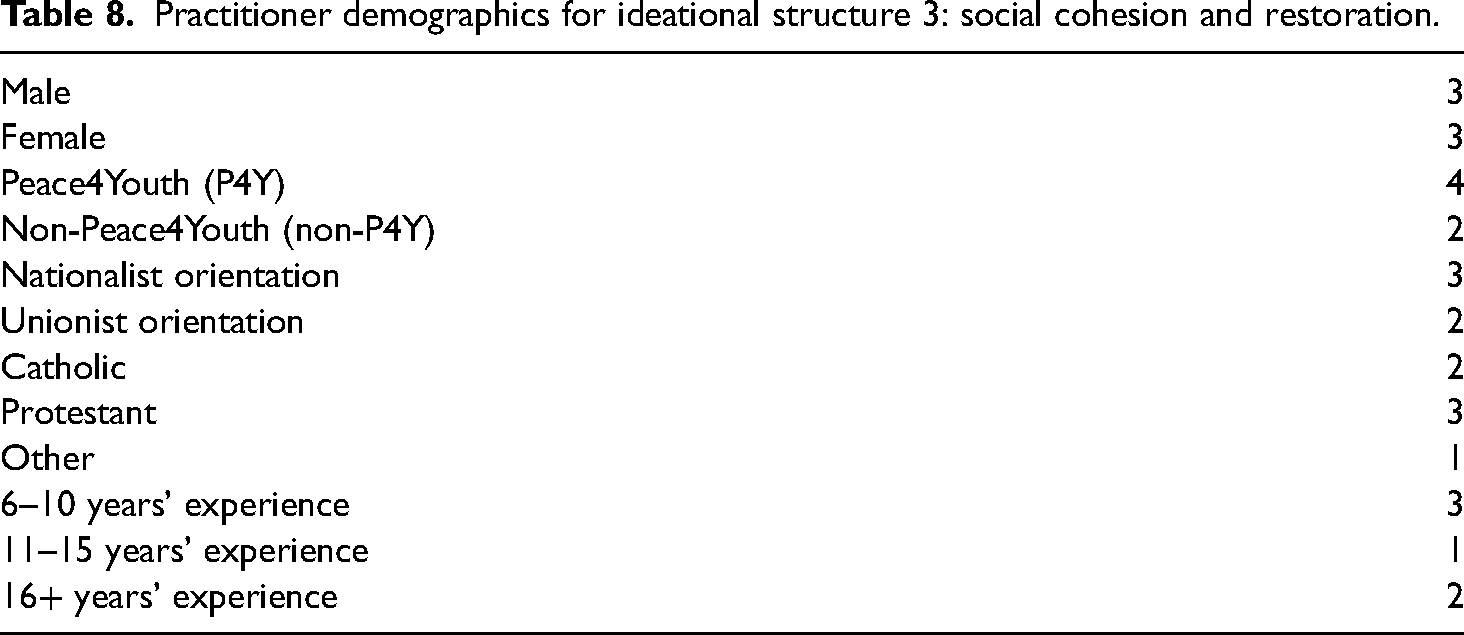
Practitioner demographics for ideational structure 3: social cohesion and restoration.
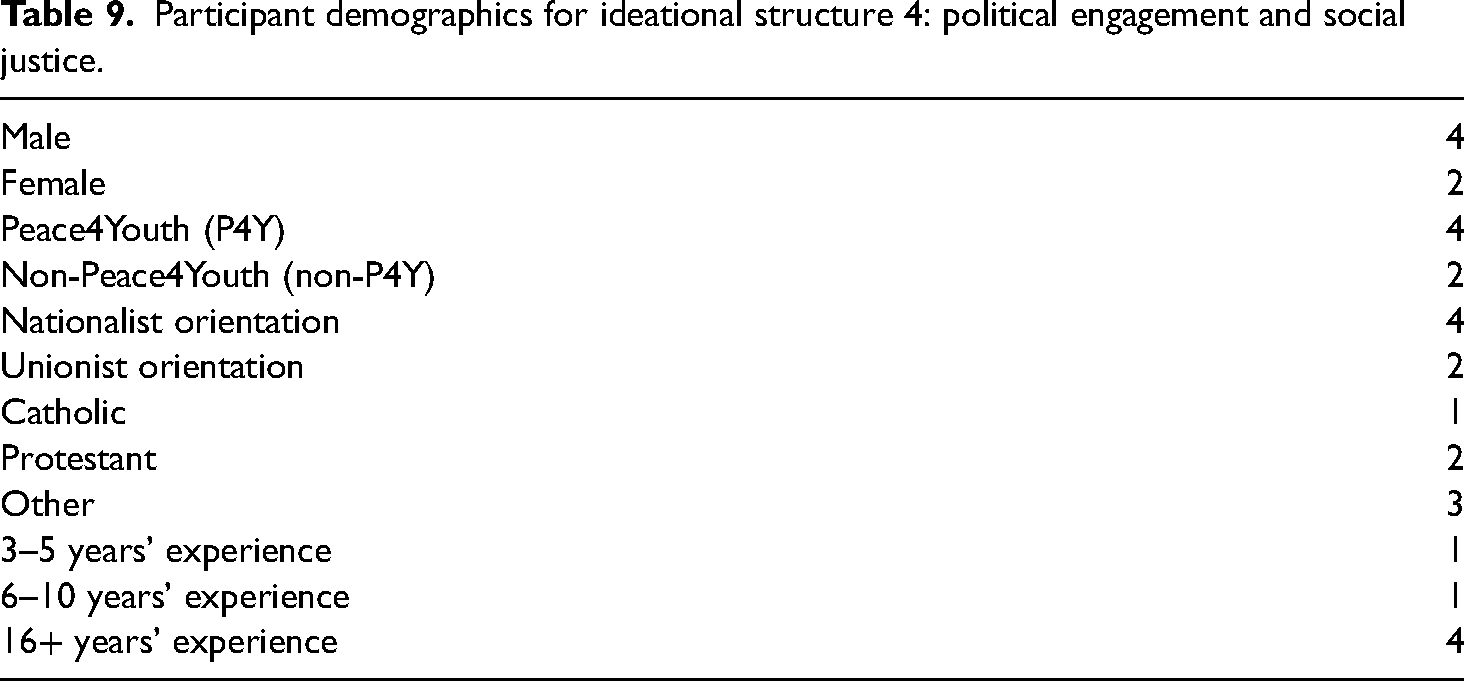
Participant demographics for ideational structure 4: political engagement and social justice.
Practitioners not working to EU targets (non-P4Y) disproportionately align with factor array 1 accounting for more than a third of the 13 non-P4Y practitioners in the study overall.
Ideational structure 2: mutual understanding
Ideational structure 2 gravitates towards cultivating harmonious co-existence and avoiding any form of conflict (29: −3). Friendships formed through emphasising commonalities are core features of peacebuilding (31: +5; 3: +2) and are sustained through the depoliticising of social spaces (24: +3) and contested issues (20: +5). Dialogue around difference is valued (26: +4), although this is accompanied by a proactive concern for the emotional security of young people, evidenced by the high ranking of statements citing safe spaces (20: +5; 26: +4; 24: +3; 22: +3).
A future-focused disposition determines historical issues that should be left in the past (32: −3; 18: −4). Forgiveness is deemed valuable to the extent that it helps people move on and avoid bitterness and cynicism (2: +1). Exploring historical and contemporary contributions of women in peacebuilding is not prioritised and the historical aspect of statement 42 is deemed increasingly irrelevant to young people (42: −4).
Motivated to ameliorate tensions and divisions, this viewpoint is most likely to embrace the idea of a shared communal identity in Northern Ireland (27: 0). The right to cultural expression is de-contested through the principle of reciprocity; the range of cultural identities in Northern Ireland should be celebrated and respected (40: +1; 15: 0). Cross-cultural participation builds empathy and mutual understanding (41: +2) and goes beyond the limited notion of toleration (1: −2). The principle of reciprocity further offers a safeguard against the partisan promotion of culture (17: −5). In this context, young people are encouraged to take pride in their cultural heritage (22: +3) while respecting the right of others to do likewise.
Intentional political action is dissuaded (23: −5; 5: −2; 25: −1) and challenges to political identities and behaviours such as questioning traditional voting habits is not advocated (30: −2; 45: 0). Young people are understood to be generally disillusioned with politics and societal change (5: −2; 25: −1; 37: 0). As youth worker 14 alludes, peacebuilding from this perspective is focused at personal and interpersonal levels in contrast to systemic or structural concerns: They [young people] just despise politics; they have no interest in it, don't want to learn about it, don't want to speak about it, and I think it's at the point there's other alternatives in peacebuilding… there are other ways to peace build such as, my view is focus on commonalities between people so they see they all have their own issues, they all choose to be here for the same reasons, they all want to get to move on to further education, employment and training that's why they are here to get themselves ready, it's a process to get them ready, a stepping stone to move on. (YW14)
This is the largest factor array in the study, dominated by EU-funded P4Y workers, indicating an alignment between this view of peacebuilding and the objectives of the EU P4Y programme. Table 7 shows that twelve P4Y workers are joined by only three non-P4Y practitioners. There is a tendency for those most recently qualified to load on this factor while more experienced practitioners are less represented.
Ideational structure 3: social cohesion and restoration
Guiding ideational structure 3 is a perception that communities have become dysfunctional spaces where illegitimate forms of authority have acquired and maintained considerable status. In this context, peacebuilding requires work with young people to challenge unsanctioned power structures (6: +2). Furthermore, promoting trust in policing (12: +1) is significant to establish law, order and stability. Youth sector peacebuilding is considered to have a specific role in tackling violence specifically linked to paramilitary-style attacks on young people (36: +4). The allure of radicalisation to join paramilitary groups is to be counteracted with explicit diversionary tactics (16: +4) and the promotion of restorative principles (8: +5; 39: +3). Youth worker 34 offers a candid contextual analysis: The amount of those [paramilitary style] attacks that were actually hiding community dysfunctionality, hiding criminality in the community under the guise of this, and then how that was also being used in terms of recruitment – these young lads were vulnerable and using that fear to coerce them and groom them into joining criminal and paramilitary gangs. (YW34)
Building friendships is not prioritised as a core peacebuilding objective (31: −1). Alternatively, concepts of empathy, understanding and trust (41: +2; 47: +1) are drawn upon to facilitate steps towards reconciliation and social cohesion. Restorative approaches are championed as ways to emancipate young men and women from paramilitary influence and community ostracisation (2: +5; 8: +5; 39: +3).
Exploring the past is regarded as unhelpful and counterproductive (32: −5; 18: −4; 11: −3). Acknowledgement and truth-telling are approaches irrelevant to the post-Good Friday Agreement generation of young people (48: −4). Promoting identity and culture particular to segregated communities has a minimal place in peacebuilding work, and caution is impressed over the destabilising potential of contested cultural traditions (17: −5; 15: −3). It should be acknowledged with young people that perpetuating notions of single identity exacerbates divisions (22: −3), and instead, the liberty to hold multiple identities should be explored (45: +2). This does not mean that societal fractures can be papered over with idealistic notions of a shared identity (27: −4) and focusing on commonalities (3: −2).
Focused work on critical thinking (14: −1; 36: 0) and engaging young people in politics is not prioritised. Social activism (5: −1) and political participation (37: −1) are peripheral concerns. Holding institutions to account is not seen as the role of young people and institutions should be taking seriously their responsibility to serve the best interests of all citizens, including young people, without having to be called to account (25: −2). Forgiveness is a crucial concept from this perspective (2: +5) required for genuine reconciliation, closure on the past and a de-escalation of ongoing sectarian feuds. Both an acceptance of responsibility and an extension of forgiveness are evident in the comments of youth workers 8 and 9: You can't move forward if you don't accept some responsibility for something that's went wrong. (YW07)
If young people can learn to forgive, then they can move on. (YW08)
Table 8 shows ideational structure 3 contains an equal ratio of male to female practitioners. Three identify on the nationalist end of the scale and two practitioners identify moderately as unionist. One practitioner does not identify themselves on the nationalist–unionist spectrum, stating their positionality as a ‘foreign national’. With a small grouping of six practitioners and an absence of starkly disproportionate attributes, limited inferences can be extrapolated from the demographics.
Ideational structure 4: political engagement and social justice
The fourth ideational structure demonstrates greatest commitment to advancing political engagement at community and societal levels as the core work of peacebuilding (6: +5). This approach is underpinned by a rights framework (7: +3) emphasising social inclusion (28: +4; 13: +2) and global perspectives on citizenship (33: +4). A critical notion of empowerment insists youth participation in political processes (37: +4) with a particular focus on holding those in power to account (25: +3; 6: +5). A tacit trust in policing to deliver justice (12: −4) conflicts with the impulse of those embodying this ideational structure to ask questions of powerful institutions.
Youth sector peacebuilding is geared towards politicising young people, enabling them to act as agents of social change (5: +3). Reflecting on these themes, Youth worker 38 states peacebuilding should be about: Young people not just being told ‘you deserve to have your voice heard’, but you deserve to have your voice heard and the things that you come up with we want to try and implement them to create societal change… I think we’re talking about challenging the structures that are there and putting young people into some of those environments where decisions are made. (YW38)
Action is prioritised (5: +3; 21: +3) over dialogue (26: 0; 14: 0) and this perspective is the most likely of all viewpoints to consider engaging young people in collective non-violent resistance (23: −1). Notions of neutrality are viewed as important to facilitate civic and political engagement (20: +2). Systemic class inequalities within the education system must be tackled as part of the peacebuilding agenda (43: +5). Supporting young people to recognise oppression and injustice accompanies a focus on political engagement and politicisation (38: +2). Gender-based violence, alienation of young people within their communities, minority rights and mental health and well-being are all important issues that young people are engaging with in the pursuit of peace (34: +1; 4: +1; 28: +4; 35: +1).
Promoting Northern Irish as an inclusive identity is viewed as an attempt to depoliticise identity politics (27: −5). Focusing on commonalities (3: −2) is similarly perceived as an insipid strategy in a world of diverse identities. Addressing and learning from the past (11: −5; 32: −2; 18: −2) and promoting rights of cultural expression (17: −3; 15: −1) are generally perceived as antiquated approaches to peacebuilding. Social cohesion between the sectarian divides of Loyalism and Republicanism is not perceived as sustainable (44: −3). From this perspective, peacebuilding should move beyond intractable issues and party politics towards an interdependent politics of social change and inclusion. Youth worker 18 expresses this orientation stating: Core to my values has always been around promoting the place of equality and a rights-based approach, so I think that fundamentally links in with peacebuilding, and not the traditional notion of green and orange stuff but peacebuilding for all and equal rights. (YW18)
Similar to factor array 3 demographics, there are limits on what can be inferred from the small cohort. The most salient feature of this group, as shown in table 9, is that half have not identified as either Catholic or Protestant. Of these three practitioners identified as ‘Other’, one grew up in Great Britain, one grew up south of the Northern Irish border, and one grew up in Northern Ireland. There is a tendency for those aligned with this factor array to problematise the binary categories of Catholic and Protestant identities.
Discussion: implications of 4 peacebuilding orientations
These four ideational structures crystalise distinctive orientations towards peacebuilding within the youth sector, each accompanied with differing levels of recognition within the field. Understood as a form of embodied cultural capital, both the Mutual Understanding and Social Cohesion and Restoration perspectives reflect the priorities of the State whose interests are oriented towards maintaining stability and the status quo. An inclination to talk about and practice peacebuilding with young people in either of these ways mirrors the symbolic capital of funders and organisations who have successfully obtained peace monies. This generates a ‘flow of social energy’ (Rawolle and Lingard, 2013: 123), reinforcing a peacebuilding orthodoxy premised on the more harmonising propensities of Mutual Understanding and Social Cohesion and Restoration. Peacebuilding objectives linked to the more critical and radical perspectives of ideational structures 1 and 4 are noticeably absent from decades of youth policy and peace strategies in Northern Ireland (Hamilton and McArdle, 2020).
Furthermore, youth sector peacebuilding is dependent on how agents and agencies endowed with the power of the state distribute forms of capital and legitimise the ‘official discourse’ on peacebuilding (Bourdieu, 1989). Economic capital administered through inter-state sanctioned funding has built capacity of many youth organisations (Morrow et al., 2018). Organisations are required to play by the rules of the funding-cycle game, and this offers further insights into why more radical and agitational approaches to peacebuilding encapsulated in the Critical Thinking and Dialogue and Political Engagement and Social Justice ideational structures are not more prolific in policy or practice. At the various levels of organisation, policymaking and inter-state funding, an orthodoxy envelops the field where the objectives of peacebuilding are conceptualised at the personal and interpersonal levels. Ultimately, peacebuilding is framed as a harmonising activity. Practitioners who inhabit the field are immersed in this discourse. While the number of practitioners loading on each factor is not generalisable to the entire population, it is noteworthy that factor 2 – Mutual Understanding – is the largest factor with 15 participants loading on it. This aligns most evidently with peacebuilding programmes funded by the EU (PEACE IV and PEACE Plus) and the Northern Ireland Executive (T: BUC).
Figure 3 maps the four ideational structures from this study within a model that captures key dimensions of tension and struggle. It is a tension that illuminates the struggle for an accumulation of symbolic capital that accompanies an ‘official point of view’ within the field (Bourdieu, 1989: 22). The dialectic of harmonising and politicising identifies a salient stake within the field with the former representing an orthodoxy bringing with it significant symbolic value and the latter a more heterodox and agitational disposition. The continuum of dialogue and action differentiates propensities towards introspection or implementation.
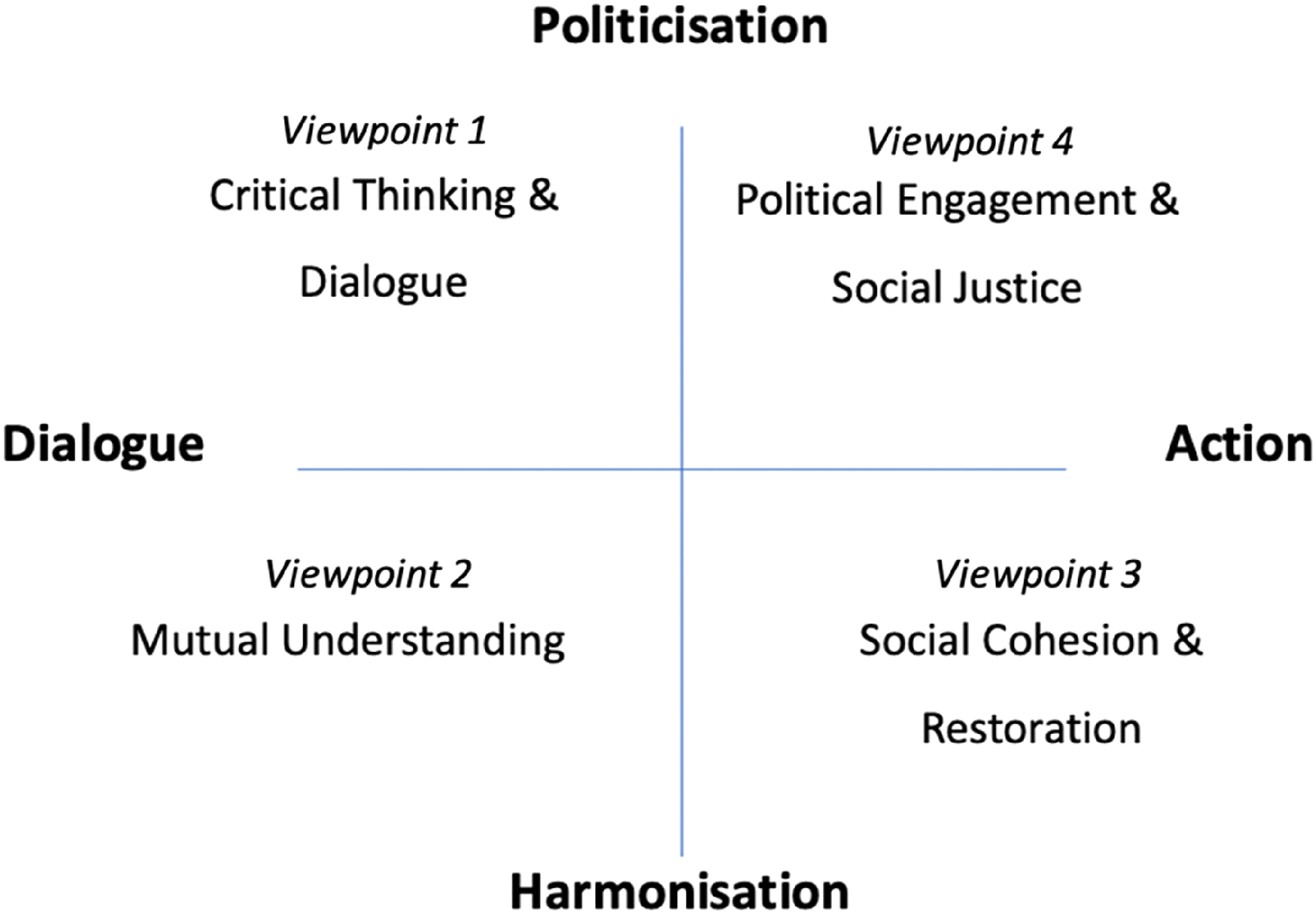
A sociopolitical model of youth sector peacebuilding.
Harmonising dialogue, in this study represented by the Mutual Understanding perspective, echoes early cross-community contact schemes and Education for Mutual Understanding initiatives stretching back to the 1980s (NICED, 1988) that have been the guiding light of youth peace policy. These have been refashioned in the more recent T: BUC strategy with a focus on short-term summer camps (Hamber and Kelly, 2018). Alongside this, the harmonising action perspective of Social Cohesion and Restoration aligns with a contemporary policy drive to tackle paramilitarism and counter violent extremism through initiatives to prevent radicalisation and embed restorative principles (Morrow and Byrne, 2020; TEO, 2015).
While these harmonising interventions can be personally transformational for young people, opportunities to promote the involvement of youth in peacebuilding at the structural and political levels through participative democracy and activism are stunted when policy and practice remain locked at the individual and interpersonal level, setting young people up as service users rather than political agents. However, it is these harmonising approaches that continue to be incentivised and reproduced through state policy and major funders. Harmonising tendencies can be observed on two levels. First, in youth programmes intended to create harmony through an emphasis on personal development and interpersonal relationships. Second, in galvanising harmony with peacebuilding structures where practitioners are employed on short-term contracts and are incentivised to work diligently to meet predefined targets. This limits time, energy and longevity for engaging in politicising processes with young people that might pose radical critiques to contemporary peacebuilding policy.
A politicising dialogue orientation of Critical Thinking and Dialogue resonates strongly with Freire's (1996) work on oppression and liberation. The politicising action of Political Engagement and Social Justice prioritises youth activism as a core tenant of the work. Constraints on such politicising peacebuilding approaches are experienced as practitioners and young people have limited input on the direction of peace policy or defining the outcomes required by peace programmes. An embodied politicising capital held by practitioners, committed to peacebuilding as a radical and agitational practice, does not accumulate equal measures of symbolic value from the youth sector peacebuilding architecture compared with those embodying harmonising dispositions. While the language of critical dialogue and activism may be recognised and even used by policymakers and funders, this has not been accompanied by steps to dismantle an increasingly technocratic sector or embedding such concepts within well-resourced peace programmes.
The four ideational structures are specific to this study of youth sector peacebuilding in Northern Ireland. The model that they have informed is amenable and adaptable to other youth settings globally and other sectors locally and internationally. It is expected that other perspectives will be found in other contexts, yet the axis of harmonising–politicising and dialogue action remains a helpful framework for analysing emerging perspectives. A constant flow of symbolic capital from powerful institutions that confer greatest value to practice that focuses on social peacebuilding processes at the personal and interpersonal levels reproduces harmonising proclivities. Concomitantly, more radical politicising approaches to peacebuilding that explicitly seek to challenge the status quo and engender critical political participation are more likely to be diluted in policy and subsequently less practiced. Using this analysis more politicising and therefore emancipatory approaches to peacebuilding might be pursued with a more coherent and focused conceptualisation of distinctive orientations along a politicising–harmonising axis. The major contribution of this article is a clear language and model to conceptualise and critique approaches to peacebuilding in civil society.
Politicisation, like peacebuilding, is a contested concept with pejorative implications in polarised societies that have endured political violence. The politicising of issues in Northern Ireland is often seen as recourse to sectarian politics and further entrenchment of sociopolitical divisiveness. This paper seeks to reclaim politicising as a valuable concept for the youth sector and wider peacebuilding processes. Politicising in a sociopolitical model of youth sector peacebuilding speaks to the cultivation of political consciousness, of recognising and challenging the hidden violence of exclusion from politics and decision making, of linking the personal with the structural and forging collective processes of activism, resistance and transformation at community, regional, national and international levels.
Limitations and opportunities
This research intentionally explores practitioner perspectives to map and articulate diverse orientations towards peacebuilding held by youth workers. Future studies involving young people and policymakers would advance this research agenda and provide further depth to analysing youth sector peacebuilding from a range of vantage points. Furthermore, the findings of this study are not generalisable in the sense of positivist principles extending to whole populations, a process that has been referred to as ‘statistical inference’ (Thomas and Bass, 1992). The paper presents four distinctive shared perspectives or orientations towards peacebuilding situated in a particular time, place and sector of post-conflict transition.
The trustworthiness of the data is found in both the credibility of the participants having a diverse and varied experience in peacebuilding work and a factor solution that the researchers spent many hours investigating to arrive at four factors accounting for key measures of simplicity, clarity and distinctiveness (Webler et al., 2009). Furthermore, the qualitative data coded and analysed using principles of reflexive TA contribute to a triangulation of data, adding authenticity to the interpretation of the factors. The findings outlined here are intended as a catalyst for deliberation and further empirical research into articulating and analysing the implications of perspectives on peacebuilding that co-exist and compete for legitimacy in contested societies and particular sectors therein in Northern Ireland and beyond.
Conclusion
Freeden's (1996, 2013) morphological analysis operationalised through Q methodology has enabled distinctive shared practitioner perspectives on peacebuilding with young people to be illuminated. The converging of morphological analysis with Q methodology is a valuable framework that researchers might draw upon in sociopolitical studies examining collective patterns of thought and practice. Drawing on Bourdieu's concepts of field and capital has enabled an analysis of the four ideational structures as particular types of embodied cultural capital valued variably within the sector. Multilateral reflexive conversations are required across the policy–practice nexus to recognise and challenge complicity in the disproportionate amounts of value credited to harmonising over politicising dispositions. This paper offers a model and vocabulary as an impetus and starting point for such dialogue, locally grounded and internationally significant, ultimately advocating a re-orientation towards a more politicised and radical youth sector peacebuilding field.
Footnotes
Acknowledgements
The authors would like to thank Eliz McArdle and Prof. Kris Lasslett for their supervision of fieldwork and developing the theory that underpins this article. The authors would also like to thank Dr Andrew Sneddon for his insightful feedback on an earlier draft and anonymous peer reviewers for their constructive feedback.
Declaration of conflicting interests
The author(s) declared no potential conflicts of interest with respect to the research, authorship, and/or publication of this article.
Funding
The author(s) received no financial support for the research, authorship, and/or publication of this article.
