




Abstract
Over the past decade, social policy in Ireland has taken an increasingly ‘workfarist turn’. This has proceeded through benefit cuts, tighter eligibility criteria for payments, and claimant activation via penalty rates for breaching new conduct conditions. However, key to understanding the post-crisis reconfiguration of welfare is not just the increasingly workfarist content of social policy but also how the delivery of public employment services has been reorganised through processes of marketisation and tightening performance management of delivery organisations and the staff who work within them. Positioning these governance reforms as processes of ‘double activation’, and drawing on survey and interview research with frontline staff working for agencies contracted by government to deliver activation, this study explores how frontline staff experience performance management as a disciplinary regime: the degree to which frontline workers are subject to management control and performance management in their jobs, what forms this takes, and how it shapes their field of action and choice. In so doing, the study draws attention to the ways in which the governance of caseworkers and the governance of claimants are inter-related, and the degree to which performance management regimes influence frontline practices to motivate the enforcement of workfarist policy practices.
Keywords
Introduction
Since 2011, social policy in Ireland has taken ‘an increasingly workfarist turn’ (Gaffney and Millar, 2020: 69). This has proceeded through a series of Pathways to Work reforms involving benefit retrenchment (cuts to payments and tighter eligibility criteria) and claimant activation via the introduction of penalty rates for breaching job-search obligations and other conduct conditions. Ireland's turn towards activation aligns with what Brodkin argues is a wider international convergence towards an unfolding ‘global workfare project’ (2013: 12), although the process of change in Ireland has been particularly ‘rapid and compressed’ (Dukelow, 2021: 47). Within just six years, Ireland's system of social protection transitioned from what was ostensibly a system of passive entitlements paid according to need to an active system of conditional payments reserved for jobseekers. These policy dynamics have been extensively evaluated by scholars from diverse sociological, social policy, and political economy perspectives (Boland and Griffin, 2015, 2018; Dukelow, 2021; Murphy, 2016), and there is now a growing body of research examining claimants’ experiences of activation (cf. Finn, 2021; Whelan, 2021a, 2021b). However, key to understanding the post-crisis reconfiguration of welfare is not just the increasingly workfarist content of Irish social policy but also how the delivery of public employment services (PES) has been reorganised through governance reforms involving strategies of ‘double activation’ (McGann 2021a). Indeed, neither of the two main PES—the publicly-run Intreo service and the JobPath programme delivered by private agencies under Payment-by-Results contracts—existed a decade ago.
The introduction of JobPath in 2015 is especially significant as a watershed moment in the reconfiguration of employment services, marking the first time that PES had been procured through the New Public Management (NPM) instruments of competitive tendering and performance-based contracting. NPM is a broad term that describes a series of interrelated governance shifts in public administration, the thrust of which involves moving away from a focus on procedural accountability towards ‘management-by-results’ (Ehrler, 2012: 328). Within this paradigm, the creation of quasi-markets and widespread use of ‘performance-centred mechanisms of accountability’ (Soss et al., 2013: 126) have emerged as key governance instruments for organising how PES are delivered. Considine and colleagues (2015: 135) characterise this in terms of a convergence towards a NPM mode of ‘corporate-market governance’ that blends marketisation (competition, outsourcing) with an emphasis on managing contractors through performance indicators, quantifiable objectives, and continuous measurement. Importantly, these systems of performance management involve not just setting indicators but also economies of financial inducements to motivate desired policy outcomes. Payment-by-Results contracts are an archetypal example, although the threat of contract cancellation exerts its own financial pressure on organisations to perform even where services are contracted without Payment-by-Results. This is especially when organisations’ existing contracts are tightly time-limited, and the wider contracting environment is characterised by ‘episodes of contention’ (Taylor et al., 2016: 255) and competition between organisations for legitimacy and resources.
This is currently the case in Ireland. The existing contacts for externally-delivered PES, including JobPath and the community-run Local Employment Services (LES) and Jobs Clubs, are all due to expire in December 2021. Whether these existing programmes will be continued, and on what basis, remains uncertain. However, indications are that whatever services are contracted will be procured through competitive tendering and performance-based contracting, thereby further exposing delivery organisations and caseworkers to ‘incentives for right behaviour and penalties for noncompliance’ (Soss et al., 2011a: 229) just as they use ‘to motivate jobseekers’ (Considine et al., 2015: 30). This is what the concept of ‘double activation’ signifies, drawing attention to how ‘welfare reform has initiated a tougher regime of social control, not just for welfare clients, but also for their case managers’ (Soss et al., 2011a: 230). More than this, those who study governance reforms at the street-level delivery of welfare-to-work draw attention to how the activation of claimants via sanctions and conditionality is inextricably linked to the double activation of providers and caseworkers via contract conditions, outcomes-based payment models, and performance targets. This is not only in relying on similar behavioural instruments but also because of how contracting regimes that direct motivation and behaviour in street-level organisations tend, in turn, to reconfigure how jobseekers are governed by caseworkers on the ground; and often in ways that ‘exacerbat[e] workfare's already considerable commodifying tendencies’ (Brodkin, 2015: 14).
Developing this idea, this study explores how contemporary welfare reform materialises in a focus on not only governing claimants but also subjecting frontline workers to increased performance monitoring and surveillance. It examines the degree to which frontline workers in contracted PES are subject to management control and performance management, what forms this takes, and how it shapes their field of action and choice. In so doing, the study pays particular attention to the ways in which the governance of caseworkers and the governance of claimants are inter-related, and the degree to which performance management regimes influence frontline practices to make the enactment of workfare more likely. The study examines these questions, drawing on survey research with frontline JobPath and LES staff as well as subsequent interviews with frontline staff and key officials within the DSP, trade unions, agency management, and policy advisors.
The paper proceeds by briefly reviewing how the delivery of PES in Ireland has been reorganised through a series of governance reforms. This is followed by a more detailed excavation of the intersections between marketisation, the performance management of frontline workers, and the phenomenon of ‘double activation’ before introducing the study and findings. The paper concludes with a discussion of how the governing of street-level workers via systems of managerial control and performance measurement shapes the governing of jobseekers’ experiences of unemployment through the enforcement of administrative compliance and ‘work-first’.
Reforming PES governance
Welfare-to-work services in Ireland are now delivered by a ‘mixed economy’ of activation comprised of PES directly provided by Intreo, and several externally provided services delivered by private and community-sector organisations under various forms of performance-based contracting. This mixed economy has replaced what was previously a fragmented network of PES, mainly comprised of a national employment service provided by An Foras Áiseanna Saothair (FÁS) and supplemented by community-based employment services such as Job Clubs and LES in areas of high unemployment. The latter were established in the mid-1990s as parallel services to FÁS and to provide intensive guidance to those experiencing greater labour market disadvantage. Significantly, participation in either FÁS or LES was institutionally separated from social protection. This structural division between welfare and employment supports has since been collapsed as PES institutions have been overhauled following a FÁS corporate governance scandal and wider public sector reform agenda that paved the way for greater outsourcing (Köppe and Maccarthaigh, 2019).
In its 2011 programme for government, the newly elected Fine Gael/Labour Government promised to ‘pin down accountability for results at every level of the public service’ (Government of Ireland, 2011: 28) through ‘a reformed incentive system’, ending fixed budgets for service providers like ‘FÁS’, and opening up delivery ‘to a range of providers’ (Government of Ireland, 2011: 29–30). An early reform initiative was the dissolution of FÁS. Its further education and training functions were transferred to a new agency, SOLAS, while its PES staff were transferred to the DSP to deliver a new ‘one-stop shop’ benefits and employment service. From 2012 until 2016, the new Intreo service was progressively rolled out along with a new active case management model and information management system known as Business Object Model implementation (BOMi). With FÁS disbanded, the DSP took over contracting LES, introducing targets that each LES would be measured against Initially, the target was for LES to progress at least 50 percent of clients into work or training although this changed in 2016 to a single metric of placing 30 percent of clients into full-time employment (INDECON, 2018). This target applies regardless of local labour market variation, and even though LES are funded on a costs-met basis. Nonetheless, because LES's contracts with the DSP are only 12-months in duration, there is ongoing pressure to meet performance targets for fear that their contracts will not be renewed or put out to tender. This risk has intensified since the introduction of JobPath.
Compared with LES, JobPath is a much larger programme with an annual caseload of approximately 50,000 jobseekers most of whom have been on the Live Register for 12 months or more. It was procured through a competitive tender over late 2013 and 2014, when the DSP invited potential providers to submit price-bids for registration fees and outcome payments based on indicative volumes of client referrals (DSP, 2013). The contract was closely modelled on the UK Government's then Work Programme, which the two successful bidders—Seetec, a British company, and Turas Nua, a partnership between the UK-based Working Links and Ireland's FRS Recruitment—both had experience of delivering. Like the Work Programme, it is predominantly performance-based. Payments for placing clients into 13 to 52 weeks of employment accounting for over 90 percent of the €3718 total possible payments per client available to providers (DEASP, 2019: 17). However, compared with its UK counterpart which allowed contractors to largely determine what services they provdied, the JobPath contract is a ‘grey box’ design with greater specification of minimum standards regarding appointment frequency, clients’ progression plans, and caseload sizes that must be adhered to (Wiggan, 2015).
At the time, the main rationale for procuring JobPath was the limited public sector capacity to deliver activation services. Despite the new Intreo service, case officers continued to have approximately 1000 jobseekers on their caseloads and a public sector hiring freeze prevented the DSP from hiring additional caseworkers (DEASP, 2019). Nonetheless, the turn towards marketisation also aligned, ideologically, with how a perceived problem of ‘persistent under-performance’ (Government of Ireland, 2011: 28) was framed under the government's public sector reform agenda. A 2014 Public Sector Reform Plan called for greater use of outsourcing and a new approach to contracting ‘based on releasing funds in return for delivering specific outcomes’, citing JobPath's Payment-by-Results approach of ‘incentivising providers to find work for the maximum number of long-term unemployed people’ as the blueprint for the future (DPER, 2014: 15).
This orientation towards performance-based contracting has been reiterated in subsequent evaluations of JobPath and the LES. In 2019, a joint OECD/DSP econometric evaluation concluded that JobPath demonstrated ‘it is possible to achieve positive results for unemployed people with a payment-by-results contractual model’ (DEASP 2019: x). Likewise, in its evaluation of LES, the economic consultancy INDECON urged the DSP to consider a ‘competitive procurement model’ with a clearer focus on job sustainment targets (2018: xiii). This has now eventuated in the government's approach to commissioning new regional employment services (Res), in areas of the country not currently served by the existing network of LES. In May 2021, the DSP issued a Request for Tender for four RES contracts. According to the tender documents, performance payments will account for over a third of the total potential payments, and interested parties were again asked to ‘price-bid’ on the value of the performance payments they would deliver the contracts for (DSP, 2021). The Minister for Social Protection has subsequently indicated in Oireachtas committee hearings that the RES will form the blueprint for the next phase of LES commissioning beyond 2021 (Oireachtas, 2021).
Performance management as double activation
The performance management of providers, whether through quasi-market competition or benchmarking agencies’ performance against specified targets, is often introduced under the pretext of enhancing administrative accountability and efficiency. However, critics argue that these systems of performance management are far from being purely technical or apolitical in nature. Rather, it is argued that ‘the prospects of incurring rewards or penalties’ work to ‘reshape agency itself’ (Soss et al., 2013: 123) in what amounts to an extension of the governmental project of activation ‘beyond the unemployed individuals who are policy's official subjects’ to the delivery organisations and ‘street-level staff who are policy's putative producers’ (Brodkin, 2013: 11). To this extent, Brodin argues that performance management constitutes ‘a form of policy politics in that it effectively “makes” law by other (managerial) means’ (2011: i273). By this she means that performance targets, and the rewards and penalties that they attract, restructure the choices that street-level workers make to change ‘who gets what and how’ (Brodkin, 2011: i255).
Here, Brodkin follows Lipsky (2010) in positioning street-level organisations and frontline workers as ‘de facto policymakers’ (van Berkel, 2013: 88) who determine the eventual nature of the benefits and services that citizens receive through how they exercise administrative discretion. This exercise of administrative discretion is an inherent feature of policy delivery because policies are frequently characterised by ambiguous or conflicting goals. So frontline workers must use their judgement to navigate priorities and tensions as they put policy into practice. A key aim of performance management regimes, in this respect, is to steer how frontline workers use their discretion in ways that ultimately ‘raise the odds that preferred paths will be taken’ (Soss et al., 2011b: i203–204)
The political effects of performance management regimes are evident from numerous international studies, the most widely documented being the incentives that they create for agencies to favour ‘speed-over-need’ (Brodkin, 2011: i273) through practices of creaming and parking. Evidence from multiple studies across a variety of countries suggests that when performance is counted in hard terms of job placements, organisations and frontline workers respond by prioritising (creaming) their easiest to help clients; namely, those who are closest to the labour market and who are seen as having a higher chance of delivering a payable outcome. Conversely, jobseekers who are perceived as having more complex needs will be ‘parked’ in the sense of being denied any meaningful support beyond what is needed to claim registration payments (Carter and Whitworth, 2015; van Berkel and Knies, 2016). Likewise, there will be a disincentive to invest in supports that ‘attend to clients’ entrenched employment deficits’ (Dias and Maynard-Moody, 2007: 208) in the long-run (e.g. low-literacy, mental health issues) if the cost of doing so is high and employment outcomes can't be guaranteed within the timeframe of the contract.
Other studies emphasise the interplay between ‘systems for discipling clients (e.g. sanctions) and systems for disciplining service providers (e.g. performance management)’ (Soss et al., 2011b: i205). Most notably, Soss et al.'s research on the contracted-out delivery of welfare-to-work in Florida demonstrates how performance management regimes ‘intensify the use of sanctions to discipline welfare recipients’; not because sanctions are considered effective in motivating employment but because they are the only real power caseworkers can wield, and out of frustration that ‘they are being held accountable while the client is not’ (Soss et al., 2013: 127). Caswell and Høybye-Mortensen (2015) observe a similar relationship between sanctioning and performance management in Danish welfare administration, where the benchmarking of municipalities by sanctioning rates combined with the national government's emphasis on prioritising ‘work-first’ led to management pressure on caseworkers to take a hardline approach to applying sanctions. More broadly in Denmark, systems of performance management have been consistently used to limit the discretion of caseworkers in municipal job centres, who policymakers have historically viewed as resistant to implementing workfarist activation (Larsen, 2013: 113).
Viewed from this perspective, the turn towards workfarist activation and the reorganisation of PES delivery through marketisation and performance measurement resemble ‘two sides of the same coin’ (Van Berkel and Van Der Aa, 2005: 330). Both are animated by a shared theory of human motivation, or ‘bad agency’ (Wright, 2012: 312), that blames the persistence of social policy issues on a misalignment between people's self-interest and the incentive structures in their environment. In the case of workfarist activation, this arises in the ‘pathological theory of unemployment’ underwriting conduct conditionality, which locates the source of long-term unemployment in ‘the behavioural problems of the poor’ (Marston and McDonald, 2008: 256) rather than economic or structural conditions. In the case of the NPM toolkit of ‘performance and outcomes measurement linked to fiscal incentives’ (Brodkin, 2011: i245), it arises in the view—drawn from public choice economics—of service workers as self-interested ‘knaves’ who ‘cannot be trusted to do their job properly without outside intervention’ (Le Grand, 2010: 60). To this extent, claimant activation and the performance management of service providers are ‘cut from the same neoliberal cloth’ (Soss et al., 2013: 138) of deploying financial incentives and contractual obligations to reshape the behaviours of ‘recalcitrant welfare and administrative subjects’ (McGann 2021a: 23). So, while referring directly to the project of using performance monitoring and financial incentives to steer the agency of street-level organisations and caseworkers, ‘double activation’ also signifies how this governmental project of ‘activating the organisations and frontline staff involved in policy implementation’ (van Berkel, 2013: 100) is linked to, and associated with, efforts to activate and control the agency of claimants through sanctions and conditionality.
Study method
While the governance of claimants through sanctions and conditionality has been extensively researched, little is known about how contracted providers and caseworkers in turn experience processes of ‘double activation’ (although see N Whelan, 2021). The data reported in this study are drawn from an online survey of frontline JobPath and LES staff conducted between 1 July and 14 August 2020, and follow-up interviews with 20 respondents. This research with frontline JobPath and LES staff is part of larger comparative research examining Ireland's ‘mixed-economy’ of activation and the impact of different governance models on the frontline delivery of employment services for the long-term unemployed (See McGann 2021b). Despite being commissioned very differently, JobPath and LES are otherwise similar in that they are targeted at similar cohorts (people who have been on jobseeking payments for 12 months or more), provide job search support for approximately 12 months, and under contract to the same government department. By contrast, other PES including Intreo and contracted PES such as Job Clubs and Employability either only deliver assistance with job searching and labour market advice on a short-term basis (e.g. Job Clubs) or are targeted at different cohorts such as newer claimants (e.g. Job Clubs, Intreo) or people with disability (Employability). So, they are not directly comparable in the way that JobPath and LES are.
Ethical approval for the research was granted by [University] Research Ethics Committee [SRESC-2020-2398872] and all names reported are pseudonyms. The questionnaire used in the survey was adapted (with permission) from that used by Considine et al. (2015, 2020) to track the impacts of market governance reforms on the frontline welfare-to-work delivery in Australia and the UK in the late 1990s and again, most recently, in 2016. The Irish adaptation comprises approximately 60 questions concerning the characteristics of frontline workers—client-facing staff who ‘work directly with jobseekers to find employment’—the organisational environments in which they work, their perceptions of performance targets, their beliefs about unemployment, and disposition towards enacting workfare practices.
All JobPath and LES providers agreed to participate in the survey, and an invitation was forwarded by agency managers to their staff, who participated anonymously. In total, 77 (out of 253 potential) JobPath respondents and 112 (out of 170 potential) LES respondents completed the survey. As shown in Table 1, there were marked differences in the profile of the JobPath and LES respondents. The former tended to be considerably younger and, also, to report lower qualification levels. Also, none of the JobPath respondents reported being members of a trade union compared with two-thirds of LES staff. These differences in the two frontline workforces are consistent with previous international studies indicating that PES marketisation is often followed by processes of de-skilling and de-collectivisation as providers try to reduce their staffing costs to compete for contracts and increase profits (Considine et al., 2015; Greer et al., 2017).
Survey respondents.
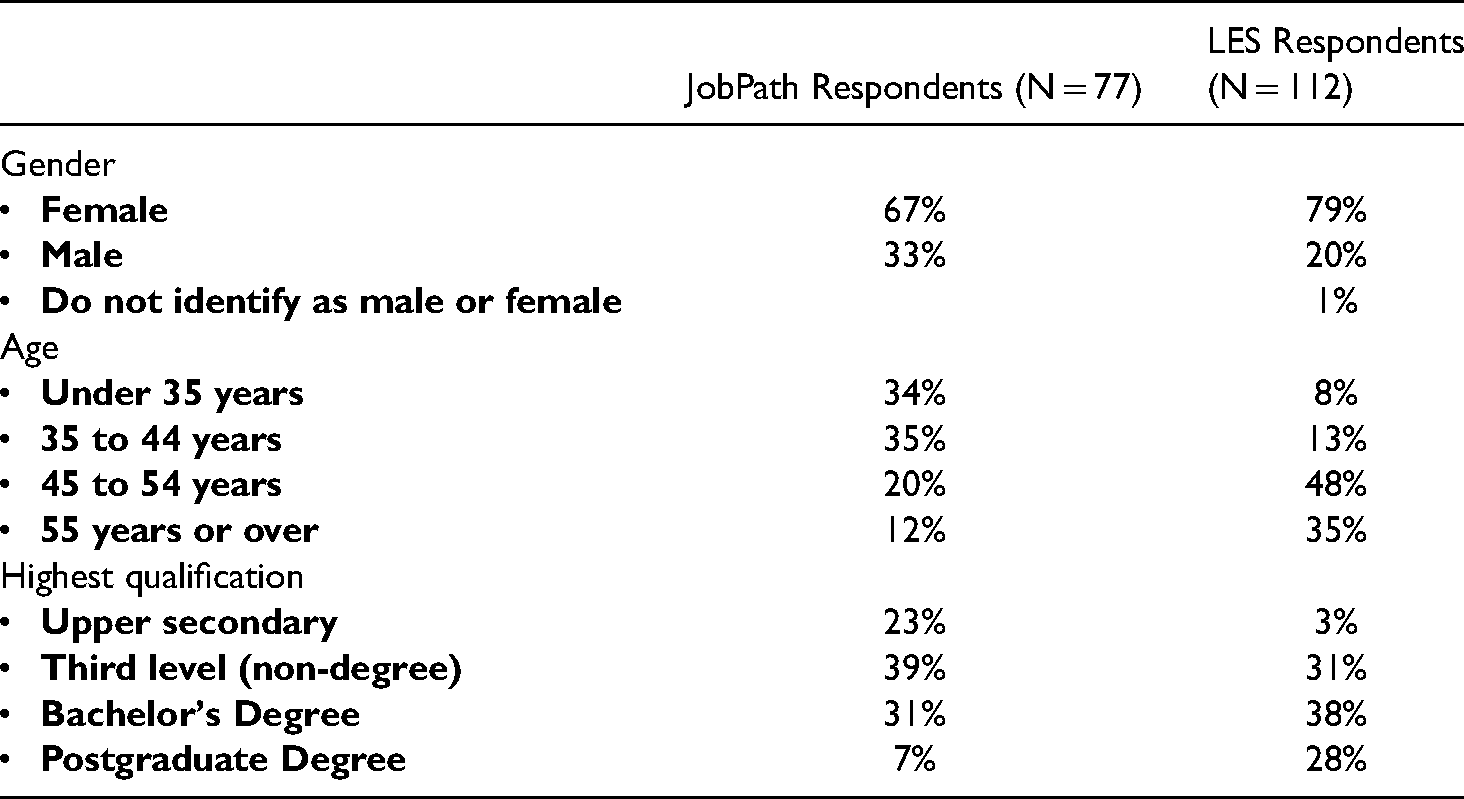
SPSS software was used to analyse the survey data, and differences in responses were tested for statistical significance using Fisher's exact test of independence. This test was chosen due to the small number of responses on some items, which precluded using Chi-Square tests.
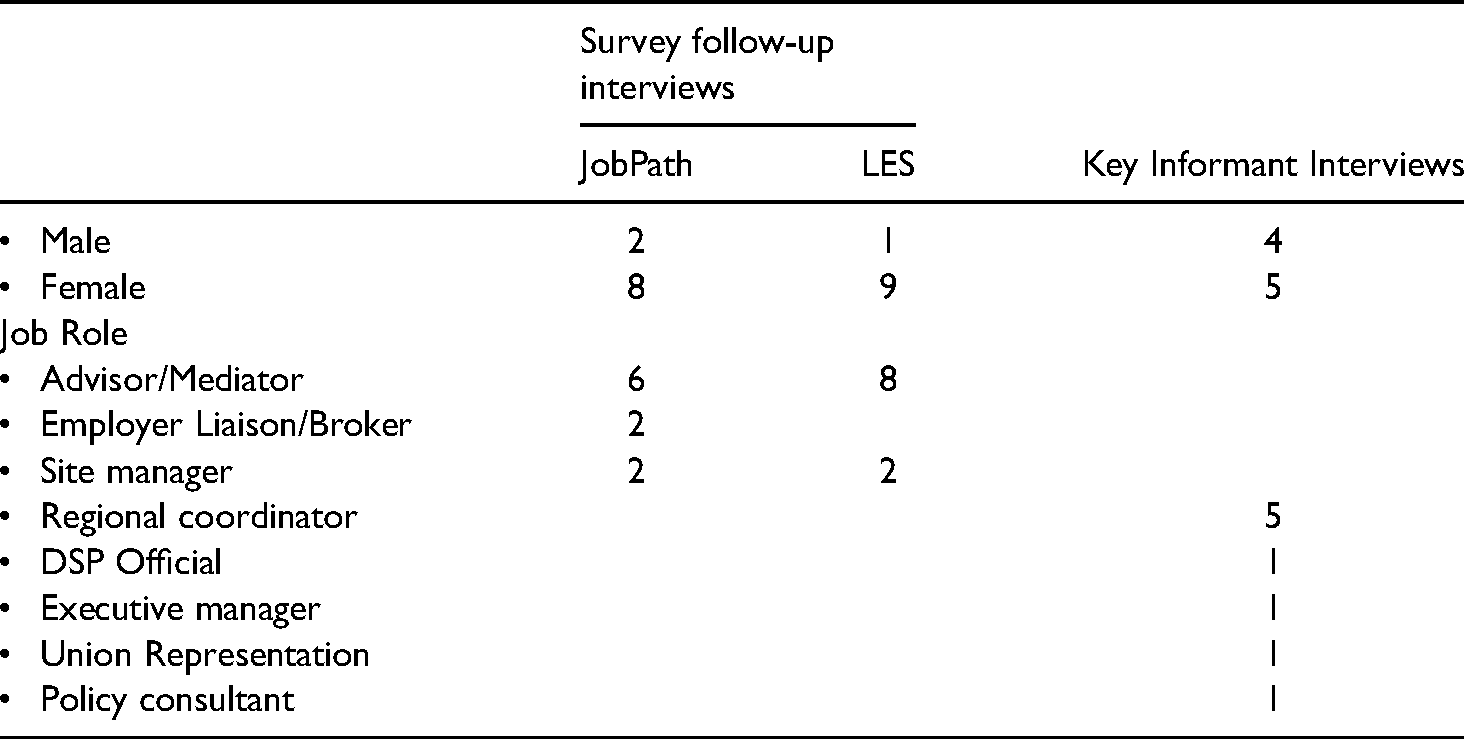
Follow-up interviews with 20 participants were conducted between October 2020 and January 2021. Participants were selected using purposive sampling: the sample was evenly balanced between JobPath and LES participants and included people working in each JobPath agency as well as employees from eight different LES organisations. In total, 14 advisors or mediators were interviewed, along with four managers, and two staff who worked as employer liaisons or job brokers (See Table 2). However, most of the managers along with one employer liaison had also previously worked as an advisor and could therefore discuss their experiences of working as an advisor during the interview. This research with frontline workers was supplemented by nine key informant interviews, which included five senior LES coordinators, a JobPath senior executive, a trade union representative, an official within the division of DSP that coordinates PES contracting, and a policy consultant who served as an independent advisor to government during the period of reform. NVivo software was used to organise and manage the coding of all interview data using a framework analysis approach. Following the framework approach (see Gale et al., 2013), codes based on pre-defined themes of interest drawn from the literature (e.g. perceptions of performance targets, sanctions) as well as emergent recurring themes were structured into hierarchical sets of themes and cases organised to enable comparison across groups of cases and systematic identification of commonalities and differences.
Interviewees.
Findings
Performance management by fear
The decision to marketize PES has often been portrayed as a political necessity that was driven more by pragmatic considerations and an urgent need ‘to meet capacity deficits’ (Murphy, 2021: 137) than an ideological commitment to marketisation. As a policy consultant and advisor to government explained, ‘DPER just simply wouldn't wear creating hundreds of new jobs in Intreo’ (KI7). To this extent, JobPath was positioned by a DSP official as ‘a creature of the last recession’ and ‘the extraordinary growth in the Live Register, which necessitated the contracting of JobPath and that's continued from there’ (KI8). However, interviews made clear that capacity issues weren't the only consideration. From the DSP's perspective, marketisation brought with it the opportunity to measure providers’ performance in ways that it had hitherto been unable to do. This was not just through the contract's payment model but also the fine-grained metrics that it was able to build into the contract as ‘when you procure something from the start, you can put in as many metrics as you want’ (KI8). Indeed, the DSP official went on to rationalise the criticism that JobPath providers face for the low percentage of participants who sustain full-time employment as a by-product of the fact that ‘its metrics are so good, and everything can be measured’ (KI8) whereas the LES’ ‘costs-met’ model meant that the DSP focused overly on holding them accountable for expenditure rather than results: What we should be measuring is their performance … but what we seem to be measuring, or spend a disproportionate amount measuring, is why do they have such high energy bills, or they need a lot of software this year. (KI8)
This performance measurement orientation was not just about documenting outcomes that would otherwise still be produced. It was also seen as a means of motivating changes in frontline behaviour. Drawing on public choice economics ideas about accountability and motivation, an independent advisor involved in the labour market reform consultations explained that there needs to be ‘some sort of incentive to get people to enthusiastically encourage people to search for work and get it’ (KI7). To illustrate his point, he reflected on the pre-reform period where, if you were working in FÁS ‘you didn't suffer from stress, you didn't have anybody managing the number of interviews you held, nobody was watching what you achieved in terms of getting people back to work’ (KI7).
From this point of view, the creation of JobPath was seen as ‘a disruptor’ (KI6), as one executive put it. It offered flexibility for scaling-up and scaling-down PES, but it also unsettled, and to a degree threated, prevailing PES practices. This carried over to LES staff, who frequently associated the DSP's new performance measurement orientation with the development of a more hostile contracting approach. One LES manager likened the change to the DSP coming in ‘like a big boot’ where ‘[i]t suddenly became about the numbers and how we report, and the focus shifted off the work with the clients (FES11).
There was a fear of the impending threat that Payment-by-Results would be extended to LES, and that partnership organisations would be ‘out of the game’ (KI2) because no board would be prepared to assume the financial risks associated with frontloading the payment of staff wages. To this extent, a union official positioned the RES tender as the ‘thin edge of the wedge’ (KI9), forecasting that not-for-profit organisations would struggle to be competitive in a tender for future LES contracts because of their fixed staffing costs.
While recognising the need to be accountable, there was a perception that the exclusive focus on job placement targets was contributing to ‘a loss of identity’ (FES11) and detracting from the LES’ core mission of assisting the very long-term unemployed. Trevor, who coordinated an LES in the south of the country, described the performance metric as ‘horrendous’, explaining that: If you want to get your contract renewed at the end of the year, you will only have interest in that one measure … I’m not saying that we do that. But if you were totally self-interested that's all you would do (KI4).
Embedded in Trevor's observation is a recognition of the conduct conditionality now faced by providers who risk incurring financial sanctions through contract termination if they don't perform. This was seen as an ever-present possibility when ‘every year they made a point of whether we were getting a contract for next year’ (KI5) and people would ‘hear in the ether about LES that are failing to reach targets, and they’ve been reduced to six-month contracts’ (FES4). ‘So, it's a sense of fear’, as one mediator explained, likening the performance management of providers to the activation of claimants: What I find ironic is that the same fear that the PtW process has generated within clients is also getting more and more replicated within the organisations that are supposed to be servicing those clients (FES4).
Street-level performance management
It is organisations rather than individuals who are the principal subjects of performance-based contracting, although we can expect that such organisations will ‘in one way or another send signals to workers about the performance expected from them’ (van Berkel and Knies, 2016: 63). To explore how performance-based contracting translates into the performance management of workers, JobPath and LES staff were surveyed about the degree to which they themselves were subject to performance monitoring. As shown in Table 3, the findings pointed to significant differences between the performance management regimes applied to JobPath and LES staff. These related both to the extent to which they were incentivised through targets and the degree of supervisory oversight they were subject to. The latter was evaluated through three questions asking about the lines of authority within their organisations, whether their supervisors knew a lot about the work that they did, and whether workers deferred to their supervisors on issues not covered by procedural guidelines. On each of these items, JobPath staff indicated that they were subject to tighter management control, and these differences were statistically significant. For instance, 66 percent of JobPath respondents strongly agreed that their supervisor knows a lot about the work that they do from day-to-day compared with 30 percent of LES staff. Similarly, fewer than 8 percent of JobPath staff reported that the lines of authority were not clear in their work compared with 21 percent of LES staff. The significance of these lines of authority was further reflected in the fact that 56 percent of JobPath respondents strongly agreed that they would defer issues not covered by procedural guidelines to their supervisor compared with just 26 percent of LES respondents.
Performance management and monitoring of frontline jobPath and LES staff.
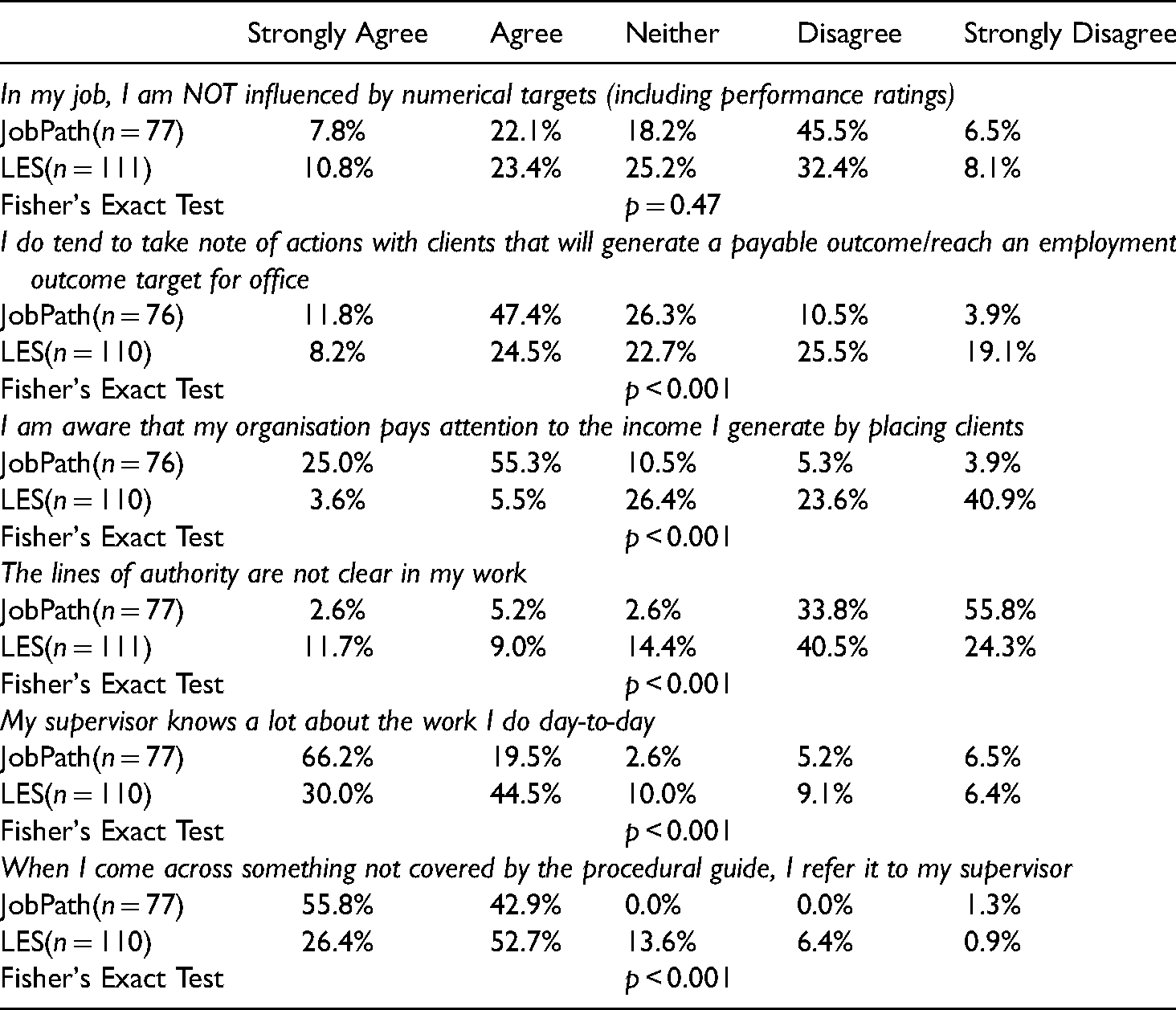
Taken together, these data suggest that JobPath staff, especially, feel subject to tight management control and, in follow-up interviews, a sense that their line manager ultimately ‘is watching us’ (FES10) pervaded many accounts of organisational management regimes. This manifested in different ways. The first was what might be described as ‘outcome measurement’ and concerned how advisors’ performance against targets would be tracked, sometimes overtly. One advisor recounted how a manager wanted to implement a whiteboard for ranking everyone's performance ‘to create that competitive atmosphere in the office’ (FES16). Advisors would write up their placements every time a placement was made, but the proposal was resisted by the staff who didn't want to be ‘publicly shaming the ones that weren't getting the numbers in’ (FES16).
The second aspect of performance management involved forms of ‘activity monitoring’, where advisors were held to account for what they did rather than target achievement. The focus in this instance was on inputs, and whether advisors were following organisations’ contractual obligations to the DSP on things like whether clients ‘have a progression plan’, ‘have a CV’ and are seen with given time frames (FES3, Manager). ‘Everything that is part of the contract is monitored’, as one advisor explained, including whether Personal Progression Plans are ‘done on time and filled in properly’, to the ‘assessments to be done’, to whether ‘every fifteen days that we have an appointment with each client’ (FES05). Advisors would be subject to monthly review meetings ‘as a kind of check on compliance’ (FES08) with one JobPath manager describing how she would also randomly ‘do checks on people's customers’ and on their case notes to see ‘their [customer] journeys, what they’re doing, what interventions have been put in place?’(FES21).
This activity monitoring pressured advisors to, in turn, create activities for clients. For instance, Carl explained that advisors were expected to ‘set a new task’ every time they met with clients, such as asking jobseekers to update their CV, ‘contact a specific company’ or ‘find a course’ (FES16). These records of activities were seen as vital documentation that providers could provide the DSP at the end of a customer's journey to prove ‘here's what they’ve done’ (FES3). But, as Carl explained, the need to always set tasks meant ‘you can be kind of just giving them a silly task for the sake of it’ and to create ‘the illusion of progression’ (FES16).
This frustration with having to perform activity was shared by some LES mediators, with one mediator reflecting on how administrative accountability had colonised casework such that ‘meetings seem to be about systems and measurement rather than let's actually get people off the dole’ (FES17). ‘It's like feed the Tamagotchi and forget about the core reason of why we are there’, as she put it in reference to the BOMi information management system that LES staff were required to use. This system was also a primary means by which mediators were subject to supervisory oversight, as their managers ‘can go in and check on BOMI, see what your level of activity is’ (FES12) and ‘how you’re going to reach your 30 percent [target]’ (FES17).
As shown in Table 3, an awareness of performance targets was pervasive among both JobPath and LES staff. Only a third of frontline workers reported that they were not influenced by targets, although the data suggested that JobPath staff were far more cognisant than LES staff of the financial significance of meeting targets and, indeed, their actions with clients more generally. This financial significance was organisational rather than individual, in that JobPath staff did not receive performance bonuses other than ‘accolades like employee of the month’ (FES14). Still, 80 percent ‘agreed’ or ‘strongly agreed’ that their organisation paid attention to the income they generated by placing clients while 59 percent indicated that they tended to take note of actions with clients that would generate a payable outcome or reach a target. This compared with 9 percent and 33 percent of LES staff respectively, and these differences were statistically significant.
What's measured and what matters
The ubiquity of frontline performance measurement is clear from the survey and interview data. However, its contribution to enhancing service delivery was often question by interviewees. Some JobPath advisors expressed feeling ‘very conflicted’ about the fact that ‘[w]hen you whittle it down really, it comes down to the jobs and the numbers of jobs that we get’ (FES10). They perceived a potential tension between the ‘two sides to the business’ in that they felt ‘a duty of care to the clients’ that had to be balanced against the fact ‘I have to reach my job targets’ (FES2). Other advisors, particularly those who had previously worked in target-driven industries such as retail and telemarketing, welcomed performance measurement as keeping ‘you on your toes (FES5) and even breeding ‘a friendly rivalry’ (FES16), as Carl, an advisor with retail experience explained. Although he stressed that this focus on ‘trying to hit them targets’ would never ‘be a case of let's push John into the McDonald's job just for the sake of employment’ (FES16). His remark highlighted one of the main reservations other frontline staff held about targets and performance payments: that they incentivised advisors to ‘get them into Tescos because I have a target’ (FES1), as one mediator provocatively put it.
To consider this question, Spearman's rank-order correlations were run to assess if there was any relationship between survey items tracking the extent to which frontline staff are outcome-oriented in their approach and other items tracking their disposition towards ‘work-first’. These ‘work-first’ measures included a question where respondents were given a scenario that, after a short time, a client is offered a low-skill, low-paying job that would make them better off financially. Respondents were then asked to indicate what they would advise jobseekers to do, on a scale from ‘1. Take the job and leave welfare’ to ‘7. Stay on benefits and wait for a better opportunity’. A second ‘work-first’ indicator was a question asking respondents to rank whether they perceived that the more important goal of their agency was ‘to help clients get jobs as quickly as possible’ or ‘to raise education or skills levels so jobseekers can get the jobs they want in the future’. As shown in Table 4, there was a moderate but significant correlation between how participants responded to these ‘work-first’ measures and the extent to which they agreed that (i) their organisation pays attention to the income they generate by placing clients and that (ii) they, personally, take note of actions with clients that achieve a payable outcome or performance target. Although we cannot infer that performance measurement causes frontline staff to be more ‘work-first’ oriented, the two nonetheless appear to go hand in hand.
Associations between performance measurement and work-first.
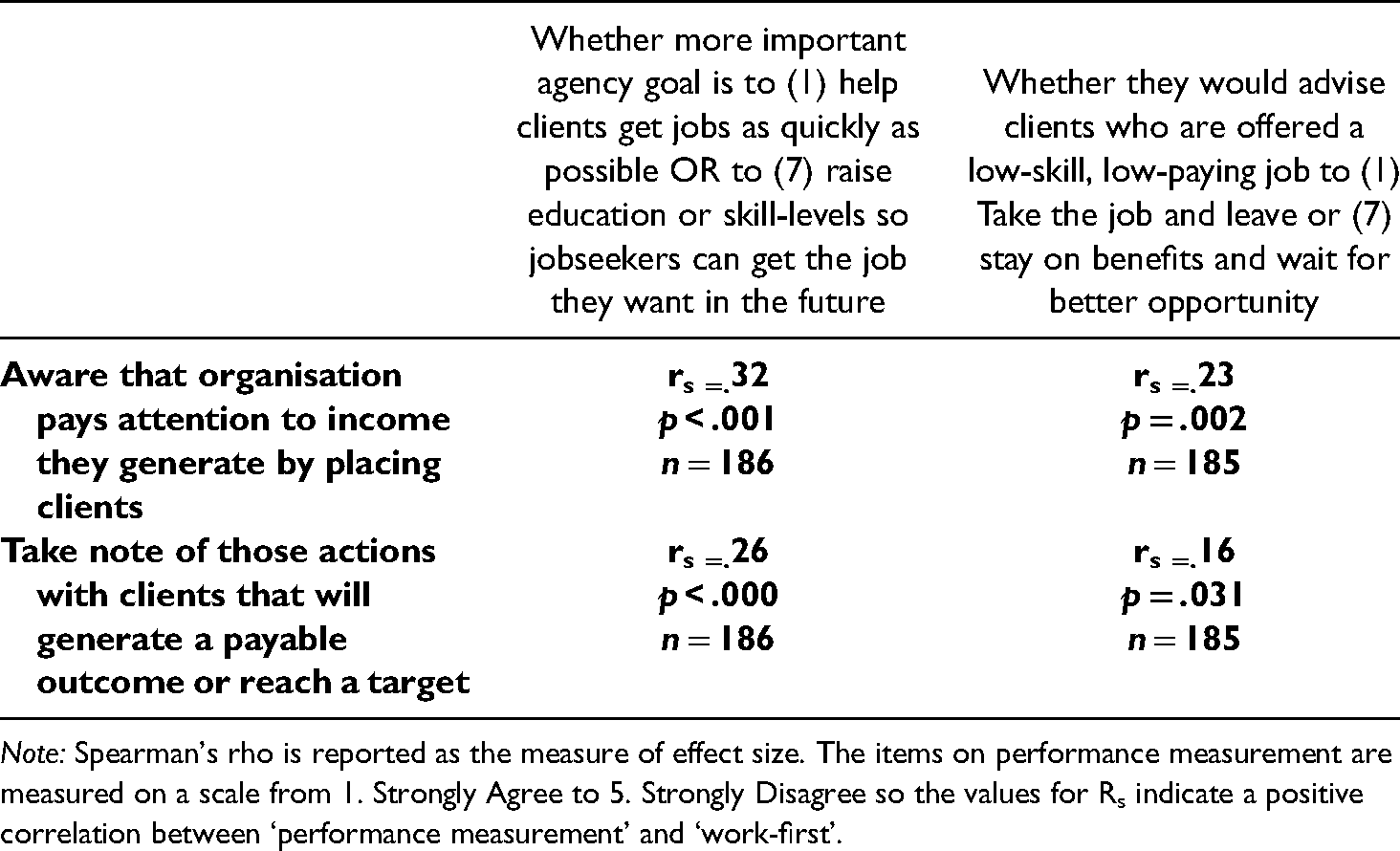
Note: Spearman's rho is reported as the measure of effect size. The items on performance measurement are measured on a scale from 1. Strongly Agree to 5. Strongly Disagree so the values for Rs indicate a positive correlation between ‘performance measurement’ and ‘work-first’.
Beyond the concern that performance incentives motivated pushing ‘square pegs into round holes’ (FES1), there was widespread criticism that the targets they were measured against were poor indicators of the quality of support provided to clients. Although, noticeably, this criticism was more muted among JobPath staff. Indeed, only one advisor criticised the focus on job placements as ‘very unfair … and it shouldn't just be down to someone having thirty hours a week full-time work because that's not the end goal for everyone’ (FES10). The absence of criticism of employment-oriented targets among JobPath interviewees may reflect the fact that few had any experience of delivering employment services prior to JobPath, or under conditions where their success in placing clients into jobs was not closely monitored. Moreover, several were accustomed to working to targets from previous jobs in telemarketing or retail management and claimed to therefore ‘suit the job well’ (FES15).
In this contest, JobPath staff's cognisance of the degree to which their employer was monitoring their ability to generate income from job placements may denote an uncritical acceptance of, and socialisation into the regimes of managerial control governing their work rather than a critical resistance to the commodification of their performance. By contrast, most LES interviewees had over 20 years’ experience of working in employment services and had experience of working with jobseekers without the pressure to meet the numbers. They perceived the LES’ 30 percent placement target as ‘pure nonsense’ (FES4) and an arbitrary measure that took little account of the challenges that jobseekers’ experienced or the enormous variation in offices’ caseloads. One mediator in an LES on the periphery of Dublin put the fact that he almost always achieved his target down to ‘the demographics’ of his caseload and the fact that he had ‘a natural throughput of people … who are going to find employment relatively quickly’ (FES4). There was a desire for other kinds of ‘pathways outcomes’ (Shutes and Taylor, 2014: 216), such as progressions into training or education to be recognised as more meaningly indicators of performance. This stemmed from the view that a sizeable proportion of jobseekers would not find employment within the short time-window mediators had to work with them. But there was still important work to be done to help them ‘develop themselves’ and progress towards employment, whether it be to ‘complete a course’ or connect with mental health service; things that, for long-term unemployed clients, ‘do mean so much’ but which, as a mediator in an LES north of Dublin elaborated, ‘from the statistical end of it … is completely undervalued’ (FES17).
In this respect, performance metrics were seen as driven by the fiscal priority of reducing the claimant count rather than an inclusion agenda of enabling people to overcome barriers to their social and economic participation. The focus on full-time employment was dictated ‘by the powers that be to get people off the Live Register’ but, as one LES manager explained, ‘that's nothing to do with the stepping-stone of somebody going from unemployed with an addiction to part-time work and stable to maybe, if they kept that going, full-time work’ (FES19). So, the ‘the bigger picture is never taken into account’ (FES7), leaving the work of supporting jobseekers to address complex barriers to participation to be done ‘in-spite of the targets’ (KI4). However, the capacity to keep doing this work hindered on first meeting the numbers to ‘keep officialdom off your back’ as otherwise LES would be ‘in trouble with our contract’(FES19).
Concluding discussion
The period of post-crisis reform has been likened by critics to a transformation in ‘the entire spirt of spirit of welfare’ (Boland and Griffin, 2018: 101) in Ireland. Much attention has been given to how this transformation has been experienced by claimants, and the role that the threat of sanctions has played in governing jobseekers through instilling ‘fear, stress and anxiety’ (J Whelan, 2021a: 43) to produce what Finn characterises as ‘feigned compliance’ (2021: 79); namely, a superficial performance of ‘going through the motions’ (J Whelan, 2021b: 21) of applying for unsuitable or unattainable jobs merely to satisficing caseworkers’ demands for ‘bureaucratic “box-ticking”‘ (Finn, 2021: 82) and to maintain the veneer of compliance. Reflecting on the implications of widening conditionality for social citizenship, Boland and Griffin argue that ‘where payments become conditional, arbitrary and subject to specific performance, social security loses its essence and becomes precarious’ (2015: 45–6). Access to social citizenship ceases to be a right and instead becomes conditional on the performance of an ‘individual responsibility to sell one's labour through the market’ (Shutes and Taylor, 2014: 204). To this extent, claiming benefits has become an increasingly ‘governed experienced’ conditioned by ‘constant demands to perform’ (Boland and Griffin, 2015: 45)
However, it is not just claimants who are now governed through threats of sanctions and payment conditionality. The behaviours of service providers and caseworkers too are increasingly under surveillance and subject to financial inducements in what Shutes and Taylor (2014) argue amounts to an extension of ‘work-related conditionality’ to the financing of PES. This is most pronounced in JobPath's performance-based payment model, but it is also manifest in the latent threat that LES organisations perceive of losing future contracts if they fail to meet their numbers. So, while they are not subject to the immediacy of Payment-by-Results, they nonetheless experience being disciplined by what might be described as contracting-by-results.
The findings reported suggest that these regimes of contracting-by-results work to discipline PES organisations and caseworkers by instilling fear and anxiety among organisations who might be considered ‘incumbent providers’. This is the term that Taylor and Rees use to describe pre-existing providers whose status and position in the wider PES system comes under threat from processes of marketisation and the changes in terms of commissioning they involve. Writing in reference to the commissioning of the UK Work Programme, they position the landscape of PES as a strategic action field ‘where providers jostle for position and legitimacy’ (Taylor et al., 2016: 264). Periods of (re)procurement mark ‘episode[s] of contention’ that disturb existing provider positions by opening the field to ‘invaders’ (Taylor et al., 2016: 264) from other fields, whether it be employment services markets in other countries or parallel social or human services fields domestically. Murphy (2021: 138–9) has recently extended this analytical approach to Ireland's PES landscape to highlight the ‘field-shaping’ role played by processes of PES contracting and how uncertainty over future procurement can generate ‘co-opetition’ between local actors. The findings reported here illustrate how this uncertainty over future procurement is deployed strategically by the DSP to performance-manage the frontline delivery of PES. Despite being funded on a cost-met basis, performance measurement induces fear and anxiety among LES mediators and managers, who are kept on a tight leash through short-term contracts and the ongoing fear of losing funding if they don't meet the numbers. The proximity of an alternative market of JobPath providers and DSP's proven disposition towards competitive tendering makes this fear all the more palpable.
The findings also bring into view the political effects of performance management as ‘a disciplinary regime’ (Soss et al., 2013: 126). As Brodkin argues, ‘discourses of performance and accountability tend to treat specification and measurement of objectives as, largely if not entirely, a technical concern’ (2011: i256). Yet these are inherently political choices that restructure the concerns considered by caseworkers when putting policy into practice. We see this in how the performance-based payments used to steer contractors, in turn, become embedded in the minds of frontline delivery staff. In particular, while the study findings show that many LES staff feel influenced by numerical targets, awareness of the commodity value of their performance is particularly acute among JobPath staff. Close to 60 percent say that they take note of actions with clients that deliver payable outcomes, while 80 percent are mindful that their ability to generate revenues from placing clients into work is monitored by their employer. This internalisation of the commodity status of their work with clients, which is instilled through continuous outcome measurement and monthly review meetings, is far less evident among LES staff, perhaps reflecting the not-for-profit orientation of those organisations. But most significantly, the findings show that it is associated with an orientation towards enacting ‘work-first’; the caseworkers who are mindful of the commodity value of their actions with clients are also the same caseworkers who implore jobseekers’ to commodify their own labour by taking low-paid, low-skill jobs rather than waiting for better-paid opportunities to come along. In this way, the organisation of PES delivery through marketisation and performance management does indeed work to facilitate a workfarist ‘shift in the substance’ of activation policy, as Bredgaard and Larsen (2007: 295) have similarly found in relation to early waves of marketisation in Denmark. As do the regimes of supervisory oversight and activity measurement that caseworkers are subject to. These pressure caseworkers to ‘feed the Tamagotchi’ of administrative compliance by giving jobseekers ‘a million little box ticking exercises’, illustrating how the activity monitoring of caseworkers leads to the activity monitoring of claimants and the experience of being on ‘a bureaucratic carousel’ (Finn, 2021: 78) recounted by jobseekers in previous studies. Similarly, the commodification of caseworkers’ performance motivates a workfarist commitment to claimant commodification that propels the ‘injunctions to accept whatever is available’ (Boland and Griffin, 2015: 44) repeatedly described by jobseekers in previous studies. What this study adds to the existing Irish literature on street-level activation is a recognition of the double dynamics involved in this ‘enforcement of an “any work any job policy” policy’ (J Whelan, 2021b: 21); how the commodification and governing of jobseekers is anchored in, and propelled by, the governing of caseworkers through instruments of marketisation and performance measurement. This is not to imply a deterministic logic whereby double activation necessarily always produces workfare practices at the street-level. Certainly, there are examples of caseworkers resisting pressures to enforce work-first and conditionality policies. Nonetheless, governing caseworkers through measuring their returns against job placement targets tends to increase the chances that jobseekers will find themselves governed in such ways.
Yet the findings also show that the performance indicators by which caseworkers are governed are often also experienced as arbitrary metrics that conceal those aspects of their work that matter most More than this, many see the ‘myopic attention on job placement’ (Dias and Maynard-Moody, 2007: 209) as inherently counterproductive to the goal of reducing poverty among disadvantaged social groups. Almost all LES mediators, although comparatively few JobPath advisors, described feeling conflicted and torn between meeting the numbers and providing meaningful support to clients, illustrating the potential, as described by Lynch, for ‘deep alienation in the experience of constantly living to perform’, especially when metrics are ‘of questionable’ worth (2010: 55). While Lynch was reflecting on the implications of incessant performance measurement in universities, the delivery of welfare-to-work is also increasingly subject to ‘the unrelenting measurement of performance’ and associated risk that ‘only the measurable matters’ (Lynch, 2010: 55). When job placements are all that's measured, the work of supporting those who need employment assistance the most becomes invisible and barely counts.
Footnotes
Acknowledgements
This research has received funding from the European Union's Horizon 2020 research and innovation programme under the Marie-Sklodowska-Curie grant agreement no. 841477. The views expressed are those of the author alone. Neither Maynooth University nor the European Commission are responsible for any use that may be made of the information in this article. The author is grateful to an anonymous reviewer for their highly constructive feedback on an early manuscript draft. He would also like to thank the frontline staff who participated in this research and to acknowledge the mentorship of Mary P. Murphy and the support of Australian colleagues (Mark Considine, Jenny M. Lewis, Siobhan O'Sullivan and Phuc Nguyen) in encouraging an Irish replication of their surveys of frontline employment services staff.
Data availability

Declaration of conflicting interests
The author(s) declared no potential conflicts of interest with respect to the research, authorship, and/or publication of this article.
Funding
The author(s) disclosed receipt of the following financial support for the research, authorship, and/or publication of this article: This work was supported by the H2020 Marie Skłodowska-Curie Actions (grant number 841477).