




Abstract
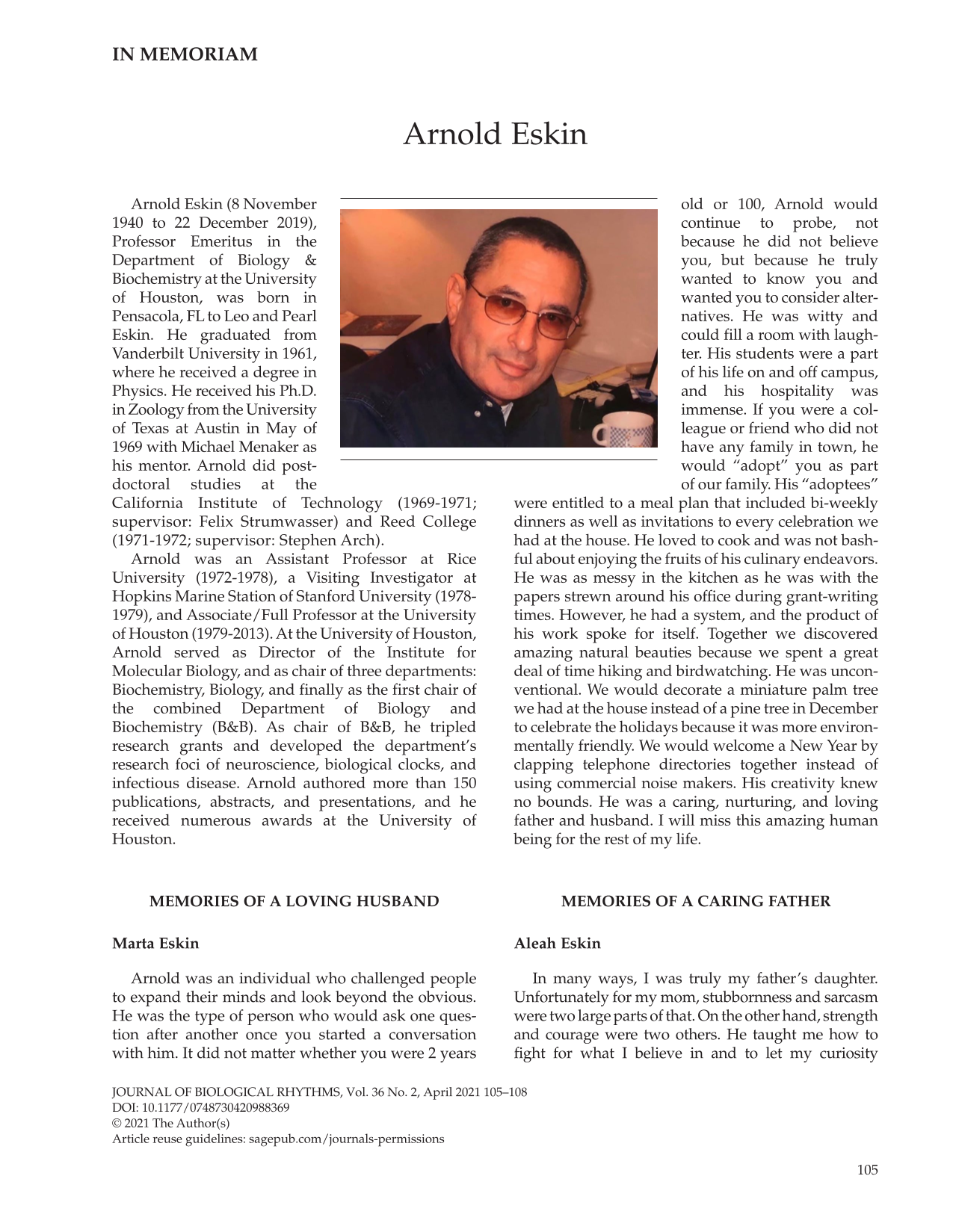
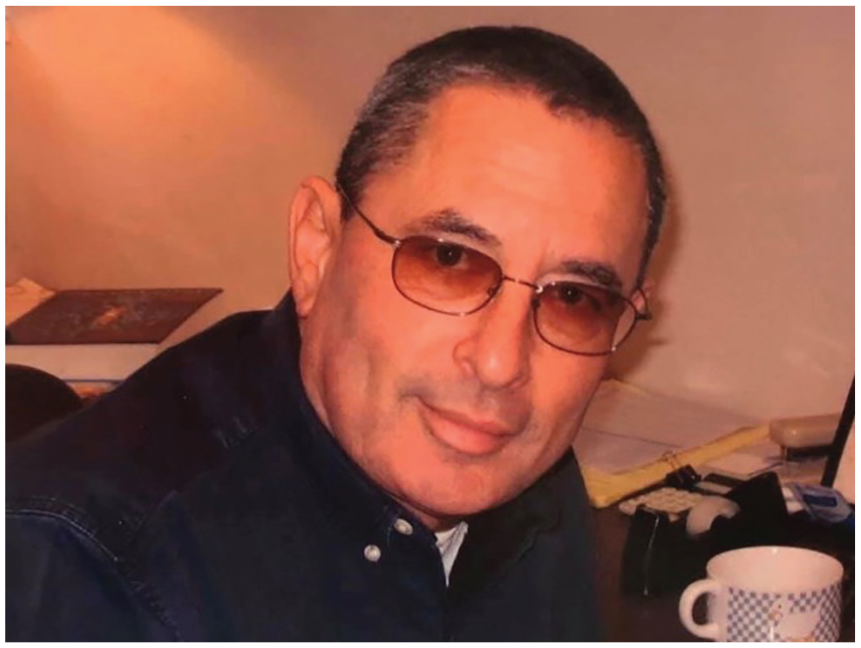
Arnold Eskin (8 November 1940 to 22 December 2019), Professor Emeritus in the Department of Biology & Biochemistry at the University of Houston, was born in Pensacola, FL to Leo and Pearl Eskin. He graduated from Vanderbilt University in 1961, where he received a degree in Physics. He received his Ph.D. in Zoology from the University of Texas at Austin in May of 1969 with Michael Menaker as his mentor. Arnold did post-doctoral studies at the California Institute of Technology (1969-1971; supervisor: Felix Strumwasser) and Reed College (1971-1972; supervisor: Stephen Arch).
Arnold was an Assistant Professor at Rice University (1972-1978), a Visiting Investigator at Hopkins Marine Station of Stanford University (1978-1979), and Associate/Full Professor at the University of Houston (1979-2013). At the University of Houston, Arnold served as Director of the Institute for Molecular Biology, and as chair of three departments: Biochemistry, Biology, and finally as the first chair of the combined Department of Biology and Biochemistry (B&B). As chair of B&B, he tripled research grants and developed the department’s research foci of neuroscience, biological clocks, and infectious disease. Arnold authored more than 150 publications, abstracts, and presentations, and he received numerous awards at the University of Houston.
Memories of A Loving Husband
Marta Eskin
Arnold was an individual who challenged people to expand their minds and look beyond the obvious. He was the type of person who would ask one question after another once you started a conversation with him. It did not matter whether you were 2 years old or 100, Arnold would continue to probe, not because he did not believe you, but because he truly wanted to know you and wanted you to consider alternatives. He was witty and could fill a room with laughter. His students were a part of his life on and off campus, and his hospitality was immense. If you were a colleague or friend who did not have any family in town, he would “adopt” you as part of our family. His “adoptees” were entitled to a meal plan that included bi-weekly dinners as well as invitations to every celebration we had at the house. He loved to cook and was not bashful about enjoying the fruits of his culinary endeavors. He was as messy in the kitchen as he was with the papers strewn around his office during grant-writing times. However, he had a system, and the product of his work spoke for itself. Together we discovered amazing natural beauties because we spent a great deal of time hiking and birdwatching. He was unconventional. We would decorate a miniature palm tree we had at the house instead of a pine tree in December to celebrate the holidays because it was more environmentally friendly. We would welcome a New Year by clapping telephone directories together instead of using commercial noise makers. His creativity knew no bounds. He was a caring, nurturing, and loving father and husband. I will miss this amazing human being for the rest of my life.
Memories of A Caring Father
Aleah Eskin
In many ways, I was truly my father’s daughter. Unfortunately for my mom, stubbornness and sarcasm were two large parts of that. On the other hand, strength and courage were two others. He taught me how to fight for what I believe in and to let my curiosity wander. He pushed me to be bold and take risks. He also taught me how to really enjoy myself and not take life too seriously at times. Out of every promise we made to each other, there was one that truly stuck: we made a pact that for everything that he taught me, he would in turn, learn from me as well. He emphasized the fact that we should all constantly be learning; to him, breathing and learning were practically the same thing. Even though he has passed, I will continue to learn from my dad every day. I will carry his words, thoughts, and love with me for the rest of my life. So, whether he was Dr. Eskin or Arnold or friend to you, he remains with us all. On behalf of all of us, thank you Dad, for everything.
In Memory of A Lifelong Mentor
Samer Hattar
When you come to a new country, the first people you meet make a huge impression on you. I was lucky to meet Arnold Eskin. Although many times during my PhD studies in Dr. Eskin’s lab, as we used to call him at the University of Houston, I was ready to murder him, it became apparent later in life that Dr. Eskin had a different unconventional way of caring about you. A way that builds your character and personality. It took me many years after I left his lab to appreciate the care and knowledge that Arnold, as I started calling him later, imparted on me and in reality, many others in the circadian field. I will tell this story about a really wonderful scientist and person from a personal vantage point.
Probably the most interesting personality trait of Arnold is that he did not have time for fools. Once you know this about Arnold, everything fits in place. Arnold himself was an incredibly hard-working person. He was in a small department at the University of Houston when I first met him. He had expectations that clearly were not in sync with some members of the department. When I was interested in joining his laboratory, literally everyone in the department suggested against that decision. What nearly everyone missed about Arnold is that he knew what it takes to make it in science and if he saw a spark in you, he was committed to assure that you actually make it yourself. In this remembrance, I will tell a few specific examples to provide the readers with the incredible impact Arnold made in his life.
The “Eskinogram”
Arnold is best known in the circadian field for what is known as the Eskinogram. While Arnold was always quick to honestly acknowledge that the “Eskinogram” was a redrawing of a figure from a paper by Pittendrigh & Bruce in 1957, Arnold was the champion of using the simplicity and utility of the Eskinogram to direct his experimental design and creation of hypotheses. In science, you draw a diagram and you try to nullify hypotheses that are tested against such a model. Arnold’s Eskinogram allowed the circadian field to simplify the complicated concepts of circadian rhythms into a single diagram. He knew things were much more complicated, but he wanted a simple way to test a system that was unknown at the time. Despite the major advances we’ve made as a field, the Eskinogram utility still holds a significant place in this field.
Circadian Phase to Non-Light Zeitgebers
Arnold had many impactful papers during his career. I will highlight three results due to their timeliness at the time of publication. The first discovery concerned the need for new protein synthesis to phase shift in response to non-photic zeitgebers, specifically serotonin. This was transformative as it showed that phase shifting the clock requires new proteins to be synthesized. The second discovery showed that adding transcription inhibitors leads to predictable changes in the properties of the clock; this was a seminal study that led to the discovery of the molecular clockwork of the circadian clock. Finally, Arnold also studied learning and memory (specifically long-term memory), and he discovered that Tolloid, a metalloprotease that activates growth factors, leads to the consolidation of long-term memories. Arnold’s impact on these areas will be lasting.
Chair Power
One of the hardest aspects of being in a small department during graduate school was the lack of pride your colleagues displayed toward the department and the university. When I joined the University of Houston, maybe the luckiest break that happened was that Arnold agreed to become the chair of the department. He literally transformed the place. We started inviting great scientists who took the time to meet with the students. The department hired spectacular scientists and Arnold encouraged the students to read the applications of these terrific candidates and attend their chalk talks. The whole atmosphere of the department changed and the learning that I obtained in those times have led to my eventual success in my career.
Always Mentorship
Perhaps the greatest lasting impact of Arnold was the people who he produced from his lab. So again, despite the fact that he was in a small department, he had many people who left his lab who are very successful scientists in major institutions and continue to carry his profound legacy onward. His drive and courage left indelible marks on the people who worked with him or people who interacted with him, like my wife Rejji Kuruvilla, who told me, “Dr. Eskin was the first one to trust me as a scientist. His trust propelled me to succeed in my career.”
Friendships
Perhaps the fondest memories of Arnold happened after I left his lab and started to be his friend. He invited my family to his house for several delightful dinners and made my parents feel so proud of their son. Every time we met, I had the most wonderful time with him, Marta, and their daughter Aleah. You could feel the pride that he showed about his people’s success by the questions his young daughter at the time used to ask. Clearly, Arnold had talked about his trainees to his family and highlighted his pride in our success. Arnold was very funny and incredibly social. He worked hard and enjoyed life to the fullest. He affected my life far beyond science into every aspect of my development.
A Friend and Departmental Colleague
Paul Hardin
Arnold was an immensely insightful scientist who was way ahead of his time. One of his long-term projects to identify cycling proteins in the Aplysia eye clock was undertaken before good technology to do this was available. His knowledge of clock properties, history of the field, and its personalities was incredible. He told many stories about Pittendrigh and other founders of the field and their interactions at meetings as well as the founding and importance of the Society for Research on Biological Rhythms (SRBR) and his reverence and admiration for Fred Turek’s efforts (among others) to get the society going. Seeing the success of SRBR, Arnold and Vinnie Cassone conceived and initiated our regional clocks meeting, the
My most fond memories of Arnold were as a department chair, friend and colleague at the University of Houston (UH). Arnold had a few quirks. We always knew an National Institutes of Health (NIH) grant deadline was coming because Arnold would escape the interruptions as chair to rent a beach house in Galveston so that he could completely focus on writing. If the beach house looked anything like his paper writing at work, he would have stacks of reference papers, manuscript drafts, data and figures laid out over lab benches and tables. It looked like a mess, but he had perfected his system and knew where everything was. Arnold had a boisterous personality and a great sense of humor and style. He and Marta loved getting together with his departmental compadres (Susan Hardin and myself, Stuart and Laurence Dryer, and Greg Cahill among others) socially and hosted many parties at his apartment. These were often raucous affairs talking about science, art, departmental politics, family, travels, and drinking copious quantities of wine in, of course, the correct order: white first, lighter reds, bolder reds (only the best ones first), then onto any swill that was “drinkable” when we could no longer tell the difference. Arnold would typically have his trademark orange shirt on during these affairs. His refined taste for good food and wine extended to many incredible dinners with seminar speakers and job recruits. Arnold knew where all the best restaurants were in Houston and spared no cost in making visitors feel welcome and appreciated.
Arnold started his second family with Marta while I was at UH. Arnold’s daughter Aleah had him twisted around her little finger from birth. Arnold was a completely dedicated father to Aleah. He was always so proud of her and her accomplishments and made sure you knew all about them. It was heartwarming to see. Arnold will always have a special place in my heart. I will miss Arnold exclaim “good God almighty” to express happiness, surprise, concern and many other emotions. RIP, Arnold!
A “Larger Than Life” Collaborator
Terry Page
I first met Arnold in 1978 while I was a postdoc in Pittendrigh’s lab at Hopkins Marine Station and he quickly became a good friend and mentor. During the 2 years he was there we tried collaborating on a project to follow-up on his discovery that serotonin could generate phase shifts in the Aplysia eye rhythm. The project ultimately came to nothing, but I did learn quite a bit from our interactions. One was that that Arnold had no compunction about dragging me back into the lab late at night (after I cooked his dinner) to try to make progress on our collaboration. As an experimental scientist he was indefatigable. In addition, I learned the value of a broad and scholarly knowledge of the literature, care in experimental design and execution, and the importance of being critical about your own and others’ work. I also learned that Arnold didn’t have very good hands in the lab—that was to be my role while Arnold supervised and provided the intellectual input!
One of the things that first comes to mind when I think of Arnold was his penchant for organizing “events” that were always memorable. One particular tour-de-force of Arnold’s organizational abilities was Pittendrigh’s 60th birthday surprise party attended by ex-students, postdocs, and colleagues from the world over (including the arrival by Jurgen Aschoff from the sea, rowed to shore in Monterey Bay wearing a nightgown, and carrying a huge banner). A few of the other lesser but no less memorable Arnold-led excursions I was privileged to be in on included a large gathering at Big Bend National Park (including Ron Konopka and Greg Cahill, two other scientists who passed away too young), a vacation trip with Marta, my wife, and myself to the Caribbean islands, or simply birdwatching in Texas or on the Georgia coast. Arnold was also deeply committed to quality in cuisine, so naturally all of these activities were accompanied by fine food and wine! Even when on the road, any search for a quick lunch would involve an extended discussion of which fast-food establishment offered the best hamburgers.
Another marked characteristic of Arnold was his integrity and unflagging honesty. He didn’t believe in anonymous reviews and would sign his reviews good or bad (he sent me a copy of the “anonymous” letter he wrote to Vanderbilt for my tenure, which I must say was not all gushingly positive!). This habit of course occasionally caused some hard feelings but Arnold was not deterred. Though I thought it admirable, I was never sure this was a wise endeavor, but it was a telling characteristic of Arnold’s commitment to be completely honest and above board in his scientific and personal life.
Overall, Arnold was one of those “larger-than-life” characters who had a major impact on the many people who knew and cared about him. It’s really too sad that there won’t be more Arnold going forward!
A Scientific Sparring Partner
Carl Johnson
For those of us who overlapped with him, Arnold Eskin was one of the vibrant characters of Chronobiology. Arnold was a second mentor to me while he was at Hopkins Marine Station in 1978-1979, where I was a PhD student of Colin Pittendrigh. Arnold was possibly the most intellectually engaged scientist that I’ve ever met—but also one of the most intractable. I never knew when a casual conversation with Arnold would transform into a verbal fencing match with “no prisoners taken.” This characteristic of Arnold (which mellowed a little as he got older) sometimes did not serve him well in his personal relationships, but it was an excellent training ground for me in learning to be critical and always to question my assumptions. I’ll never forget how Arnold would grill me on experimental design to appreciate that the best experiment was the one that gave interesting and informative information whatever the result turned out to be. Arnold rightly pointed out that most of the experiments I designed were ones in which one possible outcome would be wildly exciting, but the other possible result was boring and uninformative. Sadly, I still have that defective characteristic in the experiments that I design, but at least Arnold identified it for me and consequently I appreciate my limitations (and 99% of the time, the results of experiments that I have designed have been boring & uninformative, but 1% of the time . . . !).
So, Arnold could be challenging and even aggressive (at least that is the way that I as a beginning graduate student perceived him), but in retrospect I think of Arnold as an excellent example of one of my favorite T-shirt messages, “I yell because I care.” Arnold was challenging because he CARED; he cared about science, thinking deeply, investing time in his trainees, good food & wine, and fundamentally he cared about you. I’ve missed his presence in my life.