




Abstract
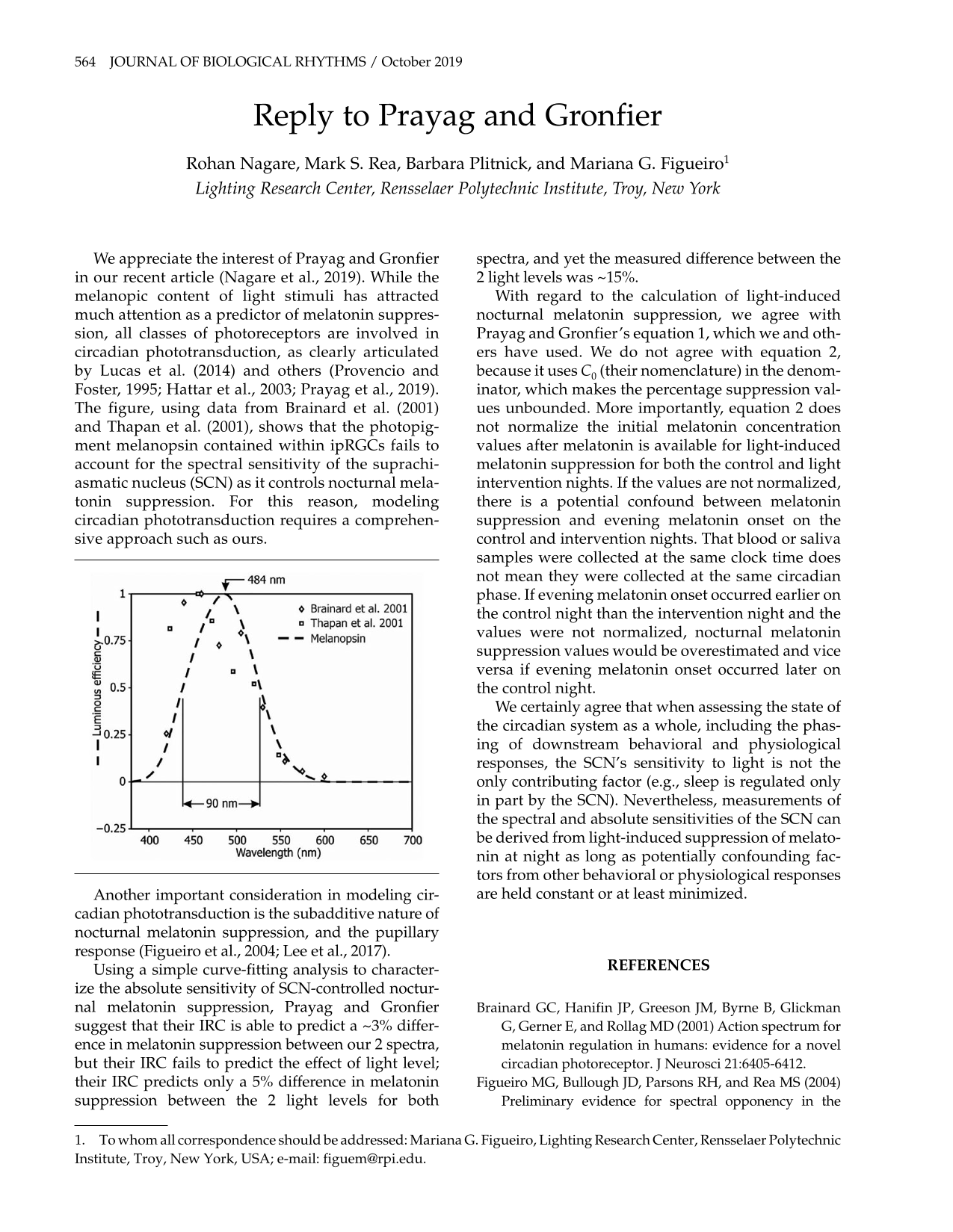
We appreciate the interest of Prayag and Gronfier in our recent article (Nagare et al., 2019). While the melanopic content of light stimuli has attracted much attention as a predictor of melatonin suppression, all classes of photoreceptors are involved in circadian phototransduction, as clearly articulated by Lucas et al. (2014) and others (Provencio and Foster, 1995; Hattar et al., 2003; Prayag et al., 2019). The figure, using data from Brainard et al. (2001) and Thapan et al. (2001), shows that the photopigment melanopsin contained within ipRGCs fails to account for the spectral sensitivity of the suprachiasmatic nucleus (SCN) as it controls nocturnal melatonin suppression. For this reason, modeling circadian phototransduction requires a comprehensive approach such as ours.
Another important consideration in modeling circadian phototransduction is the subadditive nature of nocturnal melatonin suppression, and the pupillary response (Figueiro et al., 2004; Lee et al., 2017).Using a simple curve-fitting analysis to characterize the absolute sensitivity of SCN-controlled nocturnal melatonin suppression, Prayag and Gronfier suggest that their IRC is able to predict a ~3% difference in melatonin suppression between our 2 spectra, but their IRC fails to predict the effect of light level; their IRC predicts only a 5% difference in melatonin suppression between the 2 light levels for both spectra, and yet the measured difference between the 2 light levels was ~15%.
With regard to the calculation of light-induced nocturnal melatonin suppression, we agree with Prayag and Gronfier’s equation 1, which we and others have used. We do not agree with equation 2, because it uses C0 (their nomenclature) in the denominator, which makes the percentage suppression values unbounded. More importantly, equation 2 does not normalize the initial melatonin concentration values after melatonin is available for light-induced melatonin suppression for both the control and light intervention nights. If the values are not normalized, there is a potential confound between melatonin suppression and evening melatonin onset on the control and intervention nights. That blood or saliva samples were collected at the same clock time does not mean they were collected at the same circadian phase. If evening melatonin onset occurred earlier on the control night than the intervention night and the values were not normalized, nocturnal melatonin suppression values would be overestimated and vice versa if evening melatonin onset occurred later on the control night.
We certainly agree that when assessing the state of the circadian system as a whole, including the phasing of downstream behavioral and physiological responses, the SCN’s sensitivity to light is not the only contributing factor (e.g., sleep is regulated only in part by the SCN). Nevertheless, measurements of the spectral and absolute sensitivities of the SCN can be derived from light-induced suppression of melatonin at night as long as potentially confounding factors from other behavioral or physiological responses are held constant or at least minimized.