




Abstract
Among the scientific resources that Colin Pittendrigh passed on to his colleagues after his death in 1996 were two unpublished papers. These manuscripts, developed first in the mid-1960s and continually updated and refined through the late 1970s, centered on the development and experimental exploration of a model of circadian entrainment combining aspects of the well-known parametric (continuous) and nonparametric (discrete) models of entrainment. These texts reveal the experimental work surrounding Pittendrigh’s determination of the limits of entrainment and the explanation of the bistability phenomenon. These manuscripts are being made publicly available in their final format (February 1978) as supplementary material to this introduction.
Keywords
A motivating force in Colin Pittendrigh’s interest in entrainment was the notion, first suggested by Erwin Bünning in 1936, that a circadian clock is involved in photoperiodic time measurement (Bünning, 1936). In 1960, Bünning expanded on this notion, delineating his vision of the clock’s involvement in the photoperiodic response (Bünning, 1960). His model postulated that two segments of the circadian cycle, one “light-requiring” and the other “dark-requiring,” initiated “photoperiodic induction” under specific circumstances: Long-day induction would occur when the dark-requiring process overlapped with the light, and short-day induction would occur when the light-requiring process overlapped with the dark. Pittendrigh accepted the general basis of Bünning’s hypothesis: “In our view, there is no doubt that his general proposition (that circadian rhythmicity does affect the photoperiodic time-measurement) is correct” (Pittendrigh and Minis, 1964). However, Pittendrigh found the model incomplete with regard to the phasing of the central pacemaker orchestrating the light-requiring and dark-requiring processes. In his view, the model did not address the dual role of the photoperiodic light cycle: setting the phase of the pacemaker as well as inducing long- or short-day seasonal responses. As Pittendrigh noted in 1964, “It is a remarkable fact that so much effort has been put into testing the Bünning hypothesis without any fundamental inquiry being made into the mechanism of how light entrains (and hence phase controls) the rhythm” (Pittendrigh and Minis, 1964).
The two unpublished manuscripts 1 included in the online supplement encapsulate the efforts of Pittendrigh and his coauthors to develop more fully the “nonparametric” model of entrainment proposed by Pittendrigh and Minis (1964). The first of the two manuscripts reports the experimental validation of the assumptions underlying the nonparametric (discrete) model of entrainment and offers a variety of experimental results that ultimately must be explained by any complete hypothesis of the mechanism of entrainment.
Despite the extensive experimental evidence that was consistent with the nonparametric model of entrainment presented in the first manuscript, there were deviations between some of the model’s apparent predictions and the empirical results. Importantly, the model, simply applied, failed to properly estimate the limits of Drosophila pseudoobscura entrainment. Based only on the maximum magnitude of the phase shifts, the mathematical model predicted that flies should entrain to T cycles ranging from 12 to 36 h; however, computer simulations (with added noise) and experimentation revealed that the limits were narrower—closer to 18 to 30 h. The model also failed to predict which of the steady states would prevail in certain skeleton photoperiods (PPs; especially PPs 11:13, 12:12, and 13:11); this “bistability” was assumed to be the result of factors that the model did not take into account, such as initial phase and the order of the dark intervals. Explaining these deviations from the model’s prediction is the focus of the second manuscript, which explores analytically the criteria that must be met for stable entrainment in the face of biological instability in the pace-making oscillation.
Phase Response Curves and the Start of the Entrainment Debate (1958-1964)
Two years before Bünning published his 1960 paper linking the circadian clock to photoperiodism, Hastings and Sweeney (1958) reported the first phase response curve (PRC), followed soon after by DeCoursey (1960). PRCs allowed quantitative prediction of the response of the phase of the underlying master circadian pacemaker to light pulses. The PRC could therefore be used to determine certain properties of stable entrainment. When a pacemaker with a free-running period τ (in hours) is stably entrained to an environmental cycle with a period T (in hours), the pacemaker undergoes a phase shift of (τ – T) hours each cycle. If the environmental cycle consists of a single repeating pulse, that one pulse must elicit the (τ – T) hour phase shift. When the PRC is used, the phase of the pacemaker at which a light pulse produces the necessary (τ – T) hour phase shift is easily identified. When the pacemaker is stably entrained to the light cycle, the phase of the pacemaker at which the light pulse occurs in each cycle is identical. When the pacemaker is not yet stably entrained to the environmental cycle, however, each successive pulse will strike the pacemaker at a different phase until steady-state entrainment is achieved. The magnitude of each phase shift can be determined using the PRC by shifting the curve horizontally commensurate with the phase shift of the pacemaker. As the pacemaker approaches and eventually reaches steady-state entrainment, the successive phase shifts will approach, over the course of several cycles, the requisite (τ – T) hour shift.
As measurements and analyses of entrainment grew more sophisticated, two prevailing theories of the underlying mechanism emerged. The first, championed by Jürgen Aschoff, was parametric entrainment (i.e., continuous entrainment), involving the continuous modulation of the pacemaker’s angular velocity to modify phase. The second, proposed by Pittendrigh, was nonparametric entrainment (i.e., discrete entrainment), involving phasic and rapid modifications to the pacemaker’s phase by light. This latter view of entrainment prompted the experiments detailed in Pittendrigh and Minis’s 1964 paper that analyzed entrainment by “skeleton photoperiods.”
By 1964, it was known that circadian pacemakers could entrain to a zeitgeber cycle consisting of 1 pulse per cycle (Pittendrigh and Minis, 1964). Pittendrigh took this approach 1 pulse further, reducing the entire photoperiod to its on-off transitions (a skeleton photoperiod, PPs). Under the skeleton photoperiod paradigm, for example, the light phase of a skeleton photoperiod simulating LD 8:16 would be represented by two 15-min pulses of light separated by 7.5 h of darkness in one interval and 16 h of darkness in the other interval. Using the Drosophila eclosion rhythm frequently employed by Pittendrigh, the phase of the rhythm was plotted for complete and skeleton photoperiods ranging from 1:23 to constant light. As expected, the eclosion peaks of flies in complete photoperiods maintained a steady phase relationship near the onset of light regardless of the time of the photoperiod’s offset. Flies in 24-h skeleton photoperiods did the same for relatively short skeleton photoperiods (e.g., PPs 1:23, 6:18, 9:15). Beyond a 10.5-h spacing between the 15-min light pulses (simulating an 11-h day), however, the average phase became ambiguous, and at 13.5-h intervals between the light pulses (simulating a 14-h day), the phase of eclosion changed entirely (see Figs. 2 and 3 in Paper I). Because a skeleton photoperiod of 10:14 is very nearly the same as one of 14:10 (PPs 10:14 would be represented by a skeleton of 0.25L:9.5D:0.25L:14D, and PPs 14:10 would be represented by a skeleton of 0.25L:13.5D:0.25L:10D), flies “ψ jumped” so that the subjective day now spanned the shorter interval and the eclosion peak occurred near the second pulse rather than the first. The fact that flies were able to set a stable phase relationship strictly using the discrete on-off transitions between light and dark and were able to reset their subjective day to span the shorter light-pulse interval demonstrated that major features of entrainment could be explained by nonparametric mechanisms. Pittendrigh acknowledged, however, that the differences observed between complete and skeleton photoperiods beyond 14:10 suggested that some aspect of the entrainment of the pacemaker might be parametric.
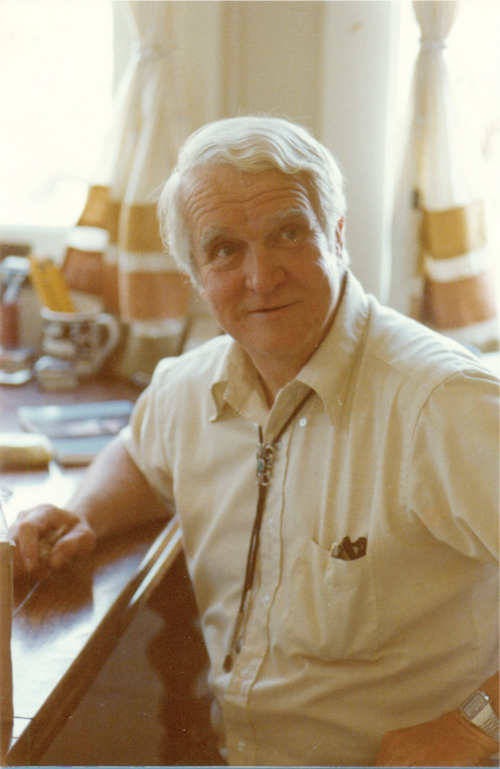
Colin Pittendrigh.
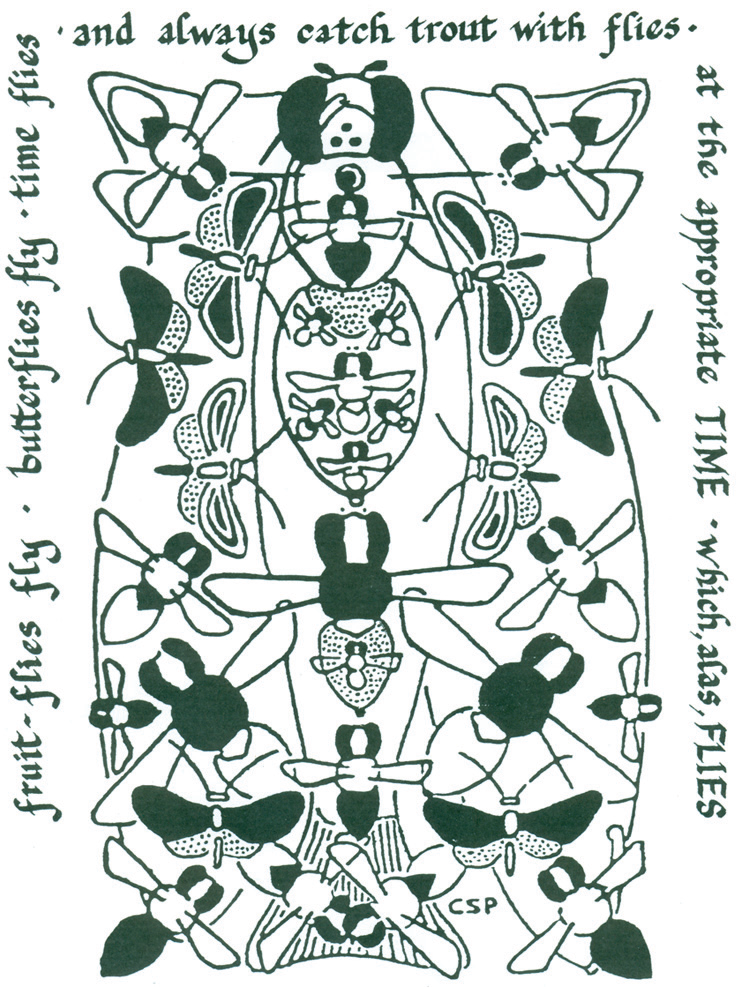
A doodle drawn by Colin Pittendrigh while he was bored in an NIH study section. The verse is a compilation of quotes from Colin, and the calligraphy was by his research assistant, Kathy Williams.
An Experimentally Validated Model (1964-1976)
Since the 1970s, the debate regarding nonparametric and parametric entrainment has been set aside as effort has been directed toward a more thorough understanding of the physiological and molecular complexities of the entrainment mechanism. Although Pittendrigh’s “instantaneous” resetting model may better be exploited to generate (and test) quantitative predictions than the “level and threshold” theory of his close friend Jürgen Aschoff (Aschoff and Wever, 1962; Daan, 2000), aspects of each model have been found to be accurate. Just as Pittendrigh acknowledged that the ψ-jumping seen in skeleton photoperiods suggested a parametric aspect of entrainment in continuous light cycles (Paper I), so too did Aschoff plainly state that some combination of the two mechanisms is most likely to be the case (Aschoff, 1963).
Pittendrigh was not satisfied with this loose combination of models, however. He maintained throughout the 1960s that although the parametric model had some relevance to the true mechanism of entrainment, the nonparametric model was more useful because it was more quantitative and predictive. Without a better way to continuously measure the velocity of the pacemaker itself in real time, it would be difficult to quantitatively investigate the parametric model. As such, he sought in 1964 to create a nonparametric model that would provide real predictive value using experimentally derivable period and PRC information. After testing its validity by subsequent studies that relied on its predictions, Pittendrigh intended to create a comprehensive and direct experimental test of his model. These tests are the focus of Paper I. After confirming its predictions, Pittendrigh set out to address two critical nonintuitive points of his model in Paper II: the existence of bistability and limits of stable entrainment.
Of the two manuscripts that are the focus of this introduction, the first was drafted soon after the publication of Pittendrigh and Minis’s 1964 report on skeleton photoperiods. The second paper was drafted in 1974 at the time when one of the authors (S.D.) was a postdoctoral reseacher in Pittendrigh’s laboratory at Stanford University. The theory and experiments detailed in the unpublished manuscripts reflect the state of the art in the early 1970s. The manuscripts were repeatedly revised and updated until 1978. They were intended for publication in The American Naturalist but, although widely spread among friends as “the Ottesen papers,” were never submitted for publication. It is likely that a strong factor in that omission was Pittendrigh’s ongoing uncertainty about the mechanisms of entrainment, as described by one of the authors (Daan, 2000) of this introduction:
Most of you, I am sure, consider the problem of entrainment basically as solved. Most have sat in courses in which the principle of phase resetting was explained. There is somehow an endogenous oscillation, which runs at a frequency slightly deviating from once per 24 h, and that deviation is corrected each day by an instantaneous, abrupt phase shift in response to light: every evening at dusk and/or every morning at dawn, as dictated by the laws of the phase response curve (PRC). Most of you have made your own exercises, either graphically or on the computer, and you have experienced that, indeed, entrainment can work this way. But few have been stubborn enough to ask, “Does it work this way in nature?” Colin Pittendrigh, who was the inspired genius behind this whole theory, remained uncertain, and questioning, until his death on March 16, 1996. —Serge Daan, during his delivery of the first Colin S. Pittendrigh Lecture at the 6th Meeting of the Society for Research on Biological Rhythms in 1998
Although many of the concepts and results introduced in the two manuscripts eventually made their way into the circadian literature in the years after the manuscripts were written, the full documents allow us to examine more fully the thought processes behind the work.
Since 1965, the concepts established here have been indirectly tested and examined by many researchers who set out to assess circadian properties in a variety of organisms. The fact that these core principles have held up well for so many years speaks to the value of Pittendrigh’s contributions to the field. And despite the fact that these papers were not published during Pittendrigh’s lifetime, the essential results of these analyses were widely known by many chronobiologists and therefore influenced mainstream chronobiological research. The concepts of photoperiod and phase angle of entrainment become even more relevant as we examine contemporary phenomena like seasonal affective disorder, familial advanced sleep phase syndrome, and delayed sleep phase syndrome. Many of the components that Pittendrigh and his colleagues probed indirectly through the measurement of eclosion timing are now more readily accessible. For instance, two-pulse experiments described in these manuscripts and elsewhere (Chandrashekaran, 1967) determine that phase shifts are realized within 1 h; with current knowledge of the molecular pacemaker, there would be great value in determining the exact molecular mechanisms that dictate the pacemaker’s reorganization during this first hour post shift. Therefore, there is certainly a benefit to recalling the underlying work that established these concepts with the possibility of guiding future experimental design.
Footnotes
Acknowledgements
The authors thank Maria Luísa Jabbur for input on the text and proofreading of the transcripts, as well as Sandy Pittendrigh and Eric Ottesen for giving us the opportunity to publish these manuscripts.
Conflict of Interest Statement
The author(s) have no potential conflicts of interest with respect to the research, authorship, and/or publication of this article.
Notes
References
Supplementary Material
Please find the following supplemental material available below.
For Open Access articles published under a Creative Commons License, all supplemental material carries the same license as the article it is associated with.
For non-Open Access articles published, all supplemental material carries a non-exclusive license, and permission requests for re-use of supplemental material or any part of supplemental material shall be sent directly to the copyright owner as specified in the copyright notice associated with the article.
