



Abstract

Professor Dr. med. Dr. h.c. mult. Andreas Oksche, Honorary President of the European Biological Rhythms Society, passed away peacefully on January 23, 2017. We mourn his death and shall always remember him as an eminent scholar with a worldwide reputation, a gifted scientific ambassador, and an impressive academic mentor.
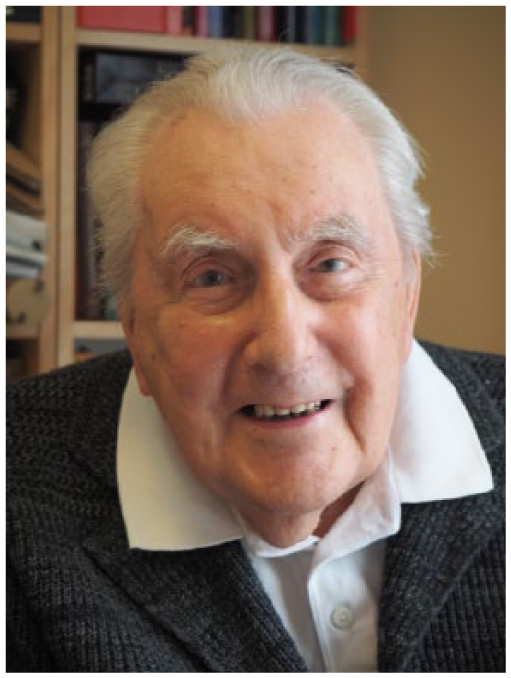
Andreas Oksche at the age of 90 (July 2016).
Andreas Oksche was born in Riga, Latvia, on July 27, 1926; studied medicine at the Philipps University of Marburg; and received his doctoral degree (Dr. med.) in 1952 with a thesis on the pineal complex (frontal organ) of the grass frog. This achievement established the foundation of a successful career in neuroendocrinology. Between 1952 and 1960, Oksche was a research associate with Alfred Benninghoff and Klaus Niessing in the Department of Anatomy in Marburg. Following postdoctoral work with Ernst and Berta Scharrer, he joined the laboratory of Professor Wolfgang Bargmann in Kiel. These three pioneers in neuroendocrinology strongly influenced Oksche’s academic career. He was appointed Professor of Anatomy at the Justus-Liebig-University of Giessen in 1964 and two years later became the Director of the Department of Anatomy. He retired from these offices and became professor emeritus in 1994.
The scientific work of Andreas Oksche focused on three major neurobiological topics: 1) comparative investigations of the pineal complex and photoneuroendocrine systems, 2) evolution and structural organization of the neuroendocrine hypothalamus, and 3) morphofunctional investigations of neuroglial cells with special reference to glia secretion.
In his comprehensive studies on the pineal complex of various vertebrate species, Professor Oksche demonstrated a conspicuous transformation of the pineal complex in the course of evolution and, in cooperation with Jean-Pierre Collin, defined three principal cell types: the “true” pineal photoreceptor of anamniotic vertebrates, the modified pineal photoreceptor of sauropsids, and the neuroendocrine pinealocytes of mammals. Oksche performed his neurohistological, ultrastructural, and histochemical studies in close cooperation with Professor Eberhard Dodt, Bad Nauheim, who discovered the direct light sensitivity of the pineal complex in anamniotes. Based on these findings, Oksche developed the concept of the “photoneuroendocrine” cell that translates photic stimuli directly into a neuroendocrine response. Subsequent investigations performed with an international group of scientists including David C. Klein, Morten Møller, and Horst Korf unraveled intimate molecular relationships between retinal photoreceptors and pinealocytes; these efforts also helped to characterize cells of primitive neuroectodermal tumors (retinoblastoma, pineocytoma, medulloblastoma). This body of work has enhanced our understanding of extraocular photoreception, photoneuroendocrine systems, and the biology of vertebrate timekeeping.
Through his intellectual contributions and interactions with colleagues in the general area of photoneuroendocrinology, Professor Oksche played a highly influential role in the realization of the biological importance of the suprachiasmatic nucleus. Accordingly, he was invited to present the introductory lecture in the first congress devoted to this structure in 1989. The resulting chapter provided an authoritative historical background that strongly influenced the recognition of the suprachiasmatic nucleus as a master oscillator.
Oksche’s intention to search for general morphological patterns (Bauplan) of neuroendocrine systems is also evident by his thorough investigation of the neuroendocrine hypothalamus. In close cooperation with Donald Farner, Professor Oksche studied the magnocellular and parvocellular hypothalamic neurosecretory systems of passerine birds and their role in the photoperiodic regulation of gonadal activity. In the course of these studies, Oksche developed the concept that neurosecretory nuclei in the hypothalamus are arranged in clusters consisting of distinct neuronal and glial elements that establish functional entities. This view was extended by others, including Professor Eckhart Simon and his coworkers at Bad Nauheim, and became widely accepted.
A third line of research addressed secretory features of glial cells in the subcommissural organ. Oksche had already concluded in the 1950s that the cells of the subcommissural organ secrete their products via two pathways, the first being into the ventricular system as “Reissner’s fibers” and the second into the vessels of the subarachnoid space. In the 1990s, the identification of the products secreted from the subcommissural organ was pursued with great success in close cooperation with his friend Esteban M. Rodriguez, Valdivia, Chile.
It was characteristic of Andreas Oksche that he always recognized the value of newly developed techniques and used these techniques at a very early stage. Thus, he started to use electron microscopy in the early 1960s, the Falck-Hillarp technique in 1966, and immunocytochemistry in 1976. By correlating structure with function, Andreas Oksche succeeded in formulating concepts that profoundly influenced our comprehension of neuroendocrine systems.
As academic mentor Oksche was highly demanding but always open-minded and supportive—a shining example for scientific honesty and integrity. His students became productive leaders and extended Oksche’s scholarly interests and values through research and education. His mentoring was not limited to his students, however, but was also applied to his professional colleagues.
Andreas Oksche was not only an eminent researcher but also a highly successful editor and scientific ambassador. For more than four decades he edited Cell and Tissue Research. In 1977, he became a founding member of the European Pineal Study Group (EPSG), the predecessor of the European Biological Rhythms Society (EBRS), and organized the second colloquium of the EPSG in Giessen in 1981. Succeeding Professor Ariëns Kappers, Andreas Oksche served as President of the EPSG from 1981 to 1987. Between 1973 and 1977 Oksche was President of the European Society for Comparative Endocrinology and organized its ninth conference in Giessen in 1977. He served the Anatomical Society as President from 1978 to 1979.
Council of the European Pineal Study Group in Pécs, Hungary, 1984. From left to right: M. Møller, Copenhagen, Denmark; M. Karasek, Łódź, Poland; P. Pévet (Secretary Treasurer), Strasbourg, France; J. Arendt, Guildford, UK; G. P. Trentini, Modena, Italy; A. Oksche (President), Giessen, Germany; B. Mess (Vice-President), Pécs, Hungary; J. Ariëns-Kappers (Honorary President), Amsterdam, Netherlands; M. G. M. Balemans, Utrecht, Netherlands; L. Vollrath, Mainz, Germany; J.-P. Collin, Poitiers, France.

The international reputation of Andreas Oksche is reflected by his many honors and awards. In 1973, he became a member of the Leopoldina, the National Academy of Science in Germany. In 2005, the Leopoldina awarded him its highest scientific award, the Cothenius Medal. He received honorary doctoral degrees from the Veterinary Faculty of the Justus-Liebig University, the University of Lund, and the University of Strasbourg. He was elected as Honorary Member of the Anatomical Society in 1995 and as Honorary President of the EBRS in 2005. He was a member of the Royal Physiographical Society Lund and the Latvian Academy of Sciences.
Despite all his achievements and honors Andreas Oksche stayed humble throughout his life. All of us who had the privilege to be close to him will always remember his scientific drive, empathy and generosity. He was charming, courteous, and a true gentleman.
We thank Andreas Oksche for his support, intellectual influence, advice, and friendship, which we shall not forget.