




Abstract

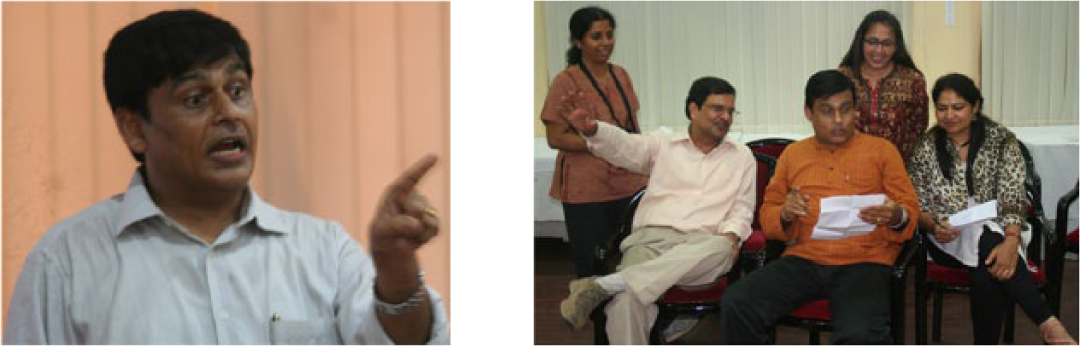
Vijay while teaching (left) and while singing a folk song with colleagues (left to right: Sheeba, Anand, Vijay, Sudhi, and Sangeeta).
Photographs taken during the SERB School in Chronobiology at Shillong, 2012.
Vijay Kumar Sharma, Professor and Chairman, Evolution and Organismal Biology Unit, Jawahalal Nehru Advanced Scientific Research Center (JNCASR), Bangalore, India, died after a brief illness in Bangalore on the morning of 24 October 2016, at the young age of 49. The scientific community has lost a young, energetic, and outstanding practitioner of chronobiology. He was widely recognized for his outstanding contributions and decorated with the Young Scientist Medal (1998) and A. K. Bose Memorial Award (2001) of the Indian National Science Academy and the C. N. R. Rao Oration Award (2010) of JNCASR. Sharma was a Fellow of the Indian Academy of Sciences (2012) and Indian National Science Academy (2013) and was to become one of the youngest associates of the Indian Academy of Sciences, Bangalore (1998-2002).
Education and Career
Sharma was born in 1967 in West Bengal and educated at the University of Calcutta. After obtaining a master’s degree in physics, he went on to join North-Eastern Hill University Shillong, where his career took a rather unusual path. Despite his training in physics, he chose to work on theoretical perspectives of biological rhythms for his PhD, a step that carved his future and shaped the course of chronobiology in India. Driven by his passion for understanding rhythms in animals, Sharma moved to the south, to the Madurai Kamraj University, and joined hands with Professor M. K. Chandrasekaran (MKC), the doyen of chronobiology in India. Eventually, this association, cemented by the mutual interest in chronobiology, lasted their lifetime. Sharma’s insightful thoughts and innovative ideas took him to some of the most famous laboratories in the world: to the University of Tubingen, Germany; the Norwegian University of Science and Technology, Nor-way; and the Univer-sity of Groningen, the Netherlands (1997-2000). Later, he worked as a Visiting Scholar/Professor at several institutions, including Northeastern Univer-sity, Boston, Massa-chusetts, USA; Univer-sity of Massachusetts Medical School, Worcester, USA; Imperial College of Science, Technology, and Medicine, London, UK; University of Leicester, Leicester, UK; University of Stavanger, Stavanger, Norway; New York University, New York, USA; and the University of California, Irvine, USA. He finally settled down as faculty at the JNCASR, Bangalore.
Research: Chronobiology and Behavior
While his passion for novel ideas drove him to test different strategies, his thoughts converged on understanding the adaptive significance of biological rhythms. His laboratory used an integrated approach to reveal internal timekeeping using multiple experimental approaches, from behavior to molecular biology, in both laboratory and natural settings. Although he initially used mouse, he was comfortable handling fruit fly, cave dwelling millipede, ant and even a plant, to get specific answers to pressing questions. In recent years, Sharma was focused on a question with far wider implications. How are circadian clock properties shaped by selection? Using a laboratory selection-based approach, he asked fundamental questions regarding the adaptive significance of circadian clocks and showed that clocks confer an intrinsic adaptive advantage. His laboratory generated populations of flies that have divergently-phased emergence patterns, which in turn enabled him to demonstrate that chronotype divergence is accompanied by changes in period, phase response curves, light sensitivity, and lability of circadian clocks. Flies with arrhythmic clocks had significantly compromised survival advantages. Reduction in lifespan induced by circadian rhythm disruption could be rescued when arrhythmic flies were maintained under a periodic light environment. This was experimentally established by the assay of lifespan of both rhythmic and arrhythmic wild type as well as clock mutant flies. If the flies were exposed to continuous LL conditions, several circadian functions such as emergence and activity were abolished, although the egg laying rhythm continued. He convincingly demonstrated that the egg laying rhythm was not regulated by ventral lateral neurons. Sharma was also intrigued by the possible links between pathways that determine developmental duration and the circadian clock. He found that selecting for faster development resulted in a correlated response in clock period, and he also showed for the first time that circadian clock properties aged as a consequence of physiological aging rather than in a chronological manner. His research on the role of seasonal timers in modulating development rates, carried out on two sympatric species of Camponotus social ants, showed that day active and night active species developed faster under long days and short days, respectively, which indicated species-specific seasonal differences in developmental rates. Using flies selected for higher precision in their emergence rhythm, his group showed that indeed clock stability links to other circadian properties such as shorter clock period, lower inter- and intra-individual variation in phase, and higher fecundity. In addition to these questions, Sharma also was interested in social aspects of circadian clocks, which were addressed using ant colonies and fruit flies. The former model showed how in a eusocial insect different castes have varying circadian clocks and that foragers which experience cyclic environmental cues can pass on time cues to other castes which are mostly confined to the colony. In the case of flies, studies in his laboratory revealed the role of Or47b odor receptor in mediating socio-sexual interactions, which in turn modulate rhythmic activity/rest patterns. All along, Sharma maintained an interest in theoretical aspects of circadian organization, also proposing a model to explain gating of emergence in flies.
Sharma was the pillar of the Indian Society for Chronobiology, and he served it in different capacities in the last decade and half. He was Vice President and was recently elected to serve as the Secretary of the Society. He also served as a member of the Editorial Boards of Journal of Circadian Rhythms, Journal of Genetics, and Current Science. He was a reviewer for several highly reputed journals. He also served as a member of the Programme Advisory Committee in Animal Sciences of the Science and Engineering Research Board, one of the major funding agencies in India.
Teacher and Mentor
Sharma was fully dedicated to the cause of promoting chronobiology in India. He would go far out of his way and spend hours traveling to far-flung areas to sensitize young faculty and students to this exciting branch of biology. He was a most common face at the Government of India–initiated Inspire teaching program aimed at initiating undergraduate minds. He served as a major instrument in organizing and conducting 8 Schools in Chronobiology, a program that helped to popularize chronobiology across the country. A salient accomplishment was the participation of international faculty to teach chronobiology: from basics to the frontiers. To test the merit of the students at the schools, he would fish out some classical papers from the literature and discuss the contents to the core. He particularly enjoyed teaching time-series analysis. He was a gifted teacher who could seamlessly blend serious science with lighthearted humor. His classes were always entertaining, punctuated with anecdotes, and live with emerging science. He encouraged active student participation and patiently answered questions until the students fully understood the nuances of the topic. Both of us also have had the privilege of interacting with his graduate students, in informal as well as formal settings. They would always tell us how tough he was as a supervisor and generous as a mentor.
Wonderful Colleague and a Friend
Both of us met Sharma at different times in his career. I (V.K.) met Sharma at the National Conference on Chronobiology at New Delhi, after he had just joined MKC’s group. He was full of new ideas and enthusiastically talked about the concept of “master and slave” oscillators. I could immediately spot the star in him and anticipated his mark on contemporary science. Apart from science, he was a great storyteller who could spice up the evenings after meetings were done. Warm at heart and human in his dealings, we always cherished his company. His friends and colleagues mourn his loss, and the chronobiology community across the globe will miss his vibrant presence.