Abstract

Three decades have now passed since the publication of the inaugural issue of Journal of Biological Rhythms (JBR). The experimental subjects in those first papers were Syrian and Siberian hamsters, ground squirrels, cockroaches, and bubble snails; the experimental techniques included behavioral and physiological monitoring, circumscribed brain lesions, melatonin radioimmunoassays, electroretinography, and electrophysiological recordings; and the aims were focused on elucidating mechanisms underlying “splitting,” circannual rhythmicity, photoperiodic time measurement, and circadian pacemaker development, coupling, and output. Over the past 30 years, this diversity of models, approaches, and questions has expanded and grown even richer.
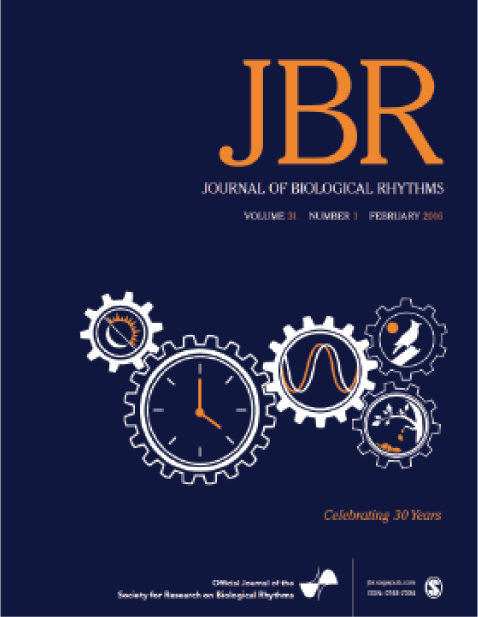
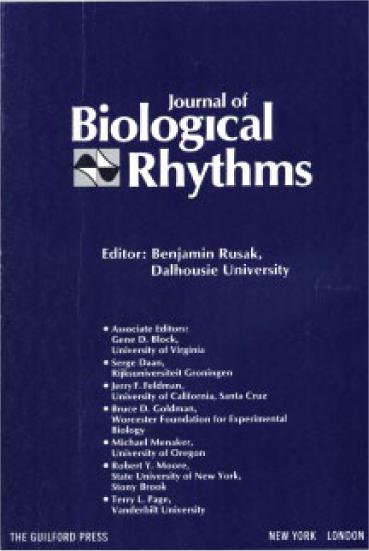
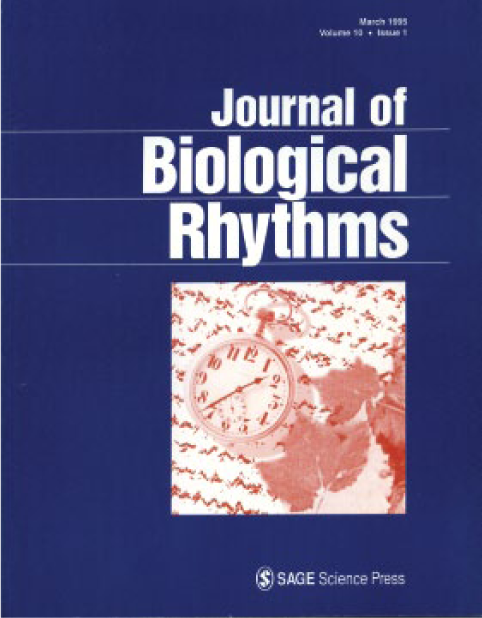
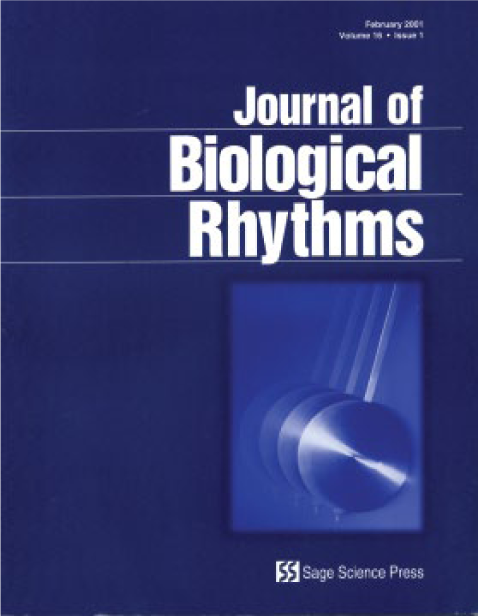
So, on the occasion of JBR’s 30th anniversary, I decided to make us a new cover; it will be our fourth. The first was about as plain as could be, with only the names of the brave new Editor (Ben Rusak) and Associate Editors (Gene Block, Serge Daan, Jerry Feldman, Bruce Goldman, Mike Menaker, Bob Moore, and Terry Page). With the initial issue of the 10th volume, editor Fred Turek introduced an illustration by Plamen Penev highlighting the “clock” metaphor that was proving so useful for the field’s progress. And 15 years ago, Editor Marty Zatz launched the iconic weighted pendulum image, also by Plamen Penev, that embodies time and oscillation.
The new cover is the result of an online competition and initial design by Ms. Kristi Popp. It emphasizes our interest in the mechanisms underlying internal timekeeping, entrainment, and overt rhythmicity but with artistic license and some measure of intended ambiguity. After all, the biological timepiece shown is not actually a physical clock, as the spaced markings attest (it’s not really 4 o’clock, is it?). Are the 2 sinusoidal rhythms in the process of desynchronizing, or are they stably oscillating with a fixed phase angle? And are the output gearwheels on the right a tribute to ornithologists and botanists or an appreciation of the selective advantages of avian (and human) owl and lark chronotypes and seasonal adaptations?
Happy anniversary JBR! Like Super Mario Brothers, Les Misérables, and Nike’s Air Jordans (also celebrating their 30th anniversaries), we’re still going strong, all thanks to our dedicated community of authors, reviewers, and readers.
Spring, 1986
March, 1995
February, 2001
February, 2016