



Abstract
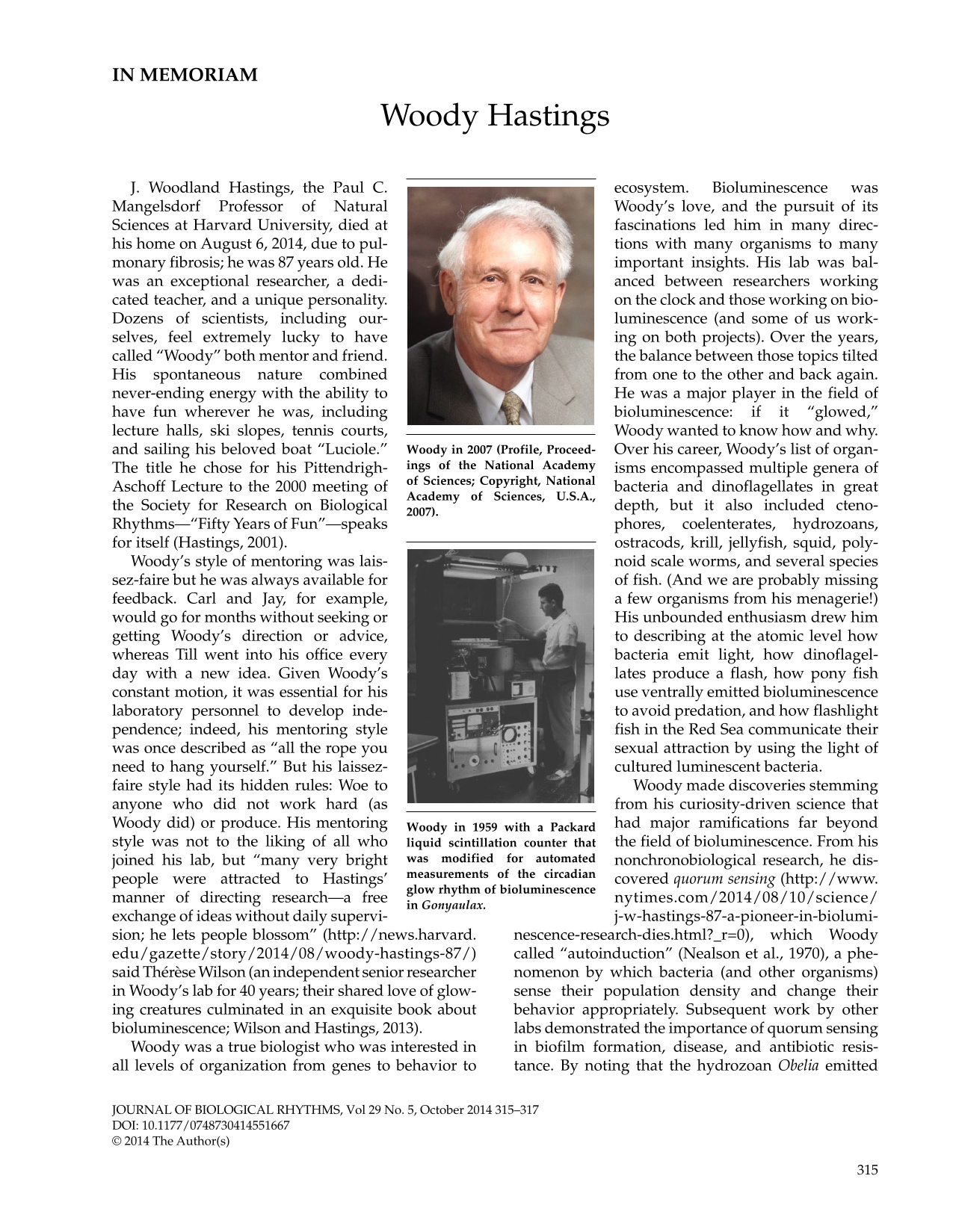
J. Woodland Hastings, the Paul C. Mangelsdorf Professor of Natural Sciences at Harvard University, died at his home on August 6, 2014, due to pulmonary fibrosis; he was 87 years old. He was an exceptional researcher, a dedicated teacher, and a unique personality. Dozens of scientists, including ourselves, feel extremely lucky to have called “Woody” both mentor and friend. His spontaneous nature combined never-ending energy with the ability to have fun wherever he was, including lecture halls, ski slopes, tennis courts, and sailing his beloved boat “Luciole.” The title he chose for his Pittendrigh-Aschoff Lecture to the 2000 meeting of the Society for Research on Biological Rhythms—“Fifty Years of Fun”—speaks for itself (Hastings, 2001).
Woody’s style of mentoring was laissez-faire but he was always available for feedback. Carl and Jay, for example, would go for months without seeking or getting Woody’s direction or advice, whereas Till went into his office every day with a new idea. Given Woody’s constant motion, it was essential for his laboratory personnel to develop independence; indeed, his mentoring style was once described as “all the rope you need to hang yourself.” But his laissez-faire style had its hidden rules: Woe to anyone who did not work hard (as Woody did) or produce. His mentoring style was not to the liking of all who joined his lab, but “many very bright people were attracted to Hastings’ manner of directing research—a free exchange of ideas without daily supervision; he lets people blossom” (http://news.harvard.edu/gazette/story/2014/08/woody-hastings-87/) said Thérèse Wilson (an independent senior researcher in Woody’s lab for 40 years; their shared love of glowing creatures culminated in an exquisite book about bioluminescence; Wilson and Hastings, 2013).
Woody in 2007 (Profile, Proceedings of the National Academy of Sciences; Copyright, National Academy of Sciences, U.S.A., 2007).

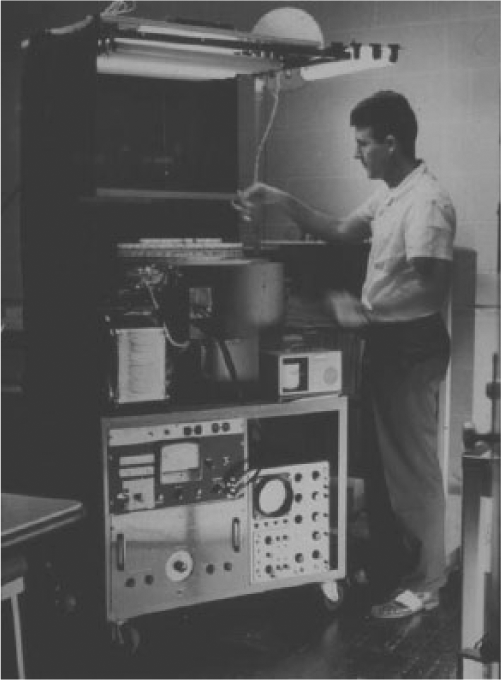
Woody in 1959 with a Packard liquid scintillation counter that was modified for automated measurements of the circadian glow rhythm of bioluminescence in Gonyaulax.
Woody was a true biologist who was interested in all levels of organization from genes to behavior to ecosystem. Bioluminescence was Woody’s love, and the pursuit of its fascinations led him in many directions with many organisms to many important insights. His lab was balanced between researchers working on the clock and those working on bioluminescence (and some of us working on both projects). Over the years, the balance between those topics tilted from one to the other and back again. He was a major player in the field of bioluminescence: if it “glowed,” Woody wanted to know how and why. Over his career, Woody’s list of organisms encompassed multiple genera of bacteria and dinoflagellates in great depth, but it also included ctenophores, coelenterates, hydrozoans, ostracods, krill, jellyfish, squid, polynoid scale worms, and several species of fish. (And we are probably missing a few organisms from his menagerie!) His unbounded enthusiasm drew him to describing at the atomic level how bacteria emit light, how dinoflagellates produce a flash, how pony fish use ventrally emitted bioluminescence to avoid predation, and how flashlight fish in the Red Sea communicate their sexual attraction by using the light of cultured luminescent bacteria.
Woody made discoveries stemming from his curiosity-driven science that had major ramifications far beyond the field of bioluminescence. From his nonchronobiological research, he discovered quorum sensing (http://www.nytimes.com/2014/08/10/science/j-w-hastings-87-a-pioneer-in-bioluminescence-research-dies.html?_r=0), which Woody called “autoinduction” (Nealson et al., 1970), a phenomenon by which bacteria (and other organisms) sense their population density and change their behavior appropriately. Subsequent work by other labs demonstrated the importance of quorum sensing in biofilm formation, disease, and antibiotic resistance. By noting that the hydrozoan Obelia emitted light at a wavelength different from that of its luciferase in vitro, Woody discovered resonance energy transfer from light-emitting luciferases to fluorescent proteins such as green fluorescent protein (GFP) (Morin and Hastings, 1971; Tu et al., 1978). The role of energy transfer from luciferases to fluorescent proteins in the natural organisms (e.g., in jellyfish) changes the color of luminescence emission (e.g., from blue to green). Woody characterized the energy transfer phenomenon from the photoprotein obelin to GFP and was the first to postulate its function relative to bioluminescence (Morin and Hastings, 1971). This insight paved the way for the commonly used method, fluorescence resonance energy transfer (FRET). These discoveries were important because (1) they led to an entirely new way of thinking about how proteins can influence and interact with each other, (2) they have been used to measure distance between proteins (as molecular measuring sticks), and (3) they enabled a new technological tool chest of ways to use proteins as diagnostic tools for disease, calcium levels, and so on.
Woody was also a timekeeping trailblazer. It was Woody’s love for the how and why of bioluminescence that led him to chronobiology. In the clocks field, Woody is renowned for his work on the unicellular dinoflagellate alga Gonyaulax polyedra (unfortunately and awkwardly renamed Lingulodinium polyedrum), which is the system that all three of us analyzed in Woody’s lab. Woody met Beatrice Sweeney (“Beazy”) at a meeting in 1954, and she inspired him with interest in Gonyaulax, whose rhythms of endogenous bioluminescence Beazy had begun to study (Hastings, 2001). Together, they characterized fundamental properties of circadian rhythmicity in Gonyaulax, and from that successful collaboration sprang their independent chronobiological research programs. Over the years, Woody’s lab contributed many seminal insights into the circadian biochemistry and physiology of Gonyaulax, in terms of both clock mechanism and clock output. His lab showed that in single cells, the clock exerts continuous control of many aspects of physiology including the cell cycle, photosynthesis, motility, and bioluminescence, expanding the panorama of circadian outputs. He proved that Gonyaulax luciferase (the light-emitting enzyme), luciferin (its substrate), and a substrate-binding protein (Luciferin-Binding Protein) are synthesized and destroyed daily—not just activated or inhibited—and so is an entire cellular organelle called the “scintillon” that houses these components. When these results were initially submitted for publication, it was difficult to convince reviewers, who thought that daily synthesis-degradation was too wasteful to be plausible. Now, it is commonly known that many proteins and mRNA transcripts exhibit daily rhythms of their abundance. Moreover, the mode of this regulation was translational in Gonyaulax rather than the more commonly assumed transcriptional control.
More generally, Woody’s ability to discern overarching principles led to major advances in the conceptualization of questions and approaches in the rhythms field. Careful measurements of period length as a function of ambient temperature led Woody and Beazy to correctly define the temperature responses of circadian period to be “compensation” rather than “independence,” which is a conceptual shift that eliminates the hypothesis that these rhythms are directly driven by an uncontrolled periodic variable in the environment and that instead signifies a biological mechanism (Hastings and Sweeney, 1957). They produced the first-ever PRC (phase response curve), a protocol that became a staple of rhythms research in the context of entrainment. Woody’s lab found that the Gonyaulax clock received light information via at least two light receptors, which was a harbinger of the complexity of light entrainment pathways that have been unraveled in other organisms. Together, Woody and Beazy also pioneered the use of inhibitors to identify pathways important for the oscillator and for circadian input and output. In this way, Woody was among the first to show that the clock mechanism was sensitive to protein synthesis and phosphorylation inhibitors but not perturbed by many other drugs. Indeed, Woody’s studies in Gonyaulax were the first real biochemical analyses of circadian regulatory pathways and were undoubtedly way ahead of their time. Ultimately, however, the lack of genetic tools in Gonyaulax hampered the identification of central clock components and did not lead to breakthrough identifications of circadian genes and biochemistry that might have leveraged the elucidation of the clock mechanism in higher organisms.
Woody’s research earned him many awards and honors, including election to the National Academy of Sciences in 2003. He wrote over 430 peer-reviewed publications; received the Farrell Prize in Sleep Medicine (2006), the Guggenheim Fellowship (1965), and the Alexander von Humboldt Fellowship (1979); was a Fellow of the American Academy of Microbiology; and was elected to the American Academy of Arts and Sciences. A 70th birthday celebration at the Marine Biological Laboratory in Woods Hole, Massachusetts, drew over 70 people, only a fraction of those he had mentored over a career that spanned 61 years from his first publication to his last.
Born March 24, 1927, in Salisbury, Maryland, Woody was the son of Vaughan A. Hastings and Katherine Anne Stevens. At age 10, he sang as a choirboy at the Cathedral of St. John the Divine in New York, where he attended its boarding school. The United States was in World War II when he graduated from Lenox School in Massachusetts in 1944, so he joined the Navy V-12 College Training program, which sent him to Swarthmore College, where he worked as an undergraduate with the famous physiologists Per Fredrik Scholander and Knut Schmidt-Nielsen. After finishing his bachelor’s degree at Swarthmore in 1947, Woody resigned from the Navy, taught biology (in French) at a lycée (high school) in southern France, and worked on reconstruction in Germany. Returning, he completed a Ph.D. program in biology at Princeton University in 1951 with E. Newton Harvey, the pioneer of bioluminescence (Harvey, 1952) who turned Woody onto the biological phenomenon that captured his passion.
Woody was a postdoctoral fellow at Johns Hopkins University from 1951 to 1953 with W. D. McElroy, where he began studies on fireflies and luminescent bacteria. In 1953, he married Hanna Machlup and accepted his first faculty position at Northwestern University, where he began studies on Gonyaulax and biological clocks. In 1957 he joined the Biochemistry Department at the University of Illinois at Urbana-Champaign, and in 1966 he moved to Harvard as Professor in the Department of Molecular and Cellular Biology. Later, Woody became the Paul C. Mangelsdorf Professor of Natural Sciences. In addition to being affiliated with Harvard, Woody had a lifelong relationship with the Marine Biological Laboratory in Woods Hole, beginning as a graduate student, then as Director of the Physiology Course, and finally as a trustee.
Woody loved to teach, but his influence on young people went beyond his lab and classrooms. For 20 years, from 1976 to 1996, he and his wife Hanna were much acclaimed co-masters at the undergraduate residential North House (now Pforzheimer House), where they nurtured a warm, friendly, and intellectually robust environment in which students could thrive during their four years at Harvard. Woody is survived by three daughters, Jennifer Hastings, Laura Hastings, and Marissa Bingham; a son, David; a companion, Barbara Cheresh; a sister, Anne MacQueen; and five grandchildren. His wife Hanna died in 2009.
Woody was a remarkable man who, although widely known, did not receive the share of international fame that he deserved, because in an era of model systems that emphasized genetic tools, he remained a biologist who worked on organisms and problems because they fascinated him. We will miss him.